

Published: November 2025 | Last updated: April 2026 | Editorial review and quality control: Martina N.
STD myths and facts get scrambled at the exact moment people need accurate information most. The misconceptions feel reasonable. They hold together just well enough to make skipping a test seem rational, to make a negative result feel definitive when it isn't, to make a monogamous relationship feel like a medical guarantee it has never been. And those misconceptions have consequences. According to provisional CDC 2024 STI surveillance data, more than 2.2 million STI cases were reported in the U.S. last year, roughly 13% higher than a decade ago, with congenital syphilis nearly 700% higher than in 2015. A national survey by Ohio State University Wexner Medical Center found that a third of Americans falsely believe STIs can only spread through sexual intercourse, and one in five think testing is only necessary when symptoms appear.
Those two findings sit next to those case numbers for a reason. Sexually transmitted infection myths don't just mislead; they delay testing, delay treatment, and let infections spread silently. This article debunks the most consequential ones, organized by category, with the depth a three-sentence myth-and-fact list can't deliver. Each section also links to deeper dives on the specific questions within it, because some myths deserve a full article, not just a paragraph.
What's the single most dangerous STD myth?
“I'd know if I had something.” The majority of chlamydia, gonorrhea, herpes, HPV, and early HIV cases produce no noticeable symptoms. Asymptomatic infection is the norm, not the rare case, which is exactly why testing exists and why deciding to test based on whether you feel symptoms is one of the riskiest moves a sexually active person can make.
Key Takeaways
- Most STIs are silent. Around 70% of women and 50% of men with chlamydia have no symptoms; the same goes for most herpes, HPV, and early HIV cases (CDC).
- A 'standard' STD panel often excludes herpes and HPV. Knowing your status means knowing exactly what was tested for, when, and whether the timing fell after the detection window.
The Foundational Myth: 'If I Had an STD, I'd Know'
You are lying in a hospital bed after a car accident, unconscious. You don't know you're injured. That does not mean you are fine. This is essentially how asymptomatic STD transmission works, and the parallel matters, because the foundational STD myth still in wide circulation is the belief that your body will tell you when something is wrong. It often won't. Chlamydia is asymptomatic in roughly 70% of women and 50% of men. Gonorrhea frequently produces nothing: no discharge, no burning, no pain. Early HIV can feel like a brief flu before going completely silent for years. Herpes can show up as a mild tingling or burning in the genital area, because the virus reactivates in sensory nerve endings before reaching the skin surface, and that early warning is routinely dismissed as friction, heat rash, or nothing at all. A first outbreak typically appears 2 to 12 days after exposure; for many people it's mild enough that it never registers as a distinct event. HPV almost never produces any symptoms at all in the people carrying it.
This is not an edge case. This is how STDs work most of the time for most people. The CDC's STI Awareness guidance puts it plainly: you cannot tell if someone has an STI just by looking at them, and because so many infections don't cause symptoms, the only way to know for certain is to get tested. Symptoms don't confirm an infection, and the absence of symptoms absolutely does not rule one out.
Every other myth below, whether about transmission, testing, or who gets STDs, is downstream of this one. Fix this belief first, and the rest gets easier to understand.
This article is published by stdrapidtestkits.com, which sells at-home STI testing kits. We recommend products based on fit-for-purpose for the reader's concern, not commercial benefit. The myth corrections in this piece stand on their own merits, with citations to CDC, WHO, NHS, and peer-reviewed sources where the specifics matter.
Why STD Myths Persist in 2026
Despite forty years of public-health campaigns and broad clinic access, STD misinformation hasn't budged much. A few interlocking reasons explain why.
First, comprehensive sex education is still patchy. As of 2024, only a minority of U.S. states require any form of sex education in schools, and fewer still require the content to be medically accurate. People who don't get accurate information at the age it would have been most useful end up filling the gap with whatever they overhear, scroll past, or ask a friend.
Second, social stigma keeps honest conversations rare. Sexually transmitted infections sit at the intersection of two culturally loaded categories, sex and illness, and that combination makes a lot of adults reluctant to bring questions to a clinician, a partner, or even a search engine using their real account. Stigma doesn't just hurt feelings; it actively suppresses testing and treatment-seeking behavior.
Third, social media trains people to trust personal stories over medical sources. A first-person video or forum thread feels more relatable than a CDC fact sheet, even when the personal story is wrong about the underlying biology. Because algorithms reward emotional content, the most viral STD posts are often the most misleading.
Fourth, some STD myths used to be true and have outlived their accuracy. Effective HIV treatment that brings viral load to undetectable levels and stops sexual transmission was confirmed by the PARTNER and PARTNER 2 studies (the U=U finding), but the cultural mental model of HIV is still shaped by the early epidemic. The same applies to HPV, which now has a vaccine that prevents the strains responsible for most cervical cancer cases. Both shifts were confirmed years ago (PARTNER 2 reported in 2018, the HPV vaccine licensed in 2006), but neither has displaced the earlier cultural framing in most adults' working understanding of these infections.
The result is an environment where misconceptions reach more people than corrections, and where the cost is not abstract. Each undiagnosed infection is a transmission opportunity. Each delayed treatment is a chance for permanent damage. The myths in this article are not edge cases; they are the dominant story most people are walking around with.
Four interlocking reasons keep STD misinformation alive: patchy sex education in U.S. schools, persistent stigma around testing and diagnosis, social-media incentives that favor personal stories over clinical evidence, and outdated cultural framings of infections whose treatment has changed (HIV under U=U, HPV after vaccine availability). Each is harder to shift than a single fact correction.
Transmission Myths: How You Actually Get an STD
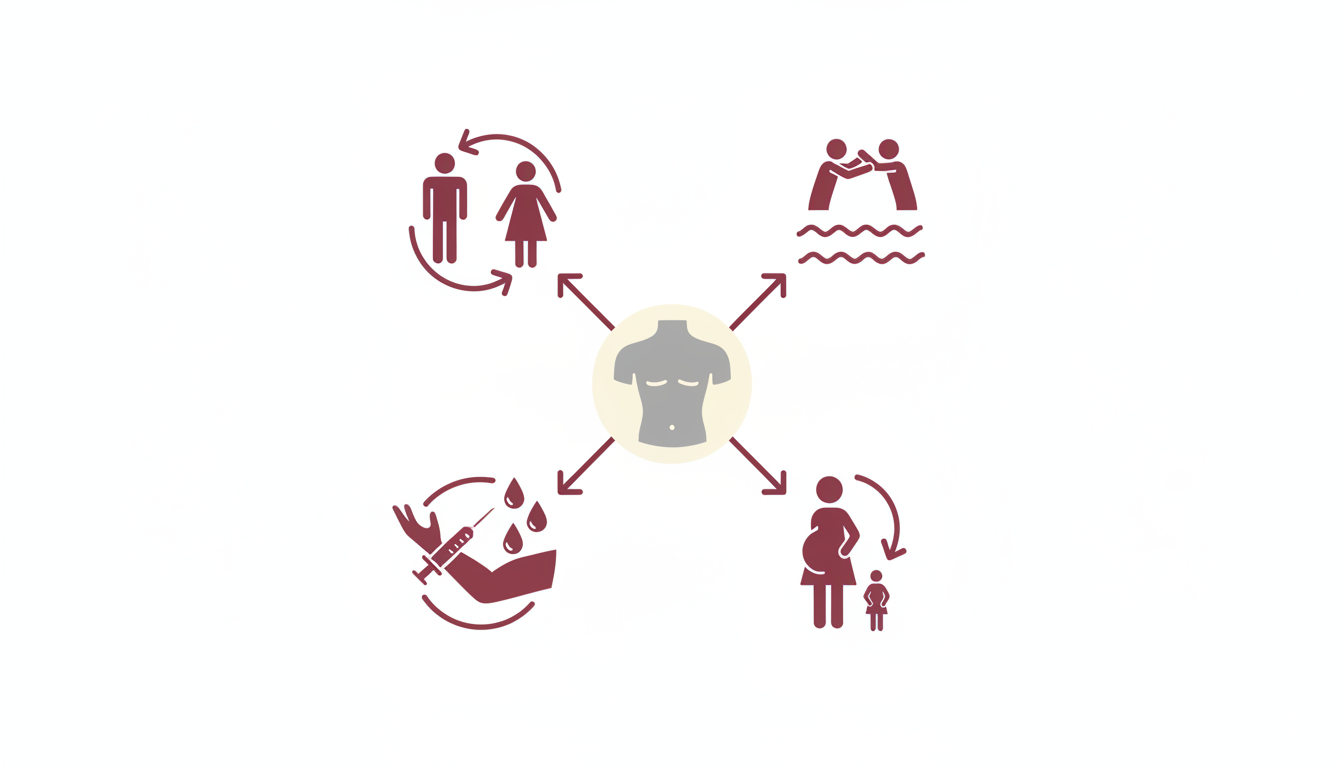
How do you get an STD? The answer most people learned (penetrative vaginal sex with an infected partner) is incomplete in ways that consistently leave people exposed. Transmission myths cluster at two extremes: overestimating the risk from casual contact such as toilet seats, towels, and shared cups, and drastically underestimating the routes that actually matter. Both cause harm. Misplaced toilet-seat panic is mostly harmless on its own; misplaced confidence about oral sex or withdrawal is not.
The most consequential transmission myth is that oral sex is essentially risk-free. It isn't. Almost every STI that spreads through vaginal sex can also spread through oral sex without a barrier, including gonorrhea, syphilis, herpes HSV-1 and HSV-2, and HPV. Throat gonorrhea is common, often produces no symptoms, and spreads easily without either person knowing. The full breakdown is in How Risky Is Oral Sex?. A closely related myth that's equally wrong: cold sores are a skin nuisance with no implications for genital herpes. HSV-1, which causes oral cold sores, can and does cause genital herpes through oral sex (Can Cold Sores Really Give You Herpes Down There?). And a specific myth most people miss entirely: Oral Sex and Hepatitis C, because hepatitis C is widely assumed to be a blood-only infection.
Can you get an STD without intercourse? Yes, and this surprises people more than it should. Withdrawal during anal sex does essentially nothing for STD risk, because the skin contact and fluid exposure that matter happen throughout the act, not only at the end. Herpes and HPV are particularly relevant here, because they spread through skin-to-skin contact regardless of ejaculation. The specifics are in Can You Really Get an STD If He Pulls Out During Anal?. More broadly, STDs Without Sex maps out everything that can transmit an infection without penetration: skin contact, shared equipment, and the specific items where surface survival matters.
Can you get an STD the first time you have sex? Yes. One exposure is enough for any STI. This is among the most persistent myths directed at younger people, and it offers false reassurance at exactly the wrong moment. Can you get an STD from kissing? For most infections the risk from kissing alone is low, but herpes HSV-1 spreads readily through oral contact, and active syphilis sores anywhere near the mouth turn kissing into a genuine route (Can You Get an STD from Kissing?).
On the other end of the spectrum: towels, toilet seats, and clothing. These are not meaningful transmission routes for most sexually transmitted diseases. The organisms that cause STIs need direct mucous-membrane contact and don't survive long on cold, dry surfaces. Can You Really Catch an STD from a Towel? covers why towels are far less dangerous than anxiety suggests, with the specific exception of hepatitis B, which can survive on surfaces for days. Can You Get an STD from Clothes? separates real risks from public-bathroom anxiety. Sex toys are similarly underestimated; shared and uncleaned toys can carry herpes, HPV, trichomoniasis, and bacterial infections (Can You Get an STD from a Sex Toy?).
Symptom Myths: Why Google Images Is Not a Diagnostic Tool
Every week, millions of people type “does this look like herpes” into a search engine and spend the next hour either making themselves catastrophically anxious or falsely reassured by image comparison. Both outcomes are dangerous. Visual identification is not a diagnosis, and symptom myths are where the gap between “what people think they know” and “what's actually true” is widest.
The most-read article on this site is The 3 Rashes That Get Mistaken for HIV. That volume of traffic tells you exactly how many people are misattributing skin symptoms to HIV when the cause is something else entirely. In the other direction, No Symptoms, No Test? Why That's a Dangerous Myth About HIV tackles the belief that HIV testing is only necessary when something feels wrong, because HIV in particular can stay completely asymptomatic for years while actively progressing.
Syphilis earns its clinical nickname as the “great imitator”, and at its core syphilis is built around a myth: that you'd know you had it. Most people who develop the chancre don't notice it for what it is. Can You Have Syphilis and Not Know It? corrects this directly. The chancre is almost always painless, heals on its own within 3 to 6 weeks regardless of treatment, and most people who develop one dismiss it entirely. By the time secondary symptoms appear (the characteristic rash on the palms and soles, flu-like illness), 6 weeks to 3 months have passed and the bacteria have been spreading the entire time. Herpes carries an equally damaging set of myths. Myths About Herpes That Keep You From Knowing the Truth takes on the full cluster: “you'd see it,” “it's rare,” “it's always painful,” “outbreaks are obvious.” Each contributes to the reason most people carrying HSV-2 have no idea they have it.
Then there are the symptoms that look concerning but usually aren't STD-related at all. Post-shaving irritation, a reaction to a new lubricant, laundry-detergent sensitivity. These cause genuine anxiety in people who've had a recent sexual exposure, and they deserve honest answers rather than vague reassurance. Laundry Detergent, Lube, Razors: What's Really Causing That Itch and Herpes or Pimple? cover exactly that. Most of the time the anxiety-inducing thing is benign. Most of the time, however, is doing real work in that sentence, and a test is the only way to move from “most of the time” to “definitely.”
One more symptom myth that cuts across every infection: Can You Have an STD Without Knowing?. The belief that infections eventually announce themselves is wrong for chlamydia, gonorrhea, herpes, HPV, and early HIV, and it's the belief that does the most damage across every category in this piece.
According to <a href="https://www.cdc.gov/herpes/index.html" target="_blank" rel="noopener">CDC estimates</a>, genital herpes (HSV-2) affects roughly 1 in 6 sexually active U.S. adults aged 14 to 49, and the majority of carriers do not know they have it. Globally, the <a href="https://www.who.int/news-room/fact-sheets/detail/herpes-simplex-virus" target="_blank" rel="noopener">WHO HSV fact sheet</a> reports a similar pattern of mostly-asymptomatic infection. The 'I'd see an outbreak' assumption is the single biggest reason that prevalence figure barely moves year over year. A blood antibody test from 12 weeks post-exposure is the only way to know your own status.
Testing Myths: Panels, Windows, and What Got Tested
Testing myths are particularly costly because they lead people to trust results they shouldn't. The most widespread is the belief that a standard STD panel covers everything worth knowing. It doesn't. The gap between what people assume they've been tested for and what their panel actually included is one of the primary ways infections stay undetected in people who genuinely believe they've done the responsible thing.
Herpes is the clearest example. The CDC doesn't recommend routine asymptomatic herpes screening for the general population, so most standard panels simply exclude it. Someone can leave a clinic with a “clean” result and unknowingly carry herpes HSV-1 or HSV-2, sincerely believing they've been screened. They have been; just not for that. HPV has no approved diagnostic test for men at all. Hepatitis B and C are included in some panels and excluded from others. Does Your STD Test Really Include Everything? maps the specific inclusions and exclusions, and why “what exactly did they test me for” is always the right question.
The testing window period is the second major testing myth, and it catches people who did everything else right. Every STI has a minimum time after exposure before it reaches detectable levels in the body. Test before that window closes and a false-negative result is likely, not because the test failed but because there simply wasn't enough detectable material yet. Testing three days after exposure and treating that result as confirmation of clean status is how people remain unknowingly infected for months. The specific windows every sexually active person should know:
| Infection | Reliable test from | Why the window exists |
|---|---|---|
| Chlamydia | 14 days after exposure | Bacteria need time to replicate in tissue to detectable levels |
| Gonorrhea | 2 to 3 weeks after exposure | Organism must establish in mucosal tissue; lab NAAT can detect from 1 to 2 weeks, at-home rapid tests are conservative |
| Syphilis | 6 weeks after exposure | Antibody production takes several weeks to reach detectable levels |
| HIV | 6 weeks (first indicator); 12 weeks for certainty | Antigen and antibody levels rise in a predictable sequence over time |
| Herpes HSV-1 & HSV-2 | 6 to 12 weeks after exposure | Antibodies typically appear within 6 weeks; some people seroconvert later |
| Hepatitis B | 6 weeks after exposure | Surface antigens or antibodies take weeks to appear in circulation |
| Hepatitis C | 8 to 11 weeks after exposure | Viral RNA and antibodies require a longer development period |
What a Test Result Actually Means
A negative result taken after the correct window has closed means the infection was not detected, and when timing is right that is a reliable result: the exposure did not lead to detectable infection. If the test was taken before the window closed, a negative result cannot be trusted and should be repeated at the appropriate time. A positive result means the test detected the infection. It's the starting point for treatment, and for bacterial STDs that treatment is curative. Retest if your initial result was taken before the detection window closed, if the result was unclear, or if you've had a new exposure since your last test.
False Negatives, Co-Infections, and Mistimed Tests covers the full range of ways a test can return a result that doesn't reflect reality, and why the myth that “testing at all = knowing your status” is more dangerous than most people realize. For the specific question of faint lines on rapid tests, Faint Lines, False Negatives, and Trichomoniasis addresses line-reading confusion directly. And for the broader question of whether at-home tests are genuinely reliable, Can You Really Trust At-Home STD Test Kits? walks through accuracy figures across the rapid-test catalog and where each kit's stated sensitivity sits relative to lab benchmarks.
When to retest
- Your first test fell before the detection window closed for that infection (see the table above).
- The result was unclear: faint line, invalid control, or a known technical error.
- You've had a new sexual exposure since your last result.
- You were treated for a bacterial STI and want a test-of-cure (timing varies by infection; ask your clinician).
Biology Myths: What Happens Inside Your Body
Biology myths surface most often after a positive result, when panic takes over and the internet becomes a source of worst-case speculation rather than useful medical information. Two failure modes show up in equal measure: people who interpret a diagnosis as a life sentence, and people who interpret it as almost nothing because they still feel completely fine. Both readings are wrong. Both lead to avoidable harm.
Getting one fact right matters more than the others after a positive result: the curable-versus-manageable split. Bacterial STDs (chlamydia, gonorrhea, syphilis, and trichomoniasis) are curable with the correct antibiotic taken fully. Hepatitis C can also be cured with modern direct-acting antivirals. Viral STDs (herpes, HIV, HPV, and hepatitis B) cannot be eliminated from the body but are manageable, in several cases very effectively so. Someone with HIV on consistent antiretroviral therapy can reach an undetectable viral load that carries essentially zero sexual transmission risk to partners (the U=U finding, confirmed by the PARTNER and PARTNER 2 studies). Someone with herpes on daily suppressive therapy meaningfully reduces both outbreak frequency and transmission risk. “Viral” does not mean “untreatable” or “life-destroying,” and Are All STDs Permanent? is the direct breakdown of which infections clear completely with treatment and which require ongoing management.
A related myth that surfaces constantly: once you've had an STD and been treated, you're somehow immune to it. You aren't. You can be reinfected with chlamydia, gonorrhea, syphilis, or trichomoniasis if you're re-exposed, most commonly because a partner wasn't treated alongside you. Reinfection isn't unusual; it's one of the main reasons partner notification and joint treatment matter so much. Bacterial STDs don't generate protective immunity the way some childhood infections do.
Herpes myths in particular deserve direct attention because the stigma attached to herpes is dramatically disproportionate to its actual clinical picture for most people who carry it. The virus is extraordinarily common; estimates put HSV-2 at roughly one in six sexually active U.S. adults, with the majority unaware they have it. The cluster of false beliefs that sustains this ignorance (“you'd see an outbreak,” “it's always painful,” “it announces itself”) is tackled in Myths About Herpes That Keep You From Knowing the Truth, and the asymptomatic carrier mechanism is in Can You Really Carry an STD for Years Without Symptoms?
Two more biology myths affect decisions people make after a diagnosis. Successful HIV treatment does not mean you can't be reinfected with a different strain. And a myth with maternal-health implications that gets almost no coverage: Can You Pass an STD Through Breast Milk?. The belief that breastfeeding is uniformly safe regardless of STI status isn't correct for HIV and some other infections, and the specifics matter for new parents.
Can STDs cause infertility? Yes. Untreated chlamydia and gonorrhea are leading causes of pelvic inflammatory disease (PID) in women, which can scar the fallopian tubes and produce ectopic pregnancy or permanent infertility. Men aren't immune; untreated gonorrhea can cause epididymitis, inflammation of the tube that carries sperm, which can permanently reduce fertility. This is a consequence of delayed treatment, not of the diagnosis itself. Catching infections early eliminates this risk almost entirely. It is the clearest medical argument for testing regardless of symptoms.
Two specific biology myths generate outsized anxiety: whether herpes causes cancer, and whether vaccines can reactivate dormant viral infections. On the first, the headline claim that “herpes causes cancer” overstates the evidence; the nuanced answer is in Can Herpes Cause Cancer?. On the second, vaccines do not trigger or worsen dormant STDs; the immune response from a vaccine works through a completely different mechanism than the immune suppression that allows latent viruses to reactivate (Can Vaccines Reactivate Herpes or HIV?).
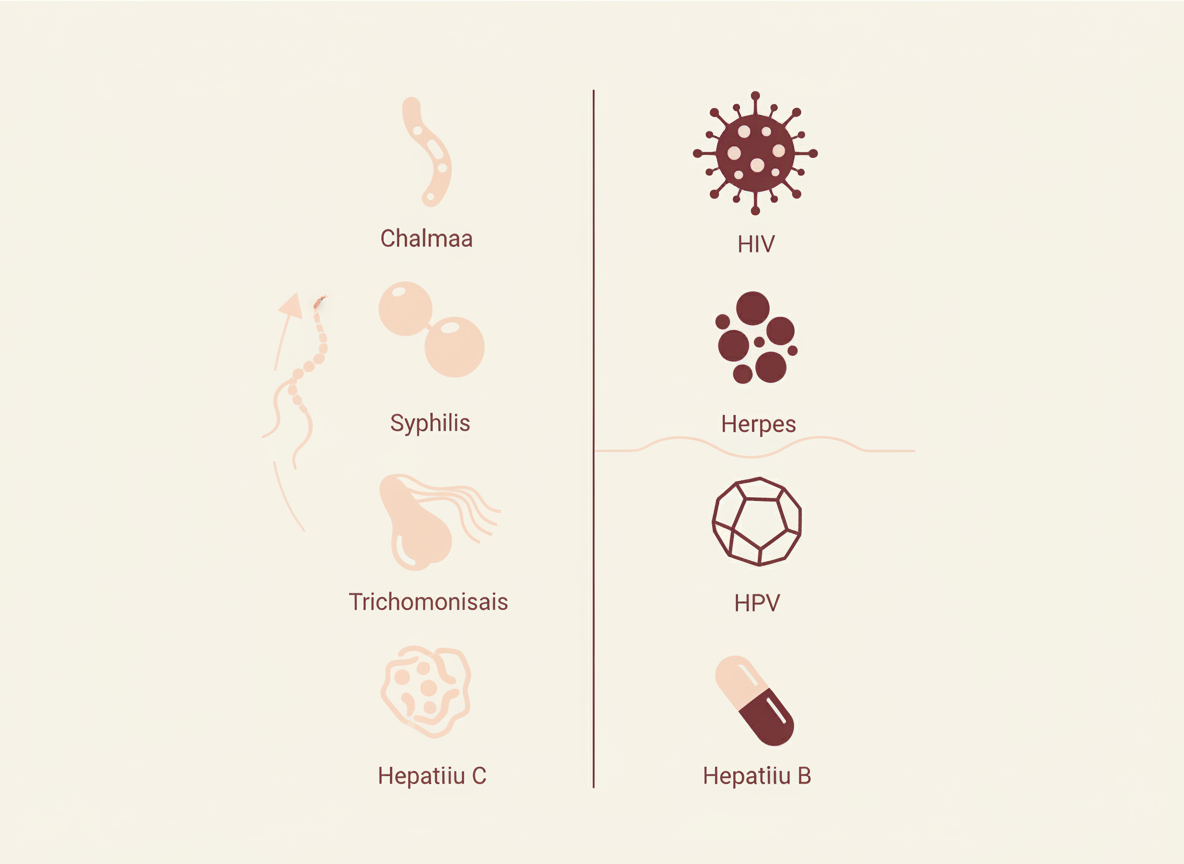
Five infections clear with treatment: chlamydia, gonorrhea, syphilis, trichomoniasis (all bacterial or protozoal, antibiotic-curable) plus hepatitis C (curable with modern direct-acting antivirals). Four are managed but not eliminated: herpes, HIV, HPV, and hepatitis B. Within that 'manageable' group, HIV on consistent antiretroviral therapy reaches undetectable viral load with essentially zero sexual transmission risk, and herpes on daily suppressive therapy meaningfully reduces outbreak frequency and transmission risk.
Relationship Myths: 'I'm Monogamous' Isn't a Test Result
Can you get an STD in a monogamous relationship? Yes. This is probably the most deeply held relationship myth in sexual health, and it's the most consequential because it tends to reduce testing frequency in exactly the people who should be testing. Monogamy reduces ongoing exposure risk significantly compared to having multiple concurrent partners without testing, but it doesn't erase what each partner brings into the relationship from their prior sexual history. HPV can lie dormant for years before becoming detectable. Herpes can be carried without a single noticeable outbreak for months or years. Someone who last tested five years ago and has since been monogamous is not confirmed-clear; they are unconfirmed.
Can You Get HPV in a Monogamous Relationship? makes this concrete, and HPV Reactivation After 40 covers the surprising phenomenon of HPV staying dormant and then becoming detectable years or decades into a stable relationship, catching people completely off guard.
HIV risk is also still widely misunderstood in ways that leave people either unnecessarily panicked or falsely unconcerned. The reality of HIV in 2026 is that someone on effective antiretroviral therapy can reach an undetectable viral load that is essentially non-transmissible to sexual partners, a public-health development that fundamentally changes the picture of what an HIV diagnosis means. The myth that HIV is always immediately devastating, and the opposing myth that “undetectable means completely cured,” both need correcting.
Lesbian STDs 101 addresses the myth that women who have sex with women carry minimal risk, a misconception that actively stops people from seeking testing they need. Whether getting an STD in a committed relationship means someone cheated is one of the most emotionally loaded myths in this category, and the answer in most cases is no. Can You Get an STD Without Cheating? corrects this directly; dormant infections can surface years into a relationship, and the biology of STD timing has no respect for relationship timelines. For the specific version of this myth around gonorrhea, which carries a particularly harsh stigma when it appears in a monogamous couple, Can You Get Gonorrhea Without Being Unfaithful? provides the clinical explanation. And for the HPV-specific myth that the vaccine makes further STD prevention unnecessary, Can You Get an STD After the HPV Vaccine? covers what the vaccine does and doesn't protect against.
HPV can stay dormant for years and become detectable around midlife, often after age 40 when immune surveillance shifts. Herpes can be carried without a noticeable outbreak for months or years before stress, illness, or hormonal change triggers shedding. Both mechanisms explain how a couple in a faithful long-term relationship can suddenly see a positive result that has nothing to do with cheating. A baseline test at the start of a relationship and a periodic refresh is what turns 'we're fine' into something verified.
Prevention Myths: Birth Control, Condoms, and What Real Protection Looks Like
Prevention myths take something genuinely effective and stretch it until it breaks. Does birth control prevent STDs? No. This is one of the most searched and most dangerous misconceptions in this category. Birth-control pills, patches, IUDs, implants, and injections all prevent pregnancy through hormonal or physical mechanisms that have no effect on the bacteria and viruses that cause sexually transmitted infections. Someone relying on the pill as their only protection against STDs has no protection against STDs (Does Birth Control Stop STDs?).
Do condoms protect against all STDs? Not completely, and this nuance matters enormously. Condoms are highly effective against fluid-transmitted infections (HIV, chlamydia, gonorrhea, and trichomoniasis); the evidence on this is strong. But herpes and HPV spread through skin-to-skin contact in areas the condom doesn't cover: the scrotum, inner thighs, perineum, and surrounding genital skin. Correct and consistent condom use reduces herpes and HPV transmission risk by creating a physical barrier over the urethral opening and shaft, where viral shedding is highest, but it doesn't cover the surrounding skin where shedding also occurs. Transmission remains possible. Understanding this should not push anyone to drop condoms. It should push you to add testing and vaccination on top.
Oral sex specifically gets underprotected by most people's prevention habits. Do Condoms Actually Protect Your Mouth? covers what does and doesn't transfer protection in those contexts, and Do Dental Dams Actually Work? gives the honest assessment of dental dams, including the gap between how often they're recommended and how rarely they're actually used.
Lube is misunderstood in both directions. Water-based and silicone-based lubricants reduce friction and microtears and are beneficial. Oil-based lubricants (Vaseline, baby oil, hand cream) degrade latex condoms and can actively increase transmission risk by compromising the barrier (Why Lube Is Both a Protector and a Risk). Two more prevention myths deserve direct answers: probiotics don't prevent or treat STDs, despite what wellness content suggests (Gut Health vs Genital Health); and HPV vaccination is for everyone, not just women. HPV causes cancers of the throat, anus, and penis in men too, and Yes, Men Get HPV Too makes the full case.
Most people who have an STI don't know it. Many STIs have no symptoms or only mild ones, so testing is the only way to know your status.
FAQs: STD Myths and Facts, Answered Directly
- What is the most dangerous STD myth?
- Epidemiology makes this clear: roughly 70% of chlamydia cases in women, half in men, and the majority of herpes and HPV infections produce no noticeable sign at all. The infection is present, transmissible, and capable of causing subclinical damage like fallopian-tube scarring while the carrier feels completely normal. Testing on a schedule, not on symptoms, is the only way around that gap.
- Can you get an STD the first time you have sex?
- Yes. One exposure is enough for any sexually transmitted infection. There is no biological mechanism that grants immunity based on the number of previous sexual encounters.
- Does birth control prevent STDs?
- No. Hormonal birth control (pills, patches, injections, IUDs, implants) prevents pregnancy through mechanisms that have no effect on bacteria or viruses. It offers zero protection against STIs. Condoms are the only widely accessible barrier method that reduces both pregnancy and STD transmission risk.
- Do condoms protect against all STDs?
- Not completely. Condoms are highly effective against fluid-transmitted infections, including HIV, chlamydia, gonorrhea, and trichomoniasis. But herpes and HPV spread through skin-to-skin contact in areas the condom doesn't cover, so correct and consistent condom use meaningfully reduces but doesn't eliminate those transmission risks.
- Can you have an STD in a monogamous relationship?
- Yes. Monogamy reduces ongoing exposure risk but doesn't erase prior infection history. HPV and herpes can both lie dormant for years before becoming detectable, including in long-term relationships where neither partner ever cheated. Testing at the start of a relationship and periodically afterwards is what actually confirms mutual status.
- Can you catch the same STD twice?
- Yes. Bacterial STDs such as chlamydia, gonorrhea, syphilis, and trichomoniasis can be caught again after successful treatment if you are re-exposed. Reinfection is most common when a partner wasn't treated at the same time. Bacterial STDs do not generate protective immunity the way some childhood infections do, so partner notification and joint treatment are essential.
- What is a false-negative STD test?
- A test that says you're clear when you're actually infected, most often because testing happened before the infection reached detectable levels in the body. Detection windows range from 14 days for chlamydia to 8 to 11 weeks for hepatitis C. Testing immediately after an exposure and treating that result as definitive is one of the most common testing mistakes.
- Are STDs curable?
- Bacterial STDs (chlamydia, gonorrhea, syphilis, trichomoniasis) are curable with the right antibiotic. Hepatitis C is also curable with modern antivirals. Viral STDs (herpes, HIV, HPV, hepatitis B) are not curable but are manageable, in some cases very effectively. HIV on consistent treatment can reach undetectable levels with essentially zero sexual transmission risk to partners.
Testing Is Where Myths End
Every myth in this article has the same resolution: more reading helps, but only an actual result from a timed test tells you what's true for you right now. Understanding the biology, knowing which infections a standard panel skips, and reading about window periods together describe what to look for, but none of them confirms your status. A test taken at the right time, covering the right infections, does that.
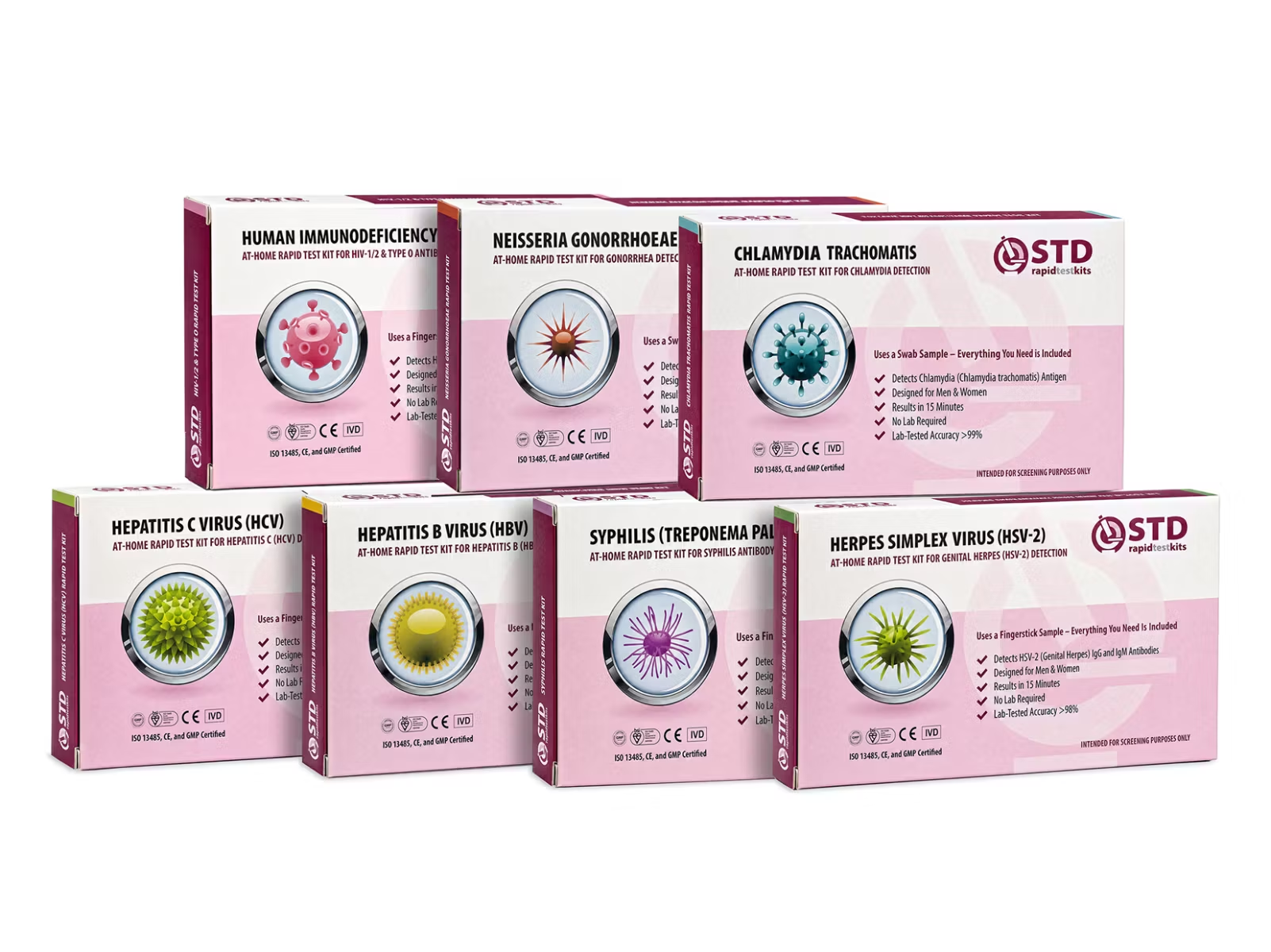
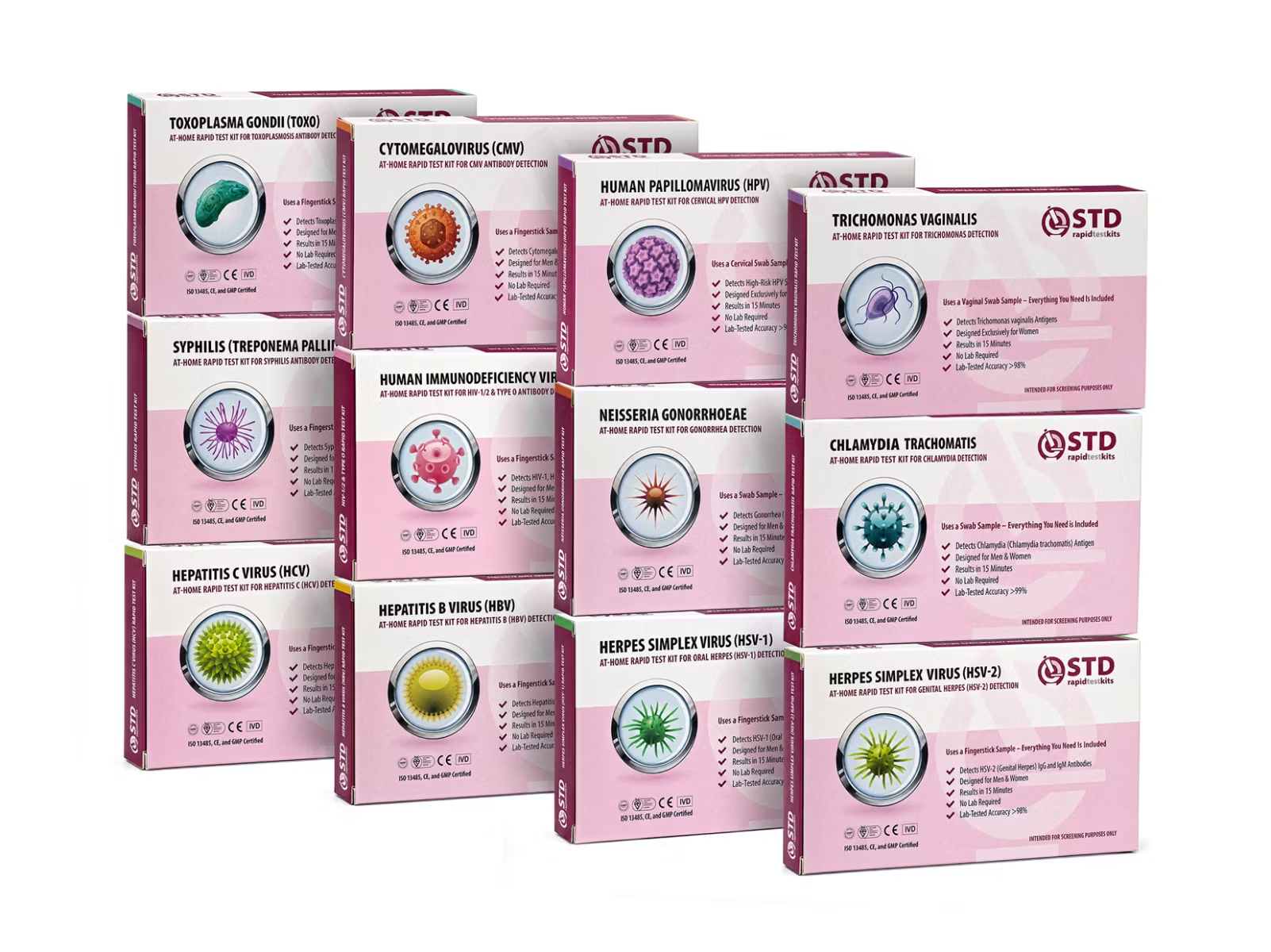
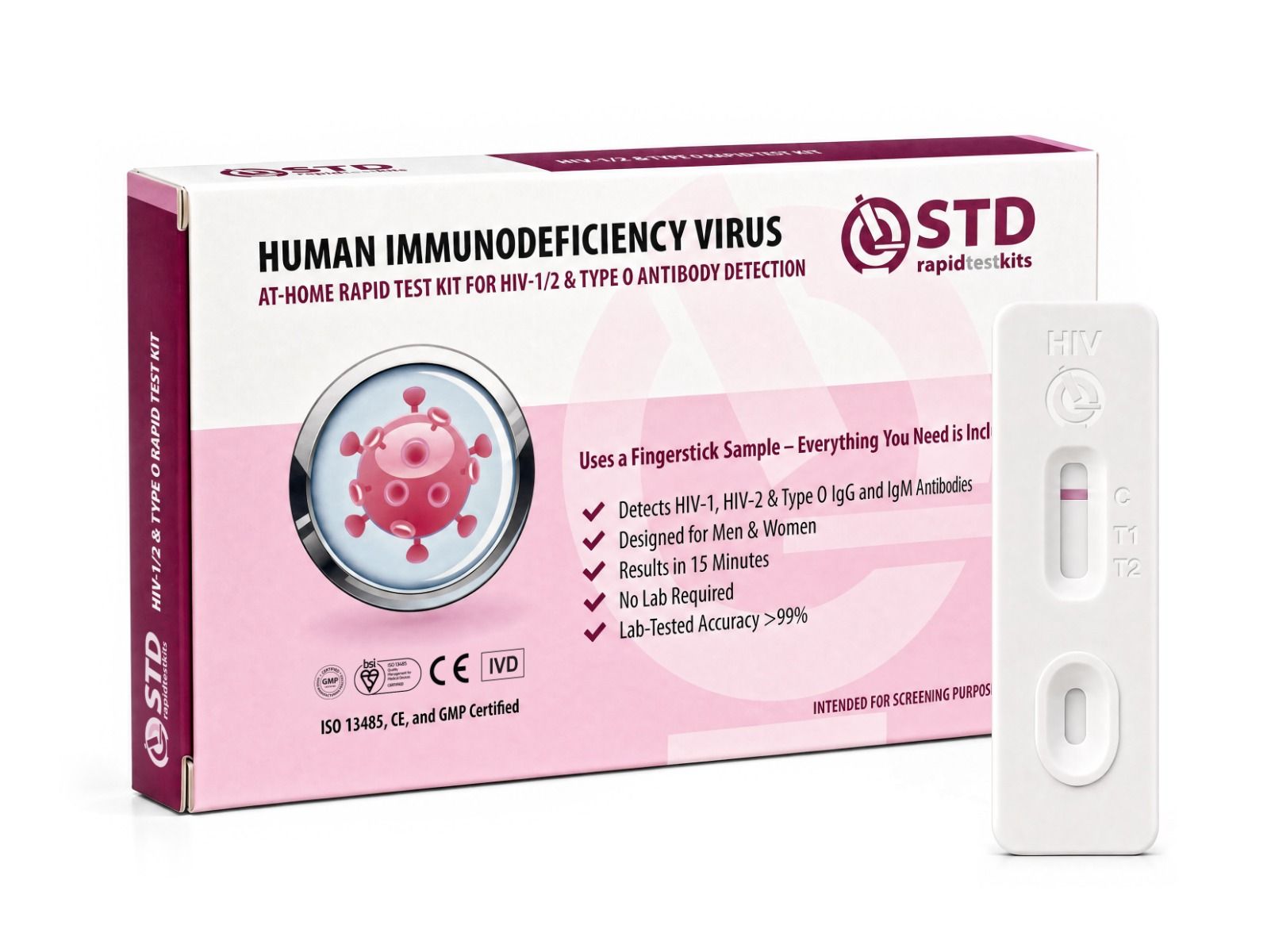
Our 7-in-1 Complete At-Home STD Test Kit covers HIV, HSV-2, chlamydia, gonorrhea, syphilis, hepatitis B, and hepatitis C: the seven infections most commonly missed by people who believe they're clear. For women wanting a more comprehensive screen, the Women's 10-in-1 Kit adds trichomoniasis and HPV 16 and 18 (validated for vaginal self-swab; male readers needing trich or HPV testing should see a clinic). Individual kits are available for every infection, including the Syphilis At-Home Rapid Test Kit, the HIV 1 and 2 At-Home Rapid Test Kit, and the combined Genital and Oral Herpes HSV-1+2 Kit. All are rapid lateral-flow tests, which are excellent screening tools but not lab-grade NAAT or PCR; a positive screen is best confirmed at a clinic, but the at-home kit is what tells you whether confirmation is needed in the first place.
STD myths persist because sexual health is still wrapped in enough stigma that honest conversations are rare. The articles linked throughout this page exist to change that, one specific question at a time. An at-home STD test is what finishes the job, replacing “I think I'm probably fine” with something you can actually stand behind.
1. Right window. Test after the detection window for that infection has closed (14 days for chlamydia, 12 weeks for HIV certainty, 6 to 12 weeks for herpes antibodies). A negative result before the window closed isn't a clean result; it's an early result.
2. Right infections. A 'standard' panel often skips herpes and HPV. Knowing exactly which infections were tested is the difference between 'screened' and 'screened for that specific thing.'
3. Right follow-up. A positive at-home rapid result is the start, not the end. Confirm with a lab where possible, treat fully, retest as a test-of-cure for bacterial STIs, and notify partners so they aren't reinfecting you the moment treatment finishes.
- U.S. Centers for Disease Control and Prevention. Sexually Transmitted Infections Surveillance, 2024 provisional data, including the 2.2 million-case figure and the long-term trend comparison.
- U.S. Centers for Disease Control and Prevention. STI Awareness, Know the Facts. Source for the asymptomatic-infection guidance and the 'you cannot tell by looking' framing.
- World Health Organization. Sexually transmitted infections (STIs) fact sheet, including transmission routes, prevalence, and management options.
- National Health Service. Sexually transmitted infections (STIs) overview, including symptom, testing, and treatment guidance for the UK general public.
- Ohio State University Wexner Medical Center. National survey on STI misconceptions, 2024 (originating research for the 'one in three believe STIs spread only through intercourse' and 'one in five only test when symptoms appear' figures).
- World Health Organization. Herpes simplex virus fact sheet covering global prevalence, asymptomatic carriage, and clinical guidance for HSV-1 and HSV-2 infections; supports the 'majority of carriers don't know' framing used in this article.
- U.S. Centers for Disease Control and Prevention. Genital herpes overview page; supports the U.S. prevalence framing for HSV-2 in the highlight-box and Biology Myths section.
