
Published: November 2025 | Last updated: May 2026 | Editorial review and quality control: Martina N.
Does a standard STD panel include Hepatitis B?
Usually not. Most clinic and at-home panels default to chlamydia, gonorrhea, syphilis, and HIV. Hepatitis B sits in a separate set of recommendations, so it is commonly skipped unless you request it by name or pick a kit that lists HBsAg. Adding it takes one blood draw with three markers.
Most people who order an at-home STD kit or get screened at a walk-in clinic assume the panel covers the obvious: chlamydia, gonorrhea, syphilis, HIV, and often herpes. What surprises a lot of readers is that Hepatitis B is usually not in that bundle, even when the test is marketed as a "full" panel. That gap is not random. It traces back to how panels are priced, how childhood vaccination is assumed, and how viral hepatitis was historically separated from other sexually transmitted infections in public-health messaging.
If you have ever walked away from a negative result thinking you were fully cleared, this is the conversation no one had with you at the clinic. The sections below cover what a standard panel actually includes, the three blood markers that answer the Hepatitis B question in one draw, when to test after a possible exposure, how at-home testing fits among your options, and what to do if a result comes back positive.
Key Takeaways
- Hepatitis B is sexually transmitted, but most "standard" STD panels do not include it unless you specifically request it or pick a kit that lists HBsAg in the panel.
- A complete first-time Hep B screen looks at three blood markers together (HBsAg, anti-HBs, anti-HBc); one marker on its own can mislead, while all three give a clean answer in one draw.
Hepatitis B Is a Sexually Transmitted Infection
Hepatitis B virus (HBV) spreads through contact with infectious body fluids: blood, semen, and vaginal fluids. According to the World Health Organization's Hepatitis B fact sheet, HBV is transmitted through contact with the blood or other body fluids of an infected person, and sexual transmission is more prevalent in unvaccinated adults with multiple partners. Mother-to-child transmission at birth and exposure to contaminated needles or medical equipment are the other major routes.
That means vaginal sex, anal sex, and (less commonly) oral sex can all transmit HBV when fluids are exchanged. Sharing items that may carry trace blood, like razors or toothbrushes, can also be a route under the right conditions. Public-health screening guidance recommends HBV testing for sexually active adolescents and adults who have not been vaccinated, particularly anyone with new or multiple partners. The cultural framing of hepatitis as a "drug-use disease" is outdated, and treating it that way pushes the screening conversation in the wrong direction.
Hepatitis B virus spreads through three main routes:
- Sexual contact: vaginal, anal, and (less commonly) oral sex when fluids are exchanged.
- Blood-to-blood contact: shared needles, shared razors or toothbrushes, occupational exposure, and rarely, contaminated medical or tattoo equipment.
- Mother-to-child at birth: the dominant route in regions where HBV is endemic and routine vaccination has not reached full coverage.
What a "Standard" STD Panel Actually Covers
The phrase "full panel" carries a quiet authority, and most people hear it as a promise that everything sexually transmissible has been checked. In practice the term has no fixed meaning. What gets tested depends on where you go, what your insurance pays for, the lab contract behind the clinic, and how much time the provider has during your visit. Most U.S. clinics build their default panel around four infections: chlamydia, gonorrhea, syphilis, and HIV. The CDC's STI testing guidance treats these as the baseline checks for sexually active adults.
Hepatitis B testing sits in a separate set of recommendations, usually triggered by pregnancy, men who have sex with men, multiple recent partners, household contact with someone known to be infected, or a known exposure event. That separation is administratively tidy, and it means Hepatitis B regularly slips out of routine workflows for everyone outside those flagged groups. Readers hear "full" and assume complete; clinics use "full" to describe the default bundle. Both can be true at once. If your last lab report does not list HBsAg, anti-HBs, or anti-HBc, Hepatitis B was almost certainly not part of the draw. The table below shows the inclusions you can typically expect from urgent care, telehealth, and many at-home rapid kits.
| Infection | In a typical panel? | Common test type | Sample needed |
|---|---|---|---|
| Chlamydia | Yes | NAAT (lab) or rapid antigen | Urine or swab |
| Gonorrhea | Yes | NAAT (lab) or rapid antigen | Urine or swab |
| Syphilis | Yes | Blood antibody (treponemal/non-treponemal) | Fingerstick or venous blood |
| HIV | Yes | Antigen/antibody combination | Blood or oral fluid |
| Herpes (HSV-2) | Sometimes (often opt-in) | Blood antibody | Fingerstick or venous blood |
| Trichomoniasis | Sometimes | NAAT or rapid antigen | Urine or swab |
| Hepatitis B | Usually NOT included | Three-marker blood panel (HBsAg, anti-HBs, anti-HBc) | Blood sample |
| Hepatitis C | Sometimes (adult screen now recommended) | Anti-HCV antibody | Blood sample |
The Three Blood Markers That Answer the Hep B Question
One reason Hepatitis B testing feels unfamiliar is that interpreting it takes more than a single yes-or-no result. A complete first-time workup looks at three blood markers, and each one answers a different question about where you stand. Per CDC clinical guidance on Hepatitis B diagnosis and testing, the recommended first screen is a triple-panel test that evaluates all three markers together so the result answers the question being asked.
A surface antigen on its own can flag a current infection, but it will not say whether that infection is two months old or twenty years old. A surface antibody on its own can suggest immunity, but it will not say whether the immunity came from a vaccine or from a resolved past infection. A core antibody fills in that history. Read together, the three markers describe a clear status; read separately, they raise more questions than they answer. The shorthand worth memorizing: HBsAg means active now, anti-HBs means immune (from a vaccine or a past resolved infection), and anti-HBc means a history of natural infection that does not appear from vaccination alone.
| Marker | What it indicates | Common interpretation pitfall |
|---|---|---|
| HBsAg (Hepatitis B Surface Antigen) | Active infection: virus is present in the bloodstream now | Cannot distinguish acute (recent) from chronic (long-standing) infection on its own |
| Anti-HBs (Hepatitis B Surface Antibody) | Immunity from a successful vaccine series or a resolved past infection | Levels can fall over time; a low result does not always mean immunity is gone |
| Anti-HBc (Hepatitis B Core Antibody) | Past or current natural infection (does not appear after vaccination alone) | Distinguishes vaccine-induced immunity from infection-induced immunity |
Why Hep B Falls Outside the Default
Hepatitis B testing did not get excluded because it is rare or unimportant. It slipped out of the default panel for quieter reasons that compound over decades.
The first reason is universal childhood vaccination. The United States has recommended routine infant Hepatitis B vaccination since 1991. Per CDC vaccine administration guidance, the standard series is highly effective in healthy people who complete it; the dose count depends on the vaccine brand, and a newer adult formulation needs only two doses rather than three. A generation later, many providers default to assuming protection and quietly leave Hepatitis B off the panel. The assumption holds for most people. It misses adults born before universal infant vaccination took hold, adults who immigrated from countries with different schedules, people who started but never finished the series, and a smaller group who completed it but never developed protective antibodies (a phenomenon called primary vaccine non-response, more common in adults over 40, in people with diabetes, in people with chronic kidney disease, and in people who are immunocompromised).
The second reason is conceptual. Hepatitis B is a viral liver infection that happens to be transmitted sexually, through blood, and from parent to child during birth. Many providers mentally file it under hepatology rather than sexual health, even though sexual transmission is well documented in adults. That mental filing shapes which order set a clinician reaches for during a quick visit.
The third reason is billing and coding. Adding HBsAg or a surface antibody test can require a documented risk factor under some insurance plans, and routine screening without that flag can trigger denials or surprise bills. Providers who learn this the hard way quietly trim Hepatitis B from their default order set unless something else justifies it. The phrase "full STD panel" has no single regulatory definition, so what gets included depends on the lab, the kit, the clinician's habits, and what the patient asks for.
- Adults born before universal infant HBV vaccination reached their region.
- Adults who immigrated from countries with different vaccination schedules or known coverage gaps.
- People who started but did not complete the vaccine series.
- Adults who completed the series but never developed protective antibody levels (primary non-responders).
- Long-vaccinated adults whose protective antibody levels may have waned over decades, particularly anyone immunocompromised.
Hepatitis B Can Stay Silent for Months
One reason Hepatitis B slips through the cracks is that it usually does not announce itself. According to the CDC's Hepatitis B basics page, some people with acute Hepatitis B have no symptoms or only a mild illness, often vague flu-like fatigue, nausea, low appetite, or stomach discomfort that is easy to chalk up to a passing bug or a stressful week. Some people develop jaundice, dark urine, or pale stools, but those classic signs appear in only a fraction of acute cases. When symptoms do show up, CDC notes they often begin around 90 days after exposure, though they can arrive earlier or later.
Gonorrhea and chlamydia often (though not always) produce visible discharge or pain on urination. Hepatitis B can carry on quietly for weeks or months. A small share of acute cases become chronic, the form where the virus stays in the body long-term and, over years, raises the risk of cirrhosis, liver failure, and liver cancer. Per the WHO Hepatitis B fact sheet, an estimated 254 million people were living with chronic Hepatitis B in 2022, and the infection caused roughly 1.1 million deaths that year, mostly from cirrhosis and liver cancer.
The practical consequence is common enough: someone gets a standard screen after a relationship change, sees a clean result, and only later, after fatigue, abdominal discomfort, or an unrelated blood test, learns that Hepatitis B was never on the panel they ordered.
- Symptoms can be absent or mild: per the CDC, some adults with acute Hep B have no symptoms or only mild illness, so the absence of symptoms does not mean the absence of infection.
- Quiet weeks to months: infection can carry on without obvious signs while the virus is still transmissible to partners.
- Long-term stakes: a fraction of acute cases become chronic, raising the risk of cirrhosis, liver failure, and liver cancer over years.
You can have hepatitis B even if you don't have any symptoms. About 1 in 2 people with hepatitis B do not know they are infected.
When to Test: The Hepatitis B Window Period
HBV has a measurable window period, the gap between exposure and when the infection can be detected on a test. Testing too early can hand you a false sense of security; waiting too long delays decisions about partners, follow-up care, or post-exposure prophylaxis, which works best when started within 24 hours rather than weeks. HBsAg, the surface antigen most rapid tests detect, typically becomes detectable within several weeks to about two months of exposure. When a possible exposure is recent, the cleaner approach is to draw a baseline test now to rule out a pre-existing infection, then retest once the window has fully passed.
Hepatitis B Window Period After Exposure
- Week 0 Exposure
HBsAg is not yet detectable; a test now reflects only your status before this exposure.
- Week 4 Early window
HBsAg may begin to appear, but a negative result here is not conclusive.
- Week 8 Often detectable
Most acute infections show detectable HBsAg by around two months.
- Week 12 Conclusive result
HBsAg plus anti-HBc can distinguish acute from chronic; a negative here is reliable.
Draw a baseline test now if a possible exposure was recent, then retest at the 10 to 12 week mark for a conclusive result.
At-Home Testing for Hepatitis B
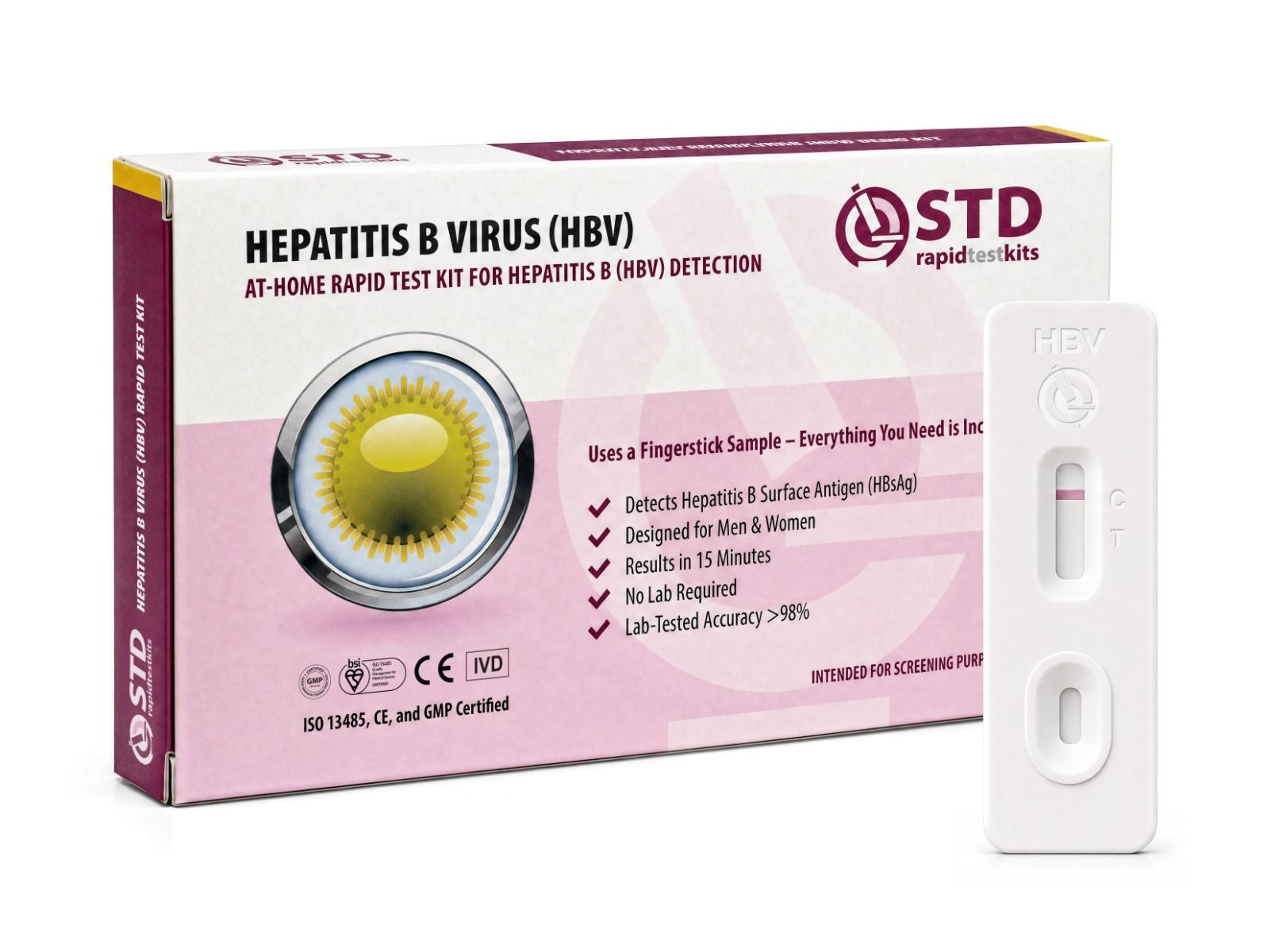
You can test for Hepatitis B at home. Rapid lateral-flow kits use a fingerstick blood sample to detect HBsAg, the surface antigen that signals an active HBV infection. The catch is that many kits sold as "comprehensive STI panels" do not include Hepatitis B at all. Before ordering, check the panel description for HBsAg or "Hepatitis B surface antigen." If those words are not there, the kit is not screening for Hepatitis B. A focused at-home Hepatitis B test is one way to close that specific gap.
At-home rapid tests are screening tools, not laboratory diagnostics. They detect active infection through the surface antigen, but they do not measure antibody status, so a complete picture still benefits from a lab panel. A positive result should be confirmed with a fuller hepatitis panel ordered through a clinician, which can separate a new infection from a long-standing chronic one and check liver function. A negative result drawn during the window period means the test could not yet detect infection, so plan to retest once you are past the 10 to 12 week mark. For many readers, an at-home kit is a faster, more private way to get a first read on status before booking a clinic appointment.
Disclosure: this site sells the at-home Hepatitis B test featured below. We mention it for transparency and recommend products only when they fit the screening question the article is answering.
How At-Home Testing Compares to Your Other Options
If standard panels routinely miss Hepatitis B, the practical question is what to do about it. Most adults choose among a few real routes, and each has trade-offs that matter differently depending on timing, privacy, and whether you already suspect an exposure. For people with no symptoms who want a fast, private first read, an at-home rapid test is a strong starting point; for a first-time complete status check or a known exposure, a clinic three-marker panel is the more thorough route. Broader at-home STI test kits can fold Hepatitis B in alongside the usual four infections so you are not relying on a panel that quietly leaves it out.
Ways to Get Hepatitis B Into Your Screen
| Testing route | What it covers for Hep B | Best for | Keep in mind |
|---|---|---|---|
| Standard clinic "full panel" | Usually excludes Hep B unless you are flagged or ask | A routine checkpoint when you have no specific Hep B concern | Feels complete but often is not; request the three markers by name |
| At-home rapid Hep B test | HBsAg only (active infection), fingerstick, about 15 minutes | A private, fast first read or a follow-up to a panel that skipped it | Screening only; a reactive result needs lab confirmation |
| Clinic three-marker lab panel | HBsAg, anti-HBs, and anti-HBc in one draw | A first-time complete status check or a known exposure | Requires asking; some plans add a small charge for the extra markers |
| Mail-in lab kit | Varies by product; only if it lists HBsAg | A lab-processed result without an in-person visit | Days-long turnaround; confirm Hep B is actually on the menu |
For the common case (no symptoms, want privacy and speed), an at-home rapid test is a reasonable first step, with a clinic panel for confirmation or a full status check.
What to Do If You Test Positive
A positive HBsAg result on a rapid screen is information, not a verdict, and the next steps are calm and concrete. Book an appointment with a clinician (primary care, a sexual-health clinic, or an infectious-disease specialist) for a confirmatory three-marker panel plus liver enzymes (ALT and AST) to check for inflammation. In the meantime, avoid alcohol until you have results, do not share razors or toothbrushes, and use barriers during sex until partners are tested or vaccinated.
Most adults clear acute Hepatitis B on their own with rest, hydration, and monitoring. According to the WHO Hepatitis B fact sheet, infection acquired in adulthood becomes chronic in less than 5% of otherwise healthy adults. Chronic infection is manageable: per the NHS overview of Hepatitis B, antiviral medications can suppress the virus, and regular check-ups with a liver specialist guide care over time. A patient-friendly summary of testing, vaccination, and follow-up is also available from MedlinePlus. The earlier you know, the more options you have.

Telling Partners Without Spiraling
Telling someone you have tested positive for Hepatitis B is uncomfortable, and the discomfort is not a sign you are doing it wrong. Aim for clarity rather than confession. A partner you have slept with deserves the chance to test and, if they are not already protected, to get vaccinated. The Hepatitis B vaccine is one of the most effective vaccines in routine use; a partner who completes the series and confirms a protective antibody level is essentially protected from acquiring HBV from you.
If a script helps, here is one that keeps it factual.
"I want to share something. I recently tested positive for Hepatitis B. It is not always included in standard STI panels, and I did not realize that until now. I am following up with a clinician, and I wanted to give you the chance to get tested or vaccinated. The Hep B vaccine is very effective, and a quick blood test can show whether you already have antibodies."
You do not have to discuss exposure dates or relationship history beyond what feels right. The key information is: I tested positive, here is what it is, here is how you can check yourself.
When Retesting Matters
Retesting is not only for people whose first result was positive. It matters in two distinct situations. The first: you tested early in the window period, before HBsAg became reliably detectable. A negative at three weeks post-exposure is not the same as a negative at ten to twelve weeks. The second: you have a confirmed acute infection and your clinician is monitoring whether it is clearing. Follow-up labs over six to twelve weeks track HBsAg, HBeAg (hepatitis B e-antigen, a marker of active viral replication), and ALT to determine whether the infection is resolving or moving toward chronic.
Per CDC clinical guidance on Hepatitis B diagnosis and testing (updated in 2023), every adult aged 18 and older should be screened for Hepatitis B at least once in their life, using the three-marker triple-panel test discussed earlier. That recommendation replaced the older risk-based-only approach. Periodic retesting is recommended for people with ongoing risk: new partners since the last test, an unprotected exposure event, sex with a partner whose Hep B status is unknown, shared injection equipment, occupational blood exposure, pregnancy, household contact with someone living with chronic Hep B, and people receiving certain immunosuppressive treatments.
There is also a third reason that is harder to put on a chart: you cannot stop thinking about it. That is a valid reason to recheck, especially if doing so lets you stop catastrophizing. A second test, taken after the proper window has passed, is one of the cheapest pieces of mental real estate available.

Asking for the Full Picture
The takeaway is simple, even when the system makes it feel complicated: a "full panel" is whatever the lab, kit, or clinician says it is, which means it might not include Hepatitis B. If you want Hepatitis B in your screen, the most reliable moves are to ask for the three-marker panel by name ("please include HBsAg, anti-HBs, and anti-HBc") at a clinic, or to choose an at-home kit that lists Hepatitis B in its panel description.
Most people who learn their previous panels never specifically included Hepatitis B feel a flash of self-blame. That reaction is understandable and misplaced. Following the advice you were given and trusting the language on clinic forms and lab reports is exactly what responsible adults are told to do. The friction sits in the system, not in you, and it closes with one extra request at your next visit or one carefully chosen kit. Both the CDC and WHO fold Hepatitis B into their adult screening guidance; it is a common, often-silent, sexually transmitted infection that the rest of the testing infrastructure has been slow to bundle in.
Do You Need to Add a Hep B Test?
Does your most recent lab report list HBsAg, anti-HBs, or anti-HBc by name?
Yes: Hepatitis B was on that draw. If all three markers were checked, you already have a clear status and need no action unless you have had a new exposure since.
Have you had a possible exposure (a new partner, an unknown-status partner, or shared equipment) since your last clear Hep B result?
Yes: Test now for a baseline reading, then retest at the 10 to 12 week mark for a conclusive result. Ask for the three-marker panel by name, or pick an at-home kit that lists HBsAg.
Did a rapid at-home HBsAg test come back reactive?
Yes: Book a clinician for a confirmatory three-marker lab panel plus liver enzymes (ALT and AST). A reactive screen is information to act on, not a final diagnosis.
No: If you have never had a documented Hep B screen, request the one-time three-marker adult panel at your next visit to close the question for good.
Guidance only; a healthcare provider can advise based on your full history.
Frequently Asked Questions
- Is Hepatitis B really considered an STD?
- Yes. Both the CDC and WHO classify Hepatitis B as a sexually transmitted infection. The virus spreads through blood, semen, and vaginal fluids, which makes unprotected vaginal, anal, and oral sex routes of transmission. Vaccination is highly effective; sexually active people who are unvaccinated remain in scope for screening.
- Why do most STD panels skip Hepatitis B?
- A few reasons stack up: it requires a blood test (which adds cost), public-health programs historically separated viral hepatitis from STI care, many providers assume patients were vaccinated as infants, and some insurance plans require a documented risk factor before Hep B testing is covered. There is no single national definition of a "full panel," so what gets included varies by lab, clinic, and kit.
- What three Hep B markers should I ask for?
- Ask for the three-marker Hepatitis B panel by name: HBsAg (surface antigen), anti-HBs (surface antibody), and anti-HBc (core antibody). The first checks for active infection, the second for immunity, and the third helps distinguish vaccine-derived immunity from a resolved past infection. Together, they give a clean answer in one blood draw.
- Can Hepatitis B be transmitted through oral sex?
- Yes, although the risk is generally lower than for vaginal or anal sex. Risk increases when there are cuts, sores, or bleeding gums in the mouth. The takeaway is that no sexual activity that exchanges fluids is automatically risk-free for HBV.
- I have no symptoms. Does that mean I don't have Hep B?
- Not necessarily. Per the CDC, some adults with acute Hepatitis B have no symptoms or only mild illness, and chronic infection can quietly affect the liver for years before producing noticeable symptoms. When symptoms do appear, they often begin around 90 days after exposure. Testing is the only reliable way to know.
- When should I test after a possible exposure?
- Plan for a retest at the 10 to 12 week mark for a conclusive negative. HBsAg, the marker most rapid tests detect, usually becomes detectable within several weeks to about two months of exposure; any negative result before then is not a clear result. If the exposure was high-risk and you are unvaccinated, ask a clinician about post-exposure prophylaxis (HBIG plus vaccine) within 24 hours rather than waiting for testing.
- Can I test for Hepatitis B at home?
- Yes. Look for at-home kits that specifically list HBsAg or "Hepatitis B surface antigen." These use a fingerstick blood sample and give a rapid result. Treat them as a screening tool, not a final diagnosis: they detect active infection but not antibody status, so a reactive home result should be confirmed with a clinical lab and the full three-marker panel through a clinician.
- If I was vaccinated as a child, do I still need to test?
- A single anti-HBs antibody test answers the question. The U.S. childhood vaccine series is highly effective in most people, but a small share never seroconvert (primary non-response is more common in adults over 40, in people with diabetes, in people with chronic kidney disease, and in people who are immunocompromised), antibody levels can fall over time, and many adults have incomplete records. Confirming antibody status removes a question that otherwise hovers.
How we sourced this article: We synthesized current guidance from leading public-health and medical organizations, primarily the U.S. Centers for Disease Control and Prevention, the World Health Organization, the UK's National Health Service, and MedlinePlus, alongside their published Hepatitis B fact sheets, clinical testing pages, and vaccine administration guidance. Where this article describes patterns clinicians commonly see, we drew on those guidelines rather than personal clinical experience. The references below are the most directly relevant for readers who want to dig further.
- World Health Organization. Hepatitis B fact sheet covering global prevalence (estimated 254 million people living with chronic infection in 2022), transmission routes, the less-than-5% adult chronic-conversion rate, and roughly 1.1 million annual deaths from hepatitis B complications.
- U.S. Centers for Disease Control and Prevention. Hepatitis B basics page covering symptoms, acute vs. chronic infection, the roughly 90-day symptom onset, and the mild-or-absent presentation in many adults.
- U.S. Centers for Disease Control and Prevention. Clinical guidance on hepatitis B diagnosis and testing, including the triple-panel (HBsAg, anti-HBs, total anti-HBc) interpretation framework and the 2023 universal one-time adult-screening recommendation.
- U.S. Centers for Disease Control and Prevention. Hepatitis B vaccine administration guidance, including the standard schedule and adult vaccination options.
- U.S. Centers for Disease Control and Prevention. STI testing guidance, including the chlamydia, gonorrhea, syphilis, and HIV checks that form the default sexual-health panel.
- National Health Service (UK). Hepatitis B overview covering symptoms, testing, and treatment with antiviral medications plus regular liver-specialist monitoring.
- MedlinePlus, U.S. National Library of Medicine. Patient-facing overview of hepatitis B testing, vaccination, transmission, and follow-up.
