
Published: November 2025 | Last updated: May 2026 | Editorial review and quality control: Martina N.
Yes. HSV-1, behind most cold sores, can transmit to a partner's genitals during oral sex, a route the <a href="https://www.cdc.gov/sti/about/about-sti-risk-and-oral-sex.html" target="_blank" rel="noopener">CDC recognizes</a> as a growing cause of new genital herpes. Symptoms appear 2 to 12 days later, or never. Swab a fresh sore at a clinic within 48 hours; otherwise take an IgG blood test 12 to 16 weeks post-exposure.
Cold sores get treated like a minor inconvenience, but the same virus behind most of them, herpes simplex type 1 (HSV-1), can land below the belt during oral sex and cause a genital outbreak. The mouth-versus-genitals split that older textbooks taught is a leftover, not a rule. This guide walks through how the crossover actually happens, what genital HSV-1 feels and looks like, the look-alikes worth ruling out before assuming the worst, and which test makes sense for your specific situation. The short version: a fresh sore is best swabbed at a clinic; a question without a sore is best handled by a blood antibody test taken at the right window.
If your cold sores have appeared in the same spot on or near your lips since childhood and you have had no new relevant sexual exposure, a blood antibody test is unlikely to tell you anything you don't already know. The rest of this guide is most useful for readers with new symptoms, a recent partner change, or a specific exposure concern.
Key Takeaways
- HSV-1 from a cold sore can cause a genital herpes outbreak. The virus does not check anatomy; it lands wherever the route of contact takes it.
- Two tests, two situations. A clinic swab is best within 48 hours of a fresh sore. With no current sore, an IgG blood antibody test is most reliable 12 to 16 weeks after possible exposure.
Why the mouth-genital divide is a myth
The neat split between oral herpes (HSV-1) on the lips and genital herpes (HSV-2) below the belt is a leftover from older textbooks. In real life, both viral types can land in either location, depending entirely on how the virus got there. According to the U.S. Centers for Disease Control and Prevention's STI Treatment Guidelines, an increasing proportion of anogenital herpes infections has been attributed to HSV-1, especially among young women and men who have sex with men whose sexual lives include frequent oral-genital contact.
Direct skin-to-skin contact with infectious viral particles drives transmission. When someone with an active oral herpes lesion gives oral sex, virus on their lips, tongue, or oral mucosa can transfer to the mucous membranes of a partner's genitals. The same applies in reverse: oral contact with someone who has a genital herpes lesion can seed an oral infection. The virus does not check anatomy; it goes where the cells let it.
What stays consistent is where the dormant virus lives between outbreaks. Once HSV-1 or HSV-2 establishes itself in a particular nerve ganglion (the cluster of nerve cells that houses latent virus), it tends to recur in that same anatomic region. HSV in the trigeminal ganglion produces recurrent oral cold sores. HSV in the sacral ganglion produces recurrent genital outbreaks.
One useful piece of clarity: once HSV-1 infects the genitals, it stays HSV-1. It does not convert into HSV-2. The type number tracks the original viral DNA, not the body site. That distinction matters for the questions readers usually ask next, namely how often the virus comes back, what tests can confirm it, and what to tell a partner.
Once HSV-1 infects the genitals, it stays HSV-1. It does not convert into HSV-2 over time. The type number reflects the original viral DNA, not where the infection happens to live in your body.
HSV-1 vs HSV-2: how each type behaves
HSV-1 and HSV-2 are close cousins inside the same viral family. They produce nearly identical lesions and they trigger the same body responses. What differs is where each one tends to settle and how often it reactivates.
HSV-1 typically infects the oral region in childhood through non-sexual contact: a relative's kiss, a shared utensil, a finger that touched a cold sore. By adulthood, about 64 percent of people aged 0 to 49 worldwide carry HSV-1 antibodies according to the World Health Organization. When HSV-1 lands on the genitals through oral sex, it generally produces a difficult first outbreak followed by quieter, less frequent recurrences. Some people never have a second visible flare.
HSV-2 is more closely tied to genital-area exposure through vaginal, anal, or genital skin-to-skin contact. The type matters for what comes next: recurrences are notably more frequent for genital HSV-2 than for genital HSV-1, per CDC treatment guidelines, especially during the first year after infection, and HSV-2 sheds asymptomatically from the genital area more often than HSV-1 does.
| Trait | HSV-1 | HSV-2 |
|---|---|---|
| Most common body site | Mouth and lips (increasingly: genitals) | Genitals and anal area (rarely oral) |
| Typical transmission route | Kissing, oral sex, shared utensils early in life | Vaginal, anal, or genital skin-to-skin contact |
| Recurrence frequency at the genital site | Lower; often only the first outbreak is visible | Higher, especially in the first year |
| Asymptomatic shedding from the genital site | Less frequent | More frequent |
| First outbreak severity | Can be severe; tends to be milder than HSV-2 over time | Often more painful and longer-lasting |
How to tell a cold sore from a genital herpes lesion
Visually, oral and genital herpes lesions follow the same script: a tingling or burning prodrome, small fluid-filled blisters that cluster, blisters that open into shallow ulcers, then crusting and healing over 7 to 14 days. What changes between cold sores and genital herpes is location, severity of the first outbreak, and recurrence pattern. The table below summarizes the typical differences; only a swab or antibody test confirms the virus type.
Cold Sore vs Genital Herpes Lesion
| Feature | Cold sore (oral, usually HSV-1) | Genital herpes (HSV-2 or HSV-1) |
|---|---|---|
| Typical location | Vermillion border of the lip; occasionally chin or nostril | Penile shaft, vulva, labia, perianal skin, inner thighs, buttocks; sometimes inside the vagina or on the cervix |
| Prodrome | Tingling or burning 12 to 24 hours before the sore appears | Itching, tingling, sometimes shooting pain in the leg or groin |
| First outbreak severity | Often mild; occasional fever, especially in childhood primary infections | Frequently severe: painful ulcers, fever, swollen groin lymph nodes, painful urination |
| Healing time | 7 to 10 days; faster with topical antivirals | 2 to 4 weeks for the first outbreak; 5 to 10 days for recurrences |
| Recurrence pattern (first year) | Many people get repeat episodes a few times a year, often triggered by stress, illness, or UV exposure | Genital HSV-2: recurrences are common, often several across the first year. Genital HSV-1: often only one first-year episode, sometimes none thereafter |
| Asymptomatic shedding | Yes, intermittent (oral and saliva) | Yes, more frequent with HSV-2 than HSV-1 genitally |
Location and recurrence pattern differ more than appearance; a swab or antibody test is the only way to confirm type.
What genital HSV-1 looks like (and why it is easy to miss)
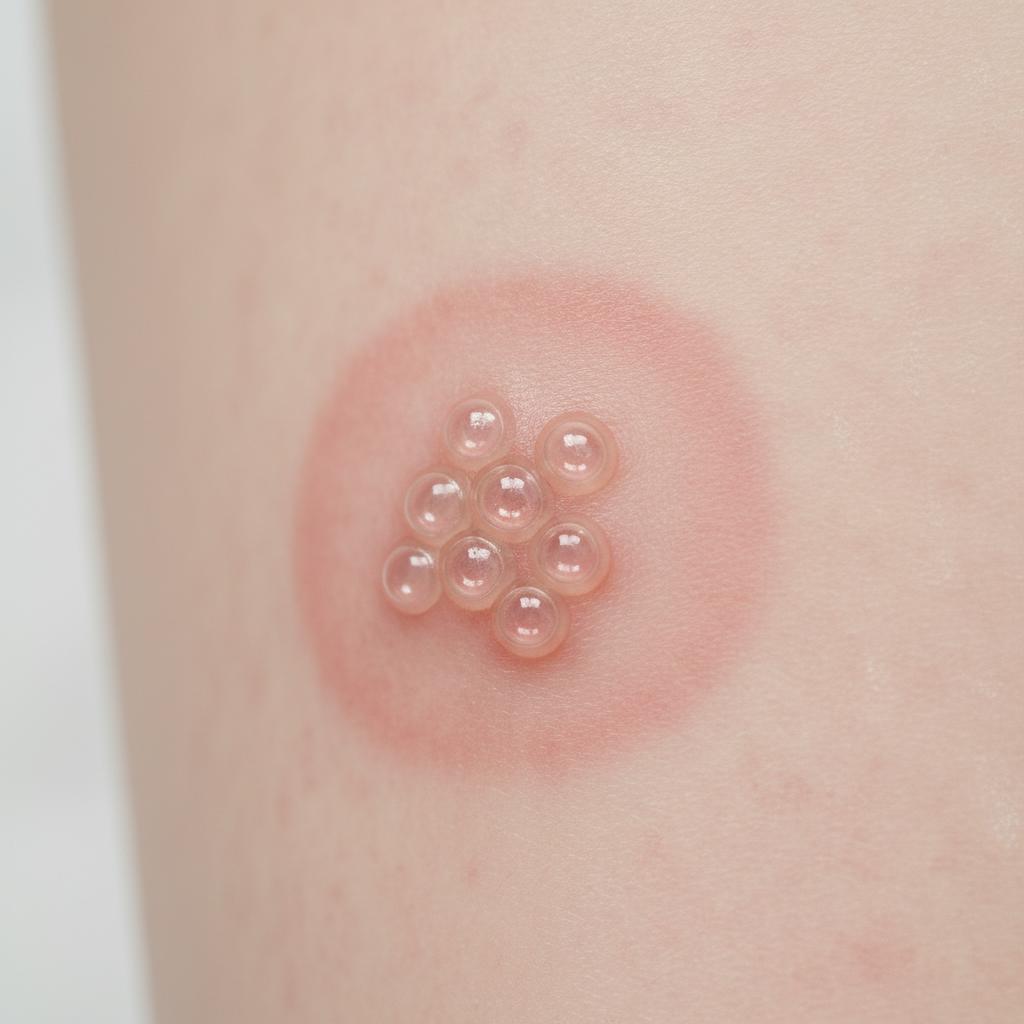
Textbook photos of herpes show angry clusters of fluid-filled blisters. Real-life genital HSV-1 is often subtler, especially after the first outbreak. The classic presentation is a tight group of small (2 to 4 mm), fluid-filled vesicles on the genital skin or surrounding mucosa. They tend to break open within a few days, leave shallow ulcers, then crust over and heal across one to three weeks.
Surrounding the lesions, you may notice tenderness, mild swelling, or a pink halo of inflammation. Many people describe a tingling or burning sensation a day or two before anything is visible, called the prodrome. Prodromal symptoms are an important early warning, both because antiviral medication started at that point can shorten the outbreak and because viral shedding is already underway.
First-episode genital HSV-1 can also bring flu-like symptoms: fever, swollen groin lymph nodes, body aches, and burning during urination. After that initial event, recurrences are typically milder for HSV-1 than for HSV-2. Some people only ever have one obvious outbreak. Others mistake their early lesions for ingrown hairs, pimples, friction blisters, or yeast irritation, and never connect the dots until they are tested for an unrelated reason.
Color and exact appearance vary with skin tone. On lighter skin, the inflamed halo reads as pink or red; on darker skin, the surrounding tissue may look hyperpigmented or violaceous.
Could it be something else? Look-alikes worth ruling out
Most genital bumps are not herpes. The genital area collects friction, sweat, hair, lubricant residue, body wash chemistry, and bacterial skin flora that can produce small lesions overnight. A panicked Google session usually finds a textbook photo, decides nothing matches, then leaves the reader more confused than before.
A few common look-alikes are worth understanding before assuming the worst. Razor burn and folliculitis show up across freshly shaved skin as diffuse small red bumps, often itchy or stinging, and clear within a few days. Ingrown hairs produce a single firm tender bump with a hair visible underneath the skin's surface. Folliculitis from sweat or tight clothing produces small pus-tipped bumps centered on hair follicles. Yeast irritation in the genital area produces diffuse redness, satellite small lesions, and itching, but rarely the clustered fluid-filled blisters that define herpes.
The point is not to self-diagnose from a comparison table. It is to know when a pattern is consistent enough with herpes to warrant a test, versus when it is consistent with something benign and self-limiting. If you have a single new firm bump that resolves in 48 hours with no recurrence, that is rarely herpes. If you have a clustered group of small fluid-filled vesicles in the same general area that ulcerated and crusted over a week or two, especially after a recent new sexual exposure, testing is the right next step.
Herpes vs Common Look-Alikes
| Condition | Typical sensation | Appearance | Duration |
|---|---|---|---|
| Genital herpes (HSV-1 or HSV-2) | Tingling or burning before, then sharp tenderness | Cluster of small fluid-filled vesicles, then shallow ulcers, then crusts | 7 to 21 days untreated |
| Razor burn / folliculitis | Itch or mild sting | Diffuse small red bumps across freshly shaved skin, some with visible hair follicle centers | 1 to 5 days |
| Ingrown hair | Tender firm bump | Single raised papule with a visible trapped hair | Days to a couple of weeks |
| Yeast (cutaneous candidiasis) | Itching and burning, often worse with moisture | Diffuse red patch with small satellite spots, no blistering | Days to weeks until treated |
Cluster patterns and fluid-filled vesicles distinguish herpes from most self-limiting skin irritations.
Yes, oral sex with a cold sore can transmit herpes to genitals
The single most useful fact in this article: a partner with an active or recently-active cold sore can transmit HSV-1 to your genitals during oral sex. The CDC explicitly identifies this route in its guidance on STI risk and oral sex.
What this looks like in practice: a partner has a small lip sore, or just felt the prodromal tingling that morning, or the sore healed two days ago and is no longer visible. They perform oral sex. Two to twelve days later, you develop a sore on your genitals. The exposure was real, the partner may not have known they were infectious, and the sore on you now is genital HSV-1. Clinically, that counts as genital herpes for diagnosis, treatment, and disclosure, even though the virus type is the one usually associated with childhood kissing.
Asymptomatic shedding makes the risk harder to predict. A meaningful fraction of HSV-1 carriers shed the virus from saliva or oral mucosa intermittently without any visible lesion. Condoms and dental dams reduce risk during oral sex but don't eliminate it for areas the barrier doesn't cover. The takeaway is not to abstain from oral sex; it is that an asymptomatic partner can still transmit, so a sudden sore after a new partner is worth investigating even when the partner says they have no symptoms.
If you've had recent oral contact with someone who had a cold sore and you're noticing a sore on your genitals, the immediate question is whether to swab now or wait for an antibody test. If the sore is fresh, see a clinic for a swab today; sensitivity drops sharply once crusting begins. If you missed that window, plan for an antibody test 12 to 16 weeks after the exposure date.
A partner whose lips look completely clear can still be shedding HSV-1 from the mouth without any visible sore. That is why a new genital sore after a recent oral-sex partner is worth investigating even when the partner reports no symptoms at all.
How soon after exposure do symptoms appear?
The herpes incubation period is unpredictable. For symptomatic first infections, signs usually surface within 2 to 12 days of exposure, though the range runs wider in practice. Many people never have a visible first outbreak at all, only learning they were infected when antibodies show up on a later blood test, sometimes years afterward.
That unpredictability matters for testing. A sore that appears 5 days after a hookup is consistent with a recent infection. A sore that appears 3 weeks later is also consistent with the same hookup; it does not mean the new partner you are with now is the source. The NHS notes that symptoms can take weeks or even years to appear in some people, and that recurrent outbreaks are shorter and milder than the first, usually preceded by a familiar prodrome.
| Exposure event | Earliest symptoms | When to test | Retesting recommendation |
|---|---|---|---|
| Oral sex with a partner who had a cold sore | 2 to 12 days after contact | Clinic swab if a sore is present and under 48 hours old; otherwise IgG antibody test 12 to 16 weeks after exposure | Retest at 12 to 16 weeks if the initial test was negative or taken too early |
| Genital-to-genital contact with no visible symptoms | Often no symptoms; sometimes mild irritation 2 to 21 days later | IgG antibody test 12 to 16 weeks after exposure | Retest at 6 months if symptoms develop and the first test was negative |
| Kissing or shared drink with a cold-sore carrier | 1 to 10 days for a possible first oral outbreak | Clinic swab if a sore is present and fresh; otherwise HSV-1 IgG test 12 weeks after exposure | Retest if recurrent oral outbreaks begin |
| Known partner positive (HSV-2) | Variable; many remain asymptomatic | HSV-2 IgG antibody test 12 to 16 weeks after exposure | Repeat at 6 months if first test was negative and exposure continues |
Testing for herpes: what works when
The right herpes test depends on whether you have a sore to sample right now or only a question about a past exposure.
If you currently have a sore, blister, or ulcer that you can show a clinician, a swab test of the lesion is the most informative option. The swab can confirm active herpes virus, identify whether it is HSV-1 or HSV-2, and document the body site. The CDC's STI Treatment Guidelines recommend nucleic acid amplification testing (NAAT) of the lesion as the most sensitive method. The window is short: ideally within 48 hours of the blister forming, before crusting begins. This is a clinic-administered test; stdrapidtestkits.com does not sell a home swab kit for active lesions.
If you do not currently have a lesion, or you want to know whether you have been exposed at all, a type-specific IgG (immunoglobulin G) blood antibody test is the appropriate tool. The blood test detects IgG antibodies your body builds in response to HSV-1 or HSV-2 over weeks. Most people develop detectable antibodies, or seroconvert, by 12 weeks after exposure, with a smaller fraction needing up to 16 weeks. Testing earlier than 3 to 4 weeks frequently misses recent infections, so timing matters.
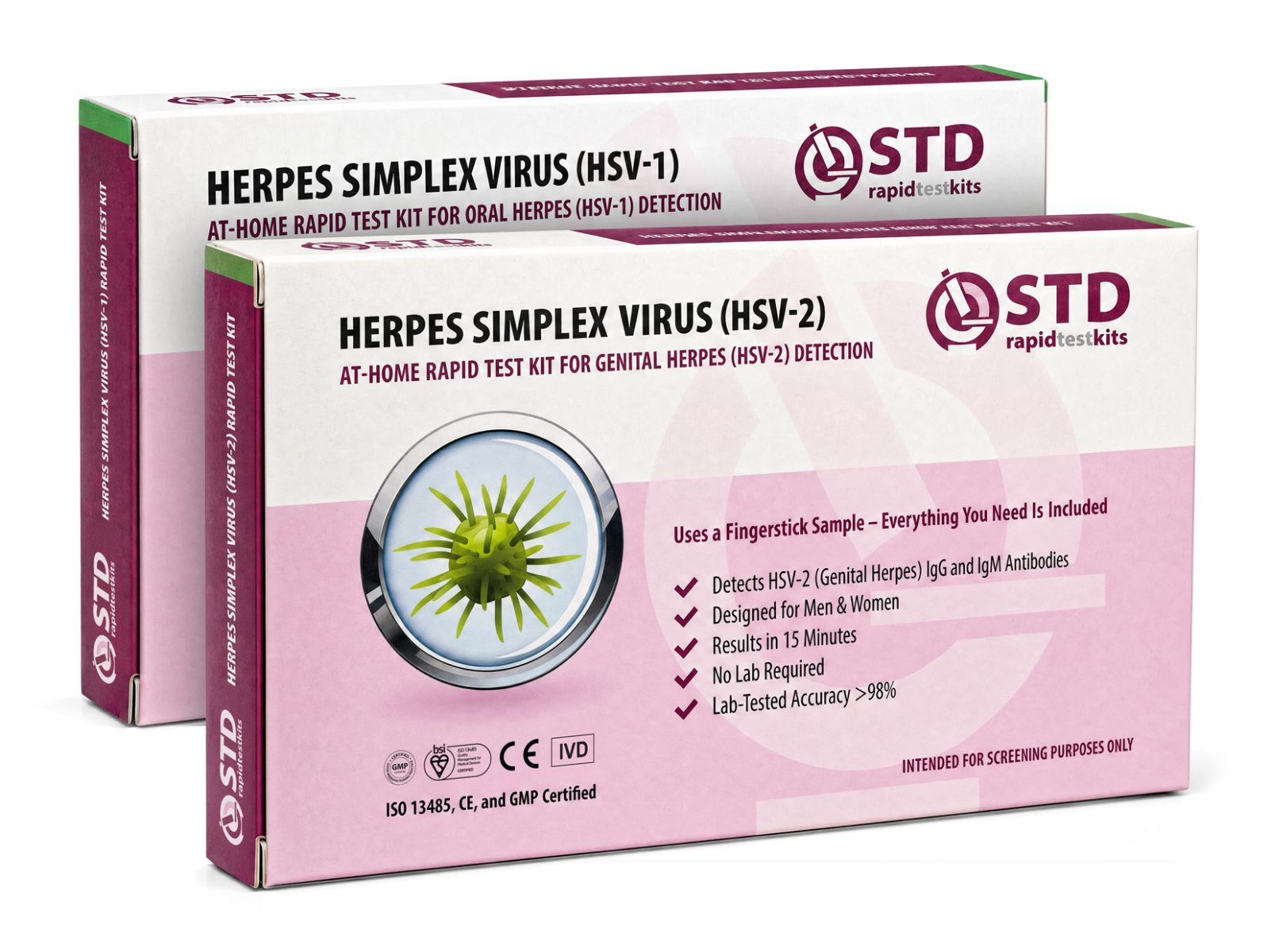
The at-home rapid herpes test is a fingerstick blood antibody test using lateral-flow chemistry, run privately at home with a result in about 15 minutes. It is a screening tool useful in the post-window period, not a substitute for swabbing an active lesion. A positive at-home result is worth confirming with a clinician's lab IgG test, especially before any partner conversation hinges on the answer.
One disclosure: stdrapidtestkits.com publishes this guide and sells the at-home rapid herpes blood tests described below. We recommend products based on fit-for-purpose for the reader's concern, not commercial benefit. For a fresh sore, a clinic swab is more accurate than any home test, and is what we'd suggest first.
Choosing between swab, lab IgG, and rapid home tests
Not every herpes test answers the same question. The right one depends on whether you have an active sore right now, how recently the exposure occurred, and what level of access or privacy you need around the test itself.
Clinic swab (PCR or viral culture) collects a sample directly from an active sore and detects viral DNA or growing virus. It is the most accurate single answer during a current outbreak and the only test that identifies both type and anatomic site. The catch is timing: past 5 days from blister formation, sensitivity drops sharply because viral shedding from the lesion is minimal.
Laboratory IgG blood antibody test detects HSV-1 and HSV-2 IgG antibodies in serum. It tells you whether you have ever been infected with HSV-1, HSV-2, or both. It does not tell you when you were infected or which body site is affected. The CDC does not recommend universal HSV antibody screening of asymptomatic adults, but supports targeted testing for people with possible exposure or recurrent symptoms suggestive of unrecognized herpes.
Rapid lateral-flow antibody test (at home) applies a fingerstick of blood to a test strip detecting HSV antibodies, with results in about 15 minutes. Lateral-flow chemistry is the same technology used in pregnancy tests and rapid COVID antigen tests. The window-period limits are the same as lab IgG. Per the CDC's STI Treatment Guidelines, type-specific HSV IgG methods reach sensitivity in the mid-to-high 90s once seroconversion is complete, with similar specificity, and low-positive HSV-2 IgG results should be interpreted carefully and confirmed when the result will drive a clinical decision.
Rapid lateral-flow tests detect the antibodies your immune system builds after infection; laboratory PCR or NAAT tests run on a fresh lesion detect viral DNA directly and carry higher analytical sensitivity during an active outbreak. The two methods are complementary rather than interchangeable, which is why a swab remains the standard of care for a current sore.
| Test type | How it works | Best used when | Limitations |
|---|---|---|---|
| Clinic swab (PCR or viral culture) | Collects a sample directly from an active sore; detects viral DNA or growing virus | During an outbreak, ideally within 48 hours of the blister forming | Sensitivity drops as the sore heals; not useful once crusting begins |
| Type-specific IgG blood test (lab) | Detects HSV-1 and HSV-2 IgG antibodies in serum | 12 to 16 weeks after a possible exposure, or for a person with recurrent symptoms but no swab-able sore | Cannot identify timing of infection or anatomic site; low-positive results may need confirmation |
| Rapid lateral-flow antibody test (home) | Fingerstick blood applied to a lateral-flow strip detecting HSV antibodies | Same window as lab IgG (12 to 16 weeks); when access or privacy makes a clinic visit difficult | Same window-period limits as lab IgG; positive results worth confirming with lab IgG; not equivalent to NAAT or PCR sensitivity |
Window periods and asymptomatic shedding
After exposure, HSV-1 typically takes 2 to 12 days to produce a first outbreak if it produces a visible one at all. Some people see lesions within a week of an oral-sex exposure; others stay symptom-free for months or years, or never notice an outbreak.
Even with no visible sore, the virus can be present and infectious on skin or mucous membranes for short stretches, a pattern clinicians call asymptomatic shedding. Studies that ask people to swab themselves daily have found HSV-2 present on a meaningful fraction of days in people with no visible symptoms, and HSV-1 sheds intermittently from oral mucosa in a sizable fraction of carriers. Shedding is generally more frequent for HSV-2 than for genital HSV-1, though both can transmit silently. This is why partners often blame each other when neither saw a sore at the moment of transmission.
"They had no visible sore" is not the same as "they could not have transmitted it." Shedding happens between outbreaks too, and MedlinePlus notes that herpes can spread even when sores are not present and that many people do not know they have it because they have no symptoms or only very mild ones.
If you take a home herpes blood test less than 3 to 4 weeks after a possible exposure, a negative result does not rule out infection. Antibodies need time to develop. For high-confidence screening, retest at the 12-week mark, and see a clinician for swab testing if a lesion appears in the meantime. A small number of people may need up to 16 weeks to fully seroconvert; if exposure was high-risk and the 12-week result is negative, a repeat at 16 weeks is worth discussing with a clinician.
1. Your first test was taken before 12 weeks post-exposure. Antibodies may not have developed yet. Retest at 12 to 16 weeks for a reliable result.
2. Your rapid result was a low-positive value close to the cutoff. Confirm with a laboratory IgG test before acting on it. False positives are most common at the assay's lower limit.
What the prevalence numbers actually say
The World Health Organization fact sheet estimates roughly 64 percent of people aged 0 to 49 worldwide carry HSV-1, and approximately 13 percent of people aged 15 to 49 carry HSV-2. In the United States, CDC surveillance data from the NHANES national survey place HSV-2 prevalence around 12 percent in adults aged 14 to 49 (about 1 in 8), with HSV-1 prevalence in that same age range roughly 48 percent and higher in older adults.
The reframe these numbers offer: more people you know carry one or both of these viruses than do not. The stigma is older than the data, and considerably stronger than the medical reality. A herpes diagnosis is a virus that found its way into your body the same way most viruses do, often through entirely ordinary contact.
High prevalence also means most exposures come from partners who do not know they are infected. Asymptomatic shedding combined with widespread under-diagnosis is why disclosure-based prevention can only go so far. At-home antibody tests have made screening accessible for people who are not ready to ask a primary-care doctor, or who do not have one.
Herpes by the numbers
- Globally, about 64% of people aged 0 to 49 carry HSV-1 (WHO).
- Globally, about 13% of people aged 15 to 49 carry HSV-2 (WHO).
- In the U.S., about 12% of adults aged 14 to 49 carry HSV-2 (around 1 in 8), and HSV-1 prevalence in the same group is around 48% (CDC NHANES data).
Suppressive therapy and living with genital HSV-1
For most people with genital HSV-1, the first outbreak is the worst one. After that, recurrences tend to be infrequent and milder. Some people never have a second visible flare. That milder recurrence pattern is one of the consistent differences between genital HSV-1 and HSV-2.
When recurrences are frequent enough to interfere with quality of life, or when reducing transmission risk to a partner is the priority, antiviral medication is the standard approach. Acyclovir, valacyclovir (Valtrex), and famciclovir all work by blocking viral replication. Two strategies are common: episodic therapy, taken at the first sign of an outbreak to shorten and soften it, and suppressive therapy, taken daily to reduce both outbreak frequency and viral shedding between outbreaks.
The evidence base on suppressive therapy is solid. Daily valacyclovir or acyclovir reduces recurrence frequency by roughly 70 to 80 percent in people with HSV-2, and reduces transmission to seronegative partners by about half in published randomized trial data on serodiscordant heterosexual couples (referenced in CDC clinical guidance). Whether suppression makes sense for you is a conversation with a clinician.
Episodic therapy: Take antivirals at the first sign of an outbreak (prodrome or new lesion) to shorten and soften that flare.
Daily suppressive therapy: Take a low dose continuously to reduce outbreak frequency and viral shedding between outbreaks. Best for frequent recurrences or when lowering transmission risk to a partner is a priority. A clinician can advise on which approach fits your situation.
Talking to a partner without panic
The disclosure conversation tends to be more terrifying in advance than in practice. Most partners, when given the facts calmly, respond with questions rather than rejection. The key is to have the answers ready, not to find perfect words.
A workable structure: name the fact, give context, leave room for questions. "Before we go further, there is something I want to share. I have HSV-1 genitally. It is the same virus that causes most cold sores. About 1 in 8 American adults has HSV-2, and about 64 percent of people under 50 globally carry HSV-1, often without knowing. There are a few things we can do to keep transmission risk low, and I am happy to walk through them." That gives the partner the medical fact, the social fact, and the path forward in a few short sentences.
The harder version of this conversation is the one where you do not know your own status yet. If you have had a recent exposure or a vague set of symptoms that never quite resolved, getting tested first gives you accurate information to share, which makes the conversation more useful for both of you. Partners who walk away over a herpes disclosure do exist, but they are far less common than the scripts in your head suggest.
Name the fact. "I want to tell you something before we go further. I have HSV-2." Swap the label to fit your result (HSV-1, oral herpes, cold sores).
Give context. "Roughly 1 in 8 American adults has HSV-2, and about two-thirds of adults globally carry HSV-1. I'm not having symptoms now. I take suppressive medication, or I avoid contact during outbreaks. The annual transmission risk with the precautions I take is low but not zero."
Leave room. "Take your time. Ask me anything you want, now or later."
Most people with genital herpes have no symptoms or have very mild symptoms. Mild symptoms may go unnoticed or be mistaken for other skin conditions like a pimple or ingrown hair.
Protection and prevention that holds up
Herpes prevention is layered. No single tool brings the risk to zero, but stacked together they bring it close.
Condoms and dental dams reduce transmission risk for genital herpes by a meaningful but partial amount. They do not cover all skin surfaces capable of shedding virus, which is why they are a partial rather than complete answer. Daily suppressive antiviral therapy substantially reduces transmission risk for serodiscordant couples per CDC treatment guidance, and helps regardless of barrier coverage gaps.
Avoiding sex during outbreaks and during prodromal symptoms (tingling, itching, sensitivity in the affected area) is one of the highest-impact moves. Most transmission events happen when one person is shedding virus and neither person knew. Sharing test results, exposure history, and current-outbreak status with a partner is what lets these medical tools actually work day to day.
| Strategy | Effect on transmission risk | Notes |
|---|---|---|
| Condoms and dental dams | Meaningful partial reduction | Does not cover all skin surfaces; best combined with other tools |
| Daily suppressive antivirals | About half reduction in serodiscordant couples (RCT data referenced in CDC guidelines) | Also reduces shedding between outbreaks; clinician-prescribed |
| Avoiding sex during outbreaks and prodrome | Very high reduction | Includes early tingling, burning, or sensitivity warnings |
| Honest disclosure and shared testing | Indirectly large | Lets two informed people make a plan together |
The emotional side people skip past
Managing the medical side of herpes is usually straightforward. The emotional part is where most people get stuck. The first 24 to 48 hours after a positive result tend to bring a flood of shame, fear about future relationships, and a sense that the body has changed in some permanent way. All of those reactions are normal. Most of them ease within weeks as facts replace fear.
About 64 percent of people under 50 worldwide carry HSV-1 antibodies, genital HSV-1 is increasingly common in younger adults, and most people with herpes do not know they have it. None of those numbers minimize what an individual feels after a diagnosis, but they do recontextualize it. Herpes is not a moral indicator; it is an extremely common viral infection that became socially weighted in ways other equally common infections did not.
Practical movement helps. If you are unsure of your status, an at-home blood test is the logical first step; for an active lesion, a clinic NAAT gives the fastest and most site-specific answer. Having a short list of facts on hand also makes the eventual partner conversation easier.
Should you test, and how?
Do you have an active sore right now, a blister or ulcer less than 48 hours old?
Yes: See a clinic for a NAAT swab today. Home kits cannot sample a lesion, and swab sensitivity falls once crusting begins.
Has a possible exposure happened, but the sore has healed or never appeared?
Yes: Take a type-specific IgG blood antibody test 12 to 16 weeks after the exposure date, when antibodies are reliably detectable.
No: If you already have a confirmed positive result, talk to a clinician about episodic or daily suppressive antiviral options.
Guidance only. A healthcare provider can advise based on your specific situation.
Frequently asked questions
- Can a cold sore really transmit genital herpes?
- Yes. Cold sores are HSV-1. During oral-genital contact, that same virus can establish a genital infection in a partner who has not already been exposed to HSV-1. The CDC explicitly lists oral sex as a recognized transmission route, and notes that HSV-1 now accounts for a growing proportion of new anogenital herpes cases, especially among young women and men who have sex with men.
- If I get cold sores, does that mean I have herpes?
- Yes. Cold sores are HSV-1 infection, and once you have it, antibodies stay for life. About 64 percent of people aged 0 to 49 worldwide carry HSV-1 per WHO modeling, most acquired in childhood through non-sexual contact. The label is medically correct; the social weight attached to it is the part that misleads.
- Does genital HSV-1 come back as often as HSV-2?
- Generally no. Genital HSV-1 typically produces a difficult first outbreak followed by infrequent or rare recurrences. HSV-2 reactivates more often, especially during the first year, per CDC treatment guidelines. People with genital HSV-1 often have one significant first-year outbreak and very little after, while genital HSV-2 tends to flare repeatedly.
- How soon after oral sex can symptoms appear?
- Usually within 2 to 12 days, with the first outbreak often hitting 4 to 7 days after exposure. Some people are asymptomatic for months or years before any visible sign appears, or never have a noticeable outbreak at all.
- My partner had no visible cold sore. Could they still have transmitted herpes?
- Yes. Herpes can transmit during asymptomatic shedding, when virus is present on skin or mucous membranes without a visible sore. This is why most transmission happens between people who thought they were both clear, and why knowing your status matters regardless of whether you have active outbreaks.
- What does a first genital herpes outbreak feel like?
- First outbreaks are often the most severe and can include painful clustered blisters, ulcers, fever, body aches, swollen groin lymph nodes, and painful urination. Some people have a much milder presentation, sometimes mistaken for a single razor bump or a yeast infection. Healing typically takes 2 to 4 weeks for a first outbreak; recurrences are usually shorter and milder.
- If I already have HSV-1 orally, can I get it again on my genitals?
- It is less likely but possible. Existing HSV-1 antibodies provide partial cross-protection against a second HSV-1 infection at a new site, which is why genital HSV-1 is somewhat less common in people who already have oral HSV-1. The protection is not absolute, and it does not protect against HSV-2 acquired genitally.
- Should I take a blood test or a swab test?
- If you have an active sore, a clinic swab test (NAAT) is the most informative option and identifies the type and body site. If you have no current lesion, a type-specific blood antibody test is the right tool, ideally 12 to 16 weeks after a possible exposure.
- My antibody test was negative but I still think I have herpes. What now?
- Timing matters. If you tested less than 12 weeks after the suspected exposure, antibodies may not have developed yet; retest at 12 to 16 weeks. If you have an active sore, switch strategies and get a clinic swab within 48 hours of the blister forming, since a swab tests for the virus directly rather than for antibodies.
- U.S. Centers for Disease Control and Prevention. About Genital Herpes. Patient-facing overview of HSV-1 and HSV-2 transmission, symptoms, and how mild symptoms can be mistaken for other skin conditions.
- U.S. Centers for Disease Control and Prevention. Sexually Transmitted Infections Treatment Guidelines, Genital HSV Infections. Source for clinical guidance on NAAT swab vs. type-specific antibody testing, type-specific serology performance and the caution on low-positive HSV-2 IgG results, suppressive antiviral therapy and its effect on transmission, and the increasing share of anogenital herpes infections attributed to HSV-1.
- U.S. Centers for Disease Control and Prevention. STI Risk and Oral Sex. Confirms oral-to-genital transmission of HSV-1 during oral sex as a recognized exposure route.
- World Health Organization. Herpes simplex virus fact sheet. Source for global HSV-1 and HSV-2 prevalence estimates (about 64 percent global HSV-1, about 13 percent global HSV-2) and transmission overview.
- U.K. National Health Service. Genital herpes overview. Patient-facing reference for incubation timing (symptoms can take weeks or years to appear) and the milder, shorter character of recurrent outbreaks.
- U.S. National Library of Medicine, MedlinePlus. Genital herpes. Patient-facing reference confirming that herpes can spread without visible sores and that many people have no or only mild symptoms.
