
Published: September 2025 | Last updated: May 2026 | Editorial review and quality control: Martina N.
You notice a small blister starting to form on your partner's lip. They wave it off. Just a cold sore, no big deal. Your stomach knots anyway, because you have read enough to know that cold sores are almost always herpes, and that the virus does not always announce itself before it spreads.
That tension between someone else's casual shrug and your own concern is what brings most readers to this article. You are not panicking. You are trying to figure out what a cold sore actually means for your relationship, your safety, and any future intimacy you are weighing right now. Nothing in this piece is meant to scare you. The point is to give you accurate information so the conversation with your partner is grounded in facts instead of half-remembered locker-room talk.
Is a cold sore a dealbreaker in a relationship?
The cold sore itself usually is not. Cold sores are almost always caused by oral herpes (HSV-1), a virus the World Health Organization estimates roughly 64% of people aged 0 to 49 worldwide carry. It can be passed by direct contact with a sore, by saliva, and even when no sore is visible, including from the mouth to a partner's genitals during oral sex. The dealbreaker question is rarely the virus. It is whether your partner will talk openly about outbreaks, take precautions during them, and respect your right to make informed decisions about intimacy.
Key Takeaways
- HSV-1 (oral herpes) is extremely common, lifelong, and can be transmitted through kissing, oral sex, and shared utensils, including during the tingling phase before any blister appears.
- How a partner responds to a calm, factual conversation about cold sores tells you more about the relationship than the cold sore itself does.
Why That Cold Sore Deserves a Real Conversation
A cold sore is rarely the actual problem in a relationship. The friction starts when one partner treats it as cosmetic and the other partner sees a public-health issue. That gap usually has nothing to do with the virus. It has to do with who has been told what about herpes, and how seriously each partner has been encouraged to take it.
You are allowed to want straightforward answers about something that affects your body. You are also allowed to want a partner who treats your concern as legitimate rather than as anxiety to be managed. Both of those things matter, and the rest of this article is built around helping you sort them out, with guidance pulled from the CDC, the World Health Organization, and the NHS.
This article is published by stdrapidtestkits.com, which sells at-home STI testing kits including HSV-1 and combined HSV antibody tests. We recommend products based on fit-for-purpose for the reader's concern, not commercial benefit. For an active sore right now, the right test is a clinic-administered swab/PCR, not a home antibody test, and we say so plainly below.
What a Cold Sore Actually Is
A cold sore is the visible flare of Herpes Simplex Virus type 1 (HSV-1), a lifelong virus that lives quietly in the nerves of the face after the first infection. The World Health Organization estimates that roughly 64% of people aged 0 to 49 worldwide carry HSV-1. Most of those people picked it up as children from a non-sexual kiss from a relative or friend.
When the virus reactivates, it follows a fairly predictable arc, summarized in the box below. Triggers that bring the virus out of dormancy include sun exposure, fever, stress, hormonal shifts, fatigue, and minor mouth injuries. Some people get one or two outbreaks a year. Others get them every few months. Some people who carry HSV-1 never get a visible sore in their life.
- Prodrome (12 to 24 hours): tingling, burning, or itching at the future blister site, before anything is visible.
- Blistering: one or more small fluid-filled blisters appear on or near the lip.
- Weeping and crusting: blisters break, weep, and form a yellowish crust.
- Healing (about day 7 to 10): the crust falls off and the skin underneath returns to normal.
How HSV-1 Travels Between People
HSV-1 spreads through direct contact with infectious saliva, the fluid inside an active blister, or skin around the mouth that is shedding the virus. The most common transmission moments are kissing, sharing drinks or utensils, and oral sex during a prodrome or active outbreak. Less commonly, it can be passed by sharing a lip balm, a toothbrush, or a razor that has touched the area within minutes of an outbreak.
The single most counterintuitive piece for many readers is asymptomatic shedding. The CDC's herpes resources describe how a person can shed HSV from the mouth or genital skin even when no sore is visible. Shedding is most likely in the year after the first infection, but it continues at lower frequencies for life. That is why a partner who has not had a visible cold sore in months can still pass HSV-1 by kissing or oral sex, although the absolute risk on any given encounter is small.
The Genital Herpes Question
For decades, the rule of thumb was that HSV-1 caused mouth sores and HSV-2 caused genital sores. That distinction has eroded. Among young adults in many high-income countries, HSV-1 is now a common cause of new genital herpes infections, primarily through oral sex with a partner who has cold sores or is shedding HSV-1 orally. The CDC notes this trend in its herpes guidance, and the NHS genital herpes page confirms that oral-to-genital transmission accounts for a growing share of first genital infections.
Genital HSV-1 tends to behave more mildly than genital HSV-2. Outbreaks are usually less frequent after the first one, and asymptomatic shedding rates are lower. The first genital outbreak can still be uncomfortable and emotionally jarring, especially if the person did not know oral herpes could end up on the genital skin. Oral sex during a cold sore outbreak or its prodrome is the high-risk window for genital transmission.
Many people who have genital herpes are not aware of their infection. The virus can be released from the skin even when no sores are present.
Why Some Partners Stay Quiet About a Cold Sore
Most people who avoid talking about HSV-1 are not lying. They are uninformed, embarrassed, or repeating what they have been told. The cultural script around cold sores has been "everyone gets them, they are nothing" for so long that many people genuinely do not know cold sores are a form of herpes that can be sexually transmitted. Other partners do know but are afraid the conversation itself will end the relationship, so they hope it never comes up.
The patterns below show up most often. The first two can usually be dissolved with a calm, factual conversation and a shared link to a reputable source. The last two are about how your partner handles being asked uncomfortable questions, which is a separate conversation worth having on its own merits.
- Misinformation: "Cold sores are different from herpes." (They are not.)
- Minimization: "Everyone has it, why bring it up?" (Not everyone has it, and not everyone wants it.)
- Avoidance: changing the subject when you mention precautions or testing.
- Ridicule: treating your concern as paranoia.
How to Bring It Up Without Starting a Fight
Defensiveness usually shows up when a partner feels accused. The conversation goes better when it sounds like you and your partner are figuring something out together rather than running an interrogation. A few openers that tend to land well:
- "I noticed your cold sore is back. I have been reading about HSV-1 and I want us to be on the same page about what we should and should not do during an outbreak. Can we talk through that?"
- "I am not freaked out, I just want to understand. Have you ever been tested specifically for HSV-1 antibodies, or do you only know about the cold sores?"
- "I want to be careful about oral sex while you are flaring. Can we agree on what feels safe for both of us until this one heals?"
Three things worth noticing in those phrasings: each one names the specific behavior at issue (oral sex during an outbreak), each one asks rather than demands, and each one signals that you plan to keep being intimate, just thoughtfully. A partner who responds with engagement is showing you what mature communication looks like.
Reducing Risk in a Relationship Where HSV-1 Is on the Table
There is no protocol that drops transmission risk to zero, but there is a meaningful difference between an unmanaged outbreak and a managed one. The evidence-based steps:
- Pause direct mouth-to-anything contact during the prodrome and active phase. That covers kissing, oral sex, sharing drinks, and sharing utensils until the sore has fully scabbed and the scab has dropped off naturally.
- Talk to a clinician about daily suppressive antiviral therapy. Medications like valacyclovir reduce both the frequency of outbreaks and the rate of asymptomatic shedding for the partner who carries the virus. The NHS guidance on genital herpes outlines antiviral treatment options, and the same logic applies to oral HSV-1 management.
- Use barriers during oral sex outside of outbreaks. External condoms or dental dams reduce contact with infectious skin if asymptomatic shedding is happening that day.
- Get tested together. A type-specific HSV antibody blood test tells each of you whether you already carry HSV-1 antibodies, which changes the risk picture significantly. If a partner tests positive for HSV-1 antibodies, future oral exposure is no longer the issue it would be for an antibody-negative partner.
- Make a plan in advance for what each of you will do at the first tingle of a future outbreak, so you are not negotiating in the moment.
The combined effect of these steps is real. A serodiscordant couple (one partner positive, one negative) following all of them reliably has substantially lower transmission rates than a couple following none of them.
When the Conversation Reveals a Bigger Problem
Sometimes the cold sore is the smaller issue in the room. If you have asked thoughtful questions and your partner is treating you as the problem, that pattern usually shows up in other parts of the relationship as well. The warning signs are listed in the box below.
Boundaries are not ultimatums. A boundary is a statement about what you will and will not do, regardless of what your partner chooses. Sample wording:
- "I am not comfortable with oral sex when one of us is flaring. I would rather wait."
- "I would like both of us to get type-specific HSV testing before we move forward sexually. Are you open to that?"
- "Until we can talk about this without one of us getting upset, I am going to slow down physically."
A partner who responds to those boundaries with respect, even reluctantly, is someone you can keep having the conversation with.
- They mock the question or act offended that you asked.
- They guilt-trip you for wanting to use a barrier.
- They tell you what you should and should not feel.
- They refuse to consider testing or to read a single source you send them.
What HSV Testing Can (and Cannot) Tell You
Two types of test get used for HSV-1, and they answer different questions. The comparison table below shows when each one is the right tool.
A nucleic acid amplification test (PCR) or viral culture done at a clinic during an active sore confirms whether that specific lesion is HSV-1, HSV-2, or something else. A clinician evaluating an active sore typically uses PCR or viral culture; type-specific serology is reserved for situations where no sore is present. PCR is the more sensitive of the two and is widely preferred when the lab offers it.
A type-specific HSV antibody blood test (sometimes called type-specific serology) looks for IgG antibodies against HSV-1 and HSV-2 in the bloodstream. This is the right test when there is no active sore but you want to know whether you have ever been infected. The catch is the antibody window: most commercial type-specific HSV IgG assays state on their package inserts that antibodies typically develop within roughly 12 weeks of a first infection, with some cases taking longer. A negative blood test in week three after a possible exposure does not rule out infection.
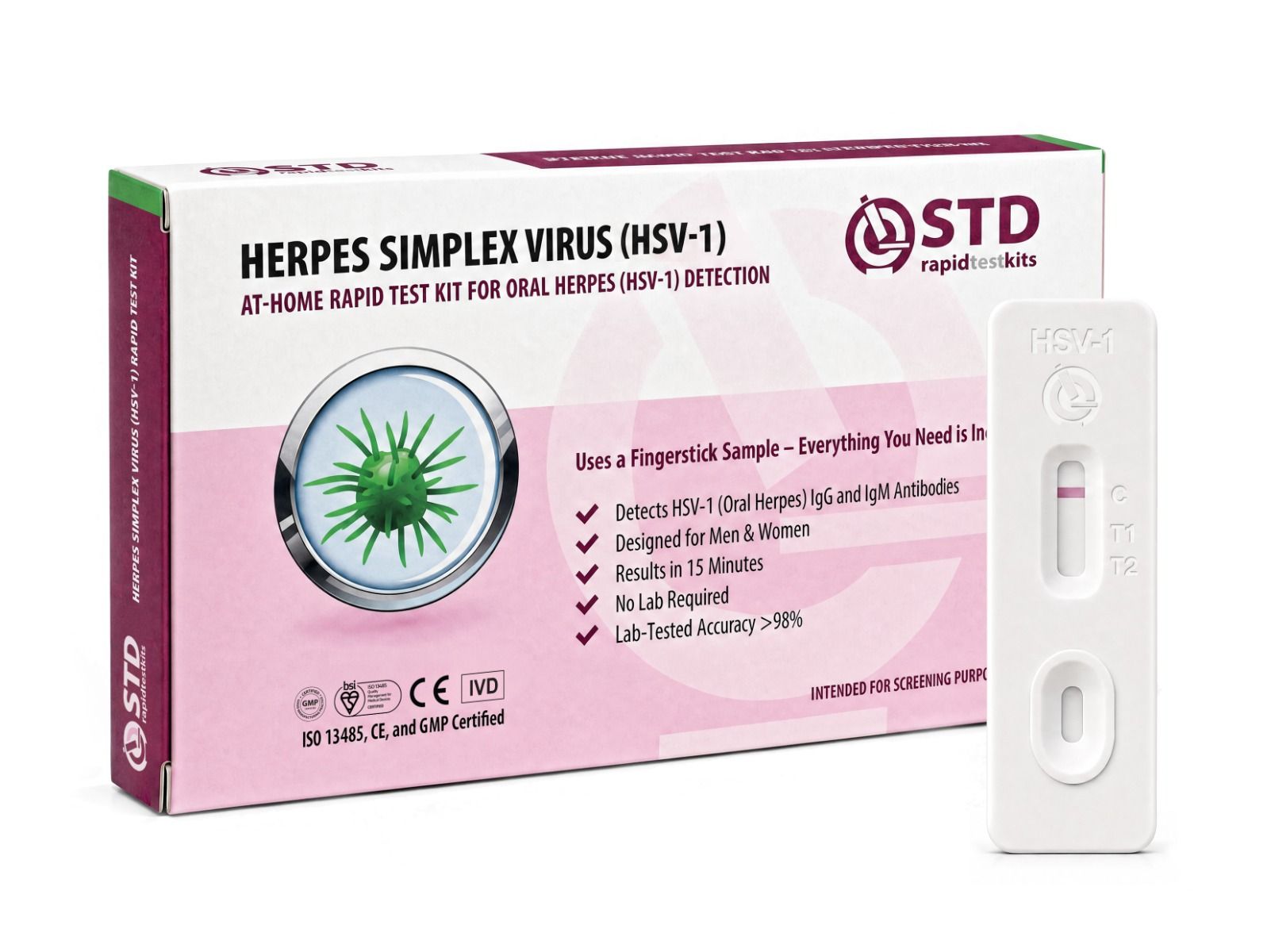
At-home rapid HSV antibody tests use the same lateral-flow chemistry as rapid blood tests run in clinics, drawing a small fingerstick sample. They are useful as a private, no-clinic-visit way to check antibody status outside of the window period. They are not the right tool for a sore you are looking at right now, which calls for a clinic swab.
If the cold sore in front of you is your partner's, not yours, the most useful thing a home test can do is confirm whether you have already been exposed (and therefore have some baseline immunity to HSV-1) or are antibody-negative and weighing your future risk.
| What you have | Best test | Where it is run | What it tells you |
|---|---|---|---|
| Active sore right now | PCR (NAAT) or viral culture from a swab of the lesion | Clinic | Whether this specific sore is HSV-1, HSV-2, or something else |
| No sore, want to know your status | Type-specific HSV IgG antibody blood test | Clinic or at-home rapid (fingerstick) | Whether you have ever been infected with HSV-1 or HSV-2 (interpret after the roughly 12-week antibody window) |
| Recent possible exposure | Type-specific HSV IgG, repeated past the window | Clinic or at-home rapid (fingerstick) | A negative result before about 12 weeks does not rule out infection; retest after the window |

FAQs
- Is a cold sore the same as herpes?
- Yes. Cold sores are caused by Herpes Simplex Virus type 1 (HSV-1) in nearly all cases. The two terms describe the same virus.
- Can my partner give me genital herpes through oral sex if they have a cold sore?
- Yes. HSV-1 from an oral cold sore can establish a genital infection through oral-to-genital contact during the prodrome or an active outbreak. Avoiding oral sex from the first tingle through full healing substantially reduces that risk.
- Can HSV-1 spread when there is no visible sore?
- Yes. Asymptomatic shedding allows the virus to pass through saliva or the skin around the mouth even when no blister is visible. Shedding is more frequent in the first year after infection and decreases over time, though it does not stop completely.
- Should I get tested for HSV-1 if my partner gets cold sores?
- A type-specific HSV antibody blood test will tell you whether you already carry HSV-1 antibodies. If you do, future oral contact does not change your status. If you do not, the result helps you and your partner plan precautions. Standard HSV IgG assay labels indicate that antibodies typically develop within roughly 12 weeks of a first infection, with some cases taking longer, so test timing matters after a recent exposure.
- Will daily antiviral medication really reduce transmission?
- Yes. Daily suppressive valacyclovir lowers outbreak frequency and asymptomatic shedding substantially; some transmission risk persists. A clinician can advise on whether daily therapy is appropriate.
- How long after a cold sore appears is it safe to kiss again?
- Wait until the sore has fully scabbed and the scab has fallen off naturally, leaving healed skin underneath. That is typically 7 to 10 days from the first tingle. Even after healing, asymptomatic shedding continues at a low background rate.
- My partner has cold sores but I tested negative for HSV-1 antibodies. What now?
- You and your partner can take precautions during outbreaks (no kissing, no oral sex from prodrome to fully healed scab), discuss daily antiviral therapy with a clinician, and use barriers during oral sex at other times. Many couples in this situation continue normal intimacy with planning.
- Can I trust an at-home HSV antibody test?
- Rapid at-home HSV antibody tests use lateral-flow chemistry similar to clinic-run rapid tests. They screen for HSV antibodies in a fingerstick blood sample and are reliable as a private starting point, provided enough time has passed since exposure for IgG to develop. A positive result is worth confirming with a clinician, who can also order a confirmatory type-specific antibody assay or a PCR if a sore is active.
- U.S. Centers for Disease Control and Prevention. Herpes basic information, including transmission, asymptomatic shedding, and the rising share of new genital infections caused by HSV-1.
- World Health Organization. Herpes simplex virus fact sheet, including the global prevalence estimate of roughly 64% for HSV-1 in people aged 0 to 49.
- UK National Health Service. Cold sores: causes, stages of an outbreak, and self-care during the contagious phase.
- UK National Health Service. Genital herpes: oral-to-genital transmission, antiviral treatment options, and self-care guidance during outbreaks.
- NIH MedlinePlus. Cold sores: general information about the condition, treatment options, and basic self-care guidance for visible outbreaks.
