
Published: October 2025 | Last updated: May 2026 | Editorial review and quality control: Martina N.
The night before a third date, a cold sore appears. The conversation in your head goes from "what should I wear" to "do I tell him, and how?" That spiral is one of the most common reasons people put off the herpes-disclosure talk altogether: the shame, the silence, the not-knowing-where-to-start.
Most readers landing here already know they carry HSV-1 and just need a practical script. Others are still working out whether their cold sores even count as "herpes" worth mentioning to a partner. Both are reasonable places to start. This guide walks through when disclosure is genuinely required, what calm and honest scripts sound like, how to handle a bad reaction without taking it personally, and how to keep your dating life from being defined by a virus that more than half the planet already carries.
Key Takeaways
- Disclose before any kissing, oral sex, or close skin-to-skin contact that could pass the virus, and always when an outbreak is visible or just finished. Casual texting and early flirting do not require disclosure.
- HSV-1 is one of the most common viral infections in adults worldwide. A calm, factual script reduces stigma far more than apologies or detailed medical history.
Is HSV-1 Really That Big a Deal?
HSV-1, the virus behind most cold sores, is one of the most common viral infections in the world. The World Health Organization estimates that roughly 3.8 billion people under age 50 carry HSV-1, about 64 percent of that age group globally.
Despite that prevalence, the stigma around oral herpes remains heavy. Part of the problem is that people confuse HSV-1 with HSV-2, the type more commonly associated with genital herpes. The other part is that anything sexually adjacent still gets treated like a moral failing rather than a virus.
HSV-1 is most often acquired in childhood through a kiss from a relative or caregiver, sharing a cup, or other casual contact. It can also be transmitted sexually, especially through oral sex, which has shifted some genital herpes cases from HSV-2 to HSV-1 over the past two decades. Both routes are common, and the route someone caught it through tells you nothing about their choices or their character.
Here is a quick snapshot to clear up the most stubborn misconceptions before any disclosure conversation.
| HSV-1 Fact | Reality Check |
|---|---|
| Is HSV-1 an STD? | Sometimes. It is a sexually transmissible infection when passed during oral sex, but it is most often caught non-sexually in childhood. The route, not the virus, decides the label. |
| Can you have HSV-1 without symptoms? | Yes. Many people who carry the virus never have a visible cold sore but can still shed the virus and pass it on, particularly around the lips and mouth. |
| Is it curable? | No, but it is highly manageable. Antivirals shorten outbreaks and reduce shedding. Avoiding contact during a visible sore protects partners. |
| How serious is it medically? | For most healthy adults, HSV-1 is a periodic skin nuisance, not a dangerous infection. The emotional load can be heavier than the medical one. |
When Disclosure Becomes the Right Call
The 2 a.m. version of this question reads "do I really have to tell someone I get cold sores?" The honest answer is that it depends on what stage of the relationship you are in and what is about to happen physically. Disclosure is not a confession that has to be filed before the second date. It is a conversation that needs to happen before kissing or oral intimacy.
Timing matters. Telling someone too early can feel like over-sharing in a way that draws more attention to the virus than it deserves. Telling someone too late, after the kiss or hookup, removes their ability to make an informed choice and is the version that most people regret.
Here is a stage-based breakdown to take the pressure off picking the perfect moment.
| Stage of Connection | Disclosure Needed? | Best Approach |
|---|---|---|
| Texting or early flirting | No | Premature. Save it for when physical intimacy is genuinely on the table. |
| First kiss or oral intimacy approaching | Yes | Bring it up before any contact. A short factual heads-up is enough. |
| Established relationship without prior disclosure | Yes, as soon as possible | Pick a calm moment, not during sex. Frame it with facts and care. |
| Active or recent outbreak | Always | Reschedule kissing and oral contact, or share an honest reason. Respect builds trust. |
Scripts That Work, Scripts That Don't
Words matter, but tone matters more. The aim is honesty without panic and clarity without apology. You are not revealing a flaw. You are giving a partner the information they need to make their own informed choice. This is closer to mentioning a food allergy than confessing a secret.
Several phrasings tend to land well across the disclosure conversations described in patient education resources from Planned Parenthood and similar nonprofits. The pattern is short, factual, and unapologetic:
"Before things move forward, I want to be upfront about something. I carry HSV-1, the virus that causes cold sores. Most people do, but it felt fair to mention. It does not change how I show up. I am happy to answer questions."
"Heads up that I sometimes get cold sores from HSV-1. I avoid kissing and oral contact when one is active. I just wanted to say so before we go further."
"Real talk: I have oral herpes. It is really common, I manage it carefully, and I value being honest about it."
What to skip: dumping a full medical history out of guilt, sending a long disclosure text at 3 a.m., or framing the news as a life sentence. If you sound ashamed or broken, your partner will mirror that fear. A calm, plain delivery signals that this is information rather than a crisis.

When the Reaction Hurts
Sometimes the person you are telling reacts well. Sometimes they freak out. Their first reaction is not always a reflection of their deeper values; it can be confusion, surprise, or a half-remembered scary story about herpes from the early 1990s. Letting a strong first reaction settle is part of the process.
If a partner needs a few days to read up and come back to the conversation, that is normal. Many people do not know basic facts about HSV-1 prevalence, asymptomatic shedding, or the difference between HSV-1 and HSV-2. Pointing them toward a couple of solid resources, like the CDC genital herpes overview or the WHO fact sheet, lets the science do some of the explaining for you.
If the reaction is cruel, dismissive, or accompanied by ghosting, that is information about the relationship, not about you.
If a partner asks for time to process, hand them a CDC or WHO link rather than trying to be the textbook yourself. Authoritative sources answer the clinical questions; you stay free to handle the relationship questions.
When You Might Need to Re-Disclose
Sometimes the talk needs to happen more than once. Maybe you mentioned it casually months ago and your partner did not really absorb it. Maybe you told them sober, but the first visible outbreak still surprised them. Maybe a fizzled connection has just rekindled and you want to bring it up again, this time with more clarity.
If a partner seems to have forgotten or minimized the original conversation, it is fine to bring it up again clearly:
"I know we touched on this before, but I want to make sure we are on the same page. I carry HSV-1. When I have a visible cold sore, I avoid kissing and oral contact. I just want us both protected."
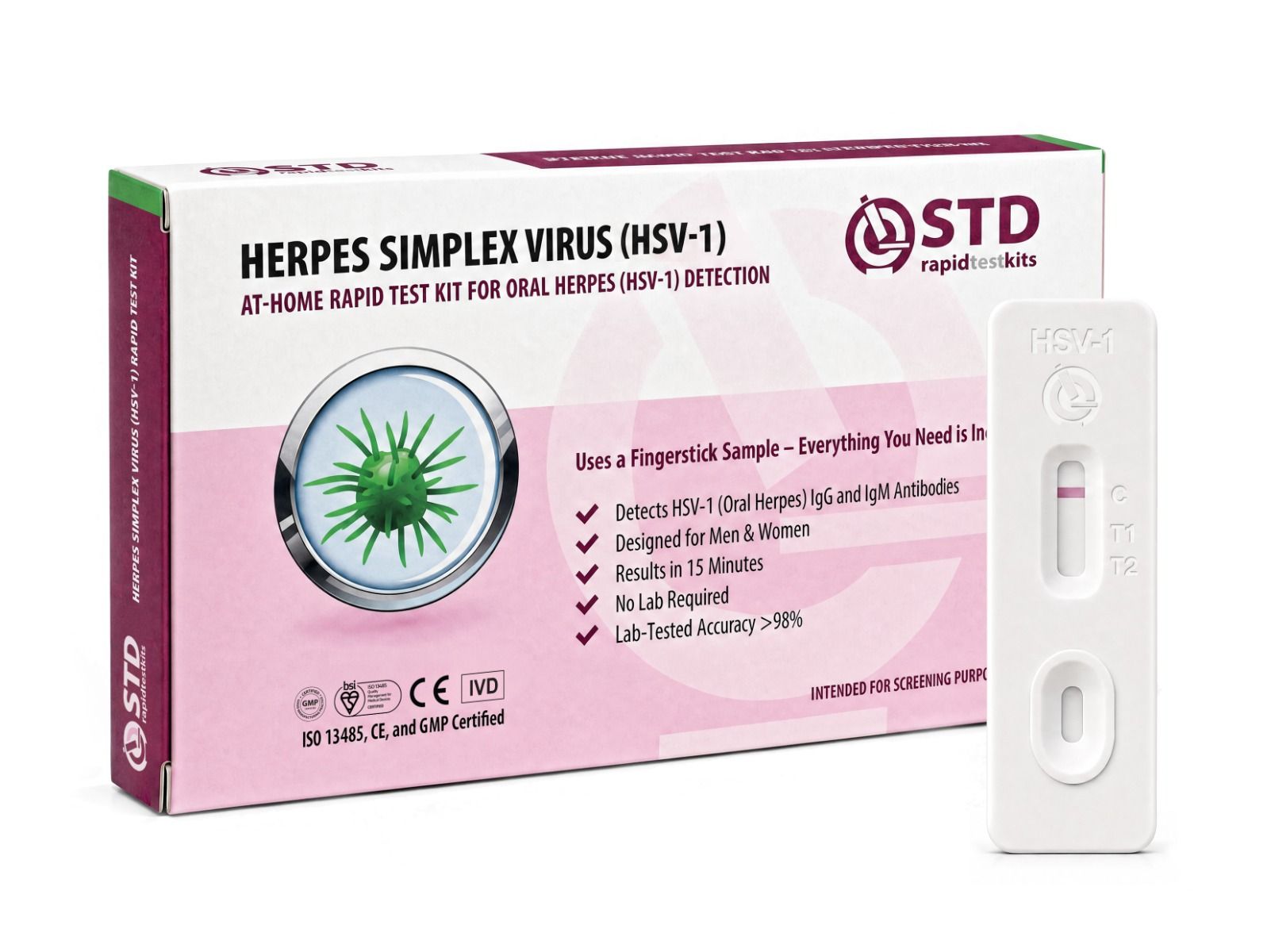
That is not over-explaining. It is taking ownership of a shared health detail in the relationship, the same way you might re-confirm a partner's allergy or birth-control plan as things change. If you are unsure whether you carry HSV-1, HSV-2, or both, a fingerstick blood antibody test can clarify your status before the next conversation.
How Much Risk Is Really on the Table?
The piece that often offers the most reassurance, both to you and to the person you are disclosing to, is concrete numbers. People with HSV-1 are not contagious all the time. Transmission risk is highest during a visible outbreak and in the few days before and after it appears, when the virus is shedding more actively. Between outbreaks, asymptomatic shedding still happens but at much lower rates.
According to the CDC's STI treatment guidance for genital herpes, daily suppressive antivirals can substantially reduce both the frequency of outbreaks and the rate of viral shedding. Avoiding kissing and oral contact during prodrome symptoms (the tingling or burning that comes before a sore) further lowers risk.
The table below is a rough heuristic for thinking about transmission risk by scenario. It is not a clinical guarantee; individual situations vary, and antiviral effectiveness depends on consistent use.
| Scenario | Approximate Risk of HSV-1 Transmission |
|---|---|
| Kissing during a visible cold sore | High |
| Oral sex during an active outbreak | High |
| Oral or kissing contact between outbreaks, no antivirals | Lower but not zero (asymptomatic shedding) |
| Oral or kissing contact between outbreaks, with daily suppressive antivirals | Low |
| No contact, no symptoms | Negligible |
Can You Still Be Intimate? Yes
If you are wondering whether HSV-1 means a smaller dating life, the answer is no. Awareness is the trade, not abstinence. People with HSV-1 have full, satisfying intimate lives. The trade is a short list of habits, not a permanent withdrawal from physical connection.
Most couples settle into something like an outbreak protocol: skip kissing and oral contact during visible sores, pay extra attention to hand-washing around a healing lesion, consider a few days of antivirals during high-stress windows when outbreaks are more likely, and use barriers during oral sex if both partners want extra reassurance. Some people track their personal triggers (sun exposure, illness, sleep deprivation, hormonal shifts) and adjust accordingly.
What matters most is the mutual understanding the disclosure conversation establishes. A partner who values honesty over the illusion of perfection is exactly the kind of partner you can build something real with. A relationship strong enough to absorb a cold sore conversation is already standing on something solid.

When Shame Doesn't Just Fade
Knowing the facts does not always switch off the shame. You can know that HSV-1 is common, manageable, and not your fault, and still feel a wave of disgust when a blister appears. That gap between what you know and what you feel is human. Some people describe it as a kind of grief, mourning a version of themselves they imagined would be untouched by something like this.
A reframe that tends to help: most adults are quietly carrying something they do not lead with. A scar, a fear, a chronic condition, a complicated history. Yours just happens to flare visibly a few days a year, and that visibility is the only thing that makes it feel different.
Many people find that recurrence frequency drops as the years pass and the immune system adapts. The first year after a clear diagnosis is usually the hardest, both medically and emotionally. Later years tend to involve fewer flares and far less mental real estate.
Why Disclosure Can Bring You Closer
It sounds counterintuitive that telling someone about a virus could deepen a relationship rather than damage it. The pattern shows up consistently across patient education resources and disclosure-focused research at organizations like Planned Parenthood and the American Sexual Health Association: many people report that the conversation became one of the most trust-building moments of their relationship.
The reason is not the virus itself. It is what the disclosure models. Bringing up a sensitive health topic with calm, clarity, and self-awareness shows a partner that you are capable of being vulnerable without falling apart. It often gives them implicit permission to share something real of their own. That kind of mutual exchange is what attachment actually looks like.
Most people with genital herpes do not know they have it. There is no cure for genital herpes, but there are medicines that can prevent or shorten outbreaks.
Disclosure Beyond Dating
Romantic partners are not the only people who occasionally need to hear about HSV-1. A roommate may notice a sore on your lip and wonder. A parent may remember being the source of your first cold sore decades ago, transferred during an ordinary toddler kiss. A dentist may need to delay a routine cleaning until a flare has healed.
Practicing the same calm, factual delivery in low-stakes contexts makes the high-stakes versions easier. It also chips away at the broader stigma. Each time someone hears HSV-1 described as "incredibly common, mostly unbothersome, not the same as HSV-2" rather than whispered about or apologized for, that small re-education travels with them.
You Don't Have to Do This Alone
If the idea of disclosure still feels overwhelming, practice with someone safe first. A trusted friend, a therapist, or even your own reflection in the mirror counts. Some people script it word for word. Others record a voice memo and play it back to test the tone. There is no single correct version, only one that is honest and sounds like you.
Sharing the responsibility helps too. Pointing your partner to the CDC, NHS, WHO, or a clinic-vetted patient resource lets the science answer the technical questions while you focus on the human ones. If they take the information and walk away, that is data about who they are. If they read up and come back ready to talk, you have just learned something important about who they are too.
Being honest about HSV-1 is not about being perfect. It is about giving partners the same respect you would want extended to you. Cold sores show up on skin a few days a year. Courage shows up in the conversation, every time you have it.
Try saying the script aloud to a trusted friend or into a voice memo before you have to use it for real. Tone lands better when it has been rehearsed once in a low-stakes setting, and you will hear the spots where the words feel too apologetic or too clinical.
FAQs
- Do I really need to disclose HSV-1 if I only get cold sores once a year?
- Yes, before kissing or oral contact, even if you do not have a visible sore at the moment. Asymptomatic shedding is real, and the disclosure gives a partner the information they need to make their own informed choice. Outside of intimate contact, there is no broader rule that requires telling everyone.
- Is HSV-1 considered an STD?
- It can be, depending on how it was transmitted. HSV-1 caught from a relative's kiss in childhood is not usually labeled as an STD; HSV-1 caught during oral sex is. Same virus, different routes. The clinical advice for managing it is the same in either case.
- What if I have antibodies for HSV-1 but have never had a visible cold sore?
- That is common. Many people are exposed in childhood and never develop a noticeable outbreak. The virus can still shed asymptomatically, so the disclosure conversation is still relevant before any oral or kissing contact. A clinician can help interpret a positive antibody result in context.
- How do I bring it up without it sounding like a big deal?
- Match the tone you would use to mention a food allergy. Direct, factual, brief, and unapologetic. Something like: "Heads up that I carry HSV-1. It is the virus that causes cold sores, very common, and I avoid contact when one is visible." Then move on rather than spiraling into more detail than the moment needs.
- What if a partner reacts badly or ghosts after disclosure?
- It happens, and it is rarely about you specifically. Some people react from outdated information rather than considered values, and many of them come back days later after reading more. If a partner reacts with cruelty or simply disappears, that reflects emotional readiness, not your worth. Painful in the moment, useful information long term.
- Can I still be sexually active and have a healthy relationship with HSV-1?
- Yes. The practical protocol is short: avoid kissing and oral contact during visible outbreaks, consider daily antivirals if flares are frequent, and use barriers for oral sex if both partners want extra reassurance. That is the full list, and none of it prevents a normal intimate life.
- Should I mention HSV-1 in my dating-app profile?
- Personal preference. Some people prefer to filter out partners who would react badly by mentioning it in their bio, while others find it more comfortable to disclose later in the conversation, before plans turn physical. Either approach is reasonable. The only version that does not work is hiding it past the point where intimacy is on the table.
- Can I get tested for HSV-1 at home?
- Yes. A fingerstick blood antibody test can detect HSV-1 antibodies, and these are available as discreet at-home rapid kits. Antibody tests are most reliable 12 or more weeks after a possible exposure. For an active visible sore, an in-clinic swab is more accurate than an antibody test, since it confirms current viral activity rather than past exposure.
How We Sourced This Article: We combined current guidance from leading public health organizations (CDC, WHO, NHS) with patient education resources from Mayo Clinic and Planned Parenthood. The disclosure scripts and emotional pacing draw on documented patterns reported across reputable patient communities and clinic education materials, not personal clinical advice.
- U.S. Centers for Disease Control and Prevention. About Genital Herpes overview, including HSV-1 and HSV-2 transmission, asymptomatic shedding, and antiviral therapy.
- U.S. Centers for Disease Control and Prevention. Sexually transmitted infections treatment guidelines for genital herpes (clinician guidance on suppressive antivirals and shedding reduction).
- World Health Organization. Herpes Simplex Virus fact sheet with global HSV-1 prevalence estimates (3.8 billion people under age 50, approximately 64 percent of the age group).
- U.K. National Health Service. Genital herpes patient overview covering symptoms, antiviral treatment, and partner protection.
- Mayo Clinic. Cold sore symptoms, causes, and treatment patient resource with HSV-1 specific guidance.
- Planned Parenthood. Herpes patient education page with disclosure framing and risk reduction guidance.
