Published: December 2025 | Last updated: May 2026 | Editorial review and quality control: Martina N.
Yes. Cold sores carry HSV-1, which can transmit to the genitals during oral sex, especially when a sore is visible or in the prodrome (tingling) phase. For an active sore, get a clinic PCR swab; for a past exposure with no current sore, take a blood antibody test 12 or more weeks later.
You were told oral was the safer option. Then a partner with a fading cold sore went down on you, and now there's a tingle, or a bump, or a quiet panic two weeks later that won't let you sleep. Or you are on the other side of the same encounter: you had a cold sore that was almost gone, you didn't think it counted, and now a partner has new genital symptoms. The short version, for either of you: yes, this is a real way to get and to pass genital herpes, and it happens often enough that public-health agencies have updated their guidance to reflect it. The longer version, including what symptoms can look like, when an at-home test can confirm anything, and how to make decisions from here, takes about ten minutes to read. We'll keep it factual and skip the doom.
Key takeaways
- HSV-1 from oral cold sores can infect the genitals through oral sex; an increasing share of new anogenital herpes infections is now attributed to HSV-1, especially among young women and men who have sex with men.
- An active lesion is best confirmed by a clinic PCR swab; an at-home blood antibody test confirms HSV-1 exposure but only after roughly 12 weeks of seroconversion (up to 16 for borderline cases).
How cold sores transmit to genitals
The mechanism is unglamorous and well-documented. HSV-1 lives in the trigeminal nerve ganglion (a nerve cluster near the base of the skull) and periodically travels back to the lips and surrounding skin to shed virus. When it sheds, it lands on saliva, on the lip surface, and on the immediately surrounding tissue. During oral sex, that virus comes into direct contact with the receiving partner's genital mucosa: vulva, vagina, penis, scrotum, anus, or perineum. The warm, slightly abraded mucosal tissue is an easy entry point for a virus that has evolved specifically to infect mucous membranes (WHO herpes simplex virus fact sheet).
Transmission risk peaks when a cold sore is visible or in the prodrome phase, the day or two of tingling and tightness before a blister appears, but it is not zero between outbreaks. HSV-1 sheds asymptomatically from the mouth on a meaningful percentage of days even in people who feel completely fine, with shedding most common in the first year after a primary infection and tapering over time. Condoms and dental dams reduce contact but do not eliminate it, since the virus can be on lip skin not covered by a barrier.
Once HSV-1 successfully infects genital tissue, it establishes itself in the sacral nerve ganglia, the cluster of nerves at the base of the spine, and the new infection behaves more or less like classical genital herpes. The CDC notes that some cases of genital herpes are due to HSV-1 spreading from the mouth to the genitals through oral sex (CDC: About Genital Herpes). The timing of a first outbreak varies widely between people: some develop noticeable symptoms within days of exposure, while others have no symptoms for weeks, months, or even years (NHS genital herpes).
The WHO estimates roughly 3.8 billion people under age 50 worldwide carry HSV-1, most acquired in childhood through non-sexual contact (<a href="https://www.who.int/news-room/fact-sheets/detail/herpes-simplex-virus" target="_blank" rel="noopener noreferrer">WHO Herpes Simplex Virus Fact Sheet</a>). At the same time, modern dating culture front-loads oral sex earlier in encounters and earlier in life, often before partners have established trust or shared status. Fewer people now acquire HSV-1 in childhood from family contact, leaving a larger adult population with no protective antibodies and a virus they meet for the first time during a sexual encounter. The result is the demographic shift you keep hearing about: a growing share of new anogenital herpes infections is now attributed to HSV-1, especially in young women and men who have sex with men (<a href="https://www.cdc.gov/std/treatment-guidelines/herpes.htm" target="_blank" rel="noopener noreferrer">CDC STI Treatment Guidelines</a>).
HSV-1 vs HSV-2: why location matters more than the strain
HSV-1 and HSV-2 are siblings, not strangers. They share a substantial portion of their genome and produce identical-looking sores. The classical split, HSV-1 is oral and HSV-2 is genital, was always a generalization, and that generalization has weakened steadily over the last twenty years. What still holds is that each strain prefers its original neighborhood: HSV-1 establishes itself most easily in oral tissue, HSV-2 in genital tissue, and once each is in its preferred location, it sheds and recurs more aggressively.
That preference shows up in the numbers that matter for someone who just got infected. Genital HSV-2 produces much more frequent recurrent outbreaks and asymptomatic shedding than genital HSV-1, and the difference holds up across long-term follow-up (CDC STI Treatment Guidelines: Genital Herpes). The American Sexual Health Association puts it concretely: genital HSV-1 typically recurs less than once per year for many people, while untreated genital HSV-2 commonly produces several recurrences annually (ASHA: Herpes).
| Feature | HSV-1 on the genitals | HSV-2 on the genitals |
|---|---|---|
| Typical source | Oral sex from a partner with oral HSV-1 | Genital-to-genital contact with a partner who has HSV-2 |
| First-year recurrence pattern | Typically one or fewer outbreaks; many people have none after | Several recurrences per year for many people; varies by individual |
| Asymptomatic shedding rate | Lower, fewer days per year | Higher, more days per year |
| Severity of first outbreak | Can be intense | Can be intense |
| Severity of recurrences | Usually mild and brief (5 to 10 days) | Often more frequent and more painful |
| Long-term outlook | Many people have very few outbreaks after the first year | More predictable recurrence pattern, well controlled by daily antivirals |
What genital HSV-1 looks like, and what it isn't
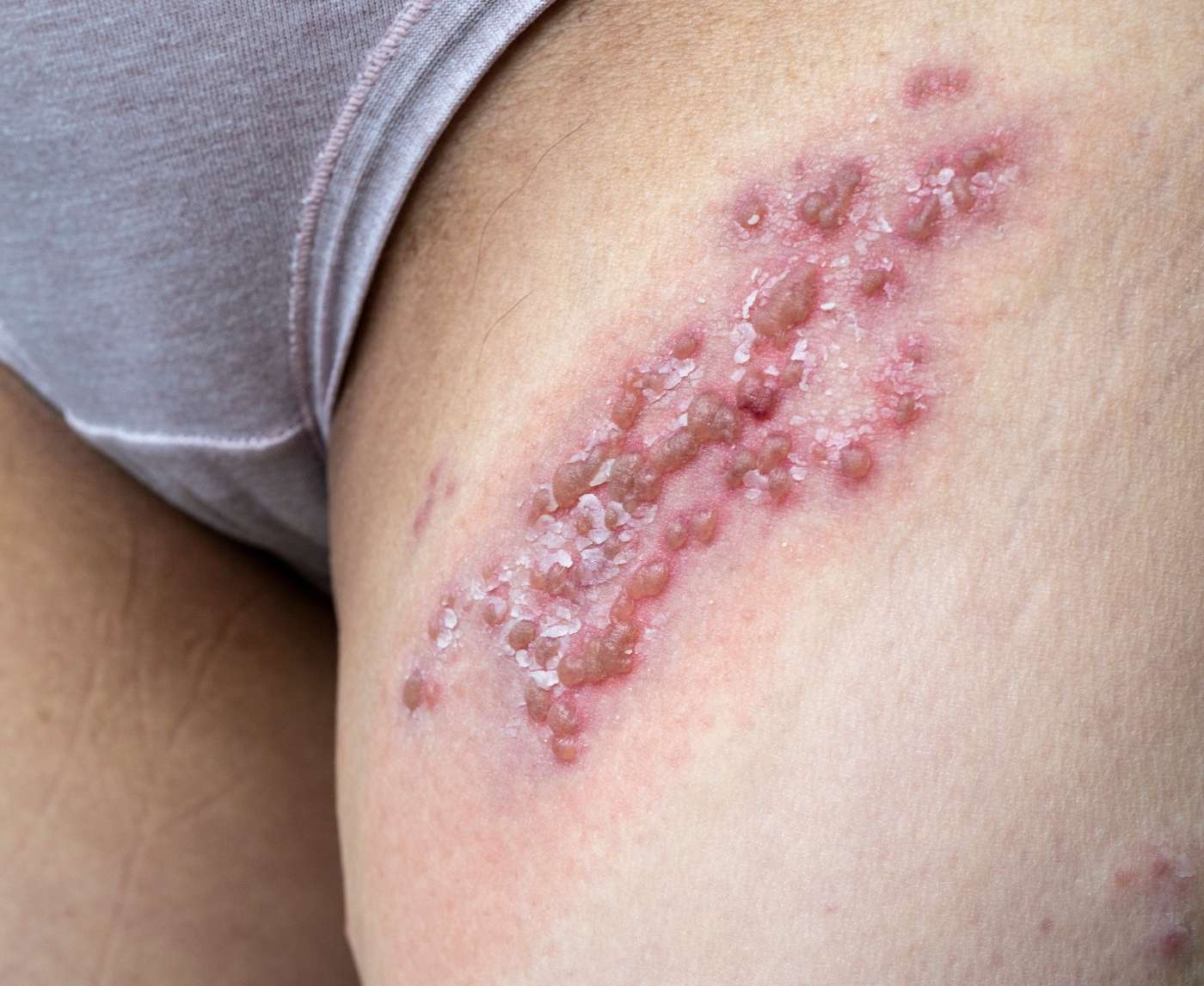
The first outbreak, when it happens at all, is usually the loudest. People describe it as starting with a tingling, prickly, or burning sensation in a localized patch of skin, sometimes a few hours before anything visible appears. Within a day or two, small clusters of clear fluid-filled vesicles, usually 1 to 3 millimeters each, develop on the affected area: shaft of the penis, labia, vulva, perineum, inner thigh, or near the anus depending on where contact occurred. Within 24 to 48 hours those vesicles break and form shallow painful ulcers that crust over and heal across the next 1 to 3 weeks for a primary outbreak (CDC: About Genital Herpes). The acute phase typically lasts 2 to 4 weeks end to end.
Many people describe the pain as similar to a paper cut or a burn, sharp at the surface, more uncomfortable when peeing or wiping than when sitting still. A first-time outbreak can also bring flu-like symptoms: low-grade fever, swollen groin lymph nodes, body aches, and headache. Recurrent outbreaks, when they happen, are smaller, faster (often 5 to 10 days from prodrome to healing), less painful, and rarely come with the systemic flu feeling.
What it isn't, often: a single ingrown hair, a yeast infection rash, friction irritation from new underwear, or a razor nick. The cluster pattern, the prodromal tingle, and the tendency to recur in the same neighborhood of skin are what distinguish HSV-1 from look-alikes. Visual matching alone is not enough to confirm or rule out herpes; the lesion morphology overlaps with several other genital skin issues. The image gallery below shows the visual pattern alongside two of the most common confusions, but treat it as an orientation tool, not a diagnostic substitute.
Cold sores, canker sores, and other oral confusions
Half the people who Google their lip sore have a canker sore, not herpes. The two are completely different conditions and the distinction matters for risk: canker sores are not contagious and do not transmit anything to anyone. Cold sores are HSV-1 and do. Quick differentiator: cold sores happen on the outside of the mouth, on the lip border or just outside it, in clusters of small fluid-filled blisters that crust over. Canker sores happen on the inside of the mouth, on the soft tissue lining the cheek, the back of the lip, or the tongue, as flat ulcers with a white or yellowish center and a red rim.
People also conflate cold sores with stress pimples, chapped lips, fever blisters (the older folk name for cold sores; same thing), or angular cheilitis (the cracked corners of the mouth that come from saliva irritation or yeast). If you are uncertain whether a partner's lip mark is a cold sore, the safest assumption before oral contact is to wait until you can ask, or to skip the contact and revisit later. Cold sores typically heal in seven to ten days (NHS cold sores).
| Feature | Cold sore (HSV-1) | Canker sore (aphthous ulcer) |
|---|---|---|
| Location | Outside the mouth: lip border, around the lips, sometimes nostrils | Inside the mouth: cheek lining, back of lip, tongue, soft palate |
| Appearance | Cluster of small fluid-filled blisters that crust over | Flat round ulcer with white or yellow center and red rim |
| Contagious | Yes, especially during active lesion or prodrome | No |
| Triggers | Stress, illness, sun, hormonal shifts, fatigue | Stress, mouth trauma, food sensitivities, deficiencies |
| Recurrence pattern | Tends to recur in the same spot | Tends to appear in different spots each time |
| Healing time | 7 to 10 days | 7 to 14 days |
Window periods: when symptoms show up, when tests can detect HSV-1
Two windows matter here, and they are not the same. The symptom window is the time from exposure to a possible first outbreak, and it is genuinely unpredictable. Some people develop noticeable first symptoms within days of exposure, often inside the first one to two weeks; others have no symptoms for weeks, months, or even years (NHS genital herpes). A meaningful share of people never have a clear first outbreak at all and discover the infection only through a later antibody test.
The test window is the time from exposure until your immune system has produced enough type-specific antibodies for a blood test to reliably detect them, which is meaningfully longer. For HSV-1 type-specific IgG (immunoglobulin G, the body's long-lived immune marker indicating past exposure) antibody testing, most people seroconvert within six to eight weeks, but reliable negative results require waiting roughly twelve weeks, with some sources extending the window to sixteen weeks for borderline cases (CDC STI Treatment Guidelines: Genital Herpes). Most clinical references also advise against routine IgM antibody testing (IgM antibodies are short-lived early-response markers) because of high false-positive rates and poor specificity.
Practically: if you have a sore right now, a swab from the sore at a clinic gives the fastest, most specific answer; PCR testing of the swab is highly accurate when the sample is collected from an active lesion within the first 48 hours. If you have no sore but want to confirm exposure from an event weeks ago, a blood antibody test taken at the 12-week mark is the right tool. Testing too early after exposure is the single most common reason people get a false negative.
| Window type | Time from exposure | What it means in practice |
|---|---|---|
| Symptom window | Days to weeks for those who get noticeable first symptoms; can be months or years | Many people have no clear first outbreak; timing varies widely between individuals |
| Swab test (clinic PCR) | Within 48 hours of an active sore appearing | Highly specific; closes once the lesion heals over |
| Blood antibody test (IgG) | 12 weeks for a reliable negative; up to 16 weeks for borderline cases | Confirms strain-specific exposure but not site (oral vs genital) or timing |
How to test for HSV-1 after suspected oral exposure
Swab tests and blood tests answer different questions for herpes, and using the wrong one at the wrong time produces false reassurance. Knowing which fits your situation saves money and avoids the wrong kind of certainty.
Swab tests (clinic-based PCR or viral culture) sample the fluid from an active sore and look for HSV DNA directly. The CDC's STI treatment guidelines name nucleic acid amplification tests (NAATs) and PCR as the preferred diagnostics for symptomatic herpes (CDC STI Treatment Guidelines). They are highly specific and can tell you not just whether the sore is herpes but which strain (HSV-1 vs HSV-2). The catch: you need a sore present, ideally within 48 hours of it appearing. After the lesion heals, the swab window closes. We do not sell at-home swab kits for HSV; for an active lesion, the right path is a sexual-health clinic, a primary-care visit, or a telehealth service that ships a swab kit and lab-processes it.
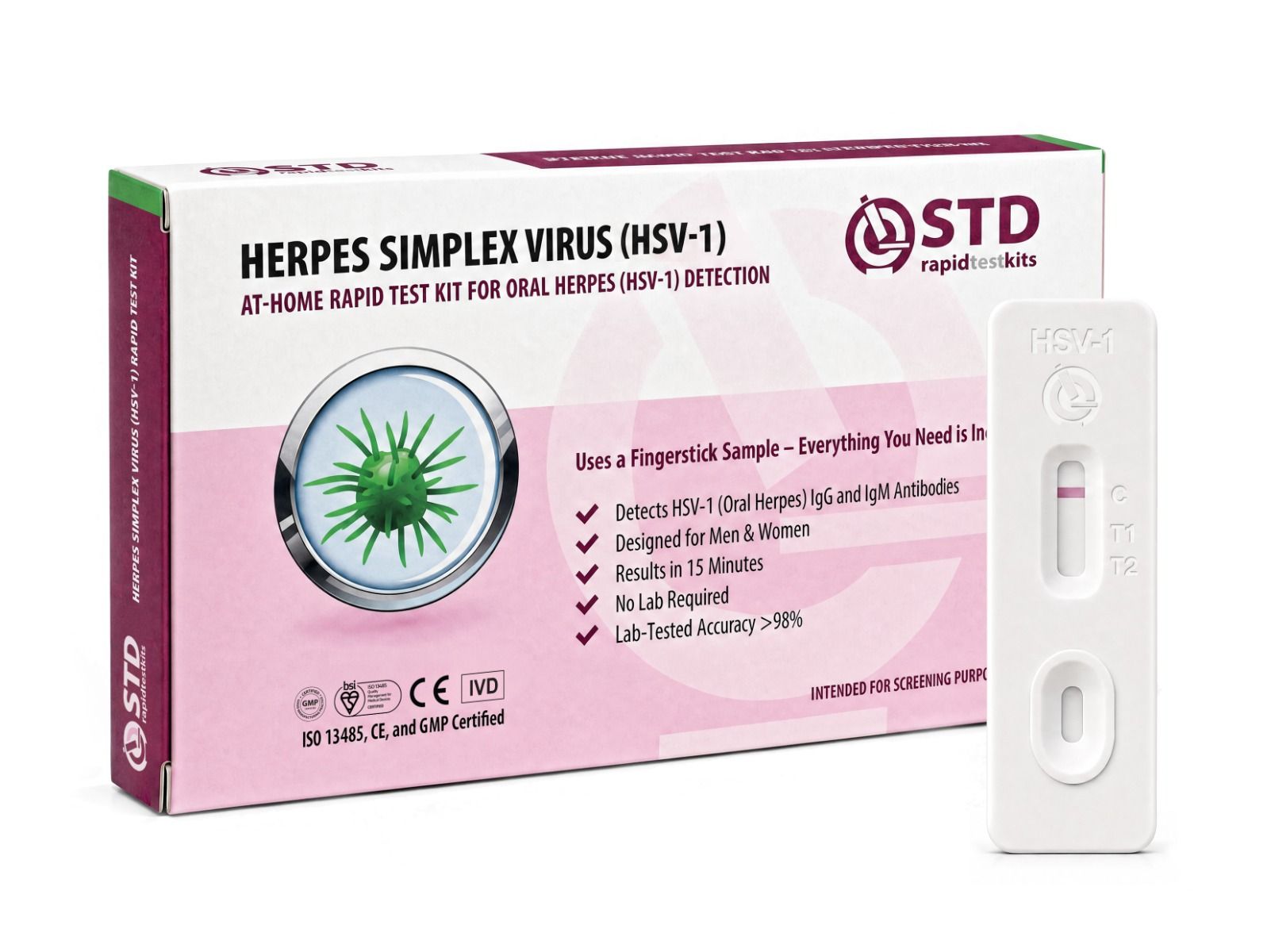
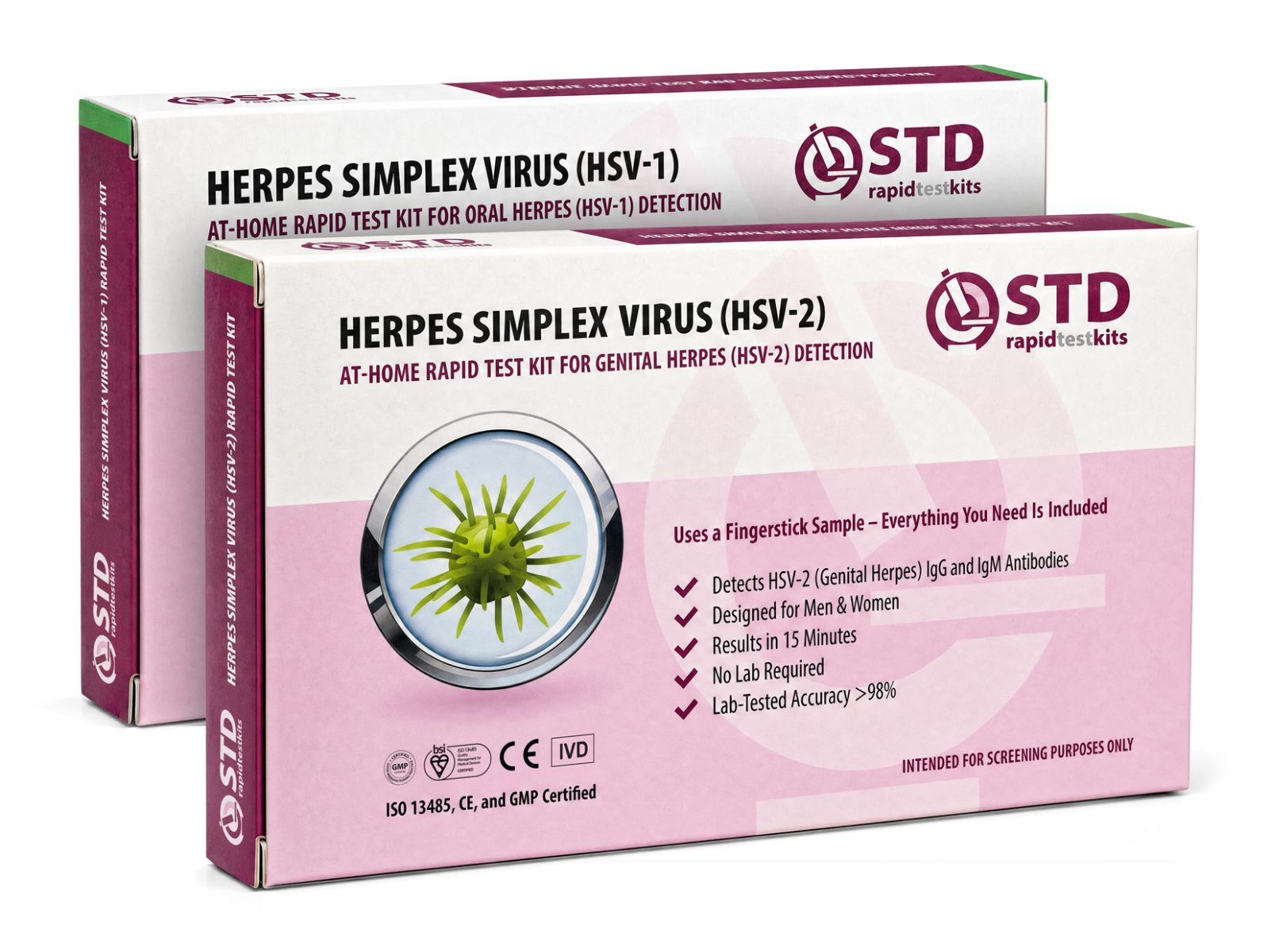
Blood antibody tests (type-specific IgG) detect your immune system's antibodies to HSV-1 and HSV-2. They tell you whether you have ever been exposed to each strain, but not where the infection lives (mouth vs genitals) or when it started. Blood tests are useful weeks-to-months after a suspected exposure, when the swab window has closed but you still want clarity. This is what our at-home HSV-1 blood antibody test covers: a fingerstick lateral-flow test for HSV antibodies, results in roughly 15 minutes, with the same caveat as any antibody test about waiting through the seroconversion window. At-home rapid kits use the same antibody chemistry as clinic IgG tests and have similar accuracy when used at the right time.
If you are reading this within hours or days of an exposure event with a partner who had a visible cold sore, both paths are reasonable: book a clinic visit if a sore appears, plan for a blood antibody test at the 12-week mark either way.
Disclosure: stdrapidtestkits.com sells the at-home rapid lateral-flow test kits referenced below. Recommendations are based on fit-for-purpose for the reader's concern, not on commercial benefit.
We do not offer an at-home swab kit for active herpes lesions. If you have a sore right now and want a fast, site-specific diagnosis, a clinic PCR swab is the correct tool, not a blood test. Our at-home blood antibody kit is the right tool for confirming HSV-1 or HSV-2 exposure 12 or more weeks after a suspected event, when you no longer have a visible lesion to swab.
Reducing the chance of passing it on, or picking it up
HSV-1 is too prevalent and too often asymptomatic for any single measure to guarantee zero transmission. Five moves meaningfully shift the math:
- Skip oral contact during a visible sore or prodrome. The tingle stage, the first 12 to 48 hours before a sore appears, carries some of the highest viral shedding. If your partner gets cold sores, ask them to wait until the sore is fully healed and skin is intact again.
- Use barriers when you can. Dental dams during oral-vulvar or oral-anal contact and condoms during fellatio reduce contact but do not eliminate it; HSV-1 can be on lip skin not covered by the barrier.
- Consider daily antiviral therapy (valacyclovir 500 mg daily) when a partner is HSV-negative and wants to stay that way. Trial data in serodiscordant couples (where one partner carries the virus and the other does not) have shown roughly half-as-much HSV-2 transmission to the negative partner under daily suppression (CDC STI Treatment Guidelines); evidence specific to HSV-1 is more limited, but the shedding-reduction mechanism applies. If a partner has known recurrent oral HSV-1, daily suppression is worth a clinical conversation.
- Talk before contact, not after. A two-minute conversation about cold-sore history is the cheapest, highest-impact intervention available, and the one most consistently skipped.
- Get tested when status is unclear. Knowing your own HSV-1 and HSV-2 status changes the conversation from anxious guesswork to informed choices.
For most adult readers, two or three of the five moves above will be the pragmatic combination; complete avoidance is rarely realistic and rarely necessary.
If your test is positive: outbreaks, antivirals, and what comes next
A positive HSV-1 result, oral or genital, is information, not a verdict. Roughly two thirds of adults under 50 worldwide carry oral HSV-1, and a growing share of new genital herpes diagnoses in young adults are now HSV-1 rather than HSV-2 (WHO data). The clinical course for genital HSV-1 specifically tends to be milder over time than HSV-2, with fewer recurrences and less frequent shedding.
Standard treatment for an active outbreak is one of three antivirals: acyclovir, valacyclovir, or famciclovir. Started within 24 to 72 hours of symptoms, antivirals shorten the outbreak and reduce its severity. For people with frequent recurrences, daily suppressive therapy reduces outbreak frequency and partner transmission risk; for genital HSV-1 with infrequent recurrences, episodic treatment (taken only at the start of an outbreak) is often enough. A clinician can prescribe either via a brief telehealth visit (CDC treatment guidelines).
Psychological adjustment after a herpes diagnosis is real and common: shame, anger, and worry about future relationships tend to surface in the weeks after. None of these reactions are unusual, none of them last forever, and none of them mean the diagnosis is harder to live with than it is. The condition itself is, for most people with HSV-1, a few outbreaks a year that pass quickly with antivirals. Most people find the adjustment takes a few weeks; peer support groups and STI-informed therapists can shorten that stretch considerably.
Recurrence at a glance
- Average recurrence rate for genital HSV-1: typically less than one episode per year for many people, per ASHA patient guidance.
- Recurrent episode duration: roughly 5 to 10 days from prodrome to healing, shorter than the 2 to 4 weeks of a primary outbreak.
- Prodromal tingling 12 to 24 hours before a sore appears is the cue to start episodic antivirals if a clinician has prescribed them.
Talking to partners without panic or shame
The disclosure conversation is rarely as bad as people imagine, and it gets easier each time. Factual and brief lands well for most people: "Before we get more physical, I want to mention I have HSV-1, the same virus that causes cold sores. Most adults have it. I take antivirals when needed and I'm careful about transmission. Happy to answer questions." If context feels relevant, add the route of acquisition and let the partner ask from there.
Skip the apology, since you didn't do anything wrong and HSV-1 is genuinely common. The honest framing is also the most useful one: HSV-1 is a virus that the majority of adults carry in some form, and most people do not know whether they carry it because most infections are silent. Naming that context up front reduces the moralizing energy that makes the conversation harder. Resist front-loading every clinical statistic, which reads as anxiety rather than information. Pick one or two facts that matter to the immediate decision, share them, and let the other person ask. Most adults respond better than people expect, often with their own status disclosure.
If you were the one who got infected and you're processing anger toward the partner who passed it: most cold sore carriers have not been told that oral HSV-1 transmits to genitals, since the information is missing from a lot of mainstream sex education. If you were the one with the cold sore who passed it on, the same gap explains why "I didn't think it counted" is closer to the typical case than the willful one. Either way, sexual-health support lines and STI-informed therapists can help you frame and rehearse the conversation.
"I learned recently that cold sores can transmit HSV-1 to a partner's genitals through oral sex, even when there is no visible sore. I want to give you that information so you can decide what testing makes sense for you."
Keep it factual. Lead with what you now know rather than with apology, and let the partner decide what testing makes sense from there.
Most people have no symptoms or only mild symptoms. Many people aren't aware they have the infection and can pass along the virus to others without knowing.
Next steps after a suspected oral-to-genital exposure
Do you have an active genital sore, blister, or ulcer right now?
Yes: Book a sexual-health clinic, urgent-care, or primary-care visit for a PCR swab of the lesion within 48 hours of it appearing. This is the fastest and most specific test, and it tells you both whether the sore is herpes and which type (HSV-1 vs HSV-2).
Has it been 12 or more weeks since the suspected oral exposure, with no current sore?
Yes: Take an HSV-1 specific (or combined HSV-1/HSV-2) at-home blood antibody test now. The seroconversion window has closed, so a negative result is reliable; a positive result is worth confirming with a clinic blood draw.
Did you test positive, or were you diagnosed by clinic swab?
Yes: Book a brief telehealth or in-person visit to discuss episodic treatment (taken at the start of each outbreak) or daily suppressive therapy (which also reduces partner transmission risk). Use the disclosure framing above with any current partner.
No: Wait until you hit the 12-week mark before taking an antibody test. Earlier tests have a high false-negative rate. In the meantime, watch for new symptoms and get any sore that appears swabbed at a clinic within 48 hours.
Pick the path that matches where you are right now. Guidance only; a clinician can advise on your specific situation.
Frequently asked questions
- Can a cold sore really give someone genital herpes?
- Yes. When someone with oral HSV-1 performs oral sex, the virus can travel from the mouth to the receiving partner's genital tissue. The route is now common enough that HSV-1 accounts for a growing share of new anogenital herpes diagnoses in young adults. A visible sore is not required, since asymptomatic shedding from the mouth is sufficient for transmission.
- How long after oral sex do herpes symptoms typically appear?
- Timing varies widely between people. Some develop a first tingle or sore within days of exposure, often inside the first one to two weeks. Others have no first-outbreak symptoms at all, or only develop them months or years later. If a current symptom is the concern, get it swabbed at a clinic; if no symptom is present and you want clarity from a past event, plan a blood antibody test at the 12-week mark.
- Can you get genital HSV-1 from oral sex with someone who has no visible cold sore?
- Yes. HSV-1 sheds asymptomatically from the mouth on a meaningful percentage of days, so transmission can happen without a visible sore. Risk is highest during a visible sore or in the prodrome (tingling) phase, but it is not zero between outbreaks.
- Do condoms or dental dams fully prevent HSV-1 transmission during oral sex?
- No. They reduce contact and lower the risk meaningfully, but the virus can be on lip skin or surrounding tissue not covered by the barrier. Combining barriers with avoiding contact during active sores or prodrome gives the best practical protection.
- What is the difference between a cold sore and a canker sore?
- Cold sores are HSV-1, appear on the outside of the mouth as clusters of small fluid-filled blisters, and are contagious. Canker sores are aphthous ulcers, appear on the inside of the mouth as flat ulcers with a white or yellow center, and are not contagious or virally caused.
- How early can a blood test detect HSV-1 after exposure?
- Six to eight weeks for initial seroconversion; twelve weeks before a negative result is reliable. Some borderline cases need up to sixteen weeks. The practical rule of thumb is to test at the twelve-week mark rather than at week four or six. Routine IgM testing is not recommended because of high false-positive rates.
- Is genital HSV-1 less severe than genital HSV-2 long-term?
- On average, yes. Genital HSV-1 typically causes one or fewer recurrences in the first year and rarely recurs after that, with lower asymptomatic shedding rates than HSV-2. The first outbreak can still be intense, but the long-term picture is usually milder.
- If a person had cold sores years ago, are they still a transmission risk now?
- Yes, though the risk is lower than during a primary infection. HSV-1 stays in the trigeminal nerve permanently and can shed in saliva even years later, with or without a visible sore. The shedding rate decreases over time but does not reach zero. Risk is highest during prodromal tingling and visible sore activity, lowest between recurrences, and reducible with barrier methods and suppressive antivirals.
- If I gave my partner HSV-1, should I notify every past partner?
- There is no public-health requirement for HSV disclosure equivalent to the contact-tracing protocols for chlamydia, gonorrhea, or HIV. The practical guideline most people land on: notify partners with whom there was oral-genital contact while a cold sore was active or just before one appeared, since those carry the highest risk. For partners outside that window the obligation is weaker; offering current information and pointing to testing resources is more useful than retroactive guilt-sharing.
- World Health Organization. Herpes simplex virus fact sheet covering global HSV-1 and HSV-2 prevalence (including the 3.8 billion under-50 HSV-1 estimate), transmission routes, and symptoms.
- U.S. Centers for Disease Control and Prevention. STI Treatment Guidelines: Genital Herpes, including epidemiological data on HSV-1 in anogenital infections, diagnostic test selection (PCR vs serology), antiviral regimens, suppressive therapy guidance, and serodiscordant-couple transmission reduction.
- U.S. Centers for Disease Control and Prevention. About Genital Herpes: overview, transmission routes, primary outbreak progression, and the role of HSV-1 in genital infections.
- NHS. Genital herpes overview including UK clinical guidance on the variable timing of first symptoms (which may take weeks or even years to appear), testing pathways, treatment, and disclosure.
- NHS. Cold sores overview covering oral HSV-1 symptoms, triggers, healing timeline, and contagiousness.
- American Sexual Health Association. Herpes resource center, including recurrence-rate comparisons between genital HSV-1 and genital HSV-2.
