
Published: October 2025 | Last updated: May 2026 | Editorial review and quality control: Martina N.
Do cold sores mean I need a herpes test?
Cold sores are almost always HSV-1, but a type-specific blood antibody test taken at least 12 weeks after exposure can also show whether HSV-2 is present. For an active sore, a PCR swab within 48 hours gives direct virus-type confirmation. At-home rapid fingerstick blood tests cover HSV-1, HSV-2, or both and return results in about 15 minutes.
A cold sore on your lip is a herpes infection, almost always caused by herpes simplex virus type 1 (HSV-1). Most people who get cold sores have never been formally tested, partly because a recurring blister on the lip feels like a nuisance rather than something that warrants a diagnosis. Yet two practical questions follow every cold sore. Could you also be carrying HSV-2, the type linked more closely to genital herpes? And could your cold sore pass the virus to a partner during oral sex? Symptoms alone cannot answer either question. A blood test or a swab of an active sore is the only reliable way to know which type you carry and where the virus has been.
This article is published by stdrapidtestkits.com, which sells at-home herpes test kits. We recommend products based on fit-for-purpose for the reader's concern, not commercial benefit.
Key Takeaways
- Cold sores are almost always HSV-1, the same virus that can cause genital herpes through oral sex; symptoms alone cannot tell you which type you carry or whether HSV-2 is also present.
- A blood antibody test is most reliable at least 12 weeks after suspected exposure (up to 16 weeks or more for some people); an active sore should be swabbed within 48 hours for direct virus detection via PCR.
How cold sores connect to herpes infection
Cold sores are caused by herpes simplex virus, the same family of viruses behind genital herpes. Two types exist: HSV-1, historically associated with oral and facial cold sores, and HSV-2, historically associated with genital herpes. Both produce similar lesions (clustered small fluid-filled vesicles on a reddened base that crust and heal over a week or two). The visible difference between them is minimal; the distinction is largely which type tends to establish residence in which part of the body.
After a first exposure, HSV travels along sensory nerve fibers to a cluster of nerve cell bodies called a ganglion, where it stays dormant, sometimes for years. For oral HSV-1, the home base is the trigeminal ganglion at the base of the skull. For genital HSV, it is typically a sacral ganglion near the lower spine. The virus reactivates periodically and travels back down the nerve to the skin, which is why outbreaks recur in roughly the same spot each time. This latent reservoir inside neurons is also why no current treatment cures herpes; antivirals interrupt active replication on the skin but cannot reach the virus while it hides inside nerve cells.
The World Health Organization estimates that roughly 3.8 billion people under 50 worldwide carry HSV-1 (about 64% of that age group), most having acquired it in childhood from non-sexual contact. Approximately 520 million people aged 15 to 49 live with HSV-2, mostly acquired through sexual contact during adulthood. A large proportion of carriers of either type have never been diagnosed, which is one reason routine testing has value even when you feel fine.
The figures below show what typical HSV lesions and common look-alikes can resemble. Photos are reference points, not diagnoses; many bumps and blisters in similar areas have other causes (canker sores, ingrown hairs, contact dermatitis, impetigo, and more).
Cold sore look-alikes that mislead you
Several bumps and ulcers on the face or genitals look enough like herpes to cause anxiety. Visual diagnosis is unreliable for multiple reasons: many conditions produce similar small clustered vesicles, the same condition can look different on different skin tones, and lesions change appearance over a few days as they crust and heal.
On the lips and around the mouth, cold sores can be mistaken for angular cheilitis (cracking at the corners of the mouth from yeast or bacterial overgrowth), impetigo (a bacterial skin infection that often produces honey-colored crusts), and aphthous canker sores, which are round white-yellow ulcers found inside the mouth rather than on the outer lip and, unlike cold sores, are not contagious (MedlinePlus). On the genitals, herpes lesions can be confused with ingrown hairs after shaving, contact dermatitis from a soap or laundry detergent, yeast infection sores, and folliculitis.
One more source of confusion: HSV reactivation does not always produce a classic vesicle. Some people get only a tingling sensation, a small red patch that never blisters, or a single fissure that resembles a dry cracked lip. The classic vesicular lesions associated with HSV are absent in many infected people (CDC STI treatment guidelines), which is one reason clinical visual diagnosis misses cases. Photo comparisons help orient your suspicion, but they cannot replace a swab of an active sore or a blood test taken at the right window.
Three conditions are most often confused with cold sores:
- Canker sore (aphthous ulcer): a round white-yellow ulcer with a red halo on the inner mouth lining, not on the outer lip. Not caused by herpes.
- Angular cheilitis: cracks and redness at the corners of the mouth from yeast or bacterial overgrowth. No clustered vesicles.
- Impetigo: a bacterial skin infection that produces honey-colored crusts, often around the nose and mouth, more common in children.
HSV-1 vs HSV-2 explained
Both HSV-1 and HSV-2 belong to the same virus family and behave in broadly similar ways: a primary infection followed by lifelong residence in nerve cells, with periodic reactivation that can produce visible sores or shed virus through skin without symptoms. The differences are statistical and behavioral rather than visible in the sore itself.
HSV-1 most commonly affects the mouth and lips but is increasingly recognized as a cause of genital herpes, particularly in younger adults whose first oral exposure happened later in life. HSV-2 most commonly affects the genitals and tends to recur more frequently in that area than HSV-1. Recurrence rates differ markedly: people with genital HSV-2 typically experience more outbreaks per year than people with genital HSV-1 (CDC STI treatment guidelines for herpes), an important detail when discussing future expectations with a partner.
HSV-1 vs HSV-2
| Feature | HSV-1 | HSV-2 |
|---|---|---|
| Most common location | Mouth, lips, face | Genitals, buttocks, inner thighs |
| How most people acquire it | Non-sexual contact in childhood (kissing relatives, sharing utensils) | Sexual contact in adulthood |
| Can also infect the other site? | Yes, through oral-to-genital contact | Less common to infect the mouth, but possible |
| Typical recurrence rate | Lower; some people never have a second outbreak | Higher; outbreaks may recur several times in the first year |
| Detected by | Type-specific blood antibody test or swab of an active sore | Type-specific blood antibody test or swab of an active sore |
HSV-1 and HSV-2 produce similar-looking sores; the differences are mostly about preferred location and recurrence frequency.
How herpes moves between mouth and genitals
The route most people overlook is oral-to-genital. If a partner with an active cold sore performs oral sex, HSV-1 can transfer to the receiving partner's genital skin and establish a genital infection. The reverse path, genital HSV-2 transferring to a partner's mouth during oral sex, is also possible though clinically less common. Standard genital-to-genital transmission of HSV-2 happens during sex when one partner has the virus active in the genital area, with or without visible sores.
Kissing transmits HSV-1 between mouths. Most adults who carry HSV-1 acquired it as a young child without any sexual contact (CDC herpes overview). None of these routes require visible blisters; the virus can shed from the skin's surface for short periods between outbreaks.
Two practical implications follow. First, a cold sore that appears around the time you started a new relationship is not automatic evidence of recent transmission from your partner; many cold sores are flare-ups of an old infection acquired years earlier. Second, having oral sex while you have an active cold sore is the highest-risk scenario for passing HSV-1 to a partner's genitals.
Asymptomatic viral shedding means the herpes virus can be present on the skin's surface even when there is no visible sore. Shedding has been documented on a meaningful proportion of days in the first year after a primary HSV-2 infection, decreasing over time. This is the main reason testing and honest partner conversations matter even between outbreaks.
What triggers a cold sore outbreak
Once HSV-1 is established in your nervous system, outbreaks happen when the virus reactivates and travels from the trigeminal ganglion back down the nerve to the lip. The triggers are not random; most people who track their outbreaks find a personal pattern.
A typical cold sore moves through four visible stages over seven to ten days. The prodromal stage begins with a faint tingling, burning, or itching at the spot where the sore will appear, usually 12 to 24 hours before anything is visible. Small fluid-filled vesicles form next, often clustered tightly together on the vermillion border of the lip. Within a day or two the vesicles rupture into shallow weeping ulcers, which then dry into a yellowish-brown crust that flakes off as the skin heals underneath. Many people learn to recognize their personal prodrome, the most useful timing cue for starting treatment.
Timing matters because prescription antiviral medications (acyclovir, valacyclovir, famciclovir) are most effective when started at the very first tingle, before vesicles form. The U.K. National Health Service notes that antiviral creams should be used as soon as the early tingling begins, because they do not always work after blisters appear. Over-the-counter docosanol cream applied at the first tingle can modestly shorten healing time as well. For people with six or more outbreaks per year, daily suppressive antiviral therapy reduces outbreak frequency and lowers asymptomatic shedding.
Common cold sore reactivation triggers
Recognizing your personal pattern helps you start antivirals early and reduce outbreak frequency.
- Physical or emotional stress (deadline weeks, exam season, grief, sleep deprivation) Common
- Fever or recent illness, including the common cold or flu Common
- Ultraviolet light exposure (sunny holidays, beach days, ski trips with reflected glare) Common
- Hormonal shifts around menstruation Common
- Lip trauma (chapped lips, a bitten lip, a recent piercing) Less common
- Recent dental work that stretches the perioral skin Less common
How herpes testing works
There are two main ways to confirm a herpes infection. The right one depends on whether you have an active sore right now or whether you are testing because of a past concern.
A swab test takes fluid or cells directly from an active sore and looks for HSV DNA. Polymerase chain reaction (PCR) is the modern reference method and is highly sensitive when the swab is taken within the first 48 hours of an outbreak. After day three or four the sore starts to crust and viral shedding falls, so PCR sensitivity drops. If you have a fresh sore now, this is the more decisive test.
A blood test looks for IgG antibodies the immune system makes against HSV-1 or HSV-2. Antibodies take time to build up, typically appearing within 2 to 6 weeks but reaching reliable detectability around 12 weeks after infection. Current tests can take up to 16 weeks or more to detect infection in some people (CDC herpes testing guidance). Type-specific IgG tests can usually distinguish HSV-1 from HSV-2 antibodies, but they cannot tell you where in the body the infection is active, only that the immune system has encountered the virus.
The sensitivity of glycoprotein G type-specific tests for detecting HSV-2 antibody varies from 80% to 98%, with false negatives more frequent at early stages of infection (CDC STI treatment guidelines). HSV-1 serologic testing has lower sensitivity and cannot distinguish oral from genital HSV-1 infection. Specificity is high in symptomatic populations but lower in screening contexts where the proportion of false positives rises. PCR sensitivity from an active sore swab is generally higher than the older viral culture method that PCR replaced.
HSV antibody detection window
- Week 0 Exposure
Virus transmits; no antibodies detectable yet.
- Week 3 Early immune response
Some early IgM may appear, but IgM tests are not type-specific and have limited diagnostic value.
- Week 6 Some tests turn positive
IgG antibodies begin appearing; some glycoprotein G assays return positive results.
- Week 12 Standard reliable window
Most type-specific IgG tests are reliable; recommended minimum wait per CDC guidance.
- Week 16 Outlier seroconversion
Some people need 16 weeks or more; retest if an earlier result was negative and exposure was recent.
Most people develop detectable IgG antibodies by week 12; some outliers need up to 16 weeks or more.
When to test for accurate results
Timing matters because antibody tests measure your immune response, and that response takes time to develop. Testing too soon after a possible exposure can produce a false negative even when the virus is present.
If you have an active sore right now, the most useful step is a PCR swab within 48 hours. After about 72 to 96 hours, the lesion is drying and PCR sensitivity falls; an antibody blood test taken at the same time is unlikely to be positive yet because antibodies take weeks to develop.
If you suspect a past exposure (a partner disclosed a positive result, you noticed something weeks ago that has since healed, or you want to clear up uncertainty before a new relationship), an IgG blood test taken at least 12 weeks after the suspected exposure date is the most reliable option. The CDC notes that current tests can take up to 16 weeks or more in some people, so a negative result before that mark should be repeated if exposure was recent.
If you have recurrent cold sores and want to know your status formally for the first time, you can test any time. Antibodies from a longstanding HSV-1 infection will already be detectable, and a single panel will also tell you whether HSV-2 is present. Once antibodies develop they remain detectable for life, so most adults need only one confirmed test to settle HSV-1 status permanently.
What at-home testing can and cannot tell you
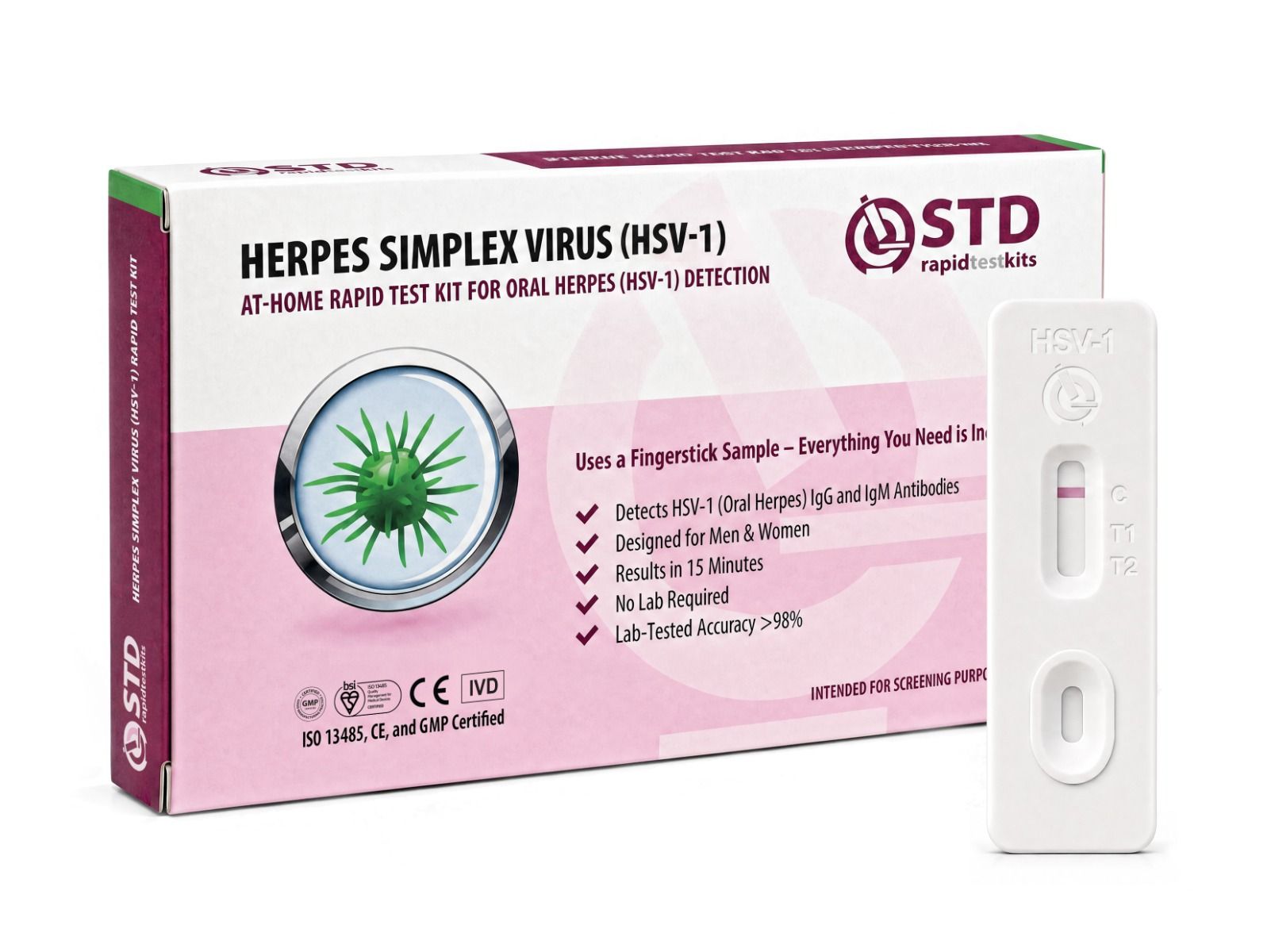
An at-home rapid herpes test is a fingerstick blood antibody test you run yourself. A small drop of blood goes onto a test cassette containing immobilized HSV antigens; if antibodies are present in the blood, they bind to those antigens and produce a colored line in the result window within about 15 minutes. These are lateral-flow immunoassays, the same technology behind rapid COVID tests. They check whether your immune system has produced IgG antibodies to HSV-1 or HSV-2, meaning whether the virus has been in your body at some point. The test does not tell you where the virus is currently active, when you were infected, or whether you are shedding right now. For lesion-specific diagnosis of an active sore, a clinician swabs the sore for PCR.
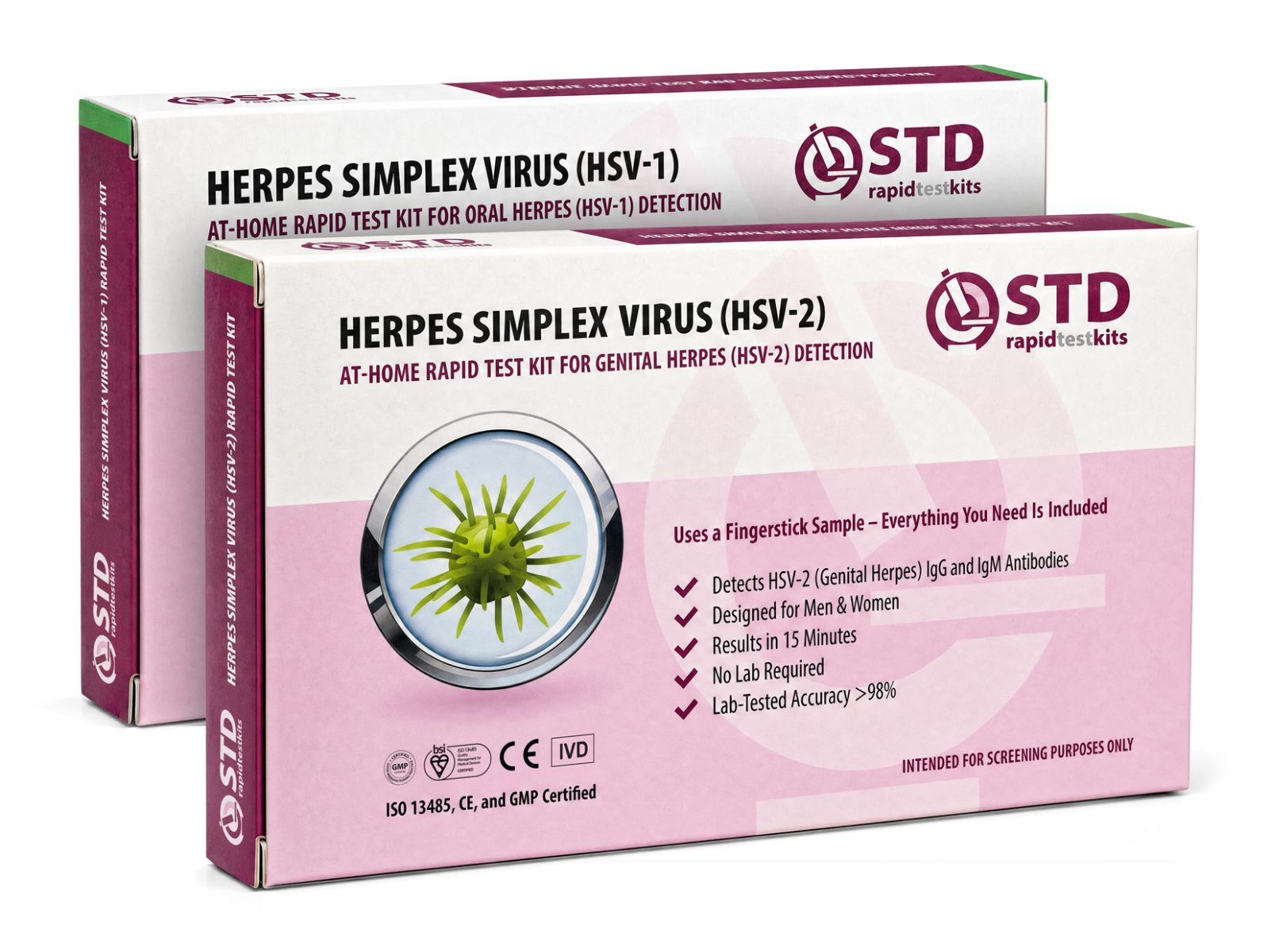
For someone who gets cold sores and wants to know whether HSV-2 is also present, that distinction matters most. A combined HSV-1 plus HSV-2 panel will likely return positive for HSV-1 (consistent with the cold sores) and either positive or negative for HSV-2. A negative HSV-2 result, taken at least 12 weeks after any relevant exposure, is reassuring.
Type-specific IgG tests have a known low-positive zone (index values between roughly 1.1 and 3.0) where false positives are more common, particularly for HSV-2 in low-prevalence populations (CDC STI treatment guidelines). If your at-home or clinic result falls in this zone, asking your provider for a confirmatory Western blot or glycoprotein G ELISA is a reasonable step. Lab-based type-specific serology remains the gold standard when a result will drive a major decision such as partner notification or pregnancy planning. This is one of the reasons clinicians do not recommend routine HSV antibody screening for people without symptoms or specific reasons to test.
That caveat does not argue against testing if you have a reason: partner disclosure, recurrent cold sores you want to characterize, or pregnancy planning.
If your test result is positive
A positive HSV-1 or HSV-2 result is common and does not change your worth, your partnership prospects, or your ability to have children. About 64% of adults under 50 globally carry HSV-1, and roughly 520 million people aged 15 to 49 worldwide live with HSV-2 (WHO HSV fact sheet). Most carriers go decades without a serious outbreak.
Practical next steps if you receive a positive result for the first time: confirm with a clinic IgG test (especially if your at-home result was unexpected or fell in the low-positive index range); speak to a clinician about suppressive antiviral therapy (daily valacyclovir or acyclovir reduces both outbreak frequency and the chance of passing the virus to a partner); and plan partner conversations honestly.
For partner conversations, plain language tends to land best. Something like: "I get cold sores from time to time, which is HSV-1. About two-thirds of adults carry it. I take medication when I feel one coming on, and I avoid kissing or oral sex during a flare. Wanted you to know." The evidence-based approach is to share your status before sex. Risk-reduction options that work in combination: daily suppressive antivirals, which significantly reduce both outbreak frequency and transmission risk; avoiding sex during prodrome (the tingling or itching phase before a sore appears) or active outbreaks; and consistent condom use, which reduces but does not eliminate transmission. Most people who disclose find their partners take it well, especially when the conversation includes practical risk-reduction steps.
For pregnancy, U.S. and U.K. obstetric guidelines converge: women with longstanding HSV are usually offered antiviral suppressive therapy from around 32 weeks of pregnancy and a clinical assessment near delivery for active lesions (NHS genital herpes guidance). Newly acquired HSV in the third trimester is the higher-risk scenario and may warrant a planned cesarean to reduce the chance of neonatal transmission.
Most people with genital herpes have no symptoms or have very mild symptoms. Mild symptoms may go unnoticed or be mistaken for other skin conditions like a pimple or ingrown hair. Because of this, most people do not know they have a herpes infection.
Managing cold sore outbreaks day to day
Once you have confirmed HSV-1 carriage, outbreak management has three layers: medication, trigger reduction, and supportive care. The combination cuts outbreak frequency for most people and shortens the outbreaks that do break through.
Prescription antivirals do the heaviest lifting. Acyclovir, valacyclovir, and famciclovir can be taken in two ways: episodic therapy (a short course at the first tingle, which shortens that specific outbreak by a day or two) or daily suppressive therapy (a low daily dose for people with frequent outbreaks, which reduces both how often outbreaks occur and how much virus is shed between them). Suppression is usually reserved for people with six or more outbreaks per year or those whose outbreaks are particularly disruptive.
Identifying your personal triggers takes a couple of months of journaling. Note the date of each outbreak alongside recent stress, illness, sleep, sun exposure, dental work, and menstrual cycle. A pattern usually surfaces. Once you know your triggers, you can be deliberate: high-SPF lip protection on sunny holidays, sleep and stress management around deadline weeks, and pre-emptive episodic antivirals around predictable triggers like a planned dental procedure.
Between medication and trigger management, supportive care handles the rest. Over-the-counter docosanol cream applied at the first tingle modestly shortens healing. Ibuprofen or acetaminophen helps with the painful ulcer stage. Avoid kissing, oral sex, and sharing lip products or utensils from the first tingle until the lesion has fully crusted and the crust has fallen off naturally; the contagious window starts before the visible sore and extends until the skin is intact again.
| Treatment | How it works | When to use | What to expect |
|---|---|---|---|
| Prescription antivirals (acyclovir, valacyclovir, famciclovir) | Block viral DNA replication during reactivation | Episodic at first tingle, or daily suppression for frequent outbreaks | Episodic dosing shortens an outbreak by 1 to 2 days; daily suppression cuts annual outbreak frequency and lowers asymptomatic shedding |
| Docosanol cream (over the counter) | Topical inhibitor that blocks viral fusion with skin cells | Apply at first tingle, five times daily until healed | Modestly shortens healing when started early |
| Ibuprofen or acetaminophen | General pain relief | During the painful ulcer stage | Comfort only; does not shorten the outbreak |
| SPF 30+ lip balm | Blocks UV exposure, a common reactivation trigger | Daily during sunny weather or on holidays | Prevents many sun-triggered recurrences |
| Trigger journaling | Identifies your personal reactivation pattern | Two to three months of tracking | Lets you anticipate outbreaks and pre-empt them with antivirals |
Choose your testing path
If you get cold sores, you almost certainly already have HSV-1 in your nerve cells. The question worth answering is whether HSV-2 is also present, and a single fingerstick blood test can settle that. The right time depends on your situation.
Which test fits your situation?
Do you have an active sore right now (visible blister, weeping ulcer, or fresh crust)?
Yes: Get a swab/PCR test within 48 hours of the lesion appearing. This gives direct virus-type confirmation and is the most decisive test for a current sore.
Did a partner disclose a positive HSV result, or did you have a possible exposure in the past 4 months?
Yes: Get an IgG blood test at 12 weeks after exposure. If the result is negative and exposure was recent, repeat at 16 weeks for full reliability.
Do you get recurrent cold sores but have never been formally tested for HSV type?
Yes: Get an IgG blood test any time. Antibodies from longstanding HSV-1 are already detectable, and the panel will also reveal whether HSV-2 is present.
Do you want a baseline before a new relationship or pregnancy planning?
Yes: Get a combined HSV-1 plus HSV-2 IgG blood test any time. This gives you and your partner a shared starting point.
No: You may not need testing right now. Revisit if your situation changes or symptoms develop.
Match your current circumstances to the right test type and timing.
FAQs
- Is every cold sore caused by herpes?
- Almost always, yes. The vast majority of cold sores on the lip or face are caused by HSV-1, a member of the herpes simplex virus family. Other conditions can mimic a cold sore, including angular cheilitis, impetigo, and aphthous canker ulcers, but the classic clustered-vesicle pattern that crusts over a week is herpes-specific.
- Can you give someone genital herpes from a cold sore?
- Yes. If you have an active cold sore (or are in the tingling prodrome before one appears) and perform oral sex, HSV-1 can transfer to your partner's genital skin and cause a genital herpes infection. Avoid oral sex during outbreaks and during prodromal symptoms. Asymptomatic shedding can also occasionally transmit the virus between outbreaks.
- How accurate are at-home herpes tests?
- At-home rapid HSV antibody tests are lateral-flow blood tests. CDC STI treatment guidelines describe glycoprotein G type-specific HSV-2 IgG sensitivity in the 80 to 98 percent range when taken at least 12 weeks after exposure. HSV-1 IgG serologic testing has lower sensitivity. Specificity is high in symptomatic populations. A confirmatory clinic IgG, glycoprotein G ELISA, or Western blot is sensible if a positive result will affect partner notification or pregnancy planning.
- How long should I wait after exposure before testing?
- For an antibody (IgG) blood test, wait at least 12 weeks after the suspected exposure date, with up to 16 weeks or more for full reliability per CDC guidance. Antibodies usually appear within 2 to 6 weeks but can take longer in some people. For a swab/PCR test of an active sore, the opposite applies: test within the first 48 hours of the sore appearing for the best result.
- Does a positive HSV-1 result mean I have genital herpes?
- Not by itself. A positive HSV-1 IgG result confirms your immune system has encountered the virus, but it does not reveal where the virus lives. Most HSV-1 carriers acquired it from non-sexual contact in childhood and only ever experience oral cold sores. A small minority have genital HSV-1 from oral-to-genital transmission. Symptom history (where sores appeared) helps interpret the result.
- Does a positive test mean I will have outbreaks?
- Not necessarily. Many people who carry HSV-1 have had only one outbreak in their life, or none at all. The antibody test detects the immune memory, not the frequency of reactivation. If you have never had a cold sore but test positive, you are likely an infrequent reactivator and may never need daily suppressive therapy.
- Is herpes curable?
- No, but it is well-managed. Once HSV is in your nerve cells (the trigeminal ganglion for oral HSV-1, a sacral ganglion for genital HSV), the virus can reactivate throughout life. Antiviral medications (acyclovir, valacyclovir, famciclovir) shorten outbreaks, reduce recurrence, and lower transmission risk. Many people experience few or no outbreaks after the first one. Research on HSV vaccines is active, but no approved vaccine exists yet.
- If I have HSV-1, do I still need to test for HSV-2?
- Yes. HSV-1 antibodies do not protect against HSV-2, and the blood tests detect each type separately. A positive HSV-1 result tells you nothing about HSV-2 status. The combined blood panel runs both checks at once if you want a complete herpes baseline, which is especially useful before a new relationship or during pregnancy planning.
- U.S. Centers for Disease Control and Prevention. Genital Herpes: overview, transmission routes (direct skin and mucous-membrane contact, kissing), asymptomatic shedding, and clinical presentation.
- U.S. Centers for Disease Control and Prevention. Herpes testing: methods, indications, and timing of antibody response, including the up-to-16-week-or-more detection window.
- U.S. Centers for Disease Control and Prevention. STI Treatment Guidelines, herpes section: glycoprotein G type-specific HSV-2 IgG sensitivity (80 to 98 percent), low-positive index values (1.1 to 3.0), suppressive antiviral therapy, recurrence rates, atypical presentations absent in many infected persons, and partner counseling.
- World Health Organization. Herpes Simplex Virus fact sheet: global HSV-1 prevalence (approximately 3.8 billion people under 50, 64%) and HSV-2 prevalence (approximately 520 million people aged 15 to 49, 13%), transmission routes.
- U.K. National Health Service. Cold sores: cause, course, prodromal stage, and antiviral guidance (antivirals most effective when started at the first tingle, before blisters appear).
- U.K. National Health Service. Genital Herpes: symptoms, testing, treatment, and pregnancy guidance including antiviral suppression from 32 weeks of pregnancy.
- MedlinePlus (U.S. National Library of Medicine). Cold sores: causes (herpes simplex virus), distinction from canker sores (canker sores are not contagious), and general management overview.
