
Published: November 2025 | Last updated: May 2026 | Editorial review and quality control: Martina N.
The fear that brings most people to this page is some version of the same thought: I have herpes, or I might have herpes, and I just read something scary about cancer. Take a breath. Herpes simplex virus, the family of viruses that causes cold sores and genital herpes, is not on the list of viruses that cause cancer. Herpes can be uncomfortable, emotionally heavy, and life-disrupting. It is not, by any current scientific consensus, oncogenic.
The actual cancer-linked sexually transmitted infections are a different group, and they tend to be the quiet ones. HPV, hepatitis B, hepatitis C, and HIV are the four with documented cancer links. Each has a clear pathway from infection to long-term cancer risk, and each has prevention strategies that work when started early. This piece walks through what the evidence says, what you can test for at home, and where the real risks live.
Key Takeaways
- Herpes simplex virus has no established causal link to any cancer. Decades of research have ruled it out as an oncogenic virus.
- Four STIs do raise cancer risk: HPV (cervical, anal, throat, penile, vulvar), hepatitis B and C (liver), and HIV (immune-related cancers including Kaposi sarcoma and certain lymphomas).
This Pain Feels Scary, But Is It Dangerous?
If you suspect herpes, your mind probably ran through the worst-case scenarios fast. Many readers worry they have permanently ruined their health, or that an STI diagnosis is a slow-burning fuse for cancer down the line. Years of tabloid coverage have helped that fear stick. Herpes is not on the list of viruses that drive cancer.
Herpes simplex virus (HSV-1 and HSV-2) lives in nerve cells. It travels along nerve pathways during outbreaks and stays dormant in nerve ganglia between flares. The cells where most virally-driven cancers begin are epithelial cells: the surface tissues of the cervix, anus, throat, and skin. HSV does not target those tissues for the kind of persistent transformation that drives cancer. That biological mismatch is why decades of research have failed to find a causal link between herpes and any malignancy.
Some older studies in the 1970s and early 1980s explored a possible HSV-cervical cancer connection. Once researchers identified high-risk strains of HPV as the actual cause of cervical cancer, the herpes hypothesis fell away. The American Cancer Society and CDC both name HPV, not HSV, as the driver.
So why does herpes carry so much weight? Because it hurts and it shows up. Visibility tricks the brain into reading severity. The stigma around herpes makes it feel life-defining, but on the cancer-risk scoreboard it does not register. HPV, hepatitis B and C, and HIV behave differently: they often produce no symptoms at all for years, which is the part that matters for cancer risk.
HSV lives in nerve ganglia, not in the surface tissues where cancer begins. Cancer-driving viruses persistently infect and transform epithelial cells (cervix, anus, throat, skin). HSV biology does not work that way, which is why decades of research have failed to link it to any malignancy.
The Four STIs That Actually Carry Cancer Risk
Most STIs that lead to cancer take years, sometimes decades, to do their damage. They tend to cause no symptoms at all in the early stages. That delay is exactly why testing matters: by the time symptoms arrive, the disease has often progressed.
HPV (human papillomavirus) is the headliner. The high-risk strains, especially types 16 and 18, are responsible for nearly all cervical cancer cases and a substantial share of anal, oropharyngeal (throat), penile, and vulvar cancers. CDC tracks more than a dozen high-risk HPV types. Most HPV infections clear on their own within two years; persistent infection is where cancer risk actually builds.
Hepatitis B and hepatitis C target the liver. Acute infection often resolves without symptoms, but chronic infection drives years of low-grade inflammation that scars the liver (cirrhosis) and eventually raises the risk of hepatocellular carcinoma, the most common form of liver cancer. The World Health Organization's hepatitis B fact sheet notes that chronic HBV infection is one of the leading causes of liver cancer worldwide. Hep B is sexually transmitted; hep C is mostly bloodborne but can be transmitted sexually, particularly among partners with HIV co-infection.
HIV does not cause cancer directly. What it does is weaken the immune surveillance that normally clears abnormal cells before they become tumors. People living with HIV have higher rates of Kaposi sarcoma (a cancer of the skin and mucous membranes most common in people with suppressed immune systems), certain non-Hodgkin lymphomas, and invasive cervical cancer. Effective antiretroviral therapy reduces but does not fully eliminate this elevated risk, which is why CDC guidance emphasizes early diagnosis and consistent treatment.
Almost all cervical cancers are caused by long-lasting infections with certain types of human papillomavirus. HPV is the most important risk factor for cervical cancer.

STI-Cancer Risk at a Glance
The table below summarizes which STIs carry oncologic risk, what cancer types each is linked to, and whether prevention is realistic. Notice that herpes is the only common STI on this list with no known cancer link, and that every other infection on the list has either a vaccine, a treatment, a cure, or a screening tool that can intercept the path to cancer.
| STI | Cancer Risk | Cancer Types | Prevention |
|---|---|---|---|
| Herpes (HSV-1/HSV-2) | None established | None | Not applicable |
| HPV (high-risk types) | High | Cervical, anal, oropharyngeal, penile, vulvar | Vaccine plus regular screening |
| Hepatitis B | Moderate to high (chronic) | Liver (hepatocellular carcinoma) | Vaccine plus antiviral treatment |
| Hepatitis C | Moderate (chronic) | Liver (hepatocellular carcinoma) | Curable with direct-acting antivirals |
| HIV | Moderate (immune-related) | Kaposi sarcoma, non-Hodgkin lymphoma, cervical | Antiretroviral therapy plus screening |
HPV Isn't Just a Women's Health Issue
HPV-related cancer used to be discussed almost exclusively in the context of cervical cancer. That framing has masked a real shift: oropharyngeal cancers (cancers of the back of the throat, base of the tongue, and tonsils) caused by HPV are an increasingly common HPV-driven malignancy in the United States. CDC data show HPV causes about 39,300 cancers annually in the U.S., including oropharyngeal cancers.
HPV in men is mostly silent. Most high-risk strains do not produce visible warts. There is no FDA-approved screening test for HPV in men comparable to the Pap smear. Some clinicians offer anal Pap testing for higher-risk patients, especially men who have sex with men, but routine HPV screening for men is not standard practice. Detection often happens during a dental or ENT exam, when an unexplained lump or persistent sore throat triggers a biopsy.
Two practical implications follow. First, the HPV vaccine matters for everyone, not just women. The CDC recommends routine HPV vaccination through age 26 and shared clinical decision-making for adults aged 27 to 45 who were not previously vaccinated. Second, men whose partners receive abnormal Pap or HPV results should view that information as relevant to their own risk profile, even if they have no symptoms themselves.
HPV Vaccination at a Glance
- Routine HPV vaccination is recommended for everyone through age 26 (CDC).
- For adults aged 27 to 45 who were not previously vaccinated, the CDC recommends shared clinical decision-making with a provider.
- The vaccine cannot undo prior HPV exposure but protects against high-risk strains not yet encountered.
How to Know Where You Stand
Most cancer-linked STIs can be detected long before they have a chance to cause cancer. The right test depends on what you are looking for.
HPV screening for people with a cervix involves Pap smears (looking for abnormal cell changes), HPV DNA testing (looking for the virus directly), or both, on the schedule your clinician recommends. For high-risk groups, anal Pap tests can detect anal cell changes. As noted above, no equivalent screening test exists for HPV in men; the practical signal is to be alert to persistent oral or throat symptoms and to push for an exam if something feels off.
Hepatitis B and C testing is a simple blood draw. Hep B has a vaccine, and chronic infection can be controlled with antiviral therapy. Hep C, until recently a long-term liver disease with limited treatment, is now curable in over 95 percent of cases with direct-acting antivirals (WHO), but only if you know you have it. CDC screening guidance recommends hepatitis C testing at least once for all adults aged 18 and older.
HIV testing is recommended at least once for all adults aged 13 to 64, with more frequent testing for higher-risk groups. Antiretroviral therapy keeps viral load undetectable in most patients, which dramatically reduces both transmission risk and long-term cancer risk.
If you find clinic visits awkward or hard to schedule, at-home rapid tests can cover the bloodborne infections (HIV, syphilis, hepatitis B, hepatitis C) and the bacterial STIs (chlamydia, gonorrhea) using a fingerstick or a self-collected swab. The trade-off is that home rapid tests use lateral-flow chemistry, which is slightly less sensitive than the lab-based NAAT or PCR tests a clinic would run. They are useful as a first screen; a positive home result should be confirmed with a clinic-based test, and a negative result during a window period should be repeated later.
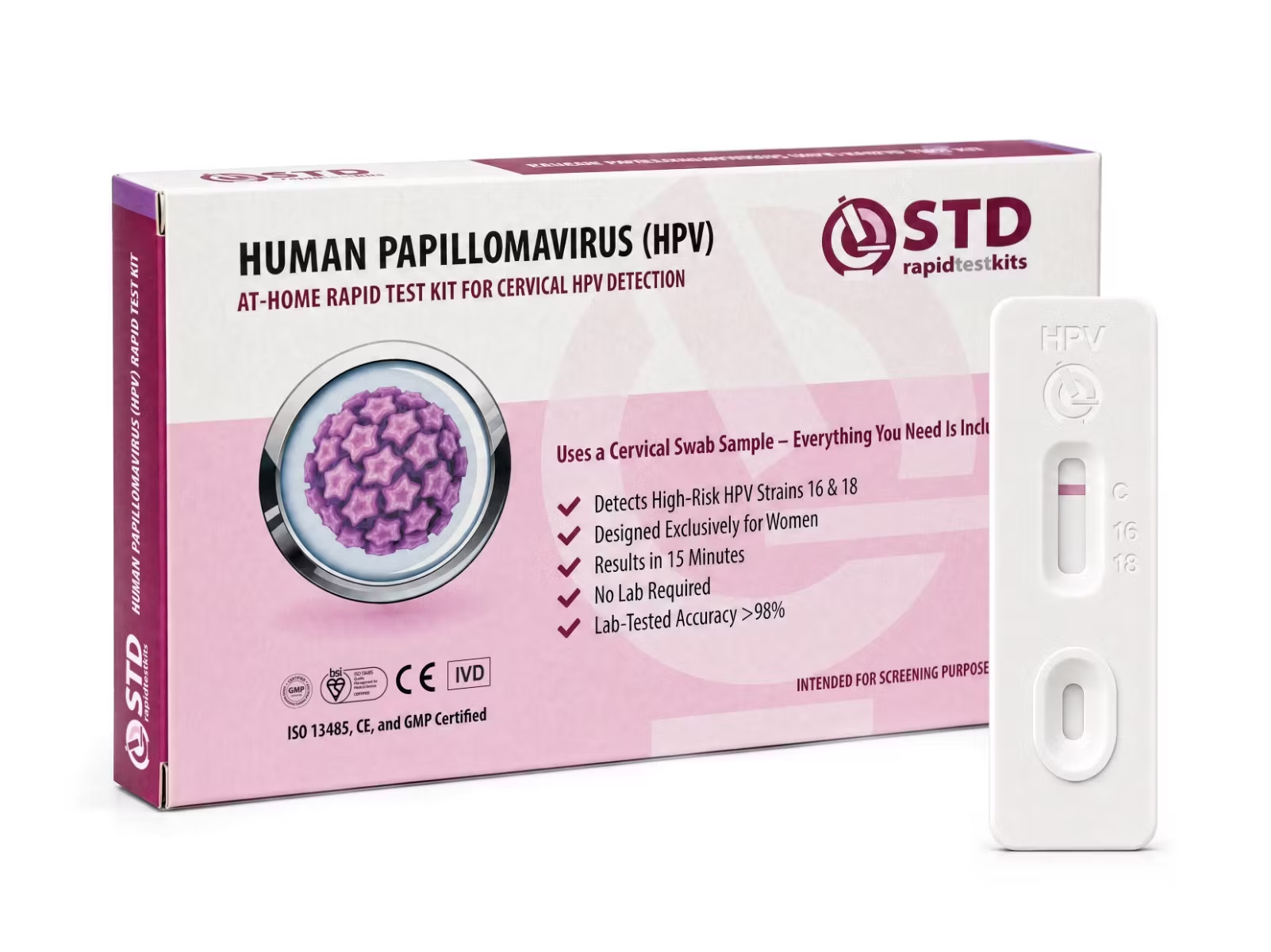
One important note about our HPV kit: it is validated for self-collected vaginal swab and is therefore for women only. We do not currently offer a home HPV test for men. Male readers concerned about HPV exposure should see a clinic for a clinical exam.
Disclosure: stdrapidtestkits.com sells the at-home test kits referenced below; product mentions reflect fit-for-purpose for the reader's concern, not commercial benefit.
Hepatitis B and C: The Quiet Liver Connection
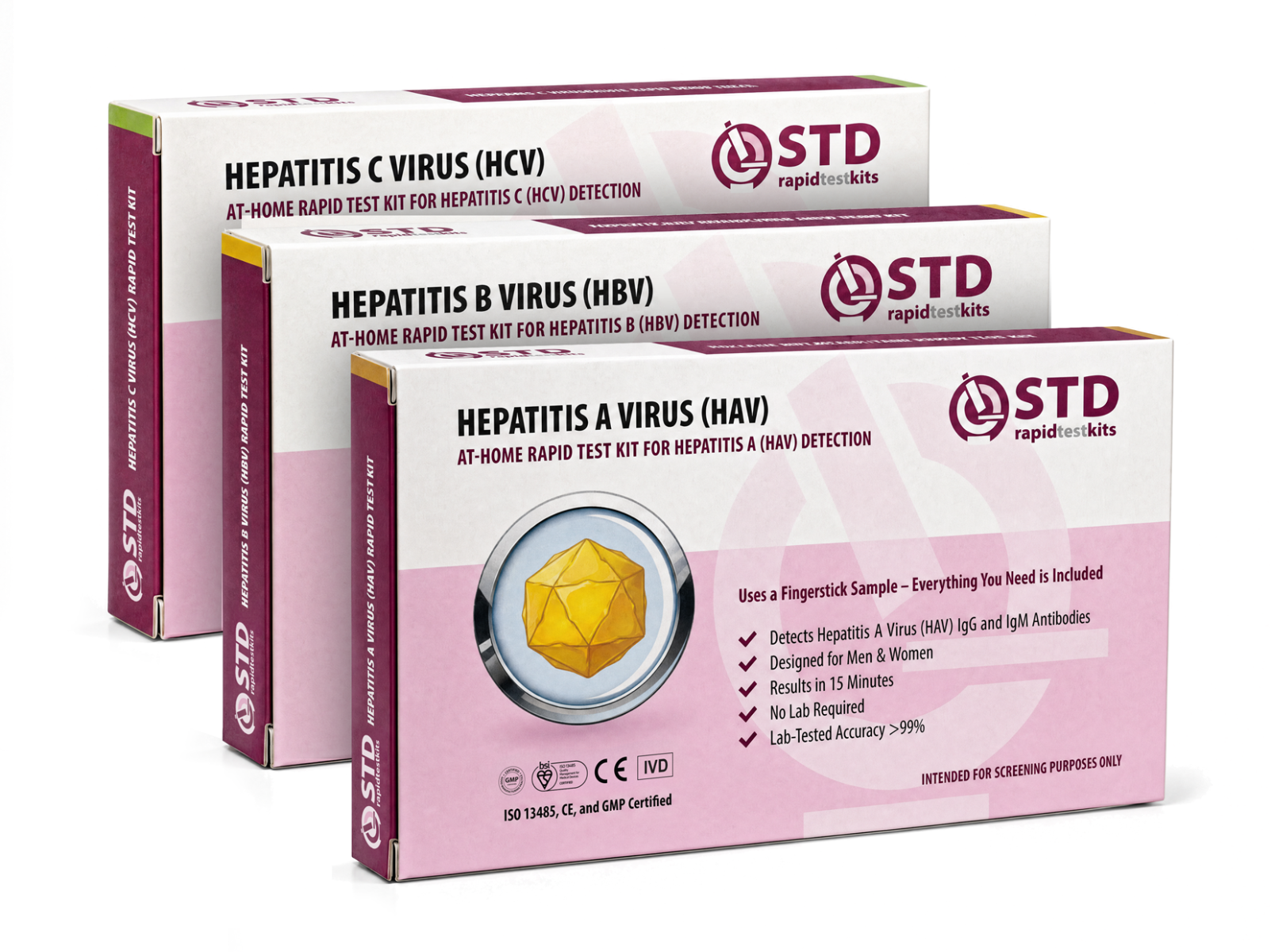
Cervical and throat cancers tend to dominate the conversation about cancer-linked STIs, but liver cancer driven by chronic hepatitis B or C infection is responsible for a comparable share of the global STI-cancer burden. The path is slow. An acute infection may pass with no clear symptoms. If the immune system fails to clear it, chronic infection settles in, often for decades. Years of low-grade inflammation scar the liver. Cirrhosis develops. From cirrhosis, hepatocellular carcinoma can emerge.
That slow timeline works in the patient's favour: a blood test today shows whether you carry hepatitis B or C, long before any liver damage accumulates. Hep B has a vaccine that prevents new infection and antivirals that suppress chronic infection. Hep C is now curable in most patients with an 8-to-12-week course of direct-acting antivirals. The only requirement is knowing your status, and many people with chronic hepatitis do not.
Sexual transmission of hepatitis C is uncommon in the general population but well-documented among partners with HIV co-infection and among men who have sex with men. Hepatitis B is more readily sexually transmitted, especially through unprotected anal or vaginal contact. If neither infection is in your testing history, a one-time screen is a high-value, low-effort step.
Why Herpes Still Hits Hard, Even Without Cancer Risk
A herpes diagnosis is not trivial. The mental health load of an HSV diagnosis is well documented in clinical literature. Patients describe feeling like their dating life is over, like their sex life is over, like they need to disclose to every future partner forever. Some of that worry is legitimate. A lot of it is stigma talking.
Herpes is manageable medically. Episodic or suppressive antiviral therapy reduces outbreak frequency and transmission risk. Most people with HSV-1 or HSV-2 live normal lives, have normal relationships, and never develop significant complications. The fear is often disproportionate to the disease, and the cancer fear in particular is misplaced.
If you carry an HSV diagnosis and you have been carrying anxiety about cancer along with it, those two concerns are unrelated. Treating the herpes does not change your cancer risk. Worrying about cancer does not change your herpes course. Time spent worrying about herpes-as-cancer-risk is time better spent making sure HPV, hepatitis, and HIV are accounted for in your testing history.
An HSV diagnosis carries significant stigma and emotional weight, but it carries no measurable cancer risk. Managing the infection with antivirals is a separate decision from managing your cancer-linked STI risk profile.
Window Periods: Why Testing Timing Matters
One source of confusion that trips up almost everyone: the difference between an incubation period and a window period. The incubation period is the time from exposure to symptoms appearing, when symptoms appear at all. The window period is the time from exposure to when a test can reliably detect the infection. They are not the same number, and for some STIs the gap is wide.
For HIV, CDC notes that fourth-generation antigen-antibody lab tests can usually detect HIV 18 to 45 days after exposure, while antibody tests (which include most rapid and self-tests) can usually detect HIV 23 to 90 days after exposure. For hepatitis C, the CDC recommends a NAT (nucleic acid) test rather than an antibody test if exposure may have been within the past six months, since the antibody response can lag. For HPV, there is no exposure-to-test window in the same sense; the question is whether persistent infection has caused detectable cell changes, which can take months or years.
The practical takeaway: if you test too early, you may get a falsely reassuring negative. If you test much later than the window, you may already be transmitting. For the cancer-linked STIs specifically, the timeline is forgiving in one direction (most take years to cause damage) and unforgiving in the other: chronic infection that goes undetected for years is exactly the path to cancer.
Window Periods at a Glance
- HIV (4th-generation antigen-antibody lab test): can usually detect HIV 18 to 45 days after exposure (CDC).
- HIV (antibody test, including most rapid and self-tests): can usually detect HIV 23 to 90 days after exposure (CDC).
- Hepatitis C: if exposure may have occurred within the past six months, CDC recommends a NAT rather than an antibody test, since the antibody response can lag.
- Hepatitis B: blood tests detect the surface antigen (HBsAg) and related markers; ask your clinician about timing if you have a recent specific exposure.
- HPV: no fixed exposure-to-test window; screening detects persistent infection or cell changes over months to years.
You Deserve Answers, Not Assumptions
Coming back to where we started: herpes does not cause cancer. The four infections that do (HPV, hepatitis B, hepatitis C, and HIV) can almost always be detected long before they damage anything. None of them require panic. All of them require knowing.
If your concern started with a herpes scare and turned into a broader worry about cancer risk, the productive next step is not to obsess over the herpes side. It is to make sure the four cancer-linked infections are accounted for in your testing history. A multi-STI panel done once when you start a new partnership, and again as a baseline every couple of years, is the foundation. The right tests, used at the right time, can turn a vague worry into a specific answer.
If a clinic visit feels like a barrier, an at-home multi-STI test kit can cover the most common bloodborne and bacterial STIs in one screen. For HPV in men, see a clinic; for women, our home swab is a useful first screen alongside routine Pap testing.
Next Steps for Cancer-Linked STI Testing
- If you have a cervix: ask your clinician about Pap smear and HPV DNA testing on the recommended schedule.
- Adults aged 18+ should screen at least once for hepatitis C; the test is a single blood draw and the infection is now curable in most cases.
- Adults aged 13 to 64 should screen at least once for HIV, more frequently if at higher risk.
- If clinic visits are a barrier, an at-home multi-STI rapid kit can cover HIV, syphilis, hepatitis B, hepatitis C, chlamydia, and gonorrhea as a first screen.
- Confirm any positive home result with a clinic-based test before treatment decisions.
Frequently Asked Questions
- Does herpes really not cause cancer at all?
- Correct. The biological reason: herpes simplex virus lives in nerve cells, not in the epithelial tissues (cervix, anus, throat, skin) where most virally-driven cancers begin. HSV does not cause the persistent cell-level transformation that drives cancer, and decades of research have ruled out a causal link. If you have herpes and have been carrying anxiety about cancer alongside it, the productive next step is to make sure HPV, hepatitis B, hepatitis C, and HIV are accounted for in your testing history. Those are the infections that actually carry oncologic risk.
- Which STIs should I actually be worried about for cancer risk?
- The big four are HPV, hepatitis B, hepatitis C, and HIV. HPV is linked to cervical, anal, oropharyngeal, penile, and vulvar cancers. Hepatitis B and C are major causes of liver cancer through chronic infection. HIV does not cause cancer directly but weakens immune surveillance, raising the risk of Kaposi sarcoma, certain lymphomas, and invasive cervical cancer.
- I am a man. Do I really need to think about HPV?
- Yes. HPV-related throat cancers are rising sharply in men, particularly those with a history of multiple oral-sex partners. There is no FDA-approved HPV screening test for men comparable to the Pap smear, so detection often happens late, when an unexplained lump or persistent sore throat is biopsied. The HPV vaccine is recommended through age 26 and on a shared decision basis up to age 45.
- How can I tell if I have one of the cancer-causing STIs?
- Usually you cannot tell without testing. HPV can persist invisibly for years. Hepatitis B and C often produce no symptoms until liver damage has already accumulated. HIV can be asymptomatic for years if untreated. Routine testing, especially when starting a new partnership, is the only reliable way to catch these infections during the window when they are still easy to manage or cure.
- Am I too old for the HPV vaccine?
- Not necessarily. The CDC recommends routine HPV vaccination through age 26. For adults aged 27 to 45 who were not previously vaccinated, the CDC recommends shared clinical decision-making with a provider. The vaccine cannot undo prior HPV exposure but can protect against strains you have not yet encountered. It is worth asking your clinician.
- Is hepatitis C really curable now?
- Yes. Direct-acting antiviral medications cure hepatitis C in over 95 percent of cases per WHO, typically with an 8-to-12-week oral course. The remaining barrier is awareness: most people with chronic hep C do not know they have it. CDC now recommends one-time hepatitis C screening for all adults aged 18 and older. A simple blood test can tell you where you stand.
- Can I have more than one STI at the same time?
- Yes, and co-infection is more common than most people expect. The behavioral patterns that lead to one STI also raise the odds of others. A positive result for one infection is generally a strong signal to run a full panel rather than a single confirmatory test. This is especially true for HPV and hepatitis, which often go untested when only the symptomatic infection is being investigated.
- Should I keep retesting for herpes if I already know I have it?
- No. HSV stays in the body for life once acquired, so repeat testing for the same diagnosis adds no information. What matters more is managing outbreaks with antiviral therapy if frequency is high, talking openly with partners, and remembering that herpes is not a marker of any cancer risk. Save the testing budget for the infections that actually need monitoring.
How we sourced this article: We summarized current guidance from the U.S. Centers for Disease Control and Prevention, the World Health Organization, and the American Cancer Society on STI-related cancer risk. Where specific cancer statistics or testing-window figures are referenced, we link directly to the page that states the figure so readers can verify the number and read the broader context. This article is published by stdrapidtestkits.com, which sells at-home STI testing kits. We recommend products based on fit-for-purpose for the reader's concern, not commercial benefit.
- American Cancer Society. Cervical cancer risk factors, including the role of HPV as the primary cause and the absence of a herpes-cancer link.
- American Cancer Society. Viruses that can lead to cancer, with substantive sections on HPV, hepatitis B, hepatitis C, and HIV-related malignancies.
- U.S. Centers for Disease Control and Prevention. HPV-related cancer information, including the figure that HPV causes about 39,300 cancers annually in the United States.
- U.S. Centers for Disease Control and Prevention. HIV testing windows, including the 18-to-45-day antigen/antibody window and the 23-to-90-day antibody-test window.
- World Health Organization. Hepatitis B fact sheet covering chronic infection, transmission routes, vaccination, and the link to liver cancer.
- World Health Organization. Hepatitis C fact sheet, including that direct-acting antivirals can cure more than 95 percent of persons with hepatitis C infection.
- U.S. Centers for Disease Control and Prevention. Hepatitis C testing guidance, including the recommendation to use a NAT rather than an antibody test if exposure may have been within the past six months.
