
Published: September 2025 | Last updated: May 2026 | Editorial review and quality control: Martina N.
If you've just been told you tested positive for HPV at 40, 45, or 52, breathe. A positive HPV test in your forties or fifties does not automatically mean a new infection. It often means a virus your immune system suppressed years (sometimes decades) ago has become detectable again. That distinction matters, because a fifteen-minute exam-room conversation can leave you with a result and no explanation, no timeline, and no plan.
This guide is for women in their late 30s, 40s, and 50s navigating the overlap of aging, hormones, and HPV. Whatever your situation, whether a decade with one partner, years of celibacy, or dating again after a long marriage, you deserve a clearer picture than 'we'll keep an eye on it.' Below, we walk through what reactivation means, why perimenopause changes the way your body handles the virus, what current screening guidelines recommend, and how to advocate for yourself when the result comes without the context it needs.
Key Takeaways
- A positive HPV test after 40 often reflects an old infection your immune system suppressed years ago, not a new exposure. Researchers call this redetection or reactivation, and it appears to be more common around perimenopause.
- Persistent high-risk HPV (especially types 16 and 18) is the main pathway to cervical cancer, which is why regular screening still matters in your 40s and 50s, even if your sex life is quiet.
A positive HPV test after 40 usually isn't a new infection
Most other sexually transmitted infections behave predictably. You're exposed, you mount an immune response, you clear it (or treat it), and a later positive result usually points to a new exposure. HPV doesn't follow that pattern. Once the virus is in the body, it can sit in the basal cells of the cervix at very low copy numbers, fall below the detection threshold of standard tests, and stay there for years. This is sometimes called viral latency.
When your immune surveillance shifts, the virus can replicate again and become detectable on a routine screen. The CDC Pink Book chapter on HPV notes that most HPV infections resolve spontaneously within a year or two. Undetectable is not the same as eradicated. The immune system holds the virus in check; it does not always remove every viral particle.
Researchers Patti Gravitt and Anne Rositch have published extensively on this pattern of redetection in older women, suggesting that a meaningful share of post-35 positives reflects reactivation of a prior infection rather than new exposure. Their cohort work first formalized the menopausal redetection signal. Common biological triggers include the following:
| Trigger | Why it matters |
|---|---|
| Perimenopausal hormonal shifts | Falling estrogen thins cervical tissue and changes local immune function |
| Immune dips (chronic stress, illness, poor sleep) | Lowered immunity allows previously suppressed viruses to resurface |
| Cervical trauma (procedures, childbirth, new sex after a long gap) | Tissue disruption can re-activate viral transcription in basal cells |
| Smoking and heavy alcohol use | Both are associated in observational studies with longer HPV persistence |
| Long-term immunosuppression (steroids, chemo, autoimmune treatment) | Reduces the body's ability to keep latent viruses dormant |
Why HPV behaves differently after 35
Your immune system isn't static, and neither is HPV. In younger people, most HPV infections clear from detection on their own within one to two years; the CDC's About Genital HPV page describes this as roughly 9 out of 10 infections going away by themselves within two years. After 35, that clearance pattern slows. The adaptive immune response loses some of the rapidity it had in your 20s. Cellular repair becomes less efficient. If you're entering perimenopause, your cervical tissue itself changes: estrogen levels drop, the protective mucosal barrier thins, and the local immune environment shifts.
None of this means a positive test is a failure of your body. It means your defense timeline now runs differently than it did in your 20s, and that change argues for consistent monitoring rather than panic.
HPV types 16 and 18 deserve specific attention. The World Health Organization fact sheet on HPV and cervical cancer attributes around 76% of cervical cancers to these two high-risk strains. Persistent infection with 16 or 18 carries a higher risk of progressing to cervical dysplasia and, over years, cervical cancer. That's the reason screening is still recommended into your 60s under current guidelines, even when your last clear test was years ago. Catching reactivation early is part of what those guidelines were designed to do.
You did not do something wrong. You're not 'dirty.' You're a living, aging human, and viral latency is part of how your immune system has always coexisted with HPV.

How hormones and immunity shape HPV clearance
Here's the part almost no one explains unless you bring it up first. As you enter your late 30s and early 40s, your immune profile shifts subtly but measurably. The drop in estrogen and progesterone during perimenopause alters how local cervical tissue responds to viruses like HPV. Cervical and vaginal epithelium thin. The microbial environment in the vagina, normally dominated by protective lactobacillus species, becomes less stable. All of these factors can make persistent HPV infection more likely.
There is also growing evidence that vaginal microbiome composition matters for HPV clearance. Lower lactobacillus and higher microbial diversity have been linked in observational studies to slower HPV clearance and higher persistence rates. Smoking, heavy alcohol intake, low vitamin D, chronic stress, and conditions that compromise the immune system (autoimmune disease, long-term steroid use, ongoing chemotherapy) all add to that risk.
None of this reflects a moral judgment on your behavior. Aging changes how your immune system holds the line on dormant viruses, and that is biology. You may have cleared a viral infection at 28 within eighteen months without knowing it; at 48, the same body in a different hormonal landscape may take longer or may keep the virus suppressed rather than eliminate it altogether. Knowing this in advance lets you make screening decisions with information rather than fear.
Most HPV infections (9 out of 10) go away by themselves within 2 years. But sometimes, HPV infections will last longer and can cause certain cancers and other diseases.
"I thought I was cleared. Then I got a call."
Melissa, 41, had clean Pap results for years. She had cleared HPV in her late 20s after several emotionally brutal colposcopies. Married at 30, divorced at 39, she hadn't had more than two partners since. She went in for a routine cervical screen at her annual physical and wasn't expecting the message that came two weeks later. "It's probably nothing," her doctor said. "But you're HPV positive again. Same strain as before. We'll watch it."
Melissa spiraled. Was it a new infection? Had her partner cheated? Had her body failed her?
The result was reactivation, not a new exposure. The same strain her body had suppressed for more than a decade had become detectable again on a sensitive HPV DNA test. Once she understood that framing, she stopped asking who she should be angry at and started asking what came next: how often to retest, what cell changes would prompt a colposcopy, what her real numerical risk was. The reframe didn't make the result fun. It made it manageable.
"I wish someone had told me this was possible," she said. "I wouldn't have wasted so much time blaming myself." That conversation, about reactivation versus new exposure, belongs in every positive-HPV debrief for women over 35. Too often it isn't there.
A positive HPV test in your 40s or 50s, particularly when it is the same strain you carried before, more often points to reactivation of a dormant infection than to a fresh exposure. The clinical follow-up is the same either way (repeat testing, possible cytology, colposcopy if cell changes appear), but the personal framing is very different. Reactivation does not call for relationship investigation. It calls for steady surveillance and a clear next-checkpoint date.
Testing after 40: what's different, what matters
If you've had a positive HPV result before or are facing one now, the testing approach in your 40s and 50s is genuinely different from your 20s. Younger people are usually screened on a Pap-only or co-test schedule; over 30, current CDC STI Treatment Guidelines and U.S. Preventive Services Task Force recommendations include HPV DNA testing as a primary or co-test option, because the virus's behavior changes with age.
A few practical distinctions worth knowing about the most common screening tools:
| Test type | Sample | Detects | Best for |
|---|---|---|---|
| HPV DNA test (high-risk strains) | Cervical swab in clinic, or self-collected swab in approved settings | Current detectable HPV infection or reactivation | Primary screening at 30+; follow-up after a prior positive |
| Pap smear (cytology) | Cervical cells from a clinic-collected swab | Cell changes (ASC-US, LSIL, HSIL, AGC) | Detecting progression toward dysplasia, not infection itself |
| Co-test (Pap + HPV) | Single cervical sample, processed two ways | Both infection and cell changes | Standard 5-year option at 30 and over |
| At-home HPV self-test | Self-collected vaginal swab (women-only kits) | Some high-risk HPV strains (kit-dependent) | Privacy, between-visit checks, screening when clinic access is limited |
What at-home HPV testing can answer (and what it can't)
A quick disclosure before we get into the specifics: we sell at-home HPV self-test kits, so the section below also describes what our product can and cannot do, alongside the general state of self-sampling. Our recommendations are based on fit-for-purpose for your concern, not on selling you the kit if a clinic visit is the better answer.
At-home HPV self-sampling has expanded substantially over the past few years. The FDA authorized the first self-collected HPV sample for use in healthcare settings in 2024, and self-collected vaginal swab kits are now a legitimate option for women over 30 who are due for HPV screening (particularly those who struggle to get to a clinic, prefer privacy after a difficult past experience, or want a quiet first look before scheduling a follow-up).
What an at-home swab can do: detect the presence of high-risk HPV types in the vaginal sample. What it can't do on its own: identify cell changes (dysplasia), grade the severity of any changes, or substitute for a colposcopy when the result requires one. A positive at-home result is the prompt for a clinic visit, not the diagnosis itself. A negative at-home result is reassurance, but does not replace your scheduled Pap or co-test on guideline-based intervals.
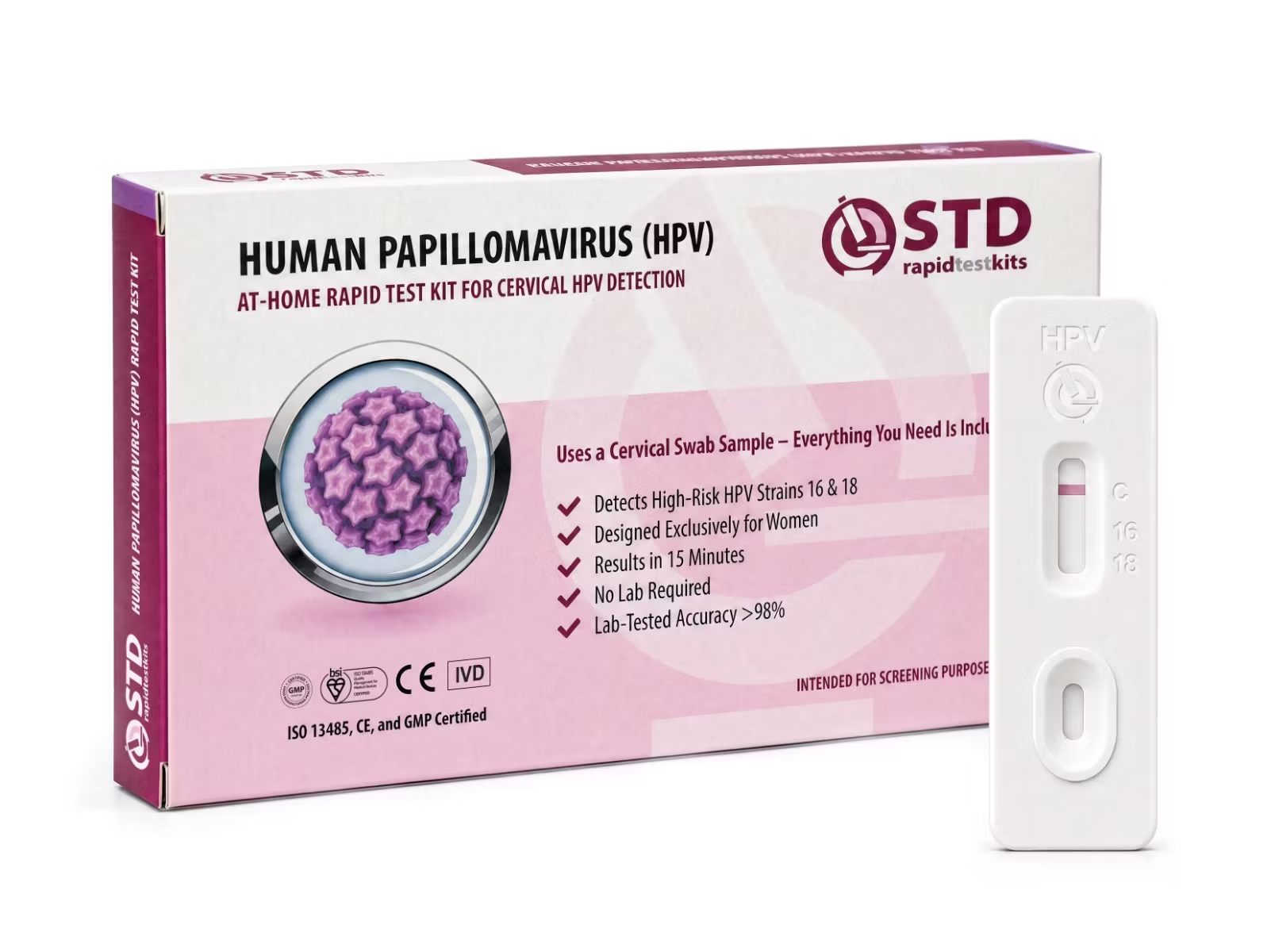
Our at-home HPV kit is validated for vaginal self-collection only (women-only); we do not sell a male-compatible HPV home test. The kit is a screening tool, not a replacement for clinic-based co-testing on your provider's recommended schedule. It fits best for readers who had a clinic test, got a confusing or ambiguous result, and want a second read on detectable HPV before their next follow-up.
What OB-GYNs don't always explain
Most OB-GYNs are competent and well-intentioned, working inside a system that gives them 15 minutes for a visit that should reasonably take 40. The result is that conversations about HPV reactivation in women over 35 often get compressed into 'let's keep an eye on it.' Here is what tends to go missing from that shortened script:
The possibility that a positive isn't new. Patients regularly assume any positive HPV test must mean a new exposure. Providers don't always clarify that latency and reactivation are normal, even expected, in older adults. That silence reflects a systemic gap in how positive results get framed inside a short appointment, more than any individual provider's intention to dismiss your concern.
The role of perimenopausal tissue changes. The cervix thins, estrogen drops, the vaginal microbiome shifts. These are mechanical reasons HPV behaves differently after 40, and they rarely come up in a routine Pap debrief. They matter, because they shape what consistent screening actually buys you over the next decade.
The emotional reality of ambiguous results. 'Mild cell changes' or 'just monitor' can feel like limbo. You deserve specifics: the cytology grade, the next checkpoint date, what finding would prompt a colposcopy, what would prompt a biopsy. As one 39-year-old reader from Arizona put it: "I was told it wasn't cancer, but not told what it was. I walked out of the appointment holding a pamphlet and zero answers."
Bring questions to your next appointment, write down the answers, and ask for a recommended follow-up date in writing. Most clinics will give you both if you ask plainly.

Should you retest? How long to wait, and why
Current screening guidelines for women over 30 in the U.S., per the CDC's STI Treatment Guidelines and the U.S. Preventive Services Task Force, look like this:
- Primary HPV DNA screening every 5 years, or
- Co-testing (Pap + HPV) every 5 years, or
- Pap-alone cytology every 3 years
If you test positive for a high-risk HPV type and your Pap is normal, the standard follow-up is repeat HPV testing in 12 months, unless cytology changes prompt earlier colposcopy. That 12-month interval assumes clinical access, emotional capacity, and no new concerns in the meantime. Real life doesn't always cooperate with that.
If you're testing at home as a check between scheduled clinic visits, or trying to verify a result before a follow-up, wait at least four to six weeks between swabs. Testing too soon after a recent sample can repeat the same ambiguity or pick up viral fragments that don't represent your current state.
If your clinic results showed actual cell changes such as ASC-US (atypical squamous cells of undetermined significance, meaning mildly abnormal cells whose meaning is unclear), LSIL (low-grade squamous intraepithelial lesion), HSIL (high-grade squamous intraepithelial lesion), or AGC (atypical glandular cells), the guideline-based follow-up is not a flat 'wait 12 months.' Those categories may call for reflex HPV typing, colposcopy, or biopsy on shorter timelines. Read your result letter carefully, and if you're not sure what an abbreviation means, your patient portal usually has a glossary; if it doesn't, your clinic's nurse line does.
When you're the one asking the hard questions
Many women over 35 are subtly expected to stay quiet, trust the system, and not ask too much. But when it's your cervix on the line, and your sense of peace, you are allowed to ask everything.
You don't have to become a medical expert. You have to be willing to slow the conversation down until you understand what the result means for the next twelve months of your life. Some women like to write three or four questions on an index card before the appointment. Others bring a friend. Both work.
If you need a first step that's private and nonjudgmental between visits, an at-home HPV self-test is one valid option. It is one way to engage the screening system on your own timeline rather than the clinic's, and for some women that small piece of agency is what makes the wait easier.
Four questions to bring to your follow-up appointment
- Could this positive result reflect reactivation of a prior infection rather than a new exposure?
- What's the typical HPV clearance pattern at my age, and how should it shape my screening schedule?
- Should we use HPV DNA typing or co-testing rather than cytology alone going forward?
- What specific cell-change finding would prompt you to recommend colposcopy or biopsy?
FAQs
- Can HPV come back after I've cleared it?
- Yes. Once HPV has been in the body, viral DNA can persist at very low levels in basal cervical cells. Standard tests stop detecting it when copy numbers drop below the assay threshold, but the virus may not be fully eliminated. When immune surveillance shifts (around perimenopause, during illness, after major stress), it can replicate and become detectable again. Researchers call this redetection or reactivation. It's usually the same strain you carried in the past, not a new exposure.
- How long can HPV stay dormant?
- Years, sometimes decades. There is no fixed window. Long-term cohort studies of women followed from their 20s into their 40s and 50s show that some women redetect the same HPV type after a decade or more of negative tests. Perimenopause is one common point at which this happens.
- Does reactivated HPV mean I will get cervical cancer?
- No. Most reactivated HPV infections, including high-risk types, do not progress to cancer. Cervical cancer typically develops only when a high-risk HPV infection (especially type 16 or 18) persists for many years and drives progressive cell changes. The role of regular screening is to catch persistent infections and any cell changes early, when they are highly treatable.
- Can stress cause HPV to come back?
- Indirectly, yes. Prolonged stress, poor sleep, and other immune stressors can lower your body's ability to keep dormant viruses suppressed. Stress alone won't reactivate HPV in every person, but it is one of several factors that can tilt the balance toward redetection.
- Is reactivation more common in perimenopause?
- Current evidence suggests yes. The hormonal shifts of perimenopause (lower estrogen, thinning cervical tissue, vaginal microbiome changes) align with research observations of increased HPV detection in women between roughly 35 and 55. The pattern was first formalized in the Gravitt and Rositch work on menopausal HPV redetection.
- Should I tell my partner if my HPV came back?
- In a long-term partnership, yes, mostly so you can both make informed decisions about screening and HPV vaccination (approved through routine vaccination to age 26 and shared clinical decision-making up to age 45 per current ACIP guidance). In a new relationship, an honest conversation supports mutual testing and prevention. Reactivation points to dormant virus resurging rather than a fresh exposure, so it has no bearing on relationship fidelity, and saying so plainly is worth doing.
- Is at-home HPV testing accurate for women over 40?
- Validation studies put self-collected vaginal samples within a few percentage points of clinician-collected samples for detecting high-risk HPV types. That accuracy applies to one specific question: whether high-risk HPV is currently detectable. The home swab does not replace cytology (Pap) for assessing cell changes, and it does not substitute for colposcopy when one is indicated. The best use case is a between-visits check or a private first look before a scheduled clinic follow-up.
- How long should I wait before retesting?
- For at-home retests, wait at least 4 to 6 weeks. For clinic-based follow-up of a positive HPV result with a normal Pap, the standard interval is 12 months unless your cytology shows changes that require earlier colposcopy. Your result letter or patient portal should specify your individual follow-up date.
How we sourced this article: We combined current guidance from leading public-health organizations (CDC, WHO, the U.S. Preventive Services Task Force, and the National Cancer Institute) with peer-reviewed research on HPV redetection in older women, and grounded the reader-experience sections in lived stories shared with our editorial team. Every external link was checked to point to a current, reputable root resource and opens in a new tab so you can verify claims without losing your place. This article was reviewed for clinical accuracy before publication; it does not replace evaluation by a licensed clinician.
- U.S. Centers for Disease Control and Prevention. STI Treatment Guidelines, HPV-Associated Cancers and Precancers. Source for current U.S. screening recommendations cited in the testing and retest sections of this article.
- U.S. Centers for Disease Control and Prevention. About Genital HPV Infection. Source for the '9 out of 10 HPV infections go away within 2 years' language quoted and cited in this article.
- U.S. Centers for Disease Control and Prevention. Epidemiology and Prevention of Vaccine-Preventable Diseases (Pink Book), Chapter 11: Human Papillomavirus. Source for the general HPV natural-history language ('most infections resolve spontaneously within a year or two').
- World Health Organization. Fact sheet on Human Papillomavirus (HPV) and Cervical Cancer. Source for the share of cervical cancers attributable to HPV 16 and 18 (~76%) and global screening guidance.
- National Cancer Institute. HPV and Cancer. Plain-language overview of which cancers are linked to persistent HPV infection and how progression unfolds over years.
