
Published: November 2025 | Last updated: May 2026 | Editorial review and quality control: Martina N.
You had sex, days passed, and nothing feels off. No burning, no rash, no discharge that looks unfamiliar. Most people in that spot want to close the case and move on. But here is the quiet detail that tips the math: many common sexually transmitted infections cause no symptoms early on, and some cause no symptoms at all. The CDC's STI guidance recommends routine screening precisely because feeling fine and being clear are different things.
This guide explains when testing after sex is worth doing, what timing windows you should pay attention to, and how to read your result once it comes back. It draws on current CDC, WHO, and NHS guidance, not anxiety. If you are reading this because something is nagging at you, that nagging is a useful signal worth taking seriously.
Key Takeaways
- Most chlamydia infections cause no early symptoms, and gonorrhea is silent in roughly half of cases, especially in women. Feeling fine is an unreliable signal that nothing is happening.
- Routine screening is timed by exposure rather than symptoms. CDC-aligned windows are roughly 1 to 2 weeks for chlamydia and gonorrhea, and 4 to 6 weeks for HIV and syphilis with a confirmatory test at 12 weeks.
How Often STIs Cause No Symptoms
When people search whether you can have an STI without symptoms, they are usually hoping the answer is no. The honest answer points the other direction. A large share of the most common infections are designed to spread quietly, and that quiet is the entire reason public-health screening guidelines exist.
The ranges below are rough but well-supported, drawn from CDC STI treatment guidelines, the WHO STI fact sheet, and NHS overview pages. Exact figures vary by study and population; treat the table as a rough orientation rather than precise rates.
| Infection | Often asymptomatic | What that means in practice |
|---|---|---|
| Chlamydia | Up to 70 to 80 percent | Most people feel nothing. Untreated infection can quietly affect fertility over years. |
| Gonorrhea | Up to roughly 50 percent | Often silent in women; men more often notice discharge or burning. |
| HIV (early stage) | Frequently silent | Acute infection may feel like mild flu, or nothing at all. |
| HPV | Very commonly silent | Most infections clear on their own; visible warts are the minority case. |
| Syphilis (primary) | Easily missed | The initial sore is painless and often hidden, so people miss the early-treatment window. |
Why No Symptoms Doesn't Mean No Risk
There is a gap between how people imagine STIs working and how they behave in practice. The mental picture is usually pain, itching, or some obvious physical sign that arrives within days. Real biology is slower and quieter. An infection can be present, contagious, and progressing while a body feels completely normal.
That gap matters in three concrete ways. Without symptoms, you can:
- Carry an infection for weeks or months without knowing it.
- Pass it to a partner during sex, even if nothing feels different.
- Develop complications such as pelvic inflammatory disease or fertility changes if chlamydia or gonorrhea stays untreated.
This is why clinicians do not wait for symptoms before testing higher-risk patients. Public-health screening exists because waiting to feel something is, statistically, too late for a meaningful share of cases.
Transmission can occur regardless of how either partner feels. People with silent chlamydia, gonorrhea, HSV-2, HPV, or early-stage HIV remain able to pass the infection on. This is the main reason CDC, WHO, and NHS all recommend periodic screening for sexually active people.
When You Should Test Even Without Symptoms
Testing is built on what happened, rather than how the next morning feels. The decision rule is simpler than people expect: if any of the following describe your last few weeks, you have a clear reason to test, regardless of how you feel right now.
- A new partner whose testing history you don't know. Unknown is a real input, not a neutral one.
- Unprotected sex, including a condom that broke or slipped. Condoms cut risk substantially without eliminating it.
- Multiple partners in the same window. Cumulative exposure adds up, even if each encounter felt low-risk.
- A partner who tested positive or asked you to test. Take that seriously, even with no symptoms.
- Routine screening every 3 to 6 months if you are sexually active with more than one partner, per CDC screening recommendations.
Outside those scenarios, periodic STI screening fits alongside a yearly blood panel or dental cleaning. Most public-health guidelines treat it as routine preventive care.
Do I need to test after sex if I have no symptoms?
Usually yes, if exposure was possible. Most chlamydia and gonorrhea infections cause no early symptoms, and HIV and syphilis are often silent at first. Test around 1 to 2 weeks after exposure for chlamydia and gonorrhea, and 4 to 6 weeks for HIV and syphilis with a confirmatory test at 12 weeks. Testing earlier than the window can produce a false negative, so timing matters more than how you feel.
Timing Matters More Than Symptoms
The single biggest mistake people make is testing too early and reading a negative result as the all-clear. Every STI test has a window period, the gap between exposure and when the infection becomes reliably detectable. Test before the window closes and you can get a false negative. A false negative at this stage reflects the biology; your body has not yet produced enough of what the test measures, even if infection is present.
The window varies by infection and by test technology. The ranges below align with current CDC HIV testing guidance and the NHS STI testing overview. They apply to standard laboratory testing; specific rapid kits may have their own window periods, so always check the insert.
| Infection | Earliest meaningful test | Best-accuracy window |
|---|---|---|
| Chlamydia | About 5 to 7 days after exposure | 1 to 2 weeks |
| Gonorrhea | About 5 to 7 days after exposure | 1 to 2 weeks |
| HIV (antigen and antibody) | Around 2 to 3 weeks | 4 to 6 weeks; confirmatory at 12 weeks |
| Syphilis | Around 3 weeks after exposure | 4 to 6 weeks; up to 12 weeks for full reliability |
| HSV antibody (blood) | 3 to 4 weeks | Most by 6 to 12 weeks; up to 12 to 16 weeks for slower-seroconverting assays |

Did Protection Cover Everything?
Condoms are highly effective, and used consistently and correctly they cut the risk of HIV and most STIs by a large margin. They do not eliminate risk, for two reasons. First, condoms cover what they cover; infections that spread by skin-to-skin contact, such as HPV and herpes, can transmit from skin that was uncovered. Second, real-world use differs from perfect use, and slips and breaks happen.
So the honest answer to whether protected sex still warrants testing is, sometimes yes. The deciding factor is what you know about your partner and what you do not. If their last test was a year ago, or they have never been tested, the math changes even if the condom stayed intact. Knowing your partner's recent status is one of the strongest risk inputs you have.
What Testing Actually Involves
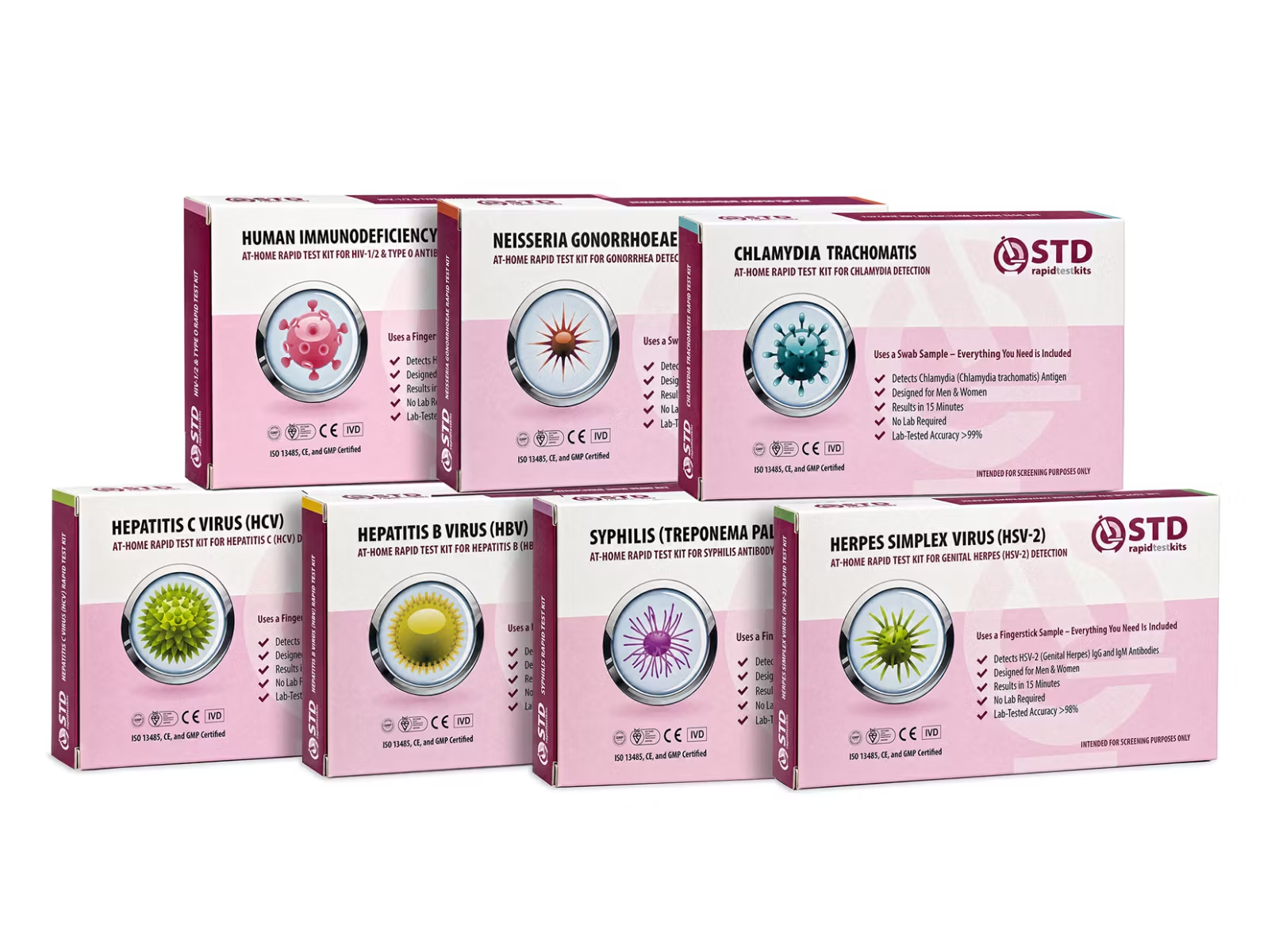
Most of the friction around STI testing is imagined rather than real. The process is short and ordinary. Depending on what you are screening for, a test uses one of three sample types:
- Urine sample. Standard for chlamydia and gonorrhea in many clinic and lab workflows.
- Self-collected swab. Vaginal or penile swab for chlamydia, gonorrhea, trichomoniasis, or HPV, depending on the kit. Throat or rectal swabs require a clinic; we do not offer those at-home.
- Fingerstick blood sample. Used for HIV, syphilis, hepatitis B, hepatitis C, and HSV antibodies. A small drop of blood from a finger prick is enough.
At-home rapid tests use lateral-flow immunoassays. That is a different technology from lab-run NAAT or PCR tests, which are the analytical gold standard for chlamydia and gonorrhea screening. Rapid tests trade some analytical sensitivity for speed, privacy, and no clinic visit. A positive rapid result is meaningful and worth acting on; a negative result inside the right window is reassuring; an inconclusive result is worth confirming in a lab.
Lab NAAT (nucleic-acid amplification testing) detects the pathogen's DNA or RNA and has the highest analytical sensitivity for chlamydia and gonorrhea. Rapid lateral-flow kits look for antigens or antibodies and trade some sensitivity for speed and privacy. Treat at-home rapid tests as screening tools; a positive result is worth confirming in a lab, and a clear negative inside the correct window is genuine reassurance.
Reading a Negative Result Correctly
A negative result inside the correct window is exactly what it sounds like: at the time of the test, with the technology used, no infection was detected. That is genuine reassurance and worth taking at face value. It is also a snapshot rather than a permanent statement about your future risk. Each new exposure resets the testing clock.
A negative result outside the window is less useful. If you tested for chlamydia at day 3, for example, the result does not yet reflect the exposure you are worried about. Plan a second test once the window closes, around 1 to 2 weeks for chlamydia and gonorrhea, 4 to 6 weeks for HIV and syphilis with a confirmatory at 12 weeks. Testing twice when timing is uncertain is part of how the math is supposed to work.
Retest if your first test fell before the window opened, or if you had a new exposure after the test. The rough retest milestones: chlamydia and gonorrhea at 1 to 2 weeks post-exposure; HIV and syphilis at 4 to 6 weeks with a confirmatory test at 12 weeks; HSV antibodies at 6 to 12 weeks, occasionally up to 16 weeks for slower-seroconverting assays.
If You Get a Positive Result
The hardest part of testing is usually the hour before the result, rather than what comes after. Most common STIs have well-established treatment pathways and good outcomes when caught early. Chlamydia and gonorrhea treat with antibiotics, often a single course. Syphilis treats with penicillin. Hepatitis B and HIV are long-term but highly manageable with modern medication; people on suppressive HIV therapy can reach an undetectable viral load and cannot transmit HIV sexually, per CDC HIV guidance on treatment as prevention.
A positive at-home rapid result is a strong signal to act on, rather than the end of the diagnostic process. The next step is confirmatory lab testing and a conversation with a clinician about treatment. Partner notification is part of that conversation; most jurisdictions have anonymous notification services if a direct conversation feels too hard. Acting on a positive early, while still in the asymptomatic window, can be the difference between a quick clean-up and a longer course of treatment.
Chlamydia and gonorrhea: antibiotics, often a single course. Syphilis: penicillin, with stage-dependent dosing. Trichomoniasis: short course of oral antibiotics. HIV: long-term antiretroviral therapy; suppressive treatment leads to an undetectable viral load and no sexual transmission. Hepatitis B and C: antiviral medication, with hepatitis C now curable in most cases. HSV: not curable but well-managed with episodic or suppressive antivirals.
The Myths That Quietly Keep People From Testing
A few beliefs make it easier to skip a test that would otherwise be a clear good idea. They sound reasonable, which is why they stick.
- "If I had something, I'd feel it." The data points the other way. Most chlamydia infections, roughly half of gonorrhea infections, and the initial stages of HIV and syphilis are commonly silent.
- "I'll wait and see." Symptoms may never appear, or may appear after the infection has been passed on or has progressed. Waiting trades early treatment for later, harder treatment.
- "It's probably nothing." Often true, statistically. Testing is the only thing that converts "probably" into a verified answer.
- "Tests are unreliable anyway." Modern lab NAAT testing is highly accurate for chlamydia and gonorrhea, and fourth-generation HIV testing reliably detects infection at 4 to 6 weeks. Window-period misuse drives most false negatives, rather than the tests themselves.
STDs are common but often have no signs or symptoms, which is why CDC recommends sexually active people get tested for STDs.
Time Your Test to Your Exposure
The shortest version of all of this: if exposure was possible, plan a test at the right window. Feeling fine does not weaken the case for testing; for most common STIs it describes the exact situation the screening guidelines were written for. A negative result inside the window is clarity. A positive result is information you can act on. Either way, you stop guessing.
The slower you are to test, the longer the uncertainty lasts, and the more time an infection has to do its quiet work or get passed on. Testing turns an open question into a specific answer you can act on. The mental loop stops when the result comes back.
FAQs
- Can you really have an STI and feel completely normal?
- Yes, and more often than people expect. Most chlamydia infections, roughly half of gonorrhea infections, and early-stage HIV often cause no symptoms. For common bacterial STIs, the absence of symptoms is closer to the rule than the exception.
- If nothing burns, itches, or looks unusual, is that a good sign?
- It is a positive signal, though an unreliable one on its own. Many STIs do not produce visible or sensory symptoms early on, and some never do. Symptoms are one signal among several; exposure timing is the more reliable input.
- Can I pass an STI to someone if I feel fine?
- Yes. Transmission does not require symptoms. People with asymptomatic chlamydia, gonorrhea, HSV-2, HPV, and early-stage HIV can still transmit the infection to partners. This is the main reason routine screening matters for sexually active people.
- What is the best time to test if I feel fine?
- It depends on what you are testing for. Around 1 to 2 weeks after exposure for chlamydia and gonorrhea, 4 to 6 weeks for HIV and syphilis using fourth-generation antigen-antibody testing, with a confirmatory test at 12 weeks. Testing earlier than the window can produce a false negative.
- Is testing without symptoms overkill?
- No. The CDC, WHO, and NHS all recommend periodic STI screening for sexually active people, with frequency depending on risk profile. Screening without symptoms is the standard of care.
- Do at-home rapid tests work without symptoms?
- Yes, when used at the correct window and following the kit instructions. Rapid lateral-flow tests are screening tools; a positive result is worth confirming with a lab test, and a negative result inside the window is meaningful reassurance.
- Should I test after protected sex if there were no symptoms?
- Sometimes. Condoms substantially reduce transmission risk without eliminating it, especially for skin-to-skin infections like HPV and herpes. If you do not know your partner's testing history, or if the condom slipped or broke, testing is the cleaner answer than guessing.
- How do I stop the mental loop of wondering?
- Test once the window has opened. Most people spend more time worrying than the test itself takes. A result, negative or positive, ends the mental loop and gives you something concrete to act on.
How We Sourced This Article: This guide pulls together current STI screening and testing guidance from the U.S. Centers for Disease Control and Prevention, the World Health Organization, the UK National Health Service, and Mayo Clinic. Where specific numbers are quoted, the cited source page contains the figure or a supporting range. Everything was reviewed for clinical accuracy by Aikaterini Maragkou, MD before publication.
- U.S. Centers for Disease Control and Prevention. Sexually Transmitted Infections (STI) overview and screening recommendations for sexually active adults.
- U.S. Centers for Disease Control and Prevention. HIV testing guidance, including window-period and fourth-generation antigen-antibody test detection timelines.
- U.S. Centers for Disease Control and Prevention. STI Treatment Guidelines, covering asymptomatic infection rates and treatment pathways for chlamydia, gonorrhea, and syphilis.
- World Health Organization. Sexually Transmitted Infections fact sheet, including global STI prevalence, transmission, and screening guidance.
- UK National Health Service. Overview of sexually transmitted infections, symptoms, and testing options.
- Mayo Clinic. Sexually transmitted diseases: symptoms, causes, complications, and when to seek testing.
