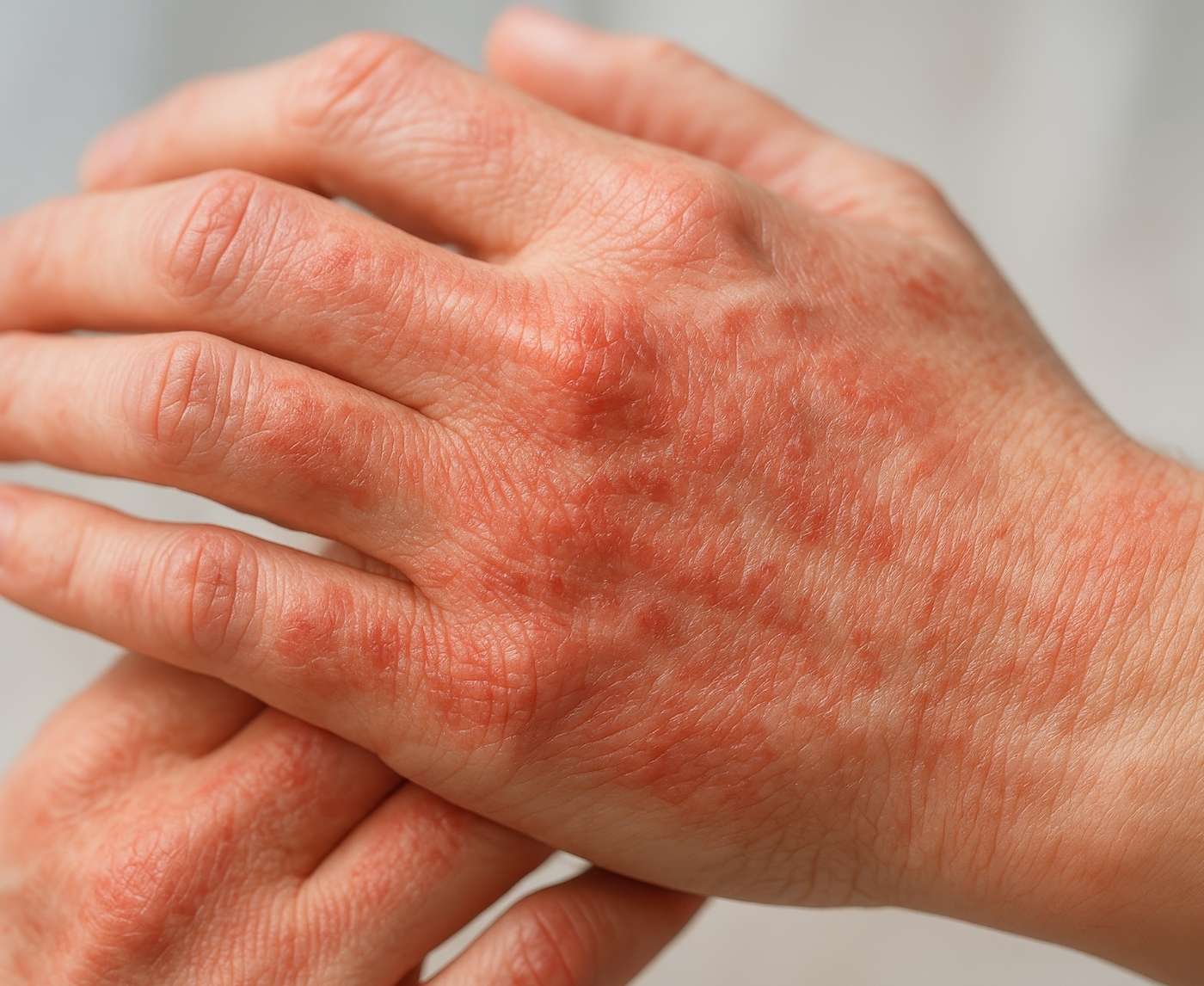
Published: October 2025 | Last updated: May 2026 | Editorial review and quality control: Martina N.
The first reaction after spotting a new genital blister is usually a phone search for “is this herpes?” Since the 2022 mpox outbreak, that question got more complicated. Lesions that used to be confidently chalked up to a herpes flare are sometimes turning out to be mpox, and mpox lesions are traveling through the same close-contact networks where classic sexually transmitted infections spread.
This article walks through how mpox blisters can look almost identical to herpes sores, primary syphilis chancres, and even chancroid ulcers. It covers the actual clinical differences, what an at-home STI kit can rule out in 15 minutes, and when to escalate to a clinician for an mpox-specific lesion swab. Most people who land here do not have mpox. They have a herpes recurrence, an ingrown hair, a yeast irritation, or another benign explanation. The goal of the next ten minutes of reading is to figure out which group you fall into and what step makes sense next.
Key Takeaways
- Mpox lesions can look nearly identical to herpes vesicles and primary syphilis chancres. Fever, swollen lymph nodes, and lesions in unusual locations are the clearest signals it might be mpox rather than a recurrence of an STI you already have.
- Rapid at-home STI kits screen for herpes, syphilis, chlamydia, gonorrhea, HIV, and hepatitis in about 15 minutes. Mpox itself still requires a clinician-collected lesion swab sent to a reference lab, so at-home tests are the rule-out, not the confirmation.
Why the Confusion Is So Common Right Now
Before 2022, mpox was rare outside a handful of West and Central African countries. The global outbreak that began that year changed both the geography and the presentation. Many of the new cases involved lesions on the genitals, perianal area, and mouth, rather than the classic centrifugal rash pattern starting on the face and spreading outward. That shift put mpox squarely into the clinical territory of common STIs.
Clinicians began seeing patients who had been diagnosed with “atypical herpes” for years, then turned out to be mpox. Others arrived convinced their genital sore was a new herpes infection and tested positive for mpox instead. The overlap is wide enough that visual diagnosis alone is unreliable. Three points anchor the rest of this article.
- Mpox lesions can appear on the genitals, anus, and mouth, not only on hands, feet, and face.
- Mpox spreads primarily through prolonged skin-to-skin contact, which includes sex without being limited to it.
- Mpox lesions overlap visually with several STIs at different stages of their progression.
Symptoms of Mpox That Look a Lot Like STIs
The visible signs of mpox (blisters, pustules, scabs) are also exactly what someone with herpes, syphilis, or chancroid might present with. That overlap is the source of most misdiagnoses, especially during the first 48 hours after lesions appear.
Mpox symptoms that commonly overlap with STI symptoms:
- Blisters or pustules around the genitals, anus, or mouth.
- A rash that begins flat (macular), becomes raised (papular), then fluid-filled (vesicular or pustular).
- Painful ulcers once blisters break open.
- Swollen, tender lymph nodes in the groin or neck.
- Flu-like symptoms in the days before lesions appear: fever, chills, body aches, headache, fatigue.
The flu-like prodrome is the most useful early signal. Classic genital herpes recurrences rarely produce systemic symptoms after the initial outbreak. If a person who has been managing herpes for years suddenly gets a fever and swollen lymph nodes with their lesions, that combination warrants ruling out mpox.
Quick Comparison: Mpox vs. Common STI Lesions
The four conditions above share enough features to fool a quick glance. The differences emerge when you look at the full picture: lesion morphology, pain level, accompanying systemic symptoms, and time course. The table below organizes those differences in one place.
| Condition | Lesion appearance | Other symptoms | Key distinguishing feature |
|---|---|---|---|
| Mpox | Firm, deep-seated blisters or pustules, often with a central depression; eventually scab | Fever, fatigue, swollen lymph nodes (often before the rash appears) | Flu-like prodrome and lesions in unusual places for the patient |
| Genital herpes (HSV-1 or HSV-2) | Cluster of small, thin-walled vesicles that break and crust | Tingling, itching, or burning before the outbreak; usually no fever after the first episode | Recurs in the same anatomical area; rarely systemic after first outbreak |
| Primary syphilis | Single painless ulcer (chancre) with firm rolled edges | Often no other symptoms at the chancre stage | Painless, single, and may heal on its own; spirochete is still active |
| Genital warts (HPV) | Flesh-colored papules or cauliflower-textured growths | Usually painless and asymptomatic | Slow-growing, do not blister or scab |
| Chancroid | Soft, painful ulcer with ragged undermined edges and exudate | Tender swollen inguinal lymph nodes | Painful (in contrast with the painless syphilitic chancre) |
Why Mpox Often Gets Misread as a Herpes Flare
Clinicians at urgent-care and sexual-health clinics have reported a consistent pattern since 2022. A person living with diagnosed genital herpes notices new lesions and assumes a recurrence, then arrives several days later with fever, swollen lymph nodes, and lesions spreading outside their usual outbreak zone. What shifts the diagnosis is rarely the appearance of the lesion itself; it is the systemic illness around it. Fever, swollen lymph nodes, and lesions in unexpected locations are the signals that point toward mpox.
Two factors make this misread common. First, anyone with chronic genital herpes is used to the visual pattern of a recurrence and is unlikely to seek testing for a new lesion in the same area. Second, mpox lesions in the early macular and papular phase resemble small herpes vesicles, especially before they progress to the firmer, more characteristic deep-seated form. Without lab testing, both clinicians and patients can easily attribute everything to the more familiar diagnosis.
The practical rule: any change in pattern (new lesion locations, systemic symptoms, slower healing, or unusual severity) warrants asking specifically about mpox testing, rather than just an antiviral refill. (Disclosure: stdrapidtestkits.com sells rapid lateral-flow home STI tests; the kit referenced below is from our own catalog.)
- New lesion locations outside the patient’s usual outbreak zone.
- Systemic symptoms (fever, chills, fatigue, swollen lymph nodes).
- Slower healing than the patient’s typical herpes recurrence.
- Unusual severity, deeper-seated lesions, or a central depression on individual sores.
Any one of these signals, in someone whose herpes outbreaks normally run a predictable course, is reason to ask a clinician about mpox testing rather than treat empirically.
Is Mpox an STI?
Formally, mpox is not classified as a sexually transmitted infection in the way chlamydia, gonorrhea, syphilis, or HIV are. The virus does not require sexual contact to transmit. It can spread through any prolonged skin-to-skin contact, contact with contaminated bedding or towels, and respiratory droplets during sustained face-to-face contact.
Functionally, however, the practical advice for sexually active adults overlaps heavily with STI prevention. The WHO mpox fact sheet documents that during the 2022 outbreak, most reported transmission chains involved intimate skin-to-skin contact, including vaginal, oral, and anal sex. Lesions frequently appeared on the genitals, perianal area, and mouth, which are the same anatomical regions where STI symptoms are typically reported.
A person does not need to have had sex to contract mpox, although sexual contact is one of the most efficient transmission opportunities. The practical screening question (“have you had close contact with someone who later developed a rash?”) sits inside the same conversation as a standard sexual-health history.
Mpox is not classified as an STI by public-health agencies because the virus can transmit through any prolonged close contact. In practice, however, most documented cases since 2022 came from intimate skin-to-skin contact during sex. The classification is a virology question; the prevention habits (talking with partners, checking for new lesions, pausing intimate contact during outbreaks) are the same ones used for STIs.
How Mpox Actually Spreads
Unlike chlamydia or gonorrhea, which depend on direct mucosal exposure to infected fluids, mpox spreads through several routes that include sexual contact but extend well beyond it. The volume of contact matters more than the type. Brief incidental contact (a handshake, a passing brush in a crowd) is unlikely to transmit. Sustained skin-to-skin contact during sex, cuddling, or sharing a bed is the high-yield transmission scenario, which is why most documented cases during outbreak periods cluster within intimate-contact networks.
- Direct contact with mpox lesions, scabs, or body fluids from an infected person.
- Touching items recently used by an infected person, including bedding, towels, and clothing that have not been laundered or disinfected.
- Prolonged face-to-face contact, particularly when oral lesions are present, through respiratory droplets and saliva.
- Sex (vaginal, oral, or anal), which combines all of the above into a single high-contact event.
What to Do If You Think You Have Mpox
The first step is not to self-diagnose. Mpox confirmation requires a lesion swab collected by a clinician and processed at a public-health or reference laboratory. No FDA-approved at-home mpox test exists yet. The role of at-home testing here is to rule out the common STIs that present similarly, so the clinician can focus the lesion swab on mpox-specific PCR.
A reasonable sequence:
- Run a full at-home STI panel for herpes, syphilis, chlamydia, gonorrhea, and HIV to get baseline data.
- If those come back negative and lesions persist or worsen, contact a clinician and explicitly ask about mpox testing. Many clinics will not test reflexively.
- Until results are clear, avoid close skin-to-skin contact and sexual activity. Cover lesions with clean dry bandages where possible.
- Wash hands frequently. Launder bedding, towels, and clothing on the hottest setting the fabric will tolerate.
If lesions appear and a known contact has been diagnosed with mpox, some clinicians will move directly to lesion swabbing without waiting for STI results. Public-health departments may also offer post-exposure vaccination within the first few days of exposure to prevent or reduce the severity of infection.
Ask your clinician directly about mpox testing if any of the following apply: STI tests have come back negative but lesions persist, you have flu-like symptoms alongside the rash, lesions are appearing in places your past herpes outbreaks have never reached, or you have had recent close contact with someone diagnosed with mpox. Routine STI panels do not include mpox.
When Mpox and Herpes Co-Exist
Co-infection is possible and increasingly documented during outbreak periods. A person with chronic genital herpes can also contract mpox, and the two infections can present concurrently. When that happens, the visual presentation gets harder to read because the patient may have two different lesion types in the same anatomical region simultaneously.
- Longer healing time than the patient’s usual herpes recurrence.
- New fever or chills that did not accompany prior outbreaks.
- Swollen lymph nodes in the groin or neck.
- Lesions appearing in locations the patient has never seen before.
None of these is definitive on its own. The combination is suggestive enough that a clinician should test for both.
How Mpox Lesions Typically Progress
The standard mpox lesion progression spans roughly two to four weeks from first appearance to full resolution. The phases are reasonably consistent, even though the timing and number of lesions vary significantly between patients:
- Macular phase: flat red or skin-colored spots, often a few millimeters across, sometimes mistaken for ingrown hairs or bites.
- Papular phase: spots become raised, firm, and palpable.
- Vesicular phase: lesions develop clear or yellowish fluid inside.
- Pustular phase: fluid becomes opaque or yellowish-white; this is when the deep-seated, central-dimple appearance is most pronounced.
- Scabbing phase: lesions crust over.
- Resolution: scabs fall off, fresh skin forms underneath.
Unlike herpes recurrences, which tend to follow a predictable pattern in the same anatomical area each time, mpox lesions can appear in clusters or scattered across multiple body areas: genitals, anus, thighs, mouth, chest, and even palms and soles. The progression also moves more slowly than a typical herpes outbreak, which usually crusts and resolves within seven to ten days.
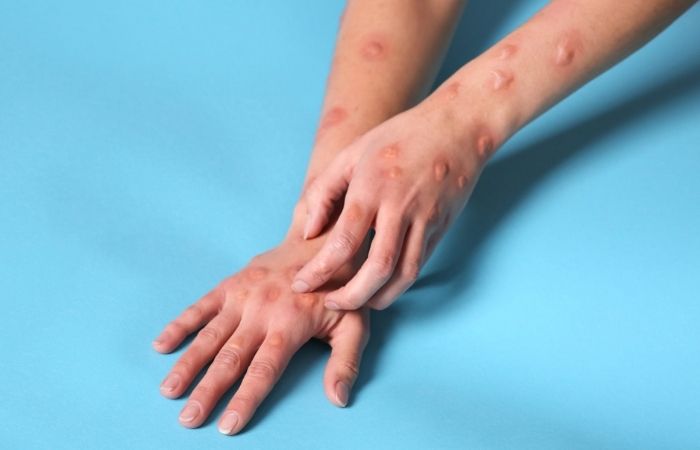
Blister Breakdown: What Lesions Can and Cannot Tell You
The temptation when a new bump appears is to compare it against photos online and decide on a diagnosis. Visual inspection alone is not reliable, even for clinicians, because so many infections produce similar-looking sores in the early stages. Pattern matching narrows the possibilities. It does not replace laboratory confirmation.
The table below summarizes the most useful differentiators (timing, pain level, and typical location) so a reader can have an informed conversation with a clinician rather than a fearful guess.
| Condition | Blister appearance | Timing and progression | Pain level | Typical location |
|---|---|---|---|---|
| Mpox | Firm, deep-seated, often with a central depression; scab over time | Lesions appear 1 to 3 days after flu-like symptoms; evolve over 2 to 4 weeks | Moderate to severe | Genitals, anus, face, hands, chest; can be scattered |
| Herpes (HSV-1 or HSV-2) | Cluster of small, thin-walled fluid-filled blisters that crust | 1 to 2 weeks post-exposure for first episode; recurrent flares possible | Burning, stinging, tingling | Genitals, anus, thighs, buttocks, lips |
| Primary syphilis | Single painless ulcer (chancre) with firm rolled edges | Typically weeks to months after exposure; heals in 3 to 6 weeks on its own | Painless, although the spirochete is still active | Genitals, anus, mouth |
| Chancroid | Soft, painful ulcer with ragged undermined edges | 4 to 10 days post-exposure; often with tender swollen lymph nodes | Very painful | Primarily genitals |
| Genital warts (HPV) | Flesh-colored papules; cauliflower texture in clusters | Weeks to months after exposure; slow to develop | Usually painless | Genitals, anus |
Testing Discreetly From Home
At-home rapid kits cannot confirm mpox, although they are useful for ruling out the STIs whose lesions overlap with mpox visually. Negative results on a comprehensive STI panel give a clinician a clearer reason to focus on mpox-specific lesion swabbing, and they save the patient one or two clinic visits at a stage when they may be feeling unwell or self-conscious.
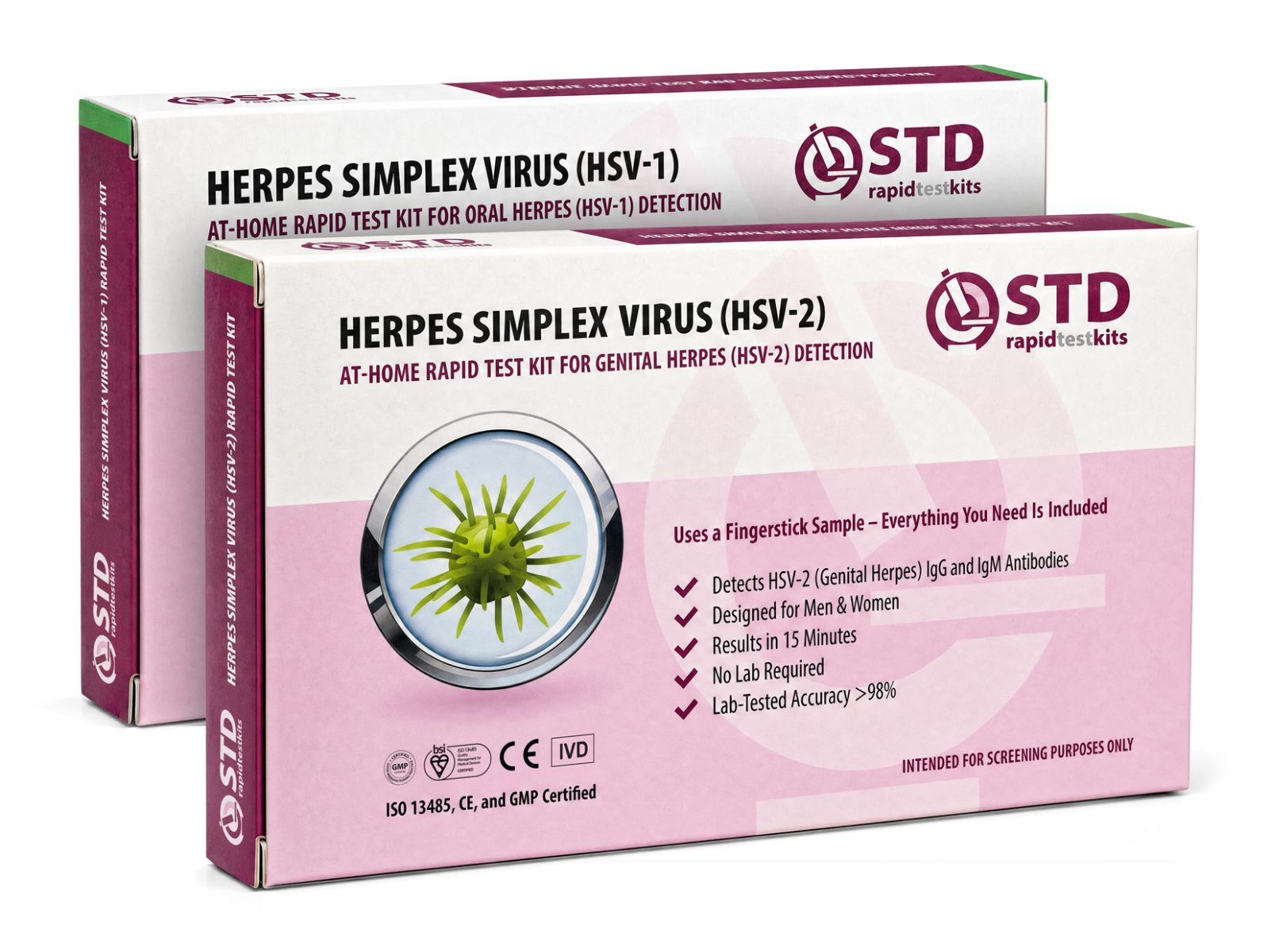
The 6-in-1 panel covers the differentials most likely to be confused with mpox: herpes, syphilis, chlamydia, gonorrhea, hepatitis B, and HIV. Results read in about 15 minutes, the samples are self-collected (a finger-prick blood draw plus self-swab), and there is no clinic queue. At-home results complement the clinic appointment. Arriving with documented negatives lets the clinician skip the standard STI re-run and move directly to mpox-specific swabbing.
Mpox spreads through close, often skin-to-skin contact, including direct contact with the rash, scabs, or body fluids of someone with mpox. The illness usually lasts 2 to 4 weeks. Most people recover fully without treatment.
Frequently Asked Questions
- Is mpox sexually transmitted?
- Practically yes, even though the virology is broader. Most documented transmission during the 2022 outbreak involved intimate skin-to-skin contact, so apply STI-prevention thinking even though the underlying virus does not technically require sexual contact to spread. The textbook classification still puts mpox outside the formal STI category.
- How can I tell if it is herpes or mpox just by looking?
- Visual diagnosis alone is unreliable. Both cause clusters of small fluid-filled blisters in the genital area. Two signals that point toward mpox over herpes: flu-like systemic symptoms in the days before lesions appear (fever, chills, swollen lymph nodes), and lesions in places where prior herpes outbreaks have never appeared. Laboratory testing (a clinician-collected lesion swab for mpox and a separate herpes PCR or culture) is the only definitive way to tell them apart.
- Can syphilis be mistaken for mpox?
- Yes. A primary syphilis chancre is a single round painless ulcer with firm rolled edges. Mpox can also present as a single deep-seated firm lesion with a central depression. Both can occur on the genitals, mouth, or anus. Negative herpes testing combined with persistent or worsening sores justifies asking a clinician about both syphilis blood testing and an mpox lesion swab.
- Can I swab at home for mpox?
- No. Mpox testing requires a clinician-collected lesion swab processed at a public-health or commercial reference lab. Rapid at-home antigen tests for mpox are not currently available in the US or UK consumer market. At-home rapid kits for herpes, syphilis, HIV, chlamydia, and gonorrhea are available and can rule those infections in or out before pushing for mpox-specific testing.
- How long am I contagious if I have mpox?
- Until every scab has fallen off and fresh skin has formed underneath, which usually takes 2 to 4 weeks. The contagious window starts the moment symptoms appear. Avoid sharing towels or bedding throughout, and pause sex and close skin-to-skin contact for the whole period.
- Do condoms prevent mpox transmission?
- Condoms reduce the risk without eliminating it. Because mpox spreads through skin-to-skin contact with any lesion, and lesions can appear on the thighs, buttocks, abdomen, hands, or mouth (anywhere skin contact happens), a condom only protects the area it physically covers. Active lesions anywhere on the body should pause all intimate contact, condoms or not.
- I tested negative for STIs but still have blisters. What now?
- This is a reasonable point to escalate to a clinician for mpox-specific testing, particularly with any close contact to someone who was sick, attendance at a high-density event, or systemic symptoms (fever, fatigue, swollen lymph nodes). Bringing documented negative at-home STI results to the appointment helps the clinician decide what to test next without re-running the same panels.
- Can I kiss or cuddle someone if I might have mpox?
- While active or unhealed lesions are present, no. Mpox can transmit through saliva contact when oral lesions are present, and through prolonged skin-to-skin contact even without intercourse. The CDC recommends isolation from household contacts where possible until lesions have fully resolved. The infection resolves on its own for most healthy adults, so the contact pause is finite and not indefinite.
How we sourced this article: This guide synthesizes current public-health guidance from the U.S. Centers for Disease Control and Prevention, the World Health Organization, and the UK National Health Service on mpox transmission, presentation, and testing. Comparative STI symptom and lesion information is drawn from the corresponding CDC topic pages for genital herpes, syphilis, and sexually transmitted infections. Editorial framing focuses on differentiating mpox from common STIs at the point where readers are most likely to be confused: a new genital lesion of unknown origin.
- U.S. Centers for Disease Control and Prevention. Mpox information center, covering signs, symptoms, transmission routes, and lesion progression stages.
- World Health Organization. Mpox fact sheet, including transmission, symptom timeline, vaccination, and management guidance.
- U.S. Centers for Disease Control and Prevention. Genital herpes information page, used for HSV symptom and recurrence pattern context.
- U.S. Centers for Disease Control and Prevention. Syphilis information page, used for chancre morphology and primary-stage timing.
- UK National Health Service. Mpox patient information page, used for UK-relevant isolation and clinician-contact guidance.
- U.S. Centers for Disease Control and Prevention. Sexually transmitted infections overview, used for the differential-diagnosis context across STI conditions.
