Published: October 2025 | Last updated: May 2026 | Editorial review and quality control: Martina N.
At-home HIV tests have shifted from a niche product to a routine option in the past decade. The U.S. Food and Drug Administration approved the first over-the-counter HIV test in 2012, and global health agencies now endorse self-testing as a way to reach people who otherwise might never set foot in a clinic. The promise is real: a private, fast result you can take in your own bathroom. The honest caveats are also real, and they matter. A test taken too soon, read incorrectly, or interpreted without context can leave you more confused than before you started.
This guide walks through what an at-home HIV test actually does, when its results are trustworthy, and what to do when something is unclear. The goal is for you to leave with enough understanding to decide whether the kit on your bathroom shelf is the right tool for your situation, and to know your next step regardless of what the lines show.
Key Takeaways
- FDA-approved at-home HIV tests are highly reliable when used at least 12 weeks after a possible exposure; testing earlier risks a false negative because the body has not yet produced detectable antibodies.
- Any reactive (positive) home result needs a confirmatory laboratory test before you can be sure of the diagnosis. A faint second line still counts as reactive.
Who Uses At-Home HIV Tests, and Why It Matters
The audience for self-testing is broader than people sometimes assume. Public-health research backs self-testing as an effective entry point to care because it reaches people who delay or avoid clinic-based testing for reasons that range from stigma to cost to logistics. The World Health Organization formally recommends HIV self-testing as part of a comprehensive testing approach, and dozens of countries now include it in their national HIV strategies (WHO HIV/AIDS fact sheet).
The typical reader profiles include:
- Someone who had a condom break and wants an early screen, with a planned retest at the 12-week mark.
- A person in a small town where the nearest sexual-health clinic is far away or where the receptionist is a neighbor.
- A traveler returning from a high-prevalence region who wants to confirm their status before resuming a sexual relationship.
- People in long-term partnerships who want to test together as a relationship-health check-in.
- Anyone who has never tested before and feels less anxious about a private at-home process than a waiting-room conversation.
For each of these readers, the calculus is similar: the test offers control, privacy, and a result on your own timeline. What it does not offer is the back-up of a clinician sitting next to you to interpret an ambiguous result. That responsibility falls on you, with help from the manufacturer's support hotline and the rest of this article.
The World Health Organization issued formal guidance in 2016 endorsing HIV self-testing as a complement to clinic-based testing, citing improved access for people who face stigma, cost, distance, or privacy barriers. Self-testing is now part of national HIV strategies in dozens of countries, and the U.S. Food and Drug Administration has approved an at-home HIV test for over-the-counter sale since 2012.
What Counts as an At-Home HIV Test?
Two broad families of products are marketed as at-home HIV tests, and they work differently enough that the choice between them affects how you should plan around your result.
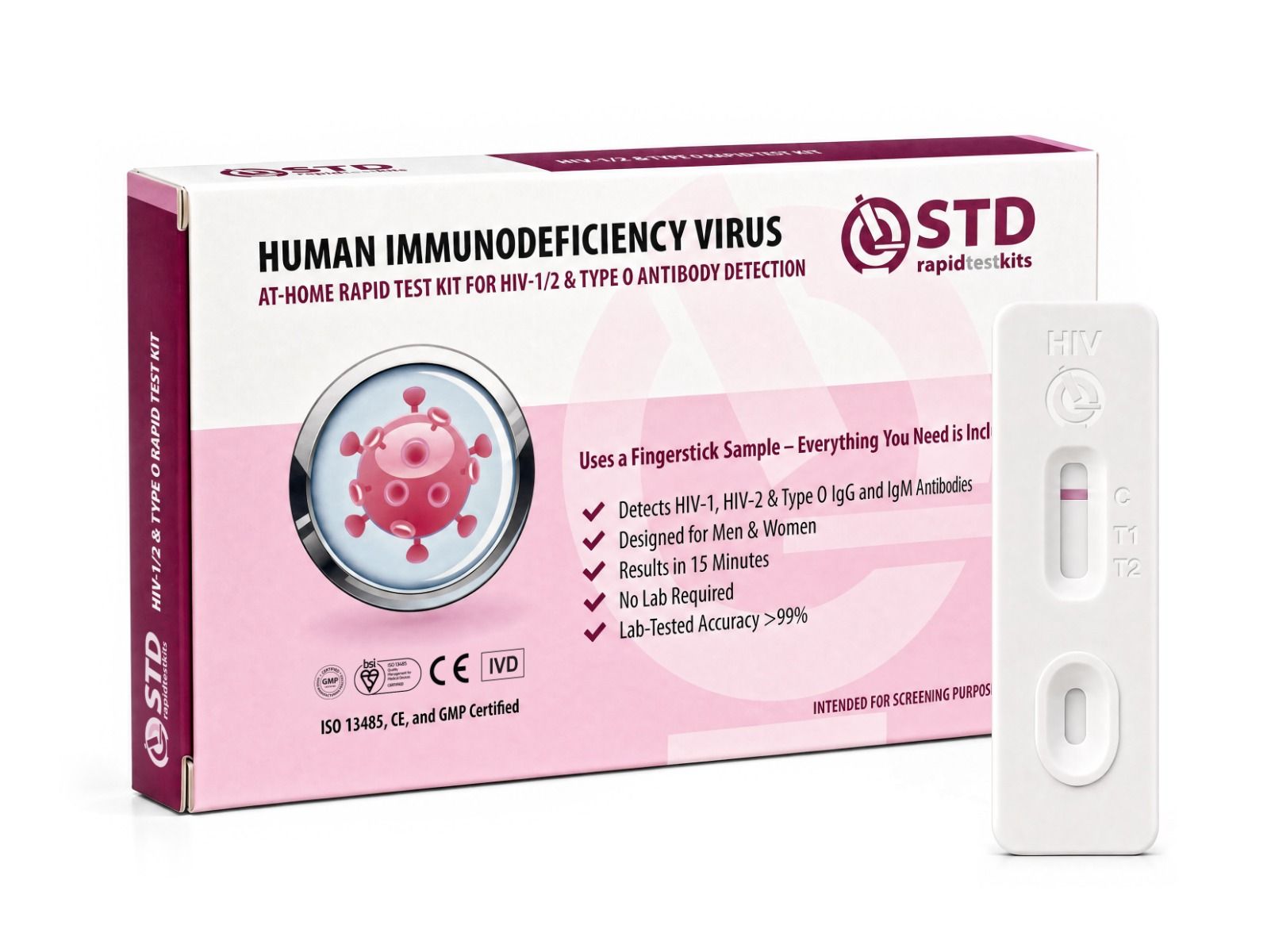
The first family is the rapid self-test, sometimes called a true home test. You collect the sample yourself (an oral fluid swab of the gum line, or a fingerstick drop of blood), wait the specified read time (usually 15 to 20 minutes), and read the result yourself by counting the lines on a lateral-flow strip. No mailing, no lab, no waiting period beyond the read window. OraQuick In-Home is the FDA-approved oral version most familiar to U.S. readers; fingerstick rapid kits use the same lateral-flow chemistry on capillary blood.
The second family is the mail-in collection kit. You collect a sample at home (usually a fingerstick blood draw onto a sample card, or a small vial of saliva), seal it, and mail it to a CLIA-certified (Clinical Laboratory Improvement Amendments-certified) laboratory. The lab runs a standard antigen/antibody or nucleic-acid test and reports the result through a secure portal a few business days later. This is a lab test where you handled only the collection step at home, so its sensitivity matches a clinic-drawn lab test.
Each format has tradeoffs. Rapid self-tests give you immediate results and zero shipping but rely on antibodies, which take longer to appear after exposure. Mail-in kits with 4th-generation antigen/antibody chemistry can detect HIV earlier (typically 18 to 45 days after exposure) but introduce a 3 to 7 day mail-and-process delay.
When you order, confirm three things: the test is FDA-approved (or, outside the U.S., approved by your national health authority), the expiration date is well in the future, and the seller publishes clear instructions for what to do if your result is reactive.
Rapid self-test (e.g., OraQuick In-Home, fingerstick rapid kits): antibody-based lateral flow; about 12 weeks after exposure for reliable detection; result read at home in 15 to 20 minutes; nothing leaves your house.
Mail-in lab kit (4th-generation antigen/antibody): sample collected at home, processed at a CLIA-certified laboratory; about 18 to 45 days after exposure for reliable detection; result returned through a secure portal in 3 to 7 days; creates a lab record under your control.
Timing Matters: Understanding the Window Period
This is where most people lose confidence in their result, and where the most painful misunderstandings happen.
The window period is the gap between exposure to HIV and the moment a test can detect it. It exists because no test detects the virus the second it enters the body. Antibody tests (which is what every U.S.-approved at-home rapid test is) need your immune system to manufacture antibodies in detectable quantities first, and that takes weeks. Antigen/antibody tests, used at labs, can detect viral protein earlier but still need at least 18 to 45 days post-exposure for reliable detection (CDC HIV testing overview).
A negative test inside the window does not mean you are HIV-negative. It means the test could not yet detect HIV if it were there. Plenty of people retest after a real exposure and find out they were positive all along, simply outside the antibody window the first time.
The table below summarizes typical detection windows by test family.
| Test type | Sample | Earliest reliable detection | Recommended retest timing |
|---|---|---|---|
| Oral fluid rapid test (e.g., OraQuick In-Home) | Saliva from gum line | About 12 weeks post-exposure | Retest at 12 weeks if first test was earlier |
| Fingerstick rapid antibody test | Capillary blood | About 12 weeks post-exposure | Retest at 12 weeks if first test was earlier |
| Mail-in 4th-generation antigen/antibody test | Capillary blood (collection card) | About 18 to 45 days post-exposure | Retest at 6 weeks if first test was earlier |
| Lab-based nucleic acid test (NAT) | Venous blood | About 10 to 33 days post-exposure | Used in clinic settings; retest per clinician |
Faint Lines, False Negatives, and Reading Results
Lateral-flow tests use a simple line system. One line in the control window means the test ran correctly and the result is non-reactive (negative). Two lines, regardless of how faint the second one is, means the test is reactive and you need a confirmatory lab test.
Read your test inside the window the manufacturer specifies. For OraQuick In-Home, the read window is 20 to 40 minutes after the test starts; results read after 40 minutes are not reliable. Lines that develop only after the read window are not valid and do not indicate a true reactive result.
False negatives at home are most often a timing issue, not a kit defect. The next most common cause is a poorly collected sample (an oral swab that did not contact the gum line firmly, a fingerstick that did not produce enough blood). False positives also occur but are uncommon; the FDA-approved labeling for the OraQuick In-Home Test reports a specificity of about 99.98 percent, meaning roughly 2 in 10,000 negative samples will produce a false reactive line.
Treat any reactive home result as a screening signal that requires laboratory confirmation. The standard of care is to follow up with a clinician for a confirmatory test (typically a 4th-generation antigen/antibody assay plus, if needed, an HIV-1/HIV-2 differentiation immunoassay or a nucleic acid test). Most kits include a 24-hour support number; call it, take notes, and book the confirmatory test before you make any other decisions about the result.
If your home test shows a second line of any darkness:
- Call the kit's 24-hour support number for guidance on local confirmatory options.
- Book a clinician-administered 4th-generation antigen/antibody test at a clinic, urgent-care center, or telehealth provider.
- Avoid sex with new partners, or use barrier protection consistently, until the confirmatory result is in hand.
- If the possible exposure was in the past 72 hours, ask about post-exposure prophylaxis (PEP) the same day you call.
Is It Really As Accurate As a Lab Test?
Short answer: it depends on which lab test you are comparing against and at what point in time you are testing.
For someone past the 12-week mark since their last possible exposure, a properly used at-home antibody test and a clinic-administered antibody test will agree the vast majority of the time. According to the FDA-approved product labeling, the OraQuick In-Home Test reports about 92.0% sensitivity and 99.98% specificity in its home-use validation study. That sensitivity figure is intentionally conservative; it accounts for user error in the home environment, not just analytical accuracy. The FDA's regulatory information on approved blood and biologic products is published at fda.gov.
For someone testing inside the early-detection window, a 4th-generation antigen/antibody test run at a laboratory is more sensitive than any home antibody test on the market. Labs can detect HIV antigen (p24) within roughly 18 to 45 days of exposure, weeks before the antibody response is detectable on a home strip.
The other axis is what happens after a reactive result. A clinic test is followed up automatically with confirmatory assays as part of the standard testing algorithm. With a home test, you carry the follow-up step yourself, which is why the support hotline and the clinic referral pathway matter alongside the strip itself.
How accurate is an at-home HIV test?
FDA-approved at-home HIV tests are highly accurate when used at the right time. The OraQuick In-Home Test, the only over-the-counter HIV test approved by the U.S. FDA, reports about 92% sensitivity and 99.98% specificity in its home-use validation study (FDA-approved product labeling). Accuracy depends on testing at least 12 weeks after a possible exposure; earlier testing risks a false negative because antibodies may not yet be detectable. A reactive home result always needs a confirmatory lab test before it counts as a diagnosis.
| Test method | Privacy | Detection window | Speed | Best use case |
|---|---|---|---|---|
| At-home oral fluid rapid test | Maximum (no record outside your home) | About 12 weeks post-exposure | About 20 minutes | Private screening at least 12 weeks after exposure |
| At-home fingerstick rapid test | Maximum (no record outside your home) | About 12 weeks post-exposure | About 15 to 20 minutes | Private screening at least 12 weeks after exposure |
| Mail-in 4th-generation lab kit | High (CLIA lab record) | About 18 to 45 days post-exposure | 3 to 7 days after mailing | Earlier detection with private results |
| Clinic-based 4th-generation test | Moderate (clinic record) | About 18 to 45 days post-exposure | Same day to 2 days | Recent high-risk exposure, symptomatic, or confirmation |
When to Retest and When to Get Help
Retesting is part of the standard testing process for HIV. It does not signal that the first test failed. The CDC recommends retesting in two specific situations:
- You tested inside the window period and need to confirm a negative result. Retest at 12 weeks for any at-home antibody test, or at about 6 weeks if you used a 4th-generation lab test.
- You had a new possible exposure since your last negative test. Each new potential exposure starts a new window.
If your home test is reactive (any line, any darkness in the test window), the next step is a clinician-administered confirmatory test, usually a 4th-generation antigen/antibody assay followed by an HIV-1/HIV-2 differentiation immunoassay if the first test is positive. Most home kits include a free 24/7 support hotline; call it for guidance on local clinics, telehealth options, and counseling.
Practical next steps after a reactive home result:
- Call the support number on the test packaging.
- Book a 4th-generation blood test through a clinic, urgent-care center, or telehealth provider.
- Avoid sex with new partners (or use barrier protection consistently) until you have a confirmed result.
- If your confirmatory test is positive, your clinician will discuss starting antiretroviral therapy. Modern treatment can reduce your viral load to undetectable, at which point sexual transmission to partners becomes effectively zero (CDC on HIV treatment).
If your possible exposure was within the past 72 hours and you are worried about transmission, talk to a clinician immediately about post-exposure prophylaxis (PEP). PEP is a 28-day course of HIV medication that can prevent infection if started within 72 hours of a high-risk exposure (CDC PEP guidance).
Negative result inside the window: retest at 12 weeks for at-home antibody tests, or at about 6 weeks if you used a 4th-generation lab kit.
Reactive (positive) home result: book a clinician-administered 4th-generation confirmatory test the same week. Use the support number on your kit packaging if you need help finding a clinic.
Possible exposure in the past 72 hours: ask a clinician about PEP today. The 72-hour clock starts at the moment of exposure.
Real-World Patterns: How People Actually Use These Tests
Public-health counselors and HIV care navigators describe a few recurring patterns in how at-home tests are used. None of them are dramatic; most are quiet decisions made on a Sunday evening or a Tuesday morning before work.
The most common is the post-incident screen. A condom failed, a hookup happened during a relationship break, an inebriated decision feels different in the morning. The reader orders a test, takes it within days, gets a negative, and feels relieved. The relief is partly real and partly premature; the test was inside the window, and a follow-up at the 12-week mark is what closes the loop. Counselors flag this as the single most common point of confusion, because the early reassurance can keep people from completing the retesting they need.
Another pattern is the routine self-screen, often used by people on PrEP or in established mixed-status partnerships. Here the at-home kit is an everyday hygiene tool rather than a crisis response, and the user already understands the window-period math.
A third pattern is the long-deferred first test. Someone has avoided testing for years because of fear, stigma, or systemic barriers. The privacy of an at-home kit is what finally lets them test. For this reader, the value of the experience comes from breaking a years-long avoidance pattern. Getting any result, positive or negative, becomes the entry point into knowing what to do next.
Three common ways readers use at-home HIV tests
- Post-incident screen: a screening test taken in the days after a possible exposure, then repeated at the 12-week mark for the actual answer.
- Routine self-screen: a regular at-home check-in for someone on PrEP or in an established mixed-status partnership.
- Long-deferred first test: the test that someone finally takes after years of avoiding clinic-based testing because of stigma, cost, or distance.
Privacy and Discretion
Privacy is often the deciding factor for someone choosing between a home kit and a clinic visit. Reputable suppliers ship in plain packaging with no condition listed on the box, billing descriptors that do not reference HIV or sexual health, and shipping addresses that you control. You can ship to a friend, a parcel locker, or a participating pharmacy if you do not want a kit at your home address.
Your test data is also private in most cases. FDA-approved at-home rapid kits do not transmit your result anywhere; the result lives only on the test strip and in your memory. Mail-in collection kits do create a digital record at the lab, but you control who sees it: typically only you and any clinician you authorize to receive a copy.
If you live in a household where mail is shared, parcel lockers and pharmacy pickup points are practical options. Many U.S. pharmacies stock OraQuick over the counter, allowing fully cash, in-person purchase with no mailing record at all.
If a kit at your home address feels too visible, consider one of these alternatives:
- Parcel locker: ship to an Amazon Hub, USPS PO Box, or carrier locker you control.
- Trusted friend: ship to someone whose mail you can collect privately.
- Pharmacy pickup: many U.S. pharmacies stock OraQuick over the counter for cash purchase.
- Generic shipping name: reputable online sellers ship in unbranded packaging with discreet billing descriptors by default.

What Can Go Wrong: Misuse, Expired Kits, and Reading Errors
Even a good kit can produce a misleading result if it is mishandled. The most common preventable issues:
Expired kits. The reagents on lateral-flow strips degrade over time. An expired kit can produce a false negative or an invalid result (no control line). Always check the printed expiration date before use; if it has passed, do not run the test.
Improper storage. Most kits specify a storage temperature range (usually 2 to 30 degrees Celsius, or about 36 to 86 degrees Fahrenheit). A kit left in a hot car, freezing mailbox, or steamy bathroom can produce unreliable results. If you suspect temperature damage, request a replacement.
Sample collection errors. Oral fluid kits require a firm sweep along the upper and lower gum line; a quick lick or a swab that misses the gum tissue produces too little sample. Fingerstick kits need a free-flowing drop of capillary blood; a cautious squeeze that produces only a smear is not enough.
Reading too early or too late. Strips read before the manufacturer's window may show a control line that has not fully developed. Strips read after the window can develop late lines that do not represent a true reactive result. Set a timer and read at the specified moment.
If you suspect any of these issues, order a fresh kit from the same verified supplier and retest before you act on a result.
Is It Approved, Safe, and Regulated?
The FDA approved OraQuick In-Home in July 2012 as the first over-the-counter HIV test in the United States, and the agency continues to maintain regulatory oversight of the product through its approved blood and biologic products program. Globally, the World Health Organization issued formal guidelines in 2016 endorsing HIV self-testing as a complement to facility-based testing, and self-testing is now part of national HIV strategies in dozens of countries.
What that approval means in practice: the test has been validated in real-world home use, the labeling reflects realistic accuracy figures (which include some user error), and the manufacturer is required to provide a 24-hour support hotline.
What it does not guarantee is that every kit sold online is the same product. Counterfeit and unauthorized HIV test kits do circulate, particularly through unregulated online marketplaces. The safest path is to buy from a vendor who explicitly states FDA approval (or the equivalent national approval where you live), ships kits with intact tamper seals, and provides clear support contacts.
Concrete warning signs when shopping: no manufacturer name on the listing, no expiration date in the product details, no support contact for a reactive result, or pricing dramatically below the published retail range for an FDA-approved kit. Any one of these is reason to close the tab and buy from a verified seller instead.
It does guarantee: the test design has passed home-use validation; the labeling reflects real-world accuracy figures; the manufacturer must provide a 24-hour support hotline; the product can be sold over the counter in the U.S.
It does not guarantee: that every kit listed on a third-party marketplace is genuine; that the product has been stored properly through the supply chain; that an expired or counterfeit kit will perform as labeled. Buy from a verified seller and check the expiration date before use.
The Bottom Line
An at-home HIV test is a real medical tool. Used correctly and at the right time, it is highly accurate, private, and accessible in ways a clinic visit cannot match. Used too soon, stored wrong, or read incorrectly, it can give a result that feels conclusive but is not.
Three things to take from this guide:
- Time matters more than the kit you choose. A 12-week post-exposure window is the minimum for trustworthy at-home antibody results.
- A reactive home test is a screening signal that requires laboratory confirmation; it is not yet a diagnosis.
- Honest retesting is part of the process. A negative inside the window is not yet a final answer.
Many people complete this process every week with a calm, factual outcome. Modern HIV care has changed the meaning of a positive result entirely; with early diagnosis and antiretroviral therapy, people living with HIV can have a normal life expectancy, and treatment that brings the viral load to undetectable also makes sexual transmission to partners effectively impossible.
All reactive HIV self-test results require follow-up confirmatory testing in a clinical setting before a diagnosis can be made.
Frequently Asked Questions
- Can I trust an at-home HIV test?
- For most people testing at the 12-week mark or later, yes, with two caveats. First, a reactive (positive) home result is a screening signal, not a confirmed diagnosis; a clinician-administered confirmatory test is required before it counts as a diagnosis. Second, a negative result inside the window period is not yet a final answer, and the test should be repeated at 12 weeks.
- What if I tested too soon after a possible exposure?
- A negative result inside the window period is not yet a final answer. Antibody-based home tests need about 12 weeks after exposure for reliable detection. If you tested earlier and the result was negative, retest at the 12-week mark. If the exposure was within the past 72 hours, talk to a clinician about post-exposure prophylaxis (PEP) right away.
- What does a faint second line on the test mean?
- Any second line, no matter how faint, counts as a reactive result. It does not guarantee you have HIV, but it does mean you need a confirmatory laboratory test. Call the support number on your test packaging and book a clinician-administered 4th-generation antigen/antibody test.
- How do I know an at-home HIV test kit is legitimate?
- Look for FDA approval (in the U.S., OraQuick In-Home is the only over-the-counter HIV test approved for self-use), an expiration date well in the future, intact tamper seals, and clear instructions. Avoid kits sold by sellers who do not name the manufacturer or who pressure you toward unusually low prices.
- Are at-home HIV tests private?
- Reputable suppliers ship in unbranded packaging with discreet billing descriptors. Rapid self-test results stay only on your test strip; mail-in kits create a lab record that you control access to. You can also ship a kit to a parcel locker, a friend's address, or pick one up at a participating pharmacy if you do not want it delivered to your home.
- Do I have to tell anyone if my home test is positive?
- After confirmation by a clinician, telling sexual partners is the right thing to do so they can test and access treatment. You do not have to do this alone. Many state and county health departments offer anonymous partner-notification services that can contact partners on your behalf without sharing your identity.
- Can I rely on symptoms to know if I have HIV?
- No. Acute HIV symptoms (fever, sore throat, rash, swollen lymph nodes) overlap with many viral infections, and a substantial proportion of people have no acute symptoms at all. Testing is the only reliable way to know your status.
- Can I use a kit that has been in my drawer for a year?
- Check the expiration date printed on the package. The reagents on lateral-flow strips degrade over time, so an expired kit can give a false negative or an invalid result. If the date has passed, do not use the test; order a fresh kit instead.
How we sourced this article: Our editorial team based this guide on current public-health guidance from the U.S. Centers for Disease Control and Prevention (CDC), the U.S. Food and Drug Administration (FDA), and the World Health Organization (WHO). Specific accuracy figures for OraQuick In-Home come from the FDA-approved product labeling. We do not provide clinical diagnosis; for symptoms or a reactive home result, see a licensed provider.
- U.S. Centers for Disease Control and Prevention. HIV testing overview, including window-period guidance and recommendations for retesting after a possible exposure.
- U.S. Food and Drug Administration. The OraQuick In-Home Test sensitivity (about 92%) and specificity (about 99.98%) figures cited in this article come from the FDA-approved product labeling. The agency's regulatory information on approved blood and biologic products is published at the FDA root.
- World Health Organization. HIV/AIDS fact sheet, including global guidance on HIV self-testing as a complement to facility-based testing.
- U.S. Centers for Disease Control and Prevention. About HIV: overview of how HIV is transmitted, prevented, tested, and treated.
- U.S. Centers for Disease Control and Prevention. Post-exposure prophylaxis (PEP) guidance, including the 72-hour window for starting PEP after a possible exposure.
- U.S. Centers for Disease Control and Prevention. HIV treatment overview, including antiretroviral therapy and the role of an undetectable viral load in preventing sexual transmission.
