
Published: October 2025 | Last updated: May 2026 | Editorial review and quality control: Martina N.
It's a question that catches polycules off guard. Everyone agreed on protection. Everyone tested last month. Everyone updated the shared log. Then a result comes back positive, and the room goes quiet. No one cheated. No one lied. So how did this happen?
The short version: a test is a snapshot, not a guarantee. STIs travel through exposure networks, not moral choices. In a polycule, every new partner of every partner becomes part of your testing math. The "window period," the gap between exposure and the moment a test can actually detect what's there, can quietly turn a clean result into a false sense of security. That gap is where most of these surprises live.
This article unpacks the biology that monogamy myths get wrong, the math that polycules tend to underestimate, and the protocols that actually keep open networks safer. It's written for the readers who already do the work of testing and consent and want to do it smarter, not the strawman version of polyamory that mainstream coverage still leans on.
Key Takeaways
- A negative STI test only reflects the moment of testing. Window periods, the days or weeks before a pathogen becomes detectable, mean someone can test clean and still be infectious to partners.
- Polyamory itself does not raise STI risk. What raises risk is treating a polycule like a closed loop, skipping retests after new exposures, and underestimating how a single partner's network connects back to yours.
Why a Clean Test Doesn't Equal a Clean Slate
Cheating is the cultural shorthand for sexual-health betrayal, but in a polycule the bigger threat is timing. Every diagnostic test has a window period: the lag between exposure and the moment when the test can reliably detect the infection. According to CDC STI screening guidance, this window varies by infection and by test technology. NAAT tests for chlamydia and gonorrhea become reliable about one to two weeks after exposure. Antibody tests for HIV and herpes can take weeks to months to turn positive after a recent exposure.
That math has a quiet consequence: a negative result on a test taken too early is, biologically, indistinguishable from a true negative. The result is accurate for what the assay could detect at the moment it ran, but it cannot rule out an infection still inside the window period. If anyone in the polycule had a new partner in the days right before testing, they may have been counted as "clean" by a test that was simply too early to see the infection.
This is not a failure of integrity. It is a failure of imagination. Most polycules are built around scheduled testing and full transparency. What's often missing is window-period thinking: the discipline of asking, "what was the most recent risk event, and has enough time passed for the test to actually catch it?" When a polycule swaps monthly snapshots for time-aware testing, the same testing budget protects everyone better.
The reframe helps in another way. STIs stop being moral verdicts and start being shared logistics, like coordinating a vaccine schedule or a household chore rotation. That removes shame from the conversation, which is also the conversation most likely to surface a missed exposure early.
A test result is accurate for what the assay could detect at the moment the sample was taken. It says nothing about exposures that occurred inside the window period before that test date. Until the relevant window has passed, treat any negative result as provisional and keep barriers in place.
How Network Math Changes the Picture
In a strict two-person closed loop, you're managing one partner's exposure history. Add a third person, a metamour, or a casual partner, and the math compounds fast. Each person's exposure surface includes everyone they have sex with, which includes everyone those people have sex with. Public-health epidemiology calls this concurrency, and it is well documented as a driver of STI spread in any sexual network, monogamous or otherwise (WHO STI fact sheet).
The implication is not that polycules are dangerous. It is that polycules need a different testing cadence than monogamous pairs, because the network has more nodes and more entry points. A four-person polycule with two outside partners each effectively shares the testing status of a dozen people, even if the inner four are the only ones logging results.
Several other dynamics shape the picture:
- Transparency does not equal information. Honest partners can still leave gaps in what gets reported, especially around brief or spontaneous encounters that feel "too small" to log.
- Asymptomatic infection is the norm, not the exception. The CDC notes that most chlamydia infections in women, and a substantial share in men, produce no symptoms (CDC chlamydia information). HPV is largely silent. Herpes can shed asymptomatically. "I feel fine" is not a status.
- Sample type matters. A genital swab or fingerstick blood test catches what a urine sample or oral conversation cannot. Mismatched test types across the polycule create blind spots, especially when oral or anal exposure is part of the picture.
The window-period table below summarizes what current screening guidance considers a usable testing interval after a known exposure. These ranges represent rapid and standard lab assays in routine use; specific kit performance varies, and any positive screen should be confirmed at a clinic.
| Infection | Reliable Testing Window | Detection Notes |
|---|---|---|
| Chlamydia | 1-2 weeks after exposure | NAAT screening; often asymptomatic, retest at 3 months if there has been ongoing exposure |
| Gonorrhea | 1-2 weeks after exposure | NAAT or rapid swab; high asymptomatic rate, especially at throat and rectal sites |
| Syphilis | 3-6 weeks after exposure | RPR and treponemal antibody tests; early primary lesions can predate seroconversion |
| Genital herpes (HSV-1, HSV-2) | 6-12 weeks after exposure | Type-specific antibody test; not routinely recommended without symptoms |
| HIV | 18-90 days after exposure | Fourth-generation Ag/Ab combo earliest at 18-45 days; antibody-only tests up to 90 days |
| Hepatitis B | 4-10 weeks after exposure | HBsAg test; vaccination status changes interpretation |
| Hepatitis C | 8-11 weeks (RNA) or up to 24 weeks (antibody) | RNA can detect earliest; antibody tests follow later |

A Polycule Walk-Through: How It Goes Wrong Even When Everyone Plays Fair
Picture Alex, Priya, and Jordan, a triad with two committed external partners between them. They run a monthly testing protocol: full panel on the first Saturday of every month, condoms with anyone outside the inner triad, and a shared note-taking app for new connections.
On a Friday, Jordan goes home with someone new. They use condoms. Two days later, Jordan tests at a walk-in clinic, gets a clean result, and feels good about it. The triad agrees Jordan is fine. The triad has unprotected sex over the weekend.
Three weeks later, Alex develops a faint burning sensation while urinating. A test confirms gonorrhea. Alex has now passed it to Priya. Jordan, the original exposure point, also tests positive on the second test. Nobody broke a rule.
Replay it with the timing visible:
- Jordan's exposure: Friday.
- Jordan's test: Sunday (two days post-exposure).
- Reliable detection window for gonorrhea: roughly 7 to 14 days post-exposure.
The Sunday test was simply too early. It returned a true negative for the prior month, and an almost-certain false negative for Friday's exposure. The protocol failed at the structural level: a result was being treated as a permanent status rather than a time-limited snapshot, even though nobody had lied. Honesty does not, by itself, change biology.
The fix here is not "test more." Testing in the dark adds cost without adding clarity. The fix is "test on the right schedule for the actual exposure pattern": one test now to baseline, a second test after the window has passed, and a barrier-up rule for any unprotected sex during the gap. That is the difference between testing as theater and testing as risk reduction.
Can you get an STD in a polycule even when no one cheats?
Yes. The most common cause is timing, not betrayal. A new partner can introduce a fresh exposure that current tests cannot yet detect. Until the window period passes for that exposure, every "clean" result inside the polycule is provisional. Layered protection (window-aware retesting plus barriers during the gap) closes that hole.
What the Data Actually Says About Polyamory and STIs
Cultural narrative says open relationships are riskier than monogamous ones. The peer-reviewed picture is more interesting. Studies of consensually non-monogamous (CNM) adults consistently find higher rates of regular STI testing and more consistent condom use compared to monogamous adults of similar ages and sexual frequencies. People who acknowledge multiple partners tend to act on that acknowledgment with screening behavior.
Monogamy's protective effect, meanwhile, depends on a specific premise: that both partners are actually exclusive, and that both have tested negative since the last possible exposure outside the relationship. Where one or both of those premises break, the supposed safety of monogamy is structural rather than real. Reviews of behavioral data find a meaningful share of monogamous adults report sex with someone outside the partnership, often without disclosing it. The CDC's guidance reflects this, recommending annual STI screening for sexually active adults regardless of relationship structure (CDC screening recommendations).
The honest framing is that risk is driven by behavior and biology, not by the label on the relationship. Specifically:
- What lowers risk: consistent barriers with new or untested partners, scheduled testing tied to actual exposure events, time-bound quarantines for new connections, and disclosed status across the network.
- What raises risk: assuming monogamy locks in status, treating one negative test as permanent, and dropping barriers without retesting after new exposures.
None of this is unique to polyamory. A monogamous couple that tests once at the start of dating and never again carries a similar structural risk to a polycule that tests once a year. The difference is that polycules talk about it. The data and guidance both point in the same direction: what determines protection is whether the testing schedule matches the actual exposure pattern, regardless of what the relationship is called.
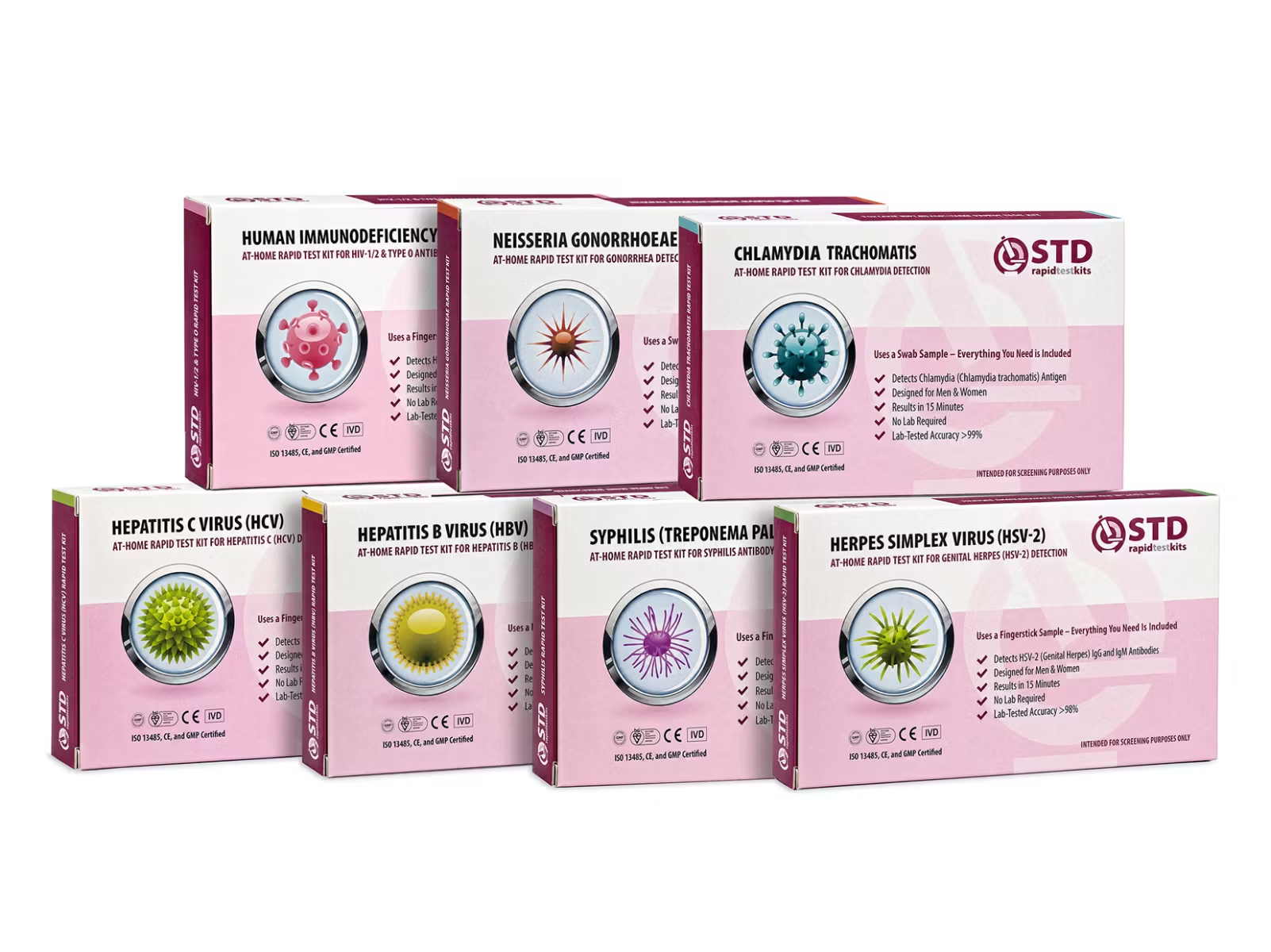
Many STIs do not cause symptoms, so people can pass them on without knowing they have one. Testing is the only way to know for sure.
Six Risk Triggers Inside Open Networks
Most polycule transmissions trace back to a small set of avoidable patterns. Knowing them by name makes them easier to spot before they cost a result.
1. New-partner entry without a quarantine. A new connection brings their entire prior exposure profile with them, and any test taken near that join date may sit inside an open window for one of those exposures. Routine practice: barriers only with the new person, plus a baseline test on day one and a follow-up test about three weeks later, before unprotected sex with anyone in the inner network.
2. Treating one test as ongoing clearance. A negative result on Monday says little about Friday. Polycules that test on a strict calendar (every first Saturday) without retesting after specific exposures are running a probability calculation in the dark.
3. Untracked spontaneous encounters. Conferences, travel, parties, breakups, reconnections. These often skip the shared log because they feel "small," but a single missed entry is exactly the kind of node that causes a network-wide round of antibiotics two weeks later.
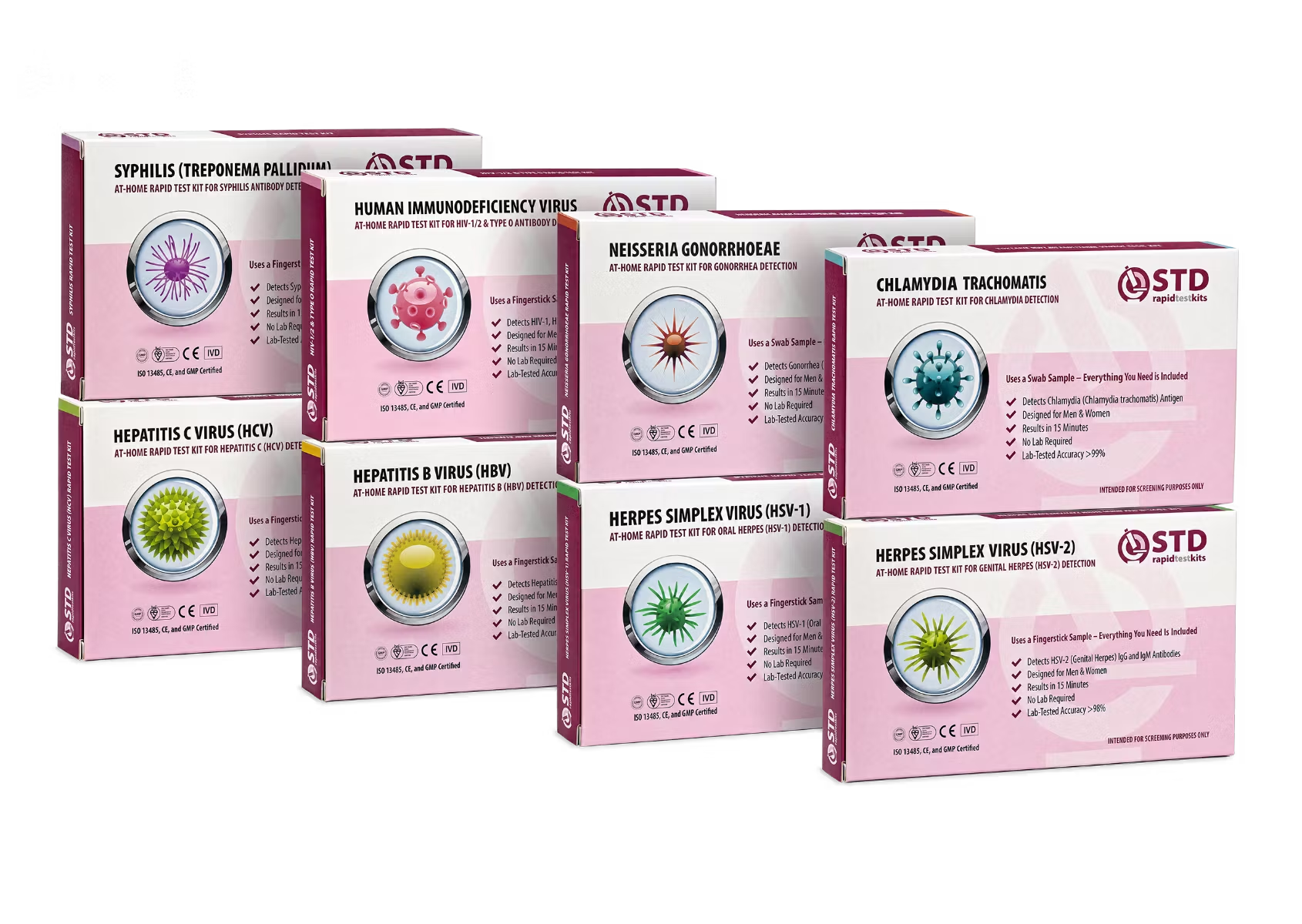
4. Sample-type mismatches. A urine NAAT misses pharyngeal and rectal infections. A genital swab catches lower-tract infections but not throat or rectal sites. If anyone in the polycule has receptive oral or anal sex, sample types in their testing should match the exposure sites; a clinic visit can fill the gaps a home swab kit cannot.
5. Asymptomatic carriage. The CDC reports that the majority of chlamydia infections in women, and a substantial portion in men, have no symptoms. Herpes can shed without lesions. A symptom-free week tells you nothing about chlamydia carriage or herpes shedding (CDC chlamydia information).
6. Barrier fatigue inside long inner circles. Established polycules often drop barriers among committed members for emotional reasons. That works only if the boundary truly is closed and the testing cadence is matched to actual exposure events outside the inner circle.
Most chlamydia infections in women, and a substantial share in men, produce no symptoms. HPV is largely silent. Herpes can shed without visible lesions. Polycules that lean on "how everyone feels" as a screening signal will miss the majority of infections currently circulating in the network.
How Often Should a Polycule Actually Test?
Calendar-based testing is convenient but blunt. A behavior-tied schedule, where the testing interval depends on what just happened, catches more infections at the moment they actually become detectable. Below is a working table aligned with the CDC's screening guidance and what behavioral research finds works in CNM networks.
This is also the table to share with anyone joining the polycule, so the cadence question is settled before anyone is stressed about it.
| Behavior | Recommended Cadence | Why It Matters |
|---|---|---|
| Multiple or new partners in the past 6 months | Every 3 to 6 months | Higher network exposure means more chances for asymptomatic infection |
| New partner just joining the polycule | Baseline test now plus retest in 2-3 weeks before barrier-free sex | The first test sets a reference; the second clears the most recent window |
| Inner circle only, no outside contacts | At least annually | Lower risk but not zero; covers reactivation and any prior undetected infection |
| Symptoms after sex | Test now plus retest in 2-4 weeks | Catches the infection responsible for symptoms plus anything still in window |
| Known exposure to a partner who tested positive | Test as soon as possible plus retest after the relevant window passes | Initial test rules out earlier infection; follow-up captures the new exposure |
| Travel or conference encounter that skipped barriers | Test at 2-3 weeks for bacterial STIs, then again at 6-12 weeks for HIV and HSV | Different pathogens have different window periods; one test cannot cover all of them |
Building a Polycule-Friendly Protection Plan
Polycules that move from "we test monthly" to "we test based on what happened" generally see fewer surprise positives over time. The shift is not about more testing; it is about smarter sequencing. Here are the protocol pieces that actually move the numbers.
Use a timed-entry rule for new partners. When someone new starts seeing a member of the polycule, agree on a quarantine period: barriers with the new person until they have completed a baseline test and a follow-up test that clears the window for their last unprotected exposure. Two to three weeks usually covers chlamydia and gonorrhea; six weeks gets most of HIV via fourth-generation testing; twelve weeks closes the antibody-test window for HIV and HSV.
Tie the testing schedule to behaviors, not the calendar. A monthly cycle is fine as a baseline, but the more important rule is "test now, retest after the window" any time someone has an exposure outside the closed inner circle. The retest is the test that actually closes the loop.
Match sample types to exposure sites. If anyone in the polycule has receptive oral or anal sex, a basic urine or vaginal swab is not enough. Pharyngeal and rectal NAAT are not part of most home kits and require a clinic visit. Plan for those at least once a year, more often with new partners.
Keep a low-shame log. Not policing, just data. Date of new contact, kind of contact, barriers used, last test date. The point is shared awareness, not judgment, so missed entries do not hide.
Default to barriers when timing is uncertain. If anyone in the polycule had unprotected sex outside the inner circle and the relevant retest has not happened yet, barriers go back on inside the inner circle until the window closes. This sounds clinical, but it is the most honest expression of "we care about each other."

When Testing Goes Wrong: Three Real-World Mistakes
The pattern is rarely deceit. It is almost always a small assumption that ages badly. Three composite cases drawn from the kinds of situations clinicians describe in CNM-aware practices:
The early-test trap. Jamie has a weekend fling, uses condoms, and tests three days later "just to be sure." The result is negative. Jamie restarts unprotected sex with their primary partner. Three weeks later, a chlamydia diagnosis arrives. The first test was inside the window for chlamydia detection; it returned a real negative for what it could see, but did not capture what was actually present. Fix: a second test at 14 days, before resuming barrier-free sex.
The quiet-exposure delay. Leo meets someone new while traveling and uses condoms but does not log the encounter or update partners. Several weeks later, mild symptoms appear. By the time Leo says something, the rest of the triad has already been exposed. Fix: a no-shame logging norm, where small or "casual" encounters get the same disclosure treatment as planned ones, because the test math does not care which category the partner fit into.
The stale-protocol drift. Cameron, Ty, and Jules form a closed triad, all test negative at the start, and ditch barriers. Six months pass. Two members have separate casual encounters with people they do not bring into the network conversation. No one retests. When Ty develops genital lesions, the testing protocol that everyone agreed on at month one has been silently retired for half a year. Fix: a quarterly check-in on the protocol itself, not just on individual results, so policy drift gets caught before transmission does.
Each of these is a process error rather than a character flaw. Each is also fixable with one or two specific protocol upgrades. Polycules that treat their testing protocol as a living document, reviewed every quarter, generally absorb these patterns and move past them.
You Can Be Safe Without Being Perfect
There is no perfect sexual safety. Not in monogamy, not in polyamory, not in abstinence after a previous exposure. There is layered risk reduction, and the more honestly a polycule names that, the safer the network becomes. This is the same principle that drives every other public-health practice: managed risk rather than zero risk.
Layered, in practice, means: barriers with new or recent partners, baseline plus follow-up testing tied to the actual window periods, sample types matched to exposure sites, an honest shared log, and a quarterly check on the protocol itself. None of these alone is sufficient. Stacked, they reduce the probability of an undetected infection to the point where a positive result becomes a manageable update rather than a network-wide crisis.
The other piece is the response. A positive result inside a polycule is not the moment to assign blame; it is the moment to test everyone, pause unprotected sex inside the network, treat what is treatable, and update the protocol so the same gap does not recur. Most STIs are curable with a single course of antibiotics or, in viral cases, manageable with antivirals. The public-health consequences of a late-detected infection are far worse than the social cost of an early honest one.
What creates the risk is the protocol gaps, not polyamory itself. The same gaps appear in monogamy, where most undetected infections trace back to assumptions about exclusivity that never got matched against testing. The communities most likely to actually do testing well are the ones that talk openly about it, which is, ironically, the polycule subculture mainstream coverage tends to write off as reckless.
If you and the people you love already do the work of consent and disclosure, the testing layer is the smaller second step. Window-aware testing, exposure-tied retests, and a quarterly protocol review move a polycule from "tested last month" to "actually protected this month," which is the practical goal worth aiming at.
FAQs
- Can I really catch an STD in a polycule even when no one cheated?
- Yes. Beyond the timing problem, the structure of the network matters. Every partner of a partner is part of your exposure surface even if you have never met them. A positive result can trace back two or three relationship nodes, all of them honest and testing regularly on schedule, because each link in the chain has its own window-period gap and its own external contacts.
- What is a window period and why does it matter so much?
- It is the lag between when a person is exposed to a pathogen and when a test can reliably detect it. For chlamydia and gonorrhea, that is roughly one to two weeks. For HIV with a fourth-generation test, about 18 to 45 days. For HSV antibody, 6 to 12 weeks. Testing inside the window can return a true negative that does not actually mean uninfected.
- We all tested before going fluid-bonded. Isn't that enough?
- It is a strong start, but only for the moment of testing. If anyone had a recent exposure right before the test, the result may not have caught it. Best practice is a baseline test plus a follow-up test after the window has passed for the most recent exposure, before barriers come off.
- How often does the CDC recommend testing for sexually active adults?
- Annual STI screening at minimum for sexually active adults, and every three to six months for adults with multiple or new partners. Specific intervals shorten further around new exposures or symptoms. Pharyngeal and rectal screening is recommended at least annually for adults with receptive oral or anal sex.
- My partner tested negative, so why did I get chlamydia?
- Possibilities: your partner was tested inside the window for their own exposure; you were exposed by someone else further out in the network; or your partner was tested with a sample type that does not catch their exposure site (a urine test does not catch pharyngeal or rectal infections). Testing cadence and sample types both need to match the actual exposures, not just the calendar.
- Is it possible to carry an STD and not know it?
- Yes, and it is the rule rather than the exception. Most chlamydia infections in women, and a significant share in men, produce no symptoms. HPV is largely silent. Herpes can shed asymptomatically. "I feel fine" is not a status.
- How soon after a hookup should I test?
- It depends on the pathogen and the test. For bacterial STIs (chlamydia, gonorrhea, syphilis), wait at least one to two weeks for an initial test, then consider a retest at four weeks. For HIV, a fourth-generation test becomes reliable around 18 to 45 days; a 90-day retest closes the antibody window. For herpes antibody, allow 6 to 12 weeks. Test now to baseline, then test again after the relevant window passes.
- What if someone in the polycule tests positive?
- Pause unprotected sex inside the network, get everyone tested with sample types matched to exposure sites, and treat what is treatable. Most STIs respond to a single course of antibiotics or are manageable with antivirals. Treat the result as a protocol-update moment, not a moral verdict; the goal is to find what gap let the infection through and close it for next time.
How We Sourced This Article: Our editorial team summarized current screening and testing-window guidance from the U.S. Centers for Disease Control and Prevention, the World Health Organization, and the American Sexual Health Association, and cross-checked specific window-period numbers against each cited source. Behavioral framing about consensually non-monogamous adults reflects published peer-reviewed survey research; we omitted any claim we could not anchor in a stable, root-domain authority. We do not provide clinical diagnosis. For symptoms or specific exposure questions, see a licensed provider.
- U.S. Centers for Disease Control and Prevention. STI screening recommendations for sexually active adults, including testing intervals by behavior and population.
- U.S. Centers for Disease Control and Prevention. HIV testing overview, window periods for fourth-generation antigen/antibody combo assays and antibody-only tests.
- U.S. Centers for Disease Control and Prevention. Chlamydia information hub, including asymptomatic prevalence, screening guidance, and patient-facing fact sheet.
- U.S. Centers for Disease Control and Prevention. Genital herpes information hub, including type-specific antibody testing guidance and asymptomatic shedding.
- World Health Organization. Sexually transmitted infections (STIs) fact sheet, global prevalence and the role of asymptomatic infection in transmission.
- American Sexual Health Association. Patient-facing testing guidance, including frequency by exposure pattern and where to access testing.
