
Published: July 2025 | Last updated: May 2026 | Editorial review and quality control: Martina N.
The thought hits mid-application: your friend just rolled the mascara wand across her lashes, and now you remember the cold sore healing on her lip. Is the panic warranted? Mostly no, though the worry is fair. HSV-1 transmission through shared makeup is real but uncommon, and the answer depends on whether the previous user was actively shedding virus, how moist the product is, and where on your face it lands. Here is what the science supports, what to watch for, and when an at-home test can give you a clean answer instead of weeks of low-grade dread.
Key Takeaways
- Sharing mascara, lip gloss, or eye makeup with someone who has an active or recently healed cold sore creates a small but real risk of HSV-1 transmission. The chance is highest when the product is wet, the other person is shedding virus, and the applicator reaches a mucous membrane like the eye margin or lip line.
- Watch for tingling, blisters, or eye irritation in the two to twelve days after a suspected exposure. An at-home HSV-1 antibody test can confirm seroconversion roughly six to twelve weeks later.
How HSV-1 actually spreads through shared makeup
HSV-1 is one of the most common viruses on the planet. The World Health Organization estimates that around 3.8 billion people under age 50 (about 64% of that age group) carry HSV-1, most of whom acquired it in childhood through ordinary family contact. Saliva exchange and direct skin contact are the dominant transmission routes for this strain, with sexual contact accounting for a smaller share.
The virus spreads efficiently when active particles in saliva or fluid from a sore reach a mucous membrane (mouth, eye, nose) or broken skin on someone else. Kissing during a cold sore outbreak is the textbook example, but anything that briefly transports those particles to a vulnerable surface can do the same job, just less reliably.
Shared makeup falls into that less-reliable bucket, with one important caveat. Cosmetic applicators that touch mucous membranes (mascara wands near the eye margin, lip gloss applicators along the inside of the lip) bypass the skin barrier that normally absorbs most casual contamination. A wand that picked up viral particles from someone shedding HSV-1, then immediately rolls across your eyelid, has a more direct route than a doorknob ever would.
That said, transmission still requires a chain of conditions to align. The donor has to be shedding virus at that moment. The virus has to survive the trip. The recipient has to have a vulnerable mucosal entry point.
Can you really get herpes from sharing mascara?
Yes, in theory and occasionally in practice, though it is uncommon. Transmission requires the previous user to be actively shedding HSV-1 (most often during or right before a cold sore) and the wand to reach a mucous membrane such as the eye margin or lip line. Dry products, healed and stable cold sores, and intact skin all reduce the risk substantially. If you suspect exposure, watch for tingling, blisters, or eye irritation over two to twelve days, then consider an HSV-1 antibody test six to twelve weeks after the contact for a definitive answer.
How long does HSV-1 survive outside the body?
HSV-1 is a fragile virus. It needs warmth, moisture, and a host cell to thrive, and it loses infectivity quickly once it leaves the body and starts to dry. Lab studies that have measured HSV-1 survival on inanimate surfaces tend to report two patterns:
- Dry, hard surfaces (countertops, doorknobs, plastic packaging): the virus typically becomes non-infectious within a few minutes to a couple of hours.
- Moist surfaces and applicators (mascara wands, lip gloss tubes, used towels): the virus can remain viable for several hours under ideal conditions, though most studies show steep drop-offs over the first hour.
That difference matters in practice. A mascara wand pulled out of a wet, warm tube and used within minutes of contamination is a fundamentally different scenario from a dry powder brush sitting on a counter overnight. The question is not just "did someone with a cold sore touch this?" but "did they touch it recently, and is the product still moist enough to keep virus alive?"
Public-health guidance has long noted that herpes transmission through inanimate objects is rare. The clinical literature treats wet cosmetic applicators as a higher-risk subcategory than typical surface exposure, which is why disposable mascara wands are standard at reputable makeup counters and why most professional makeup artists insist on single-use tools at the eye and lip.
A wand pulled from a wet tube and used within minutes of contamination carries meaningfully more risk than the same product sitting unused overnight. Moisture and recency are the two key variables.
When sharing makeup is risky versus almost certainly fine
Not every shared product carries the same risk. The factors that move the dial are predictable, and knowing them helps you decide when to worry and when to relax.
Higher-risk scenarios:
- The previous user has an active cold sore, a tingling prodrome, or a sore that healed within the past few days.
- The product is wet (mascara, liquid eyeliner, lip gloss, dewy lip balm) rather than dry.
- The applicator touches a mucous membrane: eye margin, inside of the lip, nostril.
- The product is a tester at a beauty counter, used by many people in succession with no disposable applicators.
- You have broken skin, active dermatitis, or a fresh cosmetic injury where the product lands.
Lower-risk scenarios:
- The product is dry: pressed powder, a sharpened pencil eyeliner with a fresh tip, a clean foundation brush.
- The previous user has no current or recent cold sore and is not in a prodromal phase.
- The applicator only touches intact skin away from the eye and lip line.
- The product was used hours or a day ago, giving the virus time to dry out and lose infectivity.
None of this is binary. A friend with no recent cold sore lending you her mascara on a normal Tuesday is a vanishingly small risk. The same friend lending you mascara the day after a cold sore healed is a meaningfully larger one.
Most HSV infections are asymptomatic or unrecognized, but symptoms of herpes include painful blisters or ulcers that can recur over time.
Ocular herpes: when HSV-1 reaches the eye
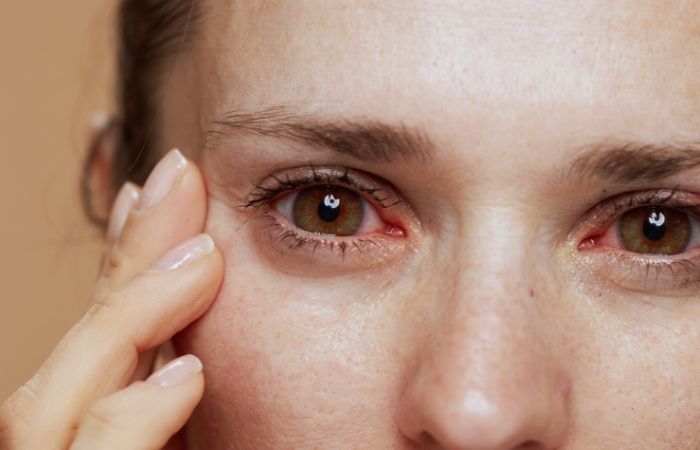
The eye is the most worrying destination for stray HSV-1 particles. When the virus infects the cornea, the condition is called herpes keratitis, and MedlinePlus notes that herpes infection of the eye is a leading cause of corneal blindness in the United States because of the scarring it can leave on the cornea.
Most cases come from the same HSV-1 that causes cold sores. Sometimes the eye is the site of a primary infection acquired near the eyelid (a borrowed mascara wand fits this pattern). More often, it is reactivation of latent virus already in the trigeminal nerve, triggered by stress, illness, sun exposure, or trauma. Either way, the symptoms tend to look the same.
Early symptoms are easy to mistake for conjunctivitis or seasonal allergies:
- Redness in one eye (the unilateral pattern is one of the strongest clues, since most viral pink eye eventually involves both eyes)
- Pain or a sharp gritty sensation, as if something is in the eye
- Light sensitivity, sometimes severe
- Watery discharge
- Blurry vision in the affected eye
- A small clear blister on the eyelid in some cases
The differentiator that often pushes a clinician toward herpes is the unilateral pattern, the presence of pain rather than just itch, and a characteristic dendritic (branching) ulcer pattern visible on the cornea with fluorescein staining. That is not something you can self-diagnose at home, which is why prompt evaluation matters.
Persistent eye redness with pain or vision changes after a makeup-sharing incident warrants a same-day eye exam, not a wait-and-see approach. Herpes keratitis treated promptly carries a good prognosis. Left untreated, corneal scarring can cause permanent vision loss.
The asymptomatic shedding problem
The reason HSV-1 spreads as widely as it does is that visible cold sores are only one of the windows during which the virus is contagious. People also shed virus when they look and feel completely fine. Clinicians call this asymptomatic viral shedding, and the CDC notes that people without visible sores can still transmit the virus to others.
For oral HSV-1, studies of seropositive adults have found detectable virus in saliva on a small but meaningful percentage of days, even outside obvious outbreaks. The shedding rate is generally lower than what is seen with genital HSV-2, but it is not zero. That explains how someone with no current cold sore can still pass the virus through a kiss, a shared drink, or, occasionally, a borrowed mascara wand.
Shedding tends to cluster around two windows: the prodromal phase (the tingling, itching, or burning sensation that precedes a visible sore by a day or two) and the immediate aftermath of a healed lesion. So someone whose cold sore "healed yesterday" or who feels a tingle she has not yet acted on is more contagious than population averages suggest. Someone who has never had a visible cold sore but tests positive for HSV-1 antibodies sheds less often, but still occasionally.
Shedding is highest during the tingling prodrome before a blister appears and for several days after a sore heals. Both windows surround but extend beyond visible symptoms, which is why the "no visible sore equals no risk" assumption breaks down in practice.
What to do if you used a borrowed mascara from someone with a cold sore
Most exposures lead nowhere. The chain of conditions required for transmission usually breaks somewhere along the way. That said, a measured response is reasonable.
Right after the exposure:
- Stop using the shared product. Do not return it for a second pass.
- If the product is yours, decide whether to keep, sanitize, or discard it. Mascara, lip gloss, and other wet eye or lip products that have been used by someone with an active or recent cold sore are reasonable candidates to throw out, both for HSV-1 caution and general cosmetic hygiene.
- Wash your hands thoroughly. Avoid touching your eyes, lips, and nose for the rest of the day, since these are the entry points the virus would need.
Over the following two weeks:
- Watch for early symptoms. Cold sores typically begin with a tingling or burning sensation a day or two before a visible blister appears. Eye symptoms include unilateral redness, pain, light sensitivity, and watering.
- Most primary HSV-1 outbreaks appear within roughly two to twelve days after exposure, with a typical incubation around four days for mucosal infection.
- If symptoms appear, see a clinician promptly. Eye symptoms in particular benefit from same-day evaluation. Antiviral medications work best when started early.
If you want a definitive answer:
- An HSV-1 antibody test can confirm whether you have been exposed and seroconverted. The catch is the timing: most people develop detectable IgG antibodies between six and twelve weeks after a primary infection. Testing earlier than that can produce a false negative.
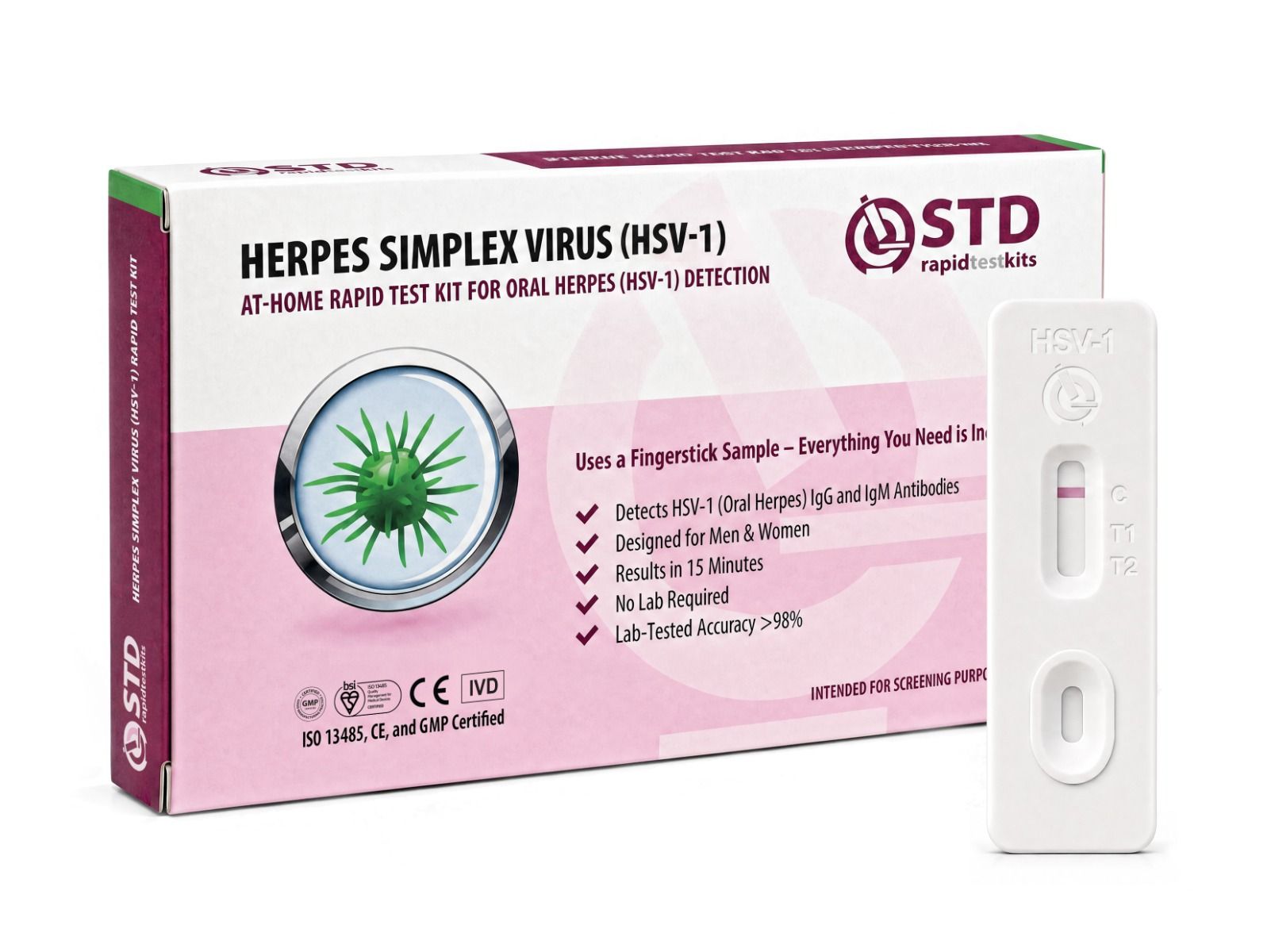
This site sells at-home rapid tests; the HSV-1 antibody test below is one option for that confirmation step.
When does an HSV-1 antibody test actually work?
At-home HSV-1 tests detect antibodies (IgG, sometimes also IgM) that your immune system makes in response to the virus. Because antibodies take time to develop after a new infection, timing matters more than people often realize.
The general rule for HSV-1 IgG antibody testing:
- Before about 6 weeks post-exposure: Most people have not yet seroconverted. A negative test at this point cannot rule out a new infection.
- 6 to 12 weeks post-exposure: The window during which most people develop detectable IgG antibodies. A test in this range is informative for most adults.
- 12 to 16 weeks post-exposure: A small subset of people seroconvert later. A negative at twelve weeks combined with continuing concern can be repeated at sixteen weeks.
An antibody test cannot tell you whether your infection is currently active or whether you are shedding virus today. It tells you whether your immune system has ever encountered HSV-1. For someone with a brand-new cold sore visible right now, a swab PCR or viral culture from the lesion itself is more useful than antibody testing, and that is a clinic test, not an at-home one.
Myths about herpes transmission worth busting
A few persistent ideas confuse the actual risk picture. Here are the ones that come up most often in clinic conversations and online forums.
"Cold sores are not really herpes."
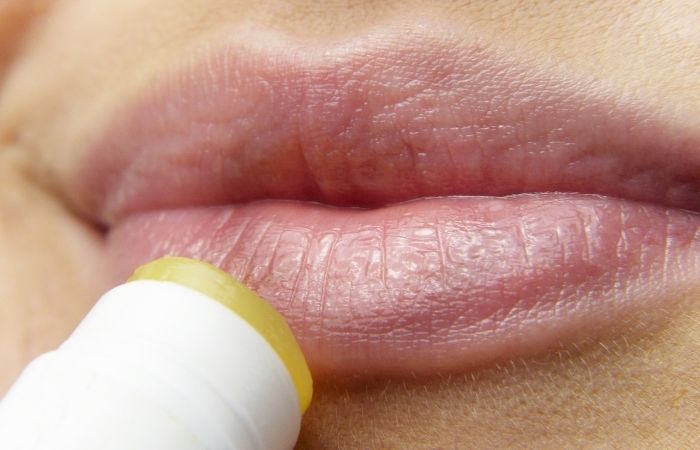
They are. The technical name for a cold sore is herpes labialis, and the cause is HSV-1 in the vast majority of cases (occasionally HSV-2). The cultural distinction between "cold sores" and "herpes" is largely a marketing artifact. Biologically they are the same virus family doing the same thing in a different anatomical location.
"If you do not see a sore, there is no risk."
Asymptomatic shedding makes this incomplete. The risk is lower outside an active outbreak, but not zero. People who have never had a visible sore can still test positive for HSV-1 antibodies and can occasionally pass the virus.
"Only HSV-2 is sexually transmitted."
HSV-1 increasingly causes genital infections too, primarily through oral-to-genital contact. The CDC describes both HSV-1 and HSV-2 as causes of genital herpes. The cultural assumption that HSV-1 is "oral only" no longer matches the clinical picture, especially in younger adults whose first HSV-1 exposure may come later in life.
"Once a cold sore scabs, it is no longer contagious."
Mostly accurate, not entirely. A fully crusted, dry, healing sore sheds far less virus than an open weeping blister. But low-level shedding can continue for a few days after the visible lesion resolves, which is one reason mascara borrowed the day after a healed cold sore is more risk than mascara borrowed three weeks later. The NHS guidance is to treat a cold sore as contagious until it has fully healed.
"Herpes can be cured."
It cannot. Antivirals reduce the frequency and severity of outbreaks and lower transmission risk, but the virus remains in nerve tissue for life. That sounds dire. In practice, most people with HSV-1 manage outbreaks with minimal disruption and never develop complications.
Cold sore = herpes labialis = HSV-1. The terms describe the same infection at the same anatomical site; the cultural distinction is not a medical one.
Practical risk reduction without paranoia
The point is not to live in fear of every cosmetic. It is to know which exposures are worth avoiding and which are not worth a second thought.
Worth treating as a hard rule:
- Do not share eye makeup. The eye is the highest-stakes destination for HSV-1 because of the risk of corneal involvement, and mascara wands are the highest-risk cosmetic vehicle.
- Do not share lip products with anyone who is currently in a prodromal phase, has a visible cold sore, or healed one in the past several days.
- Avoid testers at beauty counters that do not provide single-use disposable applicators. Lip and eye testers in particular are reservoirs for whatever the previous twenty users were carrying.
Reasonable everyday hygiene:
- Replace your own mascara every three months. The bacterial and viral load grows over time even from your own use.
- If you must share dry products (powder, sharpened pencils), wipe the surface with isopropyl alcohol between users when possible. Sharpening pencils between uses removes the contaminated tip.
- Wash your hands before applying anything that goes near your eye or lip.
- If you currently have a cold sore, use disposable applicators for your own lip and eye products until the lesion has fully healed, both to protect others and to avoid reinfecting your own eye area.
FAQs
- Can you really get herpes from sharing mascara?
- Yes, though it is uncommon. Transmission requires the previous user to be actively shedding HSV-1 (most often during or right before a cold sore) and the wand to reach a mucous membrane. The risk drops steeply when the product is dry, the other person has no recent cold sore, or the applicator only touches intact skin away from the eye and lip line.
- How long does HSV-1 survive on a mascara wand?
- Lab studies suggest a moist applicator can carry viable virus for several hours under ideal conditions, with steep drop-offs during the first hour. On dry surfaces, the virus typically becomes non-infectious within minutes to about an hour or two. The relevant question is whether the wand is still wet and was used recently.
- What does ocular herpes feel like?
- Usually unilateral redness, pain or a gritty sensation, light sensitivity, watery discharge, and sometimes blurry vision. It is often mistaken for conjunctivitis or allergies at first. Persistent eye redness with pain warrants a same-day eye exam, since untreated herpes keratitis can scar the cornea.
- Is HSV-1 the same as a cold sore?
- Yes. Cold sores (herpes labialis) are the visible manifestation of HSV-1 infection in the lip or mouth area in the vast majority of cases. They are the same pathogen; the cultural split between the two names is a naming artifact, not a biological distinction.
- Can a healed cold sore still spread HSV-1?
- Shedding drops sharply once a lesion fully crusts and dries, but low-level shedding can continue for a few days after the visible sore resolves. Sharing wet eye or lip products in the immediate post-healing window is more risky than sharing them weeks later. The NHS recommends treating a cold sore as contagious until it has fully healed.
- When should I test after a suspected exposure?
- An HSV-1 antibody test is most reliable about six to twelve weeks after exposure, when most people have seroconverted. Testing earlier can produce false negatives. If symptoms appear and you have an active lesion, a clinic-administered swab PCR is more useful than antibody testing for that specific outbreak.
- Should I throw out a mascara my friend used during a cold sore?
- If the wand was used while she had an active or recently healed cold sore and then immediately by you, discarding the product is reasonable, both for HSV-1 caution and general cosmetic hygiene. The virus loses infectivity quickly on dry surfaces, so a tube last used weeks ago is much lower risk.
- Is HSV-1 considered a sexually transmitted infection?
- It depends on how it was transmitted. HSV-1 is primarily acquired through ordinary saliva and skin contact in childhood, but it can also be transmitted sexually, particularly through oral-to-genital contact, in which case it can cause genital herpes. The CDC includes HSV-1 in its genital herpes guidance for that reason.
When at-home testing helps you move on
Most HSV-1 exposure scares end without an outbreak. The chain of conditions required for transmission rarely lines up perfectly, and even when it does, the immune system often handles the encounter quietly. The lingering question for most people is not "will I get sick" but "do I already have it." For that, an antibody test taken at the right time gives a clean answer in a few minutes at home, with no clinic visit and no awkward conversation.
If you have a recent specific exposure you are tracking, give it the six to twelve weeks an antibody test needs to be reliable. If you are testing because you generally want to know your HSV status, you can test any time.
- World Health Organization. Herpes simplex virus fact sheet. Global prevalence (3.8 billion people under age 50 with HSV-1), transmission via saliva and skin contact, and the predominance of asymptomatic infection.
- U.S. Centers for Disease Control and Prevention. About Genital Herpes. HSV-1 and HSV-2 transmission, asymptomatic shedding, and the role of HSV-1 in genital infections.
- National Health Service (UK). Cold sores: causes, the contagious window from first tingle until full healing, and prevention guidance.
- MedlinePlus (U.S. National Library of Medicine). Herpes Simplex: HSV-1 oral infection, HSV-2 genital infection, and direct-contact transmission.
- MedlinePlus (U.S. National Library of Medicine). Oral herpes simplex encyclopedia article. Notes that herpes infection of the eye is a leading cause of corneal blindness in the United States and outlines outbreak progression.
