Published: November 2025 | Last updated: May 2026 | Editorial review and quality control: Martina N.
How does herpes actually spread?
By direct skin-to-skin contact, which covers far more than penetrative sex. Kissing, oral sex, and unprotected genital contact all carry risk, and most transmission happens during asymptomatic shedding when the carrier has no visible sore and feels fine. A blood antibody test confirms HSV-1 or HSV-2 status about 12 weeks after exposure.
Herpes is one of the most common viruses on the planet, and most of the people who carry it have no idea they do. The way it really moves between bodies has very little to do with the textbook routes most people learn in high school health class. It travels through skin contact, through kissing, through oral sex, and through long, quiet stretches when nobody has a sore and nothing feels off.
This guide walks through every transmission route that matters and the ones you can stop worrying about, including the question that drives a lot of late-night searching: can the cold-sore virus end up on your genitals? Yes, and we cover that pathway in detail below. The goal is to leave you with a clearer picture of where your real risk sits, what testing can confirm, and what a positive result means once you have it. We sell at-home rapid blood antibody tests for HSV-1 and HSV-2 as part of our range of at-home STI test kits, which is one piece of the testing picture; the article also flags when a clinic visit is the better option.
Key Takeaways
- Herpes spreads through direct skin contact, not just penetrative sex. Kissing and oral sex are common routes most people overlook, and HSV-1 from a cold sore can become genital herpes through oral-genital contact.
- Most carriers shed the virus on days when they have no symptoms, which drives most transmission. At-home blood antibody tests can confirm HSV-1 or HSV-2 about 12 weeks after a suspected exposure.
Herpes Is a Skin-Contact Virus
The most useful thing to understand about herpes simplex virus is that it lives in nerve endings under the skin and travels by direct contact with infected tissue. It is not a virus that prefers semen or vaginal fluid the way HIV does. It moves wherever skin meets skin, especially across thin mucous tissue (lips, mouth, genitals, anus) where the virus crosses easily.
Direct skin contact does the work here, which is why kissing, oral sex, and unprotected grinding all carry real risk even without penetration. HSV does not need penetrative sex to transmit. Friction, heat, and direct contact during making out, oral sex, dry humping, or skin-to-skin grinding are all enough. The virus also concentrates near places a condom does not cover (the base of the penis, the vulva, the inner thighs, the scrotum), which is why barrier methods reduce risk without ever eliminating it.
The CDC's genital herpes information describes two main types: HSV-1, classically associated with oral cold sores, and HSV-2, classically associated with genital herpes. In practice that mapping is no longer clean. HSV-1 now causes a meaningful share of new genital infections in the United States, mostly through oral sex, and HSV-2 occasionally appears around the mouth.
HSV sheds from the entire genital region, including skin a condom does not cover: the base of the penis, the scrotum, the vulva, the inner thighs, and the perineum. A condom blocks the virus from crossing through what it covers, but the surrounding skin can still carry HSV during contact. Barrier protection lowers transmission risk substantially, and pairing it with the other levers in the protection section below is what gets the residual risk meaningfully lower.
HSV-1 vs HSV-2: Two Viruses, Two Patterns
Two strains of herpes simplex virus matter, and the difference shapes what to expect, what to test for, and how to talk with a partner.
HSV-1 traditionally causes oral herpes, the cold sores most people recognize. The WHO estimates that about 3.8 billion people under age 50 (roughly 64%) carry HSV-1 globally, the majority of them oral. Most people pick it up in childhood through non-sexual contact (a kiss from a relative, sharing a cup), and many never have a noticeable outbreak. Oral HSV-1 lives latently in the trigeminal ganglion, a nerve cluster behind the cheek, and reactivates periodically as a cold sore.
HSV-2 is the more typical genital herpes virus. Per the same WHO fact sheet, around 520 million people aged 15 to 49 (about 13%) carry HSV-2 worldwide, almost always through sexual contact. Once established in the sacral nerve ganglia near the base of the spine, HSV-2 reactivates more often than genital HSV-1, sometimes monthly in the first year and gradually spacing out over time.
Either virus can infect either site. The body's nerves do not care which label the virus carries. HSV-1 that contacts genital mucosa during oral sex can set up a genital infection. HSV-2 occasionally appears around the mouth, though this is less common because HSV-2 does not thrive in oral tissue as well. Once a genital infection is established, HSV-1 at the genital site recurs less frequently and usually with milder symptoms than HSV-2 at the same site, per the CDC STI treatment guidelines for genital herpes. Knowing which type you carry shapes the recurrence picture and the conversation with partners.
HSV-1 vs HSV-2 at a Glance
| Feature | HSV-1 | HSV-2 |
|---|---|---|
| Classic site | Oral (cold sores around the mouth) | Genital (vulva, penis, anus, surrounding skin) |
| Where it lies dormant | Trigeminal ganglion (behind the cheek) | Sacral ganglia (base of the spine) |
| Recurrence at the genital site | Less frequent; often one episode, then long gaps | More frequent, especially in the first year |
| Asymptomatic shedding | Common from oral mucosa; less from the genital site | Common from the genital area; persists for years |
| Global prevalence (under 50) | About 3.8 billion people, roughly 64% (WHO) | Around 520 million aged 15 to 49, about 13% (WHO) |
Either virus can infect either site; these are the typical patterns, not strict rules.
What Herpes Looks Like When It Shows Up
Most people who carry herpes never get a clear diagnosis, because the symptoms are mild, mistaken for something else, or simply absent. The CDC notes that most people with genital herpes have no symptoms or have very mild symptoms, and most do not know they carry the virus. A symptom-free body is the norm for most carriers, which is exactly why testing matters more than symptom-watching.
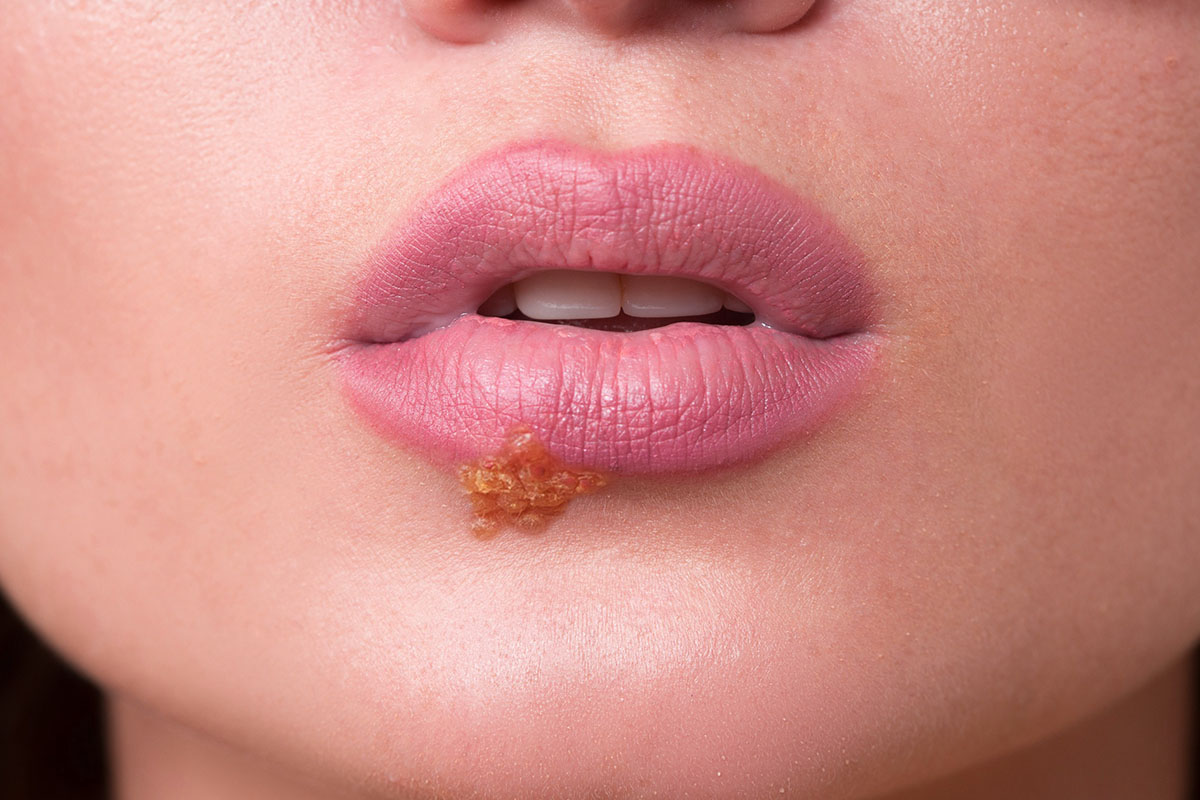
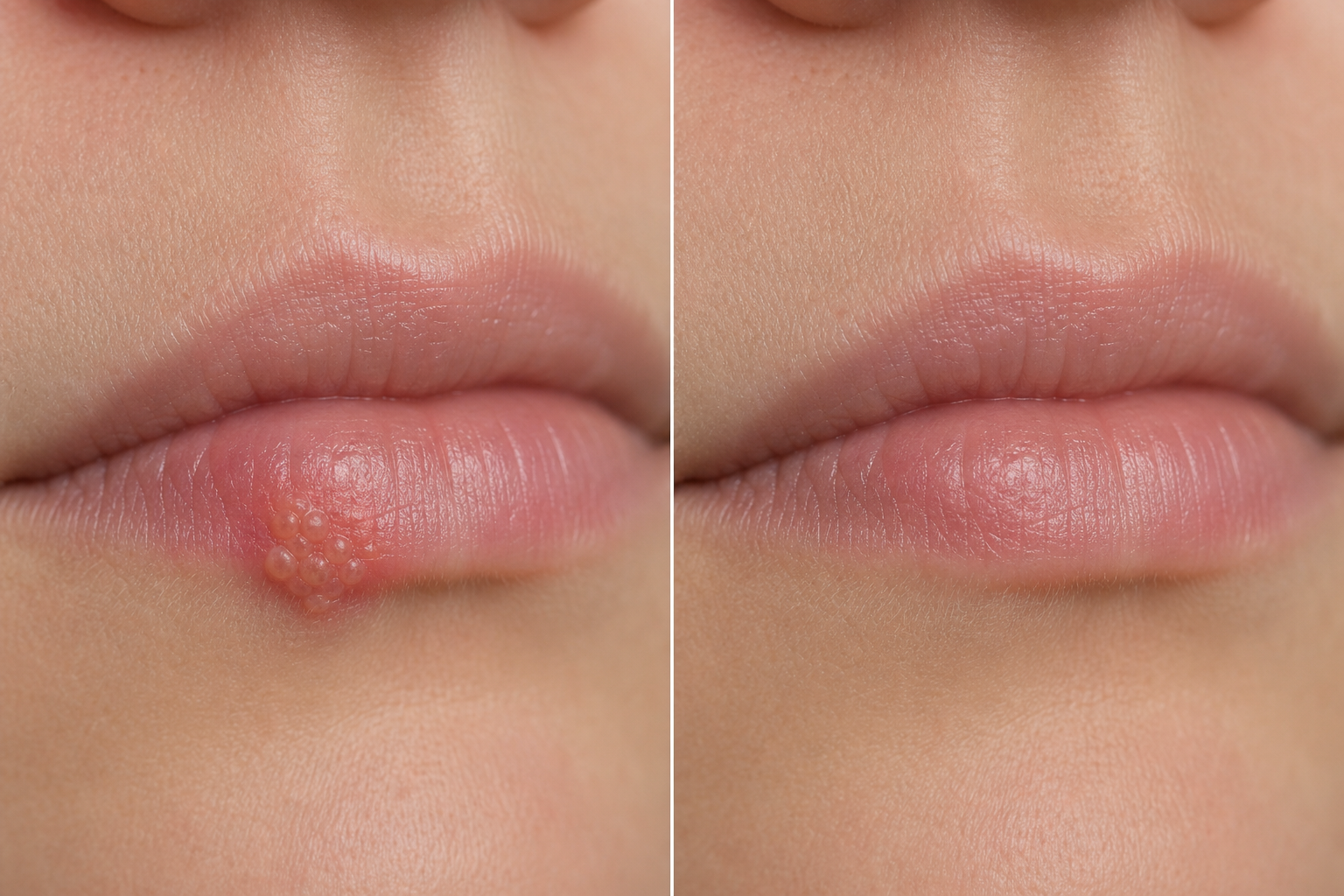
When symptoms do appear, oral herpes (HSV-1 at the mouth) and genital herpes (HSV-1 or HSV-2 at the genitals) follow a similar arc. A day or two of tingling or burning comes first, then small blisters, then shallow sores that crust and heal over a week or so. A first outbreak is usually the most intense, sometimes with fever and swollen glands, while later recurrences tend to be milder and stay in one small area. The checklist below covers what to look for, with the reminder that none of it replaces a test.
Signs of Herpes, When There Are Any
Having one or more of these does not confirm herpes, and having none does not rule it out. Only a test can confirm infection.
- No symptoms at all, which is the most common situation since most carriers never notice an outbreak Common
- Tingling, itching, or burning at the lip or genitals one to two days before a sore appears (the prodrome) Common
- Small fluid-filled blisters that break open into shallow, tender sores Common
- Crusting and scabbing as a sore heals over 7 to 10 days Common
- One or more painful sores on the vulva, penis, scrotum, anus, or surrounding skin Common
- Burning or stinging when urinating, especially when urine touches a genital sore Less common
- Tender, swollen lymph nodes in the groin or neck Less common
- Flu-like fever, body aches, and fatigue during a first outbreak Less common
One Kiss Carries HSV-1
HSV-1 is the strain most often passed through kissing, and most people pick it up in childhood from a family member rather than a romantic partner. By the time most adults reach their first sexual partner, oral HSV-1 has already been part of their life for years.
The complication is that adults still pass HSV-1 by kissing. Cold sores on the lip are visibly contagious, but the more common transmission scenario is invisible: a partner with HSV-1 sheds the virus around the mouth on a day when nothing is happening visually. They feel completely fine, and the lips look normal. A long kiss, especially with a partner who has never been exposed to HSV-1, can transmit it.
This is also how oral HSV-1 can quietly become genital HSV-1 later (covered in the next section). Most adults never get tested for HSV-1 specifically because it is so common and rarely dangerous, but knowing your status matters when a partner has not been exposed and wants to make informed choices about oral sex.
An estimated 3.8 billion people under age 50 (64%) globally have herpes simplex virus type 1 (HSV-1) infection.
Oral Sex Bridges Mouths and Genitals
Oral sex is the route that surprises people most. A partner with oral HSV-1 who performs oral sex on a partner who has never been exposed can transmit HSV-1 to that partner's genitals. The result is genital herpes caused by HSV-1 rather than HSV-2. Going the other direction (a partner with genital HSV-2 receiving oral sex) can also transmit, although that direction is rarer because HSV-2 prefers genital tissue. The CDC confirms that oral herpes caused by HSV-1 can spread to the genitals through oral sex.
CDC clinic data suggest that a growing fraction of new genital herpes cases in the United States are HSV-1 rather than HSV-2, especially among younger adults. Many people now arrive at first partnered sex with oral HSV-1 already established, and oral sex is widely practiced, so the virus finds new mucous tissue to set up in.
Three mechanisms explain most cases. A visible cold sore is the highest-risk scenario, since the blister and wet ulcerative stage shed enormous viral loads. Asymptomatic shedding from oral mucosa transmits even without a visible sore, often with lower viral load but enough contact time to matter. And hand-to-genital transfer (touching an active sore and then touching genital skin without washing) is less common but documented. One pattern worth knowing: HSV-1 acquired genitally tends to recur less often than HSV-2 acquired genitally, with most people seeing one outbreak and then long stretches of nothing.
Asymptomatic Shedding: When Nothing Looks Wrong
If herpes only spread during outbreaks, transmission would be far easier to prevent. The reason it is not is asymptomatic shedding: stretches when the virus surfaces on the skin without causing a sore, a tingle, or any visible sign. Research using daily PCR sampling has found that HSV-2 shedding occurs on a meaningful fraction of days, and many of those shedding episodes produce no symptoms at all. As NIH's MedlinePlus puts it plainly, the virus can spread even when sores are not present.
Shedding rates drop over the years after the initial infection but never fully stop. People who have lived with HSV-2 for a decade still shed on a measurable fraction of days, even when they have not had an outbreak in years. The NHS notes that the risk of passing on genital herpes is highest in the first six months after infection and becomes rare after two years, though it never reaches zero. HSV-1 shedding follows a similar pattern but appears less frequent overall, especially for genital HSV-1.
This is why the conversation about transmission cannot end at "use a condom during outbreaks." Outbreaks are the rare days. Daily life with HSV is mostly uneventful, and most days carry a low but nonzero risk of passing the virus to a partner who has never been exposed. Daily antiviral medication (valacyclovir, acyclovir, or famciclovir) suppresses shedding meaningfully and lowers the rate of HSV-2 transmission to a partner, per CDC treatment guidance.
What About Towels, Razors, and Toilet Seats
This is the question people are most embarrassed to ask and most relieved to hear answered. HSV is fragile outside the body. It dries out quickly, and exposure to air, soap, and most household surfaces inactivates it within seconds to a few minutes. The CDC and NHS both list direct skin contact as the relevant route and note that surfaces are not a meaningful one.
That means a toilet seat is not a credible source. A shared cup is unlikely outside very specific scenarios (someone with a fresh active sore using the cup, with a second person using it within seconds and having broken skin in their mouth). Sharing a fork lands in the same category. Sharing a towel that touched a fresh sore and was then immediately rubbed across genital skin is theoretically possible but almost never happens in real life.
Where surface transmission becomes a little more credible is sex toys passed between partners without cleaning. The virus survives short stretches on warm, moist surfaces, and a vibrator that touches one mucous membrane and then another can carry HSV across. Cleaning toys with soap and water between uses, or putting a fresh condom on each toy with each new body, closes that route. Razors are a low-but-real concern only if used on an active genital sore and then shared immediately, which is unusual practice.
Most people who are infected with herpes simplex virus do not know they have it because they have no signs or symptoms or have very mild symptoms.
Fingers, Toys, and Other Routes
Fingers carry the virus more often than people expect. Touching a sore, even briefly and even unknowingly, and then touching another person's mucous tissue can pass HSV along. It is also how people occasionally develop herpetic whitlow, an HSV infection of the finger itself, usually after touching their own oral sore and getting the virus into a small cut, hangnail, or torn cuticle.
Shared sex toys follow the same logic. The virus survives long enough on warm, moist surfaces that a toy moving between bodies without cleaning becomes a real route. The fix is simple: a fresh condom on each toy with each new body, or thorough washing with soap and warm water between uses. Water alone is not enough; the soap and friction matter.
Anal sex follows the same skin-to-skin logic. HSV can transmit during receptive or insertive anal contact, since the rectal mucosa is thin and easy for the virus to cross. Condoms reduce risk in both directions but again do not cover every relevant patch of skin. Fingering, especially when fingers move between a partner with HSV and another part of the same person's body, is the underrated cousin of the toy problem.
Our rapid blood antibody tests detect whether your immune system has produced antibodies to HSV-1 or HSV-2, which happens after the virus establishes itself in your body. They are most reliable about 12 weeks after a suspected exposure, the typical seroconversion window (the period during which antibodies become detectable); some people take up to 16 weeks. They cannot tell you whether a specific sore on your body right now is herpes (that requires a clinician-administered swab tested by PCR), and they cannot pinpoint when you were infected. For an active lesion, see a clinic. For confirming past infection at home, the antibody test is the right tool.
Can You Get Herpes Without Any Sex
Yes, but the routes are narrower than rumor suggests. The most common nonsexual transmission is from a parent or family member to a young child through kissing on the lips while the adult has a cold sore or is shedding orally. This accounts for a large share of childhood HSV-1 acquisition. The NHS warns that kissing a baby when you have a cold sore can lead to neonatal herpes, which is very dangerous to newborns, so adults with active cold sores should avoid lip contact with infants.
Saliva contact (sharing a drink, sharing lip balm, shared utensils used immediately) carries a theoretical risk that is low in practice. The virus dies quickly after leaving the body, and casual mouth contact rarely results in infection unless one party has an active sore and the other has a fresh break in their mucous tissue at the moment of contact.
What does not transmit herpes: handshakes, hugs, sharing clothes, swimming pools, hot tubs, public bathrooms, dentist offices, or sitting on someone's couch. The virus simply does not survive long enough on dry, hard surfaces to make those routes credible. No documented case of herpes transmission from a dry inanimate surface appears in the peer-reviewed clinical literature.
Toilet seats, doorknobs, gym equipment, and similar surfaces do not sustain the virus long enough to be a credible transmission route, and the clinical literature records no confirmed case of herpes passing from a dry inanimate object. For most people, the worry attached to these everyday surfaces is far heavier than the real risk.
Protection That Genuinely Reduces Risk
No single tool zeroes out herpes risk between partners. The combination that comes closest stacks four levers, and each one matters more in some pairings than others.
Condoms and dental dams reduce risk meaningfully but not completely, since HSV sheds from skin outside the latex. Research summarized by the CDC shows consistent condom use cuts HSV-2 transmission risk substantially, with stronger protection for the receptive partner.
Daily suppressive antivirals taken by the partner who carries HSV lower the rate of HSV-2 transmission to a partner, per CDC treatment guidance. The combined effect of suppressive antivirals plus consistent condom use is greater than either alone.
Avoiding contact during prodrome (the tingling, burning, or itching that precedes a visible sore) and active outbreaks matters because shedding peaks during these windows. Many people feel that prodrome sensation in the area where a sore is about to appear, even before anything is visible. That is the window to skip skin contact in the affected area, not only during the visible sore.
Knowing both partners' HSV status is the foundation of every other lever. Most people with HSV do not know they carry it. A blood antibody test, which looks for antibodies rather than lesions, is the only way to settle the question without an active sore to swab.
| Lever | What it does | Evidence note |
|---|---|---|
| Condoms / dental dams | Block HSV from crossing through covered skin | Cuts HSV-2 transmission substantially per CDC; stronger for the receptive partner |
| Daily suppressive antivirals | Reduce viral shedding and transmission | Lower HSV-2 transmission rate per CDC treatment guidance |
| Avoiding prodrome and outbreaks | Skip contact during peak shedding windows | Shedding is highest during the tingling-then-sore window |
| Knowing both partners' status | Lets every other lever be applied accurately | Blood antibody test reliable about 12 weeks after exposure |
Treatment: Antivirals, Triggers, and the Long View
Herpes is incurable but well-controlled with modern oral antivirals. Three FDA-approved drugs treat outbreaks: acyclovir, valacyclovir, and famciclovir. All three are oral tablets or capsules in standard outpatient care, per the CDC STI treatment guidelines. Two strategies exist, and which one fits depends on outbreak frequency and partner status.
Episodic therapy means taking the antiviral at the first sign of an outbreak (during the prodrome tingle or within the first 24 hours of a visible sore). It shortens the outbreak by a day or two and eases severity. People with infrequent outbreaks often prefer this approach.
Daily suppressive therapy means taking the antiviral every day to prevent outbreaks. The CDC notes that suppressive therapy reduces the frequency of recurrences by 70% to 80% in people with frequent outbreaks, and it also lowers asymptomatic shedding, which is what reduces partner transmission. People with frequent outbreaks or an HSV-discordant partner often choose this approach.
Outbreaks themselves are not random. Common triggers include physical stress (illness, sleep deprivation, surgery), emotional stress, hormonal shifts around menstruation, UV exposure on the lips for oral HSV-1, and local trauma (dental work, friction during sex, lip bites). Identifying personal triggers and addressing them (SPF lip balm, sleep hygiene, stress management) reduces outbreak frequency without medication for many people.
No FDA-approved herpes vaccine exists as of 2026, though several therapeutic and preventive candidates are in clinical trials. Prevention still rests on the levers in the previous section: barriers, suppressive antivirals, avoiding contact during prodrome and outbreaks, and knowing both partners' status.
Infrequent outbreaks (one or two a year) and a partner who already shares your HSV status: episodic therapy at the first sign of prodrome is usually enough. Frequent outbreaks (six or more a year), bothersome symptoms, or an HSV-discordant partner you want to protect: daily suppressive therapy is the better fit, since it lowers both outbreak frequency and asymptomatic shedding. A clinician can help match the regimen to your outbreak pattern and partner situation.
One More Reason to Know Your Status: HSV-2 and HIV
One additional reason to manage HSV-2 status is its connection to HIV. According to the WHO herpes simplex virus fact sheet, HSV-2 infection increases the risk of acquiring HIV by approximately three-fold. Genital ulcers and the local inflammation that come with HSV-2 create entry points in genital tissue that HIV can cross more easily.
The same combination that reduces herpes transmission (suppressive antivirals plus barrier methods) also reduces HIV exposure risk. Clinicians treat herpes management as part of a broader prevention strategy rather than an isolated concern, which is one reason screening for HSV-2 alongside HIV makes sense after a possible exposure.

Five Myths Worth Burning
Myth 1: Herpes only spreads during sex. It spreads through direct skin contact with infected tissue, which includes kissing, dry humping, oral sex, and any unprotected contact between mucous tissue. Penetration is one route among several.
Myth 2: You would know if a partner had it. The majority of people with HSV-2 do not know they carry it, per CDC data. Symptoms are often absent, mild, or blamed on something else (a yeast infection, an ingrown hair, razor burn, a urinary tract infection).
Myth 3: Cold sores are not really herpes. Cold sores are HSV-1, the same virus family as genital herpes. They can transmit to a partner's genitals through oral sex and to other people through kissing.
Myth 4: Condoms make herpes impossible to catch. Condoms reduce risk but do not cover all the skin where HSV sheds. Combined with daily antivirals and avoiding outbreaks, the residual risk drops further while never reaching zero.
Myth 5: Herpes ends your sex life. Most people with HSV continue to have full sexual lives, partner up, and have children. The diagnosis is mostly logistical and emotional, and most people settle into a manageable routine within weeks.
Of these five, Myth 2 is the one that drives most onward transmission. A partner who has never had a visible sore and feels fine can still carry HSV-2 and shed it without symptoms. Asking a partner "have you ever had symptoms?" is not the same as asking "have you been tested?" If you want a real answer about a partner's HSV status, an antibody blood test is the only way to get one.
FAQs
- Can I get herpes from kissing if my partner has no visible cold sore?
- Yes. HSV-1 sheds from the skin around the mouth even when no cold sore is visible, a pattern called asymptomatic shedding. Long kissing with a partner who has never been exposed to HSV-1 carries a real, if reduced, risk.
- Can oral sex give me genital herpes?
- Yes. A partner with oral HSV-1 performing oral sex can transmit HSV-1 to your genitals, producing genital herpes caused by HSV-1. It is the same virus family as HSV-2 but usually recurs less often. Avoid oral sex during prodrome, an active sore, and the healing crust phase, when shedding is highest.
- Does HSV-1 cause milder genital herpes than HSV-2?
- Generally yes. Genital HSV-1 tends to produce fewer flare-ups over time than genital HSV-2, though the first episode can feel similar regardless of type. With HSV-1 at the genital site, the first outbreak is often followed by long gaps. With HSV-2, recurrences cluster in the first year or two before spacing out. Both respond to the same antivirals.
- How long after exposure will an at-home test be reliable?
- For an at-home blood antibody test, wait at least 12 weeks; some people need up to 16 weeks to develop detectable antibodies. Testing earlier can give a false negative. If you have an active sore right now, that is a different situation: see a clinic within 48 hours for a PCR swab, which our home tests do not replace.
- If my partner takes daily antivirals, am I safe?
- Daily suppressive antivirals lower the rate of HSV-2 transmission to a partner, per CDC treatment guidance. Combined with condoms and avoiding contact during outbreaks, the residual risk is low but not zero.
- My partner has herpes. How do I protect myself?
- Stack four levers: barrier protection (condoms or dental dams), daily suppressive antivirals taken by the partner with HSV, skipping skin contact during their prodrome and active outbreaks, and confirming your own status with a blood antibody test so you know your starting point.
- What if both partners already have HSV-1?
- If both partners are seropositive for HSV-1 (confirmed by testing, not assumption), the genital transmission risk between them is much lower because both already have antibodies. Existing oral HSV-1 does not fully protect against a later genital HSV-1 infection, but it tends to reduce severity. Testing both partners gives the clearest picture for planning.
- Is there a vaccine for herpes?
- As of 2026, no approved herpes vaccine is available to the public. Trials are running on both preventive vaccines, which aim to block initial infection in uninfected people, and therapeutic vaccines, which aim to reduce outbreak frequency in people who already carry the virus. Until one is approved, prevention relies on barrier protection and antiviral suppression.
Knowing Where You Stand
Herpes is widespread, mostly silent, and almost always less catastrophic than the word "herpes" makes it sound. The virus travels invisibly on skin, between people who have no idea anything is happening. It comes down to biology, and it has nothing to do with carelessness or character.
If you are reading this after a possible exposure or a partner's recent diagnosis, the most useful next step is testing. A blood antibody test can confirm whether you have been infected with HSV-1 or HSV-2 about 12 weeks after exposure, with up to 16 weeks needed for some people. Earlier than that, a negative result is not yet conclusive, and an early test is best paired with a follow-up once the window closes. If you have an active sore right now, see a clinician for a swab and PCR rather than relying on an antibody test.
Either way, the result gives you information you can act on, and information tends to shrink the fear that drives the late-night searching. Once you know your status, the rest of the choices (talking to a partner, considering daily antivirals, watching for prodrome signs, staying current on broader STI screening) become practical steps rather than sources of dread.
Your Next Step, Based on Where You Are
Do you have an active sore right now?
Yes: See a clinic within 48 hours for a swab and PCR test. Antibody tests cannot identify a current lesion.
Are you already diagnosed, or is a current partner HSV-positive?
Yes: Ask a provider about daily suppressive antivirals to lower partner transmission risk.
Has it been at least 12 weeks since a possible exposure, with no sore present?
Yes: Take an at-home HSV-1 and HSV-2 blood antibody test for a reliable past-infection answer.
No: Wait until the 12-week window closes, then test. An earlier negative result is not yet conclusive.
Guidance only; a healthcare provider can advise based on your specific situation.
- U.S. Centers for Disease Control and Prevention. About Genital Herpes. Source for HSV-1 and HSV-2 transmission routes, oral-to-genital spread via oral sex, asymptomatic shedding, and the finding that most infected people are unaware of their status.
- U.S. Centers for Disease Control and Prevention. STI Treatment Guidelines: Genital Herpes. Antiviral therapy options (acyclovir, valacyclovir, famciclovir), episodic vs daily suppressive regimens, the 70 to 80 percent recurrence reduction with suppressive therapy, and partner-transmission reduction.
- World Health Organization. Herpes simplex virus fact sheet. Source for global prevalence (3.8 billion HSV-1 carriers under 50, about 64 percent; roughly 520 million HSV-2 carriers aged 15 to 49, about 13 percent) and the finding that HSV-2 increases the risk of acquiring HIV approximately three-fold.
- UK National Health Service. Genital herpes. Source for symptom variability, recurrence over time, and the finding that transmission risk is highest in the first six months and rare after two years.
- UK National Health Service. Cold sores. Source for HSV-1 oral transmission and the warning that kissing a baby with a cold sore can lead to dangerous neonatal herpes.
- U.S. National Institutes of Health, MedlinePlus. Genital Herpes. Source for plain-language confirmation that the virus can spread even when sores are not present.
