
Published: December 2025 | Last updated: April 2026 | Editorial review and quality control: Martina N.
A positive gonorrhea test in a relationship you trusted feels like proof: proof that someone lied, proof that monogamy broke. That reading skips over how this bacterium actually behaves in the body. Gonorrhea is good at hiding, it travels through routes most people don't think of as 'real' sex, it surfaces months after the exposure that planted it, and it tests differently in two partners who walked into the same clinic on the same morning.
This explainer pulls together the medical version of what is possible, drawn from current CDC, WHO, and NHS guidance, alongside what couples report when the result lands without warning. Read it before you start a conversation you can't take back.
Can you get gonorrhea without being unfaithful?
Yes. Most people with vaginas who have gonorrhea never develop symptoms, and many men do not either, per the <a href="https://www.cdc.gov/std/gonorrhea/" target="_blank" rel="noopener">CDC</a>, so the infection can be carried silently for weeks or months before any test catches it. A positive result tells you the bacteria are present right now. It does not tell you when the exposure happened, where you got it, or which partner is the source. Asymptomatic throat or rectal infections from a pre-relationship encounter are the most common medical explanation when neither partner has cheated.
Key Takeaways
- Most women with gonorrhea never develop symptoms, and many men do not either (CDC), so the infection can sit silent for weeks or months before a test catches it.
- A positive result confirms the bacteria are present now. It cannot date the exposure or identify the source partner, especially when throat or rectal infections are involved.
When a Positive Test Feels Like a Betrayal
Public-health staff describe the same scene over and over. A couple comes in for shared results. One partner is positive, the other negative. Both swear they have been faithful. The diagnosed partner braces for an accusation; the negative partner braces to make one. Neither has done anything wrong, and yet the test seems to have rendered a verdict.
Gonorrhea, caused by the bacterium Neisseria gonorrhoeae, is one of the most commonly reported bacterial STIs in the United States, with hundreds of thousands of new diagnoses recorded by the CDC each year, plus many more silent cases that never make the surveillance count. What sits in front of you when a result comes back positive is a finding: confirmation that the bacteria are present today, with nothing in that result about when the exposure happened, where, or from whom.
The misreading happens because most people learn about STIs from cultural shorthand: a positive result means recent sex with a new person, which means cheating. Gonorrhea's biology, its testing patterns, and its preferred hiding places regularly produce results that catch faithful couples off guard.
Asymptomatic carriage from a pre-relationship exposure that never produced a clinic-flagging symptom. Sample-site mismatch between partners, where one was swabbed at the throat or rectum and the other tested urine only. Window-period timing, where one partner tested before bacterial load reached the assay's detection threshold.
The Medical Timeline: Why Gonorrhea Stays Quiet
The standard incubation window for gonorrhea runs 2 to 14 days from exposure, with symptoms (when they show up) typically appearing in the first week. The catch is that most infections never produce symptoms loud enough to send someone to a clinic. According to the CDC, most women with gonorrhea never develop symptoms, and many men do not either. Throat infections (pharyngeal, meaning the back of the throat) and rectal infections are even more likely to fly under the radar; routine screening usually only swabs urine or genital sites unless the patient specifically asks otherwise.
That gap, between when the infection arrives and when anyone notices, is where the timeline assumption breaks. A positive result today can reflect an exposure from three weeks ago, six months ago, or, in unusual but documented cases, longer when the infection has settled into a hard-to-reach site like the pharynx.
Here is what a typical exposure-to-detection sequence looks like, and where the silence opens up:
| Event | Typical Timing | What's Happening |
|---|---|---|
| Exposure | Day 0 | Bacteria deposited at a mucous membrane (urethra, vagina, throat, rectum) through oral, vaginal, or anal contact. |
| Incubation | 2 to 14 days | Bacteria multiplies. Person is contagious. Symptoms may or may not develop. |
| Possible symptom onset | Within 7 days, if at all | Burning, discharge, or pelvic pain may appear. Pharyngeal and rectal infections usually stay silent. |
| NAAT test reliability window | 7 to 14 days post-exposure | Sensitivity is highest after the first week. Earlier tests can miss low-load infections. |
| Asymptomatic carriage | Weeks to months | Infection persists, often discovered only at a routine screen or a partner's positive result. |
How Gonorrhea Actually Spreads (Beyond Penetrative Sex)
Most people picture gonorrhea transmission as vaginal or anal intercourse. Both routes work, but they are not the only ones, and that limited mental model is part of why faithful partners end up confused. Gonorrhea lives in mucous membranes wherever they exist: the urethra, vagina, cervix, rectum, throat, and (rarely) the eyes. Any contact that lets bacteria from one mucous membrane reach another can transmit.
The transmission routes that catch couples off guard:
- Oral sex, in either direction. Going down on someone with genital gonorrhea can deposit bacteria in the giver's throat. Receiving oral sex from someone with throat gonorrhea can deposit bacteria on the receiver's genitals.
- Genital-to-genital contact without penetration. Skin-to-skin contact involving exposed mucous membranes can transmit, even when nobody considers what happened to be 'real sex.'
- Shared sex toys that touch one partner's mucous membrane and then another's, without cleaning or a fresh condom in between.
None of these routes require infidelity in the present relationship. A throat infection acquired from a single oral encounter eight months before the current relationship started can sit there, asymptomatic, and only get caught when a full-panel screen returns positive. The exposure preceded the relationship; the discovery is happening now.
One more myth worth burying. You cannot get gonorrhea from a toilet seat, a towel, a swimming pool, or casual non-sexual contact. The bacterium does not survive long outside a warm mucous membrane, which is why surface-based transmission is not a credible route.
Why Two Faithful Partners Can Get Different Test Results
One of the most disorienting parts of a surprise positive is when the partner tests negative. The instinct is to read the mismatch as proof: 'I am clean, you cheated.' Several non-betrayal explanations cover most of these cases.
The leading cause is sample-site mismatch. If one partner's test only sampled urine and the other had a throat or rectal swab as well, the partners were not screened for the same things. A urine-only test misses pharyngeal infection by design, and the CDC notes that throat infections in particular are frequently asymptomatic and missed without a targeted swab.
Window-period timing comes second. Even the gold-standard NAAT (nucleic acid amplification test) becomes most reliable about 7 to 14 days after exposure. A test taken too early, or taken before symptoms set in, can return a false negative.
Other ordinary explanations include recent unrelated antibiotic use that partially suppressed bacterial load (a course for a UTI, a dental infection, or acne can incidentally clear gonorrhea), immune-response variation between individuals, and asymmetric exposure patterns where one partner is more frequently exposed than the other due to specific sex acts within the relationship.
| Pattern | Most Common Non-Betrayal Explanation |
|---|---|
| Partner A positive, Partner B negative | Different sample sites collected (e.g. throat swab on one, urine only on the other), or B is still in the window period. |
| Both positive but only one has symptoms | Asymptomatic carriage is common in gonorrhea. Many men and most women with the infection never develop symptoms. |
| Symptoms emerge weeks into a new relationship | Pre-relationship asymptomatic infection from either partner that took time to surface. |
| Repeat tests give different answers | Window-period timing, sample-site mismatch, or recent antibiotics for an unrelated condition. |
Where the Bacteria Lives Decides Whether You Find It
Most people imagine gonorrhea as a urethral or vaginal infection, partly because that is where the recognizable symptoms (burning, discharge) tend to appear. The bacterium colonizes any mucous membrane it reaches: throat, rectum, urethra, cervix, and rarely the eyes. The diagnostic problem is that each site has a different sensitivity profile and requires its own swab.
A urine-only test reliably picks up urethral and cervical infections. It will miss a throat or rectal infection, full stop. Rectal NAAT swabs typically run in the high 80s to mid-90s for sensitivity. Throat (pharyngeal) NAAT swabs are notably lower, often in the 75 to 85 percent range, partly because the bacterial load in the throat is lower and partly because asymptomatic infections lack the clinical signal that prompts a properly directed swab. The ranges below align with extragenital NAAT validation summarised in CDC clinical guidance and peer-reviewed performance studies cited in the Sources list.
The practical translation: if either partner had oral or anal sex with a previous partner, ask the clinic for site-specific swabs explicitly. The default panel may not include them. A negative urine-only test is reassuring about urethral infection and silent on everything else.
| Sample site | Test type | Typical sensitivity | Risk of missed infection |
|---|---|---|---|
| Urine / urethral / vaginal | Lab NAAT | 95 to 98% | Low when the exposure site matches the sample site. |
| Rectal | Lab NAAT | 88 to 95% | Moderate. Requires a specific swab request. |
| Throat (pharyngeal) | Lab NAAT | 75 to 85% | Higher. Often skipped entirely if the patient does not request it. |
| At-home rapid test (genital) | Lateral-flow swab | High when used after the 7 to 14 day window | Best as a screening tool. Confirm any positive with a lab NAAT. |
Reinfection Looks Like a New Betrayal, Usually Isn't
Plenty of couples treat gonorrhea successfully, return to their normal sex life, and then test positive again weeks later. The instinct is to assume new infidelity. The far more common explanation is incomplete treatment cycles between the two partners.
The CDC's gonorrhea treatment guidelines are explicit: both partners need to be treated, both need to wait at least 7 days after completing therapy before resuming sexual contact, and both should be retested about 3 months later because reinfection is common, not because anyone is suspected of cheating.
Real-world failure modes that look like cheating but are not:
- One partner started antibiotics two days before the other and they resumed sex too soon.
- One partner did not complete the full course.
- One partner tested at a clinic, the other tested at home with a urine-only kit, and the second partner's pharyngeal infection was never identified or treated.
- One partner skipped the 3-month follow-up retest, carrying a residual infection back into the shared sex life.
Reinfection within the year following a treated episode is documented at meaningful rates in the clinical literature and largely traces back to the same partner. The 3-month retest the CDC recommends after treatment exists precisely to catch these cases before the cycle repeats.
Many people with gonorrhea have no symptoms, but they can still pass the infection to others. The only way to know for sure if you have gonorrhea is to get tested.
What to Do After a Positive Test, in the First 24 Hours
On the day a result lands, the relationship is under more stress than the body is. Most uncomplicated gonorrhea cases respond to a single intramuscular dose of ceftriaxone, per current CDC treatment guidelines. The conversation is the harder part to manage.
A reasonable sequence:
- Confirm the result. If the positive came from a rapid test, follow up with a NAAT-based confirmatory test from a clinic or lab. False positives are uncommon but not zero.
- Get both partners tested at all relevant sites. Urine plus throat swab plus rectal swab if those exposure routes apply. Asking for site-specific swabs is normal; clinics will run them on request.
- Treat both partners simultaneously, regardless of who is symptomatic and who is not. Pause sexual contact for at least 7 days after both treatments are complete.
- Retest at 3 months. The CDC recommends this for everyone treated for gonorrhea, because the goal is catching reinfection early, not assigning blame.
Skip the urge to compress all of these steps into one heated conversation on day one. Treatment, retesting, and the relationship talk can happen on different days. Spreading them out gives both partners room to absorb the medical reality before any decisions about the relationship get made.
Try a script that opens with the test, not the partner: 'My result came back positive for gonorrhea. The medical guidance is for both of us to test and treat together regardless of who carried it. Can we book that this week?' Lead with the action plan; the history conversation can follow once both of you have the full clinical picture.
From Panic to Plan: Testing Without the Clinic Wait
The piece that gets skipped most often is comprehensive site testing. Standard clinic visits sometimes default to urine-only collection. At-home rapid tests have a specific use case: they screen quickly and privately, especially for the genital site, which is where most symptomatic infections show up. They do not replace lab NAAT testing for confirmatory diagnosis, and they cannot replace a clinic visit if pharyngeal or rectal infection is suspected.
Where they work well: a partner who wants to screen on their own timeline before having a difficult conversation; a couple looking to confirm clearance after the standard 14-day post-treatment window; anyone trying to add a checkpoint between annual screenings.
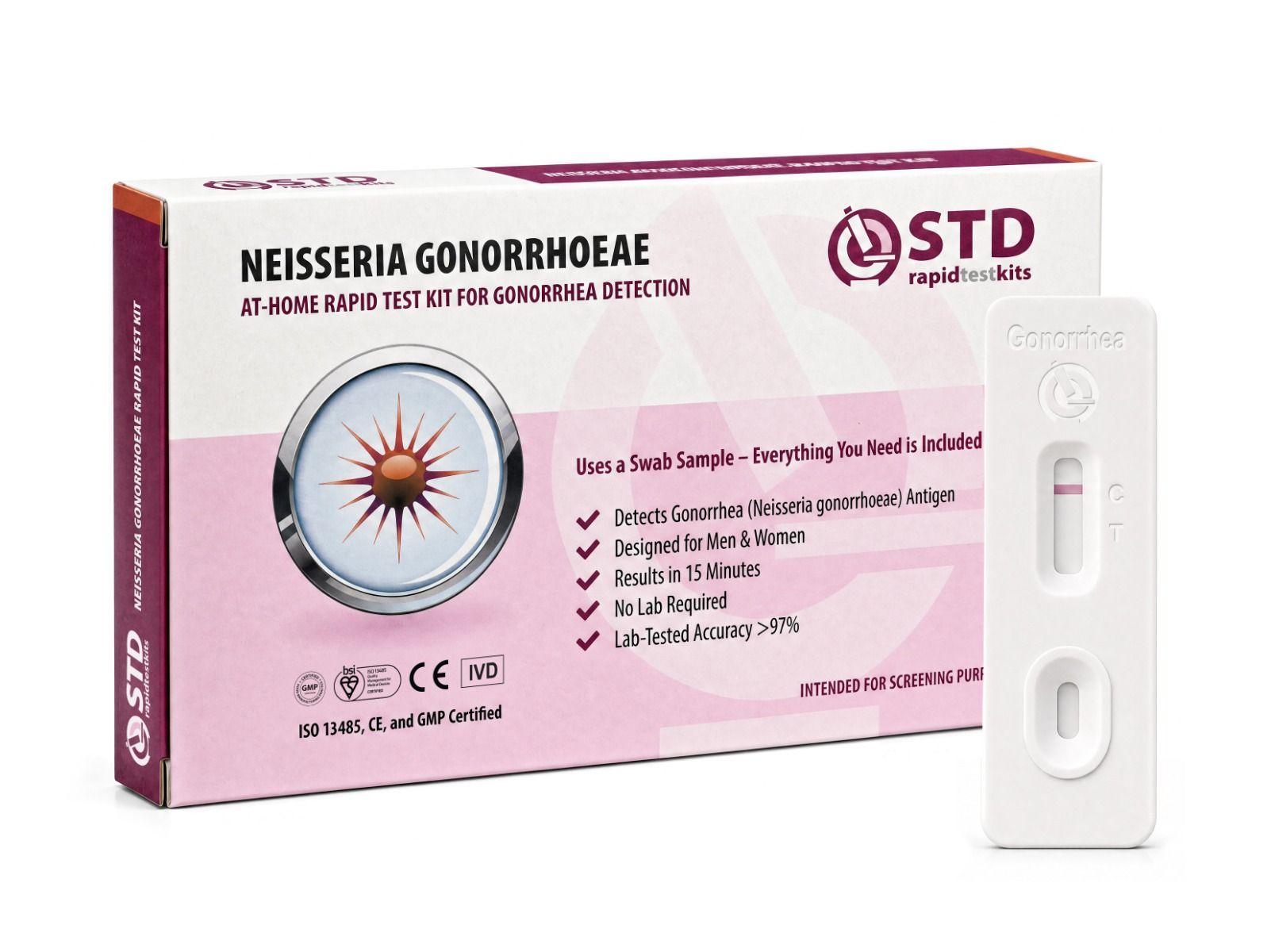
Disclosure: this site sells at-home rapid STI tests, and the products linked below reflect what we offer. Our at-home rapid tests use lateral-flow chemistry from a self-collected swab. They are not laboratory NAAT tests, and we do not claim NAAT-equivalent sensitivity. A positive result is worth confirming with a lab NAAT before treatment decisions, and a negative result outside the testing window is worth a recheck.
At-home rapid kits work well for private screening before a difficult conversation, a baseline check after the post-treatment window, and as a checkpoint between annual screenings. They do not replace a clinic visit when throat or rectal infection is on the table; those sites need their own swabs that home kits do not include. A positive at-home result is worth confirming with a lab NAAT before treatment decisions.
FAQs
- Can you really get gonorrhea without anyone cheating?
- Yes. Many men and most women with gonorrhea have no symptoms, especially when the infection sits in the throat or rectum. A pre-relationship exposure that never produced a clinic-flagging symptom can sit there for weeks or months and surface during a routine screen. The result reflects what is in your body now, not what your partner did this week.
- How long can gonorrhea sit silent in the body?
- Symptoms, when they appear, usually do so within 14 days of exposure. But asymptomatic carriage commonly stretches to weeks or months, and pharyngeal infections in particular have been documented persisting many months without treatment. Time alone does not clear the infection reliably; testing and treatment do.
- My partner tested positive and I tested negative. Does that prove they cheated?
- No. The most common explanation is sample-site mismatch (one of you got a throat or rectal swab and the other did not), or window-period timing (one of you tested too early). Recent unrelated antibiotics for a UTI, a dental issue, or acne can also temporarily suppress detection. Get both partners tested at all relevant sites before drawing conclusions.
- Can you catch gonorrhea from oral sex?
- Yes, in either direction. Giving oral sex to someone with genital gonorrhea can deposit bacteria in the throat. Receiving oral sex from someone with throat gonorrhea can deposit bacteria on the genitals. Throat infections rarely produce noticeable symptoms, so unsuspecting transmission is common, and a months-old oral encounter can be the source of a present-day positive.
- Can gonorrhea reactivate the way herpes does?
- No. Gonorrhea is a bacterial infection, not a latent virus. It does not 'flare up' on its own. If a positive shows up after a symptom-free stretch, the explanation is one of two things: the original infection was never fully cleared (incomplete treatment, missed site), or there was a new exposure from an untreated partner.
- What about a positive test from a relationship that ended years ago?
- It is possible. Pharyngeal and rectal gonorrhea can persist asymptomatically for many months, and there are documented cases of infections discovered during routine screens, fertility workups, or immigration physicals well after the original exposure. It is not the most common scenario, but it is a recognized one in clinical literature.
- Are at-home rapid tests as accurate as clinic NAAT tests?
- Not quite. Clinic NAAT (nucleic acid amplification) tests are the analytical gold standard for gonorrhea diagnosis. At-home rapid tests use lateral-flow chemistry and screen from a self-collected sample. They are useful for fast, private screening at the genital site. A positive at-home result is worth confirming with a lab NAAT before treatment, and pharyngeal or rectal infections need site-specific swabs that home kits do not cover.
- Can I test for gonorrhea without going to a clinic?
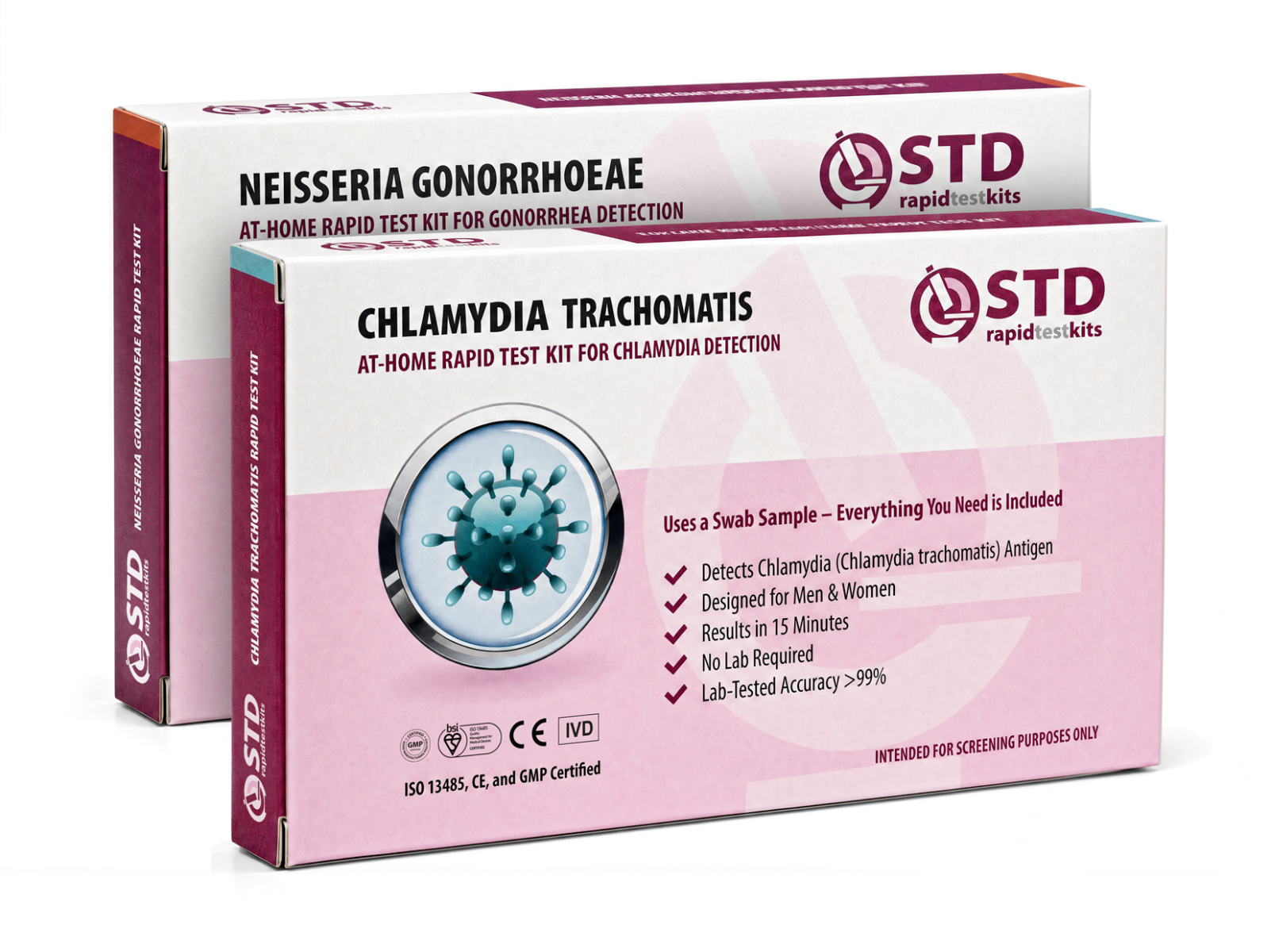
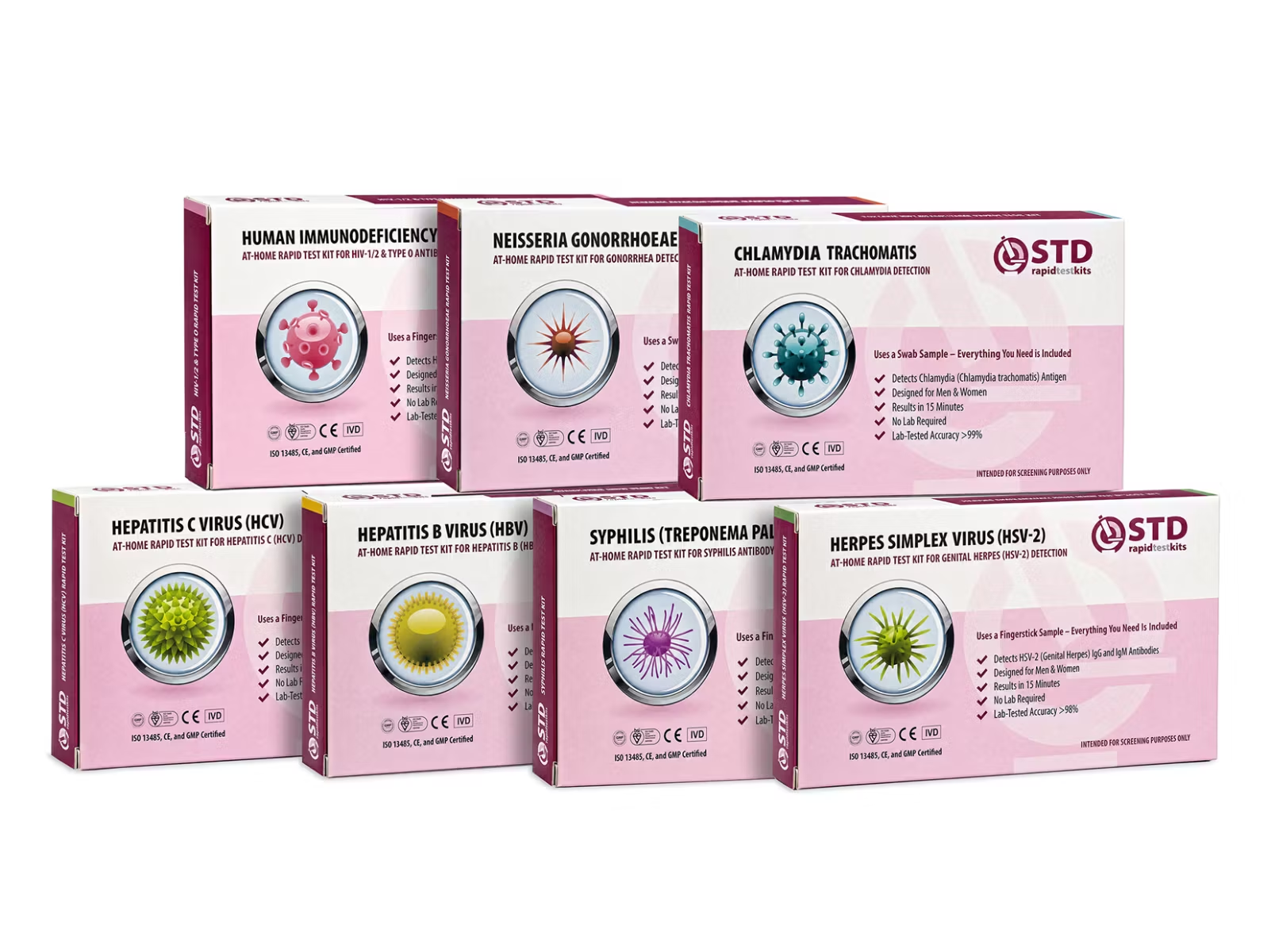
- Yes. Our at-home gonorrhea rapid test uses a self-collected swab and gives a result in about 15 minutes. It is best paired with a clinic visit if you also need throat or rectal testing, since those sites require their own swabs. For a couple resetting after a surprise positive, the combo and multi-STI panels below cover the most common ground.
- U.S. Centers for Disease Control and Prevention. Gonorrhea overview, transmission routes, and asymptomatic carriage. Source for the qualitative 'most women, many men' statements about asymptomatic gonorrhea cited throughout this article.
- U.S. CDC. 2021 Sexually Transmitted Infections Treatment Guidelines, gonorrhea section. Source for ceftriaxone single-dose treatment, partner-treatment requirement, 7-day post-treatment abstinence, and 3-month retest recommendation.
- U.K. National Health Service. Gonorrhoea patient overview, including symptoms, transmission routes, and clinical presentation.
- U.S. National Institutes of Health, MedlinePlus. Gonorrhea patient information page, with detail on pharyngeal and rectal site involvement and asymptomatic transmission.
- World Health Organization. Gonorrhoea (Neisseria gonorrhoeae infection) fact sheet. Global epidemiology, screening guidance, and notes on antimicrobial resistance.
- Cleveland Clinic. Gonorrhea: causes, symptoms, treatment, and prevention. Patient-facing reference used to cross-check site-specific testing and reinfection guidance.
