
Published: December 2025 | Last updated: May 2026 | Editorial review and quality control: Martina N.
Gonorrhea is one of the most commonly reported infectious diseases in the United States, and most of the people passing it on never feel sick first. The infection often colonizes the cervix, urethra, throat, or rectum without setting off the kind of symptoms that would send anyone to a clinic. People feel completely normal, then unknowingly hand it to a partner during sex that felt safe to both of them.
That silence is the engine behind rising case rates. If your body never warned you, your partner's body never warned them either, and neither of you had a reason to test. Understanding which tests catch silent infection, and when to use them, is the difference between months of worry and an answer within a week.
Key Takeaways
- Most gonorrhea infections cause no noticeable symptoms, and people with no symptoms are still fully contagious through vaginal, anal, and oral sex.
- A negative urine test does not rule out throat or rectal gonorrhea, the two sites where the infection is most likely to stay silent.
Why Gonorrhea Hides in Plain Sight
Public-health agencies call gonorrhea a "silent" infection because the bacteria Neisseria gonorrhoeae can settle on mucosal surfaces without triggering visible inflammation. The cervix, the back of the throat, and the rectum are common quiet sites. The local immune response is muted, the tissue looks normal, and there is no pain, no discharge, no obvious red flag (CDC).
When symptoms do show up, they often get blamed on something else. Mild urinary burning gets labeled a UTI. Light spotting or unusual discharge gets brushed off as a yeast infection or normal cycle variation. A scratchy throat reads as the leftover of a cold. None of those misreads change the underlying biology: the bacteria are present, they are replicating, and they can transfer to someone else during sex.
This is not a question of personal hygiene or behavior. It is how this particular bacterium evolved. Modern strains often provoke little inflammation, which means the body produces few warning signs even when bacterial loads are high enough to transmit easily.
The cervix, the throat, and the rectum are the three sites where gonorrhea is most likely to stay invisible. No inflammation, no discharge, no signal. A negative urine test tells you nothing about those three places unless they were sampled directly.
How It Spreads When You Feel Completely Fine
Gonorrhea transmits through contact between mucous membranes and infected fluids. That means vaginal, anal, or oral sex, with or without ejaculation. Penetration is not always required. The bacteria can move during oral-genital contact, shared sex toys, or genital-to-genital touching when fluids transfer between mucosal surfaces (WHO).
Because the infection can colonize several anatomical sites at once, a single sexual encounter can plant it in multiple places. Someone who tests negative on a urine sample may still be carrying it in the throat, the rectum, or both. Here is what the most common transmission routes look like by site:
| Body site | Can spread without symptoms? | How it transmits |
|---|---|---|
| Penis (urethra) | Yes | Urethral fluid during vaginal, anal, or oral sex |
| Vagina and cervix | Yes | Cervical fluid, mucosal contact during sex |
| Throat (pharynx) | Yes | Oral sex, giving or receiving |
| Rectum | Yes | Receptive anal sex, shared sex toys, fluid transfer |
But I Just Tested Negative. How Could I Have It?
Two things determine whether a test catches gonorrhea: timing and sample site. Test too soon after exposure, and the bacterial load may be too low to register. Test the wrong site, and a positive infection elsewhere stays hidden.
The standard lab method, a nucleic acid amplification test (NAAT), usually becomes reliable around a week after exposure, with most clinicians using fourteen days as the safer cutoff for a confidently negative result. Rapid at-home swab tests need a similar window. Most importantly, the test only checks the body site sampled. If a urine sample is the only specimen collected, throat and rectal infections are not part of the result.
If you had oral sex, that is a pharyngeal swab. If you had receptive anal sex, that is a rectal swab. Both are simple to collect and almost always missed by default STI panels unless you specifically ask.
| Testing type | Best sample | Window period | When to retest |
|---|---|---|---|
| NAAT (lab or mail-in) | Urine; throat or rectal swab | 7 to 14 days after exposure | If tested early, retest at 14+ days |
| Rapid at-home test | Swab or urine (varies by product) | 7+ days after exposure | Retest if exposure is ongoing or test was early |
What "No Symptoms" Looks Like in Real Numbers
The pattern is striking once you see it in figures. Up to half of women with cervical gonorrhea report no symptoms at all (Cleveland Clinic). For pharyngeal (throat) and rectal infections, the WHO confirms that symptoms are often absent, and clinical literature consistently shows asymptomatic disease is the norm rather than the exception at those sites (WHO fact sheet; CDC about gonorrhea).
Those numbers matter because silent infections drive silent transmission. Someone who feels healthy has no incentive to test, no incentive to disclose, and no reason to delay sex. The infection moves through sexual networks invisibly until somebody downstream gets tested and the chain finally becomes visible.
Can someone really give me gonorrhea when neither of us has symptoms?
Yes. Most people carrying gonorrhea feel fine, and they are still contagious. The infection spreads through mucosal contact during vaginal, anal, or oral sex, with no visible sores or fluids required. A symptom-free partner can pass it to you. You can pass it to someone else even after a negative urine test, if the infection is in your throat or rectum.
Most people with gonorrhea have no symptoms. Even when a person does have symptoms, they are often mild and can be mistaken for a bladder or vaginal infection.
What Untreated Gonorrhea Actually Does Over Time
"Silent" does not mean harmless. Left untreated, the bacteria can keep replicating for months, and the immune response that eventually kicks in tends to cause more damage than the bacteria themselves. The most common complications:
- Pelvic inflammatory disease (PID) in people with uteruses. PID is inflammation and scarring of the fallopian tubes and surrounding pelvic tissue. It is a major preventable cause of infertility and ectopic pregnancy (CDC).
- Epididymitis in people with testes. Inflammation of the tube at the back of the testicle causes pain and swelling, and can affect fertility in rare cases when untreated.
- Disseminated gonococcal infection (DGI), an uncommon but serious complication in which the bacteria enter the bloodstream and cause joint pain, skin lesions, and in severe cases heart-valve infection or meningitis.
- Higher HIV transmission risk. Gonococcal inflammation in genital tissue makes the mucosa more permeable to HIV during exposure, increasing the chance of acquiring or transmitting HIV when one or both partners is at risk. The elevated risk is largest during active inflammation, but even asymptomatic gonorrhea raises transmission probability above baseline. Treating the infection promptly removes that boost.
None of those outcomes require a symptomatic phase first. They can develop during exactly the same months the infection is invisible.

When a Partner Tests Positive and You Don't
This is the most common entry point to the topic. A partner gets a positive result, calls or texts the news, and the reflex is to book a test as fast as possible. The catch: a quick test can give a falsely reassuring negative if it was run too early or at the wrong site.
If your partner is positive and you have no symptoms, here is the practical sequence to follow:
- If your last sexual contact with them was within the past seven days, retest at day seven to fourteen post-exposure. Earlier than that and the bacterial load may not be detectable yet.
- If you only collected a urine sample, add a throat or rectal swab if either site had exposure. A pharyngeal swab is the only way to catch oral gonorrhea, and most basic STI panels skip it unless you ask.
- If you are still sexually active together, retest two to three weeks after their treatment. Reinfection from a still-positive partner is common and is treated the same way as a new infection.
- Ask a clinician about expedited partner therapy. In many US states, you can be treated based on your partner's confirmed diagnosis before your own test result returns, which interrupts transmission faster (CDC).
If you are unsure which site to test, the rule of thumb is to sample every site that had exposure during the relevant window. That usually means urine plus a throat swab for anyone who has had oral sex, and a rectal swab for anyone who has had receptive anal sex.
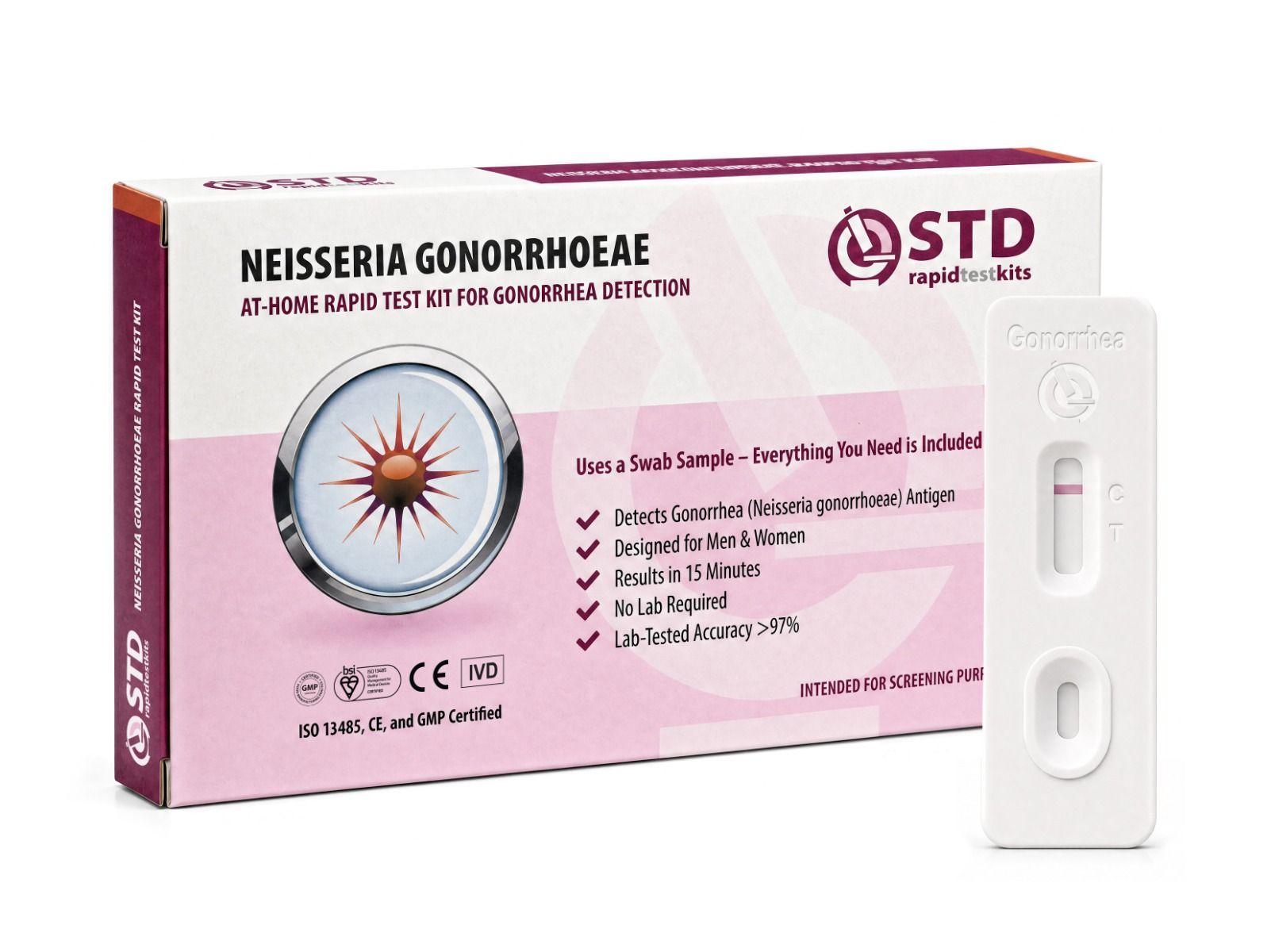
This site sells the rapid at-home tests referenced below. We link to them in the sections where the question being answered is, plainly, "which test should I run." If a clinic visit is the right next step for you, the article says so.
Why Condoms Lower the Risk Without Eliminating It
Condoms reduce gonorrhea transmission substantially during vaginal and anal sex. Consistent use is one of the strongest predictors of staying negative, and the more reliably they are used the larger the protective effect (CDC on condom effectiveness). They are not airtight, though. A few specific gaps explain most of the cases where condom users still test positive.
Where condoms leave gaps
- Condoms cover the penile shaft. They do not cover the throat, the perianal area, or external genital skin that contacts a partner's mucosa during foreplay.
- Oral sex is the single biggest blind spot. Most people skip protection for oral, and pharyngeal gonorrhea is one of the main reservoirs for silent spread.
- Real-world use is imperfect. Condoms slip, break, get put on partway through, or get removed during long sessions. Even careful users have lapses.
Telling a Partner You May Have Exposed
If you suspect you have been carrying gonorrhea, even briefly, the right move is to tell recent partners so they can test. This is not about admitting fault. The biology of asymptomatic spread means nobody is at fault for not knowing. Partner notification is what stops the chain.
A short, calm message works better than a long apology. Examples:
- "I just got a gonorrhea diagnosis. I had no symptoms, so I wanted to give you a heads-up so you can test. Happy to talk through it if you want."
- "My clinician recommended I let recent partners know. There is a chance I had gonorrhea while we were together. A quick swab or urine test will tell you for sure."
If a direct conversation feels impossible, most US states offer free anonymous partner-notification services through public-health departments. UK readers can access similar services through the NHS and local sexual-health clinics. These services send a confidential message on your behalf without disclosing your name.

Reducing the Chance of Silent Spread Next Time
You can lower the risk of unknowingly carrying or passing gonorrhea with a few habit changes. None of them require giving up sex or interrogating partners.
- Test on a calendar, not on symptoms. The CDC recommends at least annual gonorrhea screening for sexually active women under 25 and for sexually active gay and bisexual men (CDC about gonorrhea). For people with multiple or anonymous partners, the CDC's clinical screening recommendations call for testing every three to six months (CDC STI screening recommendations).
- Ask for multi-site testing. If you have had oral sex, request a pharyngeal swab. If you have had receptive anal sex, request a rectal swab. Both are easy and rarely added to default panels unless you mention them.
- Retest after treatment. Some gonorrhea strains have developed antibiotic resistance, particularly to older oral options. A test of cure two to three weeks after treatment confirms the infection cleared.
- Make testing routine for both partners. Doing it together, before sex or before a relationship becomes serious, removes the implication that someone is being accused of anything.
- Don't skip testing just because there are no symptoms. The silent-spread pattern only continues as long as people assume "no symptoms" equals "no infection."
If multiple infections are on your mind, a combined panel is usually more efficient than a single-target test. Many at-home kits screen for the most common bacterial and viral STIs in one collection.
Frequently Asked Questions
- Can I really give someone gonorrhea if I feel completely fine?
- Yes. Most gonorrhea infections produce no noticeable symptoms in either partner. The bacteria can colonize the urethra, cervix, throat, or rectum without triggering pain, discharge, or visible signs. Transmission happens through mucosal contact during vaginal, anal, or oral sex regardless of whether either person has symptoms. Feeling normal is the default state for someone carrying gonorrhea, not the exception.
- How long can gonorrhea stay in my body without me noticing?
- Untreated gonorrhea can persist for weeks to several months, especially in the throat and rectum where symptoms are rare. Cervical and urethral infections sometimes clear on their own, but more often they linger and quietly cause damage in the form of pelvic inflammatory disease (in people with uteruses) or epididymitis (in people with testes). Time alone is not a reliable cure.
- My partner tested positive and I tested negative. Am I in the clear?
- Not necessarily. A negative test after a positive partner can mean three different things: you genuinely do not have it, you tested before the seven-to-fourteen-day window after exposure closed, or you sampled the wrong body site. Retesting at day fourteen with the appropriate sample type for every exposure route (urine, throat, or rectal swab) is the standard recommendation when a partner has tested positive.
- Do I need a throat swab if I only had oral sex?
- Yes, if you want a result you can trust. Pharyngeal gonorrhea is common, mostly asymptomatic, and almost never picked up by a urine test. If you have given oral sex to someone with possible gonorrhea, a throat swab is the only sample that can confirm or rule out infection at that site. Most default STI panels skip it unless you specifically request it.
- Will using condoms every time prevent gonorrhea?
- Condoms substantially reduce risk during vaginal and anal sex but do not eliminate it. They do not cover the throat (a major route for oral gonorrhea), the perianal area, or external genital skin that touches a partner during foreplay. They also slip and break in real-world use. Consistent condom use plus regular testing is the strongest combination, not condoms alone.
- If I had gonorrhea once and was treated, can I get it again?
- Yes, every time you are exposed. There is no lasting immunity to gonorrhea. The body does not develop antibodies that prevent the next infection, which is why people get reinfected by the same partner if that partner is not treated as well. A positive test in the past does not change the risk going forward.
- How soon should I retest after exposure or after treatment?
- After a known exposure, wait at least seven days and ideally fourteen before testing. After treatment, wait at least two weeks before a test of cure to avoid false positives from residual bacterial DNA. If you remain sexually active with a previously positive partner, retest two to three weeks after their treatment completes to confirm you are clear and not being reinfected.
How we sourced this article: We combined current guidance from leading public-health and medical organizations with peer-reviewed clinical literature to make this guide practical, accurate, and aligned with current screening recommendations. The references below are the most relevant and reader-accessible sources we drew on; additional clinical literature informed the discussion of asymptomatic rates and post-treatment protocols.
- U.S. Centers for Disease Control and Prevention. About Gonorrhea: symptoms, transmission, complications, and annual screening recommendations for women under 25 and gay/bisexual men.
- U.S. Centers for Disease Control and Prevention. STI Screening Recommendations: 3-to-6-month testing cadence for people with multiple or anonymous partners and MSM at increased risk.
- World Health Organization. Gonorrhoea (Neisseria gonorrhoeae infection) fact sheet: global burden, transmission, asymptomatic disease at pharyngeal and rectal sites, and antibiotic resistance.
- U.S. Centers for Disease Control and Prevention. Condom Effectiveness: how condoms reduce STI transmission and where they fall short.
- National Health Service (UK). Gonorrhoea: symptoms, testing, treatment, and partner-notification options.
- MedlinePlus (U.S. National Library of Medicine). Gonorrhea: symptoms in men and women, causes, complications including PID and infertility, and treatment.
- Cleveland Clinic. Gonorrhea overview: presentation, asymptomatic disease in roughly half of women, and treatment course.
