
Published: December 2025 | Last updated: May 2026 | Editorial review and quality control: Martina N.
More than half a billion people worldwide live with genital herpes, and the United States alone is home to tens of millions of HSV-2 infections, most of them undiagnosed (WHO). So when someone you love says, "I have herpes," you are joining one of the most common health conversations in modern dating, with practical answers waiting on the other side of the panic.
This guide walks through the parts of that conversation that rarely make it into clinical pamphlets: what the real per-year transmission numbers look like, how couples handle disclosure and outbreaks, where suppressive medication fits, and what at-home testing can and cannot tell you. The goal is the calm version of this story, the one you can read at 2 a.m. without feeling worse afterward.
Key Takeaways
- Annual HSV-2 transmission risk in a heterosexual couple can drop from roughly 10 percent with no precautions to about 1 to 2 percent when consistent condom use, daily suppressive antivirals, and avoiding sex during outbreaks are combined.
- There is no cure for herpes, only management. For most couples, the hardest part is the first disclosure conversation, not the virus itself.
Herpes Is More Common Than the Conversation Suggests
About 1 in 8 U.S. adults aged 14 to 49 carries HSV-2, the strain most often associated with genital herpes, per CDC surveillance data drawn from National Health and Nutrition Examination Survey (NHANES) seroprevalence estimates. Include HSV-1, the strain that causes most cold sores and an increasing share of genital infections through oral sex, and the prevalence climbs past half the adult population. The WHO estimates that about 3.8 billion people under 50 carry HSV-1 globally, and roughly 520 million people aged 15 to 49 carry HSV-2.
Most of those people do not know they are infected. Herpes is harder to recognize than most other sexually transmitted infections. The first outbreak can be subtle enough to mistake for a yeast infection, a shaving cut, or an ingrown hair. Subsequent flare-ups, when they happen at all, often look like mild irritation. Some carriers go years without a single visible symptom.
The shame attached to a herpes diagnosis is older and louder than the medical reality. Movies treat it as a punchline. Health class skipped over it. Friends who would happily share antibiotic stories about chlamydia stay silent about herpes. The result is a strange gap: a condition millions of people manage routinely is still treated, culturally, as a scarlet letter.
What this means in practice for a relationship: you are navigating something common, manageable, and almost entirely social in its hardest moments. The medicine is straightforward. The conversations are where most couples need help.
The CDC estimates roughly half a million new genital herpes infections occur each year in the United States, on top of an existing carrier population in the tens of millions. Globally, the WHO estimates 520 million people aged 15 to 49 currently live with HSV-2. The reason most readers find these numbers surprising is that the majority of carriers do not know they are positive.
Understanding the Real Transmission Numbers
The fear that drives most "should I stay or go" panic is straightforward: will I catch it? The honest answer is that it depends on what you do, and the per-year risk in most couples is much lower than the panic suggests.
The most-cited transmission data come from a multi-site trial of heterosexual serodiscordant couples where one partner had genital HSV-2 and the other did not. The baseline annual transmission rate from a partner with known genital HSV-2 to an HSV-negative partner during unprotected vaginal sex was roughly 10 percent per year. Consistent condom use cut that figure by about half, per published reviews summarized in the CDC STI Treatment Guidelines. Daily suppressive valacyclovir cut it again, by about another 50 percent in the positive partner. Stacking suppressive therapy on top of consistent condom use brought combined annual risk into the 1 to 2 percent range.
A few things to keep in mind when reading any single number from a transmission study. Risk is not a flat curve across the year. Couples who avoid sex during prodrome (the tingling, itching, or aching that precedes a visible outbreak) and during active lesions push the number lower still. Direction of transmission matters too: female-to-male transmission rates have generally tested lower than male-to-female in heterosexual studies.
With reasonable precautions, the per-year math lands far below what most people assume the day they hear "I have herpes," though no realistic combination of precautions drops the figure to zero. The table below summarizes the headline numbers.
| Protection method | Approximate annual transmission risk | Notes |
|---|---|---|
| No protection, no medication | About 10 percent | Vaginal sex, HSV-2+ partner to HSV-negative partner, baseline rate from serodiscordant couple studies |
| Consistent condom use only | About 4 to 5 percent | Condoms cover most but not all genital skin; transmission can occur from uncovered areas |
| Daily suppressive therapy only | About 4 to 5 percent | Suppressive valacyclovir or acyclovir reduces asymptomatic viral shedding |
| Condoms plus suppressive therapy | About 1 to 2 percent | Best combined risk reduction; further reduced by avoiding sex during prodrome and outbreaks |
What the First Conversation Sounds Like
Most herpes-positive partners describe disclosure as the single scariest moment of their dating life, more frightening than the diagnosis itself. The fear is rejection, and it is also the fear of triggering shame in someone they care about.
There is no perfect script. Couples who have had this conversation successfully tend to share three habits: they tell early, ideally before sex, they keep the language clinical and brief, and they give the other person time to process before asking for a decision. A common opening is some version of "Before we go further, I want to share something about my health that matters for sex." A common follow-up is offering a few articles, then stepping back.
The opposite pattern, disclosure after the fact, comes up too. Sometimes the positive partner did not know they were a carrier. Sometimes they panicked and waited. The recipient is allowed to feel hurt regardless of the reason, and the path forward usually involves a few weeks of conversation, a baseline blood test, and a follow-up test at the 12-to-16-week mark.
Many couples in this situation stay together. Some do not. The deciding factor in most cases is how the conversation went afterward rather than the diagnosis itself, and the next section unpacks what that conversation tends to look like in practice. Planned Parenthood's patient guide covers disclosure scripts in detail for partners on either side.

Testing, Tracking, and Talking It Through
Couples managing herpes together tend to settle into a quiet rhythm rather than a panicked one. The first months ask the most questions: when was the last test, are we using protection consistently, what does an outbreak feel like for you, what should I watch for in myself. The conversations gradually become less frequent and more practical.
A few practical checkpoints couples find useful, summarized below.
- Baseline HSV antibody test for the HSV-negative partner soon after the relationship becomes sexual, with a confirmatory test 12 to 16 weeks later (the window in which HSV-2 IgG antibodies become reliably detectable).
- A clear agreement about what happens during prodrome or visible outbreaks. Most couples pause penetrative sex during these windows.
- Regular check-ins about medication. If the positive partner is on daily suppressive therapy, refills and adherence are part of the relationship's logistics now.
- An honest conversation about combination protection. Consistent condom use plus suppressive therapy is the data-backed approach for couples who want maximum risk reduction.
What HSV Blood Tests Can and Cannot Tell You
Testing has limits worth knowing before you order one. HSV-2 IgG blood tests can produce false positives, particularly at lower index values (the CDC notes that low-positive results between 1.1 and 3.5 on commercial assays warrant confirmatory testing). They can also produce false negatives in the early window, before antibodies develop. Type-specific testing matters; some older assays do not reliably distinguish HSV-1 from HSV-2.
If a result feels off, the CDC's clinical guidance recommends confirmatory testing with a different assay or a clinic-administered PCR swab if active lesions are present. A blood test answers a different question than a swab: an antibody test tells you whether you have ever been infected, while a swab and PCR tell you whether a specific lesion is herpes.
The takeaway for couples: lateral-flow rapid blood tests are screening tools that work best 12 to 16 weeks after a known exposure. They are reasonable for confirming or ruling out historical infection. They are not the right tool for diagnosing a sore that appeared this morning. For that, a clinic visit and a swab is the more reliable path.
This article is published by stdrapidtestkits.com, which sells at-home STI testing kits including the herpes test below. We recommend products based on fit-for-purpose for the reader's concern, not commercial benefit. At-home herpes testing is a screening tool; positive results should be confirmed through a licensed provider.
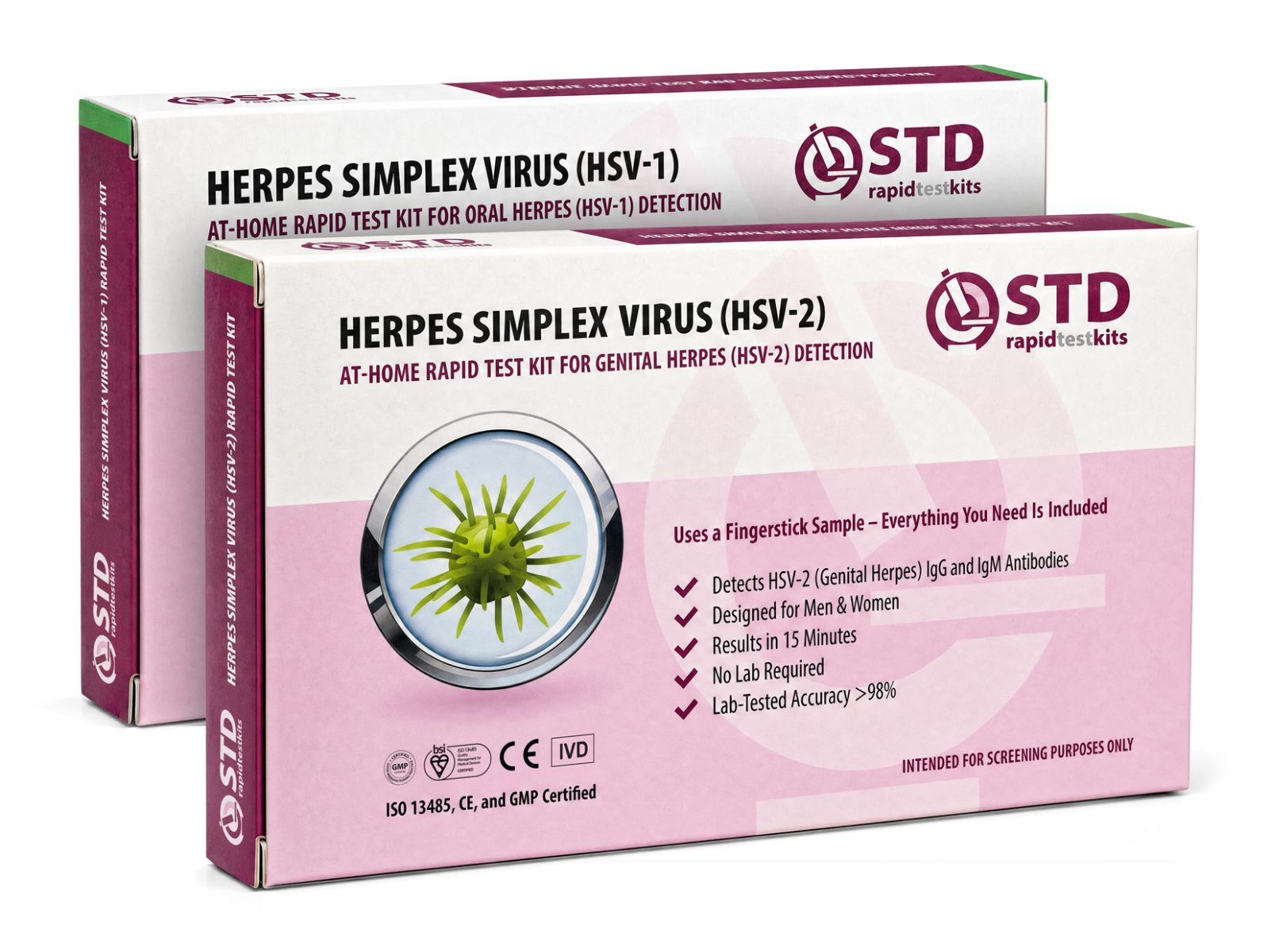
Suppressive Therapy: How Daily Antivirals Work
Suppressive therapy is daily, low-dose antiviral medication taken whether or not symptoms are present. The two most common options are valacyclovir (Valtrex) and acyclovir, both of which work by interfering with viral replication inside infected cells. Famciclovir is a less common third option.
The clinical case for suppressive therapy used to be limited to people with frequent outbreaks (six or more per year). That case has expanded. A landmark trial of serodiscordant heterosexual couples found that the positive partner taking 500 mg of valacyclovir daily reduced transmission risk to the negative partner by roughly 50 percent compared with placebo, an effect now reflected in CDC treatment guidelines. That benefit is independent of whether the positive partner is currently having outbreaks; the virus continues to shed asymptomatically from skin and mucosal surfaces between outbreaks, and suppressive therapy reduces that shedding.
A few things suppressive therapy does not do. It is not a cure; stopping the medication restores baseline shedding within days. It does not eliminate transmission risk, though it lowers it substantially. It does not replace condoms or skin-to-skin caution during prodrome and outbreaks. And daily medication can make outbreaks rarer and milder, but symptoms still mean pausing sex.
Cost and access vary. Generic valacyclovir is inexpensive and widely covered by insurance in the United States. Telehealth services have made prescription renewals easier than they used to be, particularly for couples who prefer to handle the conversation privately. Mayo Clinic's treatment overview covers dosing and side effects in more detail.
| Suppressive antiviral | Typical adult dose | Effect on transmission and shedding |
|---|---|---|
| Valacyclovir (Valtrex) | 500 mg once daily | Reduces partner-to-partner HSV-2 transmission by about 50 percent in serodiscordant heterosexual couples; reduces subclinical shedding |
| Acyclovir | 400 mg twice daily | Similar reduction in viral shedding and outbreak frequency; generally less convenient dosing |
| Famciclovir | 250 mg twice daily | Comparable suppression; less commonly first-line in the U.S. due to cost |
Intimacy and Desire When One Partner Has Herpes
The biology of herpes is solvable. The emotional layer is where many couples wobble.
A negative partner who learns mid-relationship that their partner has herpes often goes through a quiet panic phase. Googling images, comparing every itch to a symptom checklist, hesitating before kissing. This is a normal response and usually fades within weeks once the actual risk math becomes legible. Couples who push through this phase together, by reading the same sources and asking the same questions, tend to come out of it closer than they were before.
A positive partner often carries the opposite weight: guilt about transmission, self-silencing during sex, a fear of being seen as a risk rather than a person. Couples who manage this well tend to talk about it directly rather than letting it sit. Therapy helps. Joining peer-support communities of people with herpes helps. Repeating the per-year transmission numbers in plain language helps.
Intimacy in serodiscordant couples often expands rather than contracts. The change tends to feed back into the rest of the relationship's communication habits over time, in ways that have nothing to do with the virus itself.
- Explicit consent conversations and check-ins about how each partner is feeling that day.
- Nonpenetrative intimacy, including longer foreplay and oral sex outside outbreak and prodrome windows.
- A clearer shared sense of each partner's real desires, limits, and energy level, instead of defaulting to sexual scripts.
Disclosure: The Hardest Conversation, Done Honestly
For the partner with herpes, the first disclosure in a new relationship is often the worst moment of the diagnosis. The diagnosis itself, in most cases, fades within months. The fear of telling someone new can last for years.
A reasonable response from a partner is "thank you for telling me, can I have a few days to think about it." An unreasonable response is shaming, ghosting, or pressure to "prove" something. How the partner responds tells you something about the relationship that no other early conversation will surface as clearly.
People who have done this conversation well, repeatedly, tend to converge on a few habits, captured in the highlight box below. None of them are a script; they are decisions you make before opening the conversation, so the conversation itself feels less improvised.
- Time it early. Ideally before sex. The longer the gap between intimacy and disclosure, the more the conversation feels like it is about betrayal rather than about health.
- Choose the setting. Pick a moment when the other person has time and privacy to sit with the information. Disclosure on the way out the door, or by text during a workday, sets up a worse conversation than a face-to-face exchange in private.
- Bring the facts. Know which strain, when you were diagnosed, your current medication status, and the per-year transmission math with the precautions you plan to take. Then stop talking and let the other person ask.
Long-Term Relationships: What Actually Changes Over Years
For couples who have been managing herpes together for years, the virus tends to become background noise. The first months involve frequent questions and an active learning curve. By year two, most couples have settled into a routine.
What that routine looks like varies. Some couples never see an outbreak event interrupt their sex life because outbreaks have become rare. HSV outbreaks typically decrease in frequency over the first few years after primary infection, per ACOG's patient guidance. Other couples have a few "off" days a year and have learned to recognize the prodromal tingling early enough to pause without much disruption.
A small number of couples stop using condoms once both partners are comfortable with the risk profile, suppressive therapy is in place, and pregnancy is not a concern. Others keep using them indefinitely and do not feel like anything is missing. There is no single right answer here, and the right answer usually changes as the relationship matures.
What does not happen, in most healthy long-term relationships, is that herpes becomes the defining feature. It becomes one of several health variables a couple tracks together, alongside whatever else each partner brings to the table over time.
HSV-2 outbreaks typically decrease in both frequency and severity over the first few years after primary infection, per ACOG patient guidance. Many people diagnosed in their twenties report fewer than one outbreak per year by their thirties, with milder symptoms when an outbreak does occur. Suppressive therapy reduces the rate further.
What If You Catch It Anyway?
Even with everything done right, transmission still happens occasionally. The honest framing: small but nonzero. With consistent condom use plus suppressive therapy, the per-year probability sits in the low single digits.
If you test positive after a known exposure, the most useful next steps are practical. Get type-specific confirmation through an IgG blood test performed at least 12 weeks after exposure for reliable results, or a PCR swab if you have an active lesion. Get a prescription for episodic or suppressive antiviral therapy based on symptom frequency. Avoid sex during any visible symptoms. Tell future partners.
The harder work is emotional. A new diagnosis tends to trigger the same panic that the partner you may have caught it from went through years earlier. The same data still apply: most people with herpes have rare or mild symptoms, have full sex lives, have children, and have partners who love them. The fear of the diagnosis is, for most people, worse than the diagnosis itself.
If catching herpes happened because a partner did not disclose, that is a separate conversation about the relationship. The medical next steps stay the same regardless of how the transmission happened: confirmatory testing, a prescription if symptoms warrant one, and a clear plan for notifying future partners.
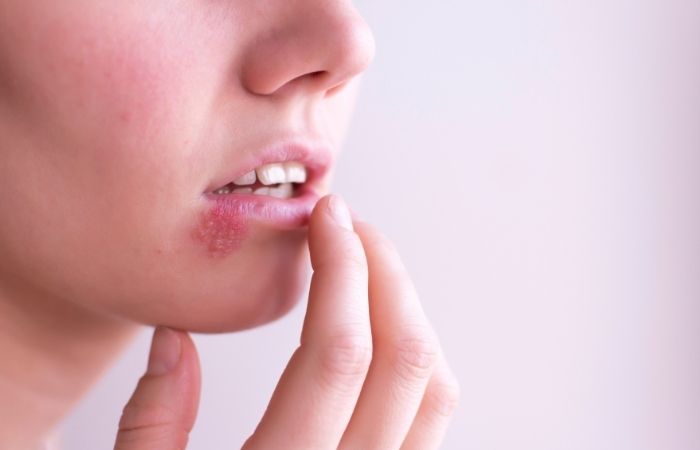
Testing Together at Home
For couples deciding to move toward unprotected sex inside an exclusive relationship, joint testing is one of the most concrete ways to make that decision data-driven rather than hopeful. Many couples describe it as a quiet but meaningful step: testing on the same afternoon, opening the results together, then having one informed conversation instead of weeks of vague worry.
At-home rapid blood tests cover the bloodborne STIs (HIV, syphilis, hepatitis B, hepatitis C, HSV-1, HSV-2) using a fingerstick sample. Genital swab tests cover chlamydia and gonorrhea. Combination kits cover most of the common panels in one package, which is often the simplest option for joint testing.
A note on what at-home herpes blood tests can tell you. They detect IgG antibodies, which take 12 to 16 weeks to become reliably positive after a new exposure. A blood test cannot tell you whether a current lesion is herpes (a clinic swab and PCR is the right tool for that). It can tell you whether you have ever been infected, with the caveats around false positives noted earlier. Lateral-flow rapid tests are screening tools. A positive result is worth confirming with a lab assay through a provider.
The herpes-specific blood test is in the section above. The combo kit below adds the six most common non-herpes STIs to complete a joint panel, which is the most common pairing couples use before moving into an exclusive arrangement.
When Herpes Affects Mental Health
Mental health is the most under-discussed part of a herpes diagnosis. Studies of newly diagnosed patients consistently show short-term spikes in anxiety, depression, and avoidance of sexual situations. For most people, these symptoms ease within months as the diagnosis becomes familiar and outbreaks become rare. For some, the impact lasts longer.
Therapy is often the single most useful intervention, particularly cognitive-behavioral approaches that target the specific shame narratives herpes tends to attach to. A therapist who handles sexual-health concerns can move a patient from "my life is over" to "I have a chronic but manageable infection" faster than self-research alone.
Partners are affected too. The negative partner can carry quiet anxiety about transmission for years. The positive partner can carry guilt that flares with every prodromal symptom. Couples who name this directly tend to fare better than couples who let it sit. Saying "this is hard for me today" out loud is often more useful than any single conversation about risk percentages.
Online peer-support communities of people with herpes have been around for decades and are often the fastest way to move from "I am alone in this" to "millions of people are doing this routinely." A diagnosis can feel isolating in the first weeks, especially before talking to anyone else who has been through it.
- A therapist trained in sexual-health concerns. Sex-positive therapy directories such as the AASECT clinician finder are a good starting point.
- Peer-support communities. Long-running options include the Herpes Opportunity forum and several active subreddit communities focused on disclosure and dating.
- Your prescriber. Suppressive antiviral prescriptions can be renewed through telehealth services without a clinic visit if that is easier than in-person.
Love Is Still Love, with a Few More Conversations
A herpes diagnosis adds logistics to a relationship. It does not cancel one. The couples who do this well are not the couples with the best luck. They are the couples who treat the virus the same way they would treat any other shared health variable: they get informed, communicate openly, and make practical decisions together.
If you are dating someone with herpes, you are dating someone who has had to learn a hard set of conversations younger and more thoroughly than most. That tends to make better partners, not worse ones. The honest version of "what is it really like" is calmer than the dramatic version Hollywood sells, and the couples who have been through it usually say the same thing: the first three months were the hardest part, and after that, life looked like the rest of their relationship.
Three things to do this month
- Run a baseline HSV antibody blood test if you have never been tested. Retest at 12 to 16 weeks if there is a recent possible exposure.
- If your partner is HSV-positive and not currently on suppressive therapy, agree to ask a prescriber about daily valacyclovir at the next appointment.
- Agree on a prodrome protocol: what happens during the tingling or itching that precedes a visible outbreak, including how either partner can pause sex without it becoming a conversation.
Frequently Asked Questions
- Can I date someone with herpes and never catch it?
- Yes, and many couples do. The annual transmission risk for a serodiscordant heterosexual couple ranges from roughly 10 percent unprotected and unmedicated, down to about 1 to 2 percent with consistent condom use, daily suppressive antivirals, and avoiding sex during outbreaks. Plenty of long-term couples never see transmission. The decisive factors are communication and consistent precautions.
- What if my partner did not disclose until after we had sex?
- You are allowed to feel hurt, and the relationship conversation that follows is separate from the medical one. On the medical side: get a baseline HSV antibody blood test now (which establishes whether you had any prior exposure), then retest at 12 to 16 weeks post-exposure for reliable detection of any new HSV-2 infection. On the relationship side, ask why they did not tell you sooner. Sometimes the answer is that they did not know they were a carrier. Sometimes it is fear of rejection. Both are real, and your response is yours to make.
- Can herpes spread between outbreaks when no symptoms are visible?
- Yes. The phenomenon is called asymptomatic viral shedding, and it is the main reason herpes spreads so widely despite being a well-known infection. The virus can be active on the skin without visible signs. Daily suppressive antivirals reduce shedding by roughly half, which is the main mechanism behind their transmission-prevention benefit per CDC guidelines.
- Is oral sex risky if my partner has oral or genital herpes?
- It depends on which strain is where. If your partner has oral HSV-1 (the strain behind most cold sores), they can pass it to your genitals during oral sex, even between active cold sores. If your partner has genital herpes and you perform oral sex on them, transmission to your mouth or throat is possible but generally lower-risk. Many couples use condoms or dental dams, time oral sex around symptom-free periods, or both.
- If I already get cold sores, can I still catch genital herpes?
- Probably, though with somewhat reduced risk. Prior HSV-1 oral infection provides partial but incomplete cross-immunity against HSV-2 and against HSV-1 in a new genital location. The reduction is real but not protective enough to skip precautions if your partner is HSV-2 positive.
- Can we stop using condoms long-term if my partner is on suppressive therapy?
- Many serodiscordant couples eventually do, once both partners are comfortable with the residual risk (roughly 4 to 5 percent per year with suppressive therapy alone, and roughly 1 to 2 percent per year when combined with consistent condoms). The decision usually depends on how risk-tolerant the negative partner is, whether pregnancy is a current consideration, and how reliably the positive partner takes their medication. There is no single right answer.
- How soon after a possible exposure can I test reliably?
- For HSV-2 IgG antibody blood tests, the recommended window is 12 to 16 weeks after exposure. Earlier testing can be useful as a baseline (it establishes that you did not have a prior infection), but a negative result before 12 weeks does not rule out a recent infection. If you have an active sore, a PCR swab from a clinic gives a much faster answer than waiting for antibodies.
- How common is herpes really?
- Most people with herpes do not know they have it. That single fact is what makes prevalence numbers feel surprising the first time you read them. The CDC estimates about 1 in 8 U.S. adults aged 14 to 49 carries HSV-2, the strain most often associated with genital herpes, and the majority of cases stay undiagnosed because symptoms can be mild, intermittent, or absent. So the "it is more common than you think" framing is not a comfort line written to soften a diagnosis. It is a description of how a slow, mostly-silent virus moves through a population.
How we sourced this article. We synthesized current public-health guidance from the U.S. Centers for Disease Control and Prevention, the World Health Organization, Mayo Clinic, ACOG, and Planned Parenthood, along with the published clinical-trial data underlying the CDC's transmission-reduction estimates for suppressive antiviral therapy. The article was drafted in plain language, fact-checked against root-domain primary sources, and medically reviewed for clinical accuracy.
- U.S. Centers for Disease Control and Prevention. Genital herpes overview, including HSV-1 and HSV-2 prevalence and transmission basics in the United States.
- U.S. Centers for Disease Control and Prevention. STI Treatment Guidelines: genital herpes simplex virus infections. Clinical guidance on episodic and suppressive antiviral therapy and transmission-reduction data.
- World Health Organization. Herpes simplex virus fact sheet, including global prevalence estimates for HSV-1 and HSV-2.
- Mayo Clinic. Genital herpes diagnosis and treatment overview, including antiviral dosing and side effects.
- Planned Parenthood. Patient guide to herpes, including disclosure and partner-conversation guidance.
- American College of Obstetricians and Gynecologists. Patient-facing FAQ on genital herpes, including partner risk, outbreak frequency over time, and pregnancy considerations.
