How to Test for Chlamydia and Gonorrhea Without Leaving Home
How rapid home swab tests work and when to use them



- At-home chlamydia and gonorrhea rapid kits use lateral-flow chemistry, similar to a pregnancy test, and produce a result in about 15 minutes from a self-collected swab.
- Lab-based NAAT remains the most sensitive option, especially when symptoms are absent, so a positive home result is worth confirming with a clinic NAAT before treatment.
Published: June 2025 | Last updated: May 2026 | Editorial review and quality control: Martina N.
Testing for chlamydia and gonorrhea at home used to mean mailing a sample to a lab and waiting two to five business days for a portal email. The shorter route on this site is different: a sealed lateral-flow cassette, a self-collected swab, and a readable line on the cassette window in about 15 minutes. This guide walks through what those rapid kits actually do, when they fit your situation, and when a clinic visit is the better call.
How do at-home chlamydia and gonorrhea tests work, and how reliable are they?
Most at-home rapid kits sold direct to consumers, including the kits on this site, are lateral-flow immunoassays. You collect a swab sample yourself, mix it with buffer, apply buffer drops to a cassette, and read the result in about 15 minutes. Sensitivity varies by product and bacterial load; it is typically higher when symptoms are present and lower when the infection is asymptomatic. That is why a positive home result is worth confirming at a clinic with a NAAT (nucleic acid amplification test) before starting antibiotics. A negative result in the first week after exposure can be too early to trust.
Key takeaways
- At-home chlamydia and gonorrhea rapid kits use lateral-flow chemistry, similar to a pregnancy test, and produce a result in about 15 minutes from a self-collected swab.
- Lab-based NAAT remains the most sensitive option, especially when symptoms are absent, so a positive home result is worth confirming with a clinic NAAT before treatment.
Why home testing matters for chlamydia and gonorrhea
Chlamydia is the most commonly reported notifiable infection in the United States, and the CDC recommends annual screening for all sexually active women under 25 because risk of infection is higher in that age group (CDC, About Chlamydia). Both infections can be silent. The majority of vaginal chlamydia infections, and a large share of pharyngeal or rectal gonorrhea cases, produce no symptoms at all, so people often only find out from screening, contact-tracing, or a complication like pelvic pain or epididymitis (inflammation of the coiled tube behind the testicle, which can cause scrotal swelling and pain).
For someone who knows they were exposed but has no symptoms, the path to a clinic test is often longer than the path to a home test. A clinic visit means a daytime appointment, a face-to-face conversation, and (in the U.S.) a bill that may show up on a parent or partner's insurance summary. A home rapid kit removes those friction points. The kit ships in unbranded packaging, the test runs on a bathroom counter, and the result stays private. For routine screening between partners, after a known exposure, or as part of a yearly check, that combination of speed and discretion is the practical case for testing at home.
Routine annual screening with no symptoms. Retesting after a known exposure once the window has closed. A quiet check between new partners. Situations where keeping the result off your insurance claims data matters more than having a clinical record on file.
What an at-home rapid kit does (and what it doesn't)
Rapid kits sold for at-home use are lateral-flow immunoassays. Inside the cassette is a strip of nitrocellulose with two zones: a test line that captures a chlamydia or gonorrhea antigen if the antigen is present in your sample, and a control line that confirms the test ran correctly. When buffer flows across the strip, antigen-bound colored particles concentrate at the test line, producing a visible second line. The chemistry is the same family of technology used in home pregnancy tests and rapid COVID-19 antigen tests.
This is meaningfully different from the test most clinics run. A clinic NAAT (nucleic acid amplification test) extracts and amplifies bacterial DNA or RNA from the sample. NAAT can detect a few copies of bacterial nucleic acid, which is why the CDC treats NAAT as the diagnostic standard for chlamydia and gonorrhea (CDC STI screening recommendations). Lateral-flow tests work at higher antigen thresholds, which is fine when bacteria are abundant (most symptomatic infections, peak shedding) and less reliable when bacteria are scarce (very early infection, deep pharyngeal carriage, asymptomatic low-load shedding).
A rapid home test is a screening tool with strong specificity, useful speed, and lower sensitivity than a lab NAAT. Treat it as a 15-minute first answer rather than the equivalent of a confirmatory lab test.
Both detect chlamydia or gonorrhea from the same kind of swab sample. The difference is what they measure. Lateral-flow detects bacterial proteins on a paper strip; results in 15 minutes at home. NAAT detects bacterial DNA in a lab; results in 1 to 5 days. NAAT is more sensitive, especially when there is no symptom and bacterial load is low. The two are complementary: rapid home screening for speed and privacy, lab NAAT for confirmation when a result will drive treatment.
Picking the right kit for your situation
The site lists three relevant single-infection kits and one combo kit. The choice depends on which exposure you are testing for and how much you already know.
If you were exposed to a partner who tested positive for chlamydia only, the dedicated chlamydia rapid swab is the cleanest fit. The kit includes a sterile self-collection swab, buffer, and one cassette. The same logic applies to a known gonorrhea exposure: the gonorrhea rapid swab is the targeted test.
The combo kit covers chlamydia and gonorrhea in one shipment. Co-infection is common; a meaningful share of people who test positive for one of the two also carry the other, depending on the surveillance source. If you do not know which infection your partner has, or if you are doing a general screening rather than a targeted retest, the 2-in-1 panel saves a step.
One scope note worth saying clearly: all three of these kits use a self-collected genital swab. The site does not sell a urine-based panel for chlamydia and gonorrhea, and it does not sell a pharyngeal (throat) or rectal swab kit. If your exposure was oral-only or anal-only, see the section on home test versus clinic visit further down; a clinic-administered swab of the actual exposure site will catch infections a home genital swab can miss.
This site sells rapid lateral-flow home test kits for chlamydia and gonorrhea; the products below are from that catalog.
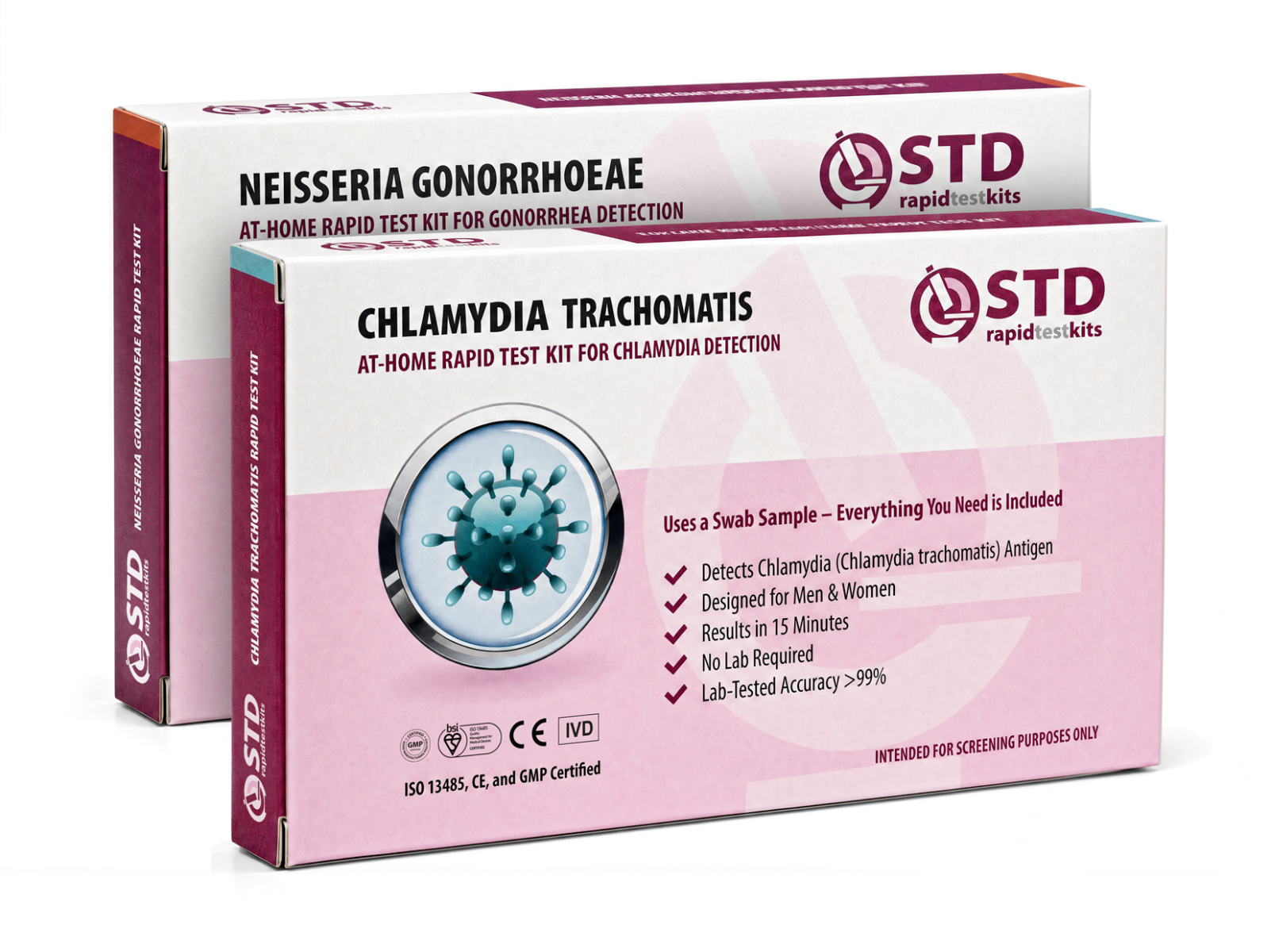
How to use the kit, step by step
The instruction sheet inside each kit is the source of truth, but the broad shape is the same across the chlamydia, gonorrhea, and 2-in-1 versions on this site.
Step 1: Read the timing instructions before you start. Most kits ask you not to urinate for 1 to 2 hours before sampling. The reason is bacterial flush: a recent pee washes away the cells you are trying to swab.
Step 2: Wash your hands and open the pouch. The pouch should be sealed and the desiccant intact. Lay out the swab, the buffer tube, the cassette, and the instruction card on a clean dry surface.
Step 3: Collect the swab sample. For a vaginal sample, insert the soft swab tip about 5 cm (2 inches) into the vaginal canal and rotate gently against the vaginal walls for 15 to 20 seconds. For a urethral sample (penis owners), insert the swab tip 2 to 4 cm into the urethral opening and rotate for a few seconds. The instruction card has the diagram; follow it.
Step 4: Mix the swab with buffer. Place the swab head into the buffer tube, swirl for 10 to 15 seconds against the tube wall to release cells, then squeeze the swab head against the tube wall as you withdraw it.
Step 5: Apply buffer to the cassette and time the read. Drop the specified number of buffer drops into the sample well on the cassette. Set a timer. Read the cassette at the time written on the instruction card, usually 15 minutes. Reading too early or too late can both produce misleading patterns.
The most common mistakes that invalidate a result: not waiting long enough between the last urination and the swab, not rotating the swab long enough to pick up cells, and reading the cassette outside the time window.
When to test: the window period that matters
A test cannot detect what is not yet there. Both chlamydia and gonorrhea have an incubation window between exposure and the point at which a sample carries enough bacteria to detect.
For chlamydia, infections become detectable on a NAAT roughly 5 to 14 days after exposure, with most positives picked up by day 14. Lateral-flow rapid tests, which need higher bacterial load, sit closer to the back end of that range. Testing on day 3 after a known exposure is too early; testing at day 14 is reasonable; testing again at day 21 if the first was negative is the standard belt-and-suspenders move.
For gonorrhea, the window is shorter on average. Bacterial loads rise faster, and most exposures produce a detectable signal between 2 and 7 days, with high reliability by day 14.
If you have symptoms (unusual discharge, burning when you pee, post-coital bleeding, lower abdominal pain), the bacterial load is almost always high enough to test immediately. A negative result with active symptoms still warrants a clinic visit because something is causing the symptoms.
For an annual screening with no specific recent exposure, just test. The CDC recommends at least yearly screening for sexually active women under 25, men who have sex with men, and anyone with new or multiple partners (CDC STI screening recommendations).
Reading your result without second-guessing
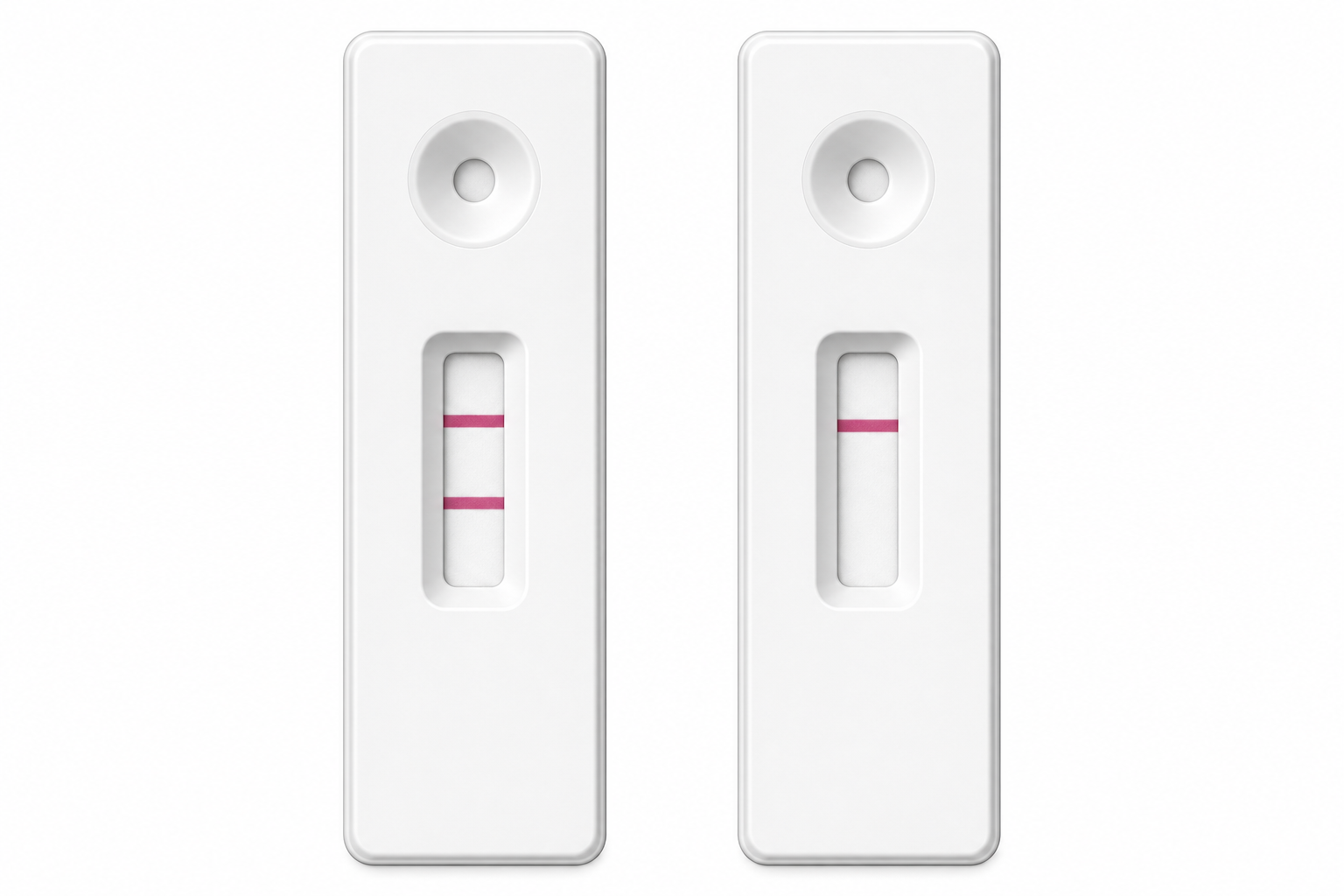
The two lines on a lateral-flow cassette are not equal. The control line (usually marked C on the cassette) tells you the test ran. If the control line is missing, the test is invalid no matter what else appears on the strip; discard it and run a fresh cassette. The test line (usually marked T) is the actual readout.
One control line, no test line: non-reactive. The sample did not contain detectable antigen at the threshold the kit reads at. With a known exposure, this still means retest in a few weeks.
One control line plus one test line of any visible intensity: reactive. A faint test line is still a positive read on most lateral-flow chemistries, because the chemistry is qualitative rather than gradient.
No control line, with or without a test line: invalid. Most often this means too little buffer was applied, the cassette was read outside the time window, or the cassette was damaged.
Photograph the cassette in good light at the read time written on the instruction card. The lines fade after the window passes, and a photograph captured at minute 15 is more reliable than a memory of what you saw at minute 25.
How to read your cassette in three states
- Non-reactive: one line at the control mark, no test line. The sample carries no detectable antigen at the kit's threshold.
- Reactive: one control line plus any visible test line. Even a faint test line counts; treat it as positive and arrange clinic confirmation.
- Invalid: no control line. The result is unreadable; discard the cassette and run a fresh one.
What to do if your result is reactive
A reactive (positive) home result tells you to take action; it is not yet a final diagnosis. The standard sequence runs through five steps: confirm at a clinic, abstain, notify recent partners, complete antibiotics, and retest in three months.
Most sexual-health clinics, urgent care centers, and primary care offices can run a NAAT from a urine sample or clinic-collected swab. NAAT is the standard before antibiotic treatment because it confirms the result and rules out a false positive from another condition. If a clinic is not available, treatment can still start under telehealth supervision rather than self-prescribed.
Both infections are transmissible during the gap between a positive test and finishing antibiotics, so use barriers strictly or abstain for the full course. Tell anyone you have had sex with in the prior 60 days; the CDC and most state health departments offer anonymous partner-notification tools if you do not want to make the call yourself.
Chlamydia is usually treated with a 7-day course of doxycycline; gonorrhea is usually treated with a single intramuscular dose of ceftriaxone. Both regimens are short and effective when taken as directed.
The CDC recommends retesting at 3 months after treatment to catch reinfection from a partner who was not treated. This follow-up screens for a new infection; it does not confirm that the first antibiotic course worked (CDC, About Gonorrhea).
1. Confirm. Get a clinic NAAT before starting antibiotics if you can.
2. Abstain. No sex until you have finished the full antibiotic course.
3. Notify. Tell partners from the prior 60 days; anonymous notification tools exist.
4. Treat. Take the full antibiotic course as prescribed.
5. Retest. Screen again at three months to catch reinfection from an untreated partner.
Home test versus clinic visit, when to choose which
The home rapid test fits cleanly when you are screening between partners, retesting after a known exposure, or running an annual check with no symptoms. Privacy is high, the cost stays off insurance, and the result lands in 15 minutes.
The clinic visit is the right call when:
- The exposure was oral-only or anal-only. The site does not sell a pharyngeal or rectal swab kit, and a genital swab will not catch infections seated in the throat or rectum.
- You have symptoms suggesting a complication: pelvic pain, fever, testicle swelling, post-coital bleeding, or rectal pain.
- You are pregnant. Untreated chlamydia and gonorrhea in pregnancy carry specific risks (preterm birth, neonatal transmission), so the diagnostic chain should run through prenatal care.
- Your home test was reactive and you want NAAT confirmation before starting antibiotics.
- You need a clinical record of the test for a partner-notification process or a workplace screening.
The two are complementary. A common pattern: home rapid test for the fast read, clinic NAAT to confirm before treatment.
You have severe pelvic or testicular pain, fever, or visible bleeding; you are pregnant; the exposure was oral or anal only; or you have already tested positive on another platform and want NAAT confirmation. A home swab does not replace a clinical evaluation when complications are possible.
Privacy, packaging, and what gets recorded
The shipping carton is plain corrugated cardboard with no STD branding, no clinical labeling, and no return address that flags health content. Inside is a sealed pouch, an instruction card, and (depending on the kit) a desiccant. Couriers do not know what is in the box; the order looks like any other small parcel.
Because the test runs on the bathroom counter, no result enters your insurance claims data. There is no doctor's note, no lab requisition, and no record at your primary care clinic unless you choose to share the result. For people whose insurance is shared with parents, partners, or employers, that gap matters; a clinic visit for STI testing routinely shows up as a coded line on an explanation-of-benefits document.
The trade-off is that a home test alone leaves no formal medical record. If you ever need to demonstrate testing for a partner, a workplace, or a future provider, run a clinic test as well. For private screening, the home rapid kit is enough on its own.
Annual screening for chlamydia is recommended for all sexually active women younger than 25 years, as well as older women with risk factors such as new or multiple sex partners.
Choosing the kit that fits your situation
Three options cover the common scenarios. The 2-in-1 combo is the broad screening pick when you do not know which infection a partner has, or when you want both infections checked from a single swab. The targeted chlamydia rapid swab is the right choice for a known chlamydia exposure (test from day 14 onwards). The targeted gonorrhea rapid swab is the right choice for a known gonorrhea exposure, where the detection window opens earlier (most exposures show a detectable signal between days 2 and 7).
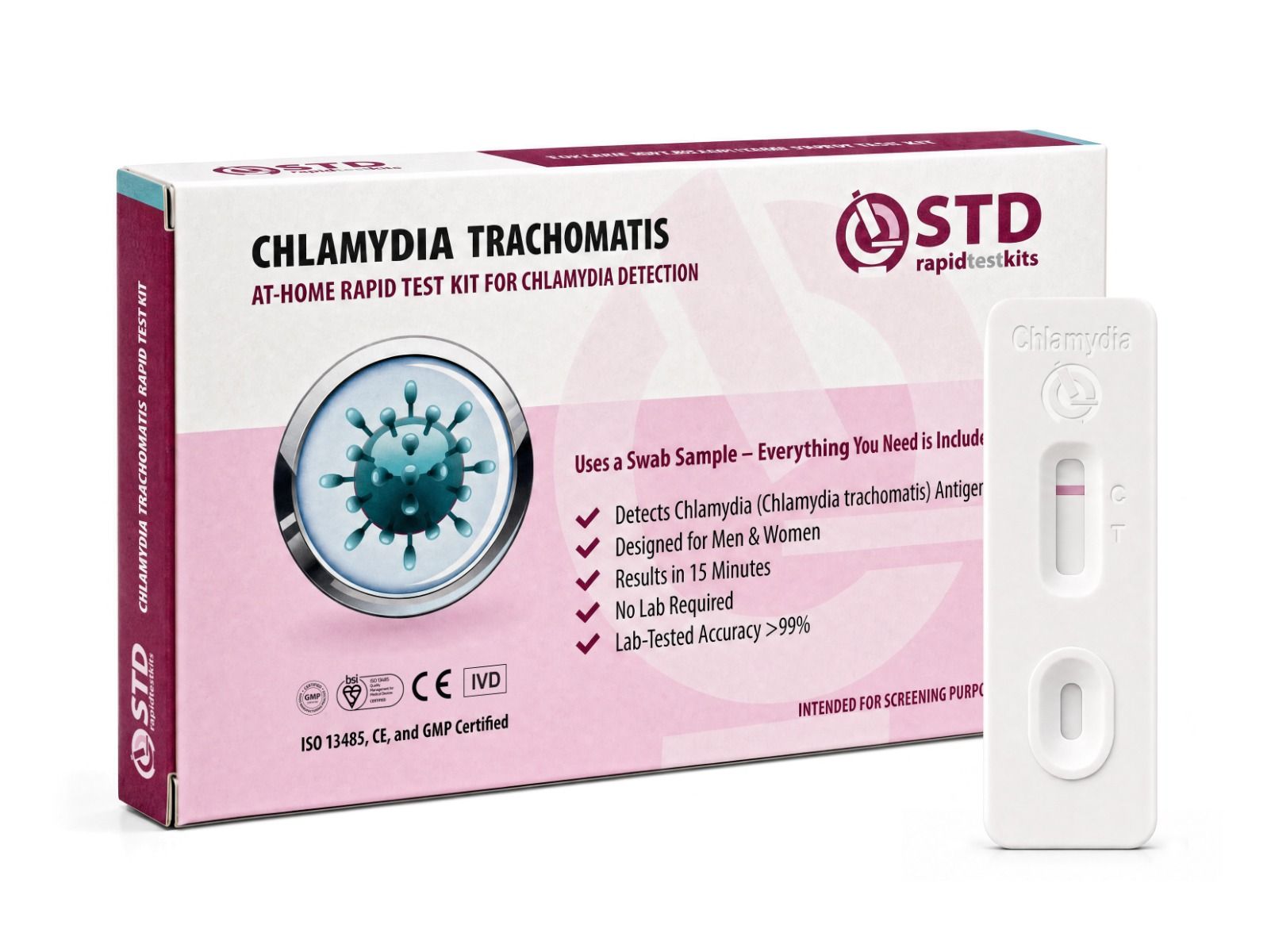
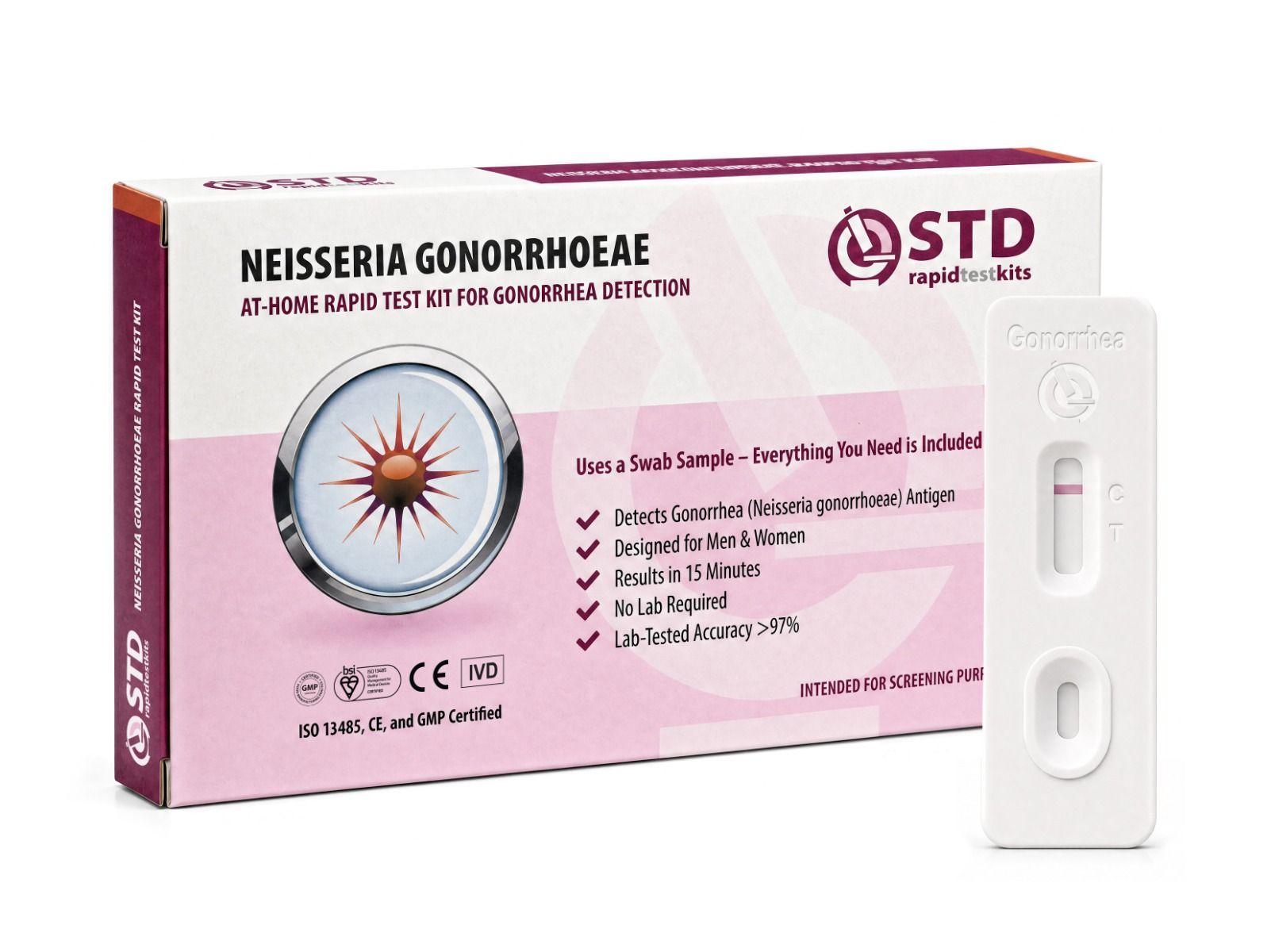
If a recent partner tested positive for gonorrhea specifically, the dedicated kit below is the cleanest match. It uses the same self-collected genital swab and 15-minute lateral-flow read as the other two kits.
Common questions about home chlamydia and gonorrhea testing
- Are at-home rapid swab tests as accurate as the test my clinic runs?
- Not exactly. Clinic NAATs are more sensitive, especially for asymptomatic infections where bacterial load is low. Rapid lateral-flow kits are designed for screening speed; sensitivity varies by product and is typically higher when symptoms are present. A positive home result is worth confirming with a clinic NAAT before starting antibiotics.
- How long after sex should I wait before testing?
- For chlamydia, wait at least 14 days after the exposure for a reasonably reliable read; testing earlier than 5 to 7 days risks a false negative. For gonorrhea, 7 days is usually enough. If you test before the window closes and the result is non-reactive, retest at the back end of the window before treating it as a clean negative.
- Can I test for throat or rectal infections with a home kit?
- Not with the kits sold here. The chlamydia, gonorrhea, and combo kits on this site are validated for self-collected genital swabs only. If your exposure was oral or anal, see a clinic that can collect a pharyngeal or rectal swab; a genital swab will miss infections seated elsewhere.
- What does a faint test line mean?
- On most lateral-flow chemistries, any visible test line at the read time is a reactive (positive) result, even a faint one. The chemistry is qualitative rather than gradient. Photograph the cassette at the read time written on the instruction card and treat a faint line as positive while you arrange clinic confirmation.
- What should I do if my home test is positive?
- Confirm at a clinic with a NAAT before starting antibiotics if you can. Avoid sex until you have finished treatment. Tell recent partners (anyone in the past 60 days). Take the prescribed antibiotic course in full. Retest at 3 months to catch reinfection from an untreated partner.
- How discreet is the packaging?
- Plain corrugated cardboard, no STD branding, no clinical labels, and no return address that flags health content. The kit looks like any other small parcel from the outside. The order does not generate an insurance claim because nothing runs through a billed clinic visit.
- Can I test myself again with the same kit?
- No. Each cassette is a single-use device, and the buffer is calibrated to one run. If you need to retest, order a fresh kit. Re-running a used cassette will produce an invalid or misleading result.
- Should I tell my doctor that I tested at home?
- Yes if the result is reactive or if you are starting antibiotics; the clinical chain works better with the home result on file. For a clean negative on routine screening, sharing is your call. The home test does not auto-populate into any medical record on its own.
- U.S. Centers for Disease Control and Prevention. About Chlamydia, including overview, transmission, symptoms, and screening guidance for women under 25.
- U.S. Centers for Disease Control and Prevention. About Gonorrhea, including symptoms, treatment regimens, and the recommended 3-month follow-up retest.
- U.S. Centers for Disease Control and Prevention. STI Treatment Guidelines, screening recommendations covering annual screening guidance for women under 25 and MSM.
- World Health Organization. Sexually transmitted infections (STIs) fact sheet, global incidence and treatment overview.
- NHS. Chlamydia condition page covering symptoms, testing pathways, and treatment.