

Published: November 2025 | Last updated: April 2026 | Editorial review and quality control: Martina N.
Gonorrhea is one of the most common bacterial STIs in the United States and one of the most likely to go unnoticed. Many people who carry it never feel a single symptom; they only learn they have it when a partner is diagnosed, or when a routine screening turns positive. The reassuring part: gonorrhea is curable with antibiotics when caught, and the at-home rapid swab covered further down is one of the fastest ways to find out where you stand without booking a clinic visit.
That said, no single test fits every situation. This guide walks through what the rapid lateral-flow gonorrhea test actually measures, when its result is reliable, when you genuinely need a clinic instead, and how the two-in-one chlamydia plus gonorrhea kit compares for the very common case where you want to rule out both at once. This article is published by stdrapidtestkits.com, which sells at-home STI testing kits; we recommend products based on fit-for-purpose for the reader's concern, not commercial benefit.
Are at-home gonorrhea test kits accurate, and which one fits my situation?
Rapid lateral-flow gonorrhea swab tests typically report sensitivity in the low-to-mid 90s and specificity above 98% when used after the right window period (about 7 to 14 days post-exposure for genital infection). They are reliable for genital screening and for ruling out asymptomatic carriage between partners. They are not the right tool for a sore-throat (pharyngeal) or rectal exposure; for those sites, a clinic-administered swab processed by NAAT is the appropriate test. The gonorrhea-only kit and the chlamydia-plus-gonorrhea two-in-one kit both use the same self-collected swab; the combination kit is a small premium for testing both infections from a single sample, which most clinical guidelines recommend.
Key Takeaways
- Rapid at-home gonorrhea swabs work for genital screening (vaginal or penile self-swab) with results in about 15 minutes; sensitivity is in the low-to-mid 90s when used at least 7 to 14 days after exposure.
- We do not sell a throat-swab or rectal-swab home test, and you should not substitute the genital kit for either; pharyngeal and rectal exposure require a clinic-administered swab for an accurate result.
How common is gonorrhea, and why does asymptomatic spread matter?
Gonorrhea is the second most reported sexually transmitted infection in the United States, after chlamydia. The Centers for Disease Control and Prevention recorded roughly 600,000 cases in its most recent annual surveillance report (the figure appears in the linked surveillance report accessible from the CDC STI statistics hub), with the actual number of infections believed to be substantially higher because so many cases never reach a clinic.
The reason that gap matters: gonorrhea is silent in most women and a meaningful share of men. CDC's clinical guidance notes that infected women often have no symptoms at all, and when symptoms do appear they are mild enough to be mistaken for a urinary-tract infection or a yeast infection (CDC, About Gonorrhea). Men more often notice burning during urination or a discharge from the penis within one to two weeks of exposure, but a sizable proportion stay asymptomatic too.
Untreated gonorrhea has consequences worth taking seriously. In women it can ascend the reproductive tract and cause pelvic inflammatory disease, which is a leading bacterial cause of tubal-factor infertility and ectopic pregnancy in the United States. In men it can cause epididymitis. In both, it raises HIV transmission risk through any local inflammation, and rare disseminated infections can spread to joints and skin.
Roughly 600,000 reported gonorrhea cases per year in the United States is only the visible portion. Most infected women have no symptoms at all, and a meaningful share of infected men carry the bacterium without ever feeling sick. By the time symptoms appear, the infection has often already had a chance to spread to a partner. Routine screening at recommended intervals is the only way to find these silent infections.
What an at-home rapid gonorrhea swab actually does
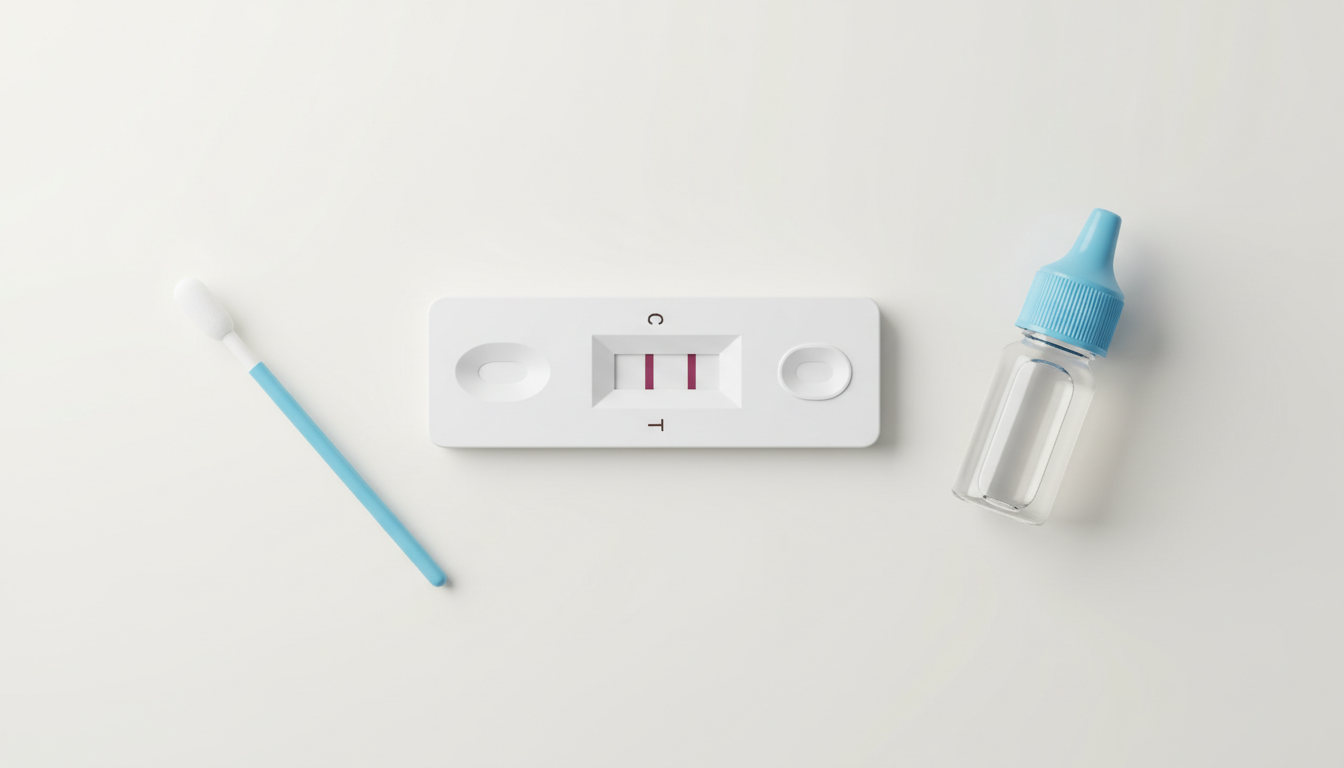
The home kit is a lateral-flow immunoassay, the same chemistry family as a home pregnancy test or a COVID-19 antigen strip. You collect a vaginal or penile swab yourself, dip it in the supplied buffer solution, and apply a few drops to the cassette. Antibodies on the strip bind to gonococcal antigens (specific surface proteins of Neisseria gonorrhoeae), and a colored line appears in the test window if antigen is present at or above the detection threshold. A second control line confirms the strip ran correctly. Results are visible in about 15 minutes.
This chemistry is fundamentally different from a laboratory NAAT (nucleic acid amplification test), which amplifies bacterial DNA from a similar swab and reaches a lower limit of detection. Labs use NAAT because it can detect very early or low-burden infections that an antigen strip might miss. Both tools have a place. The lateral-flow strip's strengths are speed, privacy, no shipping or appointment, and a result you can act on the same hour. Its limitation is sensitivity at the very edges of the window period, when bacterial load is still climbing.
The at-home rapid test functions as screening rather than laboratory diagnosis. A positive at-home result is a strong reason to start treatment promptly with a clinician, who will typically also order a confirmatory NAAT and check for co-infections. A clean negative on a properly timed swab is reassuring, and for most people it is sufficient. If you have ongoing symptoms despite a negative result, follow up with a clinic.
Genital, oral, and rectal exposure: which test fits which
Gonorrhea infects mucous membranes, and the bacterium can establish itself in any site exposed during sex. The three clinically relevant sites are the genital tract, the pharynx (throat and tonsils), and the rectum. Each site has its own testing approach, and they are not interchangeable.
Genital exposure. This is the most common site of infection and the one our home kit is built for. The kit uses a self-collected vaginal swab (women) or a penile-meatus swab (men) to sample the site directly. Symptoms in this site, when present, include burning during urination, unusual discharge, intermenstrual bleeding in women, and sometimes pelvic or testicular pain. The rapid swab works well here.
Oral or throat (pharyngeal) exposure. Pharyngeal gonorrhea follows oral-to-genital sexual contact. It is almost always asymptomatic; when symptoms appear they look like an ordinary sore throat, sometimes with swollen lymph nodes (CDC, About Gonorrhea). Importantly: a home rapid genital swab does not detect a throat infection. The two are physically separate sites. If you specifically want to test for pharyngeal gonorrhea, see a clinic; pharyngeal NAAT on a clinician-collected throat swab is the standard of care.
Rectal exposure. Rectal gonorrhea follows receptive anal sex. Symptoms, when present, include rectal discharge, anal itching, soreness, bleeding, or painful bowel movements; most rectal infections are asymptomatic too. As with pharyngeal infection, a genital swab will not detect a rectal infection. Rectal NAAT at a clinic is the appropriate test.
To be plain about scope: this site sells a genital self-swab and a chlamydia-plus-gonorrhea two-in-one combination kit, both of which sample the genital site. We do not sell a pharyngeal or rectal home swab. If your exposure was at one of those sites and the genital site, the home kit covers only the genital portion of the picture.
Our rapid home kit samples the genital site only. For confirmed pharyngeal (throat) testing, ask your clinician for a throat-swab NAAT. For rectal testing, ask for a rectal NAAT. Both are available at most sexual-health clinics and many primary-care offices. The home kit is still useful in parallel, since most people with an oral or anal exposure also had genital contact, but it is not a substitute for the site-specific test.
How accurate is the rapid swab compared to lab NAAT?
Two numbers matter when judging any test: sensitivity (how often it catches a real infection) and specificity (how often a positive result is genuinely positive rather than a false alarm).
For gonorrhea, the laboratory NAAT is the reference standard. CDC's adult treatment guidance describes NAAT performance as superior to bacterial culture, with high sensitivity on properly collected genital samples (CDC STI Treatment Guidelines, gonococcal infections in adolescents and adults). Lateral-flow rapid antigen tests sit slightly below NAAT, typically in the low-to-mid 90s for sensitivity and above 98% for specificity in manufacturer validation studies on symptomatic and recent-exposure samples.
What does that gap mean in practice?
- False negatives are more common at the edges of the window period. If you swab the day after exposure or in the very first few days, the bacterial load may be too low for the antigen strip to detect even when NAAT would already turn positive. This is why we recommend waiting at least 7 days, ideally 14 days, before testing.
- False positives are rare but possible. The high specificity means most positive results are real infections, but a confirmatory NAAT at the clinic is standard practice anyway, both to confirm the result and to check for chlamydia, which co-infects with gonorrhea in a meaningful share of cases (CDC STI Treatment Guidelines).
- Asymptomatic infections are detected at slightly lower rates than symptomatic ones. Both lab and home tests trend higher in sensitivity when bacterial load is higher, which generally tracks with symptom presence. For long-asymptomatic infections in routine screening, expect performance toward the lower end of the published range.
| Feature | Home rapid swab | Lab NAAT |
|---|---|---|
| Sensitivity (genital) | ~92 to 95% | ~96 to 99% |
| Specificity (genital) | above 98% | above 99% |
| Time to result | About 15 minutes at home | 1 to 3 days from lab |
| Sample source | Self-collected vaginal or penile swab | Self or clinician-collected swab; sometimes urine |
| Cost without insurance | $25 to $45 single, similar for chlamydia plus gonorrhea combo | $50 to $200 per panel depending on facility |
| Best use | Screening, post-exposure check, between clinic visits | Confirmatory diagnosis, symptomatic evaluation, full panel |
When to test after exposure: the window period
Gonorrhea symptoms, when they appear, typically arrive within one to fourteen days of exposure (NHS, Gonorrhoea patient information). The bacterium begins shedding antigen in detectable amounts within roughly the same window. Practical timing recommendations:
- Day 0 to day 6 after exposure: too early. Both NAAT and antigen tests can miss real infections this soon. If you have symptoms, see a clinic now and ask about empiric treatment; otherwise, wait.
- Day 7 to day 14 after exposure: the rapid swab is reliable from this window onward. This is the sweet spot for asymptomatic post-exposure screening.
- Day 14 onward: testing remains accurate. If your exposure event was several weeks ago and you have no symptoms, swab whenever it is convenient.
- If you develop symptoms at any time: swab immediately. A positive result on a rapid swab plus symptoms is sufficient evidence to start treatment with a clinician.
The window period for the throat (if you choose to get a clinic pharyngeal swab) and rectum runs slightly longer than for genital infection, because bacterial growth at those sites is slower. Most clinical guidelines suggest testing at three weeks for those sites if exposure was recent.
If you and a partner are testing together to clear each other, both partners should swab at the same point in the window for the result to be meaningful for both directions of possible transmission.
Test at least 7 days post-exposure, ideally 14, for the rapid home swab to be reliable. Day 0 to day 6 is generally too early for either home antigen or lab NAAT to detect a real infection. If symptoms appear at any point, swab right away and see a clinician regardless of where you are in the window.
How to collect the swab correctly
Sample-collection technique is the single biggest variable in home-test accuracy. The kit instructions cover the specifics, and what the technique boils down to is consistent across most kits.
For a vaginal self-swab: insert the supplied swab about two inches into the vaginal canal, rotate gently against the vaginal wall for 10 to 15 seconds, then withdraw. Do not insert further than the package indicates; the goal is the lower vaginal wall, not the cervix. Skip lubricant or vaginal washes for at least 24 hours before swabbing. Validation studies have found that self-collected vaginal swabs produce results comparable to clinician-collected samples for gonorrhea detection, which is the technical basis for home-swab kits.
For a penile self-swab: the kit usually instructs you to swab the inside of the urethral meatus (the opening of the penis) for 5 to 10 seconds. This is briefly uncomfortable. Express any visible discharge first if present, and follow that with the swab. Avoid urinating for at least one hour before swabbing; doing so right beforehand washes away the bacterial load that the strip needs.
Once the sample is on the swab, follow the kit's buffer-and-cassette steps exactly. Time the read window using a clock or phone timer; reading a strip too late (typically more than 30 minutes after applying buffer) can lead to faint false-positive bands as the strip dries.
Avoid urinating for at least one hour before swabbing; urination washes away the bacterial load the strip needs to detect. And read the cassette result within 30 minutes of applying buffer. Reading later can produce a faint false-positive band as the strip dries, which is one of the most common sources of confusion with home rapid tests.
What to do with a positive or negative result
If your result is positive: contact a clinician within a day or two. Gonorrhea is curable, and current CDC treatment guidance is a single 500 mg intramuscular injection of ceftriaxone for uncomplicated genital, rectal, or pharyngeal infection (CDC STI Treatment Guidelines, gonococcal infections in adolescents and adults). The clinician will typically also order a confirmatory NAAT and test for chlamydia (commonly co-infecting), HIV, and syphilis as part of standard practice.
You should abstain from sex or use barrier protection until both you and any recent partners have completed treatment. Notify partners from the past two months so they can test and treat as well; many clinics offer expedited partner therapy where the clinician prescribes treatment for partners who cannot easily come in.
If your result is negative and you have no symptoms: the result is reassuring. If your last exposure was at least 14 days ago and you have no symptoms, you almost certainly do not have a genital gonorrhea infection.
If your result is negative but you still have symptoms: see a clinic anyway. False negatives are uncommon but real, and persistent symptoms warrant clinical evaluation regardless of any home-test result. Other infections (chlamydia, mycoplasma, urinary-tract infection, trichomoniasis) can mimic gonorrhea symptoms and need their own tests. A NAAT and a clinical exam will sort out which.
If you had oral or anal exposure as well as genital: the home test does not cover those sites, so a negative home swab is only a partial result. Get the corresponding pharyngeal or rectal swab at a clinic to close the loop.
Three-result decision tree
- Positive result: contact a clinician within 1 to 2 days for ceftriaxone treatment and a confirmatory NAAT.
- Negative result with no symptoms and at least 14 days since exposure: result is reassuring; no further action needed.
- Negative result with ongoing symptoms: see a clinic anyway, since false negatives are uncommon but real and persistent symptoms warrant evaluation.
Cost: what you actually pay for a home test versus a clinic visit
Costs vary by region and insurance, and a few benchmarks help frame the decision.
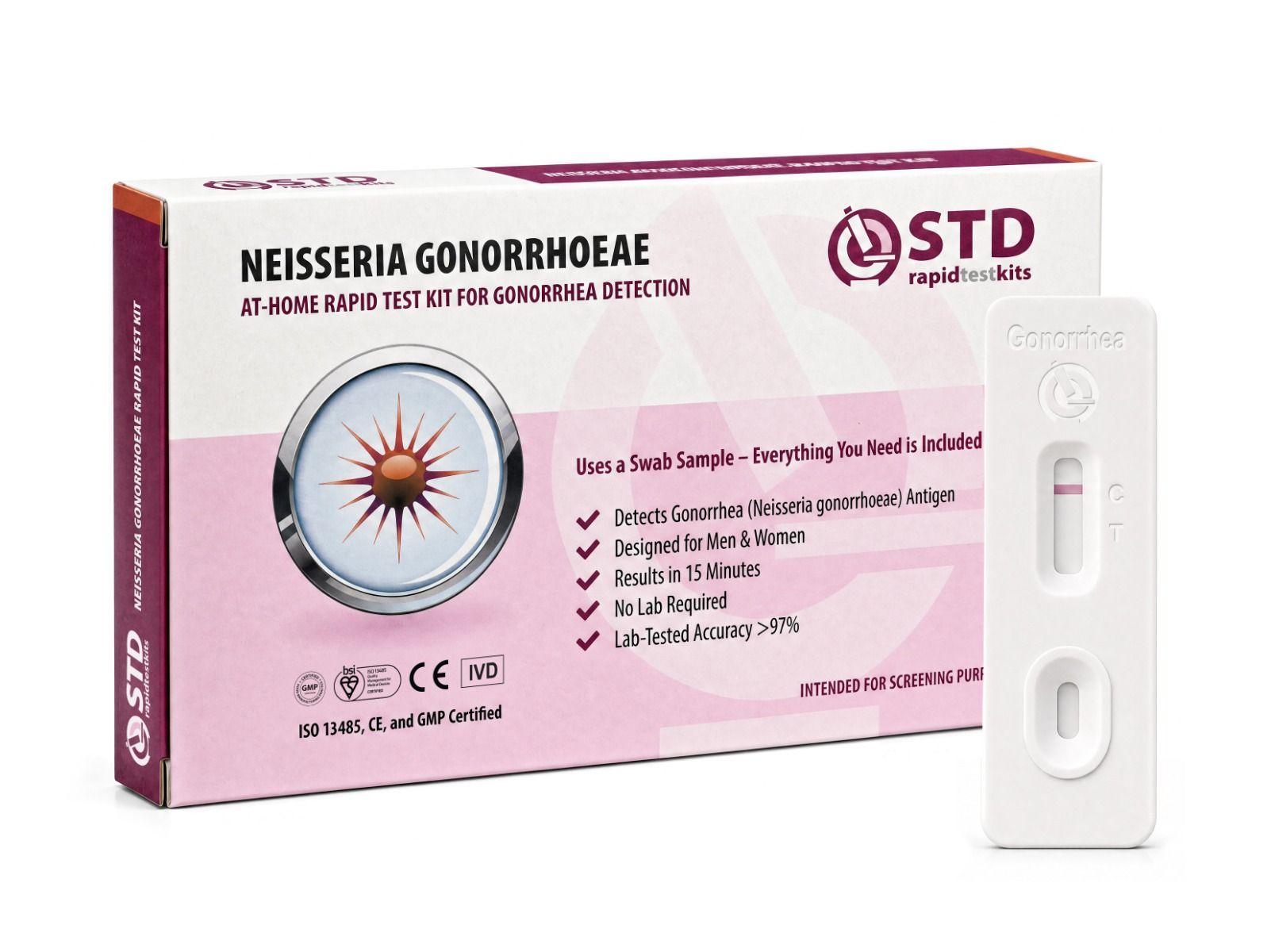
- A standalone rapid gonorrhea home test runs about 25 to 45 dollars depending on quantity and shipping. The chlamydia-plus-gonorrhea two-in-one home kit sits in a similar range, since both samples come from a single self-swab.
- A clinic visit for STI testing runs from no-cost (at federally qualified health centers, Title X clinics, or state public-health clinics that scale by income) to roughly 150 to 400 dollars at private urgent care or primary care, before insurance.
- Insurance typically covers laboratory NAAT for gonorrhea when ordered by a clinician for a clinical indication, including post-exposure screening. Annual screening for sexually active women under 25 is recommended by USPSTF and is generally covered without cost-sharing under preventive-services rules.
The home kit is appealing when you want a result the same day, when you want privacy, when a clinic visit is logistically difficult, or when you want to test between scheduled clinical screenings.
Who should screen routinely, even with no symptoms
The CDC and the U.S. Preventive Services Task Force recommend annual gonorrhea screening for several groups regardless of symptoms (CDC STI screening recommendations):
- Sexually active women under age 25. Annual chlamydia and gonorrhea screening is a routine preventive-services recommendation; the public-health rationale is the high rate of asymptomatic infection in this group and the long-term fertility implications of untreated infection.
- Sexually active women age 25 and older with risk factors: a new partner, multiple partners, a partner with concurrent partners, a partner with an STI, or inconsistent condom use.
- Men who have sex with men: at least annually, with site-specific screening (genital plus pharyngeal plus rectal as appropriate to sexual practice). More frequent screening every 3 to 6 months for those with multiple partners or HIV-positive status.
- Pregnant women: screening at the first prenatal visit, with rescreening in the third trimester for those at continued risk.
- People with a recent positive STI test for any other infection (chlamydia, syphilis, HIV), since co-infection is common and exposure routes overlap.
For routine screening in any of these groups, the home swab is a reasonable supplement to clinical care, particularly between scheduled visits. It does not replace the comprehensive panel that a clinic offers (HIV, syphilis, hepatitis screening), and people in higher-risk groups generally benefit from the broader panel at least once a year.
Untreated gonorrhea can cause serious and permanent health problems in both women and men. In women, it can cause pelvic inflammatory disease, which can lead to infertility and ectopic pregnancy.
Frequently asked questions
- How accurate are at-home gonorrhea test kits compared to a clinic NAAT?
- The home rapid swab is in the low-to-mid 90s for sensitivity and above 98% for specificity in manufacturer validation studies, when used after the recommended 7 to 14 day window period. Laboratory NAAT, the reference standard, sits a few percentage points higher in sensitivity. The two are complementary: the home test is faster and more private, the lab NAAT is more sensitive in early or low-burden infections. A positive home result is a strong signal to seek treatment and a confirmatory NAAT.
- How long after exposure should I wait before testing for gonorrhea?
- Wait at least 7 days, and ideally 14 days, after exposure. The bacterium takes time to multiply at the infection site to a level the rapid test can detect. Testing on day 1 or 2 post-exposure can produce a false-negative result even when infection is present. If you have symptoms, see a clinic immediately regardless of the window period.
- Can the home test detect oral (throat) or rectal gonorrhea?
- No. The rapid genital swab samples the vagina or penis only; throat and rectal infections live at different sites and require their own samples. If your exposure was oral or anal, ask a clinician for a pharyngeal NAAT or rectal NAAT respectively. Our home kit covers the genital site only, and we do not sell a throat-swab or rectal-swab home kit.
- If my home test is positive, is that enough to start treatment?
- A positive rapid result is strong evidence of infection, especially when combined with a recent exposure or symptoms. Most clinicians will treat empirically based on a credible positive screening test and order a confirmatory laboratory NAAT in parallel. Do not self-treat with leftover or online antibiotics; gonorrhea has developed resistance to several older drug classes, and current CDC guidance is a specific regimen (a single 500 mg intramuscular ceftriaxone injection).
- How long does gonorrhea treatment take, and when is it safe to have sex again?
- Treatment for uncomplicated gonorrhea is one injection of ceftriaxone, and the antibiotic clears the infection within a few days. CDC recommends abstaining from sex for 7 days after the injection AND until any recent partners have also been treated. A test of cure is not generally required for genital gonorrhea but is recommended for pharyngeal infections, where the bacterium is harder to eradicate.
- Should I test for chlamydia separately if I take the gonorrhea kit?
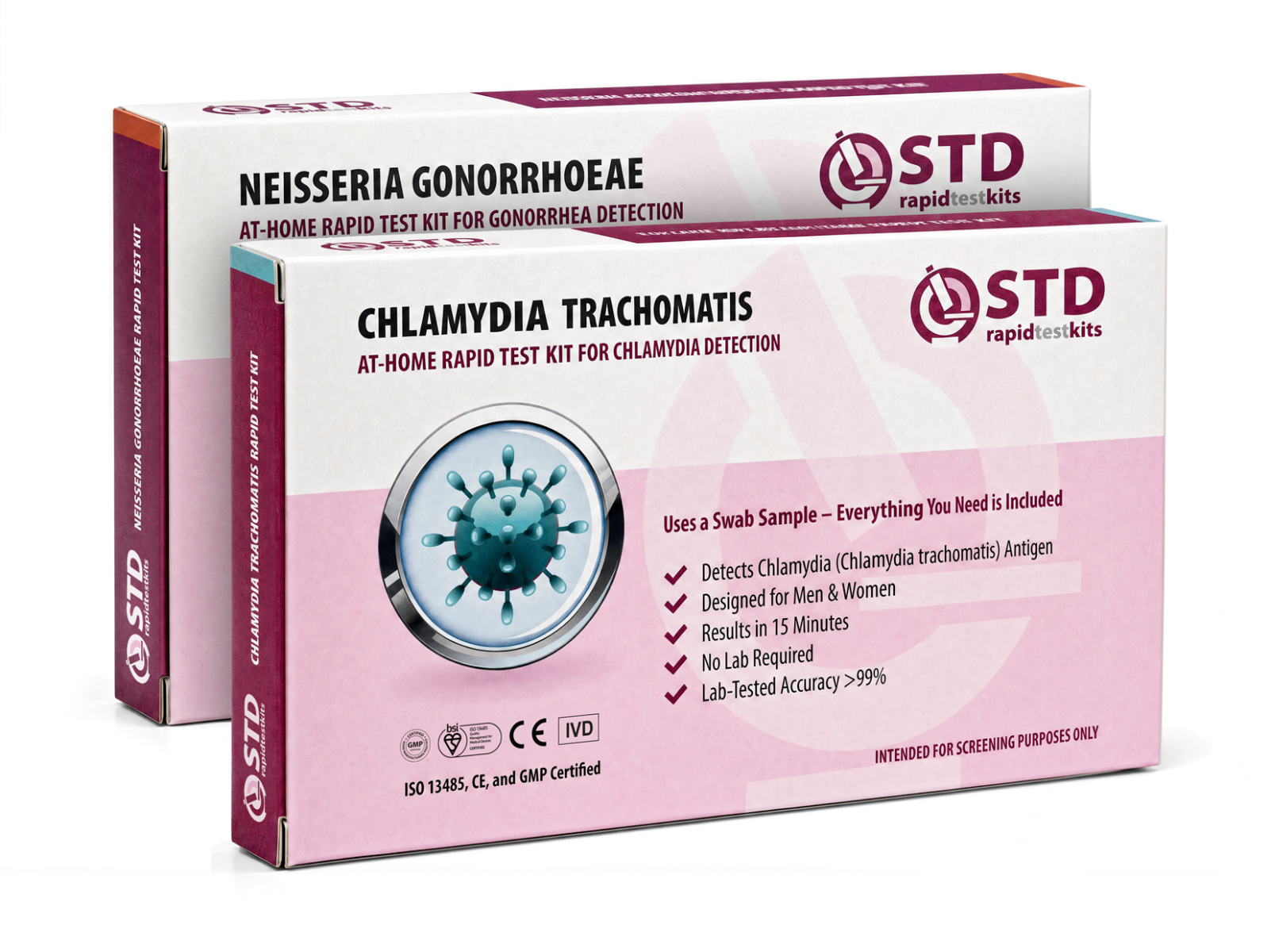
- Most likely yes. Chlamydia and gonorrhea co-infect in a meaningful share of cases, and CDC routinely recommends testing for both at the same time. The two-in-one chlamydia-plus-gonorrhea combination kit uses the same self-collected swab and reports both results, which is why it is the more popular option among readers in the at-risk groups discussed above.
- What if my partner tested positive but my home test is negative?
- Talk to a clinician anyway and consider empiric treatment. False negatives are most common in the first week after exposure and in low-burden infections; if a partner is confirmed positive, your exposure risk is high enough that many clinicians treat empirically without waiting for a second test. At minimum, get a laboratory NAAT to confirm your status, and abstain from sex until both of you have completed treatment.
- Can I test multiple times to be sure?
- A single properly timed test (at least 7 days post-exposure, ideally 14 days, on a correctly collected swab) is generally sufficient. Repeat testing makes sense in three situations: when the first sample was likely too early in the window, when symptoms emerge after a negative result, or when a partner is confirmed positive. Repeating a test on the same day adds little value.
Product: STD-6KIT-ATH-2025
- U.S. Centers for Disease Control and Prevention. STI surveillance data, including annual reported gonorrhea case counts and trends in the United States.
- U.S. Centers for Disease Control and Prevention. About Gonorrhea: clinical fact sheet covering symptoms in women and men, transmission routes by anatomic site, pharyngeal and rectal symptom patterns, and complications including PID and infertility.
- U.S. Centers for Disease Control and Prevention. STI Treatment Guidelines, gonococcal infections in adolescents and adults: NAAT testing recommendations, the 500 mg intramuscular ceftriaxone treatment regimen, and confirmatory testing guidance.
- U.S. Centers for Disease Control and Prevention. STI screening recommendations: routine annual chlamydia and gonorrhea screening for sexually active women under 25, men who have sex with men, pregnant women, and other higher-risk groups.
- UK National Health Service. Gonorrhoea: patient information on symptoms, the typical 1 to 14 day symptom-onset window, testing locations, and treatment in the UK system.
- U.S. Preventive Services Task Force. Chlamydia and gonorrhea screening recommendations for sexually active women, including the under-25 annual-screening guideline cited in U.S. preventive-services coverage rules.
