
Published: August 2025 | Last updated: April 2026 | Editorial review and quality control: Martina N.
Syphilis cases in the United States have climbed to levels not seen since the early 1950s. Reported infections reached the highest level in roughly seven decades during the early 2020s, with more than 190,000 syphilis cases reported in 2024 per CDC STI surveillance. Congenital syphilis, where the bacterium passes from a pregnant person to a fetus, has more than tripled in recent years, with nearly 4,000 cases reported in 2024 alone.
The disease is fully curable in its early stages with a single penicillin injection. The current surge reflects testing and awareness gaps rather than any failure of treatment. This article walks you through what is driving the rise, who is most affected, how the four stages of infection unfold, and how rapid blood testing fits into early detection.
Why are U.S. syphilis cases at a 70-year high?
Reported syphilis infections climbed to the highest level since the early 1950s in recent years per CDC surveillance, with congenital cases more than tripling. Drivers include declining condom use, gaps in routine screening, public-health funding erosion, drug-use overlaps, and many asymptomatic cases that go undetected without active testing. Early-stage syphilis is fully curable with a single penicillin injection. The path to early detection is routine blood tests every 3 to 12 months for sexually active adults, and at every prenatal visit during pregnancy.
Key Takeaways
- Reported U.S. syphilis cases climbed to the highest level in roughly seven decades, with congenital syphilis cases more than tripling in recent years per CDC surveillance.
- Early-stage syphilis is fully curable with one penicillin injection. Routine blood testing every 3 to 12 months is the single most effective intervention against the surge.
Why U.S. syphilis cases are surging again
Public-health officials describe today's syphilis rates as a textbook resurgence rather than a one-year spike. Several forces compounded over the past decade.
Less fear of HIV, less consistent condom use. The widespread availability of HIV pre-exposure prophylaxis (PrEP) has reduced HIV anxiety among sexually active adults. The same pill that prevents HIV does nothing to prevent syphilis, gonorrhea, or chlamydia, and condom use has fallen as PrEP uptake has climbed (CDC syphilis page). The protective behaviors that helped suppress syphilis through the 1990s have weakened in parallel.
Public-health budgets have eroded. State and local STI programs have lost significant purchasing power over the past two decades amid stagnant federal funding, according to public-health advocacy groups. Fewer disease-intervention specialists, fewer outreach contacts, and shorter clinic hours all show up downstream as missed diagnoses.
Methamphetamine and injection drug use overlap with infection clusters. The CDC has flagged a sharp correlation between rising heterosexual syphilis cases (especially in women) and methamphetamine, heroin, and injection drug use. Drug use raises both individual risk behavior and the chance of crossing into transmission networks where syphilis is already circulating.
Asymptomatic cases drive silent spread. The primary chancre that defines early syphilis is painless and can appear in places people never see, inside the vagina, rectum, or back of the throat. Many infected people pass through the primary stage without ever noticing a sore. Without active screening, those infections continue spreading.
Healthcare-access gaps hit some communities harder. Black, Hispanic, and Native American populations experience syphilis at multiples of the rates seen in white populations, a disparity that tracks with insurance coverage, clinic distance, and historical mistrust of the medical system. Geographic hotspots include the South, the Mountain West, and large urban areas in California, Texas, and Florida.
This article is published by stdrapidtestkits.com, which sells at-home STI testing kits. We recommend products based on fit-for-purpose for the reader's concern, not commercial benefit. The kits below are from our own catalog.
Who is most affected by the resurgence
Syphilis was once concentrated mostly among men who have sex with men (MSM). The current surge is broader and now reaches every demographic.
Women are seeing the steepest relative increase. Reported syphilis among women rose sharply through the late 2010s and 2020s per CDC surveillance. Because syphilis in pregnancy drives congenital cases in newborns, this trend has the worst downstream consequences.
Newborns and pregnant people. Congenital syphilis cases have more than tripled in recent years, with nearly 4,000 cases reported in 2024 per the CDC's congenital syphilis page. The CDC estimates that the majority of these cases could be prevented with timely testing and treatment during pregnancy. Most missed cases trace back to either no prenatal care at all or care that started too late in pregnancy to act on a positive result.
People living with HIV. People who are HIV-positive are several times more likely to acquire syphilis than the general population. The two infections also amplify each other: syphilitic ulcers raise HIV transmission risk, and HIV alters how syphilis presents and progresses, which makes diagnosis without specific testing more difficult.
Men who have sex with men. MSM still account for the largest share of primary and secondary syphilis cases overall. Routine screening every 3 to 6 months remains the standard of care for sexually active MSM with multiple partners.
Geographic hotspots. The highest case rates concentrate in southern states (Mississippi, Louisiana, Arkansas, New Mexico) and parts of the Mountain West and West Coast. State-by-state rates can vary by more than tenfold, often tracking with poverty and healthcare access.
U.S. syphilis cases climbed to the highest level in roughly seven decades per CDC surveillance. Congenital syphilis cases have more than tripled in recent years, reaching nearly 4,000 in 2024. Women, newborns, and people living with HIV are now driving the steepest relative increases.
Recognizing the four stages of syphilis
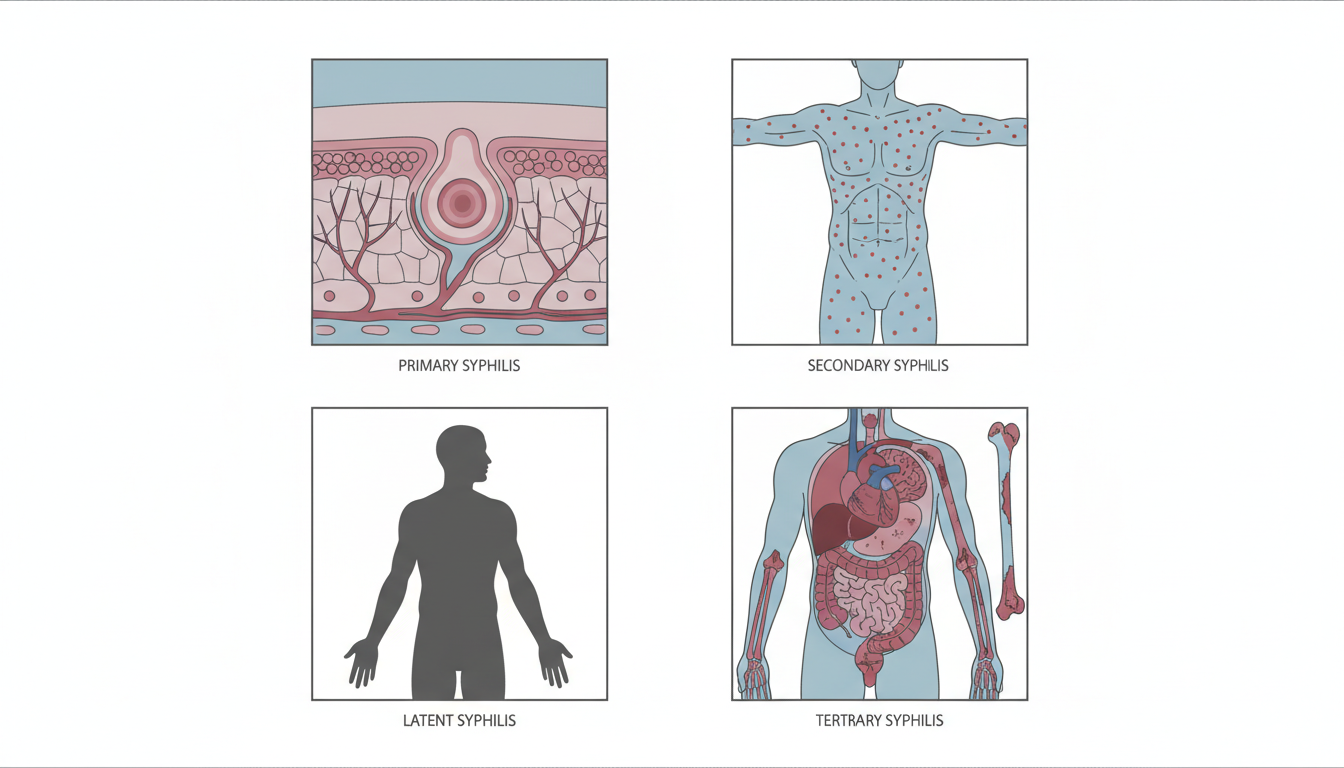
Untreated syphilis progresses through four clinical stages. Understanding what each stage looks like is the difference between catching a curable infection and missing it until permanent damage sets in.
Primary stage: the painless chancre. Two to twelve weeks after exposure (most commonly around three weeks), a single firm, painless sore appears at the site of infection. The chancre can develop on the genitals, anus, mouth, lips, or anywhere bacteria entered the body. It heals on its own within 3 to 6 weeks, with or without treatment, which is exactly why so many primary cases go undiagnosed. The infection has not gone away; it has just moved on to the next stage.
Secondary stage: rashes and flu-like symptoms. Weeks to months after the primary chancre heals, secondary syphilis appears. The classic presentation is a non-itchy, copper-colored or reddish-brown rash that can cover the trunk, palms, and soles. Other symptoms include fever, headache, sore throat, swollen lymph nodes, patchy hair loss, and moist wart-like lesions called condyloma lata in skin folds. These symptoms also resolve without treatment, which can falsely reassure people that whatever they had has passed.
Latent stage: silent infection. If untreated, syphilis enters a latent phase with no visible symptoms. Early latent syphilis (within the first year) is still potentially infectious to sexual partners. Late latent syphilis (after one year) is generally not sexually transmissible but can still pass from a pregnant person to a fetus and can still progress internally for years.
Tertiary stage: organ damage. Tertiary syphilis can develop years to decades after the initial infection in roughly 15 to 30% of untreated cases. It causes severe cardiovascular damage (aortic aneurysm, valve disease), neurosyphilis (stroke, dementia, paralysis, deafness, blindness), and gummatous lesions in skin, bone, and internal organs. Penicillin still treats tertiary syphilis, but it cannot reverse damage already done.
Congenital syphilis: the public-health emergency hiding inside the surge
The sharp rise in congenital syphilis is the most alarming piece of the broader resurgence. Babies born with syphilis face stillbirth, neonatal death, low birth weight, deformed bones, severe anemia, enlarged liver and spleen, jaundice, brain and nerve problems, blindness, and deafness. Untreated maternal syphilis leads to adverse birth outcomes in 50% to 80% of cases per the WHO syphilis fact sheet; survivors face lifelong complications.
The catastrophe is preventable. A course of benzathine penicillin G during pregnancy stops vertical transmission in the vast majority of cases. The CDC now recommends syphilis testing at the first prenatal visit, again in the third trimester, and at delivery for anyone with risk factors or living in a high-incidence area. Skipping any of those checkpoints, especially in pregnancies that present late, is how preventable cases turn into NICU emergencies.
If you are pregnant or trying to conceive, ask explicitly whether your provider is doing the three-test prenatal protocol. If you live in a high-prevalence state and are not pregnant but plan to be, a baseline test before conception is worth the time.
The CDC recommends syphilis testing at three checkpoints during pregnancy: at the first prenatal visit, again in the third trimester, and at delivery for anyone with risk factors or living in a high-incidence area. Together, these three tests prevent the vast majority of congenital cases. Ask your provider explicitly whether you are getting all three.
How syphilis testing works (lab and at-home)
Syphilis is detected through blood tests, not swabs. The body produces antibodies in response to the Treponema pallidum bacterium, and lab and at-home tests both look for those antibodies.
The two-test laboratory approach. Clinical labs typically run a treponemal-specific test (which detects antibodies against the syphilis bacterium itself) along with a nontreponemal test like RPR or VDRL (which measures the body's general inflammatory response to infection). Both must be positive for a confirmed diagnosis. The treponemal test stays positive for life after infection; the nontreponemal test titer drops with successful treatment, which lets clinicians monitor the response to therapy.
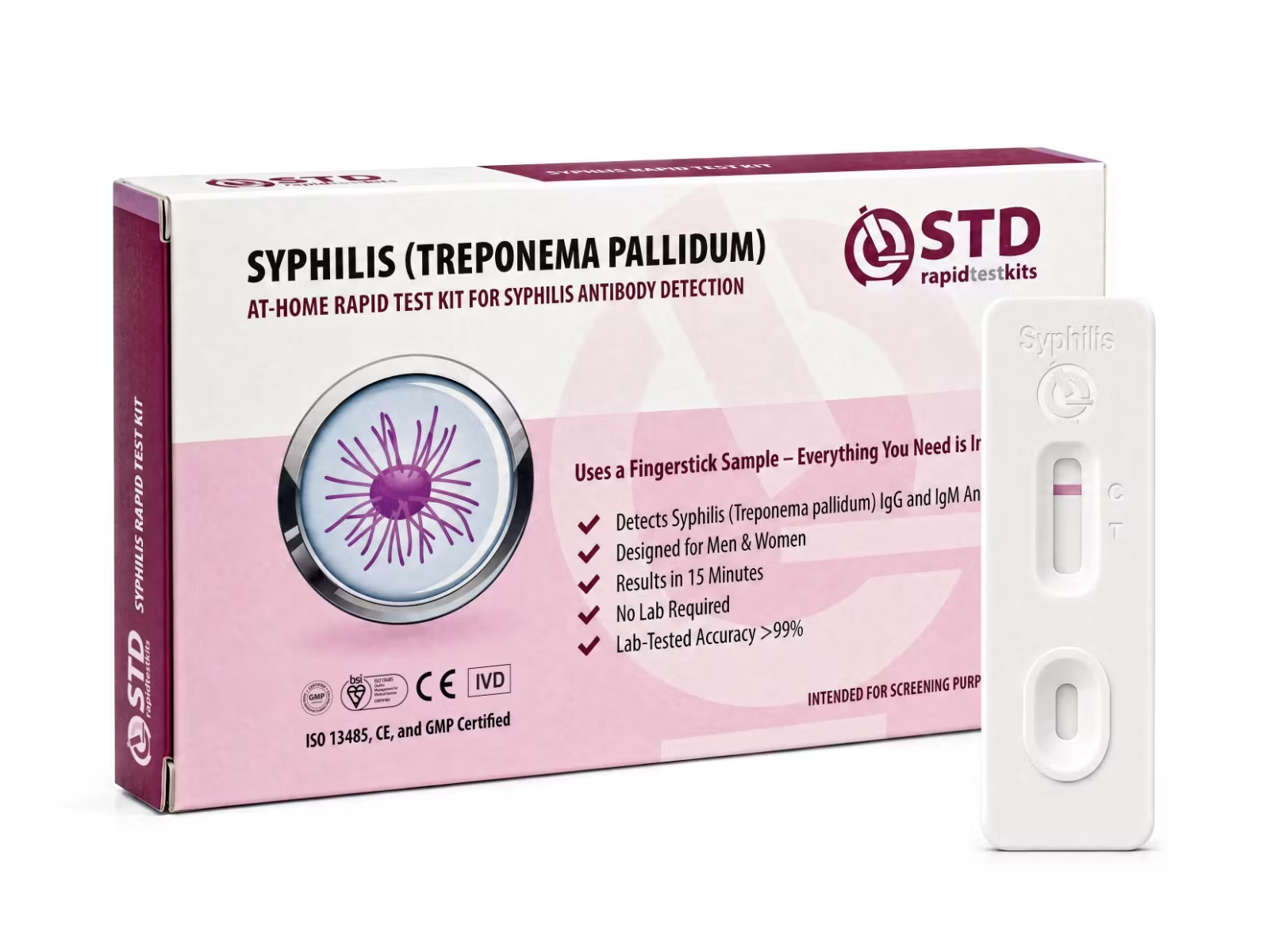
At-home rapid tests. Lateral-flow rapid tests use a fingerstick blood sample and detect treponemal antibodies in about 10 to 15 minutes. They are screening tools, not lab-equivalent confirmatory tests. A reactive home result should always be followed up with a clinical confirmatory blood test before any treatment decision, but a negative home result can rule out infection at the relevant window period without a clinic visit.
The window period. Antibody tests, lab or rapid, can typically detect syphilis 3 to 6 weeks after exposure, with most cases detectable by 6 weeks. A test taken too early after exposure can miss an active infection, so a follow-up test at 6 to 12 weeks is recommended after a known or suspected exposure.
When to test. CDC guidance covers several situations: at the start of a new sexual relationship, every 3 to 6 months for sexually active MSM with multiple partners, at every prenatal visit during pregnancy, after any unprotected sexual exposure, and any time syphilis-like symptoms appear (painless sore, unexplained body rash, swollen lymph nodes).
Testing protocol at a glance
- Window period: blood antibody tests detect most syphilis infections 3 to 6 weeks after exposure, with the majority of cases detectable by 6 weeks.
- After a known or suspected exposure: test once now, then again at 6 to 12 weeks if the first result is negative.
- A reactive at-home rapid result requires a clinical lab confirmatory test (a treponemal-specific test plus RPR or VDRL) before any treatment decision.
- Routine cadence: every 3 to 6 months for sexually active MSM with multiple partners, annually for other sexually active adults, and at every prenatal visit during pregnancy.
Treatment is straightforward when caught early
The good news embedded in this story is that syphilis remains highly treatable. Penicillin, discovered in 1928 and standardized for syphilis in the 1940s, has not lost effectiveness against Treponema pallidum, and there is no clinically significant resistance to worry about.
For primary, secondary, and early latent syphilis (within one year of infection), CDC STI treatment guidelines call for a single intramuscular injection of long-acting benzathine penicillin G at 2.4 million units. For late latent syphilis, syphilis of unknown duration, or tertiary syphilis, treatment is three weekly injections at the same dose. Neurosyphilis requires intravenous penicillin given in a hospital setting.
People with severe penicillin allergies need skin-test confirmation. In pregnant women, penicillin is the only recommended treatment, and desensitization is performed in a hospital if needed.
Successful treatment is confirmed by a falling nontreponemal antibody titer over 6 to 12 months. Most early-stage cases resolve fully with no permanent damage. Tertiary cases can be cured of active infection but cannot reverse cardiovascular or neurological damage already done.
Re-infection is possible at any time. A treated infection does not confer immunity, and partner notification plus simultaneous treatment is the only way to break the chain of transmission.
Penicillin dosing at a glance
- Primary, secondary, or early latent syphilis: one intramuscular injection of benzathine penicillin G at 2.4 million units.
- Late latent, syphilis of unknown duration, or tertiary syphilis: three weekly intramuscular injections at the same 2.4 million unit dose.
- Neurosyphilis: intravenous aqueous crystalline penicillin G given in a hospital setting.
- Pregnancy with severe penicillin allergy: hospital-based desensitization. Penicillin is the only treatment recommended in pregnancy.
Prevention strategies that reduce your risk
Condoms used correctly and consistently. Latex condoms reduce syphilis transmission risk substantially when they cover the area where a chancre is or could be. They are not 100% effective because chancres can develop outside the area a condom covers (scrotum, perineum, mouth), but consistent condom use is one of the strongest single risk-reducers available, especially when paired with regular testing.
Doxycycline post-exposure prophylaxis (doxy-PEP). The CDC issued formal doxy-PEP guidance in 2024 for MSM and transgender women with a history of bacterial STIs. A single 200 mg dose of doxycycline taken within 72 hours of unprotected sexual contact reduces syphilis acquisition substantially in eligible populations. Doxy-PEP is not currently recommended for the general population or for cisgender women due to limited efficacy data in those groups.
Routine screening. The single most effective intervention against the current surge is testing more frequently than people currently do. CDC's recommended cadence is every 3 to 6 months for sexually active MSM with multiple partners, annually for sexually active adults outside that group, and at every prenatal visit during pregnancy.
Partner notification and treatment. A positive syphilis result without partner treatment is an unfinished sentence. State and local health departments offer confidential partner-notification services in most U.S. jurisdictions; many people prefer to notify partners themselves, with whatever level of disclosure they are comfortable with.
Avoiding sexual contact during active infection. Anyone with symptoms of primary or secondary syphilis should abstain from sexual activity until treatment is complete and follow-up tests confirm response.
Open conversations with partners. Honest conversations about testing history, last test dates, and current STI status remain one of the highest-leverage prevention tools available. They are also the hardest, which is why the U.S. healthcare system carries so much avoidable transmission.
Without timely testing and treatment, syphilis can cause severe and irreversible health problems, including blindness, paralysis, stillbirth, and death. The vast majority of cases can be detected and cured.
Frequently asked questions
- How is syphilis transmitted?
- Syphilis spreads through direct contact with a syphilitic chancre, sore, or rash during vaginal, anal, or oral sex. It also passes from a pregnant person to a fetus across the placenta, which is how congenital syphilis develops. It does not spread through casual contact, shared toilets, doorknobs, swimming pools, hot tubs, bathtubs, shared clothing, or eating utensils.
- What does a syphilis sore look like?
- A primary syphilis sore is a single, firm, round, painless ulcer with a clean base, usually around 1 cm across. It appears at the site where bacteria entered the body, often the genitals, anus, lips, mouth, or rectum. Because the chancre is painless and often hidden internally, many people never notice it. It heals on its own in 3 to 6 weeks, but the infection itself moves on to the secondary stage.
- How long after exposure can a blood test detect syphilis?
- Antibody-based blood tests can typically detect syphilis 3 to 6 weeks after exposure, with most infections detectable by 6 weeks. A test taken sooner can miss an early infection. After a known or suspected exposure, the recommended approach is an initial test plus a follow-up test at 6 to 12 weeks if the first result is negative.
- Is at-home syphilis testing accurate?
- Lateral-flow rapid syphilis tests use the same antibody-detection principle as initial laboratory screening tests and report high sensitivity and specificity when used correctly after the window period. They are screening tools, not laboratory confirmatory tests. A reactive home result should be confirmed with a clinical lab test (RPR or VDRL plus a treponemal-specific test) before any treatment decision.
- Can syphilis come back after treatment?
- Treatment cures the active infection but does not protect you from getting re-infected. If a partner is infected and untreated, or if a new exposure occurs, you can acquire syphilis again. Some treponemal antibody tests will stay positive for life after infection, so monitoring relies on the nontreponemal titer (RPR or VDRL), which drops with cure and rises again with re-infection.
- Can I get syphilis from kissing?
- Transmission through casual kissing is rare but possible if a partner has an active oral chancre or secondary-stage mucous lesion at the moment of contact. The bacterium needs direct contact with broken skin or mucous membranes. People with visible oral or perioral sores should avoid kissing or oral contact until treatment is complete.
- How does syphilis affect pregnancy?
- Between 50% and 80% of pregnancies with untreated maternal syphilis end in adverse outcomes per the WHO, including stillbirth, neonatal death, prematurity, and low birth weight. A single course of benzathine penicillin G during pregnancy prevents the vast majority of cases. Confirm with your provider that you are receiving the recommended three-test protocol: first prenatal visit, third trimester, and delivery.
- What is doxy-PEP and who should consider it?
- Doxy-PEP (doxycycline post-exposure prophylaxis) is a single 200 mg dose of doxycycline taken within 72 hours of unprotected sexual contact. CDC issued formal guidance in 2024 recommending doxy-PEP for MSM and transgender women with a history of bacterial STIs in the previous 12 months. It substantially reduces syphilis, chlamydia, and gonorrhea acquisition in those populations. Doxy-PEP is not currently recommended for the general population or for cisgender women due to limited efficacy data in those groups; speak with a clinician about whether you qualify.
- U.S. Centers for Disease Control and Prevention. Syphilis information page covering transmission, four clinical stages, testing, treatment, and prevention for the general public.
- U.S. Centers for Disease Control and Prevention. Annual STI surveillance hub showing the multi-year syphilis surge to seven-decade highs and 2024 provisional case counts (more than 190,000 syphilis cases nationally).
- U.S. Centers for Disease Control and Prevention. About congenital syphilis page covering vertical transmission, neonatal outcomes, recent case counts, and the recommended three-test prenatal screening protocol.
- U.S. Centers for Disease Control and Prevention. STI treatment guidelines covering benzathine penicillin G dosing for primary, secondary, latent, and tertiary syphilis, plus doxy-PEP recommendations.
- World Health Organization. Syphilis fact sheet covering global epidemiology, clinical stages, congenital syphilis adverse-birth-outcome rates, and treatment.
- U.K. National Health Service. Syphilis condition page covering symptoms, transmission, testing, and treatment in plain language for the general public.
- MedlinePlus (U.S. National Library of Medicine). Syphilis overview covering symptoms, stages, testing types (RPR, VDRL, FTA-ABS), complications, and treatment.
