
Published: November 2025 | Last updated: May 2026 | Editorial review and quality control: Martina N.
How accurate are at-home syphilis tests?
Used after the window period, rapid treponemal kits showed pooled sensitivity around 86% (range 67% to 100% across studies) and specificity about 98% in a 2021 systematic review. Two caveats: a positive line still needs lab confirmation with a non-treponemal test (RPR or VDRL), and a negative inside the window can be false reassurance.
Most people don't read about at-home syphilis testing in the morning over coffee. They search for it at 11pm after a hookup, during a lunch break before a doctor's appointment, or in the panicked half-hour after a partner mentioned a positive result.
The real question is rarely whether the kit on your bathroom counter is medically valid. It is whether the result you are staring at actually reflects what is happening inside your body. Those are two different questions, and most of the worry that builds at 11pm comes from confusing one for the other.
You can trust the kit when you use it at the right time and read it the way the instructions say. The catch is that "the right time" is not the day after exposure, and "reading it correctly" is not as obvious as a pregnancy test. This guide walks through what at-home syphilis tests can and cannot do, where their accuracy comes from, what trips people up most often, and what to do when a result is unclear or positive.
Key Takeaways
- Rapid at-home syphilis tests detect the same treponemal antibodies that lab tests look for. A 2021 systematic review found pooled sensitivity of about 86% (range 67% to 100% across studies) and specificity near 98% when tests are used after the window period.
- A faint line, an early-window test, or a positive result all need lab follow-up. The home test answers "should I take this seriously," not "is this conclusive."
What Makes a Syphilis Test "Accurate" in the First Place?
At-home syphilis tests do not look for the bacterium itself. They look for antibodies, the proteins your immune system produces in response to Treponema pallidum, the spirochete that causes syphilis. Almost every rapid kit on the market is a treponemal antibody test, the same first-step chemistry that CDC's STI Treatment Guidelines recommend as the entry point of a reverse-sequence screening algorithm.
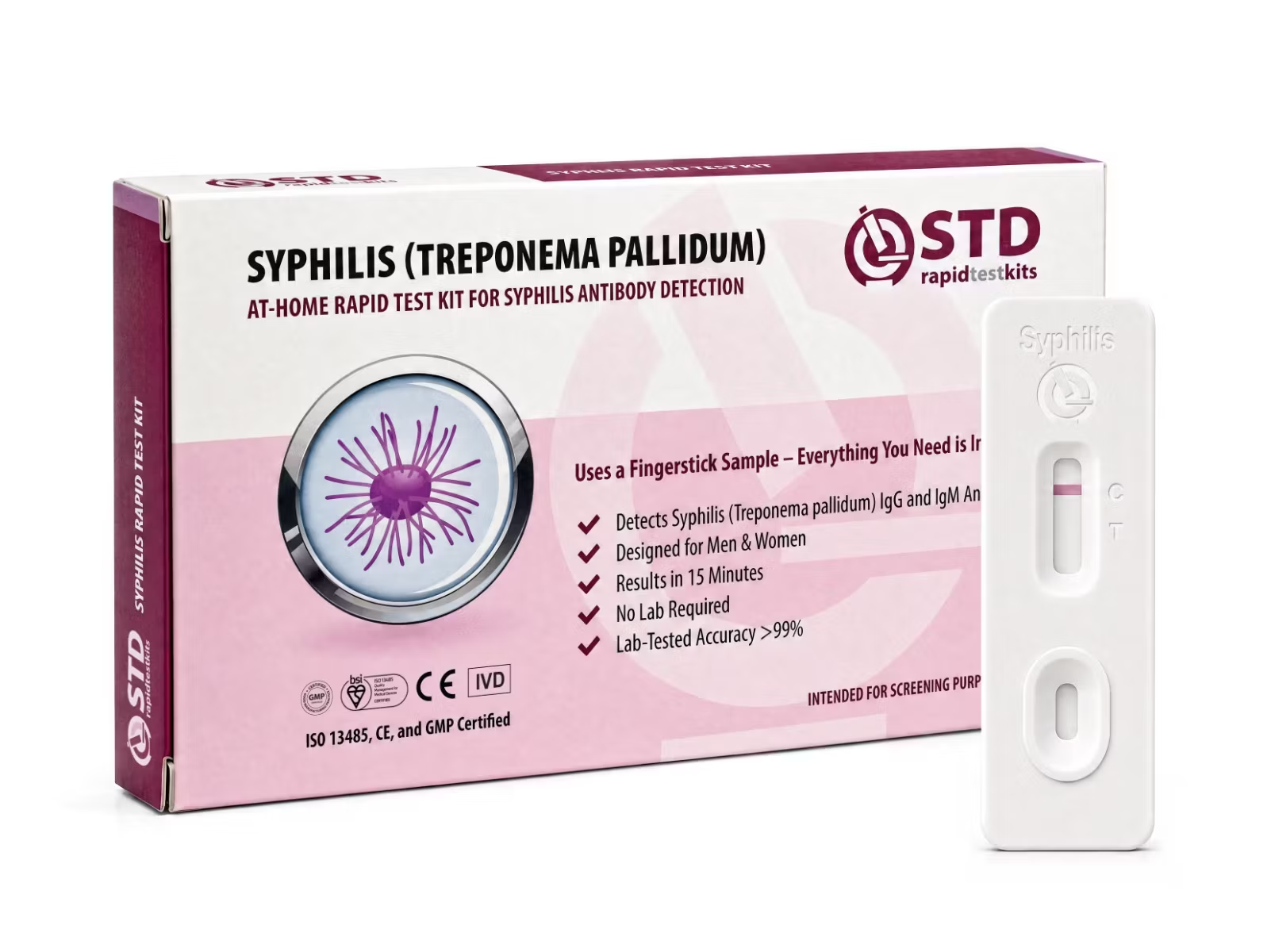
The cassette in your hand uses lateral-flow immunoassay chemistry, the same format used in many rapid HIV and pregnancy tests. A drop of fingerstick blood mixes with a buffer solution and moves across a paper membrane. If specific treponemal antibodies are present, they bind to reagents at a defined zone on the strip and a colored line forms. A second control line confirms the test ran correctly. No antibodies, no test line.
Two numbers do most of the work when people talk about test accuracy. Sensitivity is how often the test correctly flags a real infection: a 99% sensitivity means that out of 100 people with syphilis antibodies, 99 get a positive result and 1 gets a false negative. Specificity is how often the test correctly clears an uninfected person: a 98% specificity means 2 out of 100 healthy people get a false positive.
"Accuracy" by itself is a fuzzier term, usually a blended figure. Performance varies meaningfully by kit, by study population, and by stage of infection. A 2021 systematic review of rapid syphilis test diagnostic accuracy found pooled sensitivity of about 86% (95% CI 79 to 91%), with individual kits ranging from 67% to 100% depending on the population tested, and pooled specificity of about 98% (95% CI 96 to 99%). Most of the low end of that sensitivity range sits in very early primary infection, before antibody levels are robust. Once the secondary stage arrives and the immune response is fully mobilized, detection is much more reliable. The table below defines the two terms.
| Term | What It Means | Reported Range in Rapid Treponemal Tests |
|---|---|---|
| Sensitivity | Probability of a positive result when syphilis antibodies are present | 67 to 100% across studies; pooled about 86% |
| Specificity | Probability of a negative result when syphilis antibodies are absent | Pooled about 98% (95% CI 96 to 99%) |
The Window Period Changes Everything About When You Test
Picture the most common scenario. Someone has a sexual encounter on a Friday night. By Monday, anxiety kicks in, an at-home kit gets ordered overnight, and the test runs on day four. The result is negative. Relief, then back to normal life. Three weeks later, a faint sore appears. A second test runs and this time it is positive.
That first negative was not wrong, exactly. It was just early. The window period is the time between exposure and the moment your immune system has produced enough antibodies for a test to detect them. Before that, the bacterium is replicating in your body, but the antibodies the kit is looking for simply are not there yet. It is the difference between asking the question before the answer exists.
Two timelines stack here. CDC's 2024 laboratory recommendations note that the antibodies these tests detect may take up to two weeks to appear after the primary lesion, and the primary lesion itself appears about three weeks after exposure, within an incubation range of 10 to 90 days. Add those together and you get the practical guidance most clinicians give: a test in the first three weeks after exposure carries meaningful false-negative risk, accuracy improves through weeks three to six as antibodies build, and most people reach the highest sensitivity by weeks six to twelve.
The timeline below shows how detection probability evolves through that window. For context, this site sells at-home syphilis rapid tests and other STI kits, and the products referenced here are from that catalog.
How Syphilis Test Reliability Changes After Exposure
- Week 0 Exposure
Sexual contact with potential transmission. No antibodies yet, far too early to test.
- Week 1 Incubation
Bacteria are replicating but antibodies are not yet detectable. A negative here is unreliable.
- Week 3 Early immune response
Antibodies begin to develop. Sensitivity is improving but not yet definitive.
- Week 6 Reliable window
Detectable antibody levels in most people. High sensitivity in published evaluations.
- Week 12 Peak reliability
Antibodies are well established. A negative now, with no symptoms, is reasonable to act on.
A negative result is only as trustworthy as its timing. Most people reach peak reliability by week twelve.
Rapid Test vs Lab Test: Is the Clinic Automatically Better?
There is a persistent myth that a clinic test is inherently superior because it happens inside a medical building. The reality is more nuanced. Many clinics use rapid treponemal antibody assays for their initial screen too, especially in community, outreach, and urgent-care settings. The screening chemistry is often the same lateral-flow format that arrives in an at-home kit.
Where clinics differ is the confirmatory step. A reactive treponemal screen is followed by a non-treponemal test such as RPR or VDRL to measure antibody titer and assess whether the infection is active. That two-step sequence is what the CDC STI Treatment Guidelines recommend, and the layered approach is what adds diagnostic clarity.
At home, the first step is the same. The difference is that confirmation means a follow-up lab visit. That does not make the home test unreliable. It means the home test handles screening, and the lab handles staging. Consider two people: one tests at home, sees a clear line, and books confirmatory testing the next morning; the other waits three weeks for a clinic appointment because walking in feels impossible. The screening technology is not what decides how soon care begins.
At-Home Screening vs Clinic Testing
| Step | At-home rapid test | Clinic test |
|---|---|---|
| Screening (first test) | Rapid treponemal lateral-flow cassette, fingerstick blood | Often the same rapid treponemal cassette |
| Confirmation | Needs a follow-up lab visit for the non-treponemal titer | Non-treponemal titer (RPR or VDRL) usually run on the same visit |
| Time to first result | About 15 minutes | Minutes for the screen, plus lab turnaround for the titer |
| Privacy and cost | Private, flat upfront price, plain-envelope shipping, no insurance claim | Visit and any insurance billing can create a record |
At-home and clinic testing usually share the same screening chemistry. The main difference is where confirmation happens.
Common Mistakes That Skew Your At-Home Syphilis Results
Home tests are designed for privacy and speed, not for the precision of a clinical lab. The chemistry inside the cassette is the same lateral-flow technology used in COVID antigen tests and pregnancy tests. The chemistry is reliable. The user-handling steps around it are where most of the false negatives and "did I read this right?" results come from.
None of this is meant to shake your confidence in the kit. These are boring, fixable handling errors. Before opening the kit, check the expiry date printed on the outer box. An expired reagent is the one variable that neither careful technique nor good timing can compensate for. If your kit returned anything other than a single clear line or two strong lines, the right move is to retest with a fresh cassette and follow the steps slowly. Below are the mistakes that most reliably skew a rapid syphilis test.
- Reading too soon. Most kits require at least 10 minutes for the result line to develop fully. A check at minute three can show no line on a sample that would have turned positive by minute eleven.
- Reading too late. Past the window listed on the instructions, often 15 to 20 minutes, evaporation lines can appear and look exactly like a faint positive.
- Too little blood. An underfilled sample can fail to migrate through the strip properly. The control line may appear, but the test line cannot read what is not there.
- Skipping the buffer. The buffer solution is what carries the blood across the antibody-binding zone. No buffer, no flow, no valid result.
- Wrong temperature. Most kits are validated for room-temperature use; cold cars and overheated kitchens both throw off the reaction.
- Improper storage before opening. Heat and humidity degrade the reagent before you ever pop the foil. A cassette that has been sitting in a hot mailbox for three days is not the same cassette that left the warehouse.
- Re-reading hours later. A cassette stored on a counter for the rest of the day can develop changes that have nothing to do with antibody binding. Read it once, in the listed window, and trust that reading.
If you are wondering whether a rapid syphilis test can be wrong, the more useful question is whether the process was followed exactly. These kits are designed for home use, but they still require precision. Take your time. Follow the timing window carefully. Set a phone timer.
What That Faint Line Might Actually Mean
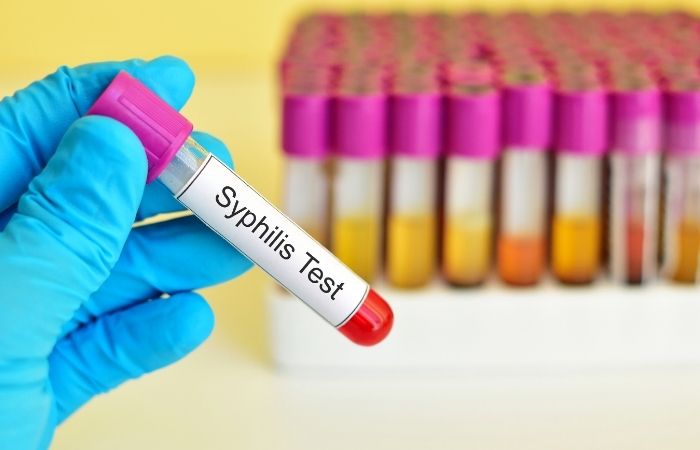
This is the part nobody warns you about. You are expecting a clear yes or a clear no. What you get is a ghost-pale band you have to angle the cassette under the bathroom light to even see. Then the second-guessing starts.
A faint line on a treponemal rapid test is a real result that needs follow-up. The reason: lateral-flow tests are designed to show a line whenever antibodies bind, regardless of how much antibody is there. A small amount of antibody (early seroconversion, low titer, recent treatment) produces a faint line. A large amount produces a dark one. The presence of the line during the test's valid reading window is what matters, regardless of its intensity.
The opposite case is the evaporation line, which forms when buffer dries on the strip past the result window and leaves a faint colored streak that is easy to mistake for a positive. The way to tell them apart: a true result line appears during the timed reading window, in the right position, with a defined edge. An evaporation line shows up later, often in a slightly different position, and tends to look smudged.
The decision tree is simple. Faint line during the reading window: treat as a presumptive positive and get a confirmatory lab test. Faint mark only after the reading window has closed: rerun with a fresh kit if you still feel uncertain, then get lab testing if the second one is also unclear. When in doubt, a clinic blood draw with both treponemal and non-treponemal testing settles the question in one visit.
When a Lab Test Might Be the Smarter Next Step
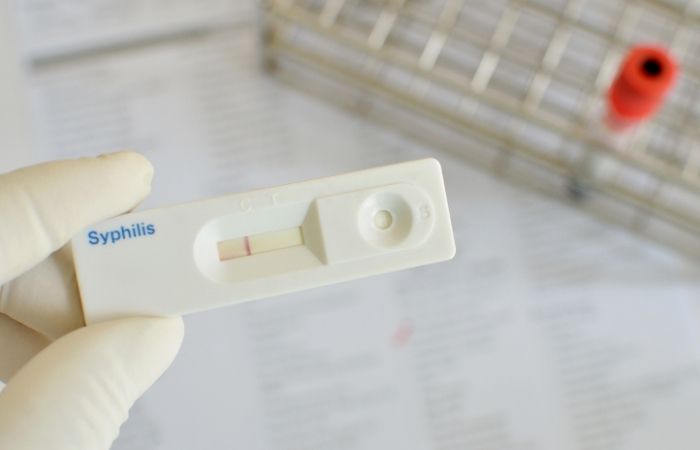
Home tests are good at one thing: telling you, fast and privately, whether your immune system has reacted to Treponema pallidum. They cannot tell you whether the infection is currently active, whether it has been treated and resolved, or whether the positive line is a cross-reaction from another condition. Lab testing covers those gaps.
Specificity for treponemal rapid tests is high, around 98% in the pooled review above, so false positives are uncommon. But they do happen. Three causes account for most of them:
- Previous syphilis infection that was successfully treated. Treponemal antibodies often persist for life, so the body still produces a reactive line years after cure. The home test cannot tell the difference between an old, treated infection and a new, active one.
- Autoimmune conditions such as lupus or antiphospholipid syndrome, which can produce cross-reactive antibodies that bind to the test reagents in ways that mimic a syphilis response.
- Exposure to other spirochete bacteria, including the organisms that cause Lyme disease or yaws, which share antigenic structures with Treponema pallidum.
This is exactly why the confirmatory non-treponemal test (RPR, the rapid plasma reagin, or VDRL, the Venereal Disease Research Laboratory test) matters. It produces a numeric titer, which clinicians use to:
- Distinguish a current active infection from one treated years ago. Treponemal antibodies can stay positive for life, while non-treponemal titers fall after successful treatment.
- Filter out the false positives that single-test screening can produce.
- Track treatment success by watching the titer drop over the months after a penicillin course.
If your home result was positive, faint, or taken too early, a clinic blood draw is the next step. Most sexual-health clinics run both treponemal and non-treponemal tests from a single sample; the NHS syphilis overview explains what to expect at a sexual health clinic, including the blood test used for diagnosis.
Although biological false-positive results are possible, no single laboratory test is sufficient for syphilis diagnosis. A reactive treponemal test should be followed by a quantitative nontreponemal test to guide patient management.
Special Situations That Change How You Read the Result
Medicine is rarely one-size-fits-all. Several situations make a syphilis antibody result harder to interpret on its own, and a few of them shift the urgency of confirmation.
Pregnancy. Untreated maternal syphilis can cause stillbirth, newborn death, and lifelong disability in the infant, which the WHO syphilis fact sheet highlights as a global public-health priority. In pregnancy, a reactive at-home rapid result needs same-day confirmatory lab testing and clinical follow-up. The urgency is about protection of the pregnancy, not panic.
Prior treated infection. If you were treated for syphilis at any point in your life, a rapid treponemal test may stay positive for life as a reflection of lasting immune memory rather than reinfection. Distinguishing past from current infection requires a quantitative non-treponemal titer (RPR or VDRL). A clinician will compare your current titer against the titer recorded at the end of your previous treatment.
Immunocompromised readers. For people with significantly weakened immune systems (advanced HIV, organ-transplant recipients on immunosuppressants, certain chemotherapies), antibody production can be delayed or blunted. A negative rapid result in this context deserves a clinician's interpretation rather than self-reassurance, because the antibody curve that the test depends on may not have climbed normally.
Antibiotics for an unrelated infection. Antibiotics taken for something else (a urinary tract infection, a tooth abscess) do not usually cause false positives. But early, incomplete antibiotic exposure during an active syphilis infection could theoretically slow antibody development and produce a temporary false negative. That situation is uncommon, but it is worth considering if symptoms persist despite a negative test.
- Pregnant readers: a reactive screen needs same-day clinic confirmation to protect the pregnancy.
- Previously treated for syphilis: a treponemal test may stay reactive for life, so only a non-treponemal titer can separate old immune memory from new infection.
- Significantly immunocompromised: antibody production may be delayed or blunted, so a negative result deserves a clinician's review rather than self-reassurance.
- On antibiotics during the window period: partial coverage could slow antibody development and produce a temporary false negative if symptoms appear later.
Testing Again: When, Why, and What to Expect
Anyone who tests inside the window period and gets a negative result should plan a second test at six to eight weeks. The reasoning is the same logic that drives clinical retesting protocols: a single early-window negative is suggestive, not conclusive.
If you have already been treated for syphilis at some point in your life, this changes the test you should use rather than whether you should test. Treponemal antibodies can stay detectable for life, even after a complete course of penicillin. A home rapid test (which is treponemal) may keep showing positive for years after a fully cured infection. To confirm whether a current infection is active, ask a provider for a non-treponemal test (RPR or VDRL). The titer trend tells the actual story.
If symptoms appear despite a negative test, symptoms win. A painless sore that comes and goes within weeks is easy to miss. A rash on the palms or soles can be subtle. Trust your body when something feels off, and ask for a clinical exam.
- Tested within the first three weeks: retest at six to eight weeks before treating a negative as conclusive.
- Previously treated for syphilis: ask for a non-treponemal titer (RPR or VDRL), since the rapid treponemal line can stay positive for life.
- Symptoms despite a negative test: get a clinical exam regardless of what the strip showed.
What Privacy Looks Like When You Are Testing Alone
For a lot of readers, the privacy of an at-home test is the only realistic path to actually getting tested. Living with family members who would react badly to a clinic visit, working in jobs where insurance billing for a sexual-health visit creates exposure, living in a small town where the local clinic staff includes someone you went to high school with: these are the realities that drive home-testing demand.
The privacy comes in two layers. First, the order itself. At-home test kits ship in plain envelopes or boxes with no medical labeling and no clue to the contents. Carriers see a package. Roommates see a package. The order does not appear on insurance statements because most direct-to-consumer kits are private-pay. Second, the testing itself happens in your bathroom on your timeline, with no waiting room and no nurse reaction to manage in real time.
What this matters for is the speed at which you act on a worrying exposure or a partner notification. People who can test the same day they get worried have a shorter path to a confirmed diagnosis and to treatment, which limits how long an untreated infection has to do damage or spread. Because one private shipment can screen for several infections at once, many people use the same moment to check for more than syphilis, since a single exposure rarely carries just one risk.
If You Test Positive: What That Means (and Doesn't)
When the result line is dark and unmistakable, the work shifts from "do I have this" to "what do I do now." Both phases are manageable. Syphilis is one of the most treatable bacterial STIs in modern medicine. A primary, secondary, or early latent infection can usually be cured with a single intramuscular injection of long-acting benzathine penicillin G, with alternative regimens available for people allergic to penicillin.
Treatment matters because untreated syphilis progresses through stages. A painless sore can mark a primary infection. Secondary infection can cause a rash, swollen lymph nodes, and other systemic symptoms. Without treatment, later stages can affect the cardiovascular system (damaging the aorta and other large vessels) and the nervous system (with effects ranging from headache and vision changes to cognitive decline). All of these late complications are preventable with timely diagnosis and standard penicillin therapy in earlier stages.
CDC STI surveillance reports document substantial increases in U.S. syphilis case rates in recent years across multiple demographic groups, which puts a positive result in its public-health context: a common reportable condition that reflects a community pattern rather than a personal failing. After a positive home test, the order of operations runs as follows.
The Order of Operations After a Positive Home Test
- Confirm at a clinic or lab. Ask for the standard reverse-sequence workup: a treponemal screen plus a quantitative non-treponemal test (RPR or VDRL). The titer establishes whether the infection is active, what stage it is in, and what treatment regimen fits. Many sexual-health clinics do same-day blood draws.
- Get treated. For early-stage syphilis, one injection of benzathine penicillin G is typically curative. Later-stage disease or pregnancy can require a longer regimen, and many clinics offer treatment at low or no cost regardless of insurance status.
- Notify recent partners. CDC guidance covers contacts from the 90 days before a primary diagnosis, the six months before a secondary diagnosis, or the year before an early latent diagnosis. State health departments offer anonymous notification if direct contact feels too hard.
- Plan retests. Your provider will order non-treponemal titers at three, six, and twelve months to confirm the infection has cleared. A fourfold drop in titer is the standard marker of treatment success.
Frequently Asked Questions
- How accurate is an at-home syphilis test, really?
- A 2021 systematic review of rapid treponemal point-of-care tests reported pooled sensitivity of about 86% (95% CI 79 to 91%), with individual studies ranging from 67% to 100%. Specificity across the same studies was about 98% (95% CI 96 to 99%). The big caveat is timing: any of these figures only apply once you are past the seroconversion window, which closes around six weeks for most people. Test too early and a negative result may not actually mean a clean bill, only that antibodies have not built up enough to register yet.
- What does a faint line on my syphilis test mean?
- If the faint line appeared during the test's valid reading window (usually 10 to 20 minutes after starting), treat it as a presumptive positive and confirm with a lab test. The intensity of a lateral-flow result line reflects antibody concentration, not whether the result is real. Faint marks that appear after the reading window are often evaporation lines, not true positives.
- Can I get syphilis from oral sex?
- Yes. Syphilis transmits through direct contact with a chancre or other infectious lesion, including via oral, vaginal, or anal sex. A single oral encounter is enough to transmit the infection, which is part of why oral exposure is one of the most under-diagnosed transmission routes.
- Why is my home test negative even though I have symptoms?
- The most common explanation is timing. If you tested less than three to six weeks after exposure, your body may not have produced detectable antibody levels yet. The second most common explanation is that the symptoms are from something else (herpes, an allergic reaction, folliculitis). If symptoms persist, retest at six to eight weeks and see a clinician for a clinical exam.
- I had syphilis years ago and was treated. Will the rapid test still be positive?
- Probably yes. Treponemal antibodies (what the rapid kit detects) can stay positive for life, even after a fully successful course of treatment. To confirm a treated infection has cleared or check for reinfection, ask a clinician for a non-treponemal test like RPR or VDRL. The titer trend, not the rapid test, tells you whether the current line is old memory or new infection.
- Do I need to tell my partner if I test positive at home?
- Yes, and if direct contact feels too hard, your state or local health department runs free anonymous partner notification services that handle the conversation for you without naming you. The window CDC asks you to cover depends on stage: contacts from the past 90 days for primary syphilis, the past six months for secondary, or the past twelve months for early latent infection.
- Is a clinic test more trustworthy than an at-home one?
- The screening chemistry is often identical. Many clinics use the same rapid treponemal lateral-flow cassette for their first step. What differs is that a clinic can run the confirmatory RPR or VDRL on the same visit. At home, that confirmation requires a follow-up lab trip; you get the first step only, but it is the same first step.
- Can I test for other STIs while I am at it?
- Yes, and most public-health guidance recommends doing so. Anyone exposed to one STI is statistically at higher risk for others, especially HIV, chlamydia, gonorrhea, and hepatitis B. Combination kits screen for multiple infections from one shipment and one testing session.
- Will my insurance know if I order a home test?
- Not unless you submit it for reimbursement. Direct-to-consumer at-home STI kits are private-pay and do not generate insurance claims, so the order does not appear in your insurance records or medical chart. Confirmation testing at a clinic does generate a record, but the home test itself does not.
The Bottom Line: A Home Test Is a First Step, Not the Last Word
An at-home syphilis test is a screening tool. Used at the right time, it gives you a fast, private answer with accuracy that holds up against published clinical evaluations. Used too early, it can give a false sense of safety. Read incorrectly, it can trigger panic that a confirmation test would have settled in an afternoon.
The most useful way to think about a rapid kit is as the first checkpoint in a two-step process. The kit decides whether to escalate, and the clinic confirms what the kit suggested. Whatever your test said, the next step depends on the result: if it was negative and you tested in the window, retest at six weeks; if it was positive or unclear, get a clinical confirmation and start treatment if indicated; if it was strongly negative and you tested well after exposure, that is a reasonable result to act on.
Your Next Step Depending on Your Result
Was your result positive, faint, or unclear in any way?
Yes: Treat it as presumptive and confirm at a clinic with both a treponemal and a non-treponemal test (RPR or VDRL) before starting any treatment.
Did you test within the first six weeks after a possible exposure?
Yes: A negative is not yet conclusive. Retest at six to eight weeks before treating it as a clean result, and see a clinician sooner if symptoms appear.
No: A negative result with no symptoms, tested well after exposure, is reasonable to act on. Retest after any future exposure.
Guidance only. A clinician can advise based on your specific exposure and history.
This article synthesizes current public-health guidance from the U.S. Centers for Disease Control and Prevention, the World Health Organization, and the NHS, along with peer-reviewed evaluations of rapid treponemal point-of-care tests. Where specific accuracy figures appear, they reflect the pooled and across-study ranges reported in a 2021 systematic review of rapid syphilis test diagnostic accuracy. This is not a substitute for clinical advice. If your test was positive, faint, or contradicted by symptoms, see a licensed clinician for confirmation.
- U.S. Centers for Disease Control and Prevention. Sexually Transmitted Infections Treatment Guidelines: Syphilis. Source for the reverse-sequence diagnostic algorithm, benzathine penicillin G first-line therapy, and partner-notification windows referenced throughout this article.
- U.S. Centers for Disease Control and Prevention. Laboratory Recommendations for Syphilis Testing, United States, 2024 (MMWR Recommendations and Reports). Source for the seroconversion-timing guidance: antibodies may take up to two weeks to appear after the primary lesion, and the primary lesion appears about three weeks after exposure within a 10 to 90 day incubation range.
- Diagnostic Accuracy of Rapid Syphilis Tests: Systematic Review (PubMed, 2021). Source for the pooled sensitivity figure (about 86%, 95% CI 79 to 91%), the across-study sensitivity range (67 to 100%), and the pooled specificity (about 98%, 95% CI 96 to 99%) cited in the accuracy table, quick-answer, and FAQ.
- U.S. Centers for Disease Control and Prevention. STI Surveillance landing page, which hubs to the annual surveillance reports documenting rising U.S. syphilis case rates referenced in the 'If You Test Positive' section.
- World Health Organization. Syphilis fact sheet. Source for the maternal and congenital syphilis context in the Special Situations section, including stillbirth, neonatal death, and lifelong disability risks of untreated maternal infection.
- NHS. Syphilis overview: symptoms, testing, and what to expect at a sexual health clinic, including the blood test used for diagnosis.
