
Published: July 2025 | Last updated: May 2026 | Editorial review and quality control: Martina N.
Yes, and the mechanism behind most STD diagnoses in committed couples is rarely infidelity. The more common cause is an untested sexual history from before the relationship began. That single fact explains the majority of unexpected positive results in monogamous partnerships, and it is the reason mutual testing before becoming sexually active together is the only thing that genuinely removes the risk from the equation.
Most STD content assumes the reader is single, recently exposed, and panicking. That covers a narrow slice of who actually needs the information. Couples at every stage, newly exclusive, long-term committed, recently married, navigating open relationships, face STD risk in ways that rarely get honest coverage. Whether you are figuring out when to test before becoming exclusive, preparing for a disclosure conversation, or processing a positive result in a relationship you trusted completely, this guide covers the practical ground.
Key Takeaways
- Most STDs in monogamous couples come from untested sexual histories that predate the relationship, not from cheating. An infection carried silently for years offers no clue about when or with whom exposure occurred.
- Mutual at-home testing before becoming sexually active together is the only step that genuinely removes STD risk from a new relationship.
The Monogamy Myth: Why “Exclusive” Does Not Mean STD-Free
You have had the talk. You are official. You both agreed to be exclusive, and somewhere in or around that conversation, one or both of you quietly assumed the STD question was now off the table. This assumption is extremely common, medically unfounded, and responsible for a significant share of infections that people in committed relationships never see coming.
The problem is not that someone cheated, though that situation is covered separately below. The problem is that most adults enter new relationships carrying untested sexual histories. The CDC notes that most chlamydia infections produce no symptoms, and that any symptoms that do appear may not show up until several weeks after sex. The same broad pattern of silent infection holds for gonorrhea, herpes, and HPV, all of which can persist without obvious signs for months or longer. A person can be entirely faithful, entirely honest, and entirely unaware that they brought an infection into the relationship from a previous partner, sometimes one from years earlier. The biology of dormancy does not pause for declarations of exclusivity.
That is what makes the monogamy assumption clinically risky. It replaces testing with trust, and trust, however earned, is not a diagnostic tool. Three of our deeper pieces unpack the science: why monogamy is not a foolproof shield against STDs, whether monogamy is actually enough to prevent STDs, and the real risk of contracting an STD in a monogamous relationship.
If you want a single rule to act on, it is this. Two tests, one for each partner, covering the infections most likely to be present without symptoms, timed correctly after the last exposure from a previous partner, will tell you both where you stand before you become sexually active together. Past-partner inventories and gut feelings cannot.

Why Dormant STDs Surface in Long-Term Relationships
Here is the scenario that produces the most confusion and the most relationship damage. A couple has been together for two, three, or five years. One partner tests positive for an infection. Neither has cheated. The relationship’s trust is suddenly being interrogated by a piece of biology that was already present before they ever met.
This is not a hypothetical edge case. The CDC’s HPV fact sheet notes that most people with HPV never develop symptoms or health problems, that in most cases the infection clears on its own, and that it can persist silently with no way to pinpoint exactly when transmission occurred. Herpes simplex virus can remain dormant for months to years before a first recognizable outbreak, often during periods of stress or illness. Chlamydia can quietly damage a woman’s reproductive system over months or years while producing no detectable symptoms in either partner. HIV deserves its own line here: it can remain in the body for years with no symptoms, which is why testing rather than waiting to feel unwell is the only reliable detection method. Per-act sexual transmission risk varies widely with route of exposure and the infected partner’s viral load, and modern fourth-generation antibody/antigen tests are typically reliable from around six weeks with confirmation at twelve weeks. Pre-exposure prophylaxis (PrEP) and post-exposure prophylaxis (PEP) are widely available options for partners at elevated risk.
For long-term couples, this matters in a specific way. A positive result is not automatically evidence of infidelity. It is often evidence of an untested past. The biology of dormancy does not provide timestamps, and it does not care about the narrative a relationship has built around honesty. Two people who have been completely faithful to each other can find themselves staring at a positive result that feels like a betrayal but may not be one. Without accurate medical information, that confusion has ended relationships where no breach of trust ever occurred.
Our breakdown of STD risks in long-term relationships covers this in full, including which infections are most likely to surface after extended dormancy and what a sensible testing cadence looks like for committed couples.
| Infection | Can Remain Asymptomatic For | Key Risk in Relationships |
|---|---|---|
| Chlamydia | Months to years | Most cases produce no symptoms; can damage reproductive health silently |
| Gonorrhea | Weeks to months | Frequently asymptomatic in women; throat infections almost always silent |
| Herpes HSV-1 & HSV-2 | Months to years before first outbreak | First outbreak can occur years after exposure, often misread as a new infection |
| HPV | Years to decades | No test pinpoints when exposure occurred; clears in most cases, can persist |
| Syphilis | Weeks to years (latent phase) | Latent syphilis produces no symptoms but remains in the body |
| HIV | Years before symptoms | Without testing, a person can be HIV-positive for years without knowing |
| Hepatitis B | Months to years | Chronic hepatitis B is often asymptomatic until liver damage is advanced |
When to Get Tested With a New Partner, and How to Bring It Up
You have met someone. Things are moving. The question of STD testing is hanging in the air, and neither of you has said anything yet. This is one of the most common sexual-health inflection points, and the way it gets handled, or avoided, carries real downstream consequences for both people.
Standard CDC guidance recommends annual testing for sexually active people under 25, and testing whenever someone starts a relationship with a new partner. That framing is medically sound but clinically useless as a conversation prompt. Nobody opens with “I would like to get tested because the CDC recommends it.” Real conversations happen when one person normalizes testing, frames it as something they do as a matter of course, not as an accusation and not as a sign they think the other person is dirty.
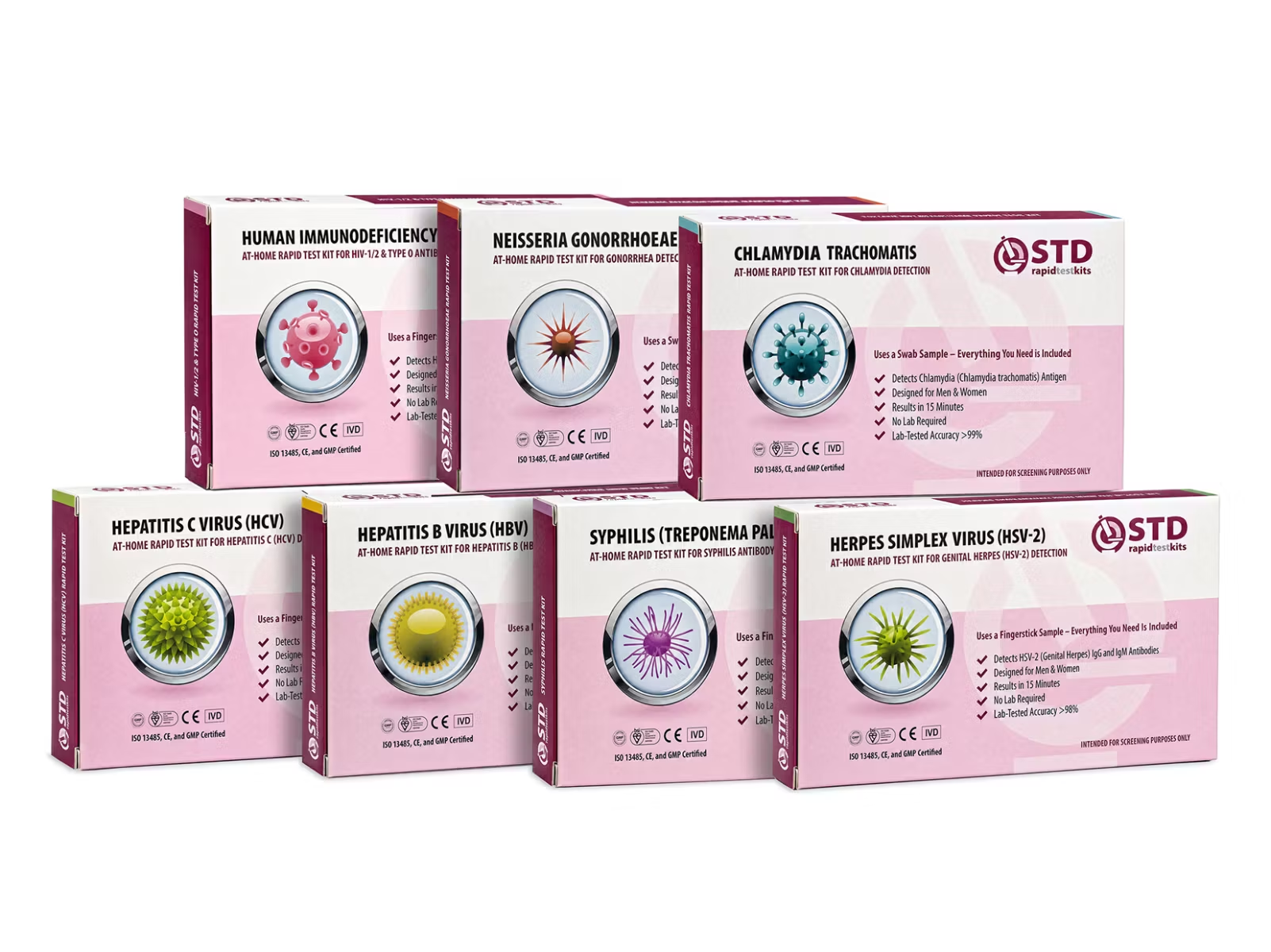
What removes almost all of the social friction is mutual at-home testing. Both partners test at the same time, on their own terms, before becoming sexually active together. No clinic, no waiting room, no asymmetry where one person asks and the other feels accused. As a quick note on disclosure: this site sells the rapid test kits mentioned in this article, and we recommend them based on fit for the reader’s concern rather than commercial benefit. The Complete 7-in-1 At-Home Rapid STD Test Kit covers HIV, syphilis, hepatitis B, hepatitis C, chlamydia, gonorrhea, and herpes in a single discreet order, with results in roughly fifteen minutes. Two people, two kits, one shared action.
Timing matters as much as the test itself. Testing too soon after the last exposure from a previous partner produces results that do not reflect current status. Every infection has a window period, the biological interval between exposure and reliable detection. For a comprehensive breakdown of when to test after each new partner, our guide to STD testing before entering a new relationship covers the timing and the conversation in practical detail. If you are weighing whether to test after every new partner, our take on the hidden risks of skipping STD tests after a new partner makes the case clearly.
Dating Apps, Casual Encounters, and the Testing Gap
A large share of new long-term couples now meet online. Dating apps have become one of the most common ways new partners first connect, which means the line between “meeting on an app” and “being in a serious relationship” has largely collapsed. Apps are simply how a lot of people meet partners now. That shift does not come with automatic sexual-health literacy, and the gap between how casually connections happen and how seriously testing is taken is where most undetected transmission occurs.
App-based dating is associated with higher rates of multiple concurrent partners, reduced condom use over time, and less consistent testing between partners. A 2025 peer-reviewed study in Nursing Reports found a significant association between dating-app use and prior STI history in young adults, alongside reduced barrier-method adherence. This is a practical observation about testing cadence, not a moral one about hookup culture. The more frequently someone forms new sexual connections through apps, the more frequently testing needs to happen, and it frequently does not.
Three of our pieces cover this from different angles: the research on dating apps and STD spread, the more direct Swipe Right, Get Infected piece, and dating apps and sexual health for students for the campus angle. For anyone actively dating through apps, a testing cadence of every three to six months, or after each new partner, whichever comes first, keeps the data current.
In most cases (9 out of 10), HPV goes away on its own within two years without health problems.
Testing Together: Making STD Screening a Normal Couple Practice
Couples who test together on a regular schedule, rather than waiting for a scare, catch dormant infections before they have time to cause damage or relationship confusion. Most couples only test when something has gone wrong, a symptom, a suspected exposure, a positive result from a previous partner surfacing. Proactive couples’ testing is rare, which is exactly why it is worth making the default.
The case for regular couples testing does not require either person to be suspicious. It requires acknowledging that biology is imperfect, that dormancy is real, that prior exposures do not come with certificates of clearance, and that knowing your shared status is an act of care. Our breakdown of at-home STD testing for couples as a shared responsibility covers the framework in full, including how to frame the conversation with a partner who has not thought about it this way before.
The testing windows below are the figures to use when timing a couple’s screen, whether you are testing before becoming exclusive, returning to monogamy after a period of non-monogamy, or running an annual relationship health check.
| Infection | Test From | Recommended Kit |
|---|---|---|
| Chlamydia | 14 days after exposure | Chlamydia At-Home Rapid Test Kit |
| Gonorrhea | 3 weeks after exposure | Gonorrhea At-Home Rapid Test Kit |
| Syphilis | 6 weeks after exposure | Syphilis At-Home Rapid Test Kit |
| HIV 1 & 2 | 6 weeks (first indicator); retest at 12 weeks for certainty | HIV 1 & 2 At-Home Rapid Test Kit |
| Herpes HSV-1 & HSV-2 | 6 weeks (early indicator); retest at 12-16 weeks for certainty | Herpes HSV-1 + HSV-2 2-in-1 Kit |
| Hepatitis B | 6 weeks after exposure | Hepatitis B At-Home Rapid Test Kit |
| Hepatitis C | 8 to 11 weeks after exposure | Hepatitis C At-Home Rapid Test Kit |
How to Tell a Partner You Have an STD, Without Ending the Relationship
You have tested. You have a result you did not expect. And now the question of what to say, and when, and how, is sitting heavily in your chest. The disclosure conversation is one of the most anxiety-provoking moments in sexual health, and one of the most important. How it goes depends less on the diagnosis itself than on how it is handled.
Research consistently shows that disclosure outcomes are better than people anticipate going in. Partners respond with compassion far more often than with rejection, especially when the conversation leads with information rather than shame, and when it happens before sexual contact rather than after. The fear of the conversation is usually worse than the conversation itself.
In practical terms, disclosure works best when it is calm, private, factual, and forward-looking. Cover what the infection is, how it is managed, what it means for your partner specifically, what steps you are already taking, and what you would like to do together going forward. Leading with information and following with emotion gives the other person something concrete to respond to instead of a shock to absorb. Our most-read article on this topic, how to talk about STDs without ending the relationship, has helped many readers find the right words. The companion piece on how to tell your partner you have an STD step by step covers the practical script. For the specific anxiety of disclosing herpes, where stigma can be most acute, is a cold sore a dealbreaker addresses HSV-1 disclosure directly.
There is a legal dimension worth knowing about. In the United States, many states have laws requiring people to disclose certain STD diagnoses to sexual partners before intercourse, and several states carry criminal penalties for knowingly exposing a partner to HIV without disclosure. These laws vary significantly by state. Some cover all STDs, some only HIV, some require proof of intent, others do not. Disclosure can therefore be an ethical question, an emotional one, and in some jurisdictions a legal one as well. Our guide to how to talk to your partner about getting tested covers both the emotional and legal dimensions.
If you have just received a positive result and need to notify partners, our guide to notifying partners after an STD diagnosis and the broader piece on the importance of informed partner contact walk through the full process: what to say, what to offer, and how to give the other person room to respond without pressure.

Polyamory, Open Relationships, and the Honest Testing Framework
Non-monogamy is not the STD risk factor most people assume it is. Research on this consistently shows that polyamorous and ethically non-monogamous individuals test more frequently, communicate more explicitly about sexual health, and use protection more consistently than many people in nominally monogamous relationships who have quietly stopped using condoms and stopped testing.
What polyamory does change is the calculus of who tests when, and how that information flows through a network of partners. In a triad, a quad, or any configuration with multiple partners, a single untested exposure can move through the entire network before anyone knows it is there. Agreed-upon testing cadences, shared knowledge of each partner’s status, and clear communication about new exposures are the practical tools that make ethical non-monogamy genuinely safer than casual unprotected monogamy.
The most important practical shift for non-monogamous couples is moving from reactive to proactive testing. In monogamous relationships, people often test in response to a symptom or a scare. In networks with multiple partners, waiting for a symptom means an infection has already had the opportunity to move. The standard recommendation for sexually active people with multiple partners is testing every three to six months. In practice, testing after each new partner within the network is a cleaner and more protective cadence, especially for chlamydia and gonorrhea, which are asymptomatic in the majority of cases and can move through a network silently before anyone realizes an exposure has occurred. Clear agreements about who tests when, and what happens after a new exposure, are the infrastructure that makes ethical non-monogamy safer than its reputation suggests.
Our three pieces on this cover distinctly different angles. Does polyamory increase your STD risk makes the counterintuitive case that it often does not, and explains why. How polyamorous relationships can stay safe from STDs covers the practical safety framework. And the polyamory guide to STI testing covers testing cadence, communication protocols, and what to do when one person in a network tests positive.
Every three to six months, or after each new partner within the network, whichever comes first. Agree on this cadence in advance, rather than negotiating it after a potential exposure.
When an STD Comes With a Real Betrayal
Sometimes the positive result does come with a breach of trust. A partner who said they had not been with anyone else. An infidelity that is now biological rather than purely emotional. An STD that arrived not from dormancy but from a decision the other person made and did not disclose. This is one of the hardest situations a relationship can face, and it deserves honest treatment rather than platitudes about forgiveness.
The first thing to do in this situation is medical, not relational: get tested yourself, immediately, and get the results. Your own status is the most urgent fact. Everything else, the conversation about what happened, the question of what the relationship means now, the decision about whether to stay or leave, gets clearer once you know your own health status.
The second thing is to understand that the presence of an STD does not automatically resolve the question of what happened. Dormancy is a real factor. A positive result in your partner does not necessarily mean they had sex with someone else recently. Before any conversation about betrayal, it is worth having a medical conversation about what the infection is, how long it may have been present, and whether transmission timing is even determinable. Some infections provide no timestamps. Others, like primary syphilis with an active chancre, are more time-bound. Getting that clarity before having the relationship conversation prevents some of the catastrophic misreadings that end relationships where no infidelity actually occurred.
If the betrayal was real, our most-read article in this hub applies directly: STD betrayal, can relationships survive has been read by thousands of people, which tells you something about how common this situation is and how few honest resources exist for it. The companion piece on rebuilding trust in a relationship after an STD diagnosis covers the longer arc of what repair looks like when both people decide to try. And what to do if your partner tests positive for an STD handles the immediate practical questions for the person on the receiving end of the news.
It is also worth naming what the biology cannot tell you. A herpes diagnosis does not come with a date of infection. A positive chlamydia result does not identify which partner, or when. HPV can persist for years with no way to determine when exposure occurred. This biological ambiguity cuts both ways. Some people accused of infidelity based on a positive result were not unfaithful. Others who genuinely were unfaithful can construct a dormancy argument that is impossible to disprove. The honest path through a betrayal situation involves both partners sitting with that uncertainty, rather than treating the test result as a verdict.
Test Together, and Remove the Guesswork
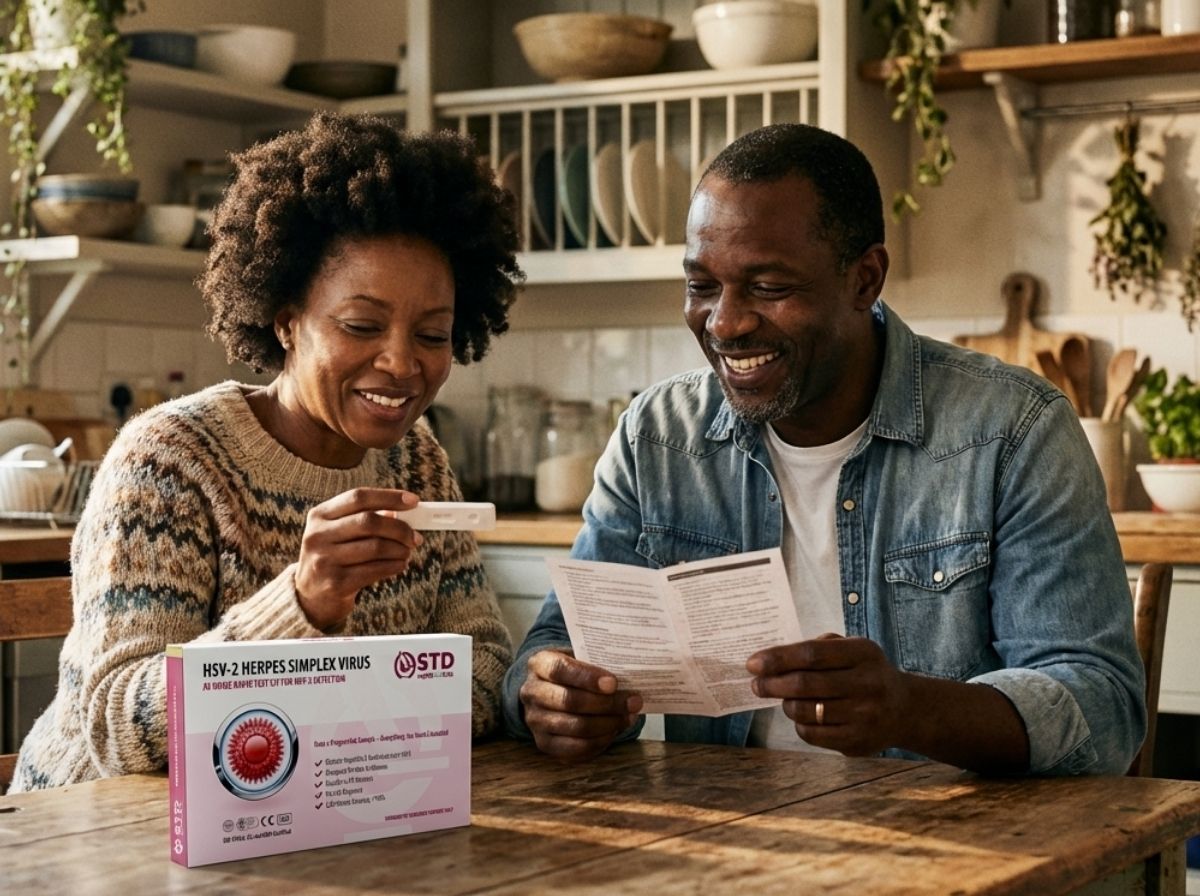
Whether you are entering a new relationship, maintaining a long-term one, navigating non-monogamy, or processing an unexpected result, the foundation is the same: knowing your status with certainty instead of assuming based on how things feel. At-home testing gives both partners a factual shared baseline before any conversation, and it removes the guesswork that makes these moments harder than they need to be.
At-home rapid testing makes that possible without waiting rooms, without judgment, and without scheduling around clinic hours. The Complete 7-in-1 At-Home Rapid STD Test Kit covers seven common infections in a single discreet kit. For couples who want a broader screen drawn from our combined-kit catalog, the multi-STD kit page shows the available bundle options. Both ship directly to you, give results in minutes, and keep your sexual health entirely in your own hands.
Frequently Asked Questions
- Can you get an STD if you and your partner are both faithful?
- Yes. Faithfulness does not retroactively clear past exposures. Many STDs can remain dormant for months or years before symptoms appear or testing becomes relevant, which means a person can enter a relationship carrying an infection they are completely unaware of. This is the most common mechanism behind STD diagnoses in long-term monogamous couples: an untested sexual history from before the relationship began.
- When should couples get tested for STDs?
- Before becoming sexually active together is the ideal time, after both partners have cleared the window periods for any exposures from previous relationships. After that, annual testing is the CDC’s baseline recommendation for sexually active people. Couples who have periods of non-monogamy, or who have experienced any potential exposure, should test after that event rather than waiting for the annual cycle.
- How do I ask my partner to get tested without making it weird?
- Frame it as something you do together, not something you are asking them to do because you suspect something. “I would like us to both get tested before we stop using condoms” is a very different conversation from “I need you to get tested.” Mutual at-home testing, ordering two kits and testing at the same time, removes most of the social friction. It becomes a shared action rather than a request that implies suspicion.
- Can you get herpes from a partner who has no symptoms?
- Yes. Herpes sheds asymptomatically, meaning the virus can be transmitted even when there are no visible sores or active outbreak signs. This is one of the primary reasons herpes is so common; most transmission happens from people who do not know they have it or who are shedding between outbreaks. Antibody testing from six weeks after exposure is an early indicator, with a retest at twelve to sixteen weeks giving more definitive results.
- Do dating apps actually increase STD risk?
- They increase the number of sexual partners and the frequency of new exposures for people who use them regularly, which statistically increases the opportunity for transmission. The risk is not in the app itself; it is in the testing gap. People who meet partners through apps and test regularly between partners have a manageable risk. People who meet multiple partners through apps and never test between them are accumulating undetected exposure over time.
- My partner just tested positive for an STD. What do I do?
- Test yourself first, ideally within the same day. While you wait for results, try to slow the conversation rather than ending it. A useful script: “I want to talk about this properly once I have my own result. I am not jumping to conclusions, and I would rather we do this from the same starting line.” Avoid accusatory questions about timing or other partners until you have facts. Many infections carry no reliable timestamp, so an angry interrogation in the first 24 hours often damages the relationship more than the diagnosis itself does.
- Is it possible to have an STD for years without knowing?
- Yes, for several common infections. Chlamydia can persist asymptomatically for years while causing internal reproductive damage. Herpes can remain dormant for years before a first outbreak. HIV can be present for years without symptoms. HPV may never produce symptoms in most people who carry it. This is why regular testing, rather than symptom-checking, is the standard recommendation for sexually active people of any relationship status.
- Can a relationship survive an STD diagnosis or betrayal?
- Some do, some do not, and both outcomes are valid. What tends to determine survival is less the infection itself and more the nature of the situation: whether the diagnosis came with dormancy or with a breach of trust, whether there was disclosure or continued concealment, whether the person involved takes accountability, and whether both partners have the tools to rebuild. Couples therapy is frequently useful. Our article on whether relationships can survive STD betrayal covers the full landscape honestly.
- U.S. Centers for Disease Control and Prevention. About Chlamydia: symptoms, asymptomatic transmission, screening recommendations. Cited for the section on why partners can carry chlamydia without symptoms.
- U.S. Centers for Disease Control and Prevention. About Genital HPV Infection: prevalence, persistence, and natural clearance. Cited for the dormancy framework and the pull-quote on asymptomatic HPV.
- U.S. Centers for Disease Control and Prevention. About Syphilis: stages, latency, and transmission. Cited for the discussion of dormancy and time-bound primary chancre evidence.
- U.S. Centers for Disease Control and Prevention. STI Surveillance 2024 (Provisional): population-level incidence and screening guidance.
- Nursing Reports (PMC). Dating Apps, STI History, and Sexual Risk Behaviors in Health Science Students, 2025. Cited for the association between dating-app use and prior STI history.
