

Published: October 2025 | Last updated: April 2026 | Editorial review and quality control: Martina N.
The conversation about getting tested rarely arrives at a convenient moment. It comes up the night before a first time, weeks into a new relationship when feelings have caught up with the calendar, or in the middle of a long partnership where neither person has tested in years. None of those moments feel ideal. Silence keeps the awkwardness from happening, and it also keeps both partners from knowing whether anyone needs to act on something.
This guide walks through the conversation step by step. It includes scripts you can borrow, ways to handle pushback or anxiety, and practical notes on testing together. The goal is not a perfect script. The goal is two informed adults making a shared decision about their health.
How do I start the conversation about getting tested?
Pick a calm, non-sexual moment. Say something like, “I want us both to get tested before we go further. I do this at the start of every new relationship because I care about both of us.” Frame the test as a shared step you take together, not a request for information from your partner. The CDC and HHS both publish conversation starters that follow the same shape: lead with care, suggest joint testing, and treat the result as routine health information rather than a verdict.
Key Takeaways
- About 1 in 5 people in the U.S. had a sexually transmitted infection on any given day in 2018, per CDC prevalence modeling, and the WHO estimates the majority of STIs globally are asymptomatic, which is why a test is more reliable than waiting for symptoms.
- Mutual testing is the only reliable way for either partner to know their status, regardless of how careful or faithful either person has been.
Why this conversation actually matters
The instinct to skip the talk is normal. Bringing up STIs feels like an accusation even when nothing is wrong. The numbers explain why the talk is worth having anyway. The U.S. Centers for Disease Control and Prevention estimated that roughly 1 in 5 people in the United States had a sexually transmitted infection on any given day in 2018, the most recent year for which a full prevalence model has been published (CDC prevalence and incidence estimates). The World Health Organization estimates more than 1 million curable STIs are acquired every day worldwide among people aged 15 to 49, and notes that “the majority” of those are asymptomatic (WHO STI fact sheet).
That asymptomatic share is why the conversation matters. If most chlamydia, gonorrhea, and HPV infections cause no symptoms in their early phase, then “I would know” is not a reliable health signal for either partner. Testing fills the gap that symptoms cannot.
There is also a relationship layer underneath the medical one. Asking to test is a small, observable signal that you take both people's health seriously. Couples who can navigate this conversation tend to find later difficult conversations easier: contraception decisions, fertility planning, vaccination history, mental health.
An asymptomatic STI is an active infection that produces no noticeable symptoms in the person carrying it, but is still transmissible to a sexual partner. Common examples include early chlamydia in both sexes, the majority of HPV infections, and many gonorrhea and trichomoniasis cases in women. The WHO and CDC both list asymptomatic transmission as a primary reason routine screening exists.
Picking the right moment and setting
The moment matters more than the script. The same sentence lands differently in a quiet kitchen on a Tuesday than it does mid-undress on a Friday night. Three principles cover most situations.
Talk before things get physical, not during. Pulling away to suggest testing once clothes are off feels like rejection, even when the intent is care. Move the conversation upstream, ideally during a regular block of shared time: a meal, a walk, the drive home from a date.
Keep it private and unhurried. A conversation that requires either of you to whisper, or that has to wrap up in five minutes, will feel rushed and accusatory regardless of word choice. A car in the driveway with the engine off works. So does a couch in your own apartment with phones face-down. A crowded restaurant works less well.
Lead with your own intent first. Telling your partner you have already booked a test, or that you take a rapid test at home at the start of every new relationship, removes most of the “why are you asking me about this?” sting. The HHS Office of Disease Prevention and Health Promotion's official conversation-starter resource recommends this same framing: lead with care, then suggest joint testing (HHS conversation starters).
You do not need to memorize a script. You do need to know your opening sentence, because the first ten seconds carry most of the awkwardness. Pick one sentence, say it out loud once before the conversation, and let the rest unfold. Many people find it easier to send a text the day before that says something like “I want us to talk about getting tested together this week, no big deal but I want us to do it,” which removes the surprise from the in-person moment.
Six ways to open the conversation
Different relationships call for different openings. Pick the example that matches your situation and adjust the wording. The patterns below are drawn from CDC general guidance, HHS conversation starters, and the framings clinicians see most often in counseling settings.
1. Before things become sexual, in a new relationship. “Before we sleep together, I want us both to get tested. I do this every time, and I want to do it with you.” Direct, future-oriented, and frames the test as a shared step rather than a hurdle.
2. Early in a relationship, after some intimacy. “We have been together a few weeks now and I really like where this is going. I would feel better if we both got tested, even if we have both been careful. I will book mine this week if you want to do the same.” Acknowledges the relationship is moving forward and pairs the request with your own commitment.
3. In a long-term relationship that has not tested recently. “I was reading about how often the CDC recommends testing, and I realized neither of us has been tested since we got together. Can we do it together this month? It would help me feel like we are taking care of each other.” Reframes the test as routine maintenance, not a response to a specific worry.
4. After a possible exposure or a slip in protection. “I want to be honest with you. We did not use a condom on Saturday and I think we should both get tested in a few weeks, after the window period for chlamydia and gonorrhea closes. Can we plan that now so we do not put it off?” Honesty plus a concrete plan beats vague reassurance.
5. Becoming exclusive or moving toward unprotected sex. “Before we stop using condoms, I would like us both to test for the full panel. It is the safest way to make this transition.” Ties the test to a decision you are about to make together.
6. Annual or biannual check-in. “It has been a year since our last STI panel. Let's get tested again this month so we are both up to date.” Treats testing the same way you would a dental cleaning or eye exam.

Scripts for different relationship stages
The right script depends on how long you have been together, how recently either of you has tested, and whether you are using condoms. The table below maps common situations to a useful opening line. Use it as a starting point, then adjust to your actual relationship.
| Relationship stage | Last tested | Suggested opener |
|---|---|---|
| First few dates, no sex yet | Either of you within 6 months | “I take rapid panels at home before I sleep with someone new. Can we do it together this week?” |
| First few dates, no sex yet | More than a year, or never | “I want to wait on sleeping together until we have both tested. It is the easiest way for both of us to feel sure.” |
| A few weeks in, sex has happened | Either of you within 6 months | “Can we share our last test results? I want us to be on the same page.” |
| A few weeks in, sex has happened | More than a year, or never | “Let's both test in the next two weeks. I will book mine tomorrow.” |
| Long-term, monogamous | More than two years | “It has been a while since either of us tested. Let's do an annual panel together.” |
| Long-term, opening up | Variable | “Before we add anyone else, I want both of us to have a fresh test on file. Can we do that this month?” |
| Reconciliation after a break | Variable | “I want us to start fresh on the health side. Let's both test before we go back to where we were.” |
What to do when your partner pushes back
Even a well-timed, kind opening can land sideways. Here is how the most common reactions tend to unfold, and a defusing move for each.
“Don't you trust me?” The instinct here is to argue about trust. Skip that. Redirect to the medical fact: most STIs are asymptomatic, so neither of you can know your status without a test, regardless of how careful or faithful either person has been. Try “This is not about trust. It is about the fact that the CDC's own data shows millions of new cases every year and most of them produce no symptoms (CDC 2024 surveillance). I would do this test in any relationship I cared about.” Then ask if they would prefer to test at home or at a clinic, which moves the conversation forward.
“I am scared of the result.” This is the most common pushback when the relationship is already serious. Treat it as fear, not refusal. The medical reality is reassuring on both sides: untreated chlamydia and gonorrhea are among the leading preventable causes of pelvic inflammatory disease and long-term fertility complications in people with fallopian tubes, per CDC estimates, so catching them early actually protects fertility rather than threatening it. HIV caught early is now a manageable chronic condition; people on antiretroviral therapy have a near-normal life expectancy and, when virally suppressed, do not transmit the virus to sexual partners. Knowing early is almost always better than not knowing. Try “I get it. I am a little nervous too. Most STIs are treatable when they are caught, and the ones that are not still get easier to manage when you know. Want to do it together so neither of us has to wait alone?” Joint testing reduces the asymmetry that makes the wait feel worse.
“It is going to be expensive.” Cost is rarely the only reason a partner declines, but the answer is genuinely reassuring. Many U.S. clinics offer free or low-cost STI testing, especially through county and municipal sexual-health programs. Planned Parenthood and other community clinics often charge on a sliding scale. At-home rapid tests cover the most common infections and skip the clinic visit entirely. The CDC's “Get Tested” locator and Planned Parenthood's clinic finder both list low-cost options.
“Can we just not?” If your partner refuses outright after a calm, non-accusatory ask, you have learned something useful about how they handle joint health decisions. The honest message from the HHS conversation-starter resource is that testing is the floor of taking each other's health seriously, and refusing to test together is a boundary you are allowed to set for your own protection (HHS guidance). You can still get tested yourself, you can still use barrier protection, and you can still decide what the refusal means for the relationship on your own timeline.
STIs are often asymptomatic. When symptoms occur, they can be non-specific.
Testing together: at home or at a clinic
Once both partners have agreed to test, the choice between an at-home rapid kit and a clinic visit comes down to four practical questions: which infections you want covered, how soon you want results, whether you want a clinician interpreting the result, and whether either partner has symptoms that need an exam.
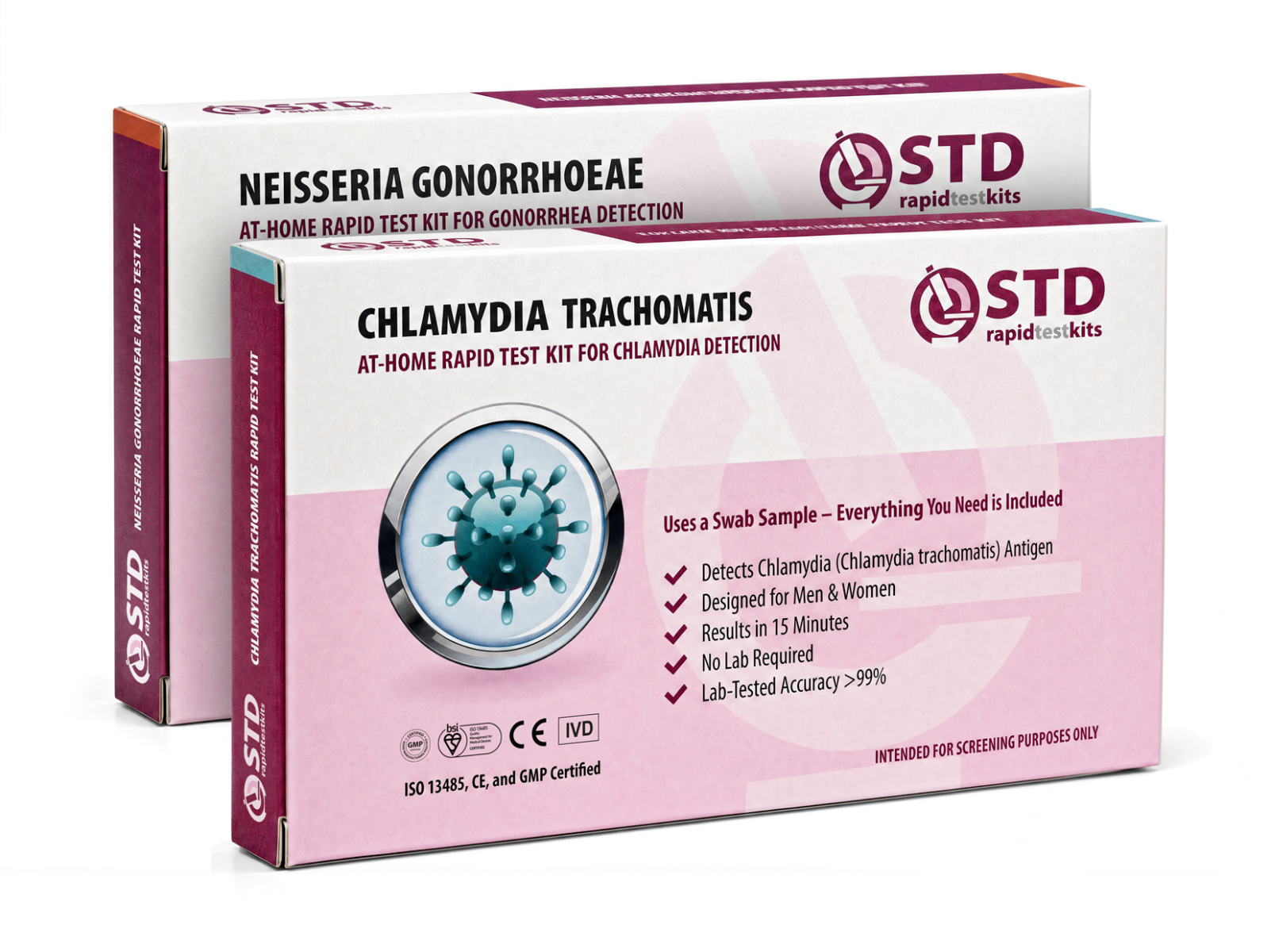
At-home rapid kits are useful for routine screening when neither partner has symptoms. They are lateral-flow tests, the same chemistry as a home pregnancy test or a rapid COVID test, and produce a result in about 15 minutes from a self-collected sample. They are a screening tool, not a diagnostic confirmation, and a positive result is worth confirming with a lab NAAT when possible. The advantage is privacy, speed, and the option to test together in your own kitchen without an appointment.
Clinic testing is the right call when either partner has active symptoms (sores, unusual discharge, pelvic or testicular pain), when a recent exposure happened inside a window period that home tests cannot reliably cover, or when one of you wants a clinician to walk through the results in person. Clinics also offer NAAT or PCR testing, which has higher analytical sensitivity than rapid lateral-flow chemistry, especially for low-level or very recent infections.
Many couples do both: a rapid panel at home for the routine annual check, plus a clinic visit if anything comes back positive or if a specific exposure needs a NAAT-confirmed result.
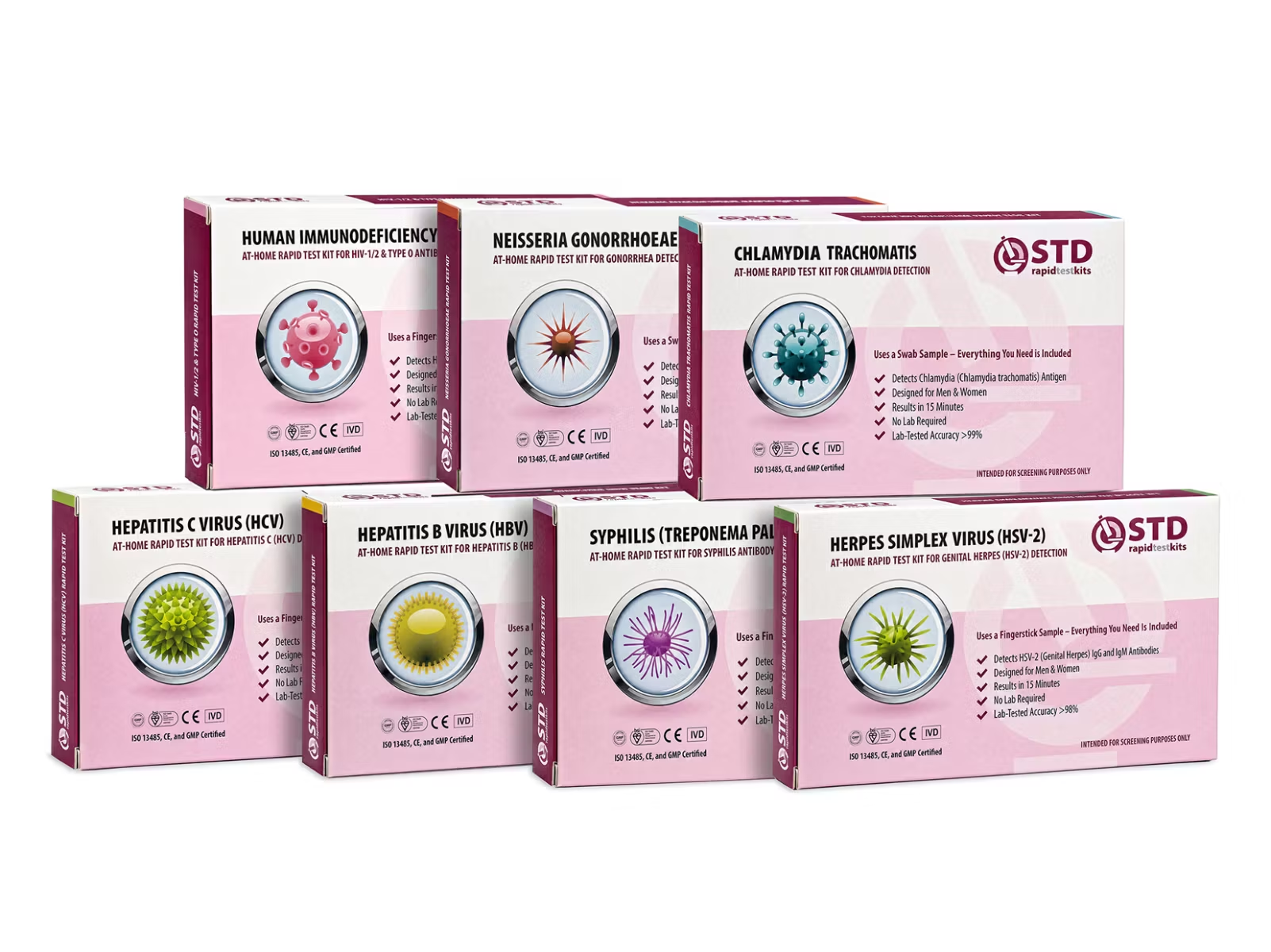
STD Rapid Test Kits sells the at-home rapid panels referenced below; product recommendations reflect what we stock and are paired with public-health guidance, not clinical diagnosis.
After the results: what comes next
The conversation does not end when the test does. The most common outcome is two clean results, but a few other scenarios are worth knowing how to handle.
Both negative. Mark the date on a shared calendar. The CDC recommends repeat testing based on individual risk factors, but for most monogamous couples a yearly screen plus an additional test after any new exposure is enough (CDC about STIs). For non-monogamous arrangements, the appropriate cadence is more often, usually every 3 to 6 months for active partners.
One positive, one negative. The most common, most treatable, and most loaded scenario. Most bacterial STIs (chlamydia, gonorrhea, syphilis, trichomoniasis) are curable with a course of antibiotics. Viral STIs (HIV, HSV, HPV, hepatitis B and C) are managed rather than cured, and the management options have improved substantially over the last decade. The negative partner does not need to assume the positive partner was unfaithful: many infections predate the current relationship by months or years and only surface because someone finally tested.
Both positive, with the same infection. Treat both partners simultaneously and avoid sex until the post-treatment retest comes back clear. The CDC's expedited partner therapy guidance is built around this exact scenario for chlamydia and gonorrhea specifically.
Whatever the result, the conversation that comes after is shorter than the one that came before. The first test is the awkward one.
Making this a regular conversation, not a one-time event
The first STI conversation is the heaviest. Subsequent ones get progressively easier because the precedent is set. Couples who normalize testing as part of their relationship maintenance, alongside dental cleanings, eye exams, and annual physicals, tend to talk about it the way they talk about any other shared appointment.
A few habits help.
Pair the test with a fixed event. Some couples test every January as part of a new-year health refresh. Others test at the start of a vacation. The point is to remove the “should we test now?” decision by attaching it to a date you would not skip anyway.
Share the result, not the anxiety. Once the test is taken, both partners should know the outcome. Hiding a result, even a clean one, breaks the trust the conversation was meant to build.
Keep a stock of home kits if home testing fits your schedule. If clinic visits are hard to schedule, having a rapid panel in the bathroom cabinet means a missed-condom moment can lead to a same-week test instead of a six-week wait for an appointment.
FAQs
- How do I bring up STI testing without making my partner think I am accusing them of cheating?
- Two words carry most of the weight: say your own status first. Tell your partner what you already do, test at the start of every relationship that matters to you, before making any request of them. That sequence turns a pointed question into an invitation. The CDC and HHS conversation-starter guides both build on the same pattern, and it lands far better than any sentence that begins with “we need to talk.”
- When is the right time to bring it up?
- Before sex, in a calm setting, with neither person under time pressure. The worst times are during or immediately before physical intimacy. The best are during regular shared time: a meal, a walk, the drive home from a date. A short text the day before can help by removing the surprise from the in-person moment.
- What if my partner refuses to get tested?
- A flat refusal after a calm, non-accusatory ask is informative on its own. You can still test yourself, you can still use barrier protection, and you are allowed to set boundaries for your own health. Treat the refusal as data about how this person handles joint health decisions, not a fight to win in a single conversation.
- How often should sexually active couples get tested?
- The CDC recommends testing based on individual risk factors. A yearly panel covers most monogamous couples; non-monogamous arrangements typically warrant testing every 3 to 6 months for active partners. Test again after any new exposure once the relevant window period for the specific infection has closed.
- Are at-home rapid tests as accurate as clinic tests?
- At-home rapid tests are lateral-flow assays, the same chemistry as a rapid pregnancy or COVID test. They are useful as a screening tool. Clinic NAAT or PCR tests have higher analytical sensitivity, especially for low-level or very recent infections. A positive at-home result is worth confirming with a lab; a negative one is reliable when used after the relevant window period.
- My partner says testing is too expensive. What are the options?
- Many county and municipal health departments offer free or low-cost STI testing. Planned Parenthood and other community clinics often charge on a sliding scale. At-home rapid kits cover the most common infections without an appointment, which works for couples who want privacy or have schedule constraints. Cost is rarely the only reason a partner declines, so address the underlying concern in parallel.
- One of us tested positive. What now?
- Do not panic, and do not assume the worst about the relationship. Many bacterial STIs are curable with a single course of antibiotics. Viral STIs are well-managed today and rarely threaten the relationship long-term. The CDC's partner-services and expedited partner therapy guidance walks through the next steps for chlamydia, gonorrhea, and syphilis. Both partners should follow up with a healthcare provider, even if only one tested positive.
- Should we share previous test results before we sleep together?
- Yes, if the results are recent (within about 6 months) and cover the same infections. If either result is older or partial, plan a fresh joint test instead. Sharing a 3-year-old negative panel as if it were current is the most common mistake couples make at this stage.
- U.S. Centers for Disease Control and Prevention. About Sexually Transmitted Infections: used for general framing of asymptomatic transmission and the rationale for routine screening.
- U.S. Centers for Disease Control and Prevention. Sexually Transmitted Infections Surveillance, 2024 (Provisional): used for current case totals and direction of trend across chlamydia, gonorrhea, and syphilis.
- U.S. Centers for Disease Control and Prevention. Sexually Transmitted Infections Prevalence, Incidence, and Cost Estimates in the United States: used for the “1 in 5 on any given day” prevalence figure.
- World Health Organization. Sexually transmitted infections (STIs) fact sheet: used for global incidence figures and the asymptomatic-share statement.
- U.S. Department of Health and Human Services, Office of Disease Prevention and Health Promotion (MyHealthfinder). STI Testing Conversation Starters: used for the “lead with care, suggest joint testing” framing throughout this article.
