
Published: August 2025 | Last updated: May 2026 | Editorial review and quality control: Martina N.
If you are starting a new sexual relationship and wondering whether both of you should get tested first, the short answer is yes, and the case for it is simpler than the conversation might feel. Most sexually transmitted infections cause no symptoms at all, treatment is far easier when an infection is caught early, and a calm conversation about testing signals to your new partner that you take their health (and your own) seriously.
This guide walks through why testing matters before a new relationship, when to test, how to bring it up without making it weird, what the realistic options look like, and the misconceptions worth clearing up. If you are in the 80% who land here looking for reassurance and a sensible plan rather than a panic-buy, you should leave with both.
Key Takeaways
- Most STIs cause no symptoms, so feeling fine is not evidence of being uninfected. Testing is the only way to know your status before you and a new partner become intimate.
- Frame the conversation as a routine health step ("I do this whenever I start dating someone new") rather than an accusation. It tells your partner you take mutual health seriously.
Why testing before a new relationship matters
The short version: STIs are common, they often hide, and the consequences of leaving them untreated are far worse than the inconvenience of testing. According to CDC prevalence estimates, sexually transmitted infections are widespread across the U.S. adult population, with tens of millions of people living with an STI at any given time and millions of new infections each year.
You can carry an infection without any clue you have it. Your new partner can too. Neither of you is being dishonest. The infection just is not showing itself. The only way to enter a new sexual relationship with eyes open is for both of you to test, ideally at the right time after each person's last exposure (more on timing windows below), and then talk about the results.
Two other reasons testing before intimacy matters. First, knowing your status lets you make informed choices about condoms, vaccines (HPV, hepatitis B), and pre-exposure prophylaxis (PrEP) for HIV if your situation calls for it. Second, the act of testing together, or at least agreeing to test, builds the kind of shared accountability that makes the relationship itself more honest from the start.
Many STIs do not cause noticeable symptoms but can lead to serious health problems if left untreated. Testing is the only way to know for sure if you have an STI.
Should you get tested for STIs before a new relationship?
Yes. Most STIs cause no symptoms, so testing is the only reliable way for you and a new partner to know your status before becoming intimate. Time each test to its detection window (about 1 to 2 weeks for chlamydia and gonorrhea NAAT, 18 to 45 days for fourth-generation HIV lab tests, 12 weeks for HSV antibodies), and confirm any positive rapid result with a laboratory test before treatment.
Most STIs cause no symptoms, and that is the whole problem
The single most important fact about sexually transmitted infections is that the vast majority of them are silent. People assume "if I had something, I would know," and that assumption is wrong for almost every common STI.
Per the CDC's chlamydia fact sheet, most people with chlamydia have no symptoms at all. The same is true for the majority of gonorrhea infections in women and a significant share in men. The CDC's HPV page states that nearly everyone will get HPV at some point in their lives, because HPV spreads through skin-to-skin contact during sex, and most of those infections clear on their own without ever producing a visible symptom. Trichomoniasis is asymptomatic in roughly 70% of infected people, according to the CDC's trichomoniasis page. Genital herpes (HSV-2) often produces no recognizable outbreak, especially the first year after infection.
The practical implication is uncomfortable but simple. You cannot self-screen with a body check, and neither can your partner. "Looks clean" is not a clinical category.

What untreated STIs can do over time
Skipping testing because "nothing feels wrong" is a high-stakes gamble because untreated infections do not stay quiet forever. They cause real, lasting damage:
- Chlamydia and gonorrhea can ascend the reproductive tract and cause pelvic inflammatory disease in women, which the CDC links to chronic pelvic pain, ectopic pregnancy, and tubal-factor infertility. In men, untreated gonorrhea can cause epididymitis and, rarely, infertility.
- Untreated syphilis progresses through stages. After an initial painless sore (the chancre) and a later rash, the infection can go latent for years before causing neurologic, cardiovascular, and ocular damage. The CDC's syphilis page describes the late-stage organ involvement in detail. The good news: syphilis at every stage is curable with antibiotics when it is found.
- Persistent high-risk HPV infections are the cause of nearly all cervical cancers, and they are also linked to anal, oropharyngeal, penile, and vulvar cancers. HPV vaccination prevents most of these, but only screening can find precancerous changes early.
- Untreated HIV progresses to AIDS over years. Modern antiretroviral therapy makes HIV a manageable chronic condition with near-normal life expectancy when treated early, but only diagnosis gets you onto treatment.
- Any active STI (especially genital herpes or syphilis with sores) raises the risk of acquiring or transmitting HIV by disrupting the mucosal barrier.
Tubal-factor infertility from untreated chlamydia or gonorrhea is one of the most consequential outcomes, because the underlying pelvic inflammatory disease is often silent. By the time a couple struggles to conceive, the fallopian-tube damage may already be irreversible. This is the central reason the CDC pushes for at least annual chlamydia and gonorrhea screening in sexually active women under 25.
How to bring up testing without making it weird
This is the part people get stuck on. Sexual-health conversations feel high-stakes because they touch on trust, history, and judgment. They do not have to. A few approaches that tend to work better than "we need to talk":
Normalize it as part of your routine
The most defusing framing is to position testing as something you do, not something you are demanding of them. "Hey, before we sleep together I always get a full STI panel, and I'd like us both to test. It's just my routine." That sentence carries the entire conversation. It is not about suspicion. It is about how you operate.
Suggest testing together
If your partner is willing, doing it together (going to the same clinic, ordering at-home kits at the same time) takes the awkward edge off. It also shortens the gap between "we decided to test" and "we have results," so the conversation does not stretch out.
Lead with respect, not suspicion
Avoid "I want us to test because I don't know who you've been with." That is a litigation, not a conversation. Try "I respect you, and I want us to start with a clean shared baseline." Most reasonable adults appreciate that framing.
What to do if they refuse
Refusal to test, especially when paired with offense or stigma talk ("you think I'm dirty?"), is information. A partner who will not take a thirty-minute step to protect both of you is showing you something about how they handle shared decisions. Making testing a precondition of intimacy is a reasonable boundary.

This article is published by stdrapidtestkits.com, which sells at-home STI testing kits. We recommend products based on fit for the reader's specific concern, not commercial benefit. The CDC, WHO, and NHS resources cited throughout this article are free public-health sources.
Testing windows: timing matters more than people realize
One of the most common reasons a test "misses" an infection is that it was taken too soon. Every STI has a window period, which is the gap between exposure and when a test can reliably detect the infection. Testing inside the window can produce a false negative, which is worse than not testing, because it gives false reassurance.
Approximate windows per CDC and FDA guidance for the most-screened infections:
- Chlamydia and gonorrhea: most labs recommend testing about 1 to 2 weeks after a potential exposure for laboratory NAAT (nucleic acid amplification test). Earlier testing can miss low-level infections.
- HIV: per the CDC's HIV testing page, fourth-generation antigen/antibody lab tests can usually detect HIV from about 18 to 45 days after exposure. Antibody-only tests (including most fingerstick at-home rapid tests) typically detect infection from about 23 to 90 days post-exposure.
- Syphilis: blood tests usually turn positive about 3 to 6 weeks after exposure.
- Hepatitis B and C: antibody tests typically detect infection from a few weeks to 6 months post-exposure, with most infections detectable by 3 months.
- Herpes (HSV-2): antibody seroconversion usually takes 12 weeks after exposure, with some people taking up to 16 weeks. The CDC does not recommend routine HSV serologic screening for asymptomatic people because of false-positive concerns.
Practical translation: if you and your new partner both had a potential exposure within the last week, the responsible plan is to test now, retest at the appropriate window for any infection that matters (commonly 4 weeks for chlamydia and gonorrhea, 12 weeks for HIV antibody tests), and use condoms in the interim.
Your testing options before a new relationship
You have several routes. They differ on cost, privacy, speed, and which tests they cover.
Sexual-health or family-planning clinics
Planned Parenthood centers, county health departments, and student health clinics provide full STI panels, often on a sliding scale or free for uninsured patients. They use laboratory NAAT for chlamydia and gonorrhea (the gold-standard sensitivity), blood draws for HIV, syphilis, and hepatitis, and physical examination for visible findings. This is the most comprehensive option and the right choice if you have symptoms, a known high-risk exposure, or need a confirmed-positive case worked up.
Your primary-care provider
Most primary-care doctors will order an STI screening panel as part of an annual visit if you ask. Insurance typically covers screening when the provider documents it as recommended care. The downside is that some patients find the conversation easier with a sexual-health specialist than with a long-term family doctor.
At-home rapid tests
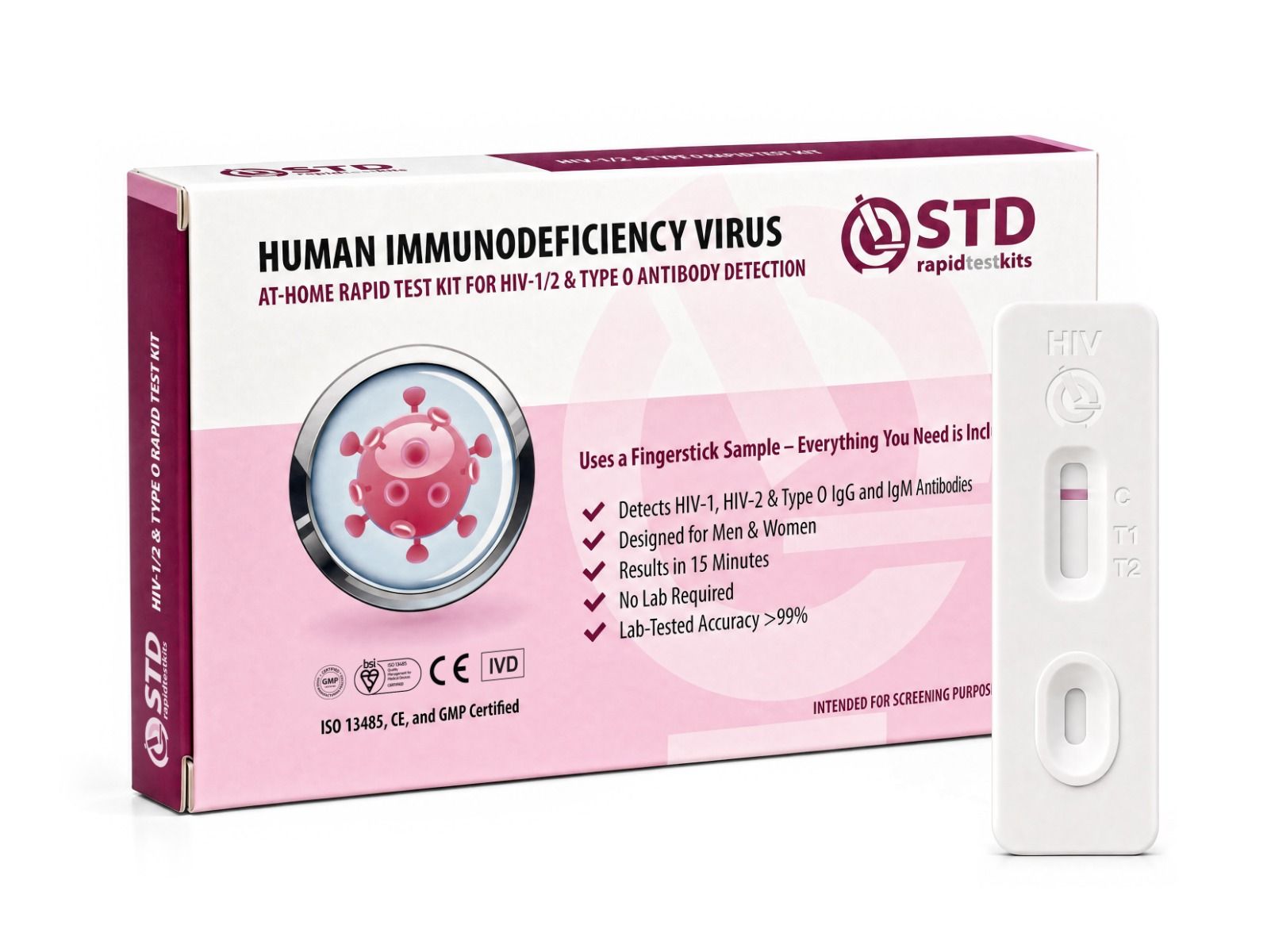
At-home rapid tests are lateral-flow immunoassays. You collect the sample yourself (fingerstick blood for HIV, syphilis, HSV, hepatitis; self-swab for chlamydia, gonorrhea, trichomoniasis, HPV in women) and read the result in roughly 15 minutes. They are private, fast, and useful for routine screening between clinic visits or before a new relationship when symptoms are absent.
Lateral-flow at-home tests are not analytically identical to laboratory NAAT: NAAT remains the most sensitive method for chlamydia and gonorrhea, and a fourth-generation lab antigen/antibody test detects HIV earlier than antibody-only rapid tests. The two test types are complementary, not equivalent. A negative rapid result is reassuring at the appropriate window; a positive rapid result should always be confirmed with a laboratory test before treatment.

Misconceptions about STI testing worth clearing up
A handful of myths keep otherwise responsible adults from testing. Here are the ones we hear most often:
"I do not have symptoms, so I do not need to test." Most STIs cause no symptoms, especially in the first months after infection. This is the single most consequential misunderstanding in sexual-health testing.
"Asking my partner to test means I do not trust them." Testing is about biology, not trust. Either of you could have an infection from a previous partner that nobody knew about. Two careful adults choosing to test before intimacy is a sign of mutual respect.
"Only people with a lot of partners get STIs." STIs do not track number of partners; they track exposure. One unprotected encounter is enough. People in long-term monogamous relationships can carry infections from years earlier.
"Condoms protect me from everything." Condoms reduce the risk of fluid-borne infections (HIV, gonorrhea, chlamydia, hepatitis) substantially when used consistently and correctly. They are much less protective against skin-contact infections (HSV, HPV, syphilis), which can spread from areas the condom does not cover.
"Testing is too expensive." Most insurance plans cover annual STI screening at no cost-share under the U.S. Preventive Services Task Force recommendations. Uninsured options include sliding-scale clinics, county health departments, and Planned Parenthood. At-home test kits are an additional option for routine screening when clinic access is hard.
"If I test positive, the relationship is over." The vast majority of common STIs are either curable (chlamydia, gonorrhea, syphilis, trichomoniasis) or manageable to the point that transmission risk can be dramatically reduced (HIV on treatment, HSV with suppressive therapy).
"At-home tests are not real testing." At-home rapid tests use the same lateral-flow chemistry as point-of-care tests used in many clinics. They are useful screening tools when used at the right window period. A positive result still warrants a confirmatory lab test before treatment.

How often should you test, generally?
Beyond testing before a new relationship specifically, the CDC's screening recommendations suggest at least annual chlamydia and gonorrhea screening for all sexually active women under 25 and for older women with risk factors. Sexually active gay, bisexual, and other men who have sex with men should screen for HIV, syphilis, chlamydia, and gonorrhea at least annually, and every 3 to 6 months with multiple partners. Everyone aged 13 to 64 should be tested for HIV at least once in their lifetime, with more frequent testing based on risk. A retest before each new sexual partner, on top of annual screening, is the simplest way to keep your status current.
CDC screening intervals at a glance
- Sexually active women under 25: annual chlamydia and gonorrhea screening. Women 25 and older: annually if risk factors (new or multiple partners, partner with an STI).
- Sexually active gay, bisexual, and other men who have sex with men: HIV, syphilis, chlamydia, and gonorrhea at least annually. Every 3 to 6 months with multiple partners.
- Everyone aged 13 to 64: HIV at least once in their lifetime. More often based on risk.
- Anyone starting a new sexual relationship: a retest on top of routine screening is the simplest way to keep your status current.
Frequently Asked Questions
- What STIs should I test for before a new relationship?
- A reasonable pre-relationship panel covers HIV, syphilis, hepatitis B, hepatitis C, chlamydia, and gonorrhea. Trichomoniasis and HPV screening (for women) are added when relevant. Routine HSV antibody screening for people without symptoms is not recommended by the CDC because of false-positive concerns; if you have a known partner with HSV or visible lesions, talk to a clinician about targeted testing.
- How long after a potential exposure should I wait to test?
- Window periods vary by infection. Chlamydia and gonorrhea NAAT is reliable from about 1 to 2 weeks post-exposure. Fourth-generation HIV antigen/antibody lab tests detect most infections from 18 to 45 days; antibody-only rapid tests typically detect from 23 to 90 days. Syphilis blood tests turn positive about 3 to 6 weeks post-exposure. HSV-2 antibody tests take roughly 12 weeks. When in doubt, an initial test plus a retest at 12 weeks covers most scenarios.
- What if my new partner refuses to get tested?
- That response tells you something worth knowing. People who frame a routine health step as an accusation tend to approach other shared decisions the same way. Making testing a precondition of intimacy is a reasonable boundary, not an ultimatum, and most adults who get past the initial defensiveness recognize that.
- Are at-home STI test kits accurate?
- At-home rapid tests use lateral-flow immunoassay chemistry, the same technology used in many point-of-care clinic tests. They are most accurate when used after the appropriate window period and have specificity above 99% in published manufacturer data. They are not analytically identical to laboratory NAAT or fourth-generation HIV lab tests, which remain more sensitive especially shortly after exposure. Use a rapid test for routine screening, and follow up any positive result with a confirmatory lab test before treatment.
- Can a blood test detect every STI?
- No. Blood tests work well for systemic infections such as HIV, syphilis, hepatitis B, hepatitis C, and HSV-2 antibodies. Chlamydia, gonorrhea, trichomoniasis, and HPV require a swab sample (vaginal, penile, throat, or rectal depending on exposure site) because they are local infections of the mucosal surfaces, not systemic infections detectable in blood.
- How should I bring up STI testing with a new partner?
- Lead with your own routine rather than a request directed at them: "I always test before sleeping with someone new, and I'd like us to both do it." Suggest going together or ordering at-home kits at the same time. Frame it as mutual care, not interrogation. Most reasonable adults appreciate the maturity of the conversation.
- What happens if I test positive?
- Most common STIs are either fully curable (chlamydia, gonorrhea, syphilis, trichomoniasis with antibiotics) or manageable with treatment that dramatically reduces transmission (HIV with antiretroviral therapy, HSV with suppressive therapy, HPV through monitoring of precancerous changes). A positive rapid result should always be confirmed with a laboratory test before starting treatment. Your healthcare provider will guide treatment, partner notification, and follow-up testing.
- Does insurance cover STI testing?
- Most U.S. insurance plans cover routine STI screening at no out-of-pocket cost when the provider documents it as preventive care, following U.S. Preventive Services Task Force recommendations. Uninsured patients can access free or sliding-scale testing through Planned Parenthood centers, county health departments, and many federally qualified health centers.
- U.S. Centers for Disease Control and Prevention. STI Statistics overview, used here as the root reference for current U.S. STI prevalence and incidence framing.
- U.S. Centers for Disease Control and Prevention. Chlamydia Basic Fact Sheet; asymptomatic presentation and screening guidance.
- U.S. Centers for Disease Control and Prevention. HIV Testing; window periods for antigen/antibody lab tests and antibody-only rapid tests.
- U.S. Centers for Disease Control and Prevention. STI Treatment Guidelines: Screening Recommendations for sexually active adults.
- U.S. Centers for Disease Control and Prevention. Pelvic Inflammatory Disease; complications of untreated chlamydia and gonorrhea.
- U.S. Centers for Disease Control and Prevention. Syphilis; stages of untreated infection and curative antibiotic treatment.
- U.S. Centers for Disease Control and Prevention. HPV; prevalence of infection and vaccination guidance.
- U.S. Centers for Disease Control and Prevention. Trichomoniasis; asymptomatic share of infections and screening notes.
