
Published: December 2025 | Last updated: May 2026 | Editorial review and quality control: Martina N.
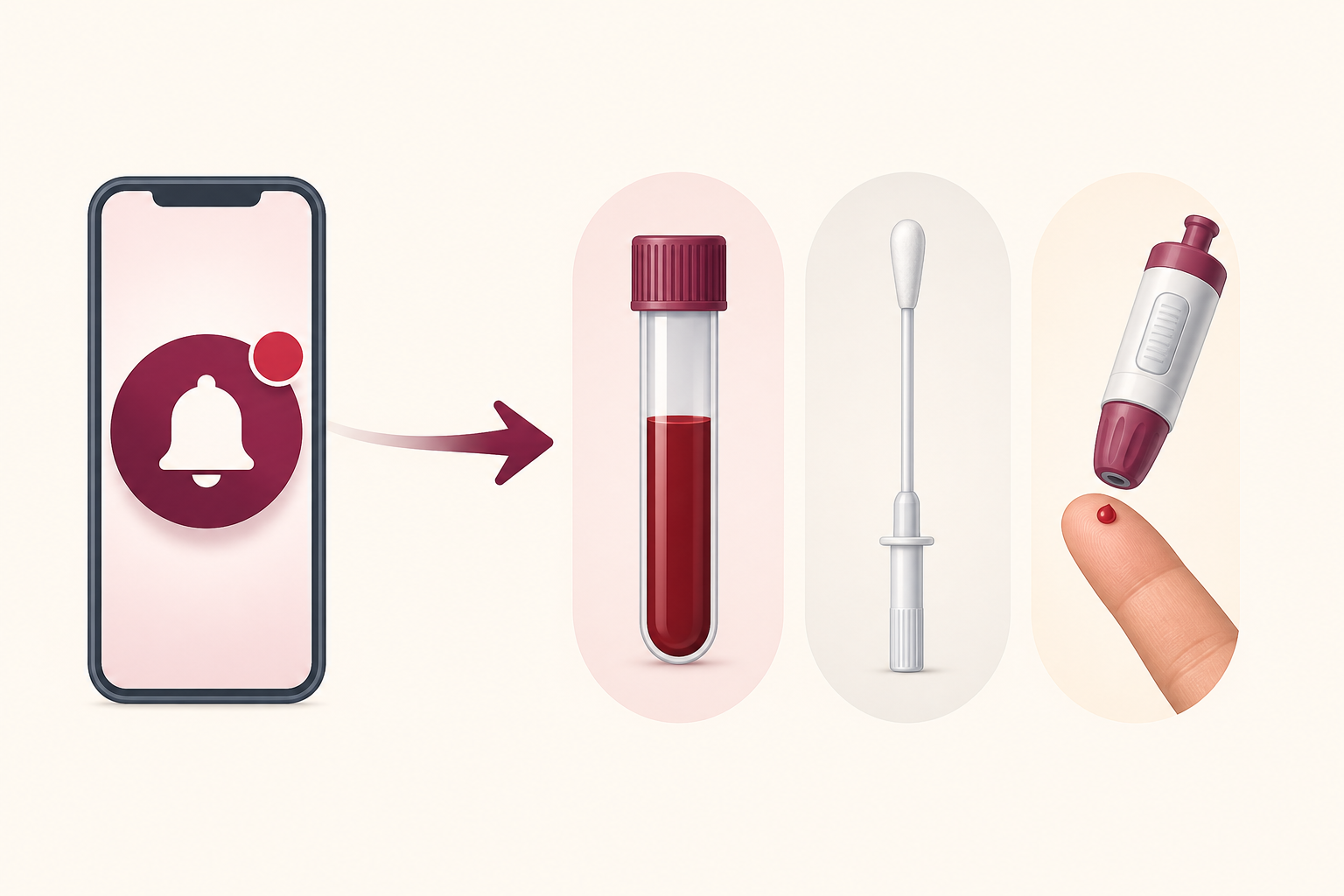
The message arrives, and your stomach drops. A partner just told you they tested positive for an STI. Maybe chlamydia. Maybe HIV. Maybe something you have to look up. Behind the panic, there is a fairly clear set of steps: figure out which infection it is, figure out the testing window for that infection, pick the right test, and book your follow-up. This guide walks through each of those, with the actual numbers from the CDC's 2021 STI Treatment Guidelines so you are not piecing together half-remembered advice from forums.
Two things to settle up front. First, you are not alone in this. Per CDC surveillance data, sexually transmitted infections are extremely common in the U.S. adult population, and many infections cause no symptoms in their early phase. Second, partner notification (the message you just got) is one of the main tools the public-health system uses to break transmission chains. Acting on it quickly is genuinely useful, both for you and for everyone you have been in contact with since the suspected exposure.
Key Takeaways
- Yes, you should get tested if a sexual partner tests positive, but the right time to test depends on which infection. Bacterial STIs like chlamydia are detectable within 1 to 2 weeks; viral and antibody tests like HIV and herpes need longer windows.
- Feeling fine is not evidence you are uninfected. Around 70% of trichomoniasis infections cause no symptoms per the CDC, and the same is true for many other STIs in their early phase.
About 70% of people with the infection do not have any signs or symptoms.
What is your actual risk if your partner just tested positive?
Receiving a partner-notification text does not mean you definitely have an STI. It means your risk is meaningfully higher than baseline, and testing is the only way to resolve the question. Per-act transmission probabilities vary a lot by infection and by what kind of sex you had.
Chlamydia and gonorrhea transmit relatively efficiently during a single act of unprotected vaginal or anal sex. Estimates summarized in the CDC 2021 STI Treatment Guidelines place per-exposure transmission risk in a wide range, often cited around one in three to one in two for a single unprotected encounter with an infected partner, depending on the specific infection and exposure. HIV transmission per act is much lower, often quoted in the range of 1 in 100 for receptive anal intercourse down to far lower numbers for insertive oral contact, with viral load and condom use shifting those numbers considerably (CDC HIV transmission risk). Herpes (HSV-2) can transmit even when no visible sore is present, through asymptomatic viral shedding.
Several factors push your individual risk above the baseline figures:
- No barrier protection used during the exposure.
- The infected partner had an active flare or high pathogen load: recent infection, visible lesion, high HIV viral load.
- The sexual contact involved tissues more vulnerable to transmission. Receptive anal contact is generally higher risk than insertive vaginal contact for HIV.
- Co-existing genital irritation, microabrasions, or another active STI, which can raise HIV susceptibility several-fold.
Factors that lower your risk:
- Consistent and correct condom use during every act.
- The infected partner is on effective antiretroviral therapy with an undetectable viral load. For HIV, undetectable equals untransmittable per the CDC.
- Oral-only contact with no visible lesions on either partner. Oral HIV transmission risk is very low, though not zero, and some other STIs transmit orally more readily.
Two people with the same partner-notification text can have meaningfully different actual exposure risk. None of this changes the recommendation to get tested.
Highest urgency: no barrier protection during exposure and a partner with a recent or active infection. Lower urgency but still test: condoms used consistently and a partner already virally suppressed on antiretroviral therapy. Testing is the recommendation in both scenarios; what differs is how worried to be while you wait.
Testing windows: when to test depends on which STI
Every infection has a window period: the time between exposure and when a test can reliably detect it. Test too early and you risk a false negative, which gives false reassurance. Test too late and you spend extra weeks in avoidable limbo. The numbers below reflect the CDC 2021 STI Treatment Guidelines and the CDC HIV testing guidance.
Bacterial infections detect quickly because the lab is looking for the bacterium itself. Viral and antibody-based tests take longer because the body needs time to build up detectable antibody levels, or for viral load to climb above the assay's detection floor.
| STI | Test sample | Earliest reliable detection | Retest interval |
|---|---|---|---|
| Chlamydia | Swab | 1 to 2 weeks | 3 months after treatment |
| Gonorrhea | Swab | 1 to 2 weeks | 3 months after treatment |
| Trichomoniasis | Vaginal swab | 5 to 28 days | After treatment |
| Syphilis | Blood antibody | 3 to 6 weeks (up to 12) | 6 weeks and 3 months |
| HIV (4th-gen Ag/Ab) | Blood (clinic) | 18 to 45 days | 3 months if ongoing exposure |
| HIV (antibody-only rapid) | Fingerstick blood | 23 to 90 days | 3 months |
| Herpes (HSV-2) | Blood antibody | Around 12 weeks | Confirm type-specific |
| Hepatitis B | Blood | 3 to 6 weeks | 6 months |
| Hepatitis C | Blood antibody | 8 to 11 weeks | 6 months |
How long should I wait to test after a partner-notification text?
For chlamydia or gonorrhea, schedule a swab test about 1 to 2 weeks after the last possible exposure. For HIV, a 4th-generation antigen/antibody test is reliable by 18 to 45 days; antibody-only home rapid tests need 23 to 90 days. For syphilis, plan on 3 to 6 weeks, with a repeat at 12 weeks if early results are negative. These windows come from the CDC 2021 STI Treatment Guidelines and CDC HIV testing guidance.
Picking the right test: at-home rapid versus clinic
You now know which STI your partner has and roughly when to test. Next decision: where to test. Clinic-based testing through your primary care provider, a sexual-health clinic, or Planned Parenthood remains the gold standard for many infections. Clinics use nucleic acid amplification (NAAT) for bacterial STIs, which is the most sensitive technology available. Cost varies by insurance, with federally qualified health centers and Planned Parenthood offering sliding-scale fees regardless of coverage.
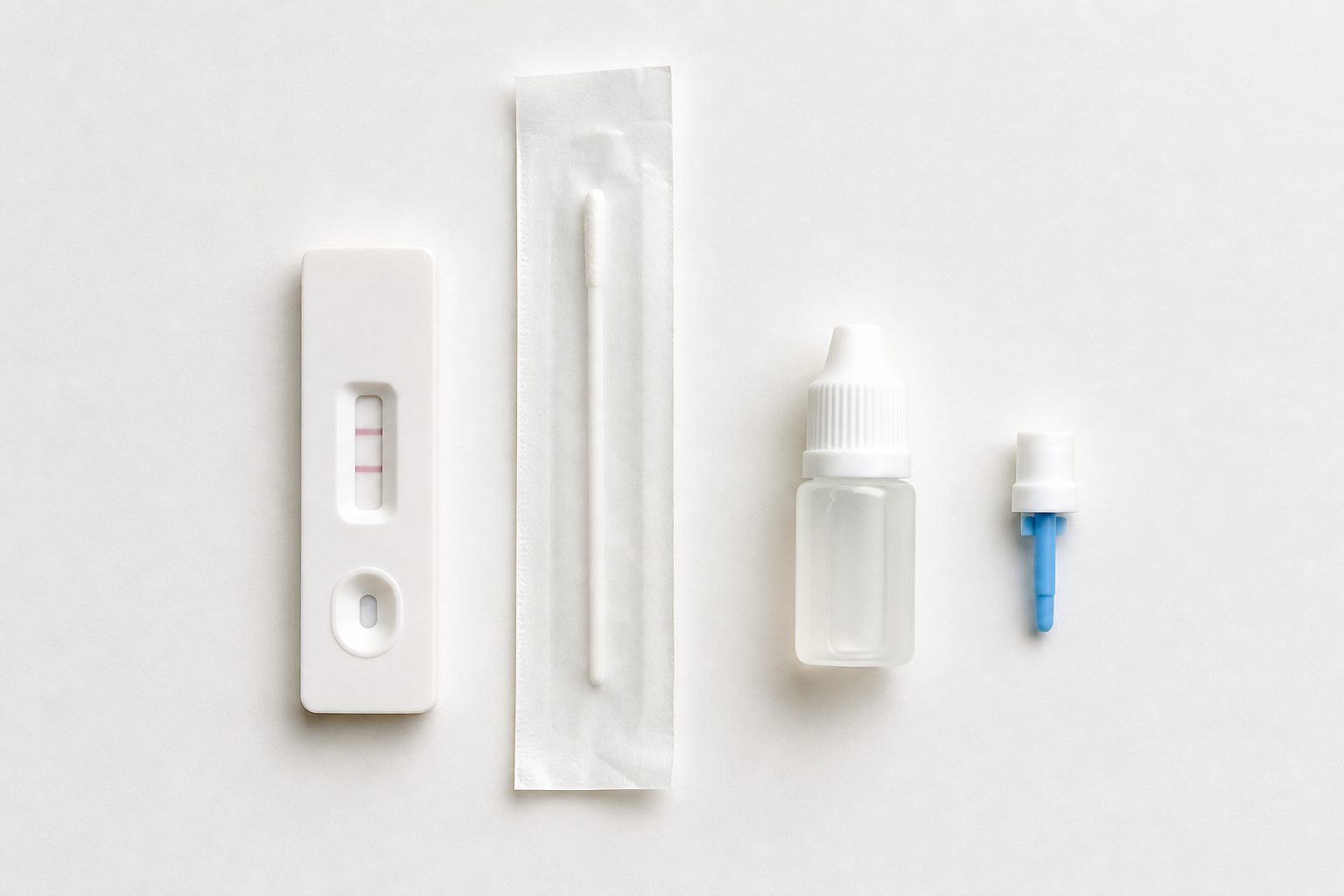
At-home rapid kits are lateral-flow immunoassays, the same chemistry family behind home pregnancy tests and COVID-19 antigen tests. Lateral-flow kits are a screening tool. They trade a few percentage points of sensitivity for same-sitting results, no clinic visit, and no insurance trail. The right time to reach for a home kit:
- Your partner's diagnosis is known and a home kit covers that infection.
- You want a fast first read before deciding whether you need a clinic visit.
- Privacy or scheduling means a clinic visit is hard right now.
- You are within the kit's reliable window for the infection in question.
The right time to skip the home kit and go directly to a clinic:
- You have severe symptoms: high fever, pelvic pain, testicular pain, jaundice, severe rash, or genital sores. See the section near the end on red flags.
- The exposure was a throat or rectal contact and you need a sample type at-home kits do not collect.
- You need same-visit treatment (azithromycin, doxycycline, ceftriaxone, and similar).
- You suspect HIV exposure within the last 72 hours and want post-exposure prophylaxis (PEP), which is time-sensitive.
One scope note worth surfacing here: there is no validated at-home rapid HPV test for men, and the women's HPV vaginal swab is a screening tool rather than a replacement for routine cervical cancer screening with Pap or co-test through a gynecologist. For HPV concerns after a partner notification, that conversation belongs with your clinician.
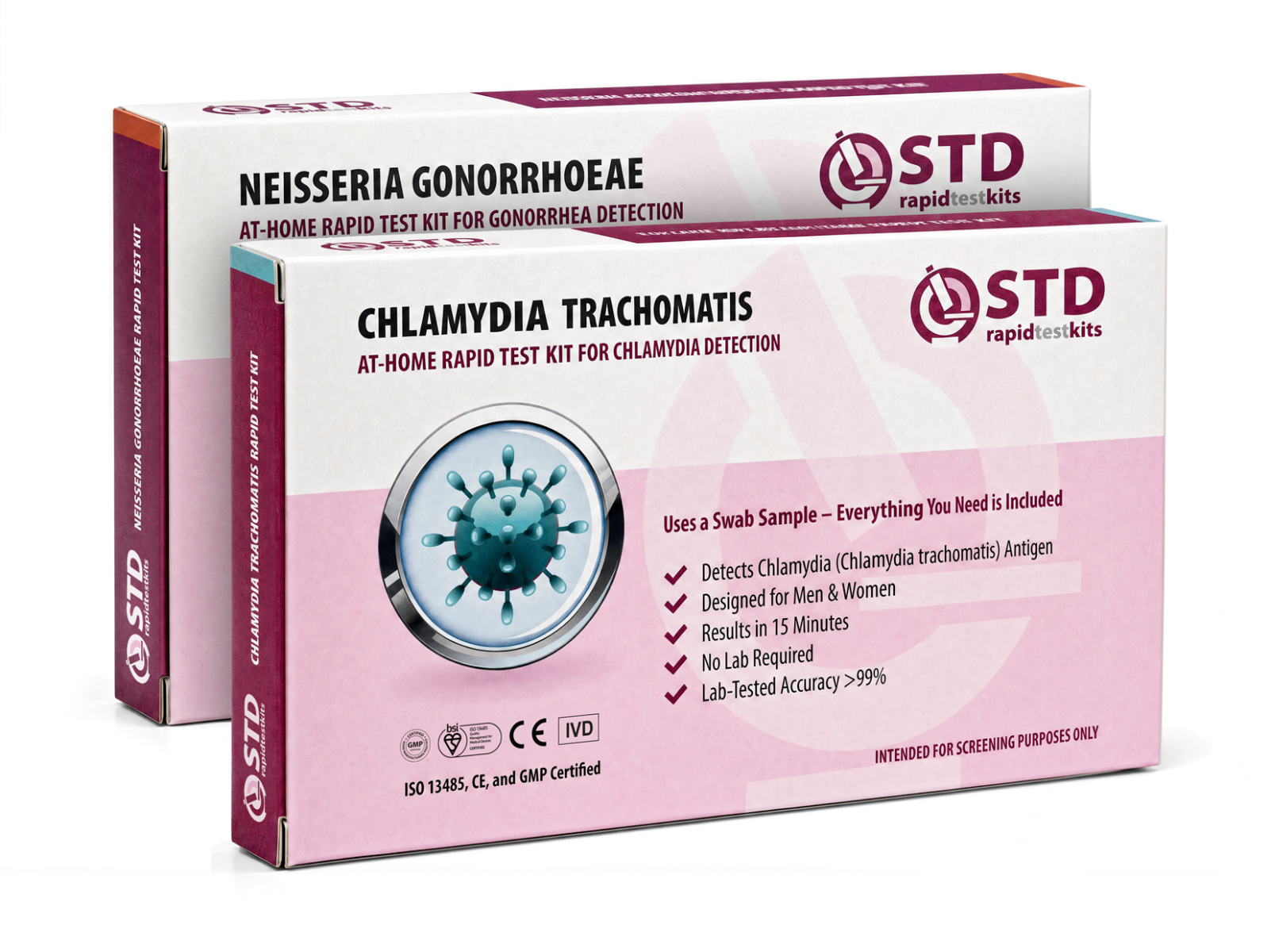
If your partner's diagnosis is unclear or they have a combination of infections, a broad-coverage panel is a sensible first move. The 7-in-1 panel covers the most common partner-notification scenarios in one kit.

What your at-home kit actually does (and what it does not)
A lateral-flow rapid test runs your sample (a fingerstick blood drop, a self-collected swab, or both depending on the panel) over a strip of antibodies fixed to nitrocellulose paper. If the target marker is present, a colored line appears in the test window within 10 to 20 minutes. The chemistry is the same family as home pregnancy tests, refined for the specific infection the kit targets.
Strengths of this technology:
- Speed: results during the same sitting, no shipping samples to a lab.
- Privacy: no clinic visit on your insurance record.
- Cost predictability: a flat retail price instead of a deductible-dependent clinic bill.
- Comfort: you collect your own sample at home without an awkward exam.
Limits worth knowing before you buy:
- Sensitivity is generally a few percentage points lower than laboratory NAAT for bacterial STIs. The CDC still considers lab NAAT the gold standard for chlamydia and gonorrhea diagnosis.
- A positive home result should be confirmed at a clinic before treatment, because lateral-flow false positives, while rare, do happen.
- Home kits do not cover every infection. Mycoplasma genitalium, lymphogranuloma venereum, and bacterial vaginosis all require clinic-based diagnostics.
- At-home rapid kits are designed for genital sample collection. Pharyngeal (throat) and rectal swab testing are not within their validated use.
The most defensible workflow when a partner tests positive: take a home rapid test inside the appropriate window for screening; if positive, follow up at a clinic for confirmatory NAAT and same-visit treatment; if negative but the window was short, repeat at the recommended retest interval.
How to talk to your partner without making it weird
The conversation goes better when you separate two things: the public-health task (notify, test, treat, retest) and the relationship task (how you both feel about what happened). Public-health first, relationship work second, because the medical clock is ticking and the relationship conversation usually goes more smoothly once neither of you is in acute panic.
If you are the one who just got the notification, the most useful messages back to your partner are practical:
- Thank them for telling you. Partner notification is socially expensive; positive reinforcement of that behavior matters for everyone.
- Ask the specific diagnosis and when they were treated or started treatment. This determines your test choice and the safe-to-resume timeline.
- Ask whether their clinician suggested expedited partner therapy. For chlamydia and gonorrhea, many states allow a clinician to prescribe treatment for you without an in-person visit (CDC Expedited Partner Therapy).
- Agree on a no-sex window until both of you have tested, treated where needed, and completed any treatment.
If you are the one delivering a positive result to a partner, lead with what you want them to do, not with explanations of how it happened:
- State the infection and roughly when you might have been infectious. You do not have to share a complete sexual history to deliver a useful notification.
- Mention the testing window and a suggested first test.
- Offer to share your clinic's partner-services line or the CDC EPT page.
If telling a partner directly feels impossible, anonymous partner-notification services let you send a notification without revealing your identity. Local public-health partner-services teams provide the same anonymous outreach in many jurisdictions; ask the clinic that handled your test.
One opener that lands well: I just got a result I need to tell you about. I tested positive for [infection]. Your clinician can run a quick test, and for some STIs they can prescribe treatment without an in-person visit. I want us both to get this handled.
Short, specific, action-oriented. No apology paragraph, no full medical history. You can talk about the rest later.
If your test is positive: what happens next
A positive home rapid test is a strong signal, not a final diagnosis. Take it as a prompt to call your clinic, not a reason to panic. The standard sequence after a positive home result:
- Confirmatory test at a clinic. The clinic will run a NAAT (for bacterial STIs) or a confirmatory serology (for HIV, syphilis, herpes). Lab NAAT is the gold standard for chlamydia and gonorrhea diagnosis per the CDC.
- Treatment. For most bacterial STIs, treatment is short and effective. Chlamydia: doxycycline 100 mg twice daily for 7 days. Uncomplicated gonorrhea: a single 500 mg ceftriaxone intramuscular injection. Syphilis: benzathine penicillin G intramuscular. Trichomoniasis: metronidazole. HIV is managed with antiretroviral therapy, started as soon as possible after diagnosis.
- Partner notification on your side. Anyone you have had sex with during the likely infectious window needs to know. Your clinician can help, or you can use anonymous notification services.
- Retest. CDC guidance recommends retesting for chlamydia, gonorrhea, and trichomoniasis at about 3 months after treatment to catch reinfection, which is common.
- No sex during treatment. Standard guidance is to avoid sex until 7 days after a single-dose treatment is completed, or until a full 7-day course is finished. For HIV, follow your clinician's specific guidance on viral suppression and transmission risk.
If the diagnosis is the most common pairing, chlamydia plus gonorrhea (often diagnosed together), the 2-in-1 swab kit can be used for follow-up screening at the 3-month retest mark or for any partner who has not yet tested.
When to skip the home test and go straight to a clinic
Home testing is a useful first move for many partner-notification scenarios, but a few situations call for a clinic visit first rather than after.
Go directly to a clinic, urgent care, or emergency department if any of these apply:
- You had a possible HIV exposure within the last 72 hours. HIV post-exposure prophylaxis (PEP) is most effective when started within 72 hours and is not available through home testing. Every hour matters.
- You have severe symptoms: high fever, pelvic or testicular pain, painful or bloody urination, severe rash, jaundice, neck stiffness, or visible genital lesions with significant pain.
- You are pregnant. STI testing during pregnancy follows a specific schedule and is generally handled through your prenatal care team.
- The exposure involved a throat or rectal site, and you need a pharyngeal or rectal NAAT swab. At-home kits in the U.S. market do not cover these sample types.
- You may have been sexually assaulted. SANE-trained nurses, forensic evidence collection, and emergency contraception or PEP are all time-sensitive.
- You have a known immunocompromising condition. Symptoms can escalate faster and need direct medical assessment.
For non-emergency questions, the CDC STI Information Hub includes referrals to free or low-cost STI clinics, and most Planned Parenthood locations test on a sliding-scale basis regardless of insurance status.
Do not screen at home first if any of these are present: a possible HIV exposure within the last 72 hours, high fever with pelvic or testicular pain, severe rash or jaundice, visible genital sores with significant pain, pregnancy, sexual assault, or known immunocompromise. These need same-visit clinical assessment and often same-visit treatment.
FAQs
- My partner has chlamydia. How long should I wait to test?
- About 1 to 2 weeks after the last possible exposure is the CDC's recommended window for chlamydia swab testing. If you test sooner, the result may be falsely negative because the bacterial load has not yet built up enough to detect. If symptoms appear before that window closes, see a clinician immediately rather than waiting.
- Can I have an STI even if I have no symptoms?
- Yes, and it is common. The CDC reports roughly 70% of trichomoniasis infections, a majority of chlamydia infections in women, and a significant share of gonorrhea and early HIV infections cause no recognizable symptoms. Absence of symptoms is not evidence of being uninfected, especially after a known exposure.
- What if we used condoms every time? Do I still need to test?
- Yes. Condoms substantially reduce risk but are not 100% effective, and several STIs (herpes, HPV, syphilis) can transmit through skin-to-skin contact in areas a condom does not cover. The CDC recommends testing after a known exposure even when condoms were used consistently.
- How accurate are at-home rapid STI tests?
- Sensitivity and specificity vary by kit and infection. Check each product page for the manufacturer's validated figures and confirm you are within the appropriate window period before testing. Laboratory NAAT remains the gold standard for chlamydia and gonorrhea diagnosis per the CDC, so the practical workflow is: screen at home, then confirm any positive at a clinic before starting treatment.
- Can I be treated without a positive test result?
- For chlamydia and gonorrhea, yes, in many U.S. states. Expedited Partner Therapy lets a clinician prescribe treatment for the partner of a diagnosed patient without requiring the partner's own test first. The CDC's EPT page lists state-by-state availability. EPT does not replace your own test; it just means you can be treated faster while you wait for results.
- What if my test is negative but my partner's was positive?
- Most likely you tested before the window period closed for that infection. Repeat the test at the CDC-recommended interval (see the testing-windows table above). If you continue to feel symptoms, see a clinician for a lab NAAT, which has a shorter detection window than antibody-based home tests.
- What should I do if my home test is positive?
- Call your clinic to schedule a confirmatory test and same-visit treatment. Avoid sex until both you and any current partners have completed treatment plus the recommended waiting period (typically 7 days after single-dose therapy, or after a 7-day course is finished). Notify recent partners; for chlamydia and gonorrhea, ask your clinician about EPT in your state.
- Can I order an at-home kit without involving my insurance?
- Yes. At-home rapid kits ship without insurance documentation and do not generate records in your insurance file. For people whose primary concern is privacy (sharing a plan with family, screening for a workplace, or simply wanting personal discretion), a home kit removes that paper trail entirely.
- U.S. Centers for Disease Control and Prevention. 2021 STI Treatment Guidelines. Recommendations for STI screening, testing windows, treatment regimens, and post-treatment retesting intervals.
- U.S. Centers for Disease Control and Prevention. HIV Testing. Recommended testing windows by test generation (4th-generation antigen/antibody combo versus antibody-only rapid) and post-exposure prophylaxis guidance.
- U.S. Centers for Disease Control and Prevention. HIV Basics. Transmission risk by exposure type, undetectable equals untransmittable (U=U), and post-exposure prophylaxis fundamentals.
- U.S. Centers for Disease Control and Prevention. Expedited Partner Therapy clinical guidance. Definition of EPT, state-by-state legal status, and prescribing partners without an in-person visit.
- U.S. Centers for Disease Control and Prevention. Sexually Transmitted Infections information hub. General STI prevention, testing, and treatment information for the public.
- U.S. Centers for Disease Control and Prevention. About Trichomoniasis. Source for the figure that about 70% of trichomoniasis infections cause no signs or symptoms.
- World Health Organization. Sexually transmitted infections (STIs) fact sheet. Global incidence figures for chlamydia, gonorrhea, syphilis, and trichomoniasis.
