Incubation Periods of Common STDs: What to Expect
Symptoms can show up two days after exposure or six months later, depending on the infection. Testing too early misses real cases; testing too late misses the window for early treatment. This guide walks through realistic incubation periods for ten common STIs, the difference between symptom onset and test detection, and when each rapid home test gives a trustworthy result.




- Incubation periods (time to symptoms) range from 2 days to 6 months across common STIs, and 50% or more of cervical chlamydia, cervical gonorrhea, male trichomoniasis, and HPV carriers stay asymptomatic.
- The testing window (time to detectable infection) is usually longer than the incubation window. For HIV antibody tests, the CDC cites a window of 23 to 90 days after exposure; 6 weeks is the standard clinical checkpoint most sexual-health providers use, and 12 weeks gives definitive reassurance.
Published: July 2025 | Last updated: May 2026 | Editorial review and quality control: Martina N.
The most common reason a sexually transmitted infection (STI) test comes back negative when an infection is actually present is simple: the test was run too soon. Incubation periods, the gap between exposure and the first signs of illness, can stretch from 2 days for gonorrhea to 6 months for hepatitis B. The testing window, the gap between exposure and the point when an antibody, antigen, or DNA test can reliably find the pathogen, is usually longer still. Getting these two intervals straight is the difference between a result you can trust and a result that gives false reassurance.
This article is published by stdrapidtestkits.com, which sells at-home rapid STI testing kits. We recommend products based on what fits the reader's concern, not commercial benefit. Where the right tool is a clinic visit instead of a home test, we say so.
Key Takeaways
- Incubation periods (time to symptoms) range from 2 days to 6 months across common STIs, and 50% or more of cervical chlamydia, cervical gonorrhea, male trichomoniasis, and HPV carriers stay asymptomatic.
- The testing window (time to detectable infection) is usually longer than the incubation window. For HIV antibody tests, the CDC cites a window of 23 to 90 days after exposure; 6 weeks is the standard clinical checkpoint most sexual-health providers use, and 12 weeks gives definitive reassurance.
Incubation period vs. testing window: not the same thing
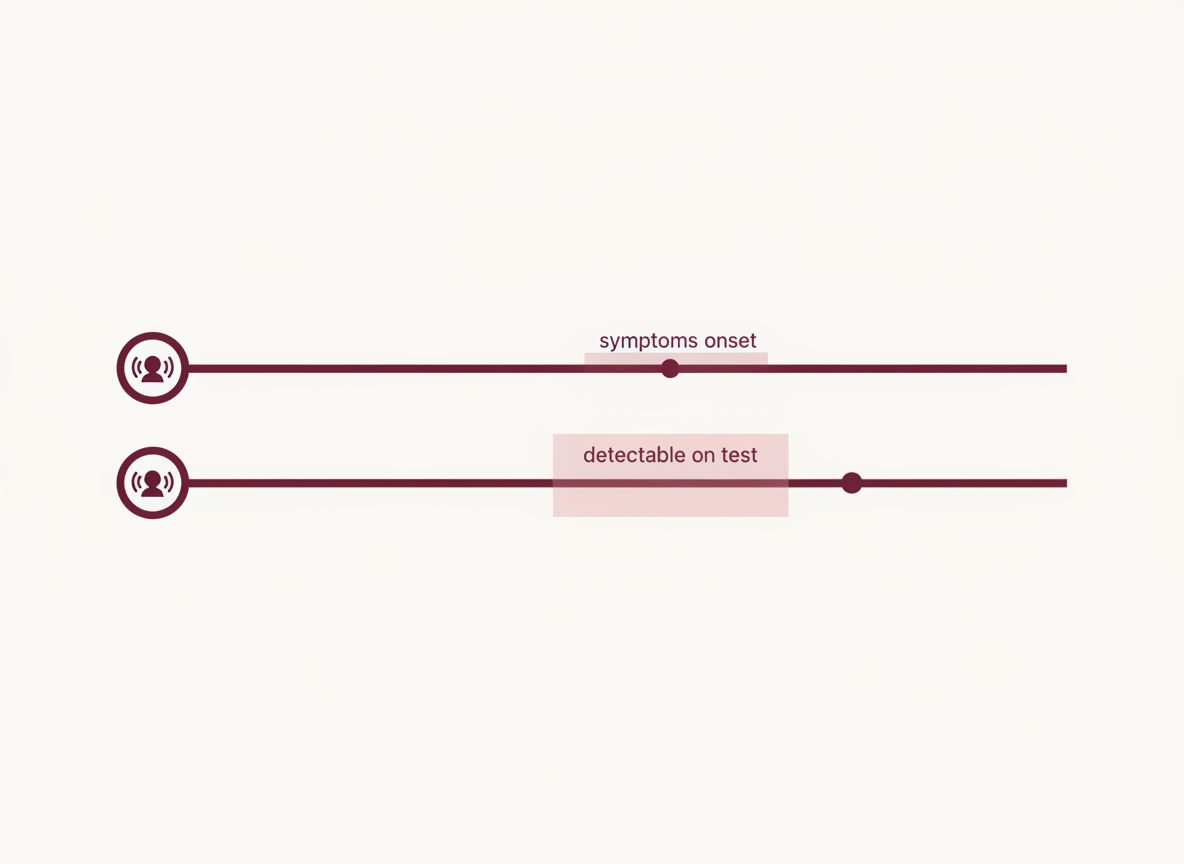
People use these terms interchangeably, but they answer different questions. The incubation period asks: when will my body start showing signs that something is wrong? The testing window asks: when will a test be able to detect what's happening inside me? The two intervals overlap, but rarely match.
An infection becomes detectable on a test only after the pathogen (or your immune response to it) has built up to the level the test can see. Antibody-based tests, including most rapid lateral-flow home kits, depend on your immune system mounting a measurable response, which takes weeks. Nucleic acid amplification tests (NAATs) used in clinical labs can detect bacterial or viral DNA earlier, but those are not what comes in a home kit.
For example, a chlamydia infection that produces burning urination on day 10 may not be reliably detectable on a lab NAAT until day 14, and antigen-based home rapid tests typically need a similar window. For HIV, the gap is wider. Acute retroviral symptoms can appear in week 2, but a fingerstick antibody test can detect HIV from 23 days at the earliest per the U.S. Centers for Disease Control and Prevention's HIV testing guidance; 6 weeks is the standard clinical checkpoint most sexual-health providers use, and 12 weeks gives definitive reassurance.
The window-period gap is why clinicians say to retest. If your first test was during the gap, a single negative is reassurance about that day, not about the underlying exposure. The right pattern after a known exposure is usually a baseline test soon after, followed by a confirmatory test once enough time has passed for the relevant test type to be reliable. We walk through the specific waiting times by infection below.
STD incubation timeline at a glance
The table below summarizes typical incubation ranges (time to symptoms) and the realistic earliest reliable testing window for each infection on a home rapid kit, where applicable. Ranges are drawn from the CDC's Sexually Transmitted Infections Treatment Guidelines, the WHO's STI fact sheet, and the NHS STI overview. Individual cases fall outside these ranges; use the table to plan, not to diagnose.
| Infection | Incubation (time to symptoms) | Earliest reliable home test |
|---|---|---|
| Gonorrhea | 1 to 14 days (typically 2 to 7) | About 2 weeks (swab antigen) |
| Chlamydia | 7 to 21 days | About 2 weeks (swab antigen) |
| Genital herpes (HSV-2) | 2 to 12 days (average 4) | 12 weeks (blood antibody); some outliers to 16 weeks |
| Syphilis | 10 to 90 days (average 21) | 3 to 6 weeks (blood antibody) |
| HIV | 2 to 4 weeks (acute symptoms) | 23 to 90 days (home antibody); 18 to 45 days (lab antigen/antibody) |
| HPV (warts) | Weeks to months; cellular changes take years | Detectable when present (women's swab) |
| Trichomoniasis | 5 to 28 days | Detectable when symptomatic (women's swab) |
| Hepatitis B | 30 to 180 days (average 90) | About 4 weeks to 6 months (blood antigen) |
| Hepatitis C | 14 to 180 days (average 6 to 7 weeks) | 8 to 11 weeks (blood antibody) |
How long does it take for STD symptoms to show up after exposure?
Incubation periods range from about 2 days (gonorrhea) up to 6 months (hepatitis B), with most STIs producing symptoms (when they produce any) between 1 and 12 weeks. Many infections never cause symptoms in 50% or more of carriers, so the absence of symptoms does not rule out infection. The testing window (when an infection becomes detectable) is usually longer than the symptom window, especially for HIV, syphilis, and hepatitis. For most home rapid tests, an accurate result requires waiting somewhere between 2 and 12 weeks after exposure depending on the infection.
Why some incubation windows cluster, and others don't
Bacterial infections (gonorrhea, chlamydia, syphilis) tend to incubate within 1 to 3 weeks because bacterial replication is fast and the immune response to bacterial antigens shows up quickly. Viral infections behave more variably. Herpes can produce a first outbreak in under two weeks, but the virus integrates into nerve cells and can stay quiet for months or years. HPV cellular changes take so long to detect that screening guidelines recommend cervical co-testing intervals of 3 to 5 years rather than acute follow-up. Hepatitis B, a DNA virus that replicates in liver cells, has the longest incubation of the bunch.
Lateral-flow home rapid tests (the technology in most of our kits) use the same biological signal that drives the incubation window, your immune system's antibody response or the pathogen's surface antigens, so test windows roughly track these incubation patterns, with longer waits for the slower-incubating infections. The table above already orders these windows from shortest (gonorrhea, chlamydia) to longest (HPV cellular changes), so use that as your reference when planning a testing schedule.
Bacterial STIs (gonorrhea, chlamydia, syphilis) incubate within 1 to 3 weeks. Viral STIs (herpes, HPV, hepatitis B, HIV) have wider windows that can stretch months, which is why their home-test waiting periods are so much longer.
Gonorrhea: rapid bacterial onset
Gonorrhea has the shortest incubation window in the chart. Symptoms typically appear 2 to 7 days after exposure, with the published range running 1 to 14 days. The bacterium Neisseria gonorrhoeae replicates fast and triggers a brisk inflammatory response in the urethra, cervix, rectum, or pharynx (the throat).
Symptoms (when they appear) include burning urination, yellow or green discharge, pelvic pain, and testicular tenderness. People with cervixes are more often asymptomatic than people with penises; about half of cervical infections cause no symptoms, while male urethral gonorrhea is usually symptomatic. Pelvic inflammatory disease (PID) is a recognized late complication of missed cervical infection. For pharyngeal and rectal gonorrhea, symptoms are less specific and frequently missed.
Our home rapid gonorrhea kit uses a self-collected genital swab and is not validated for pharyngeal or rectal samples. If your exposure was oral or anal, the right test is a clinic-administered NAAT on the appropriate sample, since the CDC's Treatment Guidelines specify sample type by anatomic site.
Our rapid swab antigen kit becomes reliable at about day 14 post-exposure. Swabs taken in the first week may carry too little antigen to register on the strip. If your exposure was within the past two weeks, wait, then test, or test now and retest at three weeks for confidence in a negative result.
Chlamydia: the silent infection
Chlamydia incubates over 7 to 21 days, but a more important number is how often it stays silent. Up to 70% of cervical and 50% of urethral chlamydia infections produce no symptoms at all (figures widely cited in clinical literature, including the CDC's STI Treatment Guidelines). When symptoms do appear, they look similar to gonorrhea: burning urination, abnormal discharge, lower abdominal pain in people with cervixes, testicular discomfort in people with penises.
The silent-spreader pattern is why the CDC recommends annual chlamydia screening for sexually active people under 25 and for older adults with new or multiple partners, regardless of symptoms. Untreated chlamydia is a leading cause of tubal-factor infertility, ectopic pregnancy, and chronic pelvic pain.
For home testing, our chlamydia rapid kit detects the bacterial antigen on a self-collected swab from about day 14 onward. Testing earlier risks a false negative because the antigen load may not yet exceed the assay's detection threshold. If your exposure was within the past two weeks, wait, then test, or test now and retest at three weeks for confidence.
Genital herpes (HSV-1 and HSV-2): variable onset
Herpes simplex virus type 2 (HSV-2) most often produces a first outbreak 2 to 12 days after exposure, with an average of about 4 days: clusters of small painful blisters on the genitals or anus, sometimes with flu-like symptoms (fever, swollen groin lymph nodes, body aches). HSV-1, historically the cold-sore virus around the mouth, is now responsible for a growing share of genital herpes cases, especially in younger adults, and follows a similar incubation pattern.
Many people never have a recognizable first outbreak. They may have a single mild episode they wrote off as razor irritation or a yeast infection, then go years between flares. The virus integrates into the nerve cell body and can reactivate any time the immune system is stressed (illness, sleep deprivation, hormonal shifts). Asymptomatic viral shedding can occur on any given day in someone with established infection, which is why people who have never noticed an outbreak can still transmit to a partner.
Testing for herpes is unique among STIs in this guide. Home rapid tests for herpes are blood antibody tests, not lesion swabs. They detect your body's antibody response to HSV-1 or HSV-2, which most commonly takes about 12 weeks to reach reliable levels, with some outliers seroconverting as late as 16 weeks. A blood antibody test cannot distinguish a current outbreak from a past one, and cannot tell you which body site is infected. If you have an active blister now, the diagnostic test is a clinic-administered swab PCR of the lesion fluid, not a home antibody test. The home blood test answers a different question: have I been exposed to HSV-2 (or HSV-1) at any point in the past?
The reactivation pattern shapes how herpes is managed long-term. Some people have a recognizable first outbreak and then go years between flares; others have several flares in the first year, with frequency declining over time as the immune response matures. Suppressive antiviral therapy (acyclovir, valacyclovir, famciclovir) reduces both flare frequency and viral shedding, and is the standard option for people with frequent recurrences.
Syphilis: a four-stage clock
Syphilis follows a staged course that few other STIs match. The primary stage starts with a single painless ulcer (the chancre) at the site of exposure, appearing on average 21 days after contact, with a published range of 10 to 90 days. The chancre heals on its own within a few weeks, even without treatment, which is one reason syphilis is missed.
Secondary syphilis follows weeks to months later. The classic presentation is a copper-colored rash on the palms and soles, plus low-grade fever, sore throat, and patchy hair loss. These symptoms also resolve on their own and the infection enters a latent phase. Untreated, latent syphilis can progress over years to tertiary syphilis with cardiovascular and neurological complications, or it can stay latent indefinitely. The four-stage progression looks like this:
- Primary: painless chancre at the exposure site; heals on its own within 3 to 6 weeks.
- Secondary: rash on palms and soles, fever, and patchy hair loss; appears weeks to months after the chancre.
- Latent: no symptoms, can persist for years.
- Tertiary: cardiovascular and neurological damage in untreated cases, often years to decades later.
Each stage's symptoms can resolve on their own, which is why syphilis is missed: the body looks fine even while the infection continues. For home testing, the rapid blood antibody kit detects treponemal antibodies, which become reliably positive 3 to 6 weeks after exposure. A test taken in the first two weeks of a primary chancre may be negative; the right move is to wait, retest at 6 weeks, or seek clinical evaluation that includes both treponemal and non-treponemal serology, especially when a chancre is present.
The progression is what makes syphilis dangerous when it goes untreated. Each stage's symptoms can resolve without treatment, so a person who saw the chancre and the rash come and go may believe the infection is gone while it continues silently. Antibody tests stay positive across all four stages, which is why screening matters even when no symptoms are visible.
HIV: acute symptoms and the testing window
Acute HIV symptoms (fever, fatigue, sore throat, rash, swollen lymph nodes) appear in roughly 50 to 80% of people 2 to 4 weeks after exposure during a phase clinicians call acute retroviral syndrome. The presentation is non-specific and often dismissed as flu, COVID, or mono. During this period, viral load is extremely high and transmission risk peaks.
The testing window is the more clinically actionable interval. Per the CDC's HIV testing guidance, the three test categories have distinct windows. Rapid antibody tests (the technology in fingerstick home kits) can detect HIV from 23 to 90 days after exposure. Rapid antigen/antibody fingerstick tests narrow that to 18 to 90 days. Lab-based antigen-antibody combination tests using blood drawn from a vein (the fourth-generation lab test) detect HIV in 18 to 45 days, the narrowest of the routine-screening options. Nucleic acid tests (NAT) detect HIV RNA from about 10 to 33 days but are not the technology in home rapid kits.
What this means in practice: a negative home rapid HIV test 1 week after a known exposure is not informative. The right pattern is a baseline test now (to rule out a pre-existing infection), a follow-up rapid test at 6 weeks (the standard clinical checkpoint most sexual-health providers use), and a final test at 12 weeks for definitive reassurance. If the exposure was high-risk and recent, post-exposure prophylaxis (PEP), a 28-day course of antiretroviral medication started within 72 hours, can substantially reduce the risk of infection. Contact a clinic or emergency room immediately; effectiveness declines with every hour of delay, and the window closes at 72 hours. PEP is time-critical and is not a home-test decision.
If your high-risk exposure was within the past 72 hours, do not wait to test at home first. Post-exposure prophylaxis (PEP) is a 28-day course of antiretroviral medication that must be started inside the 72-hour window; effectiveness declines with every hour of delay. Contact a sexual-health clinic, urgent care, or emergency room today. After PEP is started (or if the window has closed), follow the standard testing pattern: baseline test now, follow-up rapid antibody test at 6 weeks, definitive test at 12 weeks.
HPV: the months-to-years infection
Human papillomavirus (HPV) breaks the pattern. Visible genital warts (caused by low-risk HPV types 6 and 11) appear weeks to several months after exposure, with most cases showing up within 3 to 6 months. High-risk HPV types (16, 18, and several others) usually cause no symptoms at all, and the cellular changes that can progress to cervical, anal, or oropharyngeal cancer take years to develop.
For testing, our at-home HPV kit is a self-collected vaginal swab validated for female anatomy only. The kit detects high-risk HPV DNA when present, but a negative result on a single swab does not rule out a transient infection that has cleared on its own (most HPV infections clear within 1 to 2 years).
The most effective HPV prevention is vaccination. The Advisory Committee on Immunization Practices, whose recommendations appear in the CDC's STI Treatment Guidelines, recommends routine HPV vaccination through age 26 and shared clinical decision-making for vaccination through age 45.
Our at-home HPV kit is validated for self-collected vaginal swab only. We do not offer a male-compatible HPV home test. Male readers concerned about HPV exposure should see a clinic for visual inspection (visible warts can be diagnosed without a swab) or, for high-risk-type screening, anal Pap testing where indicated.
Trichomoniasis: easy to mistake for something else
Trichomoniasis incubates over 5 to 28 days. The classic presentation in people with vaginas is a frothy yellow-green discharge with a strong odor, vaginal itching, and burning during urination. People with penises are usually asymptomatic, which is why male partners often go undiagnosed and re-infect treated female partners. Roughly 70% of all infections produce no symptoms, with the rate higher in men than women.
The clinical confusion: trichomoniasis symptoms overlap heavily with bacterial vaginosis (BV) and yeast infection. Self-diagnosis based on symptoms alone is unreliable. The CDC recommends testing rather than empirical treatment, particularly because effective treatment for trichomoniasis (oral metronidazole or tinidazole) is different from BV and yeast treatments.
Our at-home trichomoniasis kit is a self-collected vaginal swab validated for female anatomy only. Male partners are usually asymptomatic carriers and should see a clinic for a urethral or urine NAAT, since untreated male partners are the leading cause of post-treatment re-infection in women.
Hepatitis B: the long-incubation hepatitis
Hepatitis B virus (HBV) has one of the longest incubation periods of any sexually transmitted pathogen. Symptoms (when they appear) develop 30 to 180 days after exposure, with an average of about 90 days, a range commonly cited by the CDC's Hepatitis B resources for acute HBV. Symptoms include fatigue, nausea, abdominal pain, jaundice (yellowing of the skin and whites of the eyes), and dark urine. Roughly half of acute infections in adults are asymptomatic.
Most adults clear acute hepatitis B on their own within 6 months, but about 5 to 10% develop chronic hepatitis B, which carries lifetime risk of cirrhosis and hepatocellular carcinoma. Chronic infection is silent for years.
For home testing, the rapid lateral-flow kit detects hepatitis B surface antigen (HBsAg), which appears 4 weeks to 6 months after exposure depending on viral kinetics. A test taken in the first month after exposure can miss the infection, and the most reliable confirmatory test is at 12 weeks with a final retest at 6 months for high-risk exposures.
The routine HBV vaccine series confers strong protection against new infection and is available from primary care providers, most pharmacies, and many sexual-health clinics. If your exposure history puts you at ongoing risk and you have not been vaccinated, the vaccine is the highest-impact prevention step you can take.
Hepatitis C: even longer, often silent
Hepatitis C virus (HCV) incubates over 14 to 180 days, with an average of 6 to 7 weeks. Acute HCV is symptomatic in only about 20 to 30% of cases; the rest have no symptoms at all. When symptoms do appear they resemble hepatitis B (fatigue, nausea, jaundice), which makes clinical distinction without testing impossible.
Sexual transmission of HCV is uncommon among monogamous heterosexual couples but is well-documented among men who have sex with men, particularly with HIV co-infection or with practices that involve mucosal trauma. Sharing needles, including for tattooing or steroid injection, remains the dominant transmission route.
The home rapid HCV antibody test becomes reliable 8 to 11 weeks after exposure. A positive antibody result does not distinguish active infection from past cleared infection; confirmation requires a follow-up HCV RNA (nucleic acid) test in a clinical lab. The good news: hepatitis C is curable in over 95% of cases with 12 to 24 weeks of direct-acting antiviral therapy, per the WHO's hepatitis C fact sheet, so a positive antibody test on a home kit is the start of a treatable pathway, not a chronic sentence.
Quickest to detect: chlamydia and gonorrhea, about 2 weeks. Slowest to detect on a home rapid test: genital herpes (HSV-2) and hepatitis B, often 12 weeks or more for full confidence. HIV antibody tests can detect from 23 days after exposure per the CDC; 6 weeks is the standard clinical checkpoint most sexual-health providers use, and 12 weeks gives definitive reassurance.
Common myths about STI timing
Four beliefs come up over and over in reader questions, and all four can lead to a missed or mistimed diagnosis. The callout below pairs each myth with the actual evidence.
- Myth: If I don't have symptoms, I'm not infected. Most chlamydia, trichomoniasis, hepatitis B and C, and HPV cases are asymptomatic at any given moment. The lack of symptoms says nothing about the absence of infection. Per the WHO's <a href="https://www.who.int/news-room/fact-sheets/detail/sexually-transmitted-infections-(stis)" target="_blank" rel="noopener">STI fact sheet</a>, the majority of curable STIs worldwide are diagnosed in people without symptoms.
- Myth: I can test the next day after a hookup. No home test on the market gives a meaningful result less than a few days after exposure. For most infections, useful testing starts 2 weeks out, and reaches full reliability between 6 and 12 weeks. Testing too early generates false reassurance.
- Myth: Only penetrative sex transmits STIs. Herpes, syphilis, gonorrhea, and HPV transmit through skin-to-skin contact and oral sex. Hepatitis B transmits through any blood or body fluid contact. The risk is lower than for vaginal or anal intercourse, but it is not zero.
- Myth: A negative test means I am clear forever. A negative test reflects your status as of the testing window for that specific infection, and any new exposure restarts the timing for re-testing.
When to test after a possible exposure
The right testing schedule depends on what you might have been exposed to and what kit you're using. The following pattern works for most readers concerned about a single recent exposure:
- Days 0 to 7: Baseline testing only if you want to document your status before this exposure could have changed it. A baseline does not detect this exposure; it documents what was true before.
- Day 14: Test for chlamydia and gonorrhea (swab antigen). A negative at this point is meaningful for these two infections.
- Week 6: Test for HIV (rapid antibody, standard clinical checkpoint), syphilis (rapid antibody), hepatitis C (rapid antibody).
- Week 12: Repeat HIV (definitive). Test for genital herpes HSV-2 (rapid antibody) and hepatitis B (rapid surface antigen).
- Month 6: Final hepatitis B test if the 12-week result was negative and the exposure was high-risk.
If you don't want to manage four separate testing dates, a multi-infection combo kit at the 6-week mark plus a follow-up at 12 weeks covers the highest-yield window for most exposures. The 6-in-1 panel below is the closest off-the-shelf match to the schedule above.
What our at-home rapid kits actually do
Every test in our catalog is a rapid lateral-flow immunoassay. The chemistry is the same family used in home pregnancy and COVID-19 antigen tests: a sample (a swab eluate or a drop of fingerstick blood) is loaded onto a strip pre-coated with antibodies that bind a specific antigen or with antigens that bind a specific antibody. A visible line confirms the binding within 10 to 15 minutes.
Lateral-flow chemistry is fast, private, and inexpensive. It is not the same technology as the laboratory NAATs (nucleic acid amplification tests) that the CDC describes as the gold standard for chlamydia and gonorrhea, or as the fourth-generation antigen-antibody combination assays used for HIV in clinical labs. Lateral flow trades a small amount of analytical sensitivity for the ability to give you an answer at home in 15 minutes.
What this means for your decision: a positive result on a home rapid test is worth confirming with a clinical lab test before starting treatment. A negative result on a properly-timed home test (after the relevant window has elapsed) is reasonably reassuring for the specific infection tested, but does not rule out infections not on the panel.
Most STIs have no symptoms or only mild symptoms that may not be recognized as an STI. Without testing, infections can go undiagnosed and continue to spread.
Frequently asked questions
- What's the difference between an incubation period and a testing window?
- Incubation is the time between exposure and the appearance of symptoms. The testing window is the time between exposure and when an infection becomes detectable on a specific test. For most STIs, the testing window is longer than the incubation period, especially for HIV, syphilis, and hepatitis B. A test result during the gap can be falsely negative.
- How soon after unprotected sex should I test?
- Minimum useful wait by test: 14 days for chlamydia and gonorrhea swabs. HIV antibody tests can detect from 23 days per the CDC, with 6 weeks as the standard clinical checkpoint most sexual-health providers use and 12 weeks as definitive. Syphilis and hepatitis C antibody tests reach reliability around 6 weeks. HSV-2 antibody and hepatitis B surface antigen tests are most meaningful at 12 weeks. For high-risk exposures in the past 72 hours, see a clinic about HIV post-exposure prophylaxis (PEP) before testing.
- Which STIs have the longest incubation periods?
- Hepatitis C tops the list at up to 6 months of silent replication. Hepatitis B runs close behind at up to 6 months (the published range reaches 180 days, though the average presentation is around 90 days; the 180-day outer bound applies to slower-incubating cases). HPV genital warts can take 3 weeks to 6 months to appear, and the high-risk cancer-causing strains take years to produce detectable cervical changes. Syphilis has the longest incubation in the bacterial group, with its first-stage chancre appearing up to 90 days after exposure.
- If I test negative two weeks after exposure, do I need to retest?
- It depends on which infection you tested for. A rapid swab for chlamydia or gonorrhea at two weeks is generally reliable. A negative HIV test at two weeks is not conclusive because the window for home antibody-only HIV tests starts at around 23 days and is fully reliable by 90 days. A negative syphilis or hepatitis B test at two weeks should be repeated at 6 to 12 weeks. Hepatitis C and HSV-2 antibody tests need about 12 weeks for full confidence. The right retest schedule depends on which test you used and how high-risk the exposure was.
- Can I transmit an STI before I have symptoms?
- Yes. Many STIs are transmissible during the incubation period before any symptoms appear, and many are transmissible from people who never develop symptoms at all. This is the central public-health argument for routine screening regardless of symptoms.
- Why might I get a negative test result and still be infected?
- Most commonly because the test was taken before the infection became detectable (the testing-window problem). Less commonly, because the sample was collected incorrectly (a poor swab) or the result was read outside the assay's time window. Repeat testing at the right interval addresses the first cause; following the kit instructions addresses the second.
- Can STI symptoms come and go?
- Yes. Genital herpes is famous for outbreak-and-quiet cycles. Syphilis chancres heal on their own and can be missed entirely. Hepatitis B and C symptoms can resolve while the infection remains active in the liver. Symptom resolution does not equal infection resolution; testing is the only way to confirm clearance.
- Can I get an STI from oral sex?
- Yes. Gonorrhea, chlamydia, syphilis, herpes (HSV-1 and HSV-2), and HPV all transmit through oral sex, with risk varying by infection and direction of transmission. Pharyngeal gonorrhea and oral HPV are well-documented. For pharyngeal STI testing, see a clinic; we do not sell a throat-swab home test kit.
- Do I still need to test if I used a condom?
- Condom-protected vaginal or anal sex substantially reduces, but does not eliminate, the risk of transmission for most STIs. Skin-to-skin infections (HSV, HPV, syphilis) can transmit from areas the condom does not cover. Oral sex without a barrier is a route for gonorrhea, chlamydia, syphilis, and HSV. If your exposure involved a known infected partner, condom slippage or breakage, or oral or anogenital contact without a barrier, testing on the appropriate window is reasonable even with consistent condom use elsewhere.
- Can stress, alcohol, or medications change the timing of symptoms or test results?
- Stress and lifestyle factors do not meaningfully shift the incubation period of an STI; symptom onset is driven by pathogen biology, not mood or recent alcohol intake. Test results are governed by laboratory chemistry on the same schedule. The exception is immunosuppression. Chemotherapy, high-dose corticosteroids, organ-transplant drugs, and advanced untreated HIV can blunt antibody responses and theoretically extend the window for antibody-based tests. If you are on immunosuppressive therapy, talk to your prescribing clinician about test timing and interpretation.
- U.S. Centers for Disease Control and Prevention. Sexually Transmitted Infections Treatment Guidelines. Authoritative U.S. clinical reference for incubation periods, screening intervals, treatment by infection, and HPV vaccination age recommendations.
- U.S. Centers for Disease Control and Prevention. HIV Testing. Window-period guidance distinguishing rapid antibody, rapid antigen/antibody fingerstick, lab antigen-antibody venous-blood, and nucleic acid HIV tests; PEP timing and eligibility.
- U.S. Centers for Disease Control and Prevention. Hepatitis B information for health professionals. Incubation, transmission, and serological detection windows for HBV.
- World Health Organization. Sexually transmitted infections (STIs) fact sheet. Global epidemiology and asymptomatic infection prevalence across major STIs.
- U.K. National Health Service. Sexually transmitted infections (STIs) overview. Patient-facing guidance on symptoms, testing intervals, and clinic referral.
- World Health Organization. Hepatitis C fact sheet. Authoritative global reference for HCV epidemiology, clinical course, and direct-acting antiviral cure rates and treatment duration.