
Published: September 2025 | Last updated: May 2026 | Editorial review and quality control: Martina N.
Burning that comes and goes can feel like a riddle your body refuses to solve. It stings on one trip to the bathroom, vanishes by the next, then returns just enough to keep you doubting yourself. You end up searching, scrolling, and going back and forth in your head about whether to test or wait. Most of the time the cause is something fairly ordinary: dehydration, friction, a soap change, a yeast flare. Sometimes the pattern points to a low-grade infection that will not resolve on its own.
The fluctuation alone cannot tell you which one you are dealing with. A few specifics about where the burning sits, when it shows up, and what you were doing right before usually can. This guide walks through the patterns clinicians use to sort intermittent burning from anything more serious, the testing window that matters most, and what to do when an at-home result does not match what your body keeps telling you.
Key Takeaways
- Burning that fades and returns rarely means the cause has cleared. Bacterial STIs like chlamydia and gonorrhea can quiet down for days while still active, which is why testing matters even when the symptom takes a break.
- Home rapid STI tests become reliable for chlamydia and gonorrhea from about 14 days after exposure. Testing earlier can return a false negative even when burning feels obvious.
Why Burning Is Not Always Constant
Inflammation does not behave like a light switch. It rises and falls based on hydration, friction, hormones, immune response, and stress level. That is why intermittent urethral burning, or vaginal burning that seems to come out of nowhere, is not unusual.
If you have mild urethritis, the tissue inside the urethra may be irritated without being severely swollen. When you are dehydrated, urine becomes more concentrated and acidic, which can make the sensation sharper. After drinking water, the same tissue feels calmer. Nothing healed in that hour. The signal just fluctuated.
The same applies to vaginal tissue. Hormone levels shift across the menstrual cycle. Friction from sex, tight clothing, shaving, or fragranced soaps can create temporary irritation that mimics an STI symptom and then fades. That inconsistency is what makes people doubt themselves and delay testing. Meanwhile, infections like chlamydia are famous for being subtle: a faint sting when you pee sometimes, slight discomfort after sex, no dramatic discharge.
The CDC notes that chlamydia, the bacterial STI most often behind intermittent urethral burning, frequently produces no symptoms at all. When symptoms do appear, they may not show up until several weeks after exposure. A quiet hour, day, or week of no burning does not rule it out.
STD, UTI, or Irritation: Reading the Pattern
This is where most of the anxiety lives. You feel a sting. You search whether it is an STD or a UTI. You read conflicting forum advice. You wonder if mild infection symptoms can disappear on their own. The table below shows how the most common causes of intermittent burning usually present, side by side.
| Condition | Burning Pattern | Other Clues | Does It Come and Go? |
|---|---|---|---|
| Chlamydia | Mild sting during urination | Often minimal or no discharge, occasional pelvic discomfort | Yes, especially early |
| Gonorrhea | More noticeable burning when peeing | Discharge more common than with chlamydia | Can fluctuate early on |
| UTI | Burning tightly linked to urination | Frequent urge to pee, bladder pressure, cloudy urine | Usually persists until treated |
| Yeast infection | External burning or raw sensation | Itching, thick white discharge | Often worsens before improving |
| Irritation (friction, soap, shaving) | Surface-level sting | Triggered after sex, exercise, or product use | Often fades within 24 to 48 hours |
What the Table Misses
Both STI and non-STI causes can fluctuate. Symptom timing alone is not diagnostic. The table gives you starting probabilities, not a verdict.
If it burns only when you pee sometimes and there is no urgency or bladder pressure, that leans slightly away from a classic UTI. If it burns more externally, on skin that feels raw after friction, that leans toward irritation. If the sensation is internal, subtle, and tied loosely to urination without strong bladder symptoms, that is when testing becomes the smart next step.
And here is the pattern many people miss: STIs do not always escalate dramatically. Sometimes they plateau at mildly annoying for weeks, which is exactly why they get ignored.
Why STI Symptoms Fluctuate
A common search is whether STI symptoms can disappear on their own. They can disappear temporarily, but the infection has not cleared. Your immune system and the bacteria or virus are in a back-and-forth.
Inflammation is not static. Immune cells surge and then settle, and tissue swells slightly and then calms. Chlamydia and gonorrhea can irritate the urethra or cervix intermittently depending on bacterial load and how local immunity is responding that day. Hydration changes urine concentration. Hormones alter vaginal pH. Sexual activity increases blood flow to the area. Anxiety can sharpen nerve awareness, especially at night when you are lying still and hyper-focused.
So yes, anxiety can make existing irritation feel sharper. But anxiety does not create a bacterial infection. If the bacteria are there, they stay until treated. According to the CDC sexually transmitted infections treatment guidelines, untreated chlamydia and gonorrhea can persist for many months and lead to pelvic inflammatory disease, epididymitis, and fertility complications regardless of how loud the early symptoms were.
If the burning shows up after sex with a new partner, fades, then returns the next time you have sex with that same partner or after a fresh exposure, treat the repetition as the signal. Bacterial load fluctuates; the bacteria do not.
Burning That Shows Up After Sex But Not Every Time
Another common search: burning after sex but not every time. This pattern often points toward either mechanical irritation or a mild infection that becomes noticeable when friction increases.
During sex, blood flow to genital tissue rises. Micro-tears can occur even with lubrication. If there is a low-grade infection, that inflamed tissue becomes more reactive, and the burning shows up after sex and fades by morning. In people with vaginas, hormonal shifts can thin vaginal tissue at certain points in the cycle, which raises the chance of post-sex sting. In people with penises, tight condoms, prolonged sex, or vigorous masturbation can leave the urethra briefly irritated.
One-off post-sex burning that resolves by the next day is usually friction. A pattern that repeats across multiple encounters, especially with a new partner, deserves a test rather than a third night of Googling.
How Timing Changes What a Test Can See
This is where fluctuating symptoms confuse people the most. You feel burning on day five after a new partner. It disappears by day seven. You assume you are fine. Or you test on day four and a negative result falsely reassures you.
Every infection has a window period, meaning the time between exposure and when a test can reliably detect it. Testing during intermittent symptoms before that window closes is the single biggest reason people get a false negative. The table below summarizes the windows for the bacterial STIs most often linked to burning.
| Infection | Typical Earliest Detection | More Reliable Testing Point | Common Symptom Pattern |
|---|---|---|---|
| Chlamydia | 7 days | 14 days | Mild, may fluctuate |
| Gonorrhea | 5 to 7 days | 14 days | Burning often stronger but can vary |
| Trichomoniasis | 7 days | 14 to 21 days | Irritation that may worsen gradually |
When should I test if the burning keeps coming and going?
If it has been 14 or more days since a possible exposure, test now. If it has been less than 7 days, you can wait until day 14 for a more reliable result, or test now and retest at day 14 if symptoms persist. A negative test taken inside the window period does not rule out infection. Pattern recognition, not symptom intensity, is what makes the timing call.
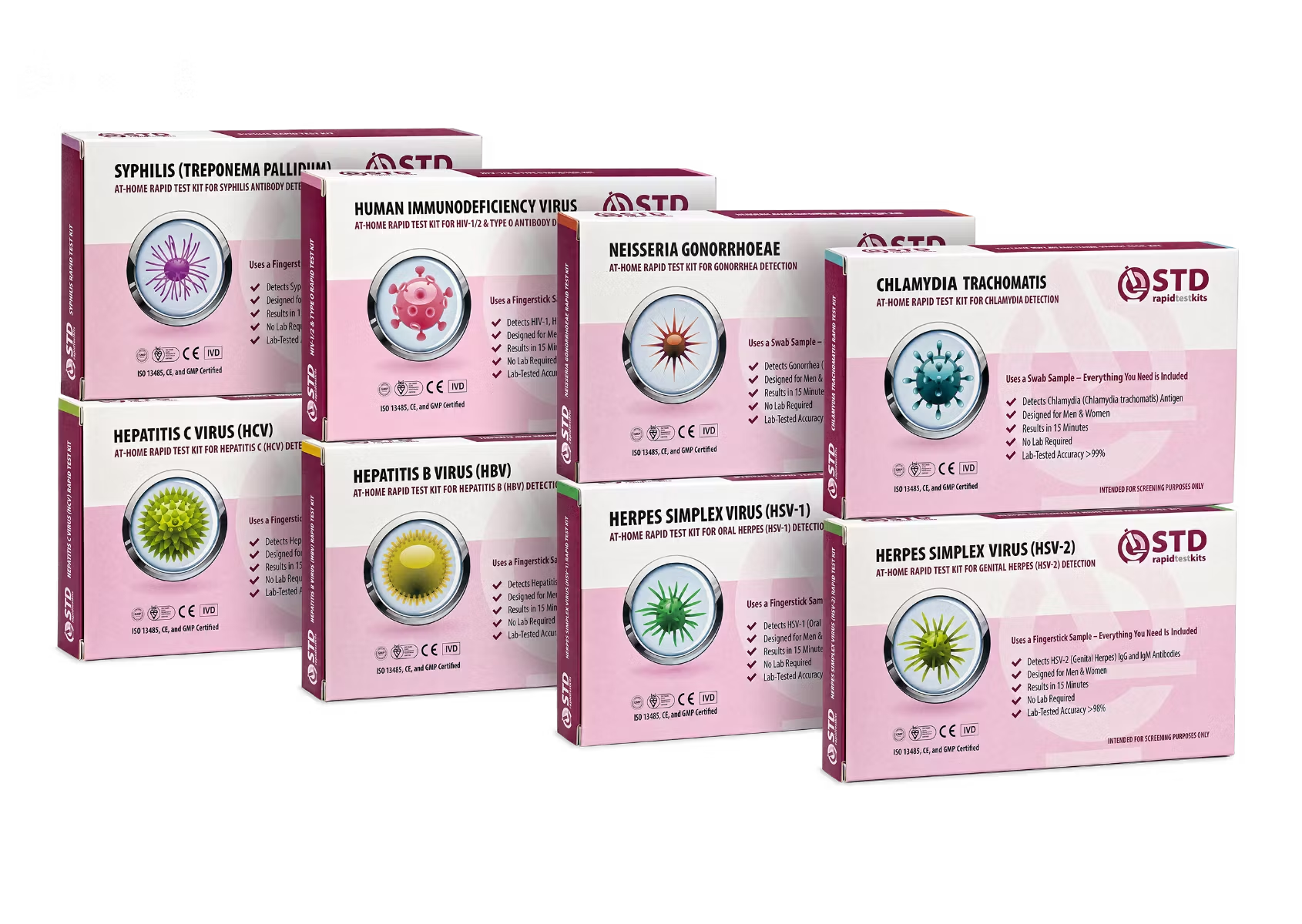
This article is published by stdrapidtestkits.com, which sells at-home STI testing kits. The kit shown below is one option for the 14-day testing window described above; we recommend it because the infections it covers match the symptom pattern this article is about, not because of commercial benefit.
When the Burning Feels Internal vs Surface-Level
Not all burning feels the same, and that difference matters more than people realize. Some describe a sharp sting right at the tip of the urethra during urination. Others describe heat on the outside skin, especially after sex or sweating. The body is more specific than people give it credit for. The trick is slowing down enough to interpret it.
Internal burning, especially inside the urethra, tends to point toward inflammation within the urinary or reproductive tract. That is where infections like chlamydia and gonorrhea typically live. The sensation may intensify when urine passes over irritated tissue. It might not hurt every time. It might be faint in the morning and stronger later in the day.
Surface-level burning shows up differently. It often presents as rawness on the vulva, along the labia, or on the penile shaft. It may worsen with friction, tight clothing, or scented products. It may sting in the shower but not during urination. That pattern leans more toward contact irritation or yeast imbalance than urethritis. The pattern test: someone who shaves, has sex that night, and wakes up with an external sting that fades by afternoon is almost certainly dealing with friction. Someone who has not changed products, has not shaved, and notices a subtle internal burn that returns across a week after a new partner deserves a test.
Internal burning follows urination, fluctuates with hydration, and is not always tied to friction. Surface burning tracks with shaving, soap, fabric, sweat, or vigorous sex, and usually fades within a day or two.
How the Same Infection Shows Up Differently
The experience is not identical across bodies. Anatomy changes the way inflammation registers. The urethra in people with penises is longer, so irritation often feels more localized at the tip. In people with vaginas, inflammation can involve the urethra and the cervix at the same time, which can create deeper pelvic discomfort layered on top of burning.
Penis burning sometimes shows up as a mild tickle or a sting without any discharge. Many people expect dramatic yellow discharge as proof of infection, but early chlamydia frequently does not present that way. It can stay subtle for weeks: a fleeting sensation after peeing, a slight irritation that vanishes for two days, a faint awareness during sex.
Vaginal burning across the cycle is heavily influenced by hormones. Around ovulation, cervical mucus increases. Around menstruation, pH shifts. These changes can amplify existing irritation and make mild infection symptoms feel cyclical. People sometimes report it only burns on certain days, which sounds random but is usually layered biology. The steady rule across all bodies: STIs do not require dramatic discharge to be real. Burning without discharge is still medically significant.
Could It Just Be Anxiety?
After a new sexual encounter, many people become hyper-focused on genital sensations they would normally ignore. A normal nerve signal becomes a spotlight. Anxiety can also tighten pelvic floor muscles, which creates a sensation of pressure or urethral awareness that some people describe as a phantom sting.
Anxiety can amplify a sensation. It does not cause inflammation inside the urethra. It cannot turn healthy tissue into a bacterial infection. If burning is repeatable during urination, particularly following a new exposure, testing remains the most grounded next step.
People do experience both ends of this. Some report intermittent burning that resolves within days of a negative test and a calmer week, suggesting anxiety amplification of an unrelated mild irritation. Others assume anxiety for weeks before a positive result forces them to act. The only thing that separated the two stories was the test.
Chlamydia often has no symptoms. If symptoms occur, they may not appear until several weeks after having sex with a partner who has chlamydia.
When a Negative Test Is Not the End of the Story
If you test at fourteen days and the result is negative, that is reassuring for the common bacterial STIs. But if burning persists, it does not mean you are imagining it. It means you expand the lens.
UTIs can occur independently of sexual exposure. Yeast imbalances can flare after antibiotics, stress, or hormonal shifts. Contact dermatitis can linger if the irritant is still in your routine. Sometimes the body is responding to friction patterns that repeat weekly without you realizing it. One person described testing negative for STIs twice while still experiencing vaginal burning after long workouts. The culprit turned out to be a new synthetic fabric in her cycling shorts. Once she changed materials, the burning resolved.
If your STI test is negative and symptoms continue, the next step is evaluation for UTI, yeast, or dermatologic irritation. The retesting table below covers the most common timing scenarios.
| Exposure Timing | First Test | If Negative but Symptoms Continue | Reasoning |
|---|---|---|---|
| Less than 7 days ago | Optional early test | Retest at 14 days | Early testing may miss infection |
| 7 to 14 days ago | Test now | Retest at 4 weeks if symptoms persist | Improves accuracy window |
| More than 14 days ago | Test now | Retest only if new exposure or worsening symptoms | High reliability at this point |
Talking to Partners While You Wait
This is the part people avoid thinking about. If burning comes and goes and you are unsure what it is, do you say something to a partner? Do you wait? Do you pause sex entirely?
If there has been a recent exposure and testing has not happened yet, using condoms or pausing new encounters until you have results is reasonable. That is not an admission of guilt. It is shared care. If you test positive, partner notification becomes part of treatment. Most bacterial STIs are treatable with a short course of antibiotics, and early treatment prevents complications and reinfection cycles.
The hard conversation is almost always shorter and less dramatic than the version you rehearse at 2 a.m. People describe rehearsing the text message for hours after testing positive. When it finally goes through, the response is often a calm acknowledgment and a plan to test the next day. Silence rarely protects anyone; information does.
When Burning Becomes an Emergency
Most intermittent burning is not an emergency. But there are exceptions worth knowing. Severe pelvic pain, fever, testicular swelling, or sharp abdominal pain alongside burning warrants immediate medical care. Those signals can mean an ascending infection or complications that need prompt treatment, not a 14-day waiting window.
The key difference is progression. Burning that rises and falls in mild waves is one thing. Pain that intensifies daily, or that comes paired with fever and pelvic ache, is another. If symptoms escalate sharply rather than fluctuate mildly, skip the home-test debate and go in.
- Severe pelvic or lower abdominal pain
- Fever above 38°C (100.4°F) alongside burning
- Testicular swelling or sharp testicular pain
- Pain that intensifies day over day rather than fluctuating
- Heavy unusual bleeding outside your normal cycle
These are warning signs of complications such as pelvic inflammatory disease or epididymitis, which need same-day clinical evaluation rather than a 14-day waiting window.
FAQs
- Can STI symptoms really come and go like that?
- Yes, especially early on. Chlamydia in particular often shows up as a mild sting one morning, nothing the next day, then a faint burn after sex. The immune system pushes back, inflammation rises and falls, and the sensation fluctuates. The bacteria are still present even when the symptom is on a break.
- If the burning stopped, isn't that a good sign?
- It feels like one, but symptom relief is not the same as medical clearance. Many STIs are mild or completely asymptomatic. The body can quiet inflammation without eliminating infection. If there has been a recent exposure, testing at the right window is still the responsible move, even if everything feels calm right now.
- How do I tell if it is just irritation from sex or something more?
- Think about pattern and timing. If it shows up right after friction, shaving, or a new product and fades within a day or two, irritation is the most likely cause. If it appears days after a new partner and repeats unpredictably, especially during urination, that leans more toward urethral inflammation and is worth testing for.
- Can anxiety really make it burn?
- Anxiety can make you hyper-aware of body signals, tighten pelvic floor muscles, and turn a small sensation into a spotlight. What it does not do is create bacteria. If burning is consistent during urination, especially after exposure, testing is the cleanest way to separate nerves from infection.
- I tested negative at day five. Am I clear?
- Day five is often too early for reliable detection of common bacterial STIs. A negative that early can be falsely reassuring. If it has been less than fourteen days since exposure, retesting at the two-week mark gives a much stronger answer.
- What if I have burning but zero discharge?
- Many cases of chlamydia produce nothing more than mild urethral burning, with no visible discharge and no color changes. Waiting for obvious discharge as confirmation can delay testing by weeks past the point it would be most useful.
- How long does STI burning last if it is real?
- Bacterial STIs do not follow a predictable schedule. Symptoms can flicker for days, disappear for a week, then return after sex or a long urination gap. Without treatment the infection stays active even when quiet, and that quiet phase is exactly when most people miss the window to act early.
- Should I tell my partner before I know for sure?
- If you are inside the testing window and unsure, using protection or pausing sex until you have results is reasonable. If a test comes back positive, honest notification is part of treatment and protects both of you from reinfection cycles. Most of these conversations are shorter and less dramatic than the version you rehearse in your head.
Before You Talk Yourself Out of It
Burning that comes and goes is unsettling precisely because it refuses to be dramatic. It does not demand attention. It whispers. It fades. It returns just enough to keep you guessing.
You do not need to wait for it to become unbearable to take it seriously. You do not need visible discharge or escalating pain to justify testing. If something feels off, even intermittently, and there has been a possible exposure in the last few weeks, getting clarity is worth it.
Three steps that close the loop
- Test at the right window. For chlamydia and gonorrhea, day 14 after exposure is the practical lower bound for reliable home testing.
- Retest if timing or symptoms warrant it. A negative inside the window, or a symptom that returns after a clean test, is a reason to repeat at the four-week mark.
- Loop in a partner if a test is positive or if you are pausing sex while you wait. Shared information is part of treatment, not an accusation.
How we sourced this article: This guide draws on current public-health guidance from the CDC, WHO, and NHS, on infectious-disease treatment guidelines for urethritis and cervicitis, and on widely reported symptom patterns from peer-reviewed clinical literature. We focused on testing-window data, symptom-presentation studies, and differential-diagnosis guidance for genital burning, then translated that material into plain language. This article is for general information and does not replace evaluation by a licensed clinician.
- World Health Organization. Sexually transmitted infections fact sheet, covering global STI prevalence, common symptoms, and screening guidance referenced in the symptom-pattern sections above.
- NHS. Sexually transmitted infections: overview of symptoms, testing, and when to see a clinician, used for the differential-diagnosis section.
- U.S. Centers for Disease Control and Prevention. Sexually transmitted infections treatment guidelines, source for testing-window guidance and statements about untreated bacterial STI persistence and complications.
- U.S. Centers for Disease Control and Prevention. About Chlamydia, source for the pull quote on asymptomatic and delayed-onset chlamydia presentation.
- NHS. Urinary tract infections (UTIs): symptoms, causes, and when to see a clinician, used for the UTI vs urethritis comparison in the differential-diagnosis section.
- U.S. Centers for Disease Control and Prevention. About Vaginal Candidiasis, used for vaginal yeast imbalance and discharge characteristics referenced in the differential-diagnosis section.
- Planned Parenthood. STDs, HIV, and safer sex resource hub, used as a plain-language secondary check on common STI presentation and prevention.
