

Published: November 2025 | Last updated: April 2026 | Editorial review and quality control: Martina N.
For men who have sex with men, the standard STI panel can leave a wide blind spot. A typical clinic visit, "I need an STI test," produces a urine cup. That sample tells you whether chlamydia is in your urethra. It tells you nothing about your throat or your rectum, the two anatomical sites where chlamydia in MSM hides most often, and almost always quietly.
This piece is for the gay or bi guy who tests every year, gets a clean panel, and still wonders why something feels off. It is also for the man who would rather not be told later that a missed rectal infection had been quietly damaging tissue or raising his HIV risk for months. Site-specific testing matters here. So does asking for it.
Why does a "negative" STI test sometimes still miss chlamydia in gay and bi men?
Most standard STI screens collect a single urine sample, which only checks the urethra. Chlamydia in the rectum or throat needs a separate swab from each site, because the bacteria stay where they land. Anal and oral chlamydia in MSM are usually silent, with the CDC reporting that the majority of cases produce no symptoms at all. Laboratory NAAT remains the most reliable detection method when run on a swab from each exposed site. At-home rapid kits, including ours, screen the urethral component plus other genital and blood-based STIs from the same exposure event; for rectal and pharyngeal swabs you still need a clinic that performs extragenital NAAT.
Key Takeaways
- Anal and throat chlamydia are usually asymptomatic in MSM. A urine test cannot find them, so each exposed site needs its own swab, ideally lab NAAT.
- If you ask for a 'standard' STI test, most clinics will run urine only. Receptive anal or oral exposure means you need to specifically request rectal and pharyngeal swabs.
Why a standard STI panel misses chlamydia in MSM
Walk into most urgent cares or general clinics and ask for an STI test. The default workflow runs on a single sample. For chlamydia and gonorrhea, that sample is almost always urine, processed by nucleic acid amplification testing (NAAT), which is the most sensitive technology widely available. NAAT correctly picks up urethral infections in the vast majority of cases. The problem is what it does not look at.
NAAT for chlamydia is only as informative as the sample you give it. A urine sample tells the lab about the urethra. It does not contain bacteria from your rectum or your throat, even when those sites are infected. To find chlamydia at those locations, the clinician has to physically collect a swab from each one and send each swab through its own NAAT run. Many clinicians will not do that unless you explicitly say you have had receptive anal sex, oral sex, or rimming. Many men, understandably, do not bring those details up unprompted in a fluorescent-lit exam room. Calling that a personal failure misses the point; the result is structural under-detection in a population that needs the opposite.
The CDC's STI Treatment Guidelines specifically recommend at least annual chlamydia and gonorrhea screening at the urethra, rectum, and pharynx for sexually active MSM, with three-to-six-month testing for those with multiple or anonymous partners (CDC, STI Treatment Guidelines for MSM). A 2019 CDC MMWR analysis of community MSM clinics documented that extragenital chlamydia and gonorrhea were common across rectal and pharyngeal sites, with a rectal chlamydia prevalence around 7.3% among screened men, infections that a urine-only workflow would not detect (CDC MMWR 2019, extragenital STI prevalence among community MSM).
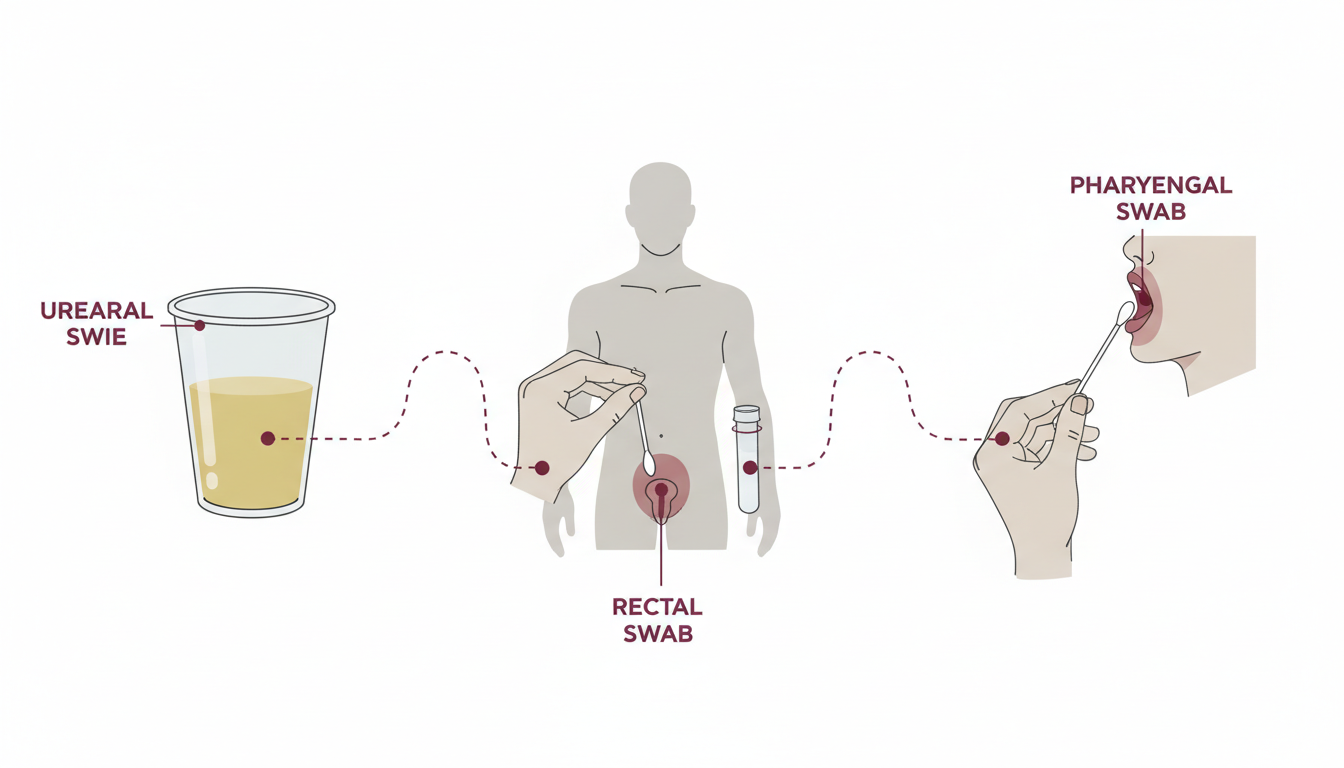
Site-specific testing: what each sample picks up
The fix here is straightforward. Each anatomic site needs its own sample, and the sample type has to match the kind of test being run. Lab-based NAAT on urine finds urethral chlamydia and gonorrhea. Lab-based NAAT on a self-collected or clinician-collected rectal swab finds rectal infections. Lab-based NAAT on a throat swab finds pharyngeal infections. None of those samples substitute for the others.
This site sells at-home rapid tests for the urethral component of this screening, and we flag throughout where clinic NAAT is needed for rectal and pharyngeal sites. At-home rapid lateral-flow tests, including the kits on this site, follow the same site logic but use simpler chemistry that returns a result in roughly 15 minutes. The trade-off is sensitivity, especially for low-bacterial-load infections. A positive result on a rapid test is highly informative; a negative result, especially after a clear exposure, is worth confirming with lab NAAT. Lateral-flow rapid testing and laboratory NAAT are complementary tools rather than equivalent ones (CDC, STI Treatment Guidelines for chlamydia).
The table below maps real-world sexual contact to the sample you actually need.
| Type of contact | Site to test | Sample needed | Where to get this test |
|---|---|---|---|
| Insertive penile contact (oral or anal) | Urethra | Urine, or self-collected penile swab | Clinic NAAT, or our at-home rapid swab |
| Receptive anal sex | Rectum | Rectal swab | Clinic that does extragenital NAAT (we do not sell a rectal kit) |
| Giving oral sex | Throat | Pharyngeal swab | Clinic that does extragenital NAAT (we do not sell a throat kit) |
| Rimming (oral-anal contact) | Throat AND rectum | Throat swab plus rectal swab | Clinic for both samples |
| Shared toys, fingers, mixed contact | All exposed sites | One sample per exposed site | Clinic, plus at-home swab for the urethral portion |
Why so many of these infections feel like nothing
The clinical literature is consistent on this point. Anal chlamydia in MSM is asymptomatic in the large majority of cases. Pharyngeal (throat) chlamydia is similar. The CDC notes that most chlamydial infections in any anatomic site cause no symptoms, which is one reason routine screening is the recommended approach instead of symptom-driven testing (CDC, About Chlamydia).
When symptoms do appear, they are easy to miss or to mislabel. Rectal chlamydia can produce mild discomfort during bowel movements, occasional spotting on toilet paper, mucus that gets mistaken for irritated hemorrhoids, or a faint sense of fullness or pressure. Pharyngeal infection can show up as a sore throat that does not respond to a course of antibiotics aimed at strep, or it can cause nothing at all. None of these signs are loud enough to make most people walk into a clinic.
That silence has a real cost. While the infection sits unnoticed, the inflammation it causes can raise the chance of acquiring or transmitting HIV during sex at the affected site (WHO, STIs fact sheet). The infection can also be passed forward each time without anyone in the chain realizing they have it. Most rectal-chlamydia transmission in MSM networks happens this way, between people who genuinely think they tested clean.
If a sore throat lingers for more than two weeks after an antibiotic course aimed at strep, and you have had oral sex within the past few months, ask specifically for a pharyngeal NAAT swab for chlamydia and gonorrhea. Standard throat cultures do not look for these organisms.
When to test, and when to retest after exposure
Timing is the second mistake people make after sample-site choice. The window period for chlamydia, the time between exposure and a reliably detectable infection, is generally one to two weeks. Testing on day three is too early; the bacterial load may not be high enough yet for even NAAT to catch it. Testing at day 14 is the practical floor for a credible result. Many clinicians will recommend a follow-up test at four weeks if the initial test was very early, or after a re-exposure.
One realistic scenario. Picture a guy who hooks up on vacation, tests on day five with a urine-only kit, gets a negative, and comes home reassured. Two weeks later something feels off and he goes to a clinic. Still no rectal swab is offered. He finally orders a comprehensive three-site lab kit and only then learns he has had rectal chlamydia for the better part of a month. The test was not wrong. The timing and the sample site were.
If you are testing within seven days of an exposure, plan to retest at the two-week mark, regardless of the first result. If your test only checks urine and you had non-insertive oral or anal contact, the urine result has nothing to say about that contact. A negative urine result for someone who had non-insertive contact is partial information about that one site, and tells you nothing about the others.
The other timing rule worth knowing: re-test three months after treatment if you had an active infection. Reinfection is common in MSM networks, especially when partners did not finish treatment or never tested at all. The CDC explicitly recommends a three-month re-test as the retest-of-choice (CDC, STI Treatment Guidelines for chlamydia).
What untreated chlamydia can do to your body
Getting chlamydia treated is straightforward. What it does to your body while it sits untreated is not. Chlamydia trachomatis targets mucous membranes, which means it lives in the urethra, the rectum, the throat, and (rarely) the eye. Left alone, the bacteria continue to provoke a low-grade inflammatory response in the surrounding tissue. Over time, that inflammation can scar and remodel the tissue in ways that do not fully reverse, even after antibiotics clear the infection.
The clinical worry list for men is short and real. Chronic urethritis can scar the urethra and cause long-term issues with urination or ejaculation. The bacteria can climb from the urethra into the epididymis, the tube where sperm matures, and trigger epididymitis. Epididymitis is sometimes intensely painful and sometimes a vague one-sided ache. In rare cases, the inflammation extends into the testicles themselves, called epididymo-orchitis. Repeated or untreated infections of this kind are an established cause of male infertility, although the absolute risk per single infection is low (CDC, About Chlamydia).
The rectal site has its own complication list. Persistent rectal chlamydia can progress to proctitis, an inflammation of the rectal lining, which causes pain on bowel movements, bleeding, mucus discharge, and pain during anal sex. Severe or untreated proctitis can ulcerate or, very rarely, cause strictures of the rectal canal. Mucosal inflammation at this site also raises the chance of acquiring or transmitting HIV during receptive anal sex, which is one of the most consequential downstream effects of letting an infection sit.
The pharyngeal site is the gentlest of the three. Untreated throat chlamydia rarely causes serious local damage, though it can persist as a silent reservoir that keeps passing infection forward to other partners.
| Body site | Possible complications | Notes for MSM |
|---|---|---|
| Urethra | Urethritis, scarring, painful urination, narrowed urethra | Most common with insertive contact; symptoms here are often the first warning |
| Epididymis and testicles | Epididymitis, epididymo-orchitis, fertility risk | One-sided pain that can feel like a pulled groin muscle; do not ignore |
| Rectum | Proctitis, ulceration, increased HIV transmission risk at the site | Often asymptomatic; can mimic IBS, hemorrhoids, or anal fissures |
| Throat | Pharyngitis, ongoing onward transmission | Rarely tested unless explicitly requested; usually asymptomatic |
What to do if you test positive
Take a breath first. Chlamydia is one of the most treatable bacterial STIs in clinical practice. The current first-line treatment in the CDC's 2021 STI Treatment Guidelines is doxycycline 100 mg by mouth twice daily for seven days. Azithromycin remains an alternative in specific situations, but doxycycline is now preferred for both urogenital and rectal infections in adults (CDC, chlamydia treatment guidelines). The course is straightforward: pills, no injections, no IV, and most people feel back to normal within the first few days.
The post-treatment rules are simple. Wait at least seven days after finishing the antibiotics before having sex again, even with a regular partner, even with a condom, even oral. The aim is to give the antibiotic enough time to clear the infection from every exposed mucosal site. Continuing to have sex during or right after treatment is one of the most common reasons reinfection rates in MSM are as high as they are.
The harder part is partner notification. The CDC suggests reaching out to anyone you have had sex with in the previous 60 days, so they can test and start treatment too. The standard advice is to keep it short, factual, and free of blame. Notifying people is the single most effective intervention for breaking transmission chains in MSM networks; it is also, often, harder than the test itself.
Plan to retest three months after treatment, even if you feel fine. The test of cure protects you from a quiet reinfection that you would otherwise carry forward into the next encounter.
"Hey, I just tested positive for chlamydia. I do not know exactly when. You should probably get tested too. No drama, just a heads up." Direct, blame-free, and short. If sending it yourself feels rough, several U.S. and U.K. health departments offer anonymous partner notification through online tools.
The CDC's STI Treatment Guidelines call for at least annual chlamydia and gonorrhea screening at the urethra, rectum, and pharynx for sexually active men who have sex with men, with screening every three to six months for those with multiple or anonymous partners (paraphrased from the <a href="https://www.cdc.gov/std/treatment-guidelines/msm.htm" target="_blank" rel="noopener">2021 STI Treatment Guidelines, MSM section</a>).
Where to get the right test for each site
This site sells at-home rapid swab kits for chlamydia and other infections, and the swab is collected from the genital site, meaning a self-collected penile swab for men. We do not sell a rectal-swab kit or a pharyngeal-swab kit. For rectal or throat chlamydia, you need a clinic that performs extragenital NAAT, ideally an LGBTQ+-focused or sexual-health-specialty clinic where the conversation will be straightforward.
If a clinic visit is hard to access (rural area, no friendly provider, work schedule that does not allow it), some lab-based mail-in services in the United States and the United Kingdom now ship multi-site collection kits with all three swabs included. The samples go to a CLIA-certified lab and results return in three to seven days. These kits cost more than a single-site test, and they require careful self-collection, but they are a real option when in-person clinic access is not.
For the urethral component of an exposure, especially when you want a fast result and privacy, our home rapid kit is fit-for-purpose. It does not, however, substitute for the rectal or throat sample if you had receptive anal or oral exposure.
If you do go to a clinic, the most useful sentence you can prepare in advance is: "I have had receptive anal sex and oral sex in the past few months. I would like swabs for chlamydia and gonorrhea at the rectum and throat in addition to a urine test."
Preventing reinfection without policing your sex life
Repeat chlamydia in MSM most often stems from reinfection within the same partner network rather than from a brand-new exposure. The reinfection often comes from the same untreated partner, who never finished or never started a treatment course. The practical fix here closes a few specific loops, none of which require having less sex.
Finish your full antibiotic course before resuming any sexual activity, including oral. Wait at least seven days after the last dose, then resume. Encourage every recent partner to test and treat in parallel; otherwise the two of you will hand the infection back and forth without realizing it. Use condoms consistently, especially during anal sex, both insertive and receptive. Plan a routine test cadence rather than a panic-driven one. The CDC suggests every three to six months for sexually active MSM with multiple or anonymous partners (CDC MSM screening recommendations).
One pattern worth flagging. If you and a regular partner are not using condoms because you have agreed not to, build in a shared screening rhythm and stick to it. Knowing that both of you tested negative across all three sites at the same time is the closest thing to a clean baseline you can practically have.
A note on the emotional layer (this is biology, not character)
It is hard to write about MSM-specific testing without acknowledging the silence around it. Many gay and bi men describe delaying tests because they were braced for a clinic conversation that would feel judgmental, or because the diagnosis would seem to confirm a story about themselves they had been resisting. The data does not support that story. Chlamydia is one of the most common bacterial infections in the world, present in every sexually active population regardless of partner count. The diagnosis carries no moral weight; it indicates exposure to a microbe.
What the diagnosis does signal is the need to act. Treat, notify, retest, and adjust the testing rhythm going forward. None of that requires shame. The clinics most likely to handle this conversation well are sexual-health-specialty clinics and LGBTQ+ community health centers, which exist in most U.S. and U.K. cities and are usually reachable through Planned Parenthood, the CDC's Get Tested locator, or a local LGBTQ+ center referral.
The CDC's GetTested locator (gettested.cdc.gov) and local LGBTQ+ community health centers are the fastest starting point for finding a provider who routinely does extragenital sampling. Many U.S. and U.K. cities also have sliding-scale sexual-health clinics that perform rectal and pharyngeal NAAT as part of their default panel for MSM patients.
FAQs
- I had a recent STI test that came back negative. Could I still have chlamydia?
- Yes, if the test was a urine sample only and you have had receptive anal or oral contact recently. A urine NAAT screens the urethra and tells you nothing about your throat or rectum. If those exposures were part of your recent sex life, ask specifically for swabs at those sites.
- Can chlamydia really transmit through oral sex without ejaculation?
- Yes. Chlamydia spreads through contact with infected mucous membranes, not specifically through semen. Brief oral-genital contact is enough for the bacteria to reach the throat. Most pharyngeal infections in MSM are silent, which is why a symptom-free throat after oral sex is no guarantee you are clear.
- We rimmed but did not have penetrative sex. Do I need to test?
- Yes. Rimming is oral-anal contact and can transmit chlamydia, gonorrhea, hepatitis A, and several other organisms in either direction. The receptive partner of the rim should consider a pharyngeal swab; the partner whose rectum was contacted should consider a rectal swab.
- We used condoms. Why do I still need extragenital testing?
- Condoms substantially reduce risk during penetrative sex, and they do not cover oral contact, do not protect during rimming or shared toy use, and most people do not use them for oral sex. Site-specific extragenital testing covers the gaps consistent condom use does not.
- How long after exposure should I wait before testing?
- At least 14 days for a credible chlamydia result. If you test in the first week, plan a follow-up at the two-week mark regardless of the first result. After treatment of a confirmed infection, retest at three months to catch any reinfection.
- What does treatment look like, and how long until I am cleared?
- Doxycycline 100 mg twice daily for seven days clears it in most cases. Wait a full seven days after the last dose before any sexual contact, then plan a three-month retest to rule out a silent reinfection.
- Should I tell recent partners if I test positive?
- Yes. The CDC recommends notifying anyone you have had sex with in the previous 60 days. Direct and short works better than long and apologetic. If telling people yourself feels rough, anonymous notification tools are available through several public-health departments and apps.
- Can untreated chlamydia in men actually cause infertility?
- It can, although the absolute risk per single untreated infection is low. The pathway is chronic urethritis or epididymitis that scars the sperm-transport tubes. Risk goes up with repeated, ongoing untreated infection, and treating early closes that risk almost entirely.
- U.S. Centers for Disease Control and Prevention. About Chlamydia: symptoms, transmission, and screening overview, supports asymptomatic-majority and male-infertility-pathway claims.
- U.S. Centers for Disease Control and Prevention. STI Treatment Guidelines, men who have sex with men, supports the at-least-annual extragenital screening recommendation and the three-to-six-month interval for men with multiple or anonymous partners.
- U.S. Centers for Disease Control and Prevention. STI Treatment Guidelines for chlamydial infections, supports the doxycycline 100 mg twice-daily for seven days first-line regimen, the general one-to-two-week window-period framing, and the three-month retest-of-choice interval.
- U.S. Centers for Disease Control and Prevention MMWR. Extragenital chlamydia and gonorrhea among community-screened MSM, supports the documented prevalence of extragenital infection (rectal chlamydia around 7.3%) at sites a urine-only workflow does not sample.
- World Health Organization. Sexually transmitted infections fact sheet, supports the elevated HIV-acquisition risk at sites of mucosal STI inflammation.
- U.K. National Health Service. Chlamydia condition page, supports access-to-testing framing and general chlamydia guidance for U.K. readers.
