

Published: July 2025 | Last updated: April 2026 | Editorial review and quality control: Martina N.
Most people only think about STI testing after something feels wrong. A bump, a burn, a phone call from a worried ex. The trouble with that timing is that by the time symptoms show up, most infections have already had time to spread, and most never produce a noticeable symptom in the first place. The U.S. Centers for Disease Control and Prevention estimates that about 1 in 5 people in the United States had a sexually transmitted infection on any given day in recent surveillance years (CDC, STI prevalence and incidence estimates). A meaningful share of those people feel completely fine.
Testing before sex with a new partner isn't paranoia and it isn't an accusation. It's the only reliable way to know what each of you is bringing into the bed. The rest of this guide explains when to test, what to test for, how to bring it up calmly, and how at-home kits and clinics fit together.
Should you really test before sex with a new partner?
Yes, when the timing allows. Most common STIs (chlamydia, gonorrhea, HPV, herpes, often HIV in early infection) cause no symptoms, so feeling fine doesn't rule out infection. A reasonable plan is to test 1 to 2 weeks before the encounter for chlamydia and gonorrhea, and use the right window-period kit for HIV, syphilis, and herpes. If a test isn't possible before, condoms reduce but don't eliminate risk for skin-to-skin infections like HPV and HSV.
Key takeaways
- Most STIs are asymptomatic, so the absence of symptoms is not evidence of an absence of infection. Testing is the only reliable check before a new partner.
- A practical pre-sex panel covers chlamydia, gonorrhea, syphilis, HIV, and (where relevant) HPV and herpes. At-home rapid lateral-flow kits make this private and low-friction; a clinic visit adds confirmatory NAAT testing for chlamydia and gonorrhea.
Why the "wait until symptoms" model fails
The default approach to sexual health, in many countries, is reactive: a person notices something unusual, gets worried, and books a test. That works for conditions where symptoms reliably show up early. It doesn't work for STIs, because the most common course for chlamydia, gonorrhea, HPV, and early HIV is silent infection. The CDC's chlamydia overview puts it plainly: chlamydia often has no symptoms, but it can cause serious health problems even without them (CDC, About chlamydia). Untreated, it can quietly cause pelvic inflammatory disease, infertility, and increased HIV susceptibility.
Several other infections behave the same way. Pharyngeal and rectal gonorrhea typically cause no obvious symptoms but are still contagious. Genital HPV usually clears on its own but can persist and progress to cervical or other anogenital cancers years later. Acute HIV often produces flu-like symptoms within 2 to 4 weeks after exposure (about two-thirds of newly infected people experience this stage), but many miss the connection or have no acute illness at all (HIV.gov, symptoms of HIV).
A clean bill of recent symptom history says very little about whether a person can transmit an infection tonight. The pharyngeal and rectal gonorrhea point especially: a partner who has never noticed a sore throat or any rectal symptom can still be carrying and transmitting the bacterium.
Asymptomatic doesn't mean rare or low-stakes. It means the infection is biologically active and contagious, but the carrier has no signal to act on. In sexual health that turns out to be the typical case, not the exception, for chlamydia, HPV, early HIV, pharyngeal and rectal gonorrhea, and most herpes carriers between outbreaks.
The asymptomatic problem, in numbers
The headline figure most people quote is 1 in 5: roughly that share of the U.S. population is estimated to have an STI at any given time, per CDC's 2018-baselined estimates updated through more recent surveillance (CDC, STI prevalence and cost estimates). The World Health Organization estimates more than 374 million new infections globally each year for chlamydia, gonorrhea, syphilis, and trichomoniasis combined (WHO, STI fact sheet).
Behind those totals are infections that, individually, are easy to miss:
- Chlamydia. Largely asymptomatic. CDC reported around 1.65 million cases in recent annual surveillance, and acknowledges actual numbers are higher because many infections go undiagnosed.
- Gonorrhea. Often silent in the throat and rectum. Symptomatic genital infection is more common in penises than vaginas, but neither is guaranteed.
- HPV. Most adults are exposed at some point. Most clear naturally. The persistent infections are the ones that drive cervical and anogenital cancer risk over years.
- Herpes (HSV-1 and HSV-2). Many carriers have never had a recognized outbreak. Asymptomatic viral shedding is enough to transmit.
- Syphilis. Can present as a single painless ulcer that heals on its own and gets missed. Cases are rising in the United States.
- HIV. Modern fourth-generation antigen-antibody tests detect most infections by around 18 to 45 days post-exposure, but the very early window can still produce a false negative.
A clean symptom history is missing data, not confirmation, especially after a new partner, a barrier failure, or a long gap since the last screen.
This article is published by stdrapidtestkits.com, which sells at-home STI testing kits. We recommend products based on fit-for-purpose for the reader's concern, not commercial benefit. Where the right answer is a clinic visit (NAAT confirmation, throat or rectal swabbing, post-exposure prophylaxis), we say so plainly.
When to test before a new partner
Testing too early misses recent infections (the test hasn't had time to detect them). Testing too late, after sex has already happened, only catches what already moved between you. The sweet spot for most pre-partner testing is roughly 1 to 2 weeks before the planned encounter, with attention to each infection's window period.
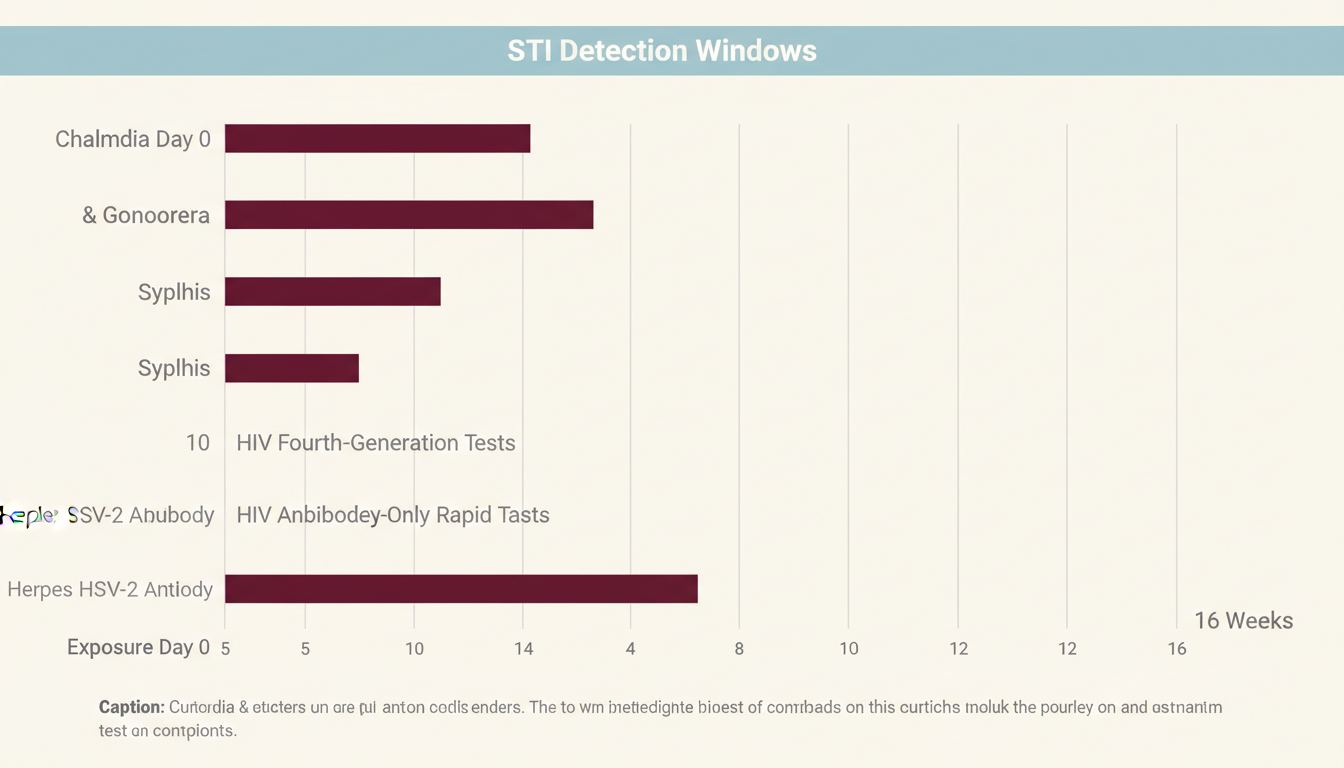
Working windows that align with current CDC and FDA-cleared assay guidance:
- Chlamydia and gonorrhea. Reliable from about 1 to 2 weeks after exposure for most assays. Pre-partner timing is comfortable.
- Syphilis. Antibody tests typically positive 3 to 6 weeks after exposure. If you have a known recent exposure, a follow-up test at 6 to 12 weeks may still be needed.
- HIV. Fourth-generation antigen-antibody tests detect most infections by 18 to 45 days. Rapid antibody-only tests typically need 23 to 90 days for reliable detection.
- Herpes (HSV-2). Antibody tests need about 12 to 16 weeks for reliable seroconversion after a new infection. A negative herpes antibody test taken too soon doesn't rule it out.
- HPV. No reliable antibody test for general use. Cervical screening (Pap and HPV co-testing) follows separate guidelines and is not a pre-encounter test.
For a one-time pre-partner check with no specific exposure history, a panel covering chlamydia, gonorrhea, syphilis, and HIV is the practical minimum. Add a herpes blood antibody test if either of you has never been screened. Add HPV cervical screening for women on the schedule recommended by their clinician (typically every 3 to 5 years between ages 21 and 65, depending on screening method).
Which test panel matches the situation
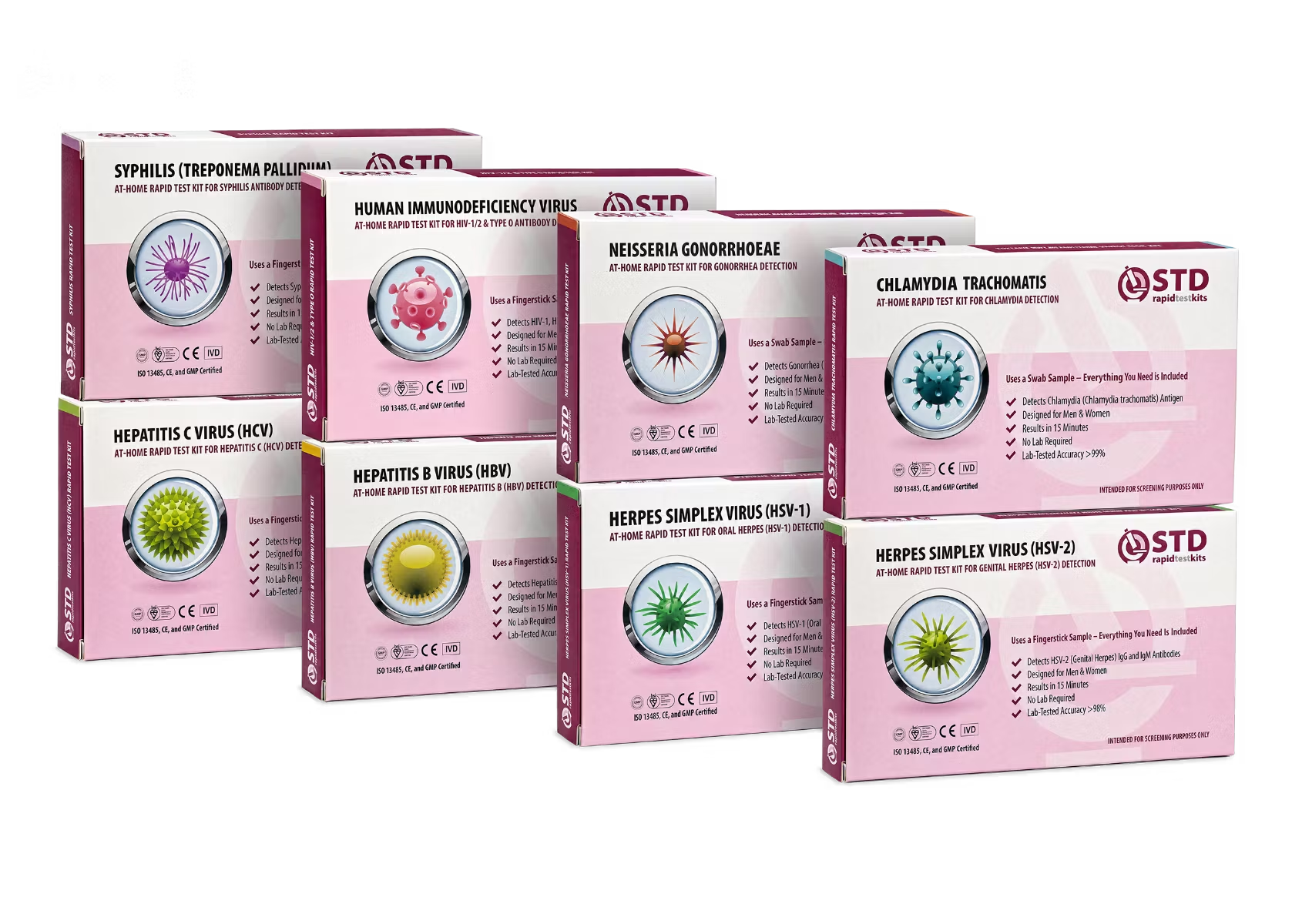
The right kit depends on what kind of partner change is on the table and what you've already screened for. For a new casual partner with no specific exposure concern, a combination kit covering chlamydia, gonorrhea, syphilis, and HIV is the calm baseline. If both partners are willing, do it together; if not, do yours and ask theirs.
When going barrier-free with a long-term partner, a more thorough panel makes sense, including herpes antibody testing if neither of you has been screened. The first time a couple drops condoms is a high-trust moment, and a clean joint baseline makes that decision more informed, not less.
A specific exposure concern (broken condom, partner disclosed an infection, you noticed a possible symptom) calls for testing now, then retesting at the right window for the specific infection. For HIV concern in particular, contact a clinician within 72 hours; post-exposure prophylaxis (PEP) is time-critical and not something at-home testing can substitute for.
The at-home rapid kits sold here are lateral-flow immunoassays. Labs use NAAT (nucleic acid amplification) for chlamydia and gonorrhea, which has higher analytical sensitivity, especially in asymptomatic infections. The two are complementary, not equivalent. A positive at-home result is worth confirming with a lab; a negative result paired with an active concern is worth retesting at the appropriate window.
How to bring it up without killing the mood
The reason most people don't ask isn't that they don't care about their health. It's that they're afraid of how the question will land. Saying "I want us to get tested" can feel like saying "I think you have something," which feels like an accusation, which feels like the end of the conversation.
Making the ask about both of you rather than about the other person strips out the accusation. "Before we go further, I'd feel better if we both tested. Most things don't show symptoms, and I want us to be clear with each other." That sentence has no accusation in it. It's a shared standard. A close cousin works just as well: "I test every few months as routine. What's your usual?" Naming your own habit first invites the other person to share theirs without putting them on the defensive.
The second approach is to match the tone of the relationship. If you're both on a dating app, a quick "I tested last month, just so you know, want me to send the results?" works. If it's a long-term partner you're going barrier-free with, the conversation can be longer, more vulnerable, and probably should be.
What partners hear when you ask is rarely "you're dirty." It's much more often "this person takes my health seriously enough to be uncomfortable for a minute." That registers as care, not suspicion.
1. "Before we sleep together, can we both test? It would let me actually relax."
2. "I test every few months. When was your last screen?"
3. "There's an at-home kit I want us to try together this week. Quick, private, results in about 15 minutes."
What if your partner refuses
Sometimes the answer is no. Sometimes it's "I was tested a while ago," or "I don't have anything," or "This feels weird." People resist for a mix of reasons: stigma, prior bad experiences with healthcare, anxiety about a positive result, or a genuine belief that recent monogamy guarantees safety.
None of those reasons obligate you to skip the test. Saying no to untested sex is not a relationship-ending move. It's a calm boundary, and it tends to land better when you've prepared a few low-pressure responses for the moments the conversation stalls. People who can't talk through a 15-minute test together will struggle with the harder conversations that come later.
1. "I'm not asking because I don't trust you. I'm asking because most STIs don't have symptoms, and neither of us would necessarily know."
2. "If a recent test exists, can you forward it? That works for me."
3. "If you're worried about doing it at a clinic, we can do an at-home kit together this weekend."
Monogamy isn't a substitute for a baseline test
The single most common reason couples skip pre-relationship testing is a version of "we're exclusive now, so we're fine." The math doesn't work that way. STIs don't track relationship status; they track biology. An infection one of you was carrying before the relationship started is still active, and still transmissible, regardless of how exclusive you've become since.
This matters most for chlamydia and HPV, both of which can persist quietly for months or years before causing any noticeable problem. An exclusive couple who never tests can transmit chlamydia back and forth indefinitely; an HPV infection that started before the relationship can progress to cervical disease that screening would have caught earlier.
The fix is one shared baseline test near the start of the relationship, especially if either of you wants to drop barrier methods. After that, regular cervical screening for women on the standard schedule, plus retesting if either of you has a known exposure or new symptom, is enough for most low-risk monogamous couples (CDC, STI screening recommendations).
If one partner has untreated chlamydia and the couple stops testing after going exclusive, the infection can pass back and forth between them indefinitely. Each round of treatment for one partner only works until the next exposure to the still-infected other partner. A single shared baseline test, with both partners treated at the same time when needed, breaks the loop.
At-home rapid kits versus the clinic
Both have a real role. Choosing well depends on the situation:
At-home rapid kits are best when:
- You want privacy. The package arrives discreetly; nobody on staff sees you.
- You want speed. Lateral-flow tests give a result in roughly 15 minutes from sample to read.
- You're doing routine pre-partner screening with no acute concern. The asymptomatic-screen use case is what these kits are designed for.
- You want to test together. Two kits, one kitchen table, fewer logistics than two clinic appointments.
A clinic is better when:
- You need NAAT confirmation of a positive at-home result for chlamydia or gonorrhea.
- You need throat or rectal swabbing. Our at-home kits cover genital and bloodwork; pharyngeal and rectal samples need clinic collection.
- You have a high-risk exposure within 72 hours and may need PEP for HIV.
- You want a urine NAAT for chlamydia and gonorrhea instead of a self-collected swab.
- You want a full clinical exam alongside testing.
The sensible pattern for most readers: routine pre-partner screening at home, with a clinic visit reserved for confirmation, complex exposure history, or anything that needs an exam.
Building a testing rhythm you'll actually keep
One pre-partner test is good. A rhythm is better. Most public-health bodies converge on a similar framework based on partner pattern and risk. The frequencies in the table below are a starting point; layer additional retests on top whenever there's a known exposure, a barrier failure, or a new symptom, regardless of where you are in the routine cycle.
Logistics that make the rhythm stick:
- Set a recurring calendar reminder. "STI screen" on the same day every quarter is the cheapest behavior change.
- Keep one combination kit at home. Future-you will thank present-you for not having to order one in a panic.
- Pair it with another routine you already keep, the way some people do dental cleanings every 6 months.
| Partner pattern | Recommended screening cadence | Add-ons |
|---|---|---|
| Multiple partners or non-monogamous | Every 3 to 6 months for chlamydia, gonorrhea, syphilis, HIV | One-time herpes antibody test if not previously screened |
| One regular partner with occasional outside encounters | Every 6 to 12 months for the same panel | Extra screen after each new outside encounter |
| Long-term monogamous, low risk | Annual screening of the same panel is enough for most readers | Cervical Pap or HPV co-testing for women on the standard schedule |
| Anyone, any setup | Retest after a known exposure, broken barrier, or new symptom | HIV testing within 72 hours of high-risk exposure for PEP eligibility |
What testing doesn't replace
Testing is one layer of sexual health, not the whole stack. Pair it with:
- Barrier methods. Condoms reduce transmission risk for chlamydia, gonorrhea, syphilis, and HIV substantially. They reduce, but do not eliminate, risk for skin-to-skin infections like HSV and HPV, which can transmit from areas a condom doesn't cover.
- HPV vaccination. The HPV vaccine is recommended routinely through age 26 and is available with shared clinical decision-making through age 45 in the United States.
- PrEP, where appropriate. For people at substantial risk of HIV exposure (for example, multiple partners, inconsistent condom use, or sex within a high-prevalence network), daily oral PrEP, or for some readers a long-acting injectable, cuts HIV acquisition risk by more than 90% when taken as prescribed.
- Honest conversation. A partner who has had an STI in the past isn't a partner to avoid. They're often a partner who has thought about this more carefully than someone who has never tested.
More than 1 million curable sexually transmitted infections are acquired every day worldwide, the majority of which are asymptomatic.
Who should be doing this (a wider list than people assume)
Pre-sex testing isn't a niche habit for high-risk groups. It's a default that benefits a wide range of readers:
- People starting a new dating phase after a divorce, a long single stretch, or the end of a long-term relationship.
- Couples deciding whether to drop barrier methods.
- Anyone in non-monogamous structures (open relationships, polyamory, occasional outside encounters by agreement).
- College-age and post-college readers exploring multiple partners, where infection prevalence is highest in surveillance data.
- Anyone who has had unprotected sex with a partner whose recent testing history they don't actually know.
Could you or your next partner be carrying something without knowing it? For almost any sexually active adult, the honest answer is yes, possibly. A short pre-partner screen converts that uncertainty into a known starting point for both of you.

Frequently asked questions
- Do I really need to test before every new partner?
- Practically, yes. Most chlamydia, gonorrhea, HPV, and early HIV infections are asymptomatic, so a new partner feeling fine doesn't mean they're uninfected. A short pre-partner screen, ideally done by both of you, removes the guesswork from a decision that affects both your bodies.
- How long after a possible exposure should I wait to test?
- For chlamydia and gonorrhea, the most common concern, two weeks is usually enough. HIV and syphilis take longer: four to six weeks minimum for most fourth-generation assays, and up to about three months for antibody-only rapid tests and for herpes HSV-2 antibody seroconversion. The full detection-window list is in the testing-timeline section above; pick the longest window that applies to your concern and retest then if your first result was negative.
- We've been monogamous for a year. Do we still need to test?
- Exclusivity doesn't reset infection history. If either of you was carrying chlamydia, HPV, or any other persistent infection before the relationship started, it's still there, because STIs track biology rather than relationship status. One shared baseline test is the move that converts an assumption into a fact, especially before going barrier-free.
- Can I skip testing if we always use condoms?
- Condoms substantially reduce transmission risk for chlamydia, gonorrhea, syphilis, and HIV but don't eliminate it, and they offer only partial protection against skin-to-skin infections like HSV and HPV that can transmit from areas a condom doesn't cover. Testing fills that gap.
- What if I test positive?
- Most STIs are either curable (chlamydia, gonorrhea, syphilis, trichomoniasis) or manageable with current treatment (HIV, HSV, HPV). A positive at-home result should be confirmed with a clinician, and most infections respond well when caught early. The harder problem is an infection you don't know about, not one you've identified.
- Are at-home rapid kits accurate enough for pre-partner screening?
- Lateral-flow rapid kits are generally in the mid-to-high 90% range for sensitivity and specificity for the infections they target, when used at the correct window period and with the right sample type. They're well-suited to the asymptomatic-screen use case. For confirmation of a positive result, or for high-suspicion cases with a recent exposure, a lab-based NAAT through a clinic adds analytical sensitivity.
- Does our at-home kit cover throat or rectal infections?
- No. Our at-home kits use self-collected genital swabs and fingerstick blood, which is the right sample type for genital and systemic infections. Pharyngeal (throat) and rectal gonorrhea or chlamydia testing requires clinic-collected swabs from those sites. If you've had unprotected oral or anal sex with a new partner, ask a clinic to add throat or rectal NAAT to the screen.
- How do I bring it up if my partner has never been asked before?
- Lead with your own habit, not their history. "I test every few months, want to do it together this week?" lands very differently from "have you been tested?" The first sentence offers a shared activity. The second sentence sounds like an interrogation. Most partners respond well to the first version.
- U.S. Centers for Disease Control and Prevention. STI prevalence, incidence, and cost estimates for the United States, including the 1-in-5 prevalence figure cited above.
- U.S. Centers for Disease Control and Prevention. STI screening recommendations by population and infection (last reviewed 2024), used to support the monogamy baseline-test recommendation.
- World Health Organization. Sexually transmitted infections fact sheet, including the global incidence figures and asymptomatic-share statement quoted in the pull quote above.
- HIV.gov. Symptoms of HIV, including the figure that about two-thirds of newly infected people experience flu-like symptoms within 2 to 4 weeks after exposure.
- U.S. Centers for Disease Control and Prevention. About chlamydia, used to support the asymptomatic-default statement and the link between untreated chlamydia and serious reproductive consequences.
- National Health Service (UK). Sexually transmitted infections overview and partner-testing guidance.
