
Published: October 2025 | Last updated: May 2026 | Editorial review and quality control: Martina N.
The morning after a one-night stand often starts the same way for everyone: a private browser tab, a hazy memory of the night, and a single question with no comfortable answer. When can a test actually tell you what's going on?
Maybe you're traveling. Maybe you're in a college dorm and the campus health center feels like the last place you want to walk into. Maybe you're lying in bed beside someone whose name slipped past you. The panic is the same, and so is the calendar that runs underneath it. Most rapid tests need at least 14 days to return a result you can trust, and the right window depends on which infection you are worried about. Testing on day three feels proactive. It also feels like relief when the result comes back negative, even though your body has not had time to produce what the test is looking for.
This guide walks through which STIs can be detected when, what the window period actually means, when symptoms override the calendar, and how to choose between an at-home rapid kit, a mail-in lab test, and a clinic visit.
Key Takeaways
- Bacterial STIs (chlamydia, gonorrhea, trichomoniasis) become reliably detectable around day 14 after exposure. HIV needs up to 45 days on a lab combo test and up to 90 days on a rapid fingerstick. Syphilis, hepatitis, and herpes IgG need 6 to 12 weeks.
- Symptoms override the calendar. Burning, sores, unusual discharge, pelvic pain, or a sore throat after oral sex mean test now and tell the clinician your timeline, regardless of how many days have passed.
What an STD test actually looks for
The phrase "STD test" gets used like it's one thing, though it almost never is. A test does not see infection itself. It sees one of three things: the genetic material of the pathogen, a protein on the pathogen's surface (an antigen), or your body's antibody response. Each signal appears at a different point after exposure, and a test taken before its target exists in detectable amounts will read negative even when the infection is real.
Nucleic acid amplification tests (NAATs), including PCR. These look for the DNA or RNA of the pathogen and are the laboratory gold standard for chlamydia and gonorrhea. Because NAATs amplify even tiny amounts of pathogen material, they detect infection earlier than antibody tests, often within 5 to 14 days. A specialized version (HIV NAT) can detect HIV from 10 to 33 days after exposure (CDC HIV testing), faster than antibody-based methods.
Antigen tests. These look for proteins on the surface of the pathogen. Fourth-generation HIV tests are antigen-antibody combo assays that detect the p24 antigen plus antibodies. The antigen component is what makes them faster than antibody-only HIV tests.
Antibody tests. These look for the immune response your body builds. Antibodies take days to weeks to appear in detectable amounts, which is why HSV-2 IgG, syphilis treponemal, and HIV antibody-only tests have the longest window periods on the menu.
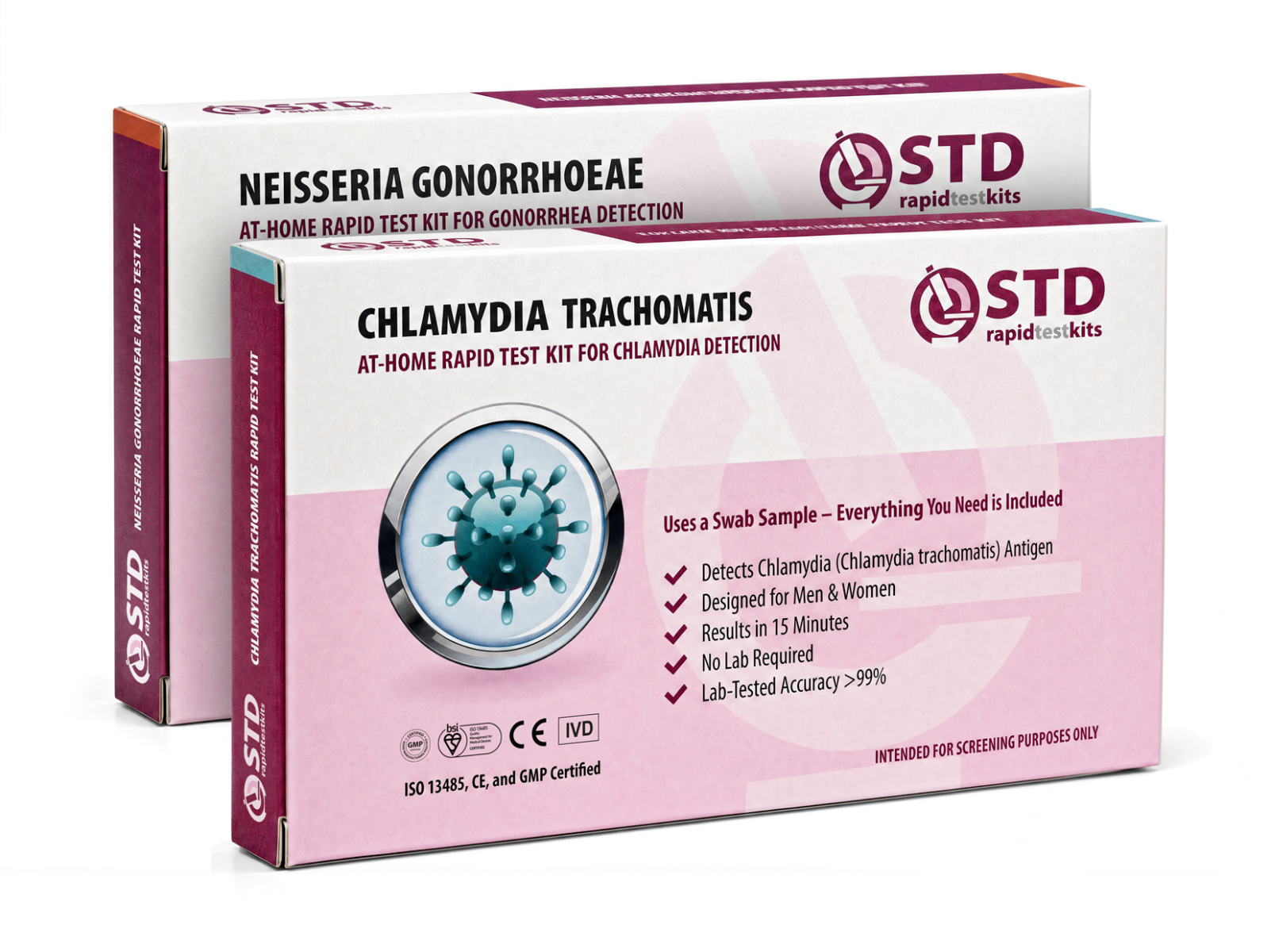
At-home rapid kits use lateral-flow chemistry, the same strip technology as a pregnancy test. They are less sensitive than lab NAAT or laboratory ELISA, especially in the early window, but for several common infections they work as a reliable screen in 15 minutes once the window has closed. Lab and rapid tools tend to be used together rather than as substitutes.
The window period describes when a test can detect the infection. The incubation period describes when symptoms appear. They are independent clocks. Symptoms can appear before the window closes, and the window can close long before any symptom appears. Plan testing by the window period for the infection you are worried about, and treat any symptom that appears as its own reason to test now.
How soon should I test after a one-night stand?
For chlamydia and gonorrhea, lateral-flow rapid tests are most reliable from about day 14 post-exposure; lab NAAT can detect them a few days earlier. For HIV, the CDC states that a fourth-generation lab antigen/antibody test detects most infections within 18 to 45 days after exposure, while a rapid antigen/antibody fingerstick can take 18 to 90 days (<a href="https://www.cdc.gov/hiv/testing/">CDC HIV testing</a>). Window periods for syphilis, hepatitis B, hepatitis C, and herpes IgG antibody tests are longer still. The pragmatic schedule used in sexual-health clinics is a two-week test for bacterial STIs followed by a comprehensive antibody-based panel at the 12-week mark.
Window periods by infection
The table below is the practical reference. "Earliest detection" is the floor; "best testing window" is the point at which a negative result is meaningful. For at-home rapid kits, treat the best-testing-window column as the day to actually run the test, not the earliest day the kit might catch something.
| STI | Sample / test type | Earliest detection | Best testing window |
|---|---|---|---|
| Chlamydia | Swab or urine (NAAT or lateral-flow) | 5–7 days | 14+ days |
| Gonorrhea | Swab or urine (NAAT or lateral-flow) | 5–7 days | 14+ days |
| Trichomoniasis | Vaginal swab or urine (women) | 7–10 days | 10–14+ days |
| HIV (NAT) | Blood (vein draw) | 10 days | 33 days |
| HIV (4th-gen Ag/Ab lab) | Blood (vein draw) | 18–45 days | 45 days |
| HIV (rapid Ag/Ab fingerstick) | Blood (fingerstick) or oral fluid | 18–90 days | 90 days |
| Syphilis | Blood (RPR + treponemal) | 3 weeks | 6–12 weeks |
| Hepatitis B | Blood (HBsAg) | 3–6 weeks | 6–9 weeks |
| Hepatitis C | Blood (antibody / RNA) | 2–6 weeks | 8–12 weeks |
| Herpes (HSV-1/HSV-2 IgG) | Blood antibody | 4–12 weeks | 12 weeks |
A practical day-by-day timeline after exposure
The number of days since the encounter is the most useful piece of information you have right now. Here is what each window means for what you can actually learn from a test.
Days 0 to 5: too early to test
Almost no test will detect anything yet. The exception is a clinical visit for severe symptoms or a post-assault protocol that includes presumptive treatment and HIV PEP, which is most effective when started within 72 hours. If you think you may qualify for PEP, contact a clinic or emergency department now, before reading the rest of this article.
Days 6 to 13: bacterial STIs may show, retest later
Lab NAAT testing for chlamydia and gonorrhea can begin to pick up infections in this window, especially if symptoms are present. Lateral-flow rapid kits are less sensitive at this stage. A negative result here means "so far so good, retest at day 14 to be confident."
Day 14 through week 4: the bacterial sweet spot
Chlamydia, gonorrhea, and trichomoniasis are now reliably detectable on both lab NAAT and well-timed rapid tests. HIV fourth-generation antigen/antibody combo tests at a clinic begin to catch most infections from around day 18 onward per CDC guidance. This is the right time for a focused two-week test if your main concern is bacterial.
Week 4 through 12: the full-panel window
By six weeks, the antibody response is typically strong enough that most syphilis, HIV, and hepatitis tests give a reliable result. By the 90-day mark, a rapid antigen/antibody HIV fingerstick has reached the outer end of the detection window the CDC states for that test type (CDC HIV testing). Herpes IgG antibody tests are generally considered reliably detectable by the 12-week mark, with some assays not seroconverting until week 16.

Symptoms override the calendar
If symptoms appear, the calendar stops mattering. Painful urination, unusual discharge, sores or ulcers near the genitals or mouth, pelvic cramping, rectal discomfort, a sore throat after oral sex, or a new rash all count. Test now and tell the clinician (or kit instructions) your exact exposure date. A clinician can swab an active sore directly, which is the fastest way to confirm herpes or chancre-stage syphilis. They can also start empirical treatment if the clinical picture supports it, even before the lab returns a result.
Subtle symptoms count too. A tingle that comes and goes, a small painless bump that you swear was not there yesterday, a faint discharge that you might dismiss as the body "settling." The instinct to wait it out is understandable. The downside of waiting is real: untreated chlamydia can ascend silently and cause pelvic inflammatory disease, while early syphilis is easiest to treat in the first six weeks.
HIV post-exposure prophylaxis (PEP) is most effective when started within 72 hours of a high-risk exposure such as a broken condom with a partner of unknown status, condomless anal sex, needle sharing, or sexual assault. PEP is a 28-day course of HIV medication that can prevent infection, and it requires a clinical visit, not an at-home kit. If you are reading this within three days of exposure, contact a sexual-health clinic, urgent care, or emergency department about PEP before doing anything else.
Exposure scenarios that still count
People sometimes hesitate to test because they are not sure their experience "counted." Biologically, an STI does not require penetrative sex, orgasm, condom failure, or memory. It requires enough contact (skin, fluid, or mucosa) to transfer the organism.
You do not remember the night. You do not need certainty about what happened to test on schedule. The act of testing on a calendar-driven plan does the work that memory cannot. If consent is part of the question, the U.S. National Sexual Assault Hotline (1-800-656-4673) connects to local services that include medical evaluation, evidence collection if relevant, and PEP discussions with a clinician.
You had oral sex without a barrier. Pharyngeal gonorrhea and chlamydia, HSV-1 and HSV-2, syphilis, and HPV can all transmit through oral-genital contact. Pharyngeal swabs are not part of our home-test catalog (that is a clinic service), though a genital screen plus a blood panel still catches most of the same risk window.
The condom broke or slipped. This counts as exposure even if you noticed within seconds. The 14-day rule applies to bacterial infections, the 4 to 12-week rule to early HIV and antibody-based detection.
You were on antibiotics for something unrelated. A course taken for a UTI, dental work, or sinus infection can suppress an unsuspected bacterial STI below the detection threshold without curing it. Mention the medication to your provider, and consider testing twice (once at the standard window, again two weeks later).
Four common scenarios that still need testing
- You do not remember what happened: testing runs on calendar dates, not memory. Day 14 for bacterial, week 12 for antibody-based.
- Oral sex without a barrier: pharyngeal gonorrhea, chlamydia, HSV, syphilis, and HPV all transmit this way. Genital plus blood panels catch the systemic risk; throat swabs are a clinic service.
- The condom broke or slipped: this is exposure even if noticed within seconds. Standard 14-day bacterial and 4 to 12-week antibody schedules apply.
- You were on antibiotics for something unrelated: a UTI, dental, or sinus course can mask a bacterial STI. Consider testing once at the standard window and again two weeks later.
At-home rapid kit, mail-in lab, or clinic? How to choose
Three modalities cover almost every situation. A rapid kit gives you a result in your own bathroom in 15 minutes, with no name on a label and nobody to talk to. The trade-off is that lateral-flow chemistry is less analytically sensitive than NAAT, so a positive result is worth confirming and a negative inside the window is worth repeating.
A mail-in lab kit sits in the middle: you collect at home, ship the sample to a certified lab, and get lab-grade results in 2 to 5 days. Privacy stays high and you do not interpret a strip yourself.
A clinic visit is the slowest in scheduling but the most comprehensive. Clinics offer the widest test menu, can collect samples for sites a home kit cannot reach (throat, rectum), and can prescribe treatment on the spot. It is the right call if you have symptoms (sores, persistent discharge, severe pelvic pain) or if you might benefit from PEP after a recent high-risk HIV exposure. The CDC and NHS still treat lab NAAT and PCR as the analytical gold standard, especially for asymptomatic infections (CDC, Getting Tested for STIs; NHS, Sexually transmitted infections).
For most people in the post-exposure window, a two-step plan covers the ground: a rapid home kit at the 14-day mark, then confirmatory mail-in or clinic testing if the rapid is positive or if symptoms emerge later. The kit linked below is sold by this site, and we earn revenue when readers buy through our links.
| Method | Privacy | Speed | Best for |
|---|---|---|---|
| At-home rapid kit (lateral-flow) | Very high: plain packaging, no name on a strip | 15 minutes | Quick at-home screen at day 14 (bacterial) or week 12 (full panel) |
| Mail-in lab kit (home collection) | High: lab-side name attaches, results via portal | 2 to 5 days post-mail | Lab-grade result without a clinic visit |
| Clinic NAAT or full panel | Moderate: may route through insurance | Same-day to 1 week | Symptoms, PEP eligibility, throat/rectal swabs, confirmatory test |
Why false negatives happen even with a good test
The most preventable pattern in sexual-health forums goes like this. Someone has a risky encounter on a Saturday, panics by Tuesday, orders a rapid test that arrives Wednesday, swabs themselves the same evening, and reads the negative line as proof that everything is fine. By the following weekend, mild symptoms start: a dull ache when urinating, swollen lymph nodes. They dismiss the symptoms because the test was negative. By the time a partner contacts them with a positive result, two weeks have passed.
The early test was not broken. It was honest about what it could see, which on day three was nothing. Chlamydia DNA needs roughly 5 to 14 days to reach detectable levels; gonorrhea is similar; the HIV antigen-antibody combo needs at minimum 18 days per current CDC guidance. The five rows below cover almost every false-negative cause we see in reader questions, with the corresponding next step.
| Cause | Why it happens | What to do |
|---|---|---|
| Tested inside the window period | The body has not yet produced enough antigen, antibody, or pathogen DNA to be detected | Retest at the recommended best-window day for that infection |
| Lateral-flow rapid kit used at low-signal stage | Rapid lateral-flow tests are less sensitive than lab NAAT, especially in the early window | Repeat with a clinic NAAT, or wait until 14+ days for a rapid retest |
| Sampling problem (swab too shallow, not enough sample) | The pathogen was present but not collected | Follow the kit instructions exactly, or use a clinic-collected sample |
| Recent antibiotics | A course taken for an unrelated infection can suppress chlamydia or gonorrhea below the detection threshold without curing it | Wait 2 to 3 weeks after finishing antibiotics, then retest |
| Expired or temperature-damaged kit | Reagents lose sensitivity once past expiry or after heat exposure | Use only in-date, properly stored kits and check the lot expiry on the foil pouch |
The day-three negative reads like reassurance. The body has not yet built enough pathogen DNA, antigen, or antibody for the strip to find. Symptoms that appear later get dismissed because the test already said no. By the time a partner notification arrives, a week or more of transmissible exposure has passed. Treat any test inside the window as a baseline, not a verdict, and put the confirmatory retest date on a calendar before you put the strip down.
The 12-week follow-up rule
You waited two weeks. You tested. The chlamydia and gonorrhea swabs came back negative. The relief is real, but the work is not done.
HIV, syphilis, hepatitis B, hepatitis C, and herpes IgG all need longer to become reliably detectable. These infections need more time before antibody levels rise high enough to register on any test, so a day-14 swab tells you about the bacterial picture only. The CDC's HIV testing page states that a rapid antigen/antibody fingerstick can take up to 90 days to detect HIV (CDC HIV testing). Antibody-based tests for syphilis, herpes, and hepatitis B and C similarly need weeks to months for reliable seroconversion; 12 weeks is the cadence widely used in sexual-health clinics for a comprehensive antibody-based follow-up panel. If your exposure involved a broken condom, a partner of unknown status, multiple partners that night, or anal sex, the 12-week panel is the recommended follow-up cadence.

When a partner tests positive and you tested negative
One of the most misread results in sexual health is a negative test taken right after a partner gets a positive one. Your body runs on its own timeline. They may have been exposed weeks before you, or they may have started showing detectable signal first. Your immune response or pathogen load might still be inside the window for the same infection.
The CDC's partner-services protocols treat a recently-exposed partner as presumptively infected for chlamydia and gonorrhea, often offering empirical treatment without waiting for a confirmatory test. For HIV, the recommendation is testing now plus follow-up at 45 and 90 days. For syphilis and HSV-2, follow-up at 6 and 12 weeks.
The right plan: test now to catch any infection already detectable in you, and put the infection-specific retest dates on your calendar. Talk to a clinician about post-exposure prophylaxis if the exposure was within the last 72 hours and HIV is on the table.
Chlamydia or gonorrhea: test now and ask about presumptive treatment; confirm again at day 14.
HIV: test now, follow up at 45 days on a lab combo test, and confirm at 90 days. Ask about PEP if the exposure was within the last 72 hours.
Syphilis: test now, retest at 6 weeks, final at 12 weeks.
HSV-2: test now, retest at 6 weeks, final at 12 weeks (some assays not until week 16).
What happens if a result comes back positive
Most STIs are treatable, and several are curable. Chlamydia and gonorrhea clear with a single course of antibiotics in most cases (current CDC recommendations are doxycycline for chlamydia and ceftriaxone for gonorrhea). Drug-resistant gonorrhea strains are a growing CDC concern; a clinic culture with sensitivity testing can confirm the right treatment if first-line therapy does not resolve symptoms. Syphilis is curable with penicillin at any stage, though the regimen depends on how long the infection has been present. Hepatitis B is most often a chronic infection managed with antivirals, while hepatitis C is now curable with 8 to 12 weeks of direct-acting antiviral therapy in most cases. HIV is a lifelong infection, but a person on suppressive antiretroviral therapy with an undetectable viral load does not transmit the virus to sexual partners (the U=U principle).
The first move after a positive at-home test is confirmation, especially for HIV, syphilis, and HSV where the diagnosis carries long-term care implications. A clinic or telehealth provider can run a confirmatory NAAT or treponemal-specific antibody test depending on the infection.
The hardest part of a positive result is rarely the medical care. It is the partner-notification conversation. Several health departments and clinics offer anonymous partner-notification services that contact a recent partner without sharing your name. A simple message such as "I recently tested positive for [infection] and you might want to test too" is enough; you do not owe anyone a full timeline.
More than 1 million curable sexually transmitted infections are acquired every day worldwide in people aged 15 to 49 years.
Privacy, shipping, and what discreet really looks like
The WHO also notes that the majority of those infections cause no symptoms, which is why calendar-driven testing matters even when nothing feels wrong. Privacy is often the deciding factor between someone getting tested and not. At-home rapid kits ship in plain unbranded packaging, with no logo, no labeling that hints at the contents, and no clue on the outside that the box has anything to do with sexual health. Inside: individually sealed components and printed instructions. The kit does not ask for your name to activate. It does not link to insurance. Results stay between you and the strip on your bathroom counter.
A few practical tactics that do not get mentioned enough: ship to a P.O. box, an Amazon Locker, or a trusted friend's address if you live with someone who opens packages. Time the order so the box arrives when you are home. For mail-in lab kits, look for prepaid return envelopes; they are the most discreet end-to-end option since you never have to label outgoing mail yourself.
Three tactics that keep the box quiet
- Ship to a P.O. box, Amazon Locker, or a trusted friend's address if you live with someone who opens packages.
- Time the order so the box arrives during a window when you are home to receive it.
- For mail-in kits, look for prepaid return envelopes. They are the most discreet end-to-end option since you never have to label outgoing mail yourself.
When worry outlasts a negative result
Anxiety after a negative test is common and does not mean you are being irrational. It often means the test was inside the window period, or that you are processing the original event.
If you tested early, schedule the appropriate retest at the window endpoint and treat that result as the dependable one. For HIV with a high-risk exposure, a 45-day combo result and a 90-day antibody confirmation together cover the dependable detection window for current testing technology. For HSV-2 antibodies, the 12-week mark is the standard, with some assays not seroconverting until week 16.
If a retest taken outside the window is also negative and the worry persists, the next step is a clinician or mental-health provider rather than another self-test. Health anxiety is its own treatable condition, and repeat self-testing every few weeks tends to feed the worry rather than resolve it.
HIV: a 45-day lab antigen/antibody combo negative plus a 90-day antibody confirmation is the dependable endpoint.
HSV-2 antibodies: 12 weeks is standard, with up to 16 weeks for slow seroconverters.
Chlamydia and gonorrhea: a day-14 NAAT or properly-timed rapid swab is the endpoint.
After these dates have come and gone with negative results, a clinician or mental-health provider is the right next step, not another kit.
How often to screen if you are sexually active
The CDC's screening recommendations apply regardless of any one specific hookup (CDC STI screening recommendations). The table below summarizes the floor cadence for the three most common situations.
| Population | Tests | Cadence |
|---|---|---|
| Sexually active with new or multiple partners | Chlamydia, gonorrhea | At least annually |
| Men who have sex with men | Chlamydia, gonorrhea, syphilis | Every 3 to 6 months depending on partner number and condom use |
| Anyone aged 13 to 64 | HIV | At least once; more frequently with higher-risk patterns |
| Recent exposure (broken condom, new partner of unknown status) | Full panel covering the relevant infections | At least once after the relevant window has closed |
FAQs
- I had unprotected sex three days ago, can I test now?
- You can, but the result will not be conclusive for any infection. Day-3 testing might catch a NAAT-detectable bacterial infection if you have strong symptoms, but lateral-flow rapid kits will almost certainly return a false negative this early. The most useful day-3 action is to call a clinic about HIV PEP if the exposure was high-risk, then plan a real test at day 14.
- I tested the day after a hookup. Was that pointless?
- Not pointless, just incomplete. An early test gives you a baseline and rules in an obviously preexisting infection if it is positive. The negative result, however, only tells you about that day. Treat the early test as step one and put the infection-appropriate retest date on your calendar. Step two is the test that gives you a dependable answer.
- I don't remember what happened. Should I still test?
- Yes. You do not need certainty about events to test for their possible biological consequences. If you have any concern that contact occurred, the testing schedule is the same as any other exposure: bacterial swabs at day 14, antibody-based panel at 12 weeks. If consent is part of the question, the U.S. National Sexual Assault Hotline (1-800-656-4673) connects to local services that include medical evaluation, evidence collection when relevant, and PEP discussion with a clinician.
- If I used a condom, do I still need to test?
- Condoms reduce risk significantly but do not eliminate it. Skin-to-skin transmitted infections like herpes and HPV can be passed from areas a condom does not cover. Condoms can also break or slip. If anything about the encounter felt off (visible breakage, slipping, partial use), test at the appropriate windows.
- Can oral sex transmit STIs?
- Yes, and most pharyngeal infections have no symptoms, so a clinic throat swab is the only way to confirm or rule out a throat-site infection. Our home kits use genital swabs or fingerstick blood; we do not sell a pharyngeal swab. If your concern is throat-site gonorrhea or chlamydia specifically, that is a clinic visit. A blood panel still detects oral-route transmission of HIV, syphilis, hepatitis B, and HSV.
- I'm on my period. Can I still use a home test?
- Blood-based fingerstick tests (HIV, syphilis, hepatitis B and C, HSV-2) work normally during menstruation. Vaginal swab tests (chlamydia, gonorrhea, trichomoniasis, HPV) are best collected after bleeding has stopped so the sample is not diluted by menstrual blood. Follow your kit's specific instructions; some assays remain valid mid-cycle.
- My partner tested negative, am I in the clear?
- Not necessarily. They may have tested inside the window period, had different exposures, or have an infection their panel did not cover. Their result is about them. Your test is about you, your timeline, and your specific exposure.
- Do I need to retest after treatment?
- Yes, but wait. The CDC recommends a 3-month retest after treatment for chlamydia or gonorrhea. Testing sooner risks a misleading positive: residual bacterial DNA can stay detectable on a NAAT longer than the active infection lasts. The point of the 3-month retest is mostly to catch reinfection from an untreated partner, not to confirm the antibiotic worked.
- U.S. Centers for Disease Control and Prevention. STI screening recommendations and clinical guidance for asymptomatic and symptomatic exposures, including 3-month retest cadence after chlamydia and gonorrhea treatment.
- U.S. Centers for Disease Control and Prevention. Getting tested for sexually transmitted infections, including who should test, why testing matters, and how to access testing services.
- U.S. Centers for Disease Control and Prevention. HIV testing technology and recommended testing intervals after exposure, with stated window periods of 10 to 33 days for NAT, 18 to 45 days for the 4th-gen Ag/Ab lab test, and 18 to 90 days for the rapid Ag/Ab fingerstick.
- U.S. Centers for Disease Control and Prevention. Viral hepatitis information hub covering hepatitis A through E, with links to condition-specific testing and treatment resources.
- World Health Organization. Sexually transmitted infections fact sheet, including global daily incidence (>1 million curable STIs/day), asymptomatic prevalence, and testing and treatment guidance.
- U.K. National Health Service. Sexually transmitted infections overview, including symptom timing, testing access, and patient-facing window-period guidance.
