
Published: September 2025 | Last updated: May 2026 | Editorial review and quality control: Martina N.
You don't have to cheat to test positive for a sexually transmitted infection. That sentence catches a lot of readers off guard. It's also the single most useful idea to sit with if you're worried about what a test might reveal in your relationship. Monogamy keeps new exposures from coming through the door. It doesn't sweep clean what walked in before either of you closed it.
Many sexually transmitted infections behave in ways that don't fit the cheating narrative. They sit silent for months or years. They aren't included in routine physicals unless someone specifically asks. They can pass during periods when nobody had visible symptoms. None of that is moral failure. It's biology, plus a screening routine that hasn't caught up with it yet.
Key Takeaways
- A positive STI test in a long-term, exclusive relationship is not, by itself, evidence that someone cheated. Many STIs sit dormant or asymptomatic for months or years.
- Standard physicals don't screen for everything. Herpes in particular is rarely included in routine panels, so most people who carry it have never been told.
Monogamy is a behavior, not a medical shield
The most common assumption about long-term relationships is that fidelity equals safety. Once you both agree to be exclusive, the thinking goes, the testing question is closed. That logic only holds if both of you started the relationship with a complete, current STI workup, then didn't have sex with anyone else in the gap between getting tested and getting your results back. Almost no one does this. So almost every monogamous couple started together with one or both partners' STI status genuinely unknown.
Most STIs are spread by people who don't know they're carrying them. The U.S. Centers for Disease Control and Prevention notes that millions of new STI infections occur in the United States each year, and the World Health Organization estimates more than one million new infections every day worldwide, the majority of which are asymptomatic. Chlamydia, gonorrhea, trichomoniasis, herpes, HPV, and the early stages of HIV and syphilis can all be silent for stretches of time that comfortably outlast the start of a new relationship.
Two things follow. First, the test you didn't take before this relationship started can still surprise you years in. Second, the test your partner didn't take before this relationship started can still surprise you years in. Neither of those scenarios involves cheating. They involve a screening gap that nobody filled.
The other piece often missed: a "clean bill of health" from a routine physical isn't an STI workup. Most general checkups don't include STI testing unless you ask, and the testing offered usually skips herpes. The CDC notes that most people with genital herpes have no symptoms or very mild symptoms, and most do not know they are infected. Many find out only when a partner has a clear outbreak or asks for the blood test directly.
Both the CDC and WHO have published that the majority of new STI infections occur in people who don't know they're carrying them. A general physical does not, by default, screen for chlamydia, gonorrhea, syphilis, HIV, hepatitis B, hepatitis C, herpes, HPV, or trichomoniasis. Most patients never specifically ask for those tests, and most clinicians won't add them without a reason in the chart.
How long can an STI stay hidden? A timeline
One of the most disorienting things about a surprise positive test in a long relationship is the math. If we've been together five years and exclusive the whole time, how can this be new? The answer is that "new on the test" is not the same as "newly acquired." Two distinct windows are at play. The incubation window is roughly how long it takes after exposure for symptoms (if any) to appear. The detection window is how long after exposure a test can reliably pick up the infection. Both can stretch into months. For some infections, the gap between exposure and a clear positive result on the right test can be measured in years.
The figures below come from CDC and NHS guidance and are useful as orientation, not as personal medical advice. Detection windows in particular vary by test type, the assay's chemistry, and individual immune response.
| Infection | Typical incubation | Can stay asymptomatic? | Detection window (test type) |
|---|---|---|---|
| Chlamydia | 1 to 3 weeks | Yes, very common, especially in women | About 1 to 2 weeks (NAAT) |
| Gonorrhea | 2 to 14 days | Yes, often | About 1 to 2 weeks (NAAT) |
| Trichomoniasis | 5 to 28 days | Yes, especially in men | About 1 to 4 weeks |
| Syphilis (primary) | 10 to 90 days | Yes, especially in early stages | 3 to 6 weeks (antibody tests) |
| HSV-1 / HSV-2 | 2 to 12 days for first outbreak (if any) | Yes, lifelong viral carriage common without outbreaks | Antibodies usually detectable 12 to 16 weeks after exposure (varies by assay; some IgG tests reliable from 6 weeks) |
| HIV | 2 to 4 weeks for acute symptoms (if any) | Yes, early infection often silent | 10 to 33 days (NAT); 23 to 90 days (antibody tests) |
| HPV | Weeks to years for warts; often none | Yes, the majority clear without symptoms | Cervical screening detects high-risk types in those eligible |
Persistent high-risk HPV strains, especially types 16 and 18, cause the majority of cervical cancers and a growing share of oropharyngeal cancers in both men and women. Cervical screening (Pap test or HPV co-test) catches HPV-related cell changes before cancer develops, and the HPV vaccine prevents most of these high-risk infections. Anyone overdue for cervical screening should follow up with their provider separately from at-home STI testing.
Why standard testing doesn't catch everything
If you've never been told you have an STI, that's worth taking seriously, but it isn't the same as confirmation. Several structural gaps explain how silent infections slip past routine medical care.
Most checkups don't include STI testing unless you ask. A general physical typically covers blood pressure, cholesterol, blood glucose, and a handful of organ-system questions. STI screening sits in a separate workflow, usually triggered by a specific request, a sexual-health-focused visit, or a clinical concern. "Everything came back fine" almost always means "everything they tested for came back fine."
Herpes is rarely tested without symptoms or a request. Most major guidelines do not recommend universal HSV blood testing for asymptomatic adults, partly because the most accurate confirmation comes from swabbing an actual lesion, and partly because antibody tests can produce false positives. The practical effect is that most people who carry HSV-2 antibodies have never been told. The infection then becomes visible only when a partner has an outbreak, asks for the blood test directly, or both.
Window periods can outlast a clinic visit. The NHS, for example, advises waiting up to seven weeks after unprotected sex before some STIs can be reliably detected. The CDC notes the HIV NAT window can run from 10 to 33 days, while antibody tests can take 23 to 90 days. A test taken too early in that window can come back negative on a real infection. People then start a new relationship believing they're cleared.
The combined effect: a person can have done everything they thought they were supposed to do (testing at the doctor, asking for results, being honest with partners) and still walk into a long-term relationship carrying an infection nobody, including their previous clinician, ever flagged.

Most people with genital herpes have no symptoms or have very mild symptoms. Because of this, most people do not know they have a herpes infection.
When a test comes back positive: what it actually means
If you or your partner gets a surprise positive in a long, exclusive relationship, the temptation is to read it as forensic evidence. It isn't. Most STI tests can't tell you when the infection was acquired, only that the body is carrying it now. For some infections, that signal can lag the actual exposure by months or years.
A more accurate read of a surprise positive: somebody in this relationship was exposed at some point, possibly long before this relationship started, possibly long before they were testing carefully, and the infection was either never previously screened for or was missed by an earlier test. That's a very different story from infidelity, and it's the more statistically likely one for the infections that quietly carry forward, especially HSV, HPV, and untreated chlamydia.
What a positive does mean: a treatment plan, a follow-up confirmation when relevant, a partner conversation, and a test for the other partner. Skipping straight to a verdict of betrayal has tanked otherwise healthy relationships and pushed people away from treatment they needed.
Can you test positive for an STI without anyone cheating?
Yes. Many STIs (herpes, HPV, untreated chlamydia, even early HIV) can stay dormant or asymptomatic for months or years and predate the current relationship. A positive test is not, on its own, a timestamp of when the infection was acquired. Confirmatory testing and a calm partner conversation are the right next steps before drawing conclusions about who did what.
How to bring testing up without it sounding like an accusation
The hardest part of testing in a committed relationship usually isn't the test. It's the conversation. Asking can feel like accusing, even when both people would actually be relieved to do it. The framing matters.
What works: position testing as something the two of you do together, not as something you're asking your partner to prove. Lead with your own gap, not theirs. "I realized I've never actually had a full STI workup. I'd feel better doing one. Want to do it together?" lands very differently than "I think we should both get tested," which lands very differently again from "I think you should get tested."
What also works: tying testing to a real change in the relationship rather than to a vague worry. Stopping condoms, coming off PrEP, trying for a pregnancy, or settling into long-term exclusivity are all natural moments to do a clean baseline together. Treating those transitions as reasons to test, rather than as reasons to assume you don't need to, is the honest version of what "safe" means.
If a partner refuses testing entirely, that's information. Reasons range from genuine fear of the result to discomfort with the medical setting to deeper relationship issues, and they deserve a real conversation rather than a one-line dismissal.

How often to test when you're committed and exclusive
Even in a closed, monogamous relationship, the case for routine testing isn't zero. It just looks different from the high-frequency screening recommended for people with multiple new partners. The goal in a long-term relationship is to clear the carry-forward question once, and then to test on the kind of life-event cadence that catches the infections most likely to slip through.
A reasonable baseline pattern for a committed couple:
- One thorough joint baseline early in the relationship covering chlamydia, gonorrhea, syphilis, HIV, hepatitis B and C, and (if either partner specifically wants the answer) herpes antibody testing. This is the screening most people skipped before getting together.
- A repeat workup at meaningful transitions: stopping condoms, coming off PrEP, planning a pregnancy, or after any break in the relationship.
- Annual chlamydia and gonorrhea screening for women under 25 and others at higher risk, per the CDC's standing recommendation for those groups, regardless of relationship status.
- Symptom-driven testing any time something physically changes: unusual discharge, a sore that doesn't fit a usual pattern, persistent pelvic or testicular pain, painful urination, or a new rash.
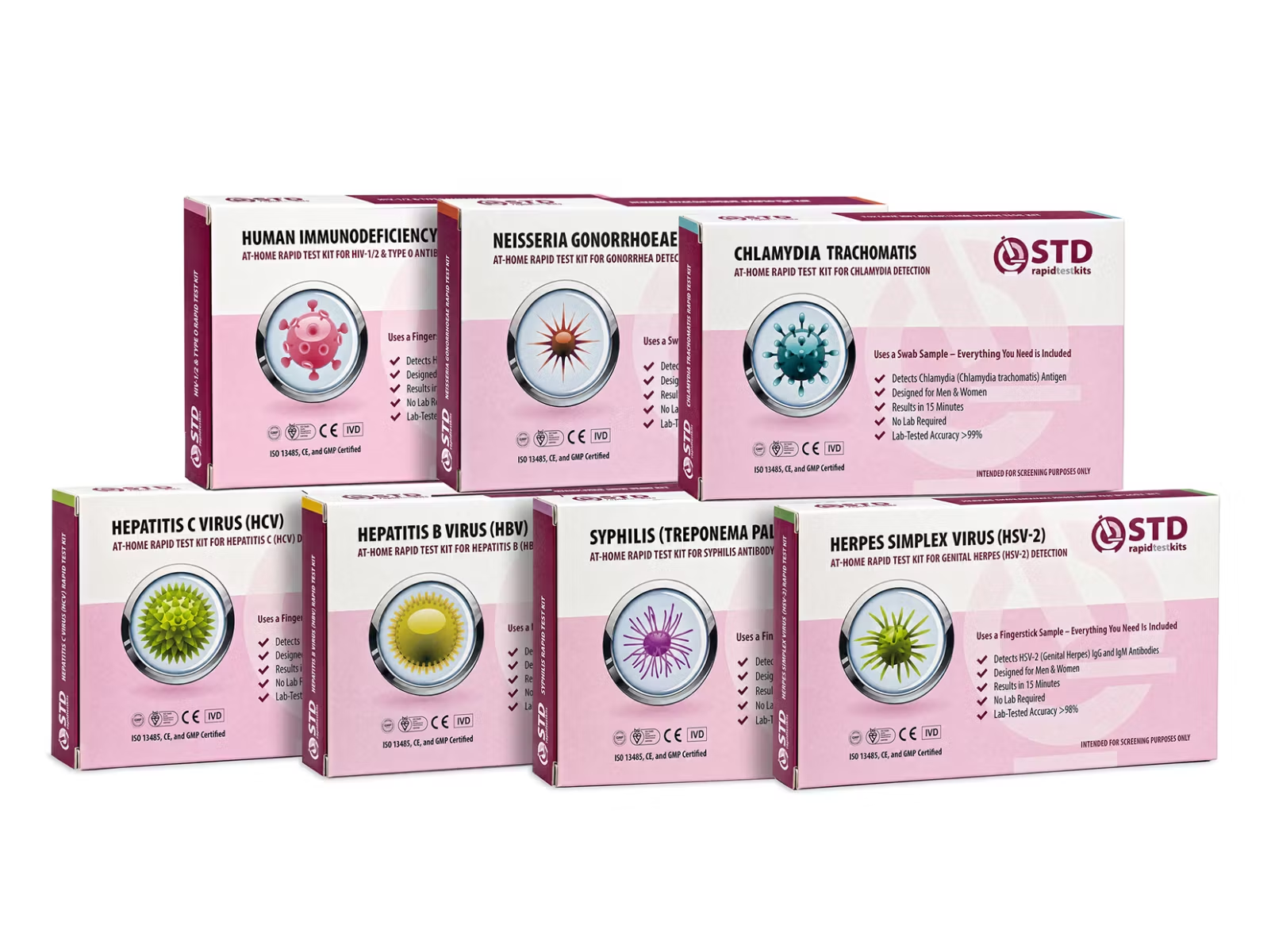
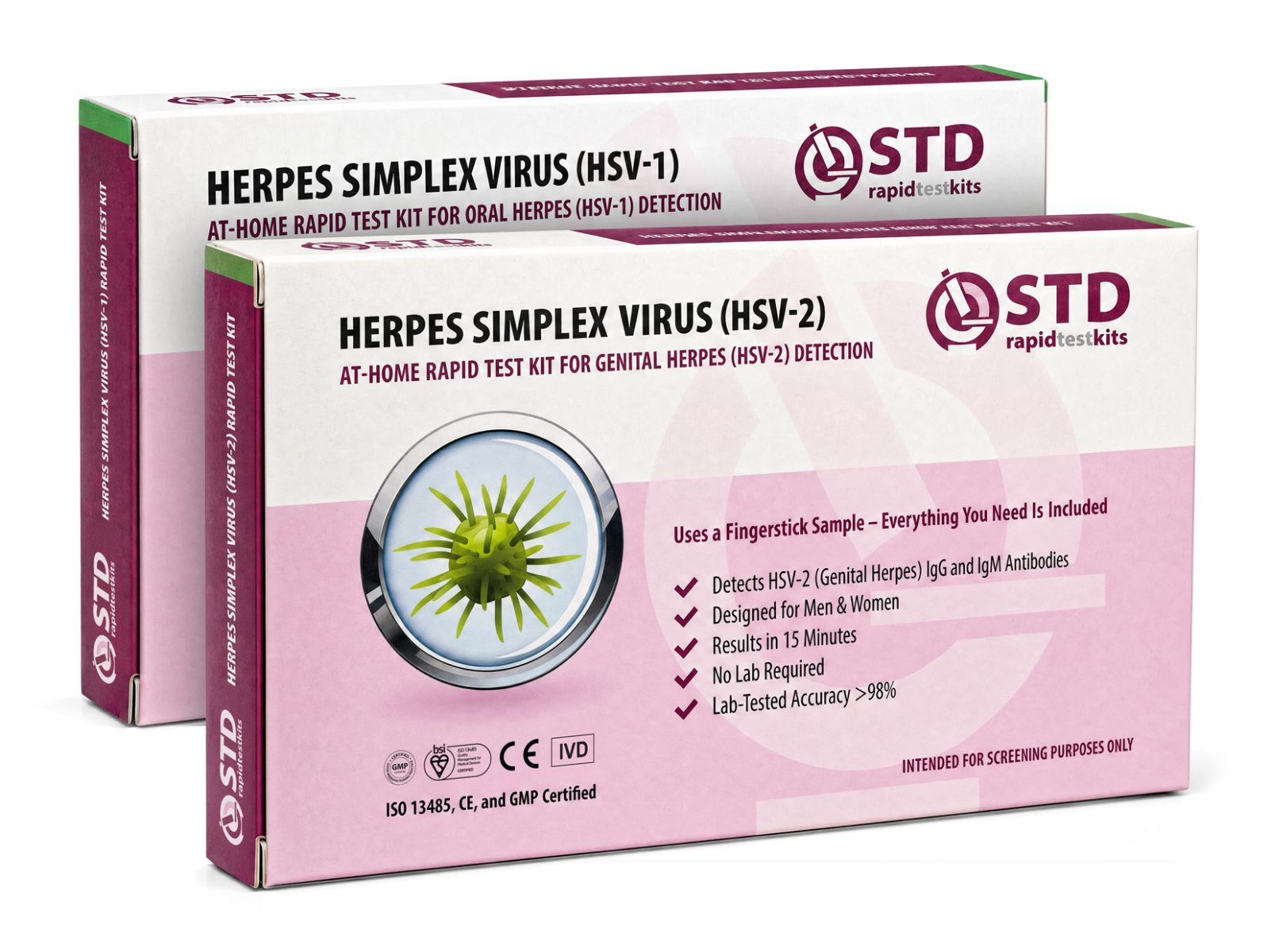
Home rapid testing fits the first two of those well. It's a private, low-friction way to do a comprehensive baseline together without scheduling a clinic visit or asking your GP for a workup that they may not order without a specific reason. (Disclosure: this article is published by stdrapidtestkits.com, which sells the at-home rapid test kits referenced below; we recommend products based on fit for the reader's concern, not commercial benefit.)
Common emotional reactions to a surprise positive
How people react in the first hour after a surprise STI result is rarely how they feel a week later. The initial response often runs straight at the worst-case interpretation: betrayal, shame, fear of what this means for the relationship. Naming the reaction and what it usually maps to underneath can keep the next 24 hours from doing damage that the underlying medical issue does not, on its own, warrant.
| First reaction | What it usually maps to | What helps in the next 24 hours |
|---|---|---|
| "I feel dirty." | Internalized stigma. STIs carry social weight that doesn't match their medical reality. | Read the actual condition's CDC fact sheet. Most STIs are common, treatable or manageable, and tell you nothing about your character. |
| "My partner cheated." | Pattern-matching from culture, rather than from the test result. Many STIs predate the current relationship. | Ask open questions before drawing a conclusion. Both partners getting tested often clarifies the story. |
| "Why didn't I know sooner?" | Frustration with a screening system that doesn't catch everything by default. | Use the moment as a reset. Schedule a real baseline rather than treating this as a personal failure. |
| "I'm scared to tell them." | Anticipated rejection, rather than actual rejection. | Plan the conversation. Lead with facts and a treatment plan, not with apology. |
Bottom line
Monogamy is a real form of risk reduction, but it does not work like a lab result. The two are sometimes mistaken for the same thing, and that mistake is what leaves long-term, faithful couples surprised by a positive test years into the relationship. What looks like proof of cheating is more often proof of an unfilled screening gap.
The healthier framing for a committed relationship is to treat testing as maintenance rather than as crisis response. People do not wait for chest pain before checking their blood pressure or for a bleeding gum before booking a dentist visit, and the same logic applies here: a symptom should not be the trigger for clarifying something between two people who already trust each other.
If you've never had a thorough STI workup as a couple, that's the place to start. If you have, decide together what kind of cadence makes sense for the life events still ahead of you. And if a positive does come back, treat it as the start of a treatment plan and a calm conversation about what the result actually means.
FAQs
- Can you really get an STI even if neither partner has cheated?
- Yes. Many STIs can sit silent for months or years and predate the current relationship. Herpes, HPV, and untreated chlamydia in particular can carry forward from a past exposure that was never diagnosed because routine screening missed it or never tested for it in the first place.
- Do STIs always cause symptoms?
- No. Public-health agencies including the CDC and WHO consistently note that the majority of STI cases are asymptomatic. Chlamydia, gonorrhea, trichomoniasis, herpes, HPV, and early HIV can all be carried with no symptoms at all, which is why screening matters more than waiting for something to feel wrong.
- Why test if I trust my partner?
- Trust and biology are separate things. Two people can be fully honest with each other and still both be carrying a piece of medical history they were never told about, especially when past partners or past clinicians never raised the question. Testing closes that gap without putting trust on trial.
- What if I test positive but I haven't been with anyone besides my partner?
- It is genuinely possible the infection predates the relationship and was never caught earlier. This is most common with herpes, HPV, and HIV in its early phase. A confirmatory test, a clinical visit, and a calm conversation with your partner are the right next steps before drawing conclusions about who did what.
- How long can an STI stay in your body without symptoms?
- It varies by infection. Herpes and HPV can carry for years without symptoms. Chlamydia and trichomoniasis can stay silent for months and quietly damage reproductive tissue over time. Even HIV can move through a long clinically silent stage. Time without symptoms is not the same as time without infection.
- If we're exclusive, do we still need condoms?
- Many couples stop using condoms once they're exclusive. The honest version of that decision is to do a thorough STI baseline together first. Condoms reduce, but don't eliminate, transmission risk for skin-to-skin infections like herpes and HPV. A clean baseline plus exclusivity gives a much more accurate picture than dropping condoms on assumption alone.
- How accurate are at-home rapid STI tests?
- Modern at-home rapid lateral-flow tests perform well as screening tools when used after the correct window period and according to the kit's instructions. They are not, however, lab NAAT tests. A positive home result is worth confirming with a clinical lab test, and a negative result very early in the window period should be repeated.
- How do I bring up testing with my partner?
- Lead with your own gap rather than theirs, and tie it to a real moment in the relationship: stopping condoms, planning a pregnancy, settling into long-term exclusivity, or just realizing it's been a long time since either of you had a thorough workup. Framing it as a shared baseline rather than a demand on your partner usually defuses the tension.
This article is built from current public-health guidance from the U.S. Centers for Disease Control and Prevention, the World Health Organization, and the UK National Health Service, plus widely accepted clinical references for incubation and detection windows. Anecdotal reactions described in the text reflect commonly reported patterns rather than identified individual cases. We do not provide clinical diagnosis. For symptoms or concerns, see a licensed provider.
- U.S. Centers for Disease Control and Prevention. About Sexually Transmitted Infections. Overview of STI prevalence, asymptomatic carriage, and the case for screening.
- U.S. Centers for Disease Control and Prevention. About Genital Herpes. Asymptomatic shedding, low rates of diagnosis among carriers, and transmission without visible sores.
- U.S. Centers for Disease Control and Prevention. HIV Testing. Window-period ranges for NAT, antigen/antibody, and rapid antibody tests; antibody tests typically detect HIV 23 to 90 days after exposure.
- World Health Organization. Sexually Transmitted Infections fact sheet. Global incidence figures and the proportion of new infections that are asymptomatic.
- UK National Health Service. Sexually Transmitted Infections (STIs). Window periods, asymptomatic carriage, and when to seek testing.
