
Published: August 2025 | Last updated: May 2026 | Editorial review and quality control: Martina N.
The assumption that polyamory automatically raises your STI risk is one of the most common misreadings in sexual health discussions. The data tells a more nuanced story. What matters most is the testing cadence, barrier use, and communication habits inside a sexual network, far more than the number of partners on paper. A monogamous couple who never test and a polyamorous network that tests quarterly with documented agreements can have very different real-world risk profiles. This guide walks through what the research says, how to set up a testing schedule that actually gets followed, how to talk about results without the conversation becoming a confrontation, and what to do if a test comes back positive.
Key Takeaways
- Risk in any relationship structure tracks behavior, not labels. Testing frequency, consistent barrier use, and honest disclosure are the variables that move the needle.
- A practical polyamorous testing cadence is every three months (quarterly) for the standard panel (chlamydia, gonorrhea, syphilis, HIV), plus an additional test before any new sexual partner.
Does Polyamory Itself Raise Your STI Risk?
What actually drives STI risk is behavior, not relationship label. Researchers who compare ethical non-monogamous people to monogamous people who report any extra-relational sex find that the non-monogamous group often tests more frequently, discloses test results more openly, and uses barriers more consistently with non-primary partners. Those three behaviors lower transmission probability across the whole network.
Surveillance data from the U.S. CDC's STI Statistics hub shows that the populations with the highest STI burden are defined by demographic and behavioral factors rather than by relationship style. CDC surveillance data consistently show that adolescents and young adults aged 15 to 24 account for a disproportionate share of new STI diagnoses each year. Inconsistent condom use and infrequent screening are the strongest predictors at the individual level. Relationship label is not on that list.
The intuition that more partners always means more risk is true only if you hold every other variable constant. In real-world polyamorous networks, partner count is rarely the only thing that differs from the monogamous comparison group. People who choose ethical non-monogamy tend to have been thinking about disclosure, consent, and testing as part of how they enter relationships in the first place, which shifts the math.
The risk variables that matter most are testing cadence, consistent barrier use, and honest disclosure. Those three factors drive outcomes in any sexual network, monogamous or not.
The Risk Factors That Actually Matter
Three behaviors do most of the work in determining transmission risk within any sexual network:
- Testing cadence. The gap between exposure and the next test is the window during which an asymptomatic infection can quietly transmit. Quarterly testing closes that gap. Once-a-year testing leaves it wide open.
- Barrier consistency. Condoms used correctly every time substantially lower per-act transmission risk for most STIs. Condoms used "most of the time" are closer to the no-condom baseline than people expect, because the highest-shedding moments are unpredictable.
- Honest disclosure. A network that does not talk about a positive result can keep transmitting the same infection for months. A network with agreed-upon disclosure rules cuts that window down to days.
Two additional factors compound the above: which infections are circulating in the local sexual community (epidemiology varies by city and demographic), and asymptomatic carriage. According to the CDC's chlamydia page, chlamydia often has no symptoms even though it can still cause serious health problems, which is why routine screening is the only reliable way to catch it. The same is true for many gonorrhea infections, especially extragenital (throat and rectal) ones.

Building a Testing Cadence That Sticks
For most polyamorous networks, the workable cadence is every three months for the standard panel, with an additional test before any new sexual partner. The standard panel varies by clinic but typically includes:
- Chlamydia and gonorrhea screening (the CDC's preferred laboratory method is nucleic acid amplification, also called NAAT, on a swab or urine sample)
- Syphilis blood test (a treponemal antibody screen)
- HIV blood test (a fourth-generation antigen and antibody combination assay, which can detect infection roughly 18 to 45 days after exposure per CDC HIV testing guidance)
- Hepatitis B and Hepatitis C blood tests, especially if anyone in the network is vaccine-incomplete or shares injection equipment
- HSV-2 blood antibody test on request (default panels often skip this; ask for it if you want it)
If your network includes oral or anal sex with multiple partners, the CDC also recommends pharyngeal (throat) and rectal swab testing for chlamydia and gonorrhea, because genital-only screening misses extragenital infections. Those swabs are clinic-administered. We do not sell at-home pharyngeal or rectal swab kits, so a clinic visit is the right path when those routes are in play.
Quarterly works because the math lines up: most bacterial STI detection windows close in under two weeks, and HIV's fourth-generation window tops out at 45 days, so a three-month cadence catches anything that seroconverted since the last test before it has long to circulate.
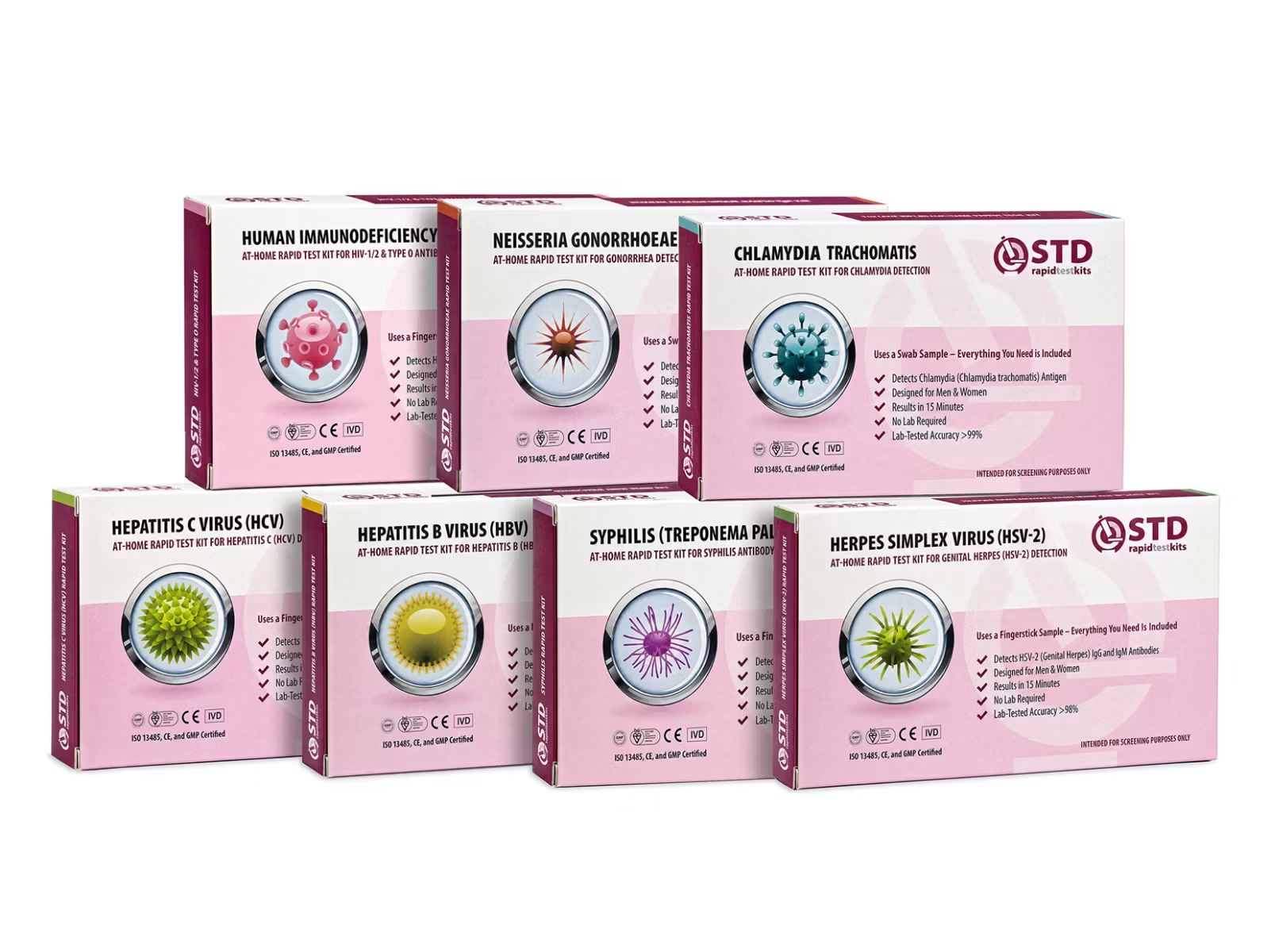
We sell at-home rapid test kits that cover much of this panel for in-network screening, which can lower the friction of testing on schedule.
Talking to Partners About Testing Without Making It Weird
The conversation gets easier when it is normalized as ordinary maintenance, not a crisis or an accusation. A few practical patterns work well across most networks:
Start with your own status. Saying "I tested last month and everything was negative. When did you last test?" frames the question in a context of shared maintenance rather than interrogation. It models the behavior you are asking for.
Set the cadence as a network norm. "Everyone in our network tests quarterly and shares results in our shared chat" reads as a household rule. A request aimed at one person can read as suspicion. A network norm reads as how we live.
Talk about new partners before they happen. The conversation "I'd like to start seeing someone new, here's what our testing process looks like" is easier than "I started seeing someone new and now we need to talk about testing." Pre-agreement removes the surprise element that makes these conversations tense.
Treat refusal as data. A partner who will not test, will not share results, or will not use barriers within an agreed structure is telling you something about how they handle joint risk. The answer, and what it reveals about how that person handles shared risk, is worth having regardless of what you decide next.

Writing a Sexual Health Agreement
A written agreement (a shared note, a doc, even a pinned message in a group chat) reduces the cognitive load of remembering what everyone agreed to. The agreements that hold up over time tend to cover the same core questions:
- Testing cadence: how often, which panel, who pays
- Barrier defaults: what is expected with primary partners, with secondary or newer partners, with one-time partners
- Disclosure rules: when do you tell other partners about a new partner, a slip in barrier use, or a positive result
- New-partner process: is there an introduction step, a waiting period, a confirmatory test before barrier-free sex
- Positive-result protocol: who you call first, how the network learns, what happens to the network's barrier defaults during the contact-tracing window
These agreements are not contracts in a legal sense. They are shared mental models. The goal is to remove ambiguity in the moments when ambiguity gets people hurt: late at night, after drinks, with a new partner who seems trustworthy. A written agreement gives you a default position to fall back on when judgment is impaired.
The agreement also evolves. Many networks revisit it annually, or whenever the network composition changes (a new partner joining, someone leaving, a relationship structure shifting from primary-with-secondaries to a flatter shape).
A three-line agreement that everyone actually follows beats a fifteen-clause agreement that gets ignored. Start with testing cadence, barrier defaults, and a positive-result protocol. Add more only when the network finds a gap that hurts.
Barriers, Vaccines, and Pre-Exposure Prophylaxis
The prevention toolkit beyond testing has three legs: barriers, vaccines, and (for HIV) PrEP.
Barriers. External and internal condoms remain the workhorse for penis-in-vagina and penis-in-anus sex. Dental dams cover oral-vaginal and oral-anal contact, though they are unfamiliar to many people and rarely stocked in pharmacies. A cut-open condom or a piece of plastic wrap (non-microwavable) is a reasonable improvisation per public-health harm-reduction guidance. Lubricant matters too: silicone-compatible or water-based, never oil-based with latex.
Vaccines. Two are directly relevant to STI prevention. The HPV vaccine is routinely recommended through age 26 per ACIP, with shared clinical decision-making for some adults aged 27 to 45 who are not adequately vaccinated. Hepatitis B vaccination is universal in U.S. childhood schedules, but many adults are unvaccinated. A blood test (anti-HBs serology) can confirm whether you are already immune.
PrEP. Pre-exposure prophylaxis is a daily or on-demand HIV medication for HIV-negative people. Per CDC PrEP guidance for clinicians, when taken as prescribed, both oral and injectable PrEP reduce the risk of getting HIV from sex by about 99%. For polyamorous networks where any partner is HIV-positive (with or without undetectable viral load), or where partner status across the network is uncertain, PrEP is worth a conversation with a clinician. It does not protect against any other STI, so it sits alongside barriers and testing rather than replacing them.
DoxyPEP (doxycycline taken after sex as a post-exposure prophylaxis for bacterial STIs) is a newer option that some clinicians prescribe for high-risk patients. It is not a substitute for screening and is not appropriate for everyone. Ask a clinician familiar with the current CDC STI Treatment Guidelines if it might be useful for you.
The three prevention legs
- Barriers (condoms and dental dams) reduce per-act transmission risk for most STIs when used correctly every time.
- Vaccines cover two STIs directly: HPV (ACIP routine through age 26, shared decision-making for some adults 27 to 45) and hepatitis B (universal in U.S. childhood schedules; check adult status with anti-HBs serology).
- PrEP reduces HIV acquisition risk by about 99% when taken as prescribed. It does not protect against other STIs, so it works alongside barriers and routine testing.
When a Test Comes Back Positive
A positive result is uncomfortable but not catastrophic for most STIs. The work splits into three jobs: treat the infection, notify partners, adjust agreements.
For bacterial STIs (chlamydia, gonorrhea, syphilis), treatment is antibiotic and typically curative. The CDC publishes specific regimens in its STI Treatment Guidelines. Avoid sex during the treatment window, which is usually seven days from treatment completion, and longer for syphilis depending on stage.
For viral infections (HIV, HSV, HPV), treatment is suppressive or management-focused rather than curative. HIV antiretroviral therapy now consistently achieves undetectable viral load in adherent patients, which corresponds to effectively zero sexual transmission risk (the U=U evidence base). HSV antiviral medication reduces outbreak frequency and asymptomatic shedding. Most HPV infections clear without intervention, and the high-risk strains that do not are managed through routine surveillance, including cervical screening for people with a cervix.
Notification is where network structure earns its keep. Tell partners in the order specified by your agreement, in a tone that conveys "this is information you need" rather than "this is an accusation." Many local health departments offer anonymous partner-notification assistance if direct conversations are difficult. Several states also operate Tell Your Partner messaging services through their public health departments.
Three jobs, in order: (1) treat the infection per CDC guidelines, (2) notify partners in the order your agreement specifies, (3) review what allowed the transmission so the agreement can be tightened.
Coordinating a Larger Network
Once a network grows past three or four regular partners, the spreadsheet problem starts. Who tested when. Who knows whom. Who is responsible for telling whom about a new partner. The cognitive load of holding it all in one person's head exceeds capacity quickly.
Tools that work for some networks:
- A shared calendar (Google Calendar, ProtonCalendar, or any other shared scheduling app) with testing dates and result-share dates
- A pinned message in a group chat with everyone's latest test date and result summary
- A simple shared document with the agreement, updated as it evolves
- A dedicated sexual health coordination app, several of which exist in the consumer space (the tooling here changes quickly, so we are not endorsing a specific product)
Privacy and coordination pull in opposite directions, and the smallest viable amount of shared information is usually "last test date" and "anything positive that requires action." Detailed result PDFs do not need to live in a shared space. A spouse or partner who needs more detail can ask the person directly.
Some networks centralize the coordination role with one person (the "scheduler") who maintains the calendar, sends test-date reminders, and tracks who has reported back. Others rotate the role quarterly. Others keep it fully distributed, with each person responsible for their own reminders.

Common Myths Worth Clearing Up
A few persistent ideas that the evidence does not support:
Myth: Polyamorous people have higher STI rates than monogamous people on average.
What the evidence says: When you compare ethically non-monogamous people to monogamous people who report any extra-relational sex, the rates are similar or sometimes lower in the non-monogamous group, because that group tests more frequently. The comparison "polyamory versus strictly monogamous" is the wrong comparison, because strictly monogamous behavior sustained over years is genuinely lower-risk regardless of how the relationship is labeled.
Myth: One annual STI test is enough.
What the evidence says: Annual testing is the bare minimum recommended for low-risk monogamous adults. Anyone with multiple sexual partners benefits from a tighter cadence, because the asymptomatic window for bacterial STIs is short and the cumulative exposure across partners is higher. Quarterly is the practical default in most polyamorous networks.
Myth: If everyone in the network tests, you can drop barriers entirely.
What the evidence says: Testing reduces but does not eliminate transmission risk. There is always a window between a recent exposure and a detectable result. Many networks operate "fluid-bonded" with primary partners (no barriers, full disclosure, agreed testing) and use barriers with non-primary partners. That is a reasonable structure. Dropping barriers network-wide based only on a shared test date is the riskier move and the one most likely to cause a chain of secondary infections if anyone slips.
Myth: At-home rapid STI tests are not accurate enough to trust.
What the evidence says: At-home lateral-flow rapid tests are screening tools, not confirmatory lab assays. A positive on a rapid test should be confirmed at a clinic with a lab NAAT (for chlamydia or gonorrhea) or a confirmatory Western blot or NAT (for HIV). A negative on a rapid test, taken at the correct window-period interval, is reliable for screening purposes. At-home rapid screening lowers the barrier to test frequently, and lab confirmation handles positives.
STIs are preventable. If you have sex, know how to protect yourself and your sex partner(s) from STIs.
FAQs
- How often should polyamorous people test for STIs?
- Quarterly testing, every three months, with an additional test before any new partner. Bacterial STIs like chlamydia have short asymptomatic detection windows, and a quarterly cadence catches anything that seroconverted since the last round before it can circulate further in the network. Once-a-year testing is too infrequent for anyone with multiple regular partners.
- What is the standard STI testing panel?
- At minimum: chlamydia, gonorrhea, syphilis, and HIV. Depending on risk and local epidemiology, add hepatitis B, hepatitis C, and HSV-2 antibody testing. People having oral or anal sex with multiple partners should also request pharyngeal and rectal swabs at a clinic, since genital-only testing misses extragenital infections.
- Are at-home STI tests accurate enough for a polyamorous network?
- At-home rapid tests are reliable screening tools. They use the same swab or fingerstick blood sample types as labs, but the underlying chemistry (lateral-flow immunoassay) is different from lab nucleic acid amplification. A positive at-home result should be confirmed at a clinic. A negative at-home result, taken at the correct window-period interval, is sufficient for screening purposes.
- What do I do if a partner refuses to share test results?
- Treat the refusal as relevant information. A partner who will not share results within an agreed network is operating outside the agreement. You can decide what consequence follows: barrier defaults with that person, pausing physical contact, or a direct conversation about why the refusal exists. The agreement is what gives you a position to negotiate from.
- Can I trust a partner who just says "I'm clean" without a recent result?
- "Clean" is not a clinical term, and "I tested negative" can mean tested negative for one infection three years ago. Ask specifically: what was tested for, when, and what was the result. A current result document or shared screenshot from a verified clinic or at-home test is the standard most polyamorous networks use.
- Does PrEP replace condoms for HIV prevention in a polyamorous network?
- Daily oral PrEP reduces HIV acquisition risk by about 99% when taken as prescribed, per CDC guidance. It does not protect against any other STI. In a polyamorous context where chlamydia, gonorrhea, syphilis, and HPV are the more common transmissions, PrEP sits alongside barriers and routine testing rather than replacing them.
- What happens if I test positive for an STI in a polyamorous network?
- Treat the infection (most bacterial STIs are curable with antibiotics, viral ones are managed), notify partners in the order your agreement specifies, and review what allowed the transmission so the agreement can be tightened. Local health departments offer anonymous partner-notification assistance if direct conversations are difficult. If the agreement had a gap that allowed the transmission, identifying it is more useful than assigning blame. A debrief usually produces tighter protocols than you had going in.
- How do I bring up testing with a new polyamorous partner?
- Lead with your own status and cadence framed as a household norm. Saying "Everyone in our network tests every three months and shares results in our shared chat. When did you last test?" frames the question as routine maintenance rather than accusation. Treat reluctance as data about how that person handles joint risk.
- U.S. Centers for Disease Control and Prevention. STI Statistics. National STI surveillance hub used for the age and risk-factor framing.
- U.S. Centers for Disease Control and Prevention. STI Treatment Guidelines. Recommended screening intervals, panel composition, antibiotic regimens, and partner-notification protocols.
- U.S. Centers for Disease Control and Prevention. PrEP for HIV Prevention (clinician resources). Efficacy data (about 99% reduction in HIV acquisition risk with adherent PrEP) and clinical eligibility.
- U.S. Centers for Disease Control and Prevention. HPV Vaccination Considerations for Clinicians. ACIP routine vaccination through age 26 and shared clinical decision-making for some adults 27 to 45.
- U.S. Centers for Disease Control and Prevention. About Chlamydia. Asymptomatic carriage and rationale for routine screening rather than symptom-driven testing.
- U.S. Centers for Disease Control and Prevention. HIV Testing. Fourth-generation antigen and antibody test window period (18 to 45 days) and recommended screening cadence.
