
Published: November 2025 | Last updated: May 2026 | Editorial review and quality control: Martina N.
Should long-term, monogamous couples still get tested for STDs?
Usually yes, at least once as a baseline. The <a href="https://www.cdc.gov/chlamydia/about/index.html" target="_blank" rel="noopener noreferrer">CDC notes chlamydia often has no symptoms</a>, and infections like HPV, herpes, and syphilis can stay silent for months or years. A one-time joint screen counts as routine sexual-health care, like a cholesterol panel; how often you repeat it depends on each partner's history.
Many couples settle into a quiet assumption once they become exclusive: that STD testing belonged to the dating phase and stops mattering after commitment. The logic feels intuitive, until public-health data complicates it. Several common sexually transmitted infections (STIs) can persist quietly for months or years after exposure, which means a stable relationship today can still carry a hidden infection from anyone's past. Screening is how you find out, no matter how secure the relationship feels.
This guide is for couples at any stage: dating, engaged, married, planning a pregnancy, or rebuilding trust after one partner had unprotected contact outside the relationship. It covers what to screen for, how often, how to raise the subject without it landing as an accusation, and how at-home rapid tests fit alongside clinic testing. The aim is to make sexual health an ordinary part of the conversation between partners, the same way blood pressure or cholesterol comes up at an annual physical.
Key Takeaways
- Infections like chlamydia, HPV, herpes, and syphilis frequently produce no symptoms for months or years, so being exclusive today does not rule out an infection from anyone's past.
- A one-time baseline screen for both partners is routine sexual-health care under CDC and WHO guidance, not a trust check, and at-home rapid kits make the process private and straightforward.
Why an STI can stay hidden long after exposure
Most couples are surprised by how routinely common STIs go unnoticed. Chlamydia, gonorrhea, HPV, herpes, and syphilis can all sit in the body without producing symptoms strong enough to send anyone to a clinic. The CDC notes that chlamydia often has no symptoms even while it can cause serious downstream complications, and the WHO reports that the majority of new STIs are asymptomatic at the time they are acquired.
Latency matters just as much. After the initial sore fades, syphilis can enter a latent phase that lasts a year or longer before it progresses. Herpes simplex virus sets up a lifelong infection with sporadic, sometimes barely visible outbreaks. HPV behaves similarly: about 9 out of 10 HPV infections clear on their own within two years per CDC data, but the strains that linger are the ones tied to cervical and oropharyngeal cancers. A long-term partner who feels perfectly healthy could still be carrying something acquired before the two of you ever met, and the only reliable way to check is a screening test that looks for the infection itself or for the antibodies the body makes against it.
Millions of new sexually transmitted infections are acquired in the United States every year, and most go undiagnosed because symptoms are mild or absent. Chlamydia and gonorrhea are frequently silent, especially in women; about 9 in 10 HPV infections clear within two years, while the persistent ones drive cervical and oropharyngeal cancers; syphilis can stay latent for a year or more between stages; and herpes is often carried for years without a single recognized outbreak. The <a href="https://www.cdc.gov/sti/about/index.html" target="_blank" rel="noopener noreferrer">CDC's STI overview</a> lays out the full surveillance picture.
What “mutually monogamous” actually protects against
Mutual monogamy lowers the chance of a new exposure during the relationship. It does not erase exposures that happened before it. Three things keep testing relevant inside committed relationships, even after both partners have agreed to be exclusive.
First, an unresolved infection from a prior partner can carry into the current relationship undetected. Unless someone was tested between their last partner and this one, no one truly knows. Second, several common STIs have long latent periods that pre-date the relationship by years; the syphilis sore that healed quietly in someone's early twenties does not announce itself a decade later. Third, in any relationship where boundaries shift (an open arrangement, a long stretch apart, an unprotected slip outside the relationship), testing is the honest way to confirm what blood work and swabs actually show.
A few transmission routes also sit outside the conventional sexual-contact category. HSV-1, the virus most people associate with cold sores, can pass through kissing or shared utensils and accounts for a meaningful share of genital herpes cases when oral-genital contact is involved. None of those pathways imply infidelity; they are simply the biology of the viruses. Imperfect earlier testing adds another layer. A window-period false negative, a panel that left out the relevant infection, or results that were never followed up on can each leave a quiet infection in place even after what looked like a clean report.
| Infection | Typical asymptomatic / latency window | What screening looks for |
|---|---|---|
| Chlamydia | Weeks to years; most infected women and about half of infected men have no symptoms | Lab NAAT in clinic, or rapid swab antigen at home |
| Gonorrhea | Often weeks to months without symptoms, especially in women | Lab NAAT in clinic, or rapid swab antigen at home |
| Trichomoniasis | About 70% of people have no symptoms per <a href="https://www.cdc.gov/trichomoniasis/about/index.html" target="_blank" rel="noopener noreferrer">CDC data</a> | Lab NAAT in clinic, or rapid vaginal swab at home (women only) |
| HPV (high-risk strains) | Months to years; about 9 in 10 clear, but persistent strains drive cancer risk | HPV DNA test or co-test with Pap (clinic); rapid antigen swab at home (women only) |
| Genital herpes (HSV-2) | Years; many carriers never have a recognized outbreak | Type-specific blood antibody test |
| Syphilis | Latent phase of a year or longer between stages | Treponemal plus non-treponemal blood tests (standard two-step lab panel) |
| HIV | Detectable by fourth-generation testing within weeks; symptoms can take years | Rapid antibody test at home, or fourth-gen antigen-antibody panel in clinic |
What happens when an infection goes untreated
Public-health authorities push routine screening because the chain from an undetected infection to long-term harm is well documented. A few examples make the stakes concrete:
- Untreated chlamydia or gonorrhea in women can cause pelvic inflammatory disease, which scars the fallopian tubes and contributes to infertility and ectopic pregnancy. The CDC lists these complications as consequences of untreated chlamydia. Screening catches the infection before that damage begins.
- High-risk HPV strains drive nearly all cervical cancers and a large share of throat cancers; the American Cancer Society reports that HPV DNA is found in about 2 out of 3 oropharyngeal cancers. Pap and HPV co-testing catch precancerous changes years before any cancer could develop.
- Untreated syphilis moves through stages that can eventually involve the heart and nervous system. Penicillin in the early or latent phase is curative; treatment after years of damage is far more limited.
- Untreated HIV is now a manageable chronic condition with antiretroviral therapy, and the outlook is far better the earlier it is found. The CDC recommends everyone aged 13 to 64 test at least once, and modern fourth-generation tests detect infection within weeks. Early treatment also drives transmission risk to a partner down to effectively zero, the principle public-health agencies call U=U, undetectable equals untransmittable, per CDC HIV treatment guidance.
The thread running through all of these is consistent: testing costs little, late detection costs a great deal, and screening is the one step that catches the asymptomatic majority before harm accumulates.
Disclosure: stdrapidtestkits.com sells the at-home kits linked in this article and may earn revenue from purchases. Product picks reflect fit for the reader's concern, not commercial benefit.
Pelvic inflammatory disease and tubal-factor infertility from untreated chlamydia or gonorrhea. Cervical and oropharyngeal cancers from persistent high-risk HPV. Cardiovascular and neurological involvement from untreated syphilis. Disease progression and higher transmission risk from undiagnosed HIV. Each of these becomes far less likely when the underlying infection is caught and managed early.
When should couples test, and how often?
For couples without a clear high-risk exposure, the practical baseline most providers describe looks like this:
- A one-time baseline screen for both partners covering chlamydia, gonorrhea, HIV, and syphilis, plus herpes and hepatitis B and C when relevant. A single multi-infection at-home STI panel can cover most of those infections in one sitting and rules the most common asymptomatic carriers in or out.
- Annual chlamydia and gonorrhea screening for sexually active women under 25, per CDC recommendations. Higher-risk groups (people with multiple or new partners, men who have sex with men, anyone with a prior STI diagnosis, people with inconsistent barrier use, or anyone living with a chronic infection such as HIV or hepatitis) should test more often, typically every three to six months.
- Targeted retesting after specific events: a positive result in either partner, a non-monogamous interval, a new STI diagnosis in your social circle, before trying to conceive, or whenever a clinician advises it during routine care.
- HIV testing at least once for everyone aged 13 to 64, with annual repeats for higher-risk groups.
- HPV and cervical screening for women through Pap and HPV co-testing on the schedule a clinician recommends, typically every three to five years depending on age and prior results.
No consensus rule says every long-term couple must repeat the full panel every year. What experts do agree on is simpler: a baseline is worth doing once, and retesting is worth doing whenever circumstances change. The CDC's screening recommendations page breaks the guidance down by age, sex, and risk profile.
Testing is a form of mutual care
Couples who screen together tend to report the same surprise: the conversation is harder than the test. Once both people sit down with the results, the experience is closer to filing a shared tax return than to the confrontation either of them braced for. Framing it as a request for shared health information, rather than a verdict on one person, takes the accusation off the table, and most partners respond well when it is put that way. The NHS guidance on STIs makes the same point: lead with care for both people.
Shared testing also opens doors to conversations couples often skip: past relationships, vaccination history for HPV and hepatitis B, any pre-existing conditions, and what each of you would want to do if a result came back positive. Having those answers in advance costs nothing and removes a quiet source of worry, even if the questions never become urgent. Treated this way, screening becomes one more recurring health task you handle together: schedule it, do it, file the results, move on.

How to bring up testing without triggering defensiveness
Raising testing in an established relationship is usually less about the medical facts and more about the framing. The most common stumbling block is the accusation a partner can hear underneath the question, the silent “you think I cheated,” which derails the discussion before any facts land.
A few approaches tend to work in practice:
- Lead with something you read. “I saw that chlamydia and HPV can stay symptom-free for years, even from before we met. We have never done a baseline. Should we?” shifts the message from “I doubt you” to “we both have a gap to close.”
- Use the routine-screening analogy. Cholesterol panels, dental X-rays, mammograms, colonoscopies: none of them imply a problem. They are checkups, and STI screening belongs in the same category.
- Make it a joint decision rather than a request aimed at one person. Going together, ordering one kit together, and reading the results together signals shared responsibility.
- Name the worry out loud. “I am not asking because I think something is wrong. I want us to have a baseline so we can stop wondering” often disarms the defensiveness by addressing it directly.
These openings make testing feel like teamwork rather than an interrogation:
- “I was looking at my annual checkup list and realized neither of us has had a full STI screen in a while. Want to do it together?”
- “My doctor recommended a yearly screen even in a committed relationship. I would feel better doing it together so we both have a clean slate.”
- “Before we stop using condoms, can we both get tested? It just makes me feel more relaxed about the change.”
- “I want to start trying for a baby in the next year. Pre-pregnancy testing is part of that. Will you do it with me?”
Family planning and pre-pregnancy testing
For couples planning a pregnancy, STI testing belongs alongside genetic carrier screening and the first prenatal visit. Several infections can pass from a pregnant person to a baby during pregnancy or birth, and a few carry serious consequences when undiagnosed. Untreated syphilis during pregnancy can cause stillbirth, neonatal death, or congenital syphilis. Untreated HIV can transmit to the infant unless antiretroviral therapy starts in time. HSV-2 can transmit during vaginal delivery if the birthing parent has an active genital outbreak. Hepatitis B can pass at birth without prophylaxis for the newborn.
Testing both partners before conception catches these while treatment is still straightforward and does not affect a pregnancy. Doing it before rather than after gives both people time to complete treatment and confirm clearance with follow-up labs. For couples already trying, that is a strong reason to put a screen on the calendar now instead of waiting for the first ultrasound.
CDC-recommended pre-conception STI screens
- HIV, for both partners, with retesting in pregnancy as needed.
- Syphilis, with universal screening at the first prenatal visit and again later in pregnancy for higher-risk situations.
- Hepatitis B surface antigen, with infant prophylaxis at birth if positive.
- Chlamydia screening at the first prenatal visit, especially for women under 25.
- HSV evaluation if either partner has a history of suspicious genital sores.
At-home versus clinic testing: what each offers
Couples have more options now than they did even five years ago. The right choice depends on what you want to learn and how you want the process to feel.
At-home rapid kits
At-home rapid kits use lateral-flow chemistry, the same approach behind pregnancy tests and rapid COVID-19 tests. You self-collect a swab or a fingerstick blood sample, run the cassette, and read the result at home in about 15 minutes. The strengths are privacy, no appointment, no waiting room, no insurance paperwork, and a fast answer for the panel the kit covers. Our at-home STI test kits are screening tools: lateral-flow chemistry has lower analytical sensitivity than the laboratory NAAT (nucleic acid amplification testing) that clinics use for chlamydia and gonorrhea, so a positive at-home result is worth confirming with a lab NAAT through a clinician.
Clinic-based testing
Clinic testing typically runs lab NAAT for bacterial STIs, fourth-generation antigen-antibody tests for HIV, and treponemal plus non-treponemal panels for syphilis. The strengths are higher sensitivity, the ability to swab sites a home kit cannot reach (throat and rectum), and a clinician on hand to read unusual results. The trade-offs are appointments, possible costs, and the friction some people feel in a clinic setting.
The practical hybrid
For many couples the sensible answer combines both: an at-home kit for a fast, private baseline, then a clinic visit if anything comes back positive or if symptoms show up later.
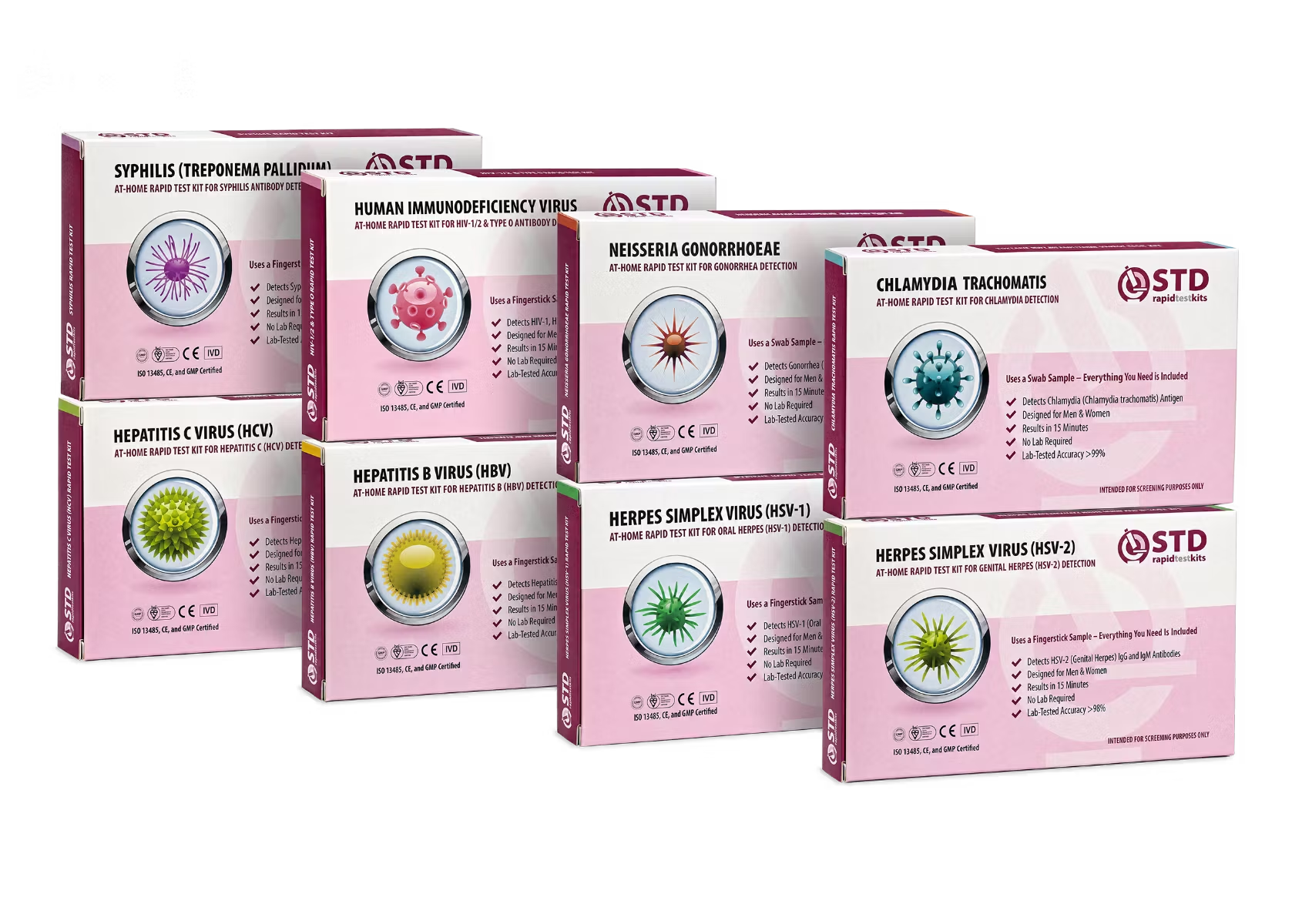
stdrapidtestkits.com sells lateral-flow rapid tests for chlamydia, gonorrhea, HIV, syphilis, hepatitis B, hepatitis C, HSV-1, and HSV-2 in any-gender formats; trichomoniasis and HPV are available as women-only vaginal-swab kits, and we do not sell a male-compatible trich or HPV home test. We also do not sell urine-sample STI tests, throat (pharyngeal) swabs, or rectal swabs. If exposure was oral or anal, plan a clinic visit alongside any at-home baseline so the right sample site gets tested.
What to do if a result comes back positive
A positive screen does not tell you when, where, or from whom an infection was acquired. With latency measured in years for several common STIs, the honest answer in many cases is that no one can know, and that is normal. What the result does tell you is what to do next.
Most STIs are treatable, and several are curable:
- Chlamydia, gonorrhea, syphilis, and trichomoniasis are bacterial or parasitic and clear with a defined course of antibiotics or antiparasitics.
- Hepatitis C is now curable; the CDC reports that direct-acting antivirals cure more than 95% of people in 8 to 12 weeks.
- HIV is managed with antiretroviral therapy that can suppress the virus to undetectable levels, at which point the risk of passing it to a partner through sex drops to effectively zero (the U=U principle).
- Herpes and HPV are not curable, but both are well managed, and the immune system often clears HPV on its own within a couple of years.
Confirm any positive at-home result with a clinician, and have the other partner tested as well. The most common reason a chlamydia or gonorrhea infection comes back is one partner going untreated, so testing and treating both people is not optional. Abstain from unprotected contact until treatment is finished and follow-up testing confirms the infection has cleared. A clinician can match the regimen to the specific infection, any drug allergies, and pregnancy status, and the CDC's GetTested locator can point either partner to nearby confirmatory testing.
What to do now
Has neither of you ever done a baseline STI screen?
Yes: Start there. An at-home 8-in-1 or 6-in-1 panel covers the core infections discussed above in one sitting, and you can test together at home.
Did a result come back reactive, or does either partner have symptoms?
Yes: Book a clinic appointment for confirmatory lab NAAT testing and treatment, and have both partners tested so an infection cannot bounce back and forth.
Did any exposure involve oral or anal contact?
Yes: Add a clinic visit for throat or rectal swabs, which at-home kits do not cover.
No: Retest after any new exposure, before trying to conceive, or whenever your clinician recommends it.
Guidance only. A clinician can advise based on your specific situation.
Many STIs have no symptoms or may only cause mild symptoms, so people can have an infection but not know it.
FAQs
- Do we really need an STD test if we've been monogamous for years?
- Most providers say yes, at least once as a baseline. Several common STIs can persist without symptoms from a prior relationship, so a one-time joint screen rules out the most likely silent infections. The CDC and most clinical guidelines treat periodic screening as part of routine sexual-health care for adults.
- Does asking my partner to get tested mean I think they cheated?
- No, and most clinicians actively discourage that framing. Testing works as a baseline health check, comparable to a cholesterol or blood-pressure screen. Many couples find that getting screened together strengthens the relationship by clearing away a category of unspoken worry.
- Can someone have an STD without any symptoms?
- For several common infections, carrying it without symptoms is the norm rather than the exception. Chlamydia produces no noticeable symptoms in most people who carry it, genital herpes can be present for years before any recognized outbreak, and high-risk HPV almost never announces itself before a screening test picks it up. A clinic or at-home screening test is the only reliable way to find out.
- How often should long-term couples retest if the baseline is negative?
- There is no universal annual mandate for low-risk monogamous couples. Most retesting is event-driven: a partner's positive result, a non-monogamous interval, planning a pregnancy, or new symptoms either of you notice. Women under 25 and other higher-risk groups should still follow the CDC's annual chlamydia and gonorrhea screening cadence, and higher-risk groups typically test every three to six months.
- What infections do most home rapid kits cover?
- Common at-home rapid panels cover chlamydia, gonorrhea, HIV, syphilis, hepatitis B, hepatitis C, HSV-1, and HSV-2, with HPV and trichomoniasis available as women-only vaginal-swab kits. Combination kits bundle several of these into a single self-collection process. Throat and rectal swabs are not part of standard at-home panels and require clinic testing.
- Are at-home rapid tests as accurate as clinic tests?
- They use different chemistry. Lab NAAT, the standard clinic workup for chlamydia and gonorrhea, generally reaches higher analytical sensitivity than at-home lateral-flow rapid tests, especially for early bacterial infections. At-home rapid panels are validated screening tools and a reasonable starting point; a positive at-home result is worth confirming through a clinician.
- Does insurance cover STI testing?
- Most U.S. health plans cover preventive STI screening for chlamydia, gonorrhea, HIV, syphilis, and hepatitis under the Affordable Care Act's preventive-services rules, often at no out-of-pocket cost. Coverage for at-home test kits varies: some plans reimburse with a receipt, others do not. Check your benefits portal or call your insurer before assuming either way. Paying out of pocket for an at-home kit also keeps the screen off any insurance record, which some couples prefer.
- Should we test before getting pregnant?
- Yes. Pre-pregnancy STI testing is recommended for both partners. Untreated syphilis, HIV, hepatitis B, and active genital herpes can transmit during pregnancy or birth with serious consequences for the baby. Catching and treating these before conception is far easier than managing them mid-pregnancy.
- U.S. Centers for Disease Control and Prevention. About Sexually Transmitted Infections (STIs): overview, asymptomatic infection, and the case for testing.
- U.S. Centers for Disease Control and Prevention. Screening Recommendations Referenced in Treatment Guidelines: by-population and by-infection screening guidance, including annual screening for sexually active women under 25.
- U.S. Centers for Disease Control and Prevention. About Chlamydia: frequently asymptomatic infection and complications without treatment, including pelvic inflammatory disease and infertility.
- World Health Organization. Sexually Transmitted Infections (STIs) Fact Sheet: global epidemiology and the majority-asymptomatic-at-acquisition finding.
- U.K. National Health Service. Sexually transmitted infections (STIs): overview, asymptomatic infection, and when to get tested.
- American Cancer Society. Oral cavity and oropharyngeal cancer risk factors: HPV (mainly HPV16) as a major cause, with HPV DNA found in about 2 of 3 oropharyngeal cancers.
