Published: August 2025 | Last updated: May 2026 | Editorial review and quality control: Martina N.
No. Chlamydia does not typically cause a rash, sores, blisters, or visible skin lesions. Unlike herpes, syphilis, and HPV, chlamydia is a bacterium that lives inside cells rather than on the surface of the skin, which means it almost never produces the kind of external changes you can see or feel. When chlamydia causes symptoms at all, they are internal: discharge, burning during urination, pelvic discomfort.
There are rare exceptions, covered later, but if you are looking at a visible sore or rash and wondering whether chlamydia caused it, the honest answer is: probably not. What is more useful is understanding which infections do cause visible skin changes, how to tell them apart, and why testing for chlamydia still matters even when nothing is visible.
Key Takeaways
- Chlamydia produces no visible skin changes in the vast majority of cases. A rash, blister, or sore is far more likely caused by herpes, syphilis, or HPV, each of which has its own recognizable visual pattern.
- Even when your visible symptom points elsewhere, a chlamydia test is still worth doing. Co-infections are common, and chlamydia can cause serious internal damage (PID, tubal scarring, infertility) without any warning sign on the skin.
Why Doesn't Chlamydia Cause a Rash or Sores?
The biology explains everything. Chlamydia trachomatis is what is known as an obligate intracellular bacterium, a clinical way of saying it can only survive and replicate inside a host cell. It specifically targets columnar epithelial cells, the tissue lining the urethra, cervix, rectum, and throat. That is where it lives, that is where it replicates, and the damage it causes (inflammation, scarring, fertility complications) happens internally and invisibly.
Skin-surface infections that produce blisters, sores, or raised bumps involve a pathogen actively replicating in or near skin tissue. Herpes replicates in nerve endings and erupts through the skin surface. Syphilis causes its characteristic ulcer because the bacteria directly invade tissue at the entry point. Chlamydia does not work that way; its activity stays inside mucosal cells and leaves no mark on the outside.
This biology is also why chlamydia is so easy to miss. According to the CDC's 2024 STI Surveillance Report, 1,515,985 chlamydia cases were reported in the United States in 2024, making chlamydia by far the most commonly reported bacterial STI. The true number is likely substantially higher because so many infections are asymptomatic and go untested.
Chlamydia trachomatis can only replicate inside host cells, not on the skin surface. The infection damages mucosal tissue lining the urethra, cervix, rectum, or throat, all of which sits below the skin. That is why a typical chlamydia infection produces no rash, no sore, and no bump you can see or feel.
Chlamydia vs. Herpes: How to Tell the Difference
Herpes is the infection most commonly confused with a "chlamydia rash" in online searches, and the distinction matters because they require completely different tests and have completely different clinical implications.
Herpes simplex virus (HSV-1 or HSV-2) presents as small fluid-filled blisters, often described as tiny water-filled bubbles, that rupture and leave raw, shallow, painful ulcers underneath. They appear in clusters rather than as a single sore. The location is typically the genitals, buttocks, inner thighs, or anus. The first outbreak is frequently accompanied by flu-like symptoms: fever, swollen lymph nodes, and body aches. The sensation that precedes and accompanies an outbreak (tingling, burning, or heightened sensitivity in the area before anything appears) is one of herpes's most distinctive features, and that prodrome does not happen with chlamydia.
Once the blisters break, they crust over and heal within two to four weeks for a primary outbreak, faster in recurrences. The virus remains in the body permanently, latent in nerve tissue, which is why outbreaks recur. Chlamydia has no equivalent; it is a bacterial infection cleared by antibiotics, with no latency and no recurring skin events.
The key visual distinction: if you are seeing multiple small blisters in a cluster that tingle, burn, and eventually break open and scab, that is herpes. A single blister or sore, or anything without the cluster-and-rupture pattern, is less characteristic of HSV. As covered in the article on genital herpes versus ingrown hair, the visual and sensory profile is specific enough to be recognizable, but the first outbreak sometimes looks atypical, which is exactly when testing becomes essential rather than optional. The CDC's About Genital Herpes page notes that a blood test can identify HSV antibodies once the body has had time to develop them. In practice, most commercial HSV antibody assays become reliable from roughly six weeks after exposure, and an active lesion can be tested directly for a faster answer.
Chlamydia vs. Syphilis: Two Very Different Sores
Syphilis produces some of the most distinctive visible lesions in all of sexually transmitted medicine, and they look nothing like anything chlamydia produces.
Primary syphilis starts with a chancre: a single, firm, round, painless ulcer at the exact site where the bacteria entered the body, typically the genitals, anus, lips, or throat. The painlessness is what makes it dangerous. Because it does not hurt, people often discover it accidentally or miss it entirely, particularly when it develops inside the vaginal canal or anorectal area. The CDC's About Syphilis page notes that the chancre lasts three to six weeks and heals on its own whether or not you receive treatment, which creates a false sense that the problem has resolved while the infection continues to advance underneath.
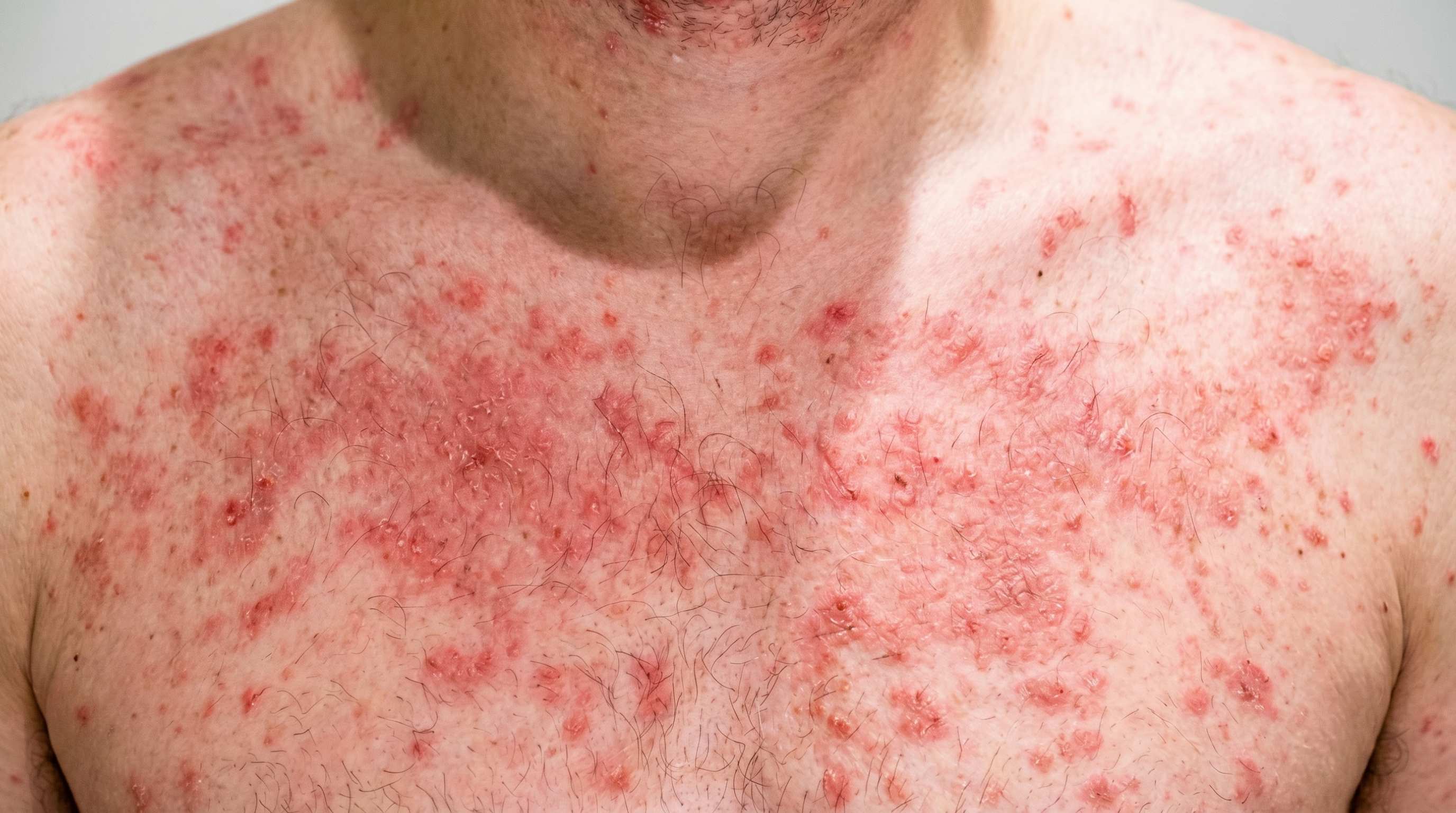
Secondary syphilis follows weeks to months later, producing what is arguably the most recognizable rash pattern in medicine: a diffuse, non-itchy rash that characteristically appears on the palms of the hands and soles of the feet, locations where rashes from most other conditions simply do not appear. The CDC describes the lesions as rough, red, or reddish-brown, and notes that the rash is sometimes so faint it can be missed. The rash may also cover the torso and be accompanied by fever, sore throat, swollen lymph nodes, and mucous membrane patches in the mouth or genitals. At this stage, syphilis is highly contagious even through skin contact with the rash.
The article on how syphilis starts and what it looks like walks through the staging in detail. Syphilis antibody testing becomes reliable from roughly six weeks after exposure, and U.S. case counts have climbed steadily across the most recent surveillance cycles.
Primary: a single firm, round, painless ulcer at the entry point, heals on its own in three to six weeks.
Secondary: a non-itchy rash on the palms and soles, weeks to months later, often with fever and swollen lymph nodes.
Both patterns are unmistakable once you know them. Neither pattern occurs with chlamydia.
Chlamydia vs. Genital Warts (HPV): Not Even Close
Genital warts are caused by specific strains of human papillomavirus, principally HPV types 6 and 11, and never by chlamydia. There is no biological mechanism by which chlamydia produces warts, and the two infections have nothing in common in how they present on the skin.
Genital warts appear as soft, flesh-colored or slightly pink growths, often with a cauliflower-like texture that distinguishes them from most other lesions. They may appear as a single small bump or in clusters, and they are typically painless, occasionally itchy. Unlike herpes, they do not blister or rupture. Unlike syphilis, they do not start as a single ulcer. They grow gradually over weeks to months rather than appearing suddenly, and they persist rather than resolving on their own without treatment.
Location varies: genital warts can appear on the penis, scrotum, vulva, vaginal walls, cervix, anus, or inner thighs. In people with penises, there is no blood test available to confirm HPV infection; visible warts are diagnosed by clinical appearance. In people with cervixes, HPV is detected through Pap smears and HPV co-testing. If you are seeing fleshy, soft, irregular growths that do not blister and do not hurt, the cause is almost certainly HPV. The article on genital warts: causes, symptoms, and treatment covers HPV in more detail, including the strains that cause warts versus the strains associated with cancer.
| Infection | What It Looks Like | Painful? | Timing After Exposure | Resolves On Its Own? |
|---|---|---|---|---|
| Chlamydia (typical) | No visible lesions | N/A | N/A | N/A |
| Herpes (HSV-1/2) | Clusters of blisters that break and ulcerate | Yes, tingling, burning, pain | 2 to 12 days | Yes, but virus stays and recurs |
| Syphilis (primary) | Single firm, round, painless chancre | Usually painless | 10 to 90 days (avg. 21) | Yes, but infection continues |
| Syphilis (secondary) | Non-itchy rash on palms, soles, torso | Usually not | Weeks after chancre heals | Yes, but infection continues |
| HPV / Genital Warts | Soft, flesh-colored, cauliflower-like growths | Usually painless | Weeks to months | Possible, but often persist or recur |
| Chlamydia (reactive arthritis) | Scaly plaques on palms/soles; shallow genital erosions | Yes (especially on soles) | Weeks to months post-infection | Sometimes; may need treatment |
What to Do If You Have a Genital Sore Right Now
If you are reading this because you have a visible sore, blister, bump, or rash, here is the most direct guidance available without a clinical examination.
If it is a cluster of blisters that tingle or burn, get a herpes test from six weeks after exposure, or see a provider now if lesions are active. If it is a single painless sore that seems to be healing on its own, get a syphilis test, and do not wait for the sore to resolve before testing; the infection advances whether or not the ulcer is visible. If you are seeing soft, flesh-colored bumps that do not blister, see a provider for an HPV clinical assessment. If you have discharge, burning during urination, or pelvic discomfort but nothing visible on the skin, test for chlamydia and gonorrhea.
Co-infections are common, so a chlamydia test is worth running even when your visible symptom points elsewhere. Having one bacterial STI raises the statistical likelihood of another being present, and chlamydia produces no visible announcement of its presence, which means it can sit undetected alongside an infection that does. Worth noting up front: this site sells at-home rapid lateral-flow tests for several of the infections discussed here, including chlamydia, syphilis, and herpes; the product recommendation below is placed where it fits the reader's likely concern, not as a substitute for clinical care.
| Infection | Test From |
|---|---|
| Chlamydia | 14 days after exposure |
| Gonorrhea | 3 weeks after exposure |
| Syphilis | 6 weeks after exposure |
| HIV | 6 weeks (first indicator); retest at 12 weeks for certainty |
| Herpes HSV-1 & HSV-2 | 6 weeks after exposure |
| Hepatitis B | 6 weeks after exposure |
| Hepatitis C | 8 to 11 weeks after exposure |
Why You're Probably Blaming Chlamydia for Something It Didn't Do
There are a few reasons people end up attributing skin symptoms to chlamydia when something else is responsible. The first is that chlamydia is the most commonly reported STI in the country, so when anything unusual happens after sex, it jumps to the top of the mental list. The second is co-infection logic: someone tests positive for chlamydia, separately has herpes outbreaks, and over time conflates the two. The third, and probably the most common, is that the visible symptom is not sexually transmitted at all.
Friction irritation, ingrown hairs, contact dermatitis from soap or scented products or latex, folliculitis, and yeast infections can all produce redness, bumps, and irritation in the genital area that looks alarming up close. Ingrown hairs present as small, inflamed bumps, often with a visible hair inside, in shaved or waxed areas. Contact dermatitis produces redness, swelling, and sometimes blistering from an irritant rather than an infection. Yeast infections cause intense itching and redness, occasionally with visible skin changes. None of these are STIs, and none require STI treatment.
The internet makes this spiral worse. Google Images returns the most severe clinical photographs of any condition, and a person examining a razor bump against a picture of a herpes outbreak at peak inflammation will almost always conclude the wrong thing. The article on STD signs often mistaken for something else works through this problem directly. Visual self-diagnosis is unreliable; testing for what you are actually worried about is the only version of this that produces real information.
Chlamydia's actual danger is invisible. The CDC's About Chlamydia page notes that initial damage from the infection often goes unnoticed, and that untreated cases can progress to pelvic inflammatory disease, scarred fallopian tubes, ectopic pregnancy, chronic pelvic pain, and infertility. None of those produce a visible surface symptom. The article on how long you can have chlamydia without knowing makes this concrete: years of silent infection can cause significant internal damage while producing nothing visible on the surface.
Chlamydia often has no symptoms, but it can cause serious health problems, even without symptoms. Untreated chlamydia can cause permanent damage to a woman's reproductive system. This can make it difficult or impossible to get pregnant later.
The Rare Exception: When Chlamydia Does Cause Skin Changes
While chlamydia does not cause skin lesions directly, it can trigger a post-infectious immune response that produces some of the most distinctive skin findings in sexually transmitted medicine. The condition is called reactive arthritis, formerly known as Reiter's syndrome, and it develops in roughly one to three percent of people after a genitourinary chlamydia infection. The bacteria do not invade skin tissue here; the immune system overreacts while fighting the infection and ends up attacking the body's own tissue in the process.
Reactive arthritis has a classic triad: joint inflammation (especially knees, ankles, and feet), eye inflammation, and urethritis. In some patients a fourth feature appears, in the form of two characteristic skin and mucosal findings that are nearly unique to this condition.
The first is keratoderma blennorrhagicum: thickened, scaly, hyperkeratotic patches that erupt primarily on the soles of the feet and palms of the hands, and can spread to the legs, toes, fingers, scalp, and trunk. The lesions begin as vesicles on a reddened base and progress to papules, nodules, and plaques that closely resemble pustular psoriasis. On the soles of the feet they are often painful enough to impair walking. Per the American Academy of Family Physicians review of reactive arthritis, the visual similarity to psoriasis is close enough that patients sometimes present believing they have a primary skin condition.
The second finding is circinate balanitis in men (or circinate vulvitis in women): shallow, painless or mildly painful erosions on the glans penis or vulva that form a ring-like or map-like pattern. On uncircumcised men these lesions remain moist; on circumcised men they may harden and crust. Both findings arrive weeks to months after the original chlamydia infection, not during the acute phase, and almost always alongside the joint and eye symptoms rather than appearing on their own.
A second, rarer exception is lymphogranuloma venereum (LGV), caused by specific serotypes of Chlamydia trachomatis (L1, L2, L3) that are distinct from the standard genital chlamydia strains. LGV's first stage includes a small, painless papule or ulcer at the infection site that heals quickly and is usually missed. It progresses to severely painful swollen lymph nodes in the groin and, if untreated, significant rectal and genital scarring. LGV is uncommon outside specific transmission networks and requires clinical evaluation and specific testing; standard chlamydia tests may not reliably detect it. As covered in the article on rectal chlamydia symptoms, the anorectal presentation is where LGV tends to cause the most serious complications.
If you are worried about a skin change you noticed two or three days after sex, neither of these is the explanation. The timing does not fit, the presentation does not fit, and the associated symptoms do not fit.
| Reactive arthritis (post-chlamydia) | Lymphogranuloma venereum (LGV) | |
|---|---|---|
| How chlamydia is involved | Immune system overreacts after infection | Caused directly by L1, L2, L3 serotypes |
| Skin findings | Keratoderma blennorrhagicum on palms/soles; circinate balanitis or vulvitis | Small painless papule or ulcer that heals quickly |
| Timing after infection | Weeks to months | Days for first stage; weeks for second stage |
| Other features | Joint and eye inflammation, urethritis | Painful swollen lymph nodes in groin |
| Frequency | 1 to 3 percent after genitourinary chlamydia | Uncommon outside specific transmission networks |
| Detected by standard chlamydia tests? | Not directly; the trigger infection is detectable | Often missed; needs clinical evaluation |
The Bottom Line
Chlamydia does not cause rashes, blisters, sores, or visible genital lesions as a direct symptom. If you are looking at a visible skin change and trying to figure out what caused it, the answer almost certainly starts with herpes, syphilis, or HPV. Each of those infections has a recognizable pattern, and understanding the differences is more useful than any image search.
What chlamydia does cause, quietly and over time, is internal damage: PID, tubal scarring, epididymitis, and infertility. As covered in the article on why asymptomatic STDs are more dangerous than you think, the infections that produce the least on the surface often cause the most damage below it. Testing is what closes that gap.
- Cluster of small blisters that tingle or burn: herpes test (or see a provider now if lesions are active).
- Single firm painless sore healing on its own: syphilis test, even after the sore disappears.
- Soft cauliflower-textured bumps: clinical HPV assessment.
- No visible symptom but recent exposure or internal symptoms: chlamydia and gonorrhea testing.
FAQs
- Does chlamydia cause a rash?
- No, not directly. Chlamydia lives inside cells and does not replicate on the skin surface, so it almost never produces visible skin changes. In rare cases, a post-infectious immune reaction called reactive arthritis can cause skin lesions on the palms and soles weeks after infection, but those arrive alongside joint pain and eye inflammation rather than alone.
- Can chlamydia look like herpes?
- No. Chlamydia produces no visible lesions. Herpes produces clusters of small fluid-filled blisters that rupture into painful sores. If you are seeing blisters, the infection is almost certainly herpes. The two can co-exist, but they require separate tests; a chlamydia test will not detect herpes.
- Does chlamydia cause genital warts or bumps?
- No. Genital warts are caused by HPV, not chlamydia. There is no mechanism by which chlamydia produces warts, cauliflower-like growths, or firm external lumps. If that is what you are seeing, the cause is HPV.
- What does chlamydia look like on the skin?
- For the vast majority of people, it looks like nothing. The CDC's About Chlamydia page notes that the infection often has no symptoms at all. The only reliable way to know it is present is to test for it.
- Can you have chlamydia and herpes at the same time?
- Yes. Co-infections are common. A positive herpes result says nothing about whether chlamydia is present, and vice versa. If you have visible symptoms and also had a recent potential chlamydia exposure, test for both separately.
- What does a syphilis sore look like vs. chlamydia?
- A syphilis chancre is a single, firm, painless, round ulcer at the entry point (genitals, anus, lips, or throat) that heals on its own over weeks. Chlamydia produces nothing like this. A single painless sore that is healing on its own is a syphilis story; test accordingly.
- How soon after exposure can you test for chlamydia?
- Wait 14 days after exposure for an accurate result. Testing earlier can produce a false negative even with active infection, because the bacterial load needs time to reach a detectable level.
- What should I test for if I have a genital sore?
- Prioritize herpes and syphilis, both of which test reliably from six weeks after exposure. Also test for chlamydia at 14 days and gonorrhea at three weeks, since co-infections are common and neither produces the sore you are seeing but either could be present silently.
This article was constructed based on current advice from the most prominent public health and medical organizations, then shaped into plain language based on the situations people actually face. In the background, our pool of research included broader public health, clinical, and peer-reviewed medical references, but the following are the most directly relevant for readers who want to verify our claims.
- U.S. Centers for Disease Control and Prevention. STI Surveillance, annual report index. Used for current chlamydia case counts (1,515,985 cases reported in 2024) and overall STI trend data.
- U.S. Centers for Disease Control and Prevention. About Chlamydia. Used for asymptomatic-infection prevalence and reproductive complications including PID, scarred fallopian tubes, ectopic pregnancy, and infertility.
- U.S. Centers for Disease Control and Prevention. About Genital Herpes. Used for HSV clinical presentation, lesion description, and antibody-testing guidance.
- U.S. Centers for Disease Control and Prevention. About Syphilis. Used for primary chancre presentation (firm, round, painless; 3 to 6 weeks to heal), and secondary rash pattern on palms and soles.
- U.S. Centers for Disease Control and Prevention. About Genital HPV Infection. Used for clinical wart morphology and the distinction between wart-causing and cancer-associated HPV strains.
- American Academy of Family Physicians. Reactive arthritis (Reiter's syndrome) clinical review. Used for the diagnostic triad, keratoderma blennorrhagicum, and circinate balanitis findings.
