Pimple or STD? How to Tell Vaginal Bumps Apart
How to tell harmless bumps from real STI symptoms




- Most new bumps in the genital area are not STIs. Ingrown hairs, friction, clogged glands, and yeast irritation account for the majority of cases the average person notices, and they usually resolve within a week.
- A bump that lasts more than 7 days, recurs in the same spot, is painless but persistent, or appears alongside fever, swollen lymph nodes, or a cluster of blisters should prompt testing rather than waiting it out.
Published: October 2025 | Last updated: May 2026 | Editorial review and quality control: Martina N.
The first time you notice a new bump or red mark on your vulva, the impulse is to spiral. Take a breath. Most new bumps in the genital area are not sexually transmitted infections; they are far more often ingrown hairs from shaving, friction marks, clogged sweat glands, or yeast irritation. A smaller fraction are STI symptoms, and recognizing those patterns early matters because the consequences of missing a syphilis chancre or an early herpes outbreak stack up over weeks.
If you noticed a single new bump today and have no other symptoms, watch it for 5 to 7 days. Pause shaving in the area, drop the tightest workout clothing, switch to fragrance-free underwear and unscented panty liners, and let the skin breathe. Most non-STI bumps fade visibly during that window. The sections below cover what to do if yours has not improved or is getting worse, including how to tell ingrown hairs apart from herpes, HPV warts, and the early sore of syphilis, plus when at-home testing is the right next step.
Key takeaways
- Most new bumps in the genital area are not STIs. Ingrown hairs, friction, clogged glands, and yeast irritation account for the majority of cases the average person notices, and they usually resolve within a week.
- A bump that lasts more than 7 days, recurs in the same spot, is painless but persistent, or appears alongside fever, swollen lymph nodes, or a cluster of blisters should prompt testing rather than waiting it out.
What causes bumps down there? Most are not STIs
Before jumping to STI worry, it helps to recognize how often the explanation turns out to be something simpler. The vulva contains hair follicles, sweat glands, sebaceous (oil) glands, and skin that responds to friction, heat, and chemicals like any other body area. New bumps in this region are common, especially after grooming, exercise, or a switch in clothing or hygiene products.
Common non-STI causes include:
- Ingrown hairs and folliculitis. Shaving, waxing, and trimming can trap a hair below the skin surface, producing a tender red bump that may form a small white head. These usually resolve within 5 to 10 days.
- Sebaceous (Fordyce) spots. Tiny, painless, pale yellow or skin-colored bumps on the labia or vulva that are a normal anatomical variant, not a problem to treat.
- Vulvar acne. The vulvar skin contains the same pilosebaceous units (the hair-follicle-plus-oil-gland units that make up most of the skin's surface) as facial skin, so it can develop blackheads, papules, and pustules in the same way. Hormonal cycles, sweat, and tight workout clothes are common triggers.
- Yeast irritation. Candida overgrowth often shows up as redness, itching, and small irritated bumps on the vulva, particularly after antibiotics or with diabetes-related blood sugar swings.
- Bartholin or Skene gland cyst. A blocked duct on either side of the vaginal opening can produce a tender, pea- to grape-sized lump that may resolve with warm compresses or need clinic drainage if it abscesses.
- Contact dermatitis. New laundry detergent, scented panty liners, lubricants, or condoms can produce an itchy red rash with small bumps that mimics infection.
- Molluscum contagiosum. Small (1 to 5 mm), dome-shaped, pearly bumps with a central dimple. It is a viral skin infection that can be sexually transmitted in adults but is usually mild and self-limiting.
Most of these resolve on their own or with gentle care. The four STI patterns covered next are the ones worth catching early.
- Ingrown hair or folliculitis: single tender red bump with a hair often visible at the center, drains and resolves in 5 to 10 days.
- Fordyce spot: tiny pale yellow or skin-colored bump that has been there for years, painless, no change over time.
- Vulvar acne: single or scattered small pustules in oily or sweat-prone areas, flares with hormonal cycles or after workouts.
- Bartholin or Skene gland cyst: single deeper lump near the vaginal opening, pea- to grape-sized, often tender on one side only.
How STI bumps look different: four patterns worth recognizing
When a bump turns out to be an STI symptom, it tends to fall into one of four pattern types. Recognizing these is the first half of deciding whether to test. The second half is timing and exposure context, covered in the sections that follow.
1. Genital herpes (HSV-1 or HSV-2). Small fluid-filled blisters, usually in clusters of 3 to 10, that appear on the labia, perineum, or upper thigh. The blisters are tender and often preceded by burning or tingling 24 to 48 hours before they appear. Within a few days they rupture and crust into shallow ulcers, then heal over 2 to 3 weeks. Recurrent outbreaks tend to come back in the same anatomical spot, which clinicians use as a supporting indicator. HSV-2 has traditionally been the type most often found in the genital area, although HSV-1 is increasingly responsible for genital infections too. Background information on genital herpes symptoms and recurrence is available from the CDC herpes overview.
2. Genital warts (caused by HPV, most often types 6 and 11). Painless, flesh-colored or slightly darker raised growths that can be flat, smooth, or develop a bumpy cauliflower-like surface. They tend to grow gradually rather than appear overnight. Single lesions and clustered groups both occur. They do not itch and do not hurt, which is part of why they are missed.
3. Syphilitic chancre (primary syphilis). A single, round, painless ulcer with a firm, raised border. The chancre typically appears within a few weeks of exposure. It is often missed because it does not hurt, and per the CDC syphilis overview, the sore usually lasts 3 to 6 weeks and heals on its own even without treatment, while the infection continues internally and progresses to secondary syphilis weeks to months later.
4. Trichomoniasis irritation. Less of a focal bump pattern and more of generalized vulvar redness, swelling, and tiny red dots, often with frothy yellow-green discharge and a notable odor. Itching and burning are common. Trichomoniasis is caused by a parasite and is treated with a single course of antibiotics. Our at-home trichomoniasis swab test is validated for vaginal self-collection only, so male readers needing testing should see a clinic.
The pattern that catches more readers off guard is the painless one. Syphilitic chancres and most HPV warts cause no discomfort at all, while ingrown hairs and yeast irritation can hurt quite a bit. Use the visual cues, timing, and persistence below before assuming pain rules anything in or out.
Ingrown hair versus herpes: the differences clinicians look for
Of all the bump-versus-STI confusions, ingrown hair versus genital herpes drives the most late-night panic searches. Very early herpes lesions can briefly look like a small pimple before they evolve, and an inflamed ingrown hair can briefly look like a sore once a trapped hair sets off enough inflammation. That visual overlap lasts maybe 24 to 48 hours. After that, the two conditions follow very different timelines.
Folliculitis (the clinical term for any inflamed hair follicle) and ingrown hairs are extremely common in the pubic area because shaving, waxing, friction from underwear, sweat trapped in tight fabrics, and the simple mechanics of curly pubic hair growing back through the skin all create inflamed follicles. Herpes is also widespread; according to the CDC overview of genital herpes, roughly 572,000 new genital herpes infections occurred among U.S. people aged 14 to 49 in 2018 alone, and many people who carry HSV never know it because symptoms can be mild or absent.
What separates the two conditions is the sequence. Ingrown hairs tend to either resolve on their own or briefly intensify and then fade within a week or so. Herpes lesions follow a recognizable cycle: tingling or burning first, then small blisters about 12 to 36 hours later, then shallow open sores within 1 to 2 days as the thin blister roofs break, then crusting and healing through the second week. Dermatologists sometimes describe the herpes presentation as a constellation rather than a star, because the clustered pattern is so distinctive. The table below summarizes the side-by-side clues.
| Feature | Ingrown hair | Genital herpes |
|---|---|---|
| Number of bumps | Usually one isolated bump | Cluster of several small blisters close together |
| What is inside | A coiled hair often visible under the skin | Clear or slightly cloudy fluid, no hair |
| Pain quality | Mild tenderness when pressed | Burning, tingling, raw soreness even at rest |
| Onset trigger | Appears 1 to 3 days after shaving or waxing | Appears 2 to 12 days after a sexual exposure |
| How long it lasts | Resolves in 5 to 10 days | Outbreak lasts 1 to 2 weeks before healing |
| Evolution | Drains or shrinks gradually | Blisters rupture into shallow open sores, then crust |
| Other symptoms | Usually none | First outbreak may include fever, body aches, swollen groin lymph nodes |
Timing matters more than people realize
One of the most useful clues is also the easiest to overlook: when did the bump first appear, and what happened in the days before? Skin irritation and viral infections follow different timelines, and lining the bump up against your last shaving session or last sexual contact often points clearly in one direction.
| Situation | Ingrown hair pattern | Herpes pattern |
|---|---|---|
| After shaving or waxing | Bump appears within 1 to 3 days, on the shaved skin | Not triggered by shaving |
| After a new sexual exposure | Unrelated to recent partners | First outbreak usually appears 2 to 12 days after exposure |
| How long the bump lasts | Resolves in about a week without treatment | Outbreak runs 1 to 2 weeks; first one is often the longest |
| Recurrence pattern | Only if hair regrows incorrectly in the same follicle | Recurrent outbreaks may follow stress, illness, hormonal shifts |
The single-bump question almost everyone asks
One of the most frequent late-night searches on this topic is whether herpes can ever appear as a single isolated bump. Yes, occasionally, but it is uncommon. Most outbreaks involve at least two or three blisters grouped together, and recurrent outbreaks tend to come back in roughly the same patch of skin each time.
An isolated bump that stays alone for several days, never multiplies, never produces clear fluid, and either drains or fades in under a week is far more consistent with an ingrown hair, a blocked sebaceous gland, or a friction nodule than with herpes. The probability shifts when a single bump turns into a cluster within 24 to 48 hours, when fluid appears inside, or when the surface ruptures into a shallow ulcer.
Atypical herpes presentations exist as well. Some people have outbreaks so mild they consist of a single small fissure, a tiny crack, or what looks like a paper cut rather than a textbook cluster. This is why clinicians do not rely on the visual alone when herpes is on the differential. They confirm with a swab from a fresh lesion or, in certain situations, a type-specific blood antibody test taken once the antibody window has passed.
A single bump that stays isolated, never produces clear fluid, and fades within a week is far more consistent with an ingrown hair than with herpes. The pattern shifts toward herpes when that bump multiplies into a cluster within 24 to 48 hours, when clear fluid appears inside, or when the surface ruptures into a shallow ulcer that stings.
Other things that mimic both
Another reason people get confused is that the genital area contains hundreds of hair follicles, oil glands, and sweat glands, and any of them can become temporarily inflamed. Several harmless conditions can look like an ingrown hair, an early herpes lesion, or both. Knowing the field of possibilities makes the eventual answer less alarming.
| Condition | What it looks like | Why it gets confused |
|---|---|---|
| Folliculitis | Several small red papules and pustules around shaved follicles | Mimics ingrown hairs and clusters can look like herpes |
| Blocked sebaceous (oil) gland | Tiny pale yellow or white bump under the skin | Can resemble an early vesicle |
| Friction irritation or chafing | Diffuse red rash with small inflamed bumps | Common after sex, exercise, or tight clothing |
| Heat or sweat rash (miliaria) | Cluster of tiny clear surface bumps | Sometimes mistaken for herpes vesicles |
| Sebaceous cysts | Firm painless lump under the skin | Often mistaken for a deep infected follicle |
| Molluscum contagiosum | Small dome-shaped bumps with a central dimple | Sexually transmissible but distinct from herpes |
Six visual clues that should push you toward testing
When you have a bump and you are deciding whether to wait it out or test, the patterns below tilt the answer toward testing rather than waiting. Use them as a quick checklist after you have looked at the bump in good light with a hand mirror.
- The bump is painless and has lasted more than 10 days.
- The bump has a firm, rolled-edge border (typical of a syphilis chancre).
- The bump is one of a cluster of small fluid-filled blisters in the same area.
- The bump is part of a slowly growing flesh-colored lesion that did not shrink within 2 weeks.
- The bump came with a fever, swollen lymph nodes in the groin, or unusual discharge.
- The bump is in a spot where you have had recurring sores before, especially with tingling or burning before the bump appears.
Conversely, a single tender red bump with a hair visible at the center, that drains a little white pus and resolves within 5 to 10 days, is almost always folliculitis. Patience is the right call there.
What inflammation looks like on different skin tones
A frequent source of misread symptoms is that medical reference photos historically over-represent fair skin. Inflammation that shows as bright pink or red on lighter skin can present as deep purple, brown, or gray on darker skin. The bump shape, border quality, texture, timeline, and accompanying symptoms matter much more than the color cue when you are interpreting a new lesion.
If a bump is dome-shaped, has a hair at the center, drains, and resolves in a few days, that is folliculitis regardless of the color it shows up as. If a bump is firm with a rolled edge, painless, and persists past 10 days, it is worth syphilis testing whatever the color reads as. If a bump appears in a tight cluster of fluid-filled blisters with tingling or burning preceding them, that is the herpes pattern across all skin tones. Trust shape, texture, and timeline over color when the photos online do not match what you see.
- Shape: dome-shaped versus flat, single versus clustered, raised versus depressed.
- Border quality: sharp and firm (chancre), soft and irregular (folliculitis), or fuzzy and ill-defined (irritation).
- Surface texture: smooth dome (cyst), fluid-filled blister (herpes), cauliflower-rough (HPV), or clean ulcer base (chancre).
- Timeline: resolves in days (irritation), recurs in the same spot (herpes), persists past 10 days painlessly (chancre), or grows slowly over weeks (HPV).
When should you get tested?
Testing makes sense any time a bump persists more than a week, recurs in the same spot, or appears with other symptoms. It also makes sense after a new sexual partner regardless of bump status, since most STIs do not produce visible symptoms in the early window. Per CDC information on STIs, many infections produce no early symptoms at all, and testing is the only way to know for sure. This site sells at-home rapid lateral-flow tests for the infections discussed below; the product mentions in this article are direct links to those kits.
Testing windows that matter for the most common concerns:
- Chlamydia and gonorrhea. Detectable by lab NAAT around 1 to 2 weeks after exposure. At-home rapid swab tests use a self-collected vaginal or penile swab and work in the same general window.
- Syphilis. Antibody tests reach reliable sensitivity around 3 to 6 weeks after the chancre appears, so if you spot a possible chancre, test now and again at 6 weeks if the first is negative. The at-home syphilis test is a fingerstick blood antibody test.
- Herpes (HSV-1 and HSV-2). If active blisters are present, swab-based PCR at a clinic is the fastest path to a definitive answer because it samples the lesion directly. Clinicians generally prefer to swab a fresh, intact or just-ruptured vesicle rather than a crusted one, because viral DNA is most abundant before the lesion dries out. Blood antibody tests take 12 weeks or more after a possible exposure to reliably show seroconversion. The at-home HSV test is a fingerstick blood antibody test, useful for confirming past exposure once that window has passed, not for diagnosing a fresh active outbreak.
- HPV. No reliable blood test exists. Visible warts are diagnosed visually by clinicians, and our at-home HPV swab test is validated for vaginal self-collection (women only) to detect high-risk HPV types. High-risk HPV types (notably 16 and 18) are linked to cervical and vulvar cancers, while warts are caused by low-risk types 6 and 11, which are different strains and not the cancer-causing ones. Regular Pap smear and HPV co-testing with a clinician remains the standard screening path for cervical cancer prevention; the at-home HPV swab kit detects HPV presence and is a screen, not a substitute for clinic-based cervical cancer screening.
- Trichomoniasis. Detectable by swab as soon as symptoms appear. The at-home trichomoniasis swab test is also validated for vaginal self-collection (women only); male readers needing trich or HPV testing should see a clinic.
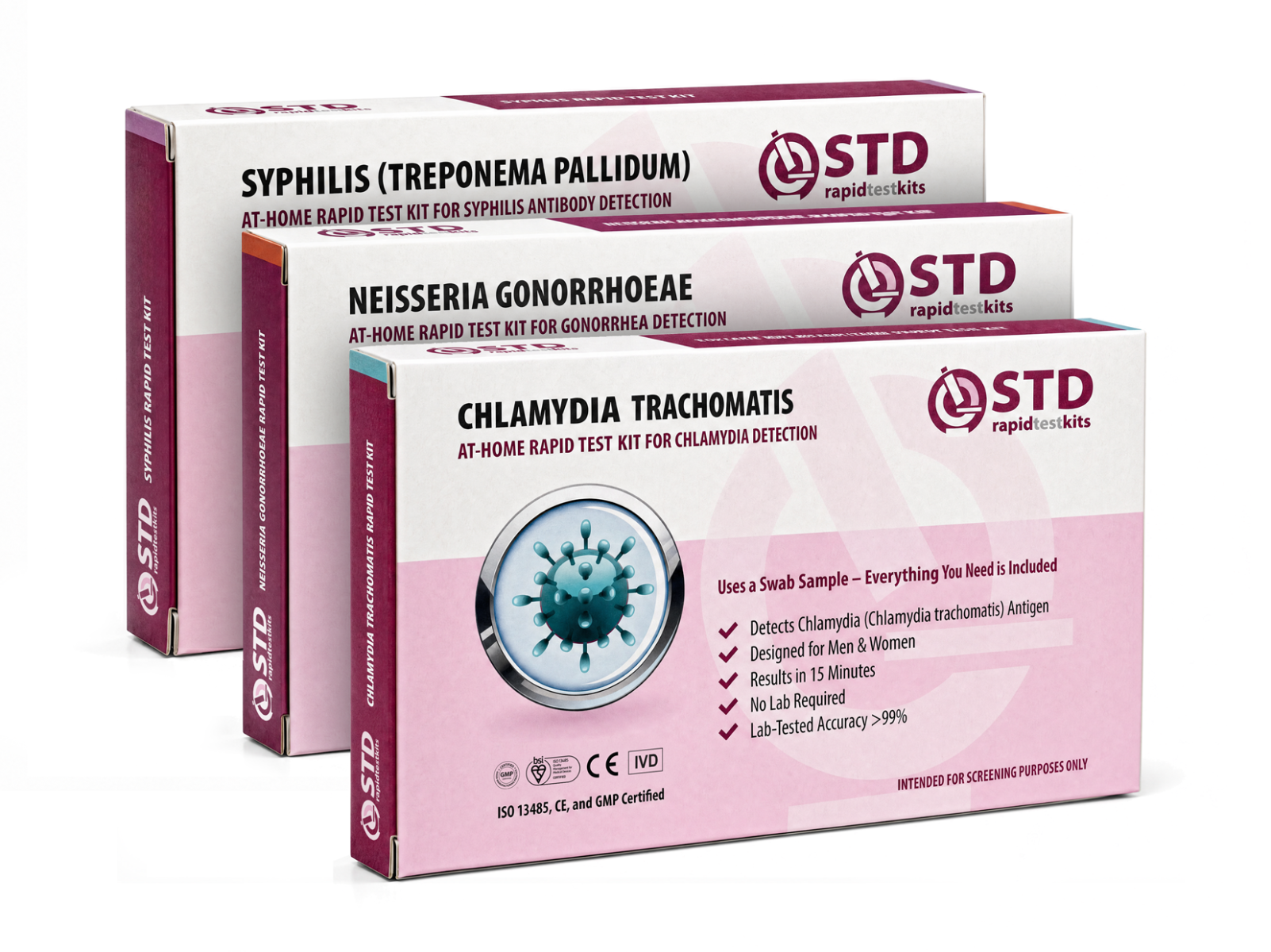
If your bump pattern points toward syphilis or you have had a recent partner change, a combo kit covers the bacterial concerns from a single sample collection event.
At-home testing versus a clinic visit
At-home rapid tests use lateral-flow chemistry, the same general technology as a pregnancy test, applied to either a fingerstick blood drop or a self-collected swab depending on the infection. They are meaningfully different from the laboratory NAAT (nucleic acid amplification) tests a clinic sends out, which run on a thermocycler and detect lower amounts of pathogen DNA. Lateral-flow tests are fast, private, and useful for screening, and a positive result is worth confirming with a lab NAAT when the result will inform treatment or partner notification.
A clinic visit is the better choice when:
- You have an open lesion that has not crusted, since a swab PCR for active herpes is more sensitive than waiting on antibody seroconversion. Fresh lesions yield more viral DNA than crusted ones, so do not delay if you suspect an outbreak.
- The bump is painful enough to interfere with daily life and may need prescription antiviral or antibacterial therapy started today. Antiviral treatment for herpes is meaningfully more effective when started within the first 72 hours of an outbreak.
- You are pregnant, since STI screening recommendations differ from the general adult schedule and untreated infections can affect the pregnancy.
- The bump is on the cervix, anus, or another internal area you cannot reasonably swab at home.
- You need a pharyngeal (throat) swab or rectal swab for a specific exposure route. We do not sell those as home kits, so a clinic visit is the right path for those sample types.
For most readers with a single new vulvar bump and no other symptoms, the practical first step is to track the bump for 5 to 7 days, then test at home if it has not resolved or has gotten worse.
Most people with herpes have no symptoms or only mild symptoms. Many people aren't aware they have the infection and can pass along the virus to others without knowing.
Common misconceptions about vaginal bumps
A handful of patterns come up repeatedly in online forums and search queries. Most of them are wrong in ways that delay testing.
- If it is an STI, it will hurt. Believing pain is required is one of the most common reasons syphilis chancres and HPV warts go unnoticed; both are typically painless.
- STI bumps are always in clusters. A syphilis chancre is almost always a single lesion, and a primary herpes blister can appear alone before the cluster pattern fills in, so requiring a cluster before suspecting an STI misses early presentations.
- Stress or friction caused a brand-new infection. Stress, friction, tight clothing, and sweaty workouts can trigger an outbreak in someone who already carries HSV, but they cannot create a new infection from nothing. No amount of shaving, exercise, or stress will give you herpes if you do not already carry the virus.
- I tested last year, so I am still fine. STI status reflects your status as of the test date plus the relevant window period. Ongoing sexual activity means ongoing testing if you want current information.
- If it itches, it is just yeast. Itching can come from yeast, contact dermatitis, trichomoniasis, or HPV. Itch alone does not narrow the diagnosis.
- It does not look like the pictures online, so it is not an STI. Reference photos online are rarely inclusive of different skin tones, body sizes, lesion stages, or anatomic variations. Use shape, border, texture, and timeline cues over color matching.
Painless does not mean safe. Syphilis chancres and most HPV warts cause no pain at all, and they are two of the STI patterns most worth catching early. A bump that does not hurt but persists past 10 days deserves testing, full stop.
Reducing ingrown hairs going forward
Ingrown hairs are mechanical, not viral. Adjusting how you shave or wax dramatically reduces how often they appear, which over time removes a major source of pubic-area panic.
The most effective changes are technique-based. Dull blades cut hair at jagged angles that bend back into the follicle, so a clean sharp razor and regular blade replacement matter more than most people realize. Softening the skin and hair in warm water for a few minutes before shaving, then applying a non-irritating shave cream or gel, gives the blade something to glide through. Shaving in the direction of hair growth on the first pass and avoiding extra-close shaves are the two single biggest predictors of fewer ingrown hairs.
Between shaves, gentle exfoliation once or twice a week (a soft washcloth is enough; harsh scrubs can worsen irritation) helps lift dead skin off the follicle openings so new hair grows out cleanly. Loose breathable cotton underwear reduces sweat and friction trapped against shaved skin. Some people find that switching from shaving to electric trimming, which leaves a slightly longer stubble, eliminates ingrown hairs entirely, because the hair never needs to grow back through a closed follicle opening.
If an ingrown hair does form, resist the urge to dig it out with a needle or squeeze it. Both push bacteria deeper, sometimes turning a minor follicle bump into a more painful infected lesion. A warm compress applied for several minutes, two or three times a day, usually softens the skin enough for the hair to release on its own. If a bump becomes red, hot, swollen, or develops pus, a clinician can drain it and prescribe a topical or oral antibiotic if needed.
Prevention checklist for ingrown hairs
- Use a clean sharp razor and replace blades regularly so hair is cut cleanly rather than torn at jagged angles.
- Soften skin and hair in warm water for a few minutes before shaving; a shower works fine.
- Apply a non-irritating shave cream or gel rather than dry-shaving, and shave in the direction of hair growth on the first pass.
- Skip the extra-close pass; pressing hard for a closer shave is the most common ingrown-hair trigger.
- Exfoliate gently once or twice a week between shaves; wear loose breathable cotton underwear when possible.
Frequently asked questions
- Can a regular pimple appear on the vulva?
- Yes. Oil glands and hair follicles in the vulvar skin can clog and inflame just like those on the face, so a small pustule on the labia or pubic mound is usually a garden-variety pimple rather than anything sexually transmitted. The most common triggers are hormonal shifts during the cycle, heat, and chafing from tight workout clothing, and an isolated bump with no other symptoms is almost always benign.
- How do I tell genital herpes from an ingrown hair?
- Herpes typically appears as a tight cluster of small fluid-filled blisters with a tingling or burning sensation 24 to 48 hours before they appear, and recurrences come back in the same spot. An ingrown hair is a single tender red bump, often with a visible hair shaft at the center, that drains and resolves within 5 to 10 days. The contents matter too: a herpes vesicle holds clear or slightly cloudy fluid in a thin fragile roof, while an ingrown hair is firm and any drainage is thicker yellowish-white pus.
- I shaved two days ago and now there is a red bump. Should I worry it is herpes?
- The timing makes an ingrown hair or razor-related folliculitis the most likely answer by a wide margin. Herpes is not triggered by shaving; it follows sexual exposure with a 2 to 12 day incubation. A bump that appears within 1 to 3 days of a recent shave, on the shaved skin, is almost always mechanical.
- What if my bump is completely painless? Could it still be serious?
- Yes. Painless bumps are a hallmark of two of the most important STIs to catch: a syphilis chancre is a single painless ulcer with a firm rolled edge, and HPV warts are painless flesh-colored growths. Use shape, timeline, and recurrence pattern as the deciding cues. A firm-bordered painless ulcer past 10 days is worth testing for regardless of how it feels.
- Can stress or friction cause a brand-new herpes infection?
- No. Stress, friction, tight clothing, and sweaty workouts can trigger an outbreak in someone who already carries HSV, but they cannot create the virus from nothing. If you do not have HSV, no amount of shaving, exercise, or stress will give you a herpes infection.
- How long should I watch a bump before testing or seeing a clinician?
- For a single new bump with no other symptoms, watch it for 5 to 7 days while keeping the area clean and friction-free. If it persists past a week, recurs, becomes painful, or appears with fever, swollen lymph nodes, or a cluster of blisters, test or see a clinician. Do not wait if the bump is part of an active blister cluster or a painless ulcer with a firm border; a clinic swab of a fresh, intact lesion is the most accurate path to a definitive herpes diagnosis.
- Can a herpes home blood test diagnose the bump I see right now?
- No. Home blood antibody tests confirm whether you have ever been infected with HSV-1 or HSV-2; they do not identify what the lesion on your skin today is. For an active bump, a clinic swab is the right tool. The blood test is best used 12 weeks or more after a suspected exposure to settle long-term status.
- Should I squeeze or pop the bump to see what is inside?
- Avoid squeezing or popping any genital bump. Squeezing pushes bacteria deeper into the skin and can turn a simple ingrown hair into an infected nodule, and if the bump is herpes, breaking the surface increases viral shedding onto your fingers and surrounding skin. Patience plus warm compresses works for most ingrown hairs; clinical evaluation works for everything else.
Choosing the right test
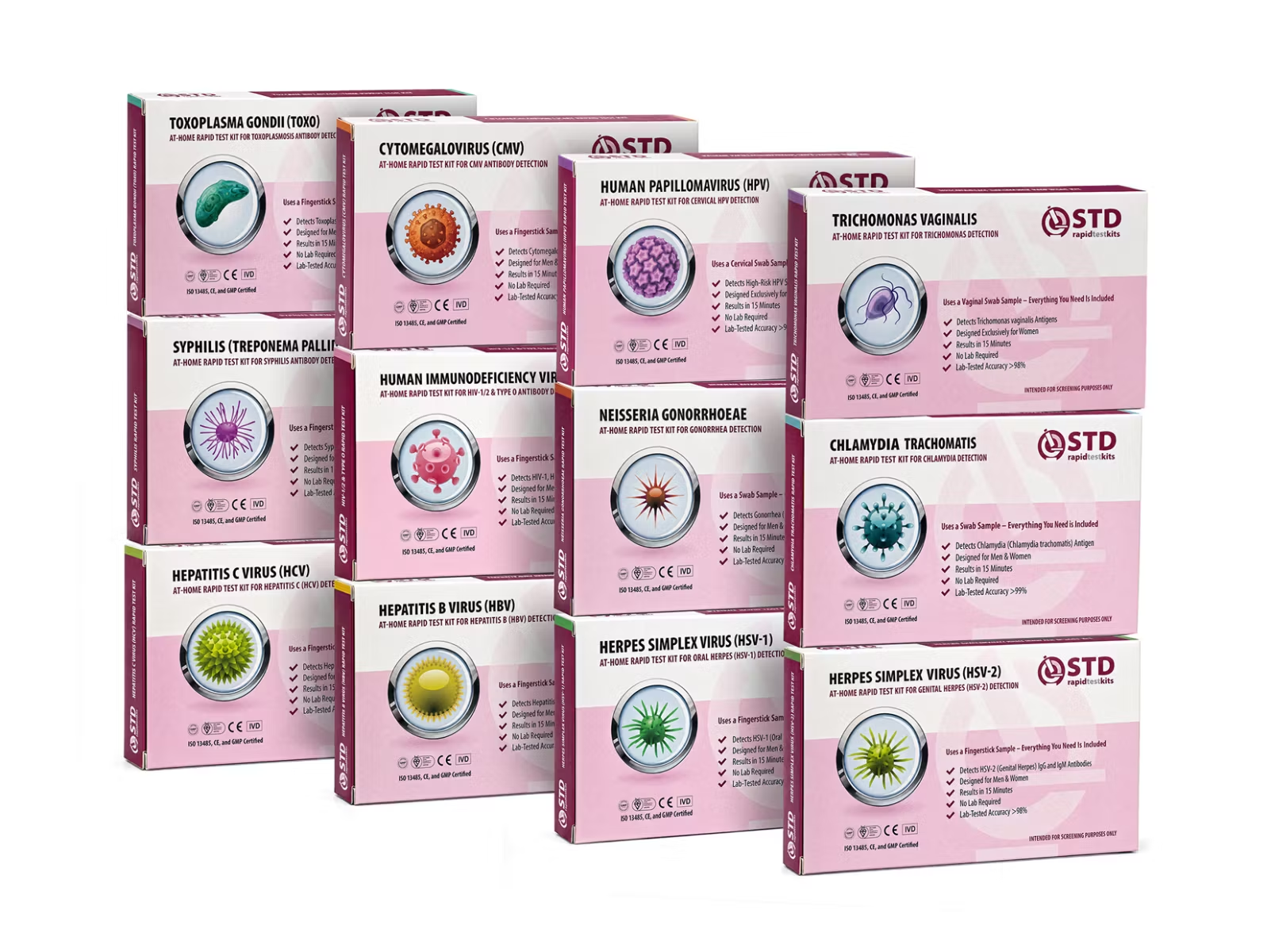
For a reader who has worked through the bump-identification path above and is ready to test, the practical question is how broad to go. A single-infection kit works when you have a clear pattern match (a herpes-style cluster, a chancre-shaped ulcer). A 3-in-1 covers the bacterial concerns from one sample event when the pattern is ambiguous. A comprehensive 10-in-1 makes sense when a new partner is the underlying concern and you want a full sweep regardless of which specific bump you are tracking.
- U.S. Centers for Disease Control and Prevention. About sexually transmitted infections, including overview of common STIs, transmission, and the asymptomatic nature of many infections.
- U.S. Centers for Disease Control and Prevention. About genital herpes, including symptom patterns, recurrence behavior, HSV-1 versus HSV-2 transmission, and 2018 U.S. new-infection counts among people aged 14 to 49.
- U.S. Centers for Disease Control and Prevention. About human papillomavirus, covering general HPV transmission, the distinction between low-risk wart-causing types and high-risk oncogenic types, vaccination guidance, and current screening recommendations.
- U.S. Centers for Disease Control and Prevention. About syphilis, including the primary chancre description, 3 to 6 week healing duration, and progression to secondary stage.
- World Health Organization. Herpes simplex virus fact sheet covering global HSV-1 and HSV-2 prevalence, asymptomatic carriage, and typical symptom patterns.
- UK National Health Service. Genital herpes condition page including symptom patterns, blister-to-ulcer evolution, first-outbreak systemic symptoms, and clinical diagnosis approach.