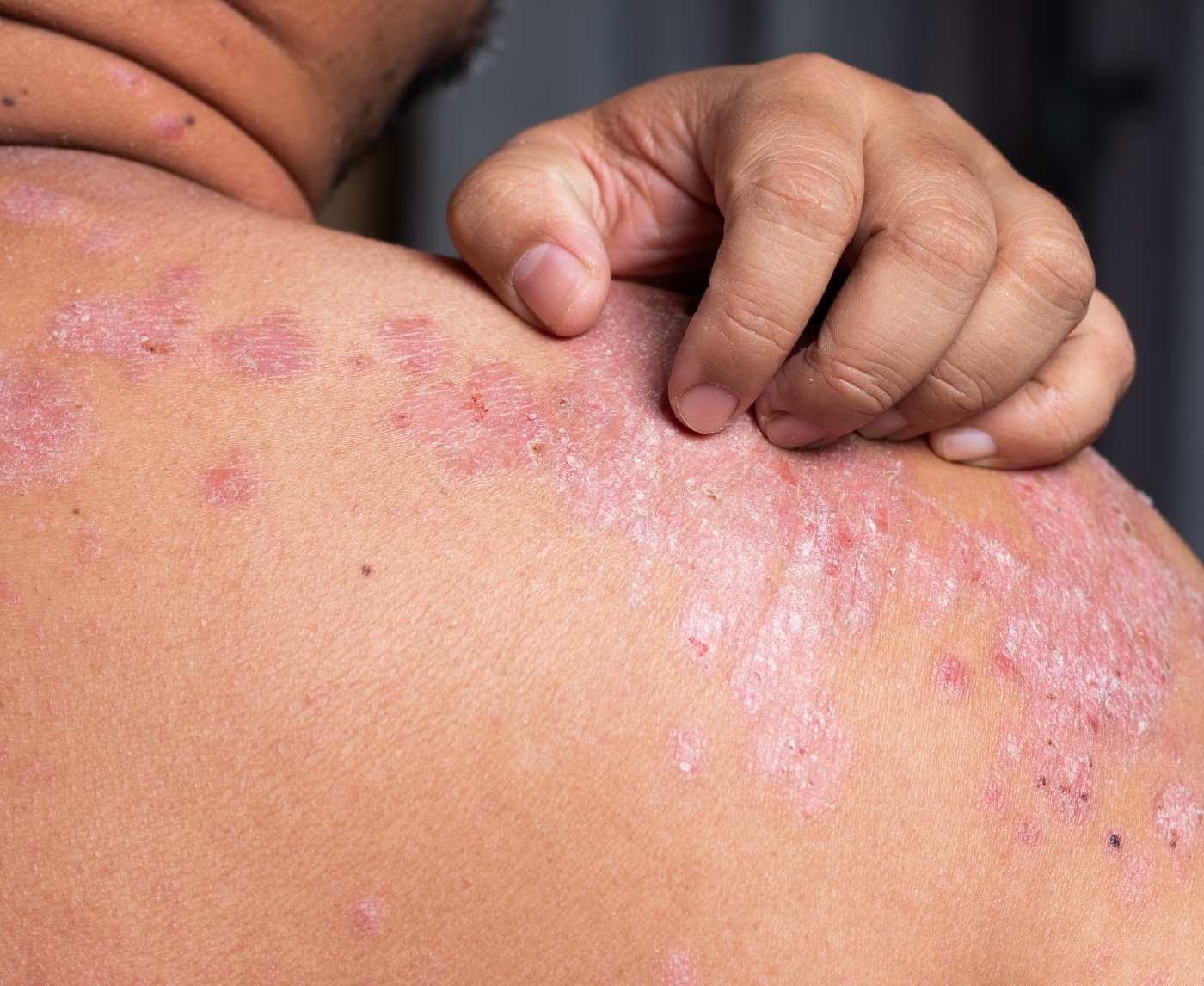

Published: August 2025 | Last updated: April 2026 | Editorial review and quality control: Martina N.
The bumps appeared in the shower and you froze. A rash near the groin, a cluster on an inner thigh, a few reddish patches climbing up a forearm. Within minutes you have ten browser tabs open and none of the photos match what you see in the mirror. Syphilis, herpes, and eczema all show up on adult skin, all cause people to lose sleep, and all look enough alike at first glance that even clinicians sometimes need a lab to tell them apart.
The good news is that each of the three follows a pattern. Once you know what those patterns are, you can stop guessing from photos and start asking the right question: is this something worth testing for, or is this skin reacting to something I can change at home? This guide walks through what each rash actually looks like, how the timing differs, why darker skin tones often get misread by photo guides, and the symptom combinations that should send you toward a test.
Syphilis vs. herpes vs. eczema, at a glance?
Syphilis usually shows up as flat, painless reddish-brown spots on the trunk, palms, or soles, two to twelve weeks after a primary sore. Herpes shows up as a painful, tightly grouped cluster of small fluid-filled blisters, often after a tingling or burning warning, with the first outbreak landing two to twelve days after exposure. Eczema is itchy, dry, and flaky, flares against external triggers like fragranced products or sweat, and tends to recur in the same body folds. Only a test can confirm an STI, but pattern, timing, and sensation narrow the field quickly.
Key Takeaways
- The single most useful clue is sensation: syphilis rashes are usually painless and not itchy, herpes lesions tingle then hurt, and eczema almost always itches.
- If a rash appears on your palms or soles two or more weeks after a new sexual partner, prioritize a syphilis test even if the rash isn't bothering you.
Why these three look so similar
Skin is a noisy diagnostic surface. The same patch of inflammation can read as bright pink on light skin, deep brown or violet on darker skin, and almost colorless on very pale skin. Friction, sweat, and clothing rub against the same body areas where many sexually transmitted infections leave marks, so the geography overlaps. And many of the small clues a clinician relies on (whether the lesion itches, whether it tingles before it erupts, whether the borders are sharp or blurred) don't come through in a photo at all.
That overlap is why three very different conditions, an autoimmune skin disease (eczema), a viral infection (herpes simplex), and a bacterial infection (syphilis), can confuse the eye for a few crucial days. The cost of guessing wrong runs in two directions. Treating an eczema flare like an STI wastes time and worry. Treating an STI like an eczema flare lets a treatable infection move into a stage where complications start to stack up.
The clinician's habit of working from pattern, timing, and history rather than from a single image is what this guide is trying to teach you. None of it replaces a test. All of it can help you decide whether a test is the next step or whether a fragrance-free moisturizer and a few days of patience are.
What a syphilis rash looks like
Syphilis follows a four-stage course (primary, secondary, latent, and tertiary), and the rash people picture when they Google syphilis is the secondary-stage rash. It typically shows up two to twelve weeks after the original painless sore (the chancre) at the site of infection, which often heals on its own without anyone noticing (CDC syphilis topic page). By the time the rash appears, the original sore may be long gone and the connection to a sexual exposure is easy to miss.
The secondary rash has a few features that make it more recognizable than people expect:
- Flat or only slightly raised spots, often described as macular or maculopapular.
- Reddish-brown on lighter skin; copper, brown, gray, or violet on darker skin.
- Often symmetrical, appearing on both sides of the body.
- Spreads to the trunk, arms, and legs, and notably involves the palms of the hands and soles of the feet.
- Usually painless and not itchy.
Palm and sole involvement is the detail that separates syphilis from most other adult rashes. Eczema rarely lands there. Herpes basically never does. A flat, painless rash on your palms after an unexplained genital or oral sore weeks earlier is the textbook secondary-syphilis presentation.
Other symptoms often arrive at the same time: low-grade fever, sore throat, fatigue, swollen lymph nodes, patchy hair loss in eyebrows or scalp, and pale moist patches on mucous membranes. Without treatment, syphilis can move into a silent latent stage and resurface years later with neurological or cardiovascular complications, which is why early testing matters even when the rash is fading on its own (WHO syphilis fact sheet).
Many people who have syphilis don't know it. Without treatment, syphilis can lead to severe health problems.
How herpes blisters break the pattern
Herpes simplex (HSV-1 and HSV-2) takes the opposite approach. Instead of a quiet symmetrical rash that doesn't bother you, it announces itself with sensation. Most people feel something before they see anything: a tingling, burning, or aching feeling along a small patch of skin, sometimes a day or two ahead of the first visible bump. That early warning is sometimes called a prodrome, and it's one of the more reliable distinguishing features of HSV.
What appears next is a tight cluster of small fluid-filled vesicles on a red, inflamed base. They sit close together rather than scattered, often within a coin-sized patch. Within a few days the blisters break, weep clear or yellowish fluid, and crust over. The whole cycle usually runs seven to fourteen days for a first outbreak; recurrences tend to be milder and shorter (MedlinePlus genital herpes).
Location follows where the virus entered:
- HSV-1 typically around the mouth, lips, and chin (cold sores), though it can appear in the genital area through oral contact.
- HSV-2 typically around the genitals, perineum, buttocks, or upper inner thighs.
- A first outbreak can come with fever, headache, painful urination, and tender swollen groin lymph nodes.
- Recurrent outbreaks tend to land in the same spot each time, which is one of the more useful long-term clues.
Because early herpes lesions can look like ingrown hairs, razor burn, or a mild eczema flare, people often dismiss the first few bumps. Once the cluster is fully formed, the picture is harder to miss: grouped vesicles on a red base, with pain that doesn't match what a simple rash would cause. The CDC's herpes resource is the cleanest plain-English summary of how the virus presents and why testing during an active outbreak gives the most useful result (CDC herpes topic page).
Tingling, burning, or aching along a small patch of skin in the day or two before any bumps appear is often the only herpes-specific clue available. Neither syphilis nor eczema produces this localized pre-rash sensation. If you've felt it once and matched it to a later cluster of blisters, treat the same sensation in the future as your signal to start antiviral treatment early or schedule a swab during the active outbreak.
How eczema mimics both
Eczema, most often atopic dermatitis, is a chronic inflammatory skin condition rather than an infection. The skin barrier doesn't hold moisture well, and the immune system overreacts to triggers most people would never react to. That distinction matters for management, because an antiviral or antibiotic does nothing for eczema, while a fragrance-free moisturizer and a short course of topical steroid does almost nothing for an active herpes outbreak (NHS atopic eczema).
Eczema is defined by itch. Often it's the symptom people remember most, sometimes severe enough to interrupt sleep or pull blood when scratched. The skin looks dry, flaky, sometimes thickened or leathery in spots that have been rubbed for years. Color varies more than people expect: pink to deep red on lighter skin, dark brown, gray, or purple on darker skin, with the texture (rough, dry, occasionally weeping if scratched open) often telling more of the story than the color.
Common eczema sites in adults:
- Inside the elbows and behind the knees (the classic flexural pattern).
- Groin, inner thighs, and under the breasts where clothing rubs and traps sweat.
- Around the navel, on the eyelids, and on the hands of people who wash often.
- Anywhere a new product (detergent, soap, lotion, lubricant) made recent contact.
That last category is the source of a lot of false-alarm panic: a flare in the groin or thigh fold easily reads as an STI rash if you don't already know your eczema pattern. Triggers are familiar to anyone who's lived with the condition: scented soaps and detergents, latex, lubricant ingredients, hot water, sweat, dry indoor air, stress, and sometimes specific food sensitivities. Flares wax and wane, often in patterns the person has experienced before.
| Feature | Secondary syphilis | Herpes simplex | Atopic eczema |
|---|---|---|---|
| Sensation | Usually painless, not itchy | Tingling or burning, then pain | Itchy, often intensely |
| Timing after trigger | 2 to 12 weeks after primary sore | 2 to 12 days after exposure | Hours to days after contact with a trigger |
| Typical location | Trunk, arms, legs, often symmetrical | Localized cluster at the site of viral entry | Skin folds or wherever a product made contact |
| Palms and soles | Common and characteristic | Rare | Rare |
| Lesion shape | Flat reddish-brown spots, smooth | Tight cluster of fluid-filled vesicles on a red base | Dry, scaly, thickened patches with blurred borders |
| Responds to fragrance-free moisturizer | No | No | Often improves |
| Confirmed by | Blood test (RPR plus treponemal) | Swab of an active lesion or HSV antibody blood test | Clinical exam, sometimes a biopsy to rule out infection |
What each one looks like, side by side
The four illustrative figures below cover the most distinctive presentation of each condition, plus one of the lookalikes that sends people to clinics convinced they have herpes. None of them is a substitute for testing. They're meant to help you recognize the broad shape of what you're looking at so you can ask better questions when you book a test or a dermatology visit. Matching more than one figure is the rule rather than the exception, and a reason to test instead of guess.
Timing tells you a lot
Timing narrows the field faster than visual pattern alone. Comparing when a rash appeared against any recent trigger does more diagnostic work than scrolling through photo comparisons.
Herpes is a quick mover. After exposure, the prodromal sensations and first blisters usually appear within two to twelve days, with most people noticing something within a week. The rash develops over forty-eight to seventy-two hours from tingle to full vesicle cluster. By two weeks the lesions have crusted and are healing. Anyone who developed a clearly painful blister cluster on day three after a new partner is dealing with timing that fits HSV.
Syphilis runs a slower, more confusing clock. The painless primary chancre appears about three weeks after exposure (anywhere from ten days to three months) and resolves on its own in three to six weeks. The secondary rash arrives weeks to months after the chancre healed, sometimes catching people who had forgotten about a small sore that came and went. A new symmetrical rash with palm-and-sole involvement six to eight weeks after a new partner, especially one with no itch and no pain, is the timing pattern that most often points to syphilis.
Eczema doesn't run a clock at all. It flares against external triggers and quiets when those triggers are removed. A rash that appeared the morning after switching laundry detergent, or after a long sweaty run in tight synthetics, is following an eczema timeline. So is a rash that comes back to the same crook of an elbow every winter when indoor heating dries the air out.
Why skin tone changes what you see
Most rash photos that show up in search results were taken on light skin, which is a serious problem if your skin is brown or black. The textbook descriptions of these conditions are written around how they look on light skin, and the visual cues those descriptions assume (bright pink inflammation, red-on-pale contrast) don't translate (American Academy of Dermatology).
On darker skin:
- Syphilis spots can look gray, copper, deep brown, or even violet rather than the reddish-brown of standard descriptions.
- Herpes lesions can look like skin-colored or grayish bumps rather than dramatic red blisters, and the surrounding inflammation that's so obvious on light skin can be subtle enough to miss entirely on the first day or two.
- Eczema patches often present as gray, dark brown, or purple-toned thickened areas rather than pink or red flares, and the post-inflammatory pigmentation that lingers after a flare can outlast the actual rash by weeks.
Photo searches are even less reliable for darker skin tones than for lighter ones. The condition you have may not look like the photos that come up. The photo set simply does not represent the full range of skin tones, so a mismatch between your skin and a search result is a sampling problem rather than a diagnostic one. With visual cues muted, sensation carries more diagnostic weight: the classic itch of eczema, the tingle-then-blister of herpes, the painless and itch-free quality of syphilis. Those features carry across skin tones in a way that color does not.
If your skin is darker and you're trying to figure out what you're looking at, prioritize describing what you feel, not just what you see. Both descriptions go in the same conversation with a clinician, and both improve the odds of a correct answer the first time.
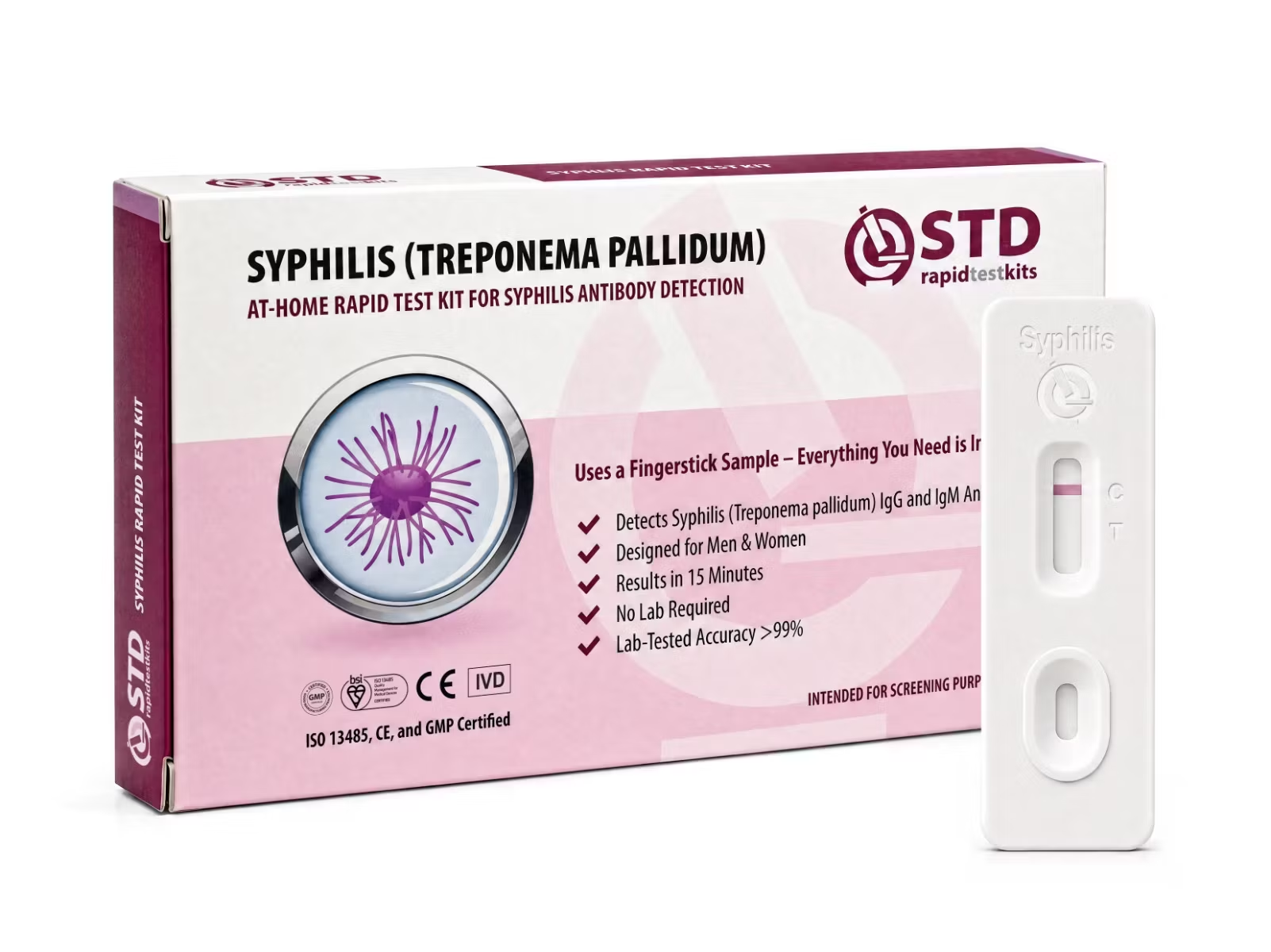
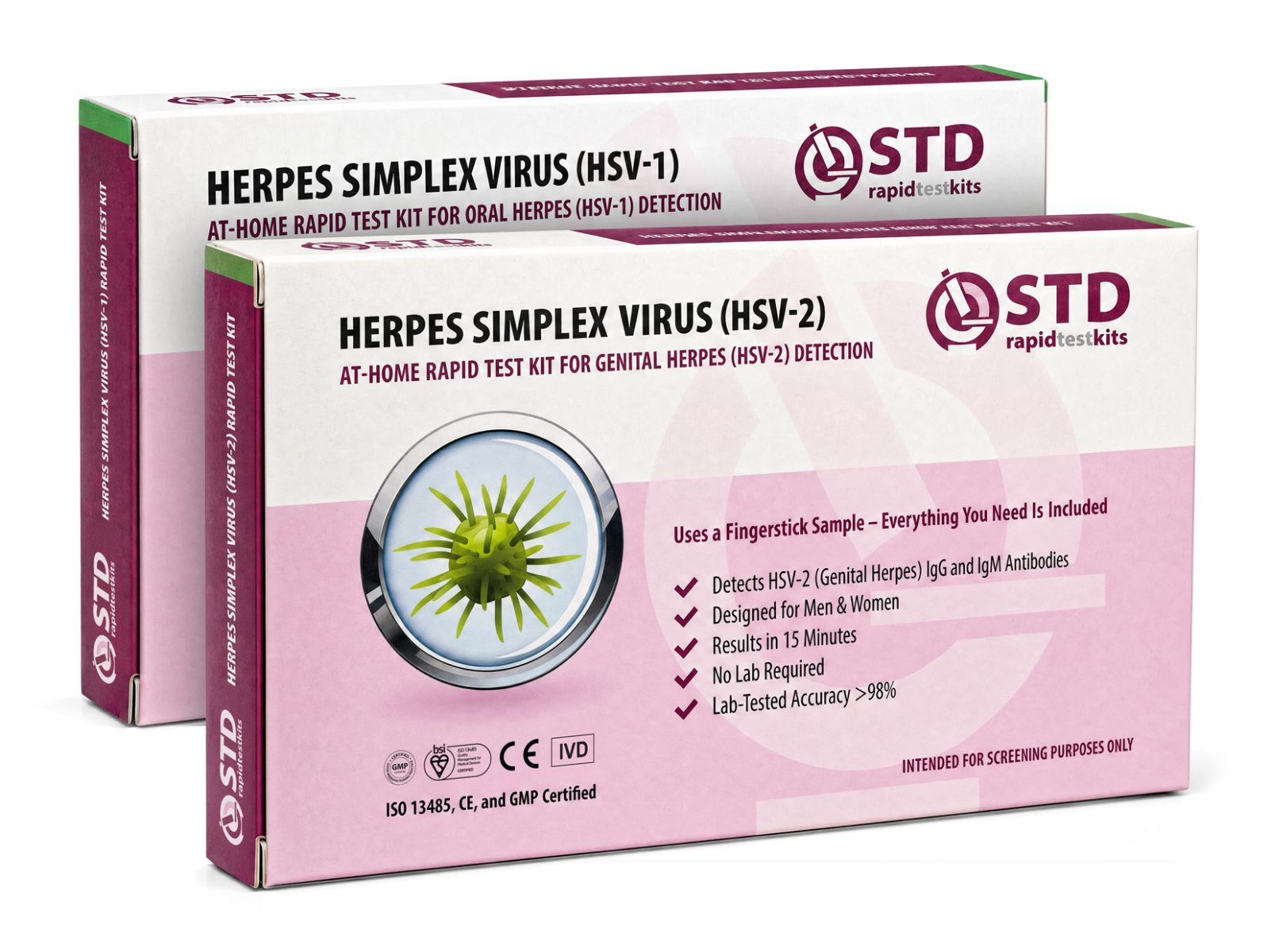
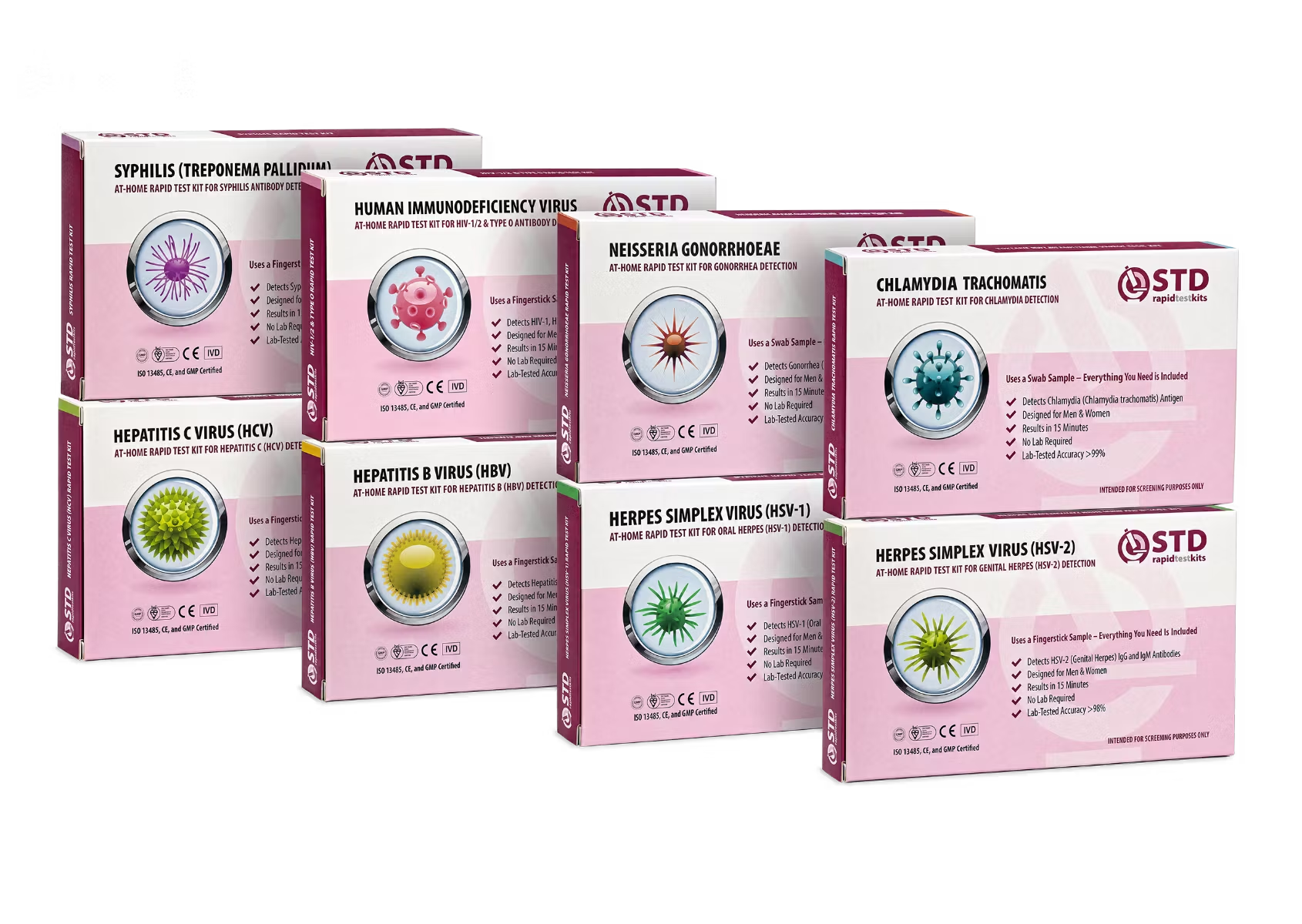
This article is published by stdrapidtestkits.com, which sells at-home rapid STI testing kits. We recommend products based on fit-for-purpose for the reader's concern, not commercial benefit. The single-infection kits referenced below (syphilis and herpes) are fingerstick blood antibody tests; the 8-in-1 combo kit includes both swab and fingerstick blood components. In all cases, a positive home result is worth confirming with a clinic lab before starting treatment.
Why self-diagnosis fails so often
Even with all of the above, the same condition can present differently on different people, and unrelated skin issues can land on the same body at the same time. Co-infections are common; a person with eczema is just as exposed to STIs as anyone else, and a person who tested positive for one STI has elevated odds of testing positive for another.
A rash that doesn't fit any single description perfectly is worth testing. So is one that fits a pattern early but evolves into something different over a few days. Both are reasons to test rather than wait.
The other failure mode of self-diagnosis is reassurance bias. People who are afraid of an STI diagnosis often hunt for the photo that lets them stop worrying, and the internet is generous with photos that look like nothing serious. The honest answer usually requires a test, since photo-searching tends to surface whichever conclusion the searcher was already hoping to find.
When testing actually answers the question
Test if any of the following apply:
- A rash on your palms or soles, especially without itching, especially if a small painless sore came and went weeks earlier.
- A clustered, painful blister patch in the genital, perianal, oral, or buttock area, particularly with tingling that preceded it.
- A new rash within four to twelve weeks of a new sexual partner.
- A rash that's spreading rather than resolving, or that's accompanied by fever, swollen lymph nodes, sore throat, or fatigue.
- A rash that doesn't respond to a week of fragrance-free moisturizer and a brief over-the-counter hydrocortisone trial.
- Any rash plus a partner who has tested positive for an STI.
Herpes blood antibody tests need around twelve weeks after exposure to register reliably; if you have an active blister cluster, a swab of the lesion at a clinic gives a faster and more specific answer. Syphilis blood tests turn positive about three to six weeks after exposure, sometimes a bit longer. A negative test taken too early doesn't rule out infection; the simplest fix is to repeat the test once the window period has passed.
At-home rapid kits use lateral-flow strip technology, the same kind of test format used for home pregnancy and COVID antigen tests. They're a screening tool, fast and private, and the lateral-flow chemistry is meaningfully different from a laboratory NAAT or PCR. A positive result is worth confirming with a clinician's lab test before starting treatment, and a negative result during the window period is worth repeating after the window closes.
Prevention that helps both your skin and your sex life
The daily habits that lower STI risk and the daily habits that calm eczema overlap more than people expect. Both reward consistency rather than perfection.
For STI risk: barrier methods (condoms, dental dams) reduce transmission of every infection covered in this article. Regular testing on a cadence that fits your sexual activity is the second pillar; once a year for low-risk patterns, every three to six months for higher-risk patterns. Conversations with new partners about recent test history are awkward exactly once and then become normal.
For your skin: the products that touch you matter more than most people realize. Fragranced soaps, scented detergents, and novelty lubricants are the most common avoidable triggers. Switching to fragrance-free, hypoallergenic versions of the same product categories is unglamorous and quietly effective. Cotton or other breathable underwear reduces sweat trapping and friction in skin folds. A bland fragrance-free moisturizer applied to damp skin after a short, lukewarm shower restores the skin barrier; the cheaper jars at the pharmacy work as well as the expensive ones.
For both: become your own observer. A two-line note in your phone when a rash appears (location, sensation, what was new in the last week) becomes useful data when you do see a clinician. Photos taken in the same lighting on day one, day three, and day seven of a rash give a clinician more than a verbal description ever can.
Three habits that protect both your skin and your sexual health
- Barrier methods (condoms, dental dams) reduce transmission of every infection covered in this article and are the cheapest insurance against the conditions that put you in front of a search engine in the first place.
- Switching to fragrance-free, hypoallergenic versions of soap, detergent, and lubricant removes the most common avoidable eczema trigger and the most common cause of false-alarm STI panic.
- A short note in your phone when a rash appears (location, sensation, recent new products), plus dated photos in matched lighting, gives any clinician more useful data than a verbal description can.
Stress, immunity, and why rashes flare at the worst times
There's a reason rashes seem to arrive at the worst possible time. Stress raises cortisol, and cortisol shifts the way the immune system distributes its attention. Latent viruses (HSV is the textbook example) are more likely to break through immune surveillance during high-stress periods, which is why people often notice a herpes recurrence ahead of a major presentation, exam, or move. Eczema flares pattern the same way: cortisol amplifies inflammatory responses, and the dry skin that comes with poor sleep, irregular eating, and travel makes the barrier easier to crack.
Even good stress, like a new relationship, a vacation, or a creative push at work, registers physiologically as stress. Sleep changes, new environments, and altered routines all upset the body's baseline.
Syphilis doesn't follow this pattern as cleanly because it's a bacterial infection that progresses on its own clock; once it's in the body, it doesn't really wait for the immune system to drop its guard. The diagnostic experience can still feel similar in one way: the symptoms are easier to misread when the person is already exhausted and assuming the worst, which is exactly when they're most likely to appear.
Frequently asked questions
- Can a syphilis rash itch?
- Most secondary syphilis rashes do not itch and do not hurt. A small minority of cases include mild itching, but a flat painless rash is the more typical presentation. If your rash is intensely itchy, syphilis is less likely than eczema, an allergic reaction, or another skin condition, but it's still worth testing if you have other risk factors.
- How fast can a herpes outbreak show up after exposure?
- If you notice tingling or unusual skin sensitivity within a week of a potential exposure, treat it as a prodrome signal worth watching. Most people see blisters within forty-eight to seventy-two hours of those first sensations, and the full first outbreak usually resolves in seven to fourteen days. Recurrences after the first outbreak vary widely; some people get them every few months, others not for years, and they tend to be milder and shorter than the first.
- Can eczema appear on the genitals?
- Yes. Atopic dermatitis can flare anywhere on the body, including the groin, vulva, scrotum, perianal area, and inner thighs. People with sensitive skin or a history of allergic reactions to soaps, detergents, fabrics, or lubricants are more prone to genital flares. Eczema in this area is non-contagious and usually responds to fragrance-free moisturizer and a short course of topical steroid prescribed by a clinician.
- How can I tell the difference between an early herpes blister and an ingrown hair?
- A single bump along the shaved area, with a visible coiled hair under the skin and minimal pain, is most likely an ingrown hair. A tight cluster of small fluid-filled blisters on a red base, especially with tingling, burning, or aching sensations starting before the bumps appeared, fits herpes. Folliculitis (a bacterial infection of the hair follicles) sits between the two: scattered small red bumps, sometimes with yellow tips, distributed across the shaved area rather than grouped in one cluster.
- Can a syphilis rash go away without treatment?
- Yes, the secondary rash usually resolves on its own within a few weeks. The infection itself does not. Untreated syphilis moves into a latent stage that can last years before resurfacing as tertiary disease, with potential cardiovascular and neurological complications. A rash that disappeared on its own is not a reason to skip testing.
- How does an at-home rapid test differ from a lab test?
- At-home rapid kits use lateral-flow strip chemistry, the same general format as home pregnancy and COVID antigen tests. They give a fast private result in about fifteen minutes and are well-suited for screening. Laboratory tests for syphilis (RPR/VDRL with confirmatory treponemal tests) and herpes (PCR or NAAT swab from active lesions) use different technology with higher analytical sensitivity. The two are complementary: home tests are a fast first answer, lab tests are the gold standard for confirmation before treatment.
- Can someone have herpes, syphilis, and eczema at the same time?
- Yes. Eczema is a chronic skin condition unrelated to either infection, and the two STIs are not mutually exclusive. Co-infections of HSV and syphilis are well documented, and either infection in a person with eczema can be harder to spot because the skin already has a baseline of inflammation. If you have eczema and a new symptom that doesn't fit your usual flare pattern (especially blisters, palm or sole spots, or anything painless and persistent), test rather than assume.
- When is a rash an emergency rather than something to watch?
- Seek same-day medical care for: rapidly spreading rash with fever and severe pain, blistering rash inside the mouth or on the eyes, signs of skin infection (warmth, increasing redness, streaking, pus), or any rash with difficulty breathing, swelling of the face or tongue, or confusion. For non-urgent cases, a rash that hasn't improved with a week of basic skin care, or that fits any of the STI patterns described above, deserves a test or a clinician visit within a few days.
- U.S. Centers for Disease Control and Prevention. Syphilis topic page covering the four-stage clinical course, primary chancre and secondary rash patterns, and current screening guidance.
- U.S. Centers for Disease Control and Prevention. Herpes simplex topic page covering HSV-1 and HSV-2 transmission, prodromal symptoms, outbreak timeline, and testing options including swab versus blood antibody tests.
- World Health Organization. Syphilis fact sheet with global epidemiology, clinical staging, and the rationale for screening and treatment.
- U.S. National Library of Medicine, MedlinePlus. Genital herpes overview including symptoms, prodrome, outbreak progression, first-outbreak duration, and recurrence patterns.
- National Health Service (UK). Atopic eczema overview including triggers, presentation across body sites, and stepwise management with emollients and topical steroids.
- American Academy of Dermatology. Eczema resource center with adult presentation, skin-of-color guidance, and trigger management.
