
Published: September 2025 | Last updated: April 2026 | Editorial review and quality control: Martina N.
A painless sore on or near the genitals can feel paradoxical. Pain is supposed to be the body's warning system, so the absence of pain reads as the absence of risk. With sexually transmitted infections, that logic does not hold. Syphilis chancres are classically painless. Some herpes outbreaks are mild enough to mistake for an ingrown hair. Several non-STI conditions look similar. The good news is that figuring out which one you have is straightforward once you know what to look for and which test fits the timing.
Is a painless genital sore an STI?
It can be. Syphilis is the most common cause of a painless genital ulcer; herpes can also present with mild or near-painless lesions. Non-STI causes such as folliculitis, ingrown hairs, friction injuries, and aphthous-type ulcers also produce sores that do not hurt. The pattern alone cannot tell you which one you have. A blood test for syphilis (and a swab if a sore is currently visible) gives a definitive answer in three to six weeks after exposure.
Key Takeaways
- Painless does not mean harmless: a syphilis chancre is firm, round, and almost always painless, yet the infection keeps spreading inside the body after the sore heals.
- If the sore lasts more than a few days, recurs, or appears after a new sexual partner, a syphilis blood test plus a herpes evaluation gives clarity in three to six weeks.
Why a sore that does not hurt can still matter
We expect injuries to ache. A cut stings, a bruise throbs, a strained muscle tightens up the next day. Most people use that ache as an internal alarm: if something hurts, do something about it. With certain sexually transmitted infections, the immune response that produces pain simply does not switch on, at least not at the visible site. The CDC describes the primary lesion of syphilis this way: "Sores are usually (but not always) firm, round, and painless."
That single line carries a lot of weight, because painless lesions are the ones people walk past. The chancre often shows up tucked under foreskin, on the labia, in the rectum, or inside the cervix where it cannot even be seen. It feels like a small firm button. It does not bleed unless rubbed. It heals on its own in three to six weeks.
The problem is what happens after it heals. Once the chancre disappears, the spirochete bacteria are already circulating in the bloodstream, ready to produce a body-wide rash a few weeks later, then organ damage years on if no one intervenes. The painless sore was the only easy chance to catch the infection at its primary stage, when a single course of antibiotics ends it.
Herpes runs the opposite stereotype. The textbook image is angry, weeping vesicles that burn during urination. That picture is real for many people, but the CDC notes the other side too: "Most people with genital herpes have no symptoms or have very mild symptoms. Mild symptoms may go unnoticed or be mistaken for other skin conditions like a pimple or ingrown hair." A small herpes lesion that itches faintly for a day is easy to write off. The virus still sheds, and it still transmits.
Then there are the look-alikes that are not STIs at all: razor folliculitis, ingrown hairs, friction abrasions from new underwear, allergic contact dermatitis, and aphthous-type genital ulcers similar to a canker sore. These usually clear up on their own within a week, but during the first few days they can be visually identical to a chancre or a herpes lesion. The overlap in appearance is why a clinician's workup runs a test rather than reading the visual.
The CDC's position on genital herpes is that most carriers "have no symptoms or have very mild symptoms," and those mild lesions are commonly mistaken for a pimple or an ingrown hair. The same body that uses pain as a reliable alarm for a sprained ankle does not use it the same way for syphilis or for mild herpes. Pain is not the alarm system here.
The likely causes of a painless genital sore
Five conditions sit at the top of the differential when a sore does not hurt. Three are sexually transmitted, two are not. Knowing the rough shape of each one helps you read the clues, but it does not replace a test.
Primary syphilis. The classic chancre is firm to the touch, round, and well demarcated, usually 5 to 15 mm across. The base is clean rather than pus-filled. There is sometimes a single nearby lymph node enlargement on the same side. The WHO describes the lesion plainly: "a round, painless, usually hard sore (chancre) appears on the genitals, anus or elsewhere." Most chancres show up about two to three weeks after exposure, though the timing can stretch longer; the NHS notes that "it can take 3 weeks or more for the first symptoms of syphilis to appear after you're infected." Without treatment, the sore heals in three to six weeks; the infection does not.
Mild or atypical herpes. Most herpes outbreaks involve some discomfort, but the discomfort runs a spectrum. A first outbreak is usually the most pronounced, with clusters of small fluid-filled vesicles that rupture and crust over, often paired with low-grade fever and tender groin lymph nodes. Recurrences in the same body region are usually milder, sometimes just a brief tingle and a small patch of redness. Globally the WHO estimates 520 million people aged 15 to 49 carry HSV-2, and most carriers "are asymptomatic or unrecognized," which is one reason the virus spreads efficiently.
Chancroid. Less common in the United States than it once was, chancroid (caused by the bacterium Haemophilus ducreyi) classically produces a soft, ragged, painful ulcer with painful regional lymph nodes. The textbook says painful, although case reports document atypical painless variants. The CDC's genital ulcer treatment guidelines flag chancroid alongside herpes and syphilis as one of the conditions to evaluate when a genital ulcer presents, even if it is now uncommon domestically.
Folliculitis and ingrown hairs. Hair removal, friction from athletic wear, and tight underwear can produce small red papules that look like ulcers as they evolve. The hair shaft is sometimes visible at the center. These usually resolve within five to seven days with no intervention beyond letting the area breathe. They tend to recur in the same shaved or waxed zones.
Aphthous-type ulcers and friction injuries. Aphthous ulcers (the same type that produce canker sores in the mouth) occasionally appear on genital mucosa, often during a stressful period, after a viral illness, or in association with conditions like Behcet disease. They are tender to direct pressure although rarely "painful" in the burning herpes sense, and they heal in a week to ten days. Friction blisters from new partners or rough sex play a similar role: a brief tear that crusts over and heals.
Two rarer causes deserve mention because the CDC includes them in the genital ulcer differential: lymphogranuloma venereum (LGV, a chlamydia subtype that can cause a small painless sore followed by tender groin swelling) and donovanosis (rare in temperate climates, slowly enlarging painless ulcers). Most readers in the United States will not encounter these, although a clinician will rule them out if the common causes do not fit.
Painless syphilis vs painless herpes: how they differ
Visually, the two infections can converge enough to fool a brief glance. Both produce ulcers. Both can show up after a new sexual contact. Both are routinely missed by people who assume the sore is friction. There are still pattern differences worth knowing about, even if the only reliable answer is a test.
Number of lesions. Primary syphilis usually produces a single chancre. Some people get a few, although the most common presentation is one. Genital herpes more typically shows multiple small lesions clustered together, the way cold-sore vesicles cluster on the lip. A single lesion does not rule out herpes, especially in a recurrence; multiple lesions do not rule out syphilis either, although the lesion count nudges the probability one way or the other.
Texture and depth. A chancre is firm. The clinical word is indurated, meaning the rim feels like a small button under the skin. A herpes lesion is shallower, often starting as a clear or yellowish vesicle that ruptures into a small wet ulcer with a softer, sometimes ragged, edge.
Pain. Almost all chancres are painless. Most herpes lesions cause at least some itching, tingling, or tenderness, especially on first outbreak; in mild recurrences the discomfort can be barely noticeable.
Healing pattern. A syphilis chancre takes three to six weeks to heal, slowly and quietly, leaving no residual mark in most cases. A herpes lesion follows a faster cycle (vesicle, ulcer, crust, healed in roughly 7 to 21 days for a first outbreak, shorter for recurrences). Recurrences cluster in the same skin region because the virus reactivates from the same nerve root.
Systemic clues. Secondary syphilis, the stage that follows the painless chancre by a few weeks, often produces a non-itchy palms-and-soles rash, mild flu-like symptoms, and patchy hair loss. A first herpes outbreak commonly involves low-grade fever, body aches, and groin lymph node tenderness, although recurrences usually do not.
Lesion patterns can lean one way; they do not decide which infection is present. The CDC's official guidance for clinicians is that "a diagnosis based only on medical history and physical examination frequently can be inaccurate," which is why the standard workup runs both a syphilis blood test and a herpes evaluation when an ulcer is present.
| Cause | Typical look | Pain? | Healing time | Test that fits |
|---|---|---|---|---|
| Primary syphilis | Single firm round chancre, raised rolled border | Painless in almost all cases | 3 to 6 weeks (untreated) | Blood antibody test from 3 to 6 weeks post-exposure |
| Herpes (HSV-1 or HSV-2) | Cluster of small vesicles that rupture into shallow ulcers | Itching to mild burning; sometimes minimal | 7 to 21 days for first outbreak | Lesion swab during outbreak; blood antibody test from 12+ weeks |
| Chancroid (rare in U.S.) | Soft ragged-edge ulcer, often with painful groin nodes | Usually painful, occasionally not | Weeks if untreated | Clinic evaluation, lesion swab |
| Folliculitis or ingrown hair | Small red bump centered on a hair follicle | Mild discomfort or itching | 5 to 7 days | Usually no test needed if it resolves |
| Aphthous-type ulcer | Shallow round ulcer with white-yellow base and red rim | Tender to pressure, not burning | 7 to 10 days | Clinical exam if recurrent or atypical |
When the sore disappears on its own
This is where painless ulcers cause the most trouble. A chancre starts small, sits there for a few weeks doing very little, then fades. Many people interpret the disappearance as proof that whatever it was, the body sorted it out. With syphilis specifically, that interpretation is wrong, and the consequence of being wrong unfolds slowly across years.
After the chancre heals, the next stage of syphilis (secondary syphilis) emerges several weeks later. The CDC describes the secondary-stage rash as appearing "when your primary sore is healing or several weeks after the sore has healed": a non-itchy rash that often involves the palms and soles, low-grade fever, sore throat, swollen lymph nodes, patchy hair loss, and occasionally raised gray lesions on mucous membranes. The rash too will resolve on its own without treatment, which doubles the disappearing-act pattern. The infection is still active. Years later, untreated syphilis can damage the nervous system, the cardiovascular system, and the eyes.
Herpes lesions also vanish on their own. The cycle is faster: a vesicle forms, ruptures, scabs over, and heals in roughly one to three weeks for a first outbreak, sometimes within a week for a mild recurrence. The skin returns to normal. The virus retreats into the nerve cells where it lives permanently, ready to reactivate during stress, illness, hormonal shifts, or for no obvious reason at all.
Two practical takeaways follow. First, a sore that lasted more than a couple of days and then went away is itself a reason to test, because both syphilis and herpes commonly leave the skin clear while the infection persists. Second, the test you use depends on timing. A swab from a fresh lesion is more sensitive than a blood antibody test in the first weeks; a blood antibody test catches infections after the lesion has healed.
That sequence (painless sore that healed, then a non-itchy rash including the palms and soles a few weeks later) is the classic transition from primary to secondary syphilis. Test and start treatment promptly; untreated, the infection continues to advance into systemic stages that can damage the nervous system and the cardiovascular system years on. A single course of antibiotics at this stage cures the infection.
Testing options and timing windows
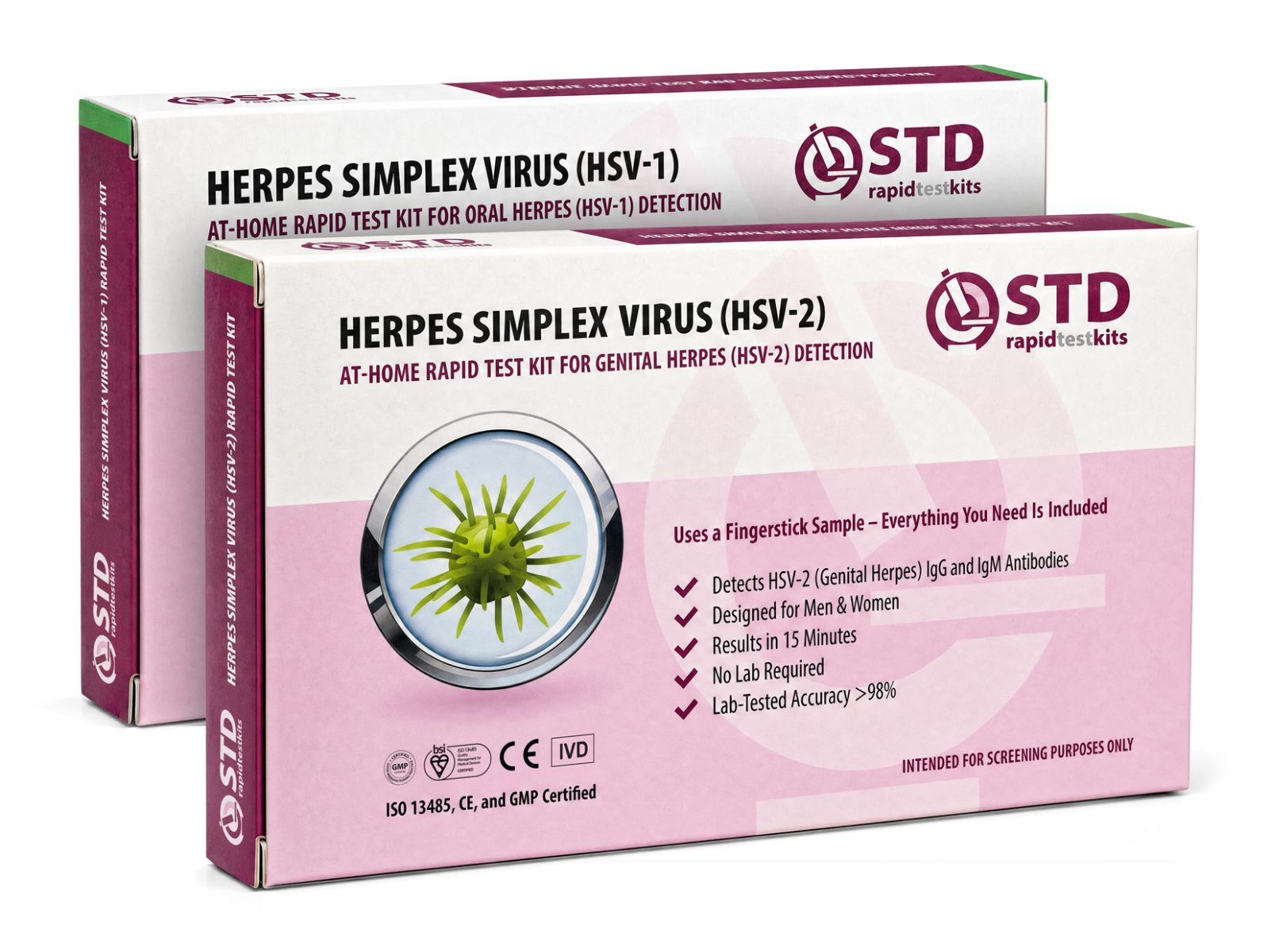
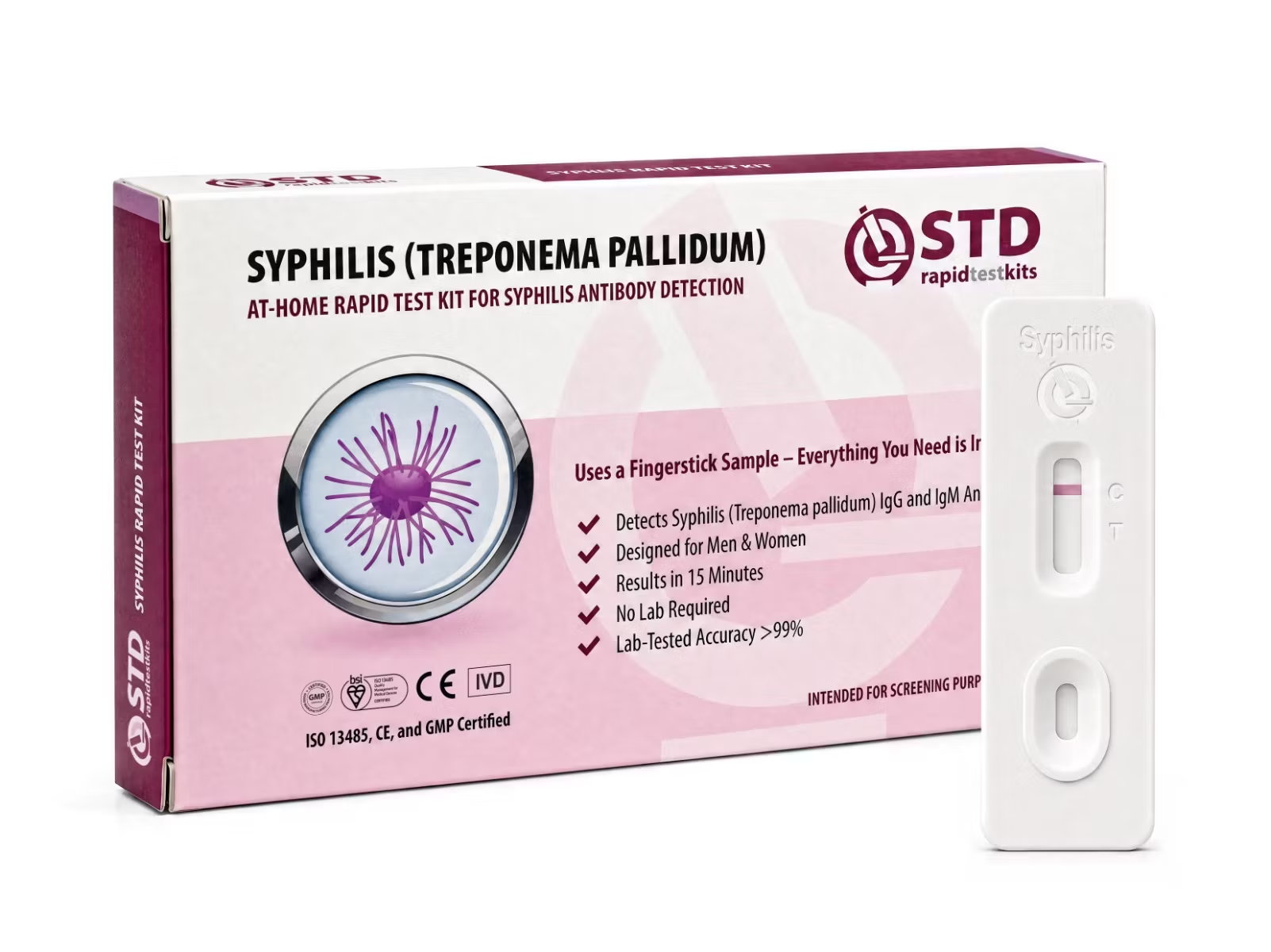
This article is published by stdrapidtestkits.com, which sells at-home rapid lateral-flow tests for syphilis, herpes, and multi-STI panels. Specific products are linked below as they fit the timing of the sore in question; we recommend by clinical fit, not by margin.
There are three tools for figuring out a painless genital sore, and the right one depends on what is currently visible and how recently the exposure happened.
Direct lesion tests (swabs). When a sore is currently present, a swab of the lesion (sampling the fluid or the base) is the highest-sensitivity test for both herpes (PCR or viral culture) and syphilis (darkfield microscopy or PCR for Treponema pallidum, available at specialty labs). PCR herpes swabs can detect virus within days of an outbreak. The catch is that swab tests need an active sore. Once it heals, that window closes. Lesion swabs are typically performed in a clinic; we do not sell a home swab test for syphilis or herpes lesions.
Blood tests. Syphilis is diagnosed by blood antibody testing (a non-treponemal test like RPR or VDRL plus a confirmatory treponemal test). Antibodies become reliably detectable around three to six weeks after exposure, which is why a negative test soon after a possible exposure should be repeated. Herpes blood tests detect IgG antibodies to HSV-1 and HSV-2; these are most useful for confirming long-standing infection rather than diagnosing a brand-new exposure, since seroconversion can take several weeks to a few months.
At-home rapid tests. Lateral-flow rapid tests are home-test fingerstick blood antibody tests; they use the same antibody chemistry as lab assays and produce a result in 15 minutes from a drop of blood. For syphilis, the at-home rapid test is most accurate from about three to six weeks after exposure onward. For herpes, an at-home blood antibody test is most useful 12 weeks or more after the suspected exposure. These home tests are screening tools; a positive result is worth confirming with a clinic-administered laboratory test, which uses higher-sensitivity NAAT or PCR chemistry. The two are complementary, not equivalent.
What to use, when. If a sore is currently present, a clinic visit for a lesion swab gives the most direct answer in the early window. If the sore has already healed, a syphilis blood test (rapid at home or lab-drawn) is the right starting point because syphilis is the painless-sore default. A herpes blood test added on tells you about long-standing exposure although not specifically about the lesion that just disappeared. If multiple infections are possible (a new partner, a hookup, group exposure), a multi-infection panel covers the field in one collection.
Protecting yourself and partners while you wait
Even a sore that does not hurt can still transmit infection. The chancre of primary syphilis is highly contagious; the few weeks it sits visible is the window when transmission risk is highest. Mild herpes lesions also shed virus, sometimes more than the painful ones, because people stay sexually active.
The practical move while you wait for results is straightforward. Avoid genital, oral, and anal contact with the affected area until you know what you are dealing with. Condoms reduce transmission although they do not eliminate it; the area covered by latex is smaller than the area where a chancre or herpes lesion can sit, and lesions on the scrotum, vulva, perineum, or upper thigh are not protected.
If you are in a relationship and the sore appeared after a possible non-monogamous exposure, the conversation is uncomfortable although it is worth having before sex resumes. Most clinicians recommend testing the partner at the right window even if the partner has no symptoms, because asymptomatic carriage is the rule rather than the exception with herpes and is common with primary syphilis if the partner missed their own chancre.
If the sore was clearly there because of friction or razor burn (hair shaft visible, the area you just shaved or waxed, no risky exposure in the relevant timeframe), the calculus is different. Even then, when it lasts more than a few days the cheapest and fastest path is a test. The test removes the doubt that prolongs the worry, and a negative result gives you back the rest of your week.
Sores are usually (but not always) firm, round, and painless. Because the sore is painless, you may not notice it.
When painless turns into urgent
Most painless genital sores do not need an emergency department. A few do.
If a body-wide rash develops after a recent painless sore, especially one involving the palms and the soles, that is the secondary stage of syphilis showing itself, and treatment should start without delay. The rash is rarely itchy and is often mistaken for a viral rash; the timing (a few weeks after a sore that healed) is the giveaway.
Fever, severe headache, vision changes, or new neurological symptoms in someone with a recent painless ulcer warrant urgent evaluation. Syphilis can affect the central nervous system at any stage; rarely, eye involvement (ocular syphilis) progresses quickly enough to threaten vision.
Sexual assault changes the playbook. After an assault, post-exposure prophylaxis for HIV and emergency contraception are time-sensitive (most regimens work best within 72 hours). Specialized sexual assault clinics will also start a baseline panel of STI tests and a follow-up plan; the painless sore concern can be addressed inside that process.
Anyone with HIV (especially with a low CD4 count), a transplant, chemotherapy, or another condition that suppresses the immune system should have a new genital sore evaluated by a clinician rather than self-diagnosed. Atypical and aggressive presentations of common infections, including herpes ulcers that do not heal, are well documented in immunocompromised patients.
For everyone else, the painless sore that stays small, isolated, and stable is rarely an emergency. It is, however, a reason to test.
Untreated syphilis in pregnancy can cross the placenta and cause stillbirth, neonatal death, or congenital infection. Untreated genital herpes near delivery raises the risk of neonatal herpes. Any new genital sore during pregnancy warrants prompt evaluation rather than watchful waiting, even if the sore looks small and is not painful.
Why stigma keeps people quiet about painless sores
A painful sore demands attention. A painless one invites silence. Many people decide to wait it out because saying anything (to a partner, a clinician, a friend) means saying the thing they are afraid to say. The result is the gap between the day the sore appears and the day someone finally orders a test, and that gap is when transmission tends to happen.
Syphilis is back on the radar of public health agencies because of rising case counts in the United States, so clinicians are seeing it routinely and treating disclosure as ordinary medicine rather than as scandal. Herpes is also genuinely common (the WHO estimates 520 million people aged 15 to 49 have HSV-2 worldwide), which means the diagnosis arrives in a much larger context than the stigma suggests.
The other reframing that helps: testing is not an accusation. It is information. A negative result tells you the sore is something else and you can stop worrying about it. A positive result starts treatment that, for syphilis, is straightforwardly curative with antibiotics, and for herpes, becomes a manageable condition with antiviral medication and a few practical conversation skills. Either result moves the situation from rumination to action.
The script that respects the relationship more than silence does is also the simplest one: "I noticed something on my body, I am getting it tested, and I would like us both to be on the same page about what it is." Concise, non-accusatory, and centered on shared information rather than blame.
Pick the right test for your situation
If a painless sore prompted this article, the multi-STI panel below covers the broadest case (sore appeared after a new partner, several infections are possible, and you want to clear the field rather than test one infection at a time). For single-infection focus, the syphilis and herpes rapid tests above each fit a specific timing window discussed in their respective sections.
FAQs about painless genital sores
- Can a syphilis chancre really be painless?
- Yes. The CDC describes the primary syphilis sore as "usually (but not always) firm, round, and painless," and notes that because the sore does not hurt, many people do not notice it. The painlessness is the rule, not the exception.
- How long does a syphilis chancre last?
- Three to six weeks without treatment. It heals on its own, leaving little or no scar in most cases, although the bacteria continue to circulate in the bloodstream, which is why testing matters even after the sore disappears.
- Is herpes always painful?
- No. The CDC notes that most people with genital herpes have no symptoms or only very mild symptoms, and mild lesions are commonly mistaken for an ingrown hair or a small pimple. The absence of pain is not a reliable sign of the absence of the virus.
- Can shaving cause a painless genital sore?
- Yes. Folliculitis and ingrown hairs after shaving or waxing produce small red bumps that can mimic ulcers as they evolve. The hair shaft is sometimes visible at the center, and these typically heal within five to seven days.
- If the sore healed already, do I still need to test?
- Yes. A healed sore is the point at which a syphilis blood test becomes most useful, since antibodies are detectable from about three to six weeks after exposure. For herpes, a blood antibody test 12 weeks or more after the suspected exposure can confirm long-standing infection.
- How long after exposure does a syphilis blood test become reliable?
- A reliable negative at six weeks is generally trustworthy for ruling out primary syphilis exposure. Tests taken before three weeks may miss early infections because the antibody response has not yet fully developed; retest at six weeks if the first result is negative and exposure was recent.
- Can a single sore be the only sign of an STI?
- Yes, especially with syphilis. A solitary painless chancre is the classic primary-stage presentation. Herpes more typically shows clustered lesions, although a single small ulcer in a recurrent outbreak is also possible. The lesion count alone cannot rule the infection in or out.
- What is the difference between a swab test and a blood test for these infections?
- A swab samples the lesion directly and detects the organism (the bacterium or virus); it is most sensitive when a sore is currently present. A blood test detects antibodies the body produced in response to the infection; it works after the sore has healed although it needs the antibody window to be complete (three to six weeks for syphilis, twelve weeks or more for herpes).
- U.S. Centers for Disease Control and Prevention. About Syphilis fact sheet, including the description of the painless chancre, sore duration of three to six weeks, and the timing of the secondary-stage rash relative to chancre healing.
- U.S. Centers for Disease Control and Prevention. About Genital Herpes page, including the note that most carriers have no symptoms or very mild symptoms.
- U.S. Centers for Disease Control and Prevention. STI Treatment Guidelines: Diseases Characterized by Genital, Anal, or Perianal Ulcers (differential diagnosis and recommended workup).
- World Health Organization. Syphilis fact sheet, including the description of the primary chancre and disease progression.
- World Health Organization. Herpes simplex virus fact sheet, including the global HSV-2 prevalence figure of 520 million people aged 15 to 49 and the asymptomatic-infection note.
- UK National Health Service. Syphilis condition page, including the statement that first symptoms can take three weeks or more to appear after infection, and the painless ulcer presentation.
- UK National Health Service. Genital herpes condition page, on the typical symptom pattern and recurrence behavior.
