
Published: October 2025 | Last updated: May 2026 | Editorial review and quality control: Martina N.
Something feels off this morning, and you had sex last night. Maybe it burns a little when you pee. Maybe there is an itch that was not there yesterday. Maybe you are lying there scanning every sensation, trying to work out whether last night's exposure already turned into something.
Here is the short version, before the panic spiral wins: a brand-new STD from last night cannot produce symptoms in 24 hours. The biology does not allow it. Whatever you are feeling right now is real, but it almost certainly has another cause, friction irritation, the early hours of a UTI, a yeast flare, a condom or lubricant reaction, or the way that anxiety expresses itself physically. This article walks through each one and tells you when an at-home STD test will give you a useful answer.
Key Takeaways
- Symptoms appearing within 24 hours of sex cannot come from an STD caught that night, because even the fastest-incubating infections need at least one to two days before they can register.
- Testing right now produces unreliable results. The earliest accurate test is 14 days after exposure for chlamydia; gonorrhea, syphilis, HIV, and herpes need three to twelve weeks.
Can STDs Actually Cause Symptoms 24 Hours After Sex?
The short answer is no, not from a new exposure. For any STI to cause symptoms, the responsible pathogen, whether bacteria, virus, or parasite, has to bind to your cells, replicate to a level high enough to trigger an immune response, and then produce the inflammation or tissue change we recognize as a symptom. That sequence takes days to weeks at minimum, and it never happens in hours.
Gonorrhea has the shortest incubation period of any common STI. The minimum is one to two days, and most people who develop symptoms notice them between day two and day five, according to the CDC's sexually transmitted infections topic resources. Chlamydia takes seven to twenty-one days, and the majority of people never develop noticeable symptoms at all. Herpes requires two to twelve days for a first outbreak. HIV's seroconversion illness, the flu-like response that many newly infected people experience, does not arrive for at least two to four weeks. Syphilis takes longer still, with the painless first sore appearing anywhere from ten to ninety days after exposure.
If your symptom showed up this morning after sex last night, the timeline alone rules out a new STI infection as the cause. The table below makes this concrete.
| Infection | Earliest Possible Symptoms | Typical Timeline |
|---|---|---|
| Chlamydia | 7 days | 7–21 days (most show no symptoms) |
| Gonorrhea | 1–2 days | 2–5 days most common |
| Herpes (HSV-1 & HSV-2) | 2 days | 2–12 days for first outbreak |
| Syphilis | 10 days | 10–90 days for first sore |
| HIV | 2 weeks | 2–4 weeks for seroconversion illness |
| Trichomoniasis | 5 days | 5–28 days (many show no symptoms) |
| Hepatitis B | 6 weeks | 6 weeks to 6 months |
Reading What Your Body Is Telling You
The most useful thing this article can do right now is help you read what your body is signaling. Below is each of the most common post-sex symptoms at 24 hours, mapped to the most likely cause, without the panic filter.
Burning when you urinate. At the 24-hour mark, this is almost always one of two things: friction irritation to the urethral opening from sex itself, or the very beginning of a urinary tract infection. Friction-related burning tends to feel mild, is worst immediately after sex, and improves steadily over the next 24 hours with rest and fluids. UTI-related burning worsens progressively, is triggered specifically by urination rather than being constant, and often comes with a persistent urge to go even when little comes out. Improving means friction; worsening with urinary urgency points to a UTI, which needs medical attention. Neither is a new STD from last night.
Itching in or around the vagina or penis. The morning-after itch is one of the most common post-sex experiences and one of the most often catastrophized. The most common cause is friction, with delicate genital tissue reacting to mechanical stress. Second most common is a sensitivity or allergic reaction to something used during sex (more on this below). Third is sex disrupting vaginal pH and triggering early yeast overgrowth. Thick, white, cottage-cheese-style discharge alongside the itch points strongly toward yeast, not an STD. A fishy odor suggests bacterial vaginosis. Pure itching with no discharge and no odor is almost always friction or a product reaction.
General soreness or tenderness in the genital area. This is mechanical: friction, pressure, and micro-trauma to tissue that was just under physical stress. Think of it the way you would think about sore muscles the morning after a hard workout. The tissue in and around the genitals is far more delicate than skeletal muscle and responds to physical activity in a similar way. This kind of soreness should feel better, not worse, within 12 to 24 hours of rest. If it is worsening or is accompanied by visible swelling and heat, that changes the picture.
Redness or a rash near the genitals. A contact reaction (to latex, lubricant, spermicide, or even a partner's bodily fluids) is by far the most likely explanation for redness appearing within 24 hours of sex. True STD rashes do not appear this quickly. The HIV rash is part of seroconversion illness that takes at least 10 to 14 days to develop and comes with systemic symptoms like fever and swollen lymph nodes. Herpes blisters take 2 to 12 days to form after a first exposure. Redness and irritation at 24 hours, localized to areas of contact, is a chemical or friction reaction until proven otherwise. See also our breakdown of skin reactions commonly mistaken for STDs.
A red bump or small lump near the genitals. Almost certainly not herpes from last night, since the timeline does not allow for it. The most likely explanations at 24 hours are an ingrown hair (especially if you shave or wax), a blocked follicle, a friction blister from skin-on-skin contact, or a pimple. If a bump develops into a fluid-filled blister over the next several days, becomes painful, and produces tingling or burning in the surrounding skin, it is worth getting examined. The 24-hour timeline rules out a brand-new infection; what surfaces may be a first outbreak of something you were already carrying without symptoms. Read more about when a bump near the genitals warrants closer attention.
Unusual discharge. This is the symptom most worth watching, because it is the hardest to explain away with friction alone. At 24 hours, even discharge changes are still more likely to reflect non-infectious causes: thick and white points to yeast; thin and grey with a fishy smell points to BV; clear and watery is often just natural variation amplified by sex. Colored, cloudy, or pus-like discharge alongside burning or pelvic pain, especially if it persists past 48 to 72 hours, is worth having evaluated. More on this: white discharge and itching that is not an STD.
Can an STD show symptoms within 24 hours of sex?
No. The fastest-incubating STI is gonorrhea, which still needs at least one to two days; most cases take two to five days. Anything you feel within 24 hours of last night's sex is almost certainly friction, a starting UTI, yeast, BV, a product reaction, or anxiety. The earliest useful STD test is 14 days after exposure for chlamydia; most other infections need three to twelve weeks.
Friction, Soreness, and the Morning-After Reality
Sex involves repetitive physical friction against some of the most sensitive tissue in the human body. Even well-lubricated sex can cause microscopic trauma to vaginal walls, vulvar tissue, the foreskin, the urethral opening, and the surrounding skin. The result feels remarkably similar to what people associate with infection: burning, rawness, and sometimes a stinging sensation when urinating. The difference is that friction-related symptoms improve with time rather than worsening, do not come with unusual discharge or odor, and are localized to areas of direct contact.
Friction-related soreness is especially common after longer sessions, when lubrication was insufficient, with a new partner whose anatomy creates different pressure patterns than you are used to, after a period of sexual inactivity, or when hormonal changes (perimenopause, postpartum, or certain birth control methods) are affecting natural moisture levels. In all of these cases, the irritation typically appears within a few hours of sex and resolves on its own within 24 to 48 hours. Rest, hydration, and avoiding further irritation are the only interventions needed.
Could It Be a Condom or Lube Reaction? How to Tell in Minutes
The genitals are among the most chemically sensitive skin on the body. During sex they make contact with a range of products (latex, spermicide, lubricant additives, fragrances, warming agents) that can trigger a localized allergic or irritant reaction looking and feeling remarkably like infection. This is more common than most people expect, and it is consistently underdiagnosed because people assume their symptoms must have a more serious explanation.
Latex allergy produces itching, redness, hives, and burning that typically appear within 30 minutes to an hour of contact. If the discomfort started during sex or shortly after, rather than the next morning, latex is worth considering. The test is simple: switch to polyurethane or polyisoprene condoms and see if the reaction disappears. Lubricants containing glycerin are known to disrupt vaginal pH and can trigger yeast overgrowth within 24 hours. Products with propylene glycol or fragrance are direct irritants for many people. Spermicide, particularly nonoxynol-9, is genuinely harsh on mucosal tissue and can cause a raw, burning sensation that persists well into the next day.
The key diagnostic question is whether you used something new, or something you have used before without issue. Contact sensitivity reactions fade within 24 to 72 hours once the irritant is removed. If you are still irritated 72 hours after stopping the offending product, something else is likely at play. Semen allergy, a hypersensitivity to proteins in seminal fluid, is less common but real, typically causing localized burning and swelling within minutes of exposure. If this pattern repeats with the same partner but not when using condoms, it is worth discussing with a healthcare provider.
Latex condoms. Reaction usually starts within 30–60 minutes of contact. Switch to polyurethane or polyisoprene and retest.
Glycerin-containing lubricants. Disrupt vaginal pH and frequently trigger yeast overgrowth within 24 hours. Try a water-based, glycerin-free option.
Propylene glycol. A direct mucosal irritant in many lubricants and personal-care products. Check ingredient lists.
Nonoxynol-9 spermicide. Harsh on genital mucosa even for people with no allergy. Persistent raw burning the next day is typical.
Fragranced soaps, washes, or wipes used before or after sex. A common culprit for delayed itching and redness that mimics infection.
Yeast Infection or BV, Not an STD: What the Discharge Is Telling You
Sex does not transmit yeast infections or bacterial vaginosis the way it transmits STDs, but it absolutely triggers both by disrupting the vaginal microbiome. The friction of sex, the introduction of semen or saliva (both of which have a different pH than the vaginal environment), and general mechanical disruption can all create conditions for Candida overgrowth or anaerobic bacterial growth within 24 to 48 hours. This is one of the most common sources of post-sex symptoms and one of the most commonly mistaken for an STD.
The fastest way to distinguish between them is the discharge itself. Yeast produces a thick, white, cottage-cheese-like discharge with intense itching and no significant odor. Bacterial vaginosis produces a thin, greyish-white discharge with a pronounced fishy smell that intensifies after sex. This happens because the higher pH of semen amplifies the odor-causing compounds produced by anaerobic bacteria. Neither of these is an STD. Both are significantly more likely than a new gonorrhea or chlamydia infection at the 24-hour mark, and both respond well to treatment once correctly identified, according to the NHS bacterial vaginosis guidance.
The absence of unusual discharge, with only itching, is almost always a sign of friction or contact sensitivity rather than any infection.
The Physical Reality of Post-Sex Anxiety
Post-sex health anxiety is well-documented as a driver of real physical sensation. When fear of infection is high, the body's stress response produces measurable changes: muscle tension, heightened sensory awareness, and what clinicians call hypervigilance to bodily sensation. Anxiety makes you notice things your body does constantly that you would otherwise filter out. The normal warmth and moisture of the genital area, the mild sensitivity of recently used tissue, minor variations in discharge; all of these become alarming signals when you are actively scanning for evidence of infection. The NHS overview of health anxiety describes the same loop in non-sexual contexts.
This is not psychosomatic in any dismissive sense. The stress response is a genuine biological mechanism. Cortisol and adrenaline cause measurable physiological changes, and anxiety is a known amplifier of bodily perception. The result is a feedback loop: worry produces sensation, sensation confirms worry, worry produces more sensation. Many people describe this cycle as feeling indistinguishable from an actual infection.
The telltale signs that anxiety is at least partly driving your symptoms: the burning or itching is present when you are lying still and worrying, and noticeably less prominent when you are distracted or busy. The sensations shift location or character. There are no objective external signs (no visible discharge, no unusual odor, no sores). If symptoms persist identically for three or four days with no worsening and no objective changes, the pattern is more consistent with anxiety than with infection.
STIs are often asymptomatic. When symptoms occur, they can be non-specific.
When and How to Actually Test After Sex
Testing too early after sex does not just give you a false negative, it gives you a false sense of certainty. Every STD has a window period: the time between exposure and when an infection can be detected. Testing inside that window produces a result that looks negative simply because the pathogen has not yet replicated to a detectable level, not because it is not there. According to the CDC's STI surveillance data, over 2.2 million cases of chlamydia, gonorrhea, and syphilis were reported in the United States in the most recent surveillance year, with the vast majority of infections going undetected because people either tested too early or never tested at all. Testing is not just for people with symptoms. It is for anyone who has been sexually active and wants an accurate picture of their health.
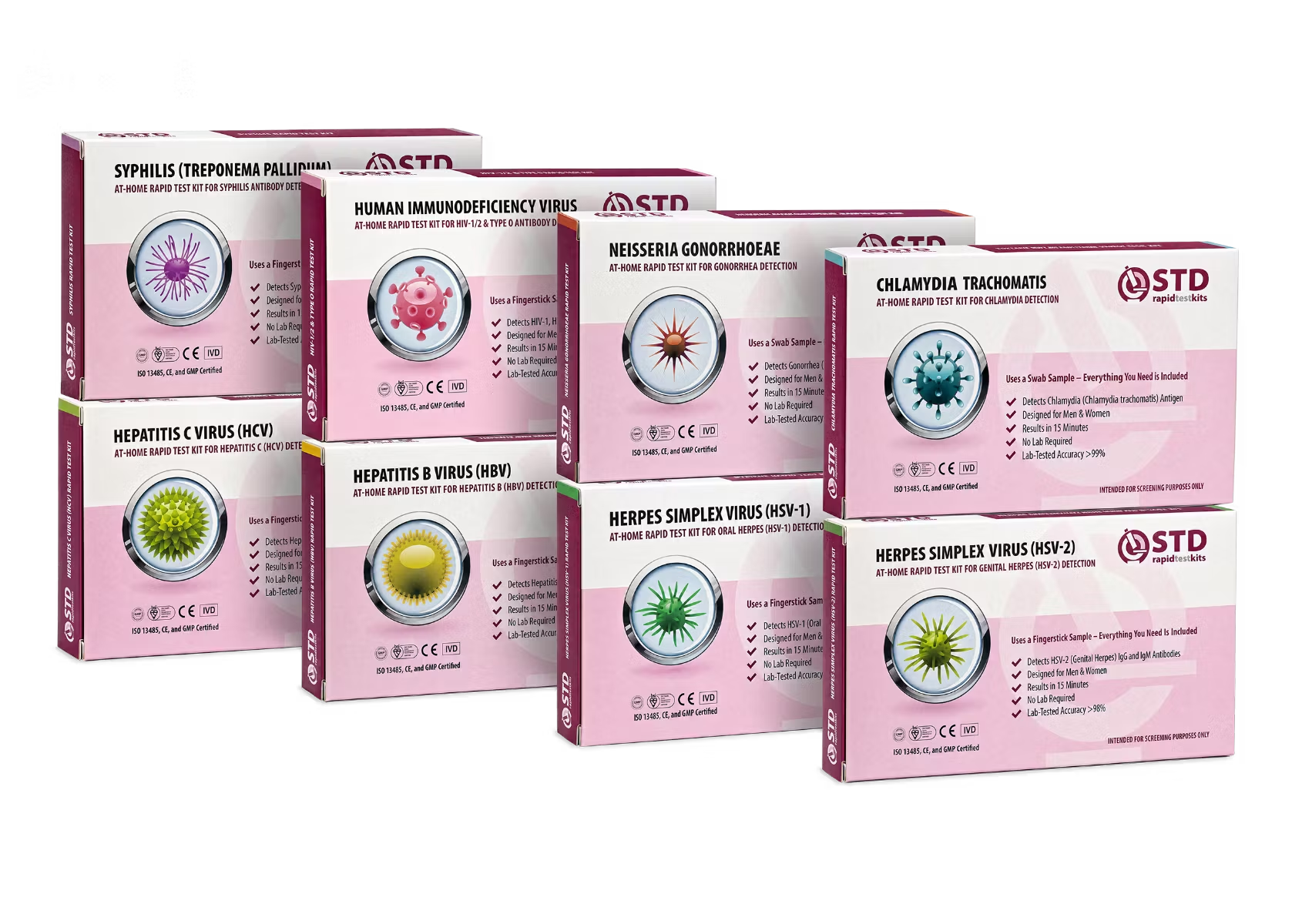
The right move right now is not to test today. It is to note the date of the exposure, give the appropriate window period time to pass, and then test. A note before the product links below: this site (stdrapidtestkits.com) sells the at-home rapid kits we are about to recommend. The recommendations are based on which kit fits which exposure window and sample type, not on commission. Here are the exact windows, no vague language.
| Infection | Test From | Notes |
|---|---|---|
| Chlamydia | 14 days after exposure | Most people have no symptoms; do not wait for them |
| Gonorrhea | 3 weeks after exposure | Symptoms can mimic a UTI; the timeline is the giveaway |
| Syphilis | 6 weeks after exposure | The first sore is often painless and easy to miss |
| HIV | 6 weeks, retest at 12 weeks | Modern rapid tests are highly accurate at 6 weeks; 12 weeks is definitive |
| Herpes (HSV-1 & HSV-2) | 6 weeks after exposure | Most people with herpes never have a recognizable outbreak |
| Hepatitis B | 6 weeks after exposure | Vaccination provides strong protection if not already immune |
| Hepatitis C | 8–11 weeks after exposure | Longer window period than most other infections |
When to Stop Waiting and See a Doctor
Everything above is written for the person whose symptoms are uncomfortable but not escalating. There are scenarios where the calculus changes, where watching and waiting is the wrong call and you need to move faster. None of these automatically mean you have an STD from last night, but all of them mean something needs attention that rest alone will not resolve.
Visible sores, blisters, or open lesions appearing within 24 hours of sex are worth examining even though the timeline rules out a brand-new infection. They may reflect a pre-existing infection showing itself for the first time. Herpes can remain asymptomatic for months or years before producing a first recognizable outbreak, and the physical stress of sex can trigger one. If a blister appears, testing with an active lesion is the most accurate approach available; you do not need to wait for a window period in that case.
Symptoms that are actively worsening (burning that goes from mild to severe over a day, spreading redness, discharge that develops a new color or strong odor) are signals to act rather than wait. The general rule holds: improving symptoms mean your body is handling the situation; worsening symptoms mean something else is going on. And if you know for certain that your partner has an active STD, do not rely on symptom absence as reassurance. Follow the window periods in Table 2 above and test at the right time. Our article on STD signs commonly mistaken for something else covers presentations that do not fit the classic picture.
Fever within 24 to 72 hours of sex combined with genital symptoms. Pyelonephritis (a UTI spread to the kidneys) is the most likely cause in this window and needs treatment.
Severe or rapidly worsening pelvic pain, especially with fever or unusual discharge, can signal pelvic inflammatory disease, which is time-sensitive to treat.
Visible blisters, sores, or ulcers, even if they appear within 24 hours. The timeline rules out infection from last night, and an active lesion is the ideal moment to test for a pre-existing herpes infection.
Inability to urinate, blood in the urine, or severe back or flank pain alongside any of the above.
FAQs
- Can you get STD symptoms within 24 hours of having sex?
- No, not from a new exposure. Even gonorrhea, the fastest-moving common STD, has a minimum incubation period of one to two days, with most people not noticing anything until day two to five. Herpes, HIV, chlamydia, and syphilis all take longer (days to weeks). Symptoms felt the morning after are almost certainly friction, a starting UTI, a product sensitivity, or anxiety producing real physical sensations. The biology of STD transmission simply does not allow for 24-hour symptoms from a brand-new exposure.
- I am burning when I pee the day after sex. Should I test for STDs?
- Not today; testing right now would fall inside the window period for every STD, so any result would be unreliable. Burning on urination 24 hours after sex is most likely friction irritation of the urethral opening or the very beginning of a UTI. Watch the trajectory over the next 48 hours: improving means friction; worsening with urinary urgency means UTI, which needs a doctor. For STD peace of mind, set a reminder to test at the 14-day mark for chlamydia or three weeks for gonorrhea, when results will actually mean something.
- Is itching after sex always a sign of infection?
- Rarely. Itching the day after sex is most often friction against delicate genital tissue, a sensitivity reaction to a condom or lubricant, vaginal pH disruption, or a yeast infection triggered by sex itself. Actual STD-related itching cannot appear this quickly from a new exposure. Thick white discharge with the itch points to yeast; a fishy odor points to bacterial vaginosis. Pure itching with no discharge and no odor is almost always friction or a contact reaction, and both resolve within 48 to 72 hours on their own.
- How soon can I test for STDs after unprotected sex?
- The earliest useful window is 14 days for chlamydia. Gonorrhea needs three weeks, syphilis six weeks, HIV six weeks for a first indicator result with a retest at twelve weeks for certainty, and herpes six weeks. Testing before these windows can produce false negatives because the infection has not yet replicated to a detectable level. Marking the exposure date on a calendar and setting a reminder for the appropriate window is more useful than testing immediately and getting an unreliable answer.
- Can sex trigger a yeast infection that shows up the next day?
- Yes, and it is more common than most people realize. Sex can disrupt vaginal pH, introduce foreign bacteria, and create friction that disturbs the vaginal microbial balance, all conditions that allow Candida (naturally present in small amounts) to overgrow within 24 to 48 hours. Telltale signs are intense itching, thick white discharge with no strong odor, and redness or irritation of the vulvar tissue. A post-sex yeast infection is not an STD; it does not mean anything went wrong, and it responds well to standard antifungal treatment.
- What is the difference between a UTI and an STD after sex?
- A UTI is not sexually transmitted; it is a bacterial infection of the urinary tract triggered when sex mechanically pushes bacteria toward the urethra. Its symptoms overlap with some STDs: burning on urination, urgency, frequency, cloudy urine. The key distinction is timing. UTI symptoms can appear within 24 to 48 hours of sex and worsen over that same window. STD symptoms from a new exposure take longer to appear and are frequently absent entirely. A urine test diagnoses a UTI quickly; STD testing requires waiting for the appropriate window.
- I noticed a red bump near my genitals after sex. Is that herpes?
- Not from last night, since herpes requires two to twelve days after initial exposure before a first outbreak is possible. A bump at 24 hours is far more likely to be an ingrown hair, a friction blister, a blocked follicle, or a pimple. If over the next several days the bump develops into a fluid-filled blister, becomes painful, and is accompanied by tingling in the surrounding skin, have it examined. The 24-hour timeline rules out catching anything last night; what the blister may signal instead is a first outbreak of herpes that was already present without symptoms.
- What if my symptoms are still there after three or four days?
- At three to four days post-sex, you are moving into a window where gonorrhea could theoretically begin causing early symptoms if transmission occurred. Symptoms that have not improved after 72 to 96 hours, or have actively worsened, deserve evaluation rather than more waiting. That still does not automatically mean you have an STD, but the 'it is just irritation' explanation becomes less convincing as time passes without improvement. A doctor's visit for a physical exam makes sense at this point, and depending on what the exam shows, testing for chlamydia might also be useful since its window opens at day 14.
Our article was constructed based on current advice from the most prominent public health and medical organizations, and then molded into simple language based on the situations that people actually experience, such as treatment, reinfection by a partner, no-symptom exposure, and the uncomfortable question of whether it "came back." In the background, our pool of research included more diverse public health advice, clinical advice, and medical references, but the following are the most pertinent and useful for readers who want to verify our claims for themselves.
- U.S. Centers for Disease Control and Prevention. STI surveillance data and reporting statistics for the United States, used here for the 2.2 million annual reported cases figure.
- Mayo Clinic. Sexually transmitted disease (STD) topic overview covering symptoms, incubation periods, and clinical presentation.
- World Health Organization. Sexually transmitted infections (STIs) fact sheet, used here for the verbatim pull quote on asymptomatic presentation and non-specific symptom patterns.
- U.S. Centers for Disease Control and Prevention. Sexually transmitted infections topic landing page, used for incubation-period summaries across chlamydia, gonorrhea, syphilis, herpes, HIV, and trichomoniasis.
- NHS. Bacterial vaginosis symptoms, causes, and relationship to sexual activity.
- NHS. Urinary tract infections (UTIs) symptoms, post-sex risk factors, and when to seek care.
- NHS. Health anxiety overview describing the feedback loop between worry and bodily sensation, applied here to post-sex anxiety patterns.
