
Published: July 2025 | Last updated: April 2026 | Editorial review and quality control: Martina N.
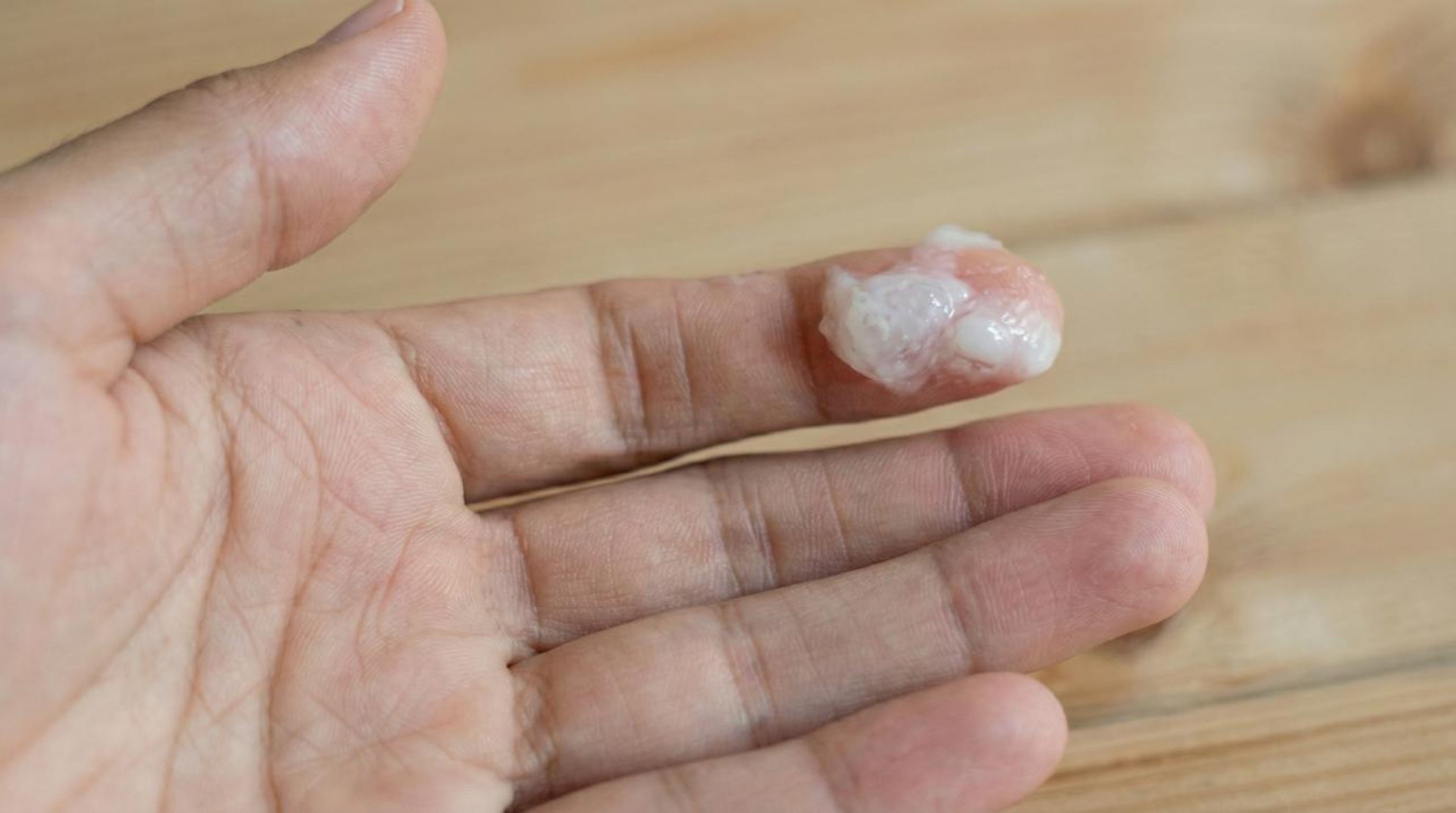
If you have noticed unusual discharge and your mind jumped straight to chlamydia, you are in good company. Chlamydia is the most commonly reported bacterial sexually transmitted infection in the United States, and abnormal discharge is one of its few visible signs. The catch: most cases produce no symptoms at all, and when discharge does appear, it rarely looks dramatic enough to confirm anything by sight.
Chlamydia discharge is typically cloudy, white, pale yellow, or slightly watery. It usually shows up between 7 and 21 days after exposure. The single reliable way to know is a test taken at the 14-day mark or later. Everything before that, including a careful look at the discharge itself, is guesswork.
What does chlamydia discharge look like?
Chlamydia discharge is most often cloudy or milky, ranging from white to pale yellow or faintly grey. The texture can be thin and watery or slightly mucus-like. Symptoms usually appear 7 to 21 days after exposure, but the appearance overlaps so much with other conditions that visual identification is unreliable. To confirm, get tested at day 14 or later. Both options work at that point: a clinic-ordered lab NAAT, or an at-home lateral-flow rapid swab read in about 15 minutes. The two technologies are different (NAAT is the lab gold standard; the at-home cassette is a screening test), but both need the 14-day window to be reliable.
Key takeaways
- Chlamydia discharge is usually cloudy, white, or pale yellow. That sets it apart from the bright yellow-green typical of gonorrhea and the cottage-cheese clumping of yeast.
- Test at day 14 after exposure or later. Earlier negatives are unreliable because the bacteria need time to replicate to detectable levels.
What chlamydia discharge actually looks like
Chlamydia rarely announces itself. When discharge does appear, it shows up as a quiet shift, something that does not quite match your usual pattern.
The fluid is often cloudy or milky. Color ranges through white, pale yellow, and occasionally faint grey. Texture varies: some people notice it feels thinner and more watery than what they are used to; others describe a thicker, slightly mucus-like consistency. There is no single look, which is one reason people second-guess what they are seeing.
According to the CDC's STI surveillance statistics, chlamydia is the most commonly reported bacterial STI in the United States, with roughly 1.6 million cases logged in a recent reporting year. What you are noticing is something clinicians see constantly. It is common, treatable, and resolved with a short course of antibiotics once identified.
Visual assessment fails for the same reason it is so common. Two people with confirmed chlamydia can describe completely different discharge experiences, and a third with a yeast infection may describe something that looks identical to either.
Chlamydia discharge in men and women
The experience can feel quite different depending on your anatomy, and that gap is where a lot of confusion starts.
In people with a penis, discharge stands out because it is not part of the normal baseline. It may show up as fluid at the urethral opening, clear, cloudy, or slightly yellow. It is sometimes only noticeable in the morning or between bathroom trips. Even a small amount is worth taking seriously, especially if it appears in the weeks following a new sexual encounter.
For people with a vagina, the picture is more layered. Some baseline discharge is normal and shifts predictably across the menstrual cycle, so the question is rarely whether discharge exists. The relevant question is whether something has changed: more volume than usual, an unfamiliar color, a faint new odor, or a texture that does not feel right.
Most people compare what they are seeing to a generic textbook description, but the more useful comparison is to your own personal baseline from a few weeks ago.
| Condition | Color | Texture | Other clues |
|---|---|---|---|
| Normal cyclical discharge | Clear or off-white | Smooth, varies with cycle | Mild scent, no irritation |
| Chlamydia | Cloudy white to pale yellow | Thin and watery, sometimes mucus-like | Possible burning when urinating |
| Gonorrhea | Yellow-green | Thicker, more profuse | Often more obvious early |
| Yeast infection | Bright white | Thick, cottage-cheese clumps | Strong itching, no sexual transmission |
| Bacterial vaginosis | Thin grey or white | Watery | Fishy odor, especially after sex |
Other symptoms that may show up alongside
Discharge is often only one piece of the picture, and the rest of the picture is frequently almost invisible.
You may feel a burning sensation while urinating, especially toward the end of the stream. Some people experience itching or mild irritation in the genital area, brief discomfort during sex, or a dull ache low in the abdomen. None of these signs are guaranteed, and many people register only one of them.
Sometimes nothing else shows up at all.
Both the NHS and the World Health Organization describe chlamydia as frequently asymptomatic, especially in people with a vagina. You can carry the infection without any obvious clue.
When symptoms start after exposure
When chlamydia does cause symptoms, they usually appear 7 to 21 days after exposure. Some people notice changes earlier, but many see nothing until the second or third week. A meaningful portion never develops noticeable symptoms at all.
Your body might be scanning for something obvious, and chlamydia rarely cooperates with that expectation. The infection can stay quiet while still being present and transmissible, so waiting for clear symptoms before testing tends to miss it.
The reason 14 days keeps coming up is that the lab test (NAAT) needs enough bacterial DNA in the sample to detect reliably. Before day 14, even an active infection can return a false negative. Testing earlier gives you a result, just not a confidence-worthy one. Mark the date of any potential exposure and plan the test for two weeks out.
Testing for chlamydia: when, how, and what it means
If you have noticed discharge and you are wondering what to do next, testing is the step that moves you from worry to information.
Lab testing uses NAAT (nucleic acid amplification testing), performed on a urine sample or a self-collected swab. NAAT detects the bacteria's DNA directly, which makes it the gold standard for chlamydia diagnosis when the timing is right. CDC's STI treatment guidelines describe NAAT as the preferred diagnostic for genital chlamydia infection.
The sensitivity is excellent, but only after the bacteria have replicated to a detectable level. Testing too early can produce a false negative even when the infection is real. The most reliable window is 14 days after exposure or later. If you tested before that and got a negative result, retesting at the two-week mark is the safer move.
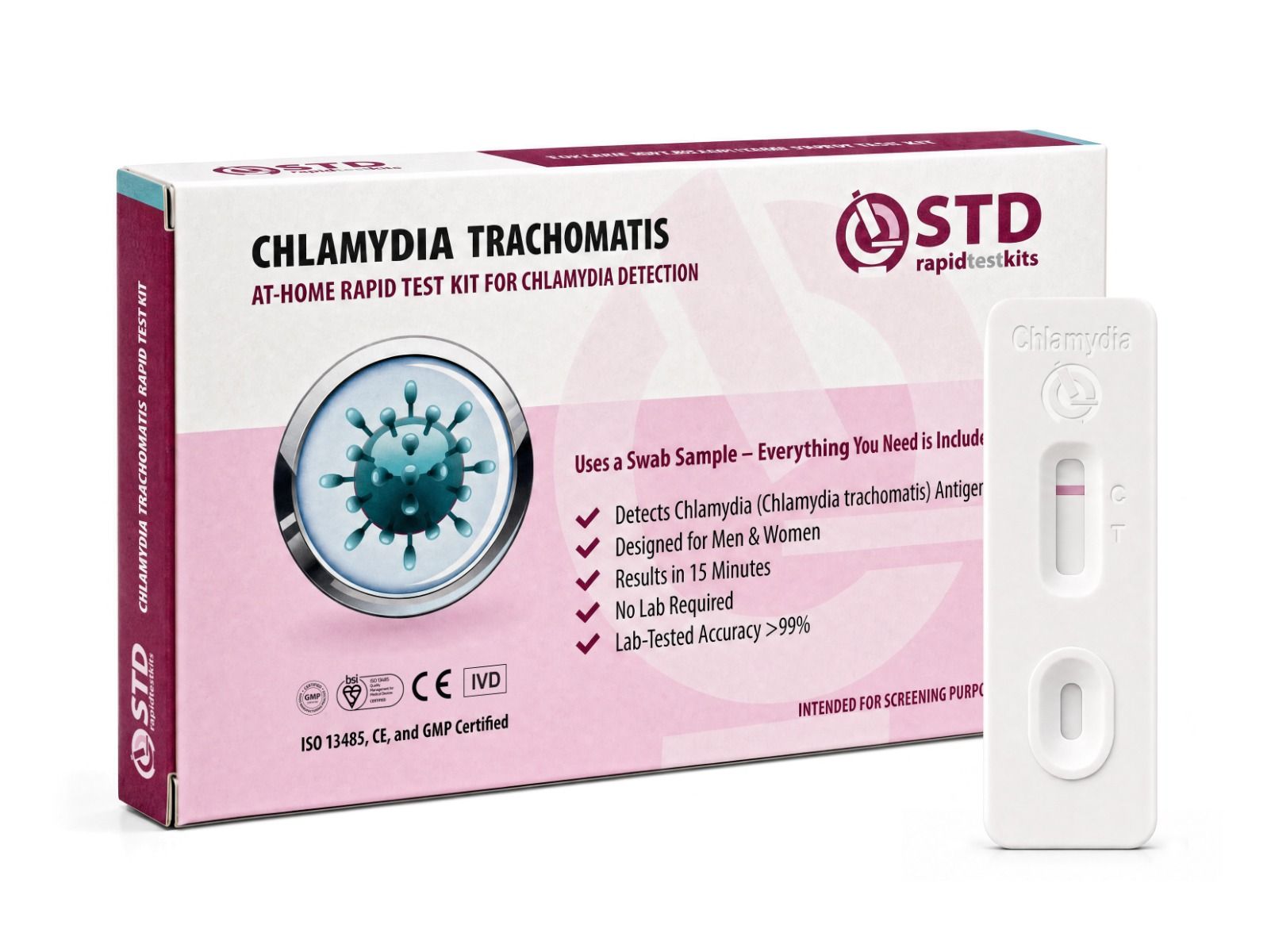
At-home rapid testing has narrowed the gap between concern and answer. As the publisher of this site, stdrapidtestkits.com sells a rapid at-home option: our Chlamydia At-Home Rapid Test Kit uses a self-collected swab and a lateral-flow cassette. Collect a sample, follow the instructions, and read the result in about 15 minutes. It is a screening test rather than a lab NAAT. A positive home result is worth confirming with your provider for treatment, and any negative taken before day 14 should be repeated.
| Days after exposure | What a test result means |
|---|---|
| 1 to 7 days | Too early. Significant chance of a false negative even with active infection. |
| 7 to 13 days | Possible detection, still unreliable. Retest if negative. |
| 14 days and later | Most accurate window. A negative here is meaningful. |
| 3 months after treatment | CDC-recommended re-test to catch reinfection from untreated partners. |
What to do if your result is positive
A positive result can land hard, even when part of you was expecting it. That reaction is normal, and the path forward is clear.
Chlamydia is treated with a short course of antibiotics. CDC's STI treatment guidelines currently recommend doxycycline 100 mg twice daily for 7 days as the first-line option for adults and adolescents, with azithromycin available in select cases such as pregnancy. Self-medicating without a confirmed diagnosis is not a workable plan; the prescription has to come from a provider.
You will also need to let recent partners know they should get tested and treated. The goal is straightforward: stop the back-and-forth reinfection that happens when one person clears the bacteria and is then re-exposed by an untreated partner.
Re-testing about three months after treatment is recommended by CDC, since reinfection is more common than relapse.
Three steps after a positive result
- Get a provider prescription. Doxycycline 100 mg twice daily for 7 days is CDC's first-line option; azithromycin is reserved for cases like pregnancy.
- Notify recent partners so they can test and treat at the same time. Treating both sides of the exposure is what prevents reinfection.
- Re-test about three months after the treatment course to catch any reinfection from a partner who was not treated.
Can you have discharge without other symptoms?
Yes, and this is where many people talk themselves out of testing.
Sometimes there is discharge and nothing else. No pain, no burning, no obvious red flag. That does not rule chlamydia out. Isolated discharge with no other symptoms is a fairly common presentation, particularly in the first couple of weeks of infection.
The CDC and WHO both describe chlamydia as frequently silent. In practice that means discharge can be the only visible clue your body produces. If it does not hurt, it is easy to dismiss; if it is mild, it is easy to rationalize. A mild or asymptomatic infection carries the same downstream complication risk as a symptomatic one, and untreated chlamydia raises that risk regardless of how loud or quiet it presents.
Both the CDC and WHO describe chlamydia as frequently silent in people with a vagina. If you have had a recent potential exposure, plan a test at day 14 or later regardless of whether you currently feel anything. Symptoms are not the trigger for testing; the exposure date is.
How long does chlamydia discharge last?
Without treatment, chlamydia discharge can persist for weeks or months.
It rarely follows a straight line. Some days the discharge feels lighter, and other days it feels heavier. That fluctuation can create false reassurance, the impression that the infection might be sorting itself out. It isn't. Chlamydia does not resolve on its own, and a few quieter days do not mean the bacteria have cleared.
With the correct antibiotic course, symptoms typically begin improving within a week. Finishing the full prescription matters even after the discharge stops, since premature stopping is one route to incomplete clearance. If symptoms persist or worsen after a treatment course, see your provider in person rather than waiting it out; persistence after a full course is a signal worth investigating.
On track during a doxycycline course:
- Discharge volume tapering within the first 5 to 7 days.
- Burning while urinating easing.
- No new symptoms appearing during or after the course.
Worth a same-day call to your provider:
- No improvement after the full 7-day course is completed.
- New pelvic, abdominal, or testicular pain during or after treatment.
- Fever, chills, or unusual bleeding.
- Symptoms that resolved and have now returned (possible reinfection from an untreated partner).
When discharge isn't an STD
Most discharge changes have non-STI explanations, and dismissing that is its own mistake.
Discharge shifts naturally throughout the menstrual cycle, with peak flow around ovulation. It can change after sex, with new soaps or laundry products, or because of temporary mechanical irritation. Yeast infections, bacterial vaginosis, and simple friction can all produce visible changes that are not sexually transmitted.
Context matters. The recent timeline of your sexual activity, the presence or absence of other symptoms, and how the change compares to your personal baseline all factor into what is most likely. If there has been no recent new exposure and the discharge fits a familiar pattern (cyclical, related to a new product, after antibiotic use), the cause is more often something benign.
Genuine uncertainty after a recent encounter is the case where testing earns its place. The cost of testing is small. Untreated chlamydia raises long-term complication risk, including pelvic inflammatory disease and tubal-factor infertility.
| Non-STI cause | Typical pattern | How to tell |
|---|---|---|
| Mid-cycle ovulation | Clear, stretchy, slightly increased volume | Predictable timing about two weeks before your next period |
| Yeast infection | Thick, white, cottage-cheese clumps | Strong itching is the dominant symptom |
| Bacterial vaginosis | Thin grey or white, watery | Distinct fishy odor, often stronger after sex |
| New soap, lubricant, or laundry product | Mild irritation, slight discharge change | Resolves within a few days of stopping the new product |
| Recent antibiotic course | Yeast overgrowth a week or two later | Familiar yeast-infection pattern after broad-spectrum antibiotics |
When to see a doctor immediately
Most chlamydia cases do not need urgent care, and at-home testing handles the diagnostic question well. A handful of symptoms move the situation into same-day-medical-attention territory rather than the watch-and-test pathway.
The signs below suggest the infection may have progressed beyond an early-stage urogenital infection, into a complication like pelvic inflammatory disease (PID, infection of the upper reproductive organs) or epididymitis (inflammation of the coiled tube behind the testicle).
- Fever, chills, or feeling systemically unwell alongside genital symptoms.
- Severe pelvic or lower-abdominal pain, especially in people with a uterus.
- Blood in the discharge or unexplained bleeding between periods.
- Significant new pain during sex.
- Swelling, redness, or warmth in the genital area.
- Testicular pain or swelling, which can indicate epididymitis.
Why visual guessing doesn't work
It is tempting to figure this out by sight: comparing what you see to images online, matching descriptions, talking yourself into a likely answer. The biology gets in the way.
Discharge presentations overlap heavily across conditions. Chlamydia and gonorrhea look similar in many people. A bacterial imbalance can mimic either. Yeast can mimic both during a less-clumpy phase. Even the same person can present quite differently across two episodes of the same infection.
The NHS notes that most people with chlamydia have no symptoms at all, which is why clinicians do not diagnose by appearance. They test.
You are not missing something obvious in your own body.
Most people who have chlamydia have no symptoms. If you do have symptoms, they may not appear until several weeks after you have sex with an infected partner.
Common mistakes when self-diagnosing discharge
Almost everyone tries self-diagnosis first. It's reasonable. You want some sense of what you are dealing with before booking an appointment, telling a partner, or deciding whether the worry is even warranted.
The instinct to self-diagnose makes sense. The trouble is that discharge is one of the least reliable symptoms to assess on your own, and the common errors tend to extend the period of uncertainty instead of resolving it.
Even clinicians do not diagnose discharge by appearance. They test. If you have spent the last few days going back and forth on what it looks like, that ambivalence is itself a useful sign that you would be better served by a test result than by another round of looking.
| Mistake | Why it misleads |
|---|---|
| Relying on color alone | Color overlaps widely between infections, normal cycle variation, and irritation. |
| Comparing to images online | Online photos often show extreme presentations rather than typical ones. |
| Waiting for pain to confirm something is wrong | Many STIs, including chlamydia, can be entirely painless. |
| Assuming symptoms must be constant | Symptoms often fluctuate without the infection clearing. |
| Testing in the first few days after exposure | Falls inside the window period; a negative there is not meaningful. |
How to tell if discharge is getting worse
One harder question is whether things are holding steady, slowly improving, or quietly progressing. Chlamydia does not follow a clean curve. Symptoms can fluctuate, fade, and return, and that does not mean the infection is resolving.
Look at trends across several days rather than any single moment. The shifts below are worth tracking. You do not need every row to apply; even one consistent change after a recent encounter is enough reason to test instead of continuing to monitor.
| Change over several days | What it may mean |
|---|---|
| Volume increasing day over day | Infection becoming more active or affecting more tissue. |
| Color shifting darker or more yellow | Increased inflammation or possible co-infection with gonorrhea. |
| New or stronger odor | Bacterial change, possibly bacterial vaginosis layered on top. |
| Burning or pain joining the discharge | Infection progressing past the initial mucosal stage. |
| Symptoms cycling on and off | The bacteria are still present despite quieter days. |
Taking control: what actually matters right now
If you have read this far, the underlying question is usually some version of: is this something I need to act on? If the discharge has changed and there has been a recent new exposure, testing is the step that converts uncertainty into a definite answer.
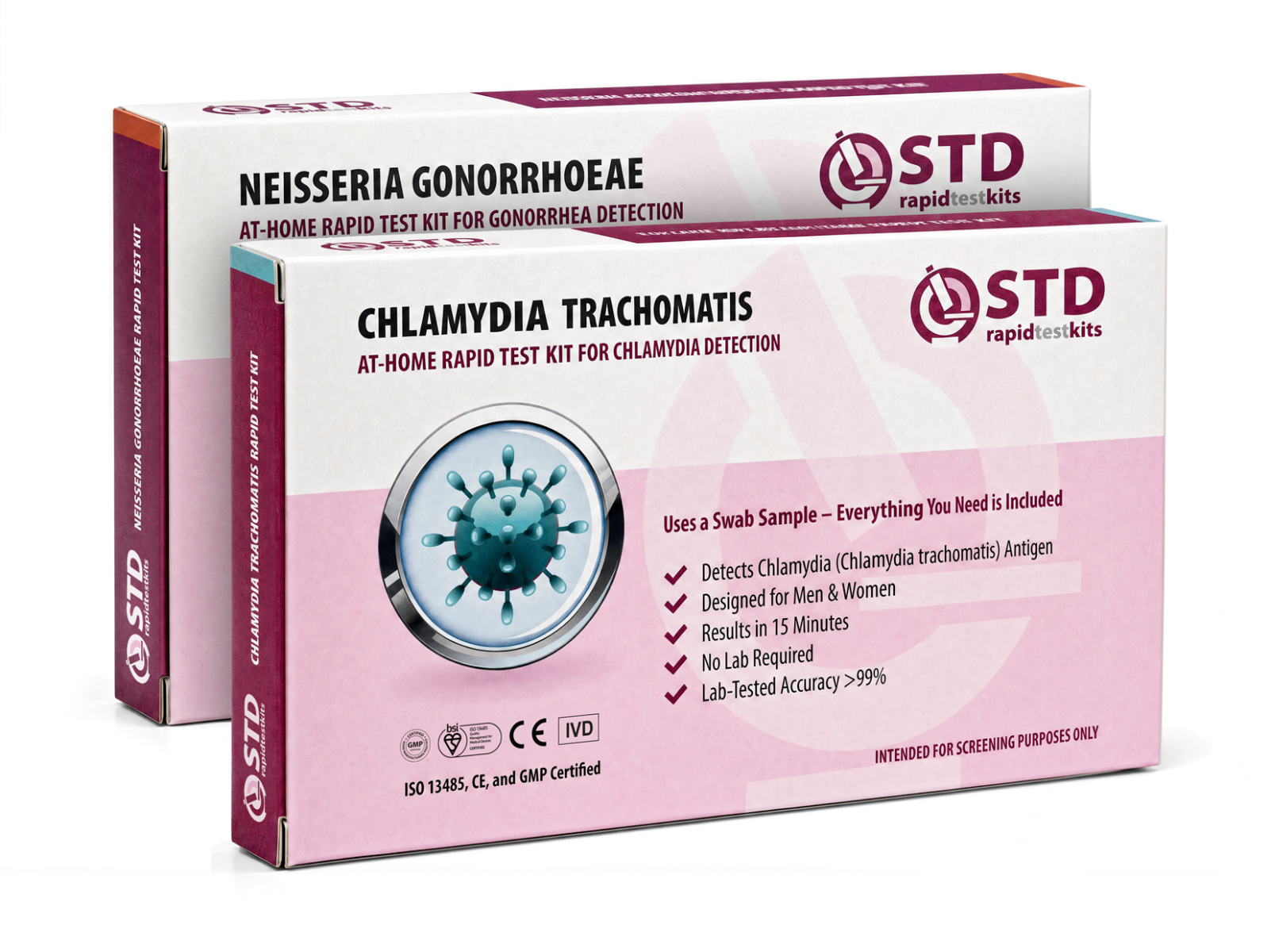
Chlamydia and gonorrhea overlap heavily in transmission and presentation. CDC's STI treatment guidelines call for gonorrhea testing whenever chlamydia is confirmed, and given how closely the two look in early symptoms, starting with both at once is often the more practical approach when discharge is the main signal and the exposure history is uncertain.
FAQs about chlamydia discharge
- How long does chlamydia discharge last?
- Without treatment, weeks to months. With doxycycline, usually noticeably better within the first week. The pattern is not predictable, lighter days are not a sign of clearance, and CDC recommends a follow-up test about three months after treatment to catch reinfection.
- Can I have chlamydia discharge with no other symptoms?
- Yes. Isolated discharge with no burning, no itching, and no pain is one of the more common presentations rather than the exception. The chlamydia bacteria infect epithelial cells from the inside out, and the immune response that drives sharper symptoms can stay quiet enough to never register. A test taken at day 14 or later is the only thing that answers the question definitively.
- Can men get chlamydia discharge?
- Yes. In people with a penis, chlamydia most often infects the urethra, and discharge at the urethral opening (clear, cloudy, or pale yellow) is a recognized sign. It is frequently subtle, sometimes only visible in the morning or as dried residue. Any new fluid at the urethral opening following a recent sexual encounter is worth testing rather than waiting out.
- Is chlamydia discharge ever yellow?
- Yes. The color can range from white through pale yellow to faintly grey. Yellow-green and clearly thick is more typical of gonorrhea, but the two can look identical in some people. What matters more than color is whether the discharge has shifted from your personal baseline.
- Does chlamydia discharge have a smell?
- Sometimes, and the odor is usually mild rather than strong. A clearly fishy odor that increases after sex is more characteristic of bacterial vaginosis than chlamydia. A subtle change in smell alongside any other shift in discharge is reason enough to test rather than monitor.
- Can the discharge come and go with chlamydia?
- Yes. Symptoms can fluctuate as the immune response shifts day to day, while the bacteria continue replicating underneath. Quieter days are not evidence of clearance. If symptoms have ever appeared after a recent exposure, a test is the only thing that confirms whether the infection is still present.
- If I test negative early, am I in the clear?
- Not if the test was taken before the 14-day window. A negative result before that point reflects bacterial DNA not yet being concentrated enough to detect, regardless of whether the infection is there. Retest at the 14-day mark or later for a result you can rely on.
- What should I do if I am not sure whether to test?
- Test at the right time and stop trying to figure it out by feel. If there has been a potential exposure, mark the date and plan a test for 14 days out. Watching and waiting does not generate new information. If you are worried about more than one infection, the chlamydia and gonorrhea combination test handles both in a single cassette.
- U.S. Centers for Disease Control and Prevention. About Chlamydia: prevalence, presentation, and asymptomatic infection.
- U.S. Centers for Disease Control and Prevention. Sexually Transmitted Infections Treatment Guidelines, Chlamydial Infections section: NAAT as preferred diagnostic, doxycycline 100 mg twice daily for 7 days as first-line therapy.
- World Health Organization. Chlamydia fact sheet: transmission routes, asymptomatic-infection prevalence, and screening recommendations.
- NHS (UK). Chlamydia overview: clinical signs, symptom variability, and testing recommendations.
- U.S. Centers for Disease Control and Prevention. Sexually Transmitted Infections Surveillance: annual reported chlamydia case counts and gonorrhea co-occurrence.
