At-Home Chlamydia and Gonorrhea Test: How It Works and When to Take It
At-home rapid kits for chlamydia and gonorrhea now do in fifteen minutes what used to require a clinic visit. This guide covers what the swab test actually does, when to use it, what the result really means, and the situations where a clinic test is still the right call.



- Chlamydia and gonorrhea are mostly silent: most carriers have no noticeable symptoms, per the CDC, which is why routine screening matters more than waiting for warning signs.
- Our at-home kit is a self-collected genital swab read by lateral-flow cassette in 15 minutes. It does not test urine, throat, or rectum, and it is a screening tool, not a lab NAAT.
Published: August 2025 | Last updated: April 2026 | Editorial review and quality control: Martina N.
At-home rapid tests for chlamydia and gonorrhea have moved from clinic-only to a shipped, same-week option. The basic premise is straightforward: collect a self-administered genital swab, run it through a lateral-flow cassette, and read the result in roughly fifteen minutes. The reason millions of people now test this way is the same reason public-health agencies worry about both infections to begin with: most carriers feel nothing, never know they need testing, and pass the infection on without intent. This guide covers what an at-home swab kit does, when to use it, what its results mean, and the cases where a clinic visit or lab molecular test is still the right call.
Can I test for chlamydia and gonorrhea at home?
Yes. You can self-collect a genital swab at home, apply it to a rapid lateral-flow cassette, and read your chlamydia or gonorrhea result in about 15 minutes without sending anything to a lab. Two practical caveats apply: test no sooner than roughly two weeks after exposure to give the bacteria time to reach detectable levels, and use a clinic test if your concern is a throat, rectal, or pregnancy-related exposure.
Key takeaways
- Chlamydia and gonorrhea are mostly silent: most carriers have no noticeable symptoms, per the CDC, which is why routine screening matters more than waiting for warning signs.
- Our at-home kit is a self-collected genital swab read by lateral-flow cassette in 15 minutes. It does not test urine, throat, or rectum, and it is a screening tool, not a lab NAAT.
Two infections, similar testing path
Chlamydia is caused by the bacterium Chlamydia trachomatis. Gonorrhea is caused by Neisseria gonorrhoeae. The two are the most commonly reported notifiable bacterial sexually transmitted infections in the United States, per the CDC's STI program. They share enough clinically that they are tested together by default: both are bacterial, both are curable with antibiotics when caught early, both transmit through unprotected vaginal, anal, and oral sex, and both can travel up the reproductive tract and damage fertility if left untreated.
Despite the parallels, the two are not identical. Untreated chlamydia in women can lead to pelvic inflammatory disease, with later consequences including chronic pelvic pain, ectopic pregnancy, and reduced fertility, per the CDC's chlamydia overview. Untreated gonorrhea progresses similarly but adds a separate concern: drug-resistant strains. The CDC has tracked rising resistance to first-line antibiotics, which is why current guidance pairs ceftriaxone with confirmation testing rather than older single-agent regimens.
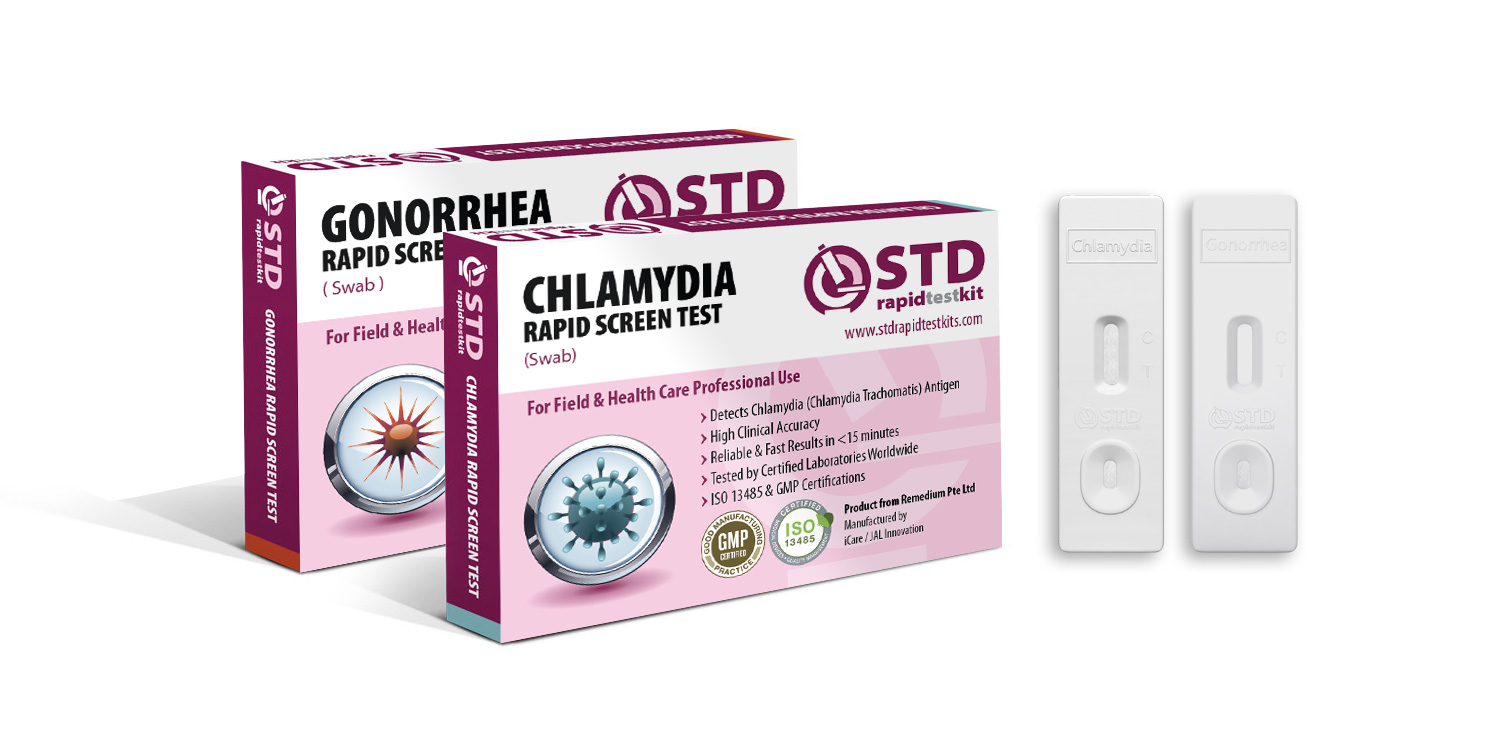
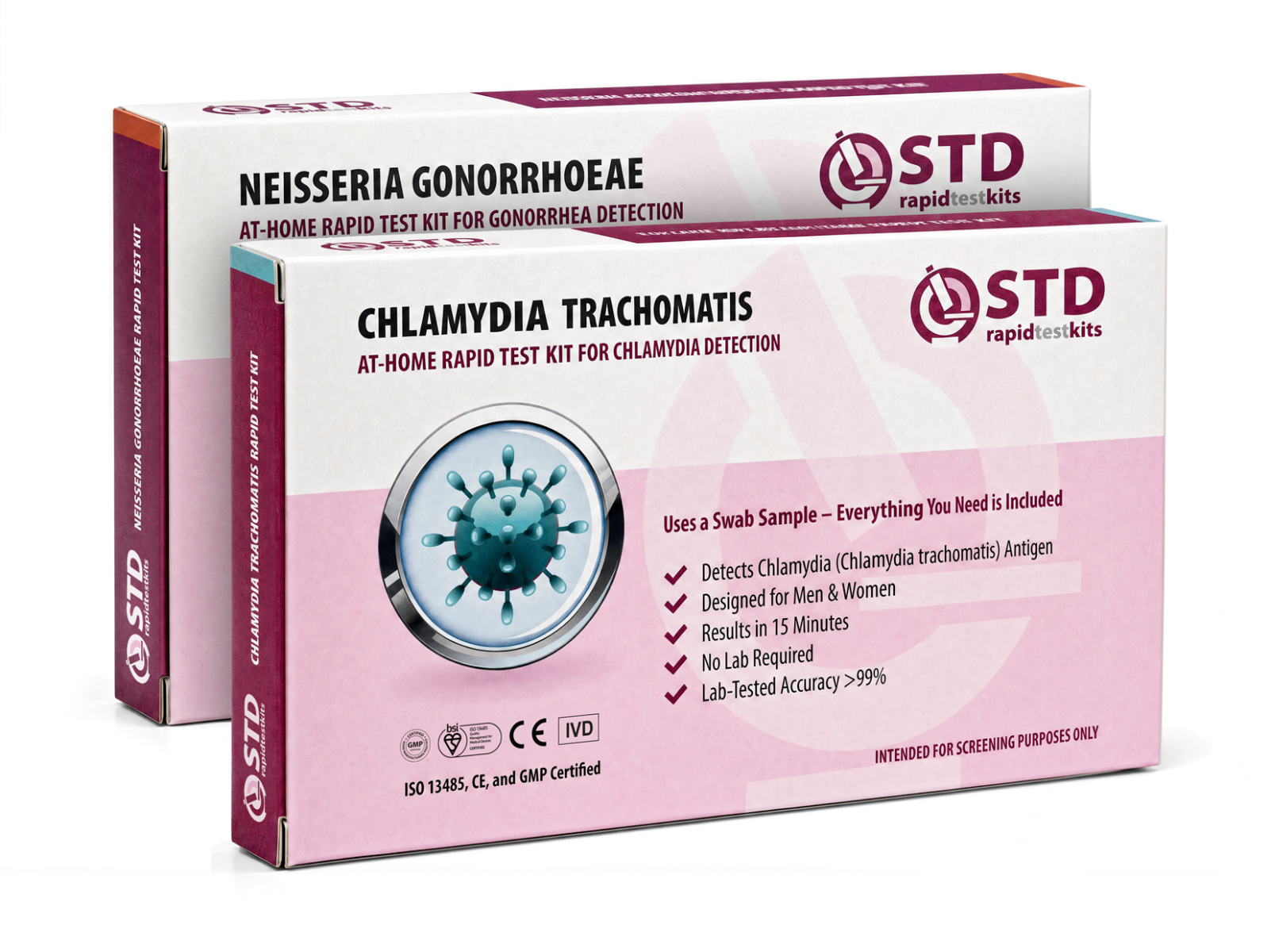
For testing purposes, the practical takeaway is that one swab can screen for both. The sample type is identical (a self-collected vaginal swab for women, a urethral swab for men), the lateral-flow cassette technology is the same, and the time to result is the same. That is why combo kits exist; the marginal cost of testing for two infections at once is low and the marginal information gain is high.
What a home swab cannot do: detect chlamydia or gonorrhea at sites the swab does not sample. If your concern is oral exposure, a pharyngeal swab is needed. If anal, a rectal swab. We do not sell either; both are clinic-administered, and we are explicit about that limit so a reader with a throat or rectal concern is not steered to the wrong product.
Our home swab covers genital-site chlamydia and gonorrhea. Throat and rectal exposures need pharyngeal or rectal swabs, which are clinic-administered. We do not sell either; if your exposure was oral or anal, a clinic test is the right path.
Why most people have no symptoms
Both infections are often called silent. The CDC's chlamydia overview states plainly that chlamydia often has no symptoms at all. The CDC gonorrhea overview describes a similar pattern in women, while men more often notice something (typically painful urination or discharge). When symptoms do appear, they are easy to dismiss or misattribute:
- Burning or stinging during urination
- Unusual vaginal or penile discharge
- Pelvic, lower-abdominal, or testicular pain
- Spotting between periods or bleeding after sex
- Rectal pain, discharge, or bleeding for those with receptive anal exposure
These overlap with urinary tract infections, yeast infections, prostatitis, mild irritation from a new soap or lubricant, and ordinary cycle changes. Many people self-diagnose, find a benign explanation, and accept it. Meanwhile the infection sits there for weeks or months, slowly causing tissue damage and quietly transmitting.
The asymptomatic pattern is the reason public-health bodies recommend routine screening rather than symptom-triggered screening for higher-risk groups: sexually active women under 25, men who have sex with men, anyone with a new partner, anyone with multiple recent partners, and pregnant patients at the first prenatal visit. The CDC's screening recommendations spell out the cadence; for under-25 women specifically, an annual test is the baseline.
Routine screening does not mean panic. It means treating an STI test like a dental cleaning: a default item on a calendar, run because the cost of finding nothing is low and the cost of missing something is high. Most home-test users fit one of three situations: a recent new partner, a known exposure or a partner who tested positive, or a preference for certainty over guessing.
If you wait until something feels wrong before testing, you will miss most infections. Both chlamydia and gonorrhea are most commonly silent. If you have had a new partner, an exposure event, or simply have not screened in a year and you fall into a CDC routine-screening category, the right time to test is now, not when symptoms appear.
When can you test after exposure?
Window period is the time between exposure and when a test can reliably detect infection. For chlamydia and gonorrhea, the bacterial load needs a few days at the infection site before a swab will pick it up. The practical guidance:
- Earliest reliable home test: about 14 days post-exposure for both infections.
- Clinic NAAT can sometimes detect at 7 to 10 days post-exposure for symptomatic patients, but home rapid lateral-flow chemistry is calibrated to a slightly later window.
- If you test before 14 days and the result is negative, retest at the 14-day mark. A negative early test does not rule out infection.
- If you have symptoms, test as soon as you can, but plan to retest at the 14-day mark if the first result is negative.
Some practical timing scenarios:
- One-time exposure with no symptoms: test at day 14, no retest needed if negative and no further exposure.
- Ongoing exposure with a regular partner: test at day 14 from the most recent contact; retest at three months if you are in a higher-risk category.
- Treatment follow-up: retest at three months after completing antibiotics. The CDC specifically recommends a three-month retest for both chlamydia and gonorrhea because reinfection rates are high (often above 10%), not because treatment failure is common.
The window-period rule is also why pregnancy and high-risk exposure cases sometimes warrant a lab NAAT instead. Lab molecular tests have higher analytical sensitivity in low-bacterial-load situations, which can matter early in the window. For asymptomatic screening at the right time, a home swab is a reasonable option; for early-symptom testing in pregnancy or for confirmation of a complex exposure, talk to a clinician about whether a NAAT is the better fit.
| Scenario | Earliest reliable test | Recommended retest |
|---|---|---|
| One-time unprotected exposure, no symptoms | Day 14 post-exposure | None if negative and no further exposure |
| Symptoms within first 1–2 weeks | As soon as symptoms appear (clinic NAAT preferred) | Repeat at day 14 if first home test negative |
| Partner tested positive | Day 14 from last contact (or sooner via clinic) | 3 months after treatment if you also test positive |
| Routine annual screening (no recent exposure) | Anytime in the screening window | Annual |
| After completing antibiotic treatment | 3 months post-treatment | Annual after a clean retest |
How the at-home swab test works
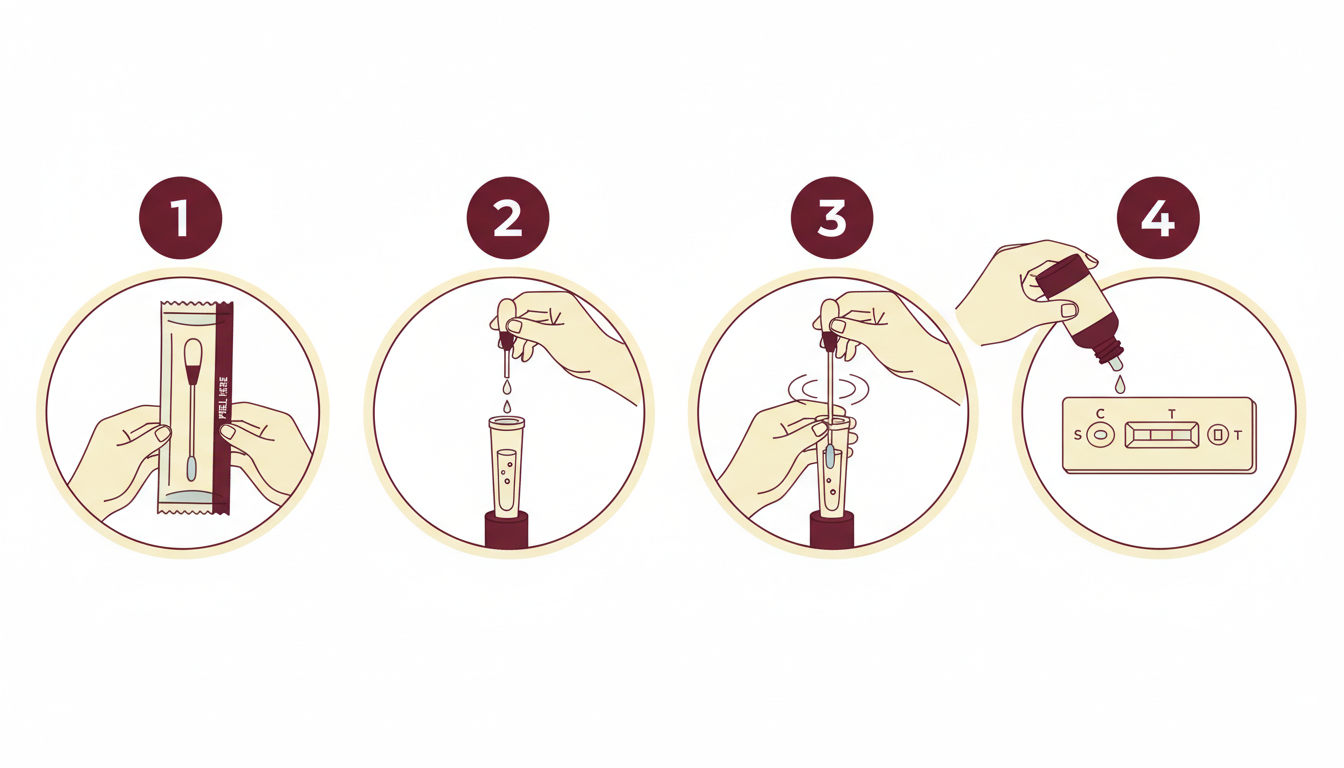
The kit components are simple: a sterile swab (vaginal or urethral depending on anatomy), a sealed buffer/extraction tube, a lateral-flow cassette, a dropper, and an instruction sheet. The whole process takes around twenty minutes including the read window.
The steps:
- Wash hands. Open the swab packaging and avoid touching the absorbent tip.
- Self-collect the sample. For vaginal swabs, insert the swab roughly 5 cm and rotate against the vaginal wall for 15 to 20 seconds. For urethral swabs, insert just past the urethral meatus and rotate gently.
- Place the swab into the buffer tube, swirl, and break or remove according to the kit's directions.
- Apply the indicated number of drops from the buffer tube to the cassette's sample well.
- Wait the full read time printed on the kit (typically 15 minutes). Reading earlier or later than the printed window risks an inaccurate result.
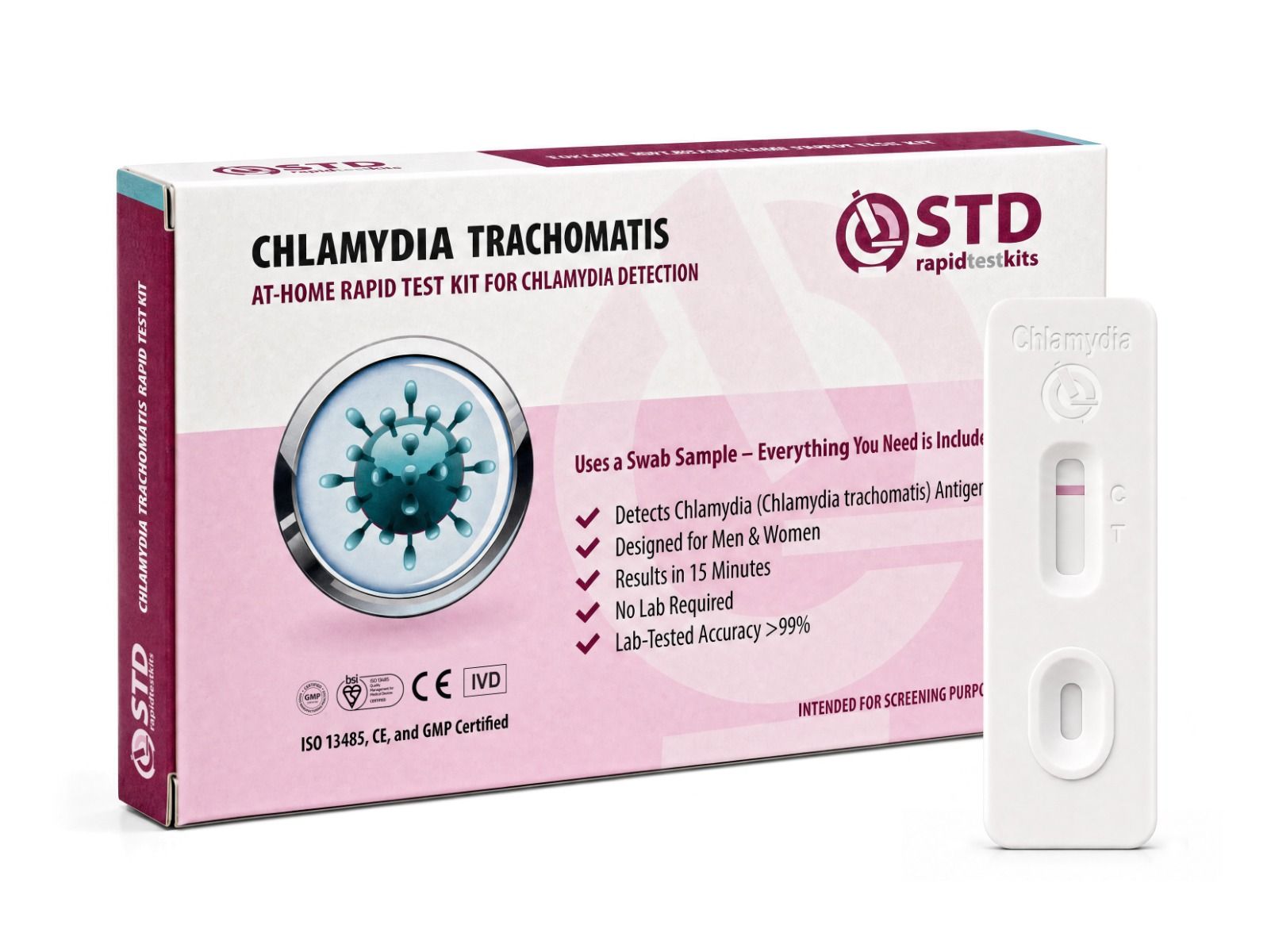
- Read the lines: a control line (C) confirms the test ran correctly; a separate test line (T) appearing alongside C indicates a positive.
What the kit does not do:
- It does not test urine. Some clinic NAATs accept urine; our home rapid kit is swab-only.
- It does not test throat or rectum samples. Different anatomical sites have different bacterial loads and different optimal collection technique; the lateral-flow cassette is calibrated for genital-tract samples.
- It does not provide gram-stain or culture data. A clinic culture can identify antibiotic-resistant gonorrhea strains; a home rapid test cannot.
One note on what "rapid" means here. The at-home cassette is a lateral-flow immunoassay, the same chemistry family as a home pregnancy test. It is not a NAAT, not PCR, not lab-grade molecular detection. The two technologies are complementary: lateral-flow is fast, private, and works well at typical and above bacterial loads; lab NAAT has higher analytical sensitivity in tricky low-load situations. A positive home test is generally trustworthy and worth treating; a negative home test in the presence of strong symptoms or a known positive partner is worth confirming with a lab.
Lateral-flow at home vs. lab NAAT
The "gold standard" phrase you will see in CDC documentation refers specifically to nucleic acid amplification testing, which clinics and labs run. NAAT can detect very small quantities of bacterial DNA, which is why it is the recommended method for asymptomatic screening in clinical guidelines.
Lateral-flow rapid tests detect a different signal: bacterial antigen captured by labeled antibodies on the test strip. Antigen detection is faster but requires a higher bacterial load to produce a visible line. In practical terms:
- Sensitivity: NAAT typically reports above 95% for both symptomatic and asymptomatic infections, per the diagnostics section of the CDC STI Treatment Guidelines (2021 edition). Most manufacturers report lateral-flow sensitivity between 90 and 98% for symptomatic samples; check the product data sheet for your specific kit. Sensitivity is somewhat lower for asymptomatic samples.
- Specificity: both technologies are above 99% in most published validation studies. False positives on either are uncommon.
- Time to result: 15 minutes for a home cassette; 1 to 5 days for a lab NAAT including shipping.
- Cost: generally cheaper for home rapid; more expensive for lab NAAT, though insurance often covers the latter when ordered by a clinician.
Home rapid tests are a screening tool, not a replacement for lab NAAT. They are appropriate for someone who wants a quick, private answer at the right window after exposure. A positive result is worth treating (talk to your clinician or a telehealth provider). A negative result in a low-symptom, low-risk situation gives reasonable reassurance. A negative result in a high-risk or symptomatic situation is worth confirming with NAAT.
We are not selling this as NAAT-equivalent because it is not. We are selling it as a fast, private, accurate screening tool that fits the most common at-home use case: someone with a specific exposure event or routine-screening prompt, looking for an answer they can act on within the same hour.
Reading your result honestly
Three result patterns:
- Control line only (C visible, T not visible): negative.
- Both lines visible (C and T): positive. The T line may be faint; any visible T line counts.
- Control line missing: invalid. Repeat with a fresh kit.
A faint T line is the most common source of confusion. Lateral-flow chemistry produces a colored line whenever antigen is present in detectable quantity, and "detectable quantity" varies between kits. If you see any T line at all, even a faint one, treat the result as positive and follow up with a clinician.
A negative result at the right time window gives reasonable reassurance in most low-risk situations, with the caveats below:
- You tested before the 14-day window.
- The infection is in a location the swab does not sample (throat, rectum).
- Your symptoms are escalating despite the negative.
- A partner has tested positive.
In any of those situations, the negative is worth re-checking. A second home swab at day 14 covers the timing concern. A clinic NAAT, throat swab, or rectal swab covers the others.
What a positive test does not tell you: it does not pinpoint when the infection started, does not identify which partner transmitted, and does not reveal antibiotic resistance. Treatment is straightforward, but resistant gonorrhea has become common enough that some clinicians follow up positive home tests with a culture confirmation before prescribing.
Any visible T line on the cassette is a positive result, even a faint one. Lateral-flow chemistry produces a colored line whenever bacterial antigen is detected; do not dismiss a faint line as background noise. Photograph the cassette within the read window and follow up with a clinician.
What to do if your test is positive
A positive home test for chlamydia or gonorrhea is treatable and is not a medical emergency. The path forward has four steps.
1. Contact a clinician. Telehealth services accept home-test results for prescribing in most U.S. states. In-person primary care, an STI clinic, or Planned Parenthood are also options. Bring a photo of the positive cassette or describe the result.
2. Take the prescribed antibiotic. The current CDC STI treatment guidelines (2021 edition) specify:
- Chlamydia: doxycycline 100 mg twice daily for 7 days as the preferred regimen, with azithromycin 1 g single dose as an alternative for specific situations including pregnancy and adherence concerns.
- Gonorrhea: ceftriaxone 500 mg intramuscular as a single dose, with weight-based adjustments for higher body weight or higher prevalence of resistant strains. For uncomplicated cases, separate chlamydia coverage may be added if chlamydia status is unknown.
3. Notify recent partners. Anyone you have had sex with in the 60 days before the test result needs to know they should test. Many states offer Expedited Partner Therapy (EPT), where the clinician treating you can prescribe antibiotics for your partner without an in-person visit. Anonymous partner-notification services exist for awkward conversations.
4. Avoid sex until treatment is complete. For chlamydia treated with doxycycline, that is 7 days after starting the regimen. For gonorrhea, 7 days after the ceftriaxone injection. Both partners need to complete treatment and the abstinence window before resuming sex; otherwise reinfection is likely.
Both infections are common, often acquired from partners who did not know they carried them, and fully treatable.
Retesting, reinfection, and partner notification
The CDC recommends retesting at three months for both chlamydia and gonorrhea. The reason is not treatment failure; the antibiotic regimens cure most cases. The reason is reinfection rates above 10% within three months, often from an untreated or undertreated partner.
Three months is also long enough that any potentially low-load post-treatment residue has cleared. Earlier than that and a NAAT may still pick up bacterial DNA fragments from the cleared infection, producing a confusing result that looks like treatment failure but is not.
A practical retesting plan:
- Complete treatment.
- Stay abstinent for the seven-day window or until the partner is also treated, whichever is longer.
- Retest at three months. A repeat home swab is reasonable for asymptomatic re-screening; a clinic NAAT is preferred if the original case was complicated (pregnancy, persistent symptoms, partner not treated).
- If the three-month retest is negative and there is no new exposure, return to your routine annual screening cadence (assuming you are in a routine-screening risk category).
Partner notification is the part most people dread and often skip. State EPT laws vary; check with your prescribing clinician about whether they can provide partner antibiotics or refer to anonymous notification services. Notification matters because untreated partners reinfect treated partners at high rates, undoing the entire point of the original treatment.
Reinfection rates above 10% within three months are the reason for the three-month retest, per CDC guidance. Earlier retesting (under three weeks post-treatment) can also misfire because cleared bacterial DNA may still register on a NAAT, producing a confusing result that looks like treatment failure but is not. The three-month mark catches reinfection from an untreated partner without the early-detection noise.
When broader STI screening makes sense
Chlamydia and gonorrhea travel together often enough that a combo kit is the default recommendation. For a substantial chunk of at-home testers, though, a broader panel is worth considering:
- New partner of unknown history.
- Multiple recent partners.
- Inconsistent condom use.
- Concerned about HIV, syphilis, hepatitis B and C, or herpes alongside chlamydia and gonorrhea.
A 6-in-1 or 7-in-1 panel covers the most common bacterial and viral STIs in a single shipment, with separate cassettes for the swab-based infections (chlamydia, gonorrhea) and fingerstick blood tests for the others (HIV, syphilis, hepatitis). The window periods differ by infection: chlamydia and gonorrhea swabs are reliable at 14 days, fourth-generation HIV antigen-antibody tests at about 23 to 45 days, syphilis at 3 to 6 weeks, and hepatitis C antibody at about 8 to 11 weeks. Plan your test timing around the longest applicable window.
The trade-off: a broader panel costs more up front and produces more individual results to interpret. For someone who is confident their concern is just chlamydia and gonorrhea (specific symptoms, specific partner exposure), the combo two-kit is the right level of test. For someone who simply wants the full screening picture in one go, the multi-kit panels exist for that purpose. If you already know your concern is chlamydia specifically and oral or anal exposure is not a factor, a single-infection kit keeps things straightforward.
Chlamydia is a common sexually transmitted infection that can be cured with antibiotics. Repeat infection is common; women, especially young women, should be tested again about three months after treatment.
FAQs
- Can I really test for chlamydia and gonorrhea at home?
- Yes. A self-collected vaginal or urethral swab applied to a lateral-flow rapid cassette gives a result in roughly 15 minutes at home. The home test is a screening tool, not a lab NAAT, so a positive result should be discussed with a clinician for treatment and a negative result in the presence of strong symptoms is worth confirming with a clinic test.
- How long after exposure should I wait to test?
- Wait roughly two weeks from the exposure event. The bacterial load needs time to build to detectable levels; testing at day 7 or 10 risks a false negative. If you run a kit before day 14 and get a negative, run a second kit once you reach the two-week mark to confirm.
- Is a home swab as accurate as a clinic test?
- Home rapid lateral-flow tests typically report 90 to 98% sensitivity for symptomatic samples and somewhat lower for asymptomatic samples. Specificity is usually above 99%. Clinic NAAT remains the reference standard, especially for asymptomatic screening, because it can detect lower bacterial loads. The home test is best used as a fast, private screening option, not a replacement for NAAT in complex cases.
- Will the home swab detect a throat or rectal infection?
- No. Our home kit is a genital swab; it does not sample the throat or rectum. If your concern is oral or anal exposure, you need a pharyngeal or rectal swab, which is administered in a clinic. We do not sell either, and we say that plainly so you do not test the wrong site.
- What if my home test is positive? Do I need to retest at a clinic?
- A positive home test should be acted on, not ignored. Most clinicians will treat based on a positive home rapid result, especially with documented exposure or symptoms. Some may want a clinic NAAT or culture for confirmation, particularly for gonorrhea where antibiotic-resistance patterns matter. Either way, contact a clinician (in-person or telehealth) within a few days of the positive result.
- Are at-home STI tests covered by insurance?
- Coverage varies. Some U.S. insurance plans reimburse for at-home STI kits with a clinician's order; many do not, and the test is paid out of pocket. Lab NAATs ordered by a clinician are more commonly covered. Check your plan's preventive-screening benefits before buying.
- How do I tell my partner I tested positive?
- Direct is usually best: a brief, factual message saying you tested positive and they should test too. Many states offer Expedited Partner Therapy, where your clinician can prescribe antibiotics for your partner without a separate visit. Anonymous partner-notification services exist if direct contact is unsafe or impractical.
- Should I retest after treatment? When?
- Yes, at three months. The CDC recommends a three-month retest for both chlamydia and gonorrhea because reinfection rates are high, mostly from untreated partners rather than treatment failure. Earlier retesting (under three weeks post-treatment) can produce confusing results because cleared bacterial DNA may still be detectable on NAAT.
- U.S. Centers for Disease Control and Prevention. About Chlamydia: confirms the asymptomatic pattern ("chlamydia often has no symptoms"), describes complications including pelvic inflammatory disease and infertility.
- U.S. Centers for Disease Control and Prevention. About Gonorrhea: asymptomatic patterns in women, more frequent symptomatic presentation in men, antibiotic-resistance trends.
- U.S. Centers for Disease Control and Prevention. STI screening recommendations by population, including under-25 women, MSM, and prenatal screening.
- U.S. Centers for Disease Control and Prevention. STI Treatment Guidelines (2021 edition): doxycycline and ceftriaxone regimens for chlamydia and gonorrhea, three-month retest guidance, NAAT diagnostics and sensitivity context.
- NHS. Chlamydia overview: symptoms, diagnostic testing, and treatment in the U.K. context.
- World Health Organization. Sexually transmitted infections: global burden, transmission, and screening.