
Published: October 2025 | Last updated: May 2026 | Editorial review and quality control: Martina N.
Daniel woke up after a friend's party with an unfamiliar name in his call log, a hickey on his neck, and no clear memory past 11 p.m. He wasn't in pain. He didn't feel sick. He also could not say with any certainty what had happened. Plenty of people have lived a version of that morning, and the question that follows is almost always the same: do I need to test for STIs if I'm not even sure I had sex?
This guide answers that, calmly and specifically. You do not need a perfect memory to make a sound decision. You need a sense of what counts as exposure, when testing is reliable for each infection, and what to do if a result comes back positive. The rest of the article walks through each of those, with timing windows pulled from current CDC and WHO guidance and practical notes on what an at-home rapid kit can and cannot tell you.
Key Takeaways
- A memory gap does not change your STI exposure risk. If genital, oral, or skin-to-skin contact may have happened, the routine CDC testing recommendations apply to you the same way they apply after any remembered encounter.
- Testing is most accurate after the relevant window period closes. For most exposures, that's roughly 2 to 3 weeks for chlamydia and gonorrhea, 6 to 12 weeks for syphilis, and 12 weeks for HIV antibody-based tests.
Why a memory gap doesn't tell you that you're safe
Memory after a heavy drinking session is patchy by design. Alcohol interferes with how the brain stores new memories, so events that actually happened can leave no usable trace even when the rest of the night feels intact. Dissociation, exhaustion, and unfamiliar surroundings can do the same. None of that lowers the physical risk that an exposure occurred. The infection was either in your contact pool or it wasn't, regardless of whether you can recall the moment.
The U.S. CDC estimates that about 1 in 5 people in the United States are living with a sexually transmitted infection on any given day, and the majority of those infections are undiagnosed. Surveillance data shows most new infections happen during ordinary encounters where condoms were inconsistent or absent. Exposure happens often during casual encounters, including ones that fall inside any reasonable blurry-night risk pool.
A calm rule of thumb works better than trying to reconstruct the night. If there is any reasonable chance that genital contact, oral contact, or fluid exchange happened, you fall inside the testing range that public-health agencies recommend for asymptomatic adults. You are not overreacting. You are doing what the guidelines already suggest for the general population, just on a more deliberate timeline.
CDC estimates that about 1 in 5 people in the United States are living with a sexually transmitted infection on any given day. Many of those infections are undiagnosed and asymptomatic, which is why routine screening exists for adults who are sexually active.
What actually counts as STI exposure
Most people picture STI exposure as completed penetrative sex with no condom. That's the highest-risk category, but several common infections transmit through contact that does not need to look like sex at all. Herpes simplex virus and HPV pass through skin-to-skin contact with an infected area, which means grinding, oral contact, or external touching can be enough on its own. Chlamydia and gonorrhea need mucosal contact, but vaginal, anal, oral, and even external rubbing without penetration can deliver that. Syphilis can pass through contact with a chancre, which is sometimes painless and easy to miss visually.
Practical exposure scenarios worth taking seriously after a memory gap include:
- Visible signs you had contact (a hickey, unfamiliar bruises, soreness, or fluids you cannot account for)
- Someone else's clothing or grooming traces on or near you
- Wake-up surroundings that suggest intimate contact, like a partner in bed who does not remember either
- A new symptom in the days after, even something mild like itching, discharge, or a sore
- A disclosure from a partner that they recently tested positive
Those scenarios are enough reason to follow the same testing schedule a clinician would recommend after any unprotected encounter, which starts with knowing the window periods.
Window periods: when each STI becomes detectable
A test cannot detect what your body has not yet had time to react to. The interval between exposure and the earliest reliable result is called the window period. Test too early and you can get a false negative, which is the most common reason people end up surprised by a later positive. The window depends on what the test is measuring (DNA, antigen, or antibody) and which infection you're checking for.
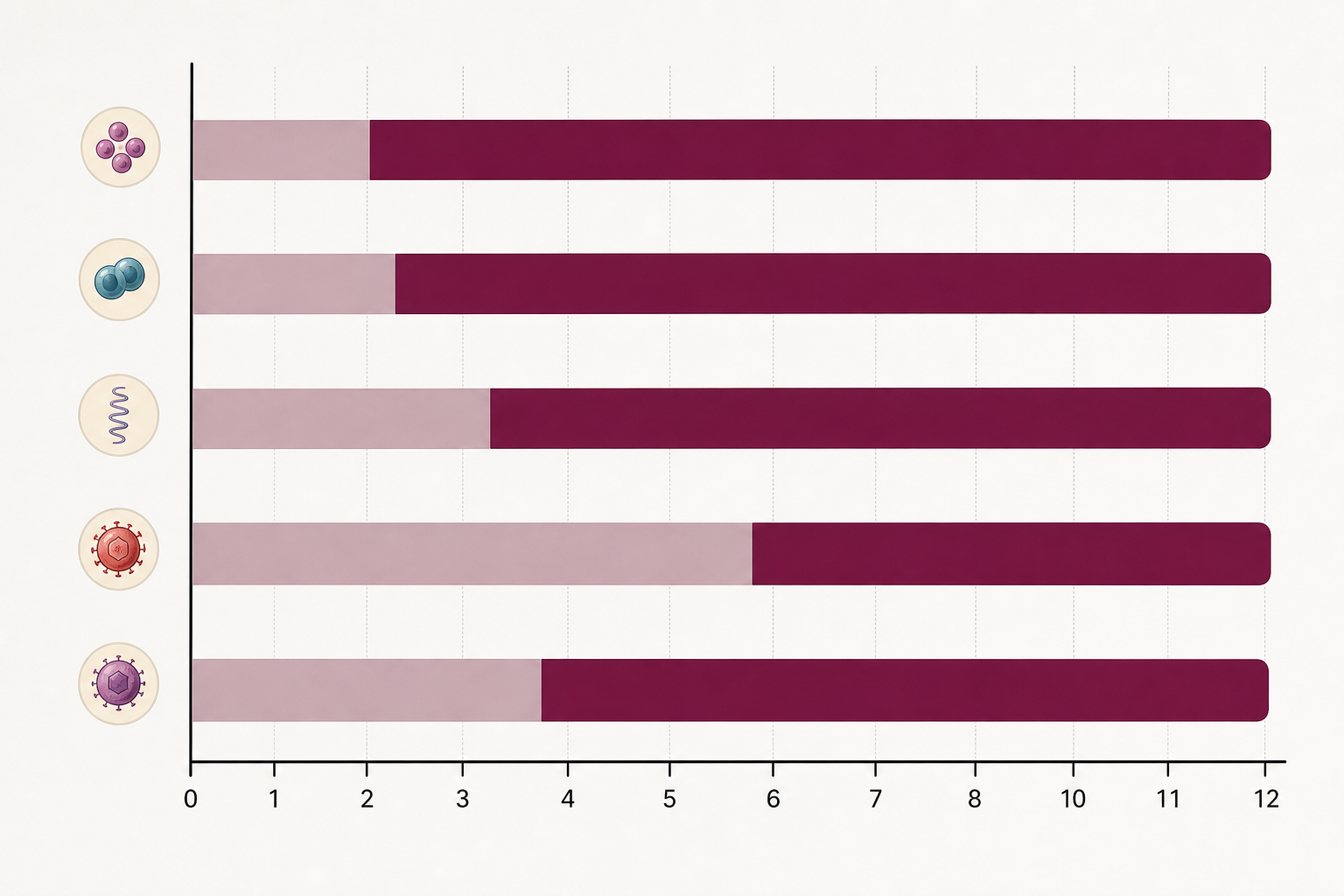
The table below summarizes current CDC and WHO guidance for the most common infections. NAAT (nucleic acid amplification test, the most sensitive laboratory method) is the standard lab assay for chlamydia and gonorrhea; at-home rapid swabs use lateral-flow chemistry on the same sample type. The earliest-reliable column is when most labs and at-home rapid kits start to detect the infection in symptomatic and many asymptomatic people. The conservative retest column is when a negative result becomes very reliable for clearing the exposure.
| Infection | Test sample | Earliest reliable detection | Conservative retest |
|---|---|---|---|
| Chlamydia | Self-collected swab or urine (lab NAAT); at-home rapid swab | 10 to 14 days | 3 weeks |
| Gonorrhea | Self-collected swab or urine (lab NAAT); at-home rapid swab | 7 to 14 days | 2 to 3 weeks |
| Syphilis | Blood antibody (lab or fingerstick rapid) | 3 to 6 weeks | 6 to 12 weeks |
| HIV | 4th-generation antigen-antibody combo, NAAT, or antibody-only | 18 to 45 days (combo); 12 weeks (antibody-only) | 12 weeks |
| HSV-2 | Blood antibody (IgG) | 4 to 6 weeks | 12 to 16 weeks |
Timing the test when you can't pin down the date
If the exposure date is uncertain, work backwards from your earliest plausible contact. Use the conservative retest column from the window-period table above and count forward. For most people who think something happened over a single weekend, this lands at the two-to-three-week mark for chlamydia and gonorrhea, six to twelve weeks for syphilis, and twelve weeks for HIV antibody-based testing.
It is reasonable to test earlier if you want a partial read. A chlamydia or gonorrhea swab taken at ten to fourteen days will catch most active infections in symptomatic people. A negative at that point does not clear you because the window has not closed, but a positive is meaningful and lets you start treatment sooner. Per CDC screening guidance, retesting roughly three months after treatment for chlamydia or gonorrhea is recommended to catch reinfection.
If symptoms appear at any point, test as soon as you notice them, regardless of the calendar. Symptomatic infections tend to show up earlier on tests because the bacterial or viral load is higher when symptoms are active. The infographic below shows the same windows visually, which can help if you are working out which date on your calendar makes sense.
Symptoms after a blurry night, and why their absence proves nothing
Symptoms are an unreliable narrator for STIs. Many STIs, including chlamydia, produce no obvious symptoms, per the CDC, meaning people often carry infections without knowing it. Genital herpes is asymptomatic or unrecognized in most people who carry it. HPV produces no symptoms in the majority of cases, even when it leads to longer-term complications. The infections that do produce symptoms often do so unevenly and after the relevant window period has already closed.
Certain symptoms in the days or weeks after a possible exposure are worth treating as a testing signal in their own right. The table below maps the most common ones to the infections most likely to cause them and the time frame in which they typically appear.
| Possible symptom | Likely STI cause | Typical onset | Test recommended? |
|---|---|---|---|
| Burning during urination | Chlamydia, gonorrhea | 2 to 7 days | Yes |
| Genital sore or blister | Herpes, syphilis | 4 to 21 days | Yes |
| Unusual vaginal or penile discharge | Chlamydia, gonorrhea, trichomoniasis | 5 to 14 days | Yes |
| Flu-like symptoms, fatigue, rash on palms or soles | HIV (acute), syphilis (secondary) | 2 to 4 weeks | Yes |
| No symptoms at all | Any STI | Not applicable | Yes, routine screening still applies |
How at-home rapid tests actually work
At-home rapid STI tests use lateral-flow chemistry, similar in principle to a home pregnancy test. You collect a sample (a self-collected vaginal or penile swab for chlamydia, gonorrhea, trichomoniasis, and HPV; a fingerstick blood drop for HIV, syphilis, hepatitis B and C, and HSV antibody testing), apply it to a buffered cassette, and read the result inside about 15 minutes. A control line confirms the test ran correctly. A second line indicates a reactive (positive) result. No lines, or only the test line without a control, means the test was invalid and should be repeated.
Lateral-flow rapid tests are not the same technology as the lab-grade NAAT or PCR that a clinic might run. Labs detect bacterial or viral DNA directly, which gives them slightly higher analytical sensitivity, especially in asymptomatic cases with low pathogen load. At-home rapid tests perform well when used after the window period has closed, particularly for screening between clinic visits and for following up on a known exposure. The two are complementary, not interchangeable. A positive rapid result is worth confirming at a clinic. A negative rapid result taken very early in the window calls for a retest at the conservative date.
For someone doing private at-home screening after an uncertain exposure, a combination panel is usually the most efficient first step because it covers several infections from a single collection session. STD Rapid Test Kits sells the at-home rapid kits referenced in this article.
Retesting: when one test isn't enough
A single test taken too early is one of the most common ways people end up surprised by a later positive result. If you swab for chlamydia five days after a possible exposure and the result is negative, that result is essentially a placeholder. The bacterial load may not have reached the detection threshold yet. A confirmatory test two to three weeks later is what closes the window.
A practical retest schedule for an uncertain exposure looks like this:
- Day 10 to 14: an initial swab for chlamydia and gonorrhea, mostly useful if symptoms have appeared.
- Three weeks: a follow-up swab that closes the chlamydia and gonorrhea window for most people.
- Six to twelve weeks: blood antibody testing for syphilis becomes reliable, with twelve weeks closing the window for most cases.
- Twelve weeks: HIV antibody-only tests become reliable. Earlier 4th-generation antigen-antibody combo testing (from 18 to 45 days) or NAAT testing is more sensitive and is the route most clinics use after a recent high-risk exposure.
- Twelve to sixteen weeks: HSV-2 blood antibody testing closes the window for nearly all cases.
If you tested positive and have completed treatment for chlamydia or gonorrhea, the CDC recommends retesting at three months to catch reinfection, not to confirm the cure. Bacterial DNA can briefly linger after a successful course of antibiotics, so retesting too soon after treatment can produce a false positive even when the infection has cleared.
If you suspect non-consensual contact
If part of you is wondering whether what happened was non-consensual, that concern is worth taking seriously on its own, separate from STI testing. You do not need bruises or a clear memory for it to count. Waking up with unexplained physical symptoms, hearing a partner describe events that do not match your sense of the night, or simply feeling that something is wrong are all reasons to reach out for support before deciding alone.
The Rape, Abuse and Incest National Network operates a confidential 24-hour hotline at 1-800-656-HOPE (4673). They can connect you with local resources for medical care, evidence collection if you decide to pursue that path, and emotional support, regardless of whether you want to file a report. Many sexual assault response programs and emergency departments offer post-exposure care that does not require naming what happened.
If the possible exposure was within the past 72 hours, you may be eligible for HIV post-exposure prophylaxis (PEP), a 28-day antiretroviral course that significantly reduces the risk of HIV infection after a high-risk exposure. PEP is most effective when started within hours of exposure. The CDC describes PEP eligibility and access here. Emergency departments and many sexual-health clinics can start PEP same-day after a brief consultation.
You do not owe anyone a memory or a label to deserve care. Calling a hotline or visiting a clinic keeps your options open without committing you to any particular path or timeline.
Within 72 hours of a possible exposure: ask an emergency department about HIV post-exposure prophylaxis (PEP), a 28-day antiretroviral course that significantly reduces HIV transmission risk.
For non-consensual contact: National Sexual Assault Hotline at 1-800-656-HOPE (4673). Confidential, available 24 hours a day, and does not require you to file a report.
Privacy, shame, and ordering quietly
Most people who hesitate to test do not hesitate because they doubt the test. They hesitate because of what testing might say about them, or because they don't want a partner, parent, or roommate to see a clinic bill. At-home rapid tests sidestep most of those concerns. STD Rapid Test Kits ships in plain padded mailers with no medical wording on the outside. Card statements show the parent company name only. You can collect, run, and discard in private. No one needs to be told.
The emotional layer is harder to dismiss in writing, but two reframes help. First, testing is a routine adult health behavior that the CDC recommends for sexually active adults broadly, not just after a worrying incident. Scheduling a dental cleaning says nothing about how well you brush. An STI screen carries the same neutrality. Second, readers who use a private test almost universally describe relief afterward, not regret. The minutes spent reading the result strip can feel uncomfortable. The hours that follow a clear result, or the start of treatment for something curable, tend to feel calmer than the days of uncertainty that came before.
Many STDs have no symptoms, so people can have one and not know it. The only way to know for sure if you have an STD is to get tested.
If your test comes back positive
A positive result on a home rapid test is meaningful, not catastrophic. Common bacterial STIs (chlamydia, gonorrhea, trichomoniasis) are curable with a short antibiotic course that a doctor or a telehealth service can prescribe after a confirmatory test. Syphilis is treatable to cure with one or more penicillin injections when caught at early stages, per CDC STI Treatment Guidelines. HIV is a manageable chronic condition with daily antiretroviral therapy; people on effective treatment with a sustained undetectable viral load do not transmit HIV sexually, the principle known as U=U. Herpes is lifelong but episodic, and antiviral therapy reduces outbreak frequency and transmission risk.
Two practical steps after a positive home result:
- Confirm with a lab test through a clinic or telehealth service, and start treatment. Many telehealth providers will prescribe based on a positive home result plus a short consultation, especially for chlamydia and gonorrhea.
- Notify recent sexual partners. Anonymous partner-notification tools like TellYourPartner.org (a free partner-notification service, not government-operated) let you send a confidential message without revealing your identity, which makes the conversation easier in many cases. Most U.S. states do not legally require partner notification, but it is an important public-health step and most clinicians strongly encourage it.
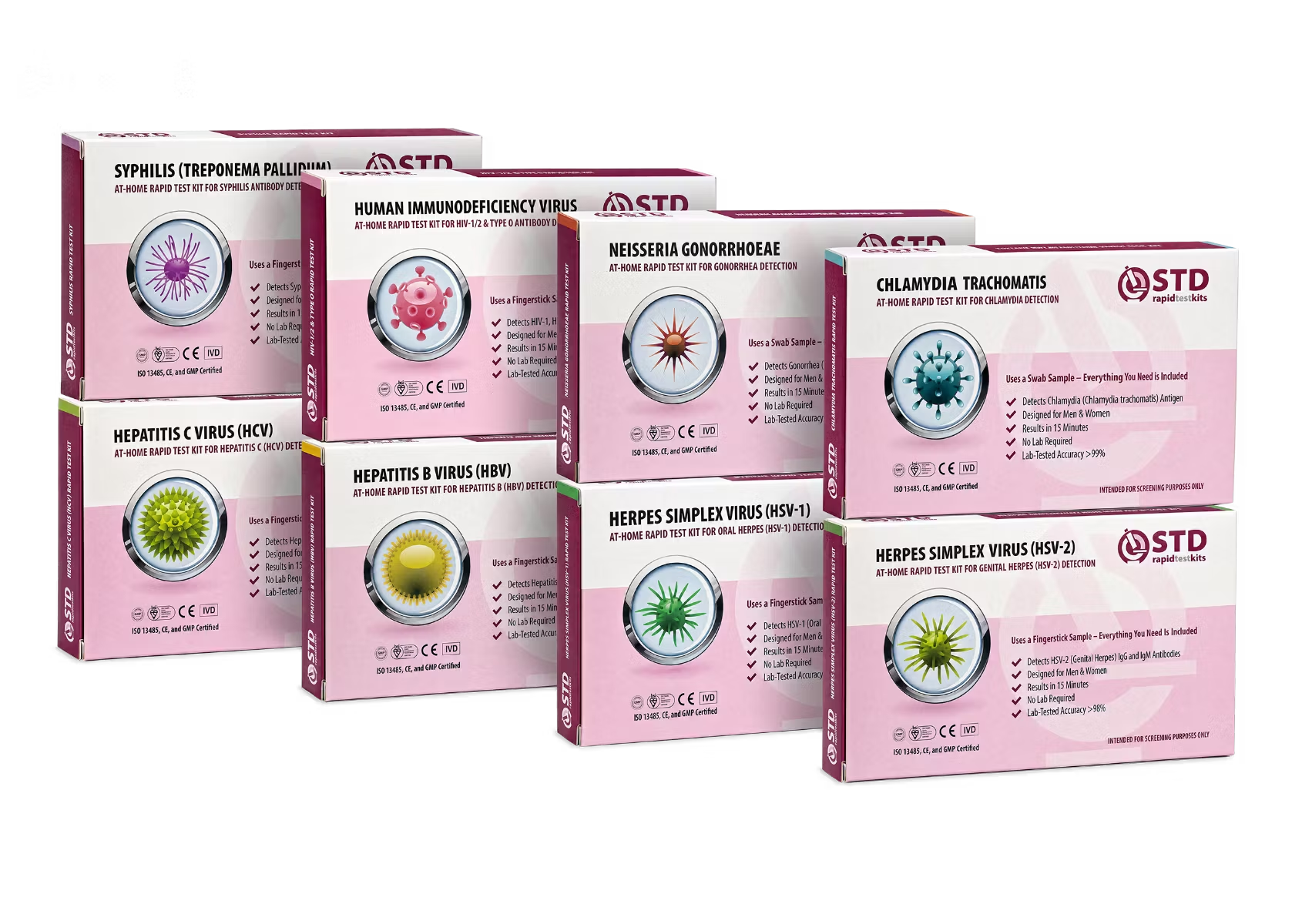
If you are unsure which test panel to start with, a wider combination kit covers more infections from a single collection session. The 8-in-1 panel below tests for eight of the most common STIs in one workflow and is a reasonable choice when the night is genuinely a blank.
You don't need a full memory to deserve care
A test result is the same whether you remember every detail of an encounter or none of it. Your body's response to a pathogen does not depend on your conscious recall of how it got there. Testing is a small, private check on what your body might be carrying, nothing more. Reading this far has already been part of that check.
If the conservative window has passed, the next move is ordering or scheduling a test. Readers still inside the early window should mark a retest date on the calendar before anything else. And if the night may have been non-consensual, call a hotline or clinic before deciding alone.
FAQs
- I can't remember if we had sex. Should I test anyway?
- Yes, if there is any reasonable chance of genital contact, oral contact, or fluid exchange. The CDC recommends routine STI screening for sexually active adults regardless of whether a specific encounter was certain. A memory gap does not lower the underlying transmission risk, and testing privately at home is low-cost insurance against finding out the hard way later.
- If I used a condom (or think I did), do I still need to test?
- Condoms substantially reduce the risk of bacterial STIs like chlamydia and gonorrhea and reduce HIV transmission risk, but they do not fully prevent infections passed through skin-to-skin contact, like herpes and HPV. If you cannot confirm a condom was used correctly for the whole encounter, testing is the simpler answer.
- How early can I take a test and get a useful result?
- For chlamydia and gonorrhea, 10 to 14 days after exposure catches most active infections, with 2 to 3 weeks for a more reliable clearance read. Syphilis becomes detectable from about 3 to 6 weeks, with 6 to 12 weeks for full clearance. HIV combination antigen-antibody tests are reliable from 18 to 45 days, and antibody-only tests at 12 weeks. HSV-2 antibody tests close out at 12 to 16 weeks for most cases.
- I have no symptoms. Is testing still worth it?
- For many STIs, including chlamydia and herpes, most carriers never develop recognizable symptoms. Routine screening exists because waiting for symptoms misses the majority of infections. HPV is similarly silent in most cases. The absence of a symptom is information about your nerve endings, not about your infection status.
- Are at-home rapid tests as accurate as clinic tests?
- Use them in sequence. Rapid at-home tests are a reliable first screen after the window period closes. If a result is reactive, follow up at a clinic where NAAT and PCR sensitivity is higher, especially for confirming a positive or catching a low-load asymptomatic infection caught early.
- What is the difference between the 6-in-1 and 8-in-1 panels?
- Both are combination home kits covering common STIs in one collection. The 6-in-1 covers six of the most common infections in a single workflow. The 8-in-1 adds two additional infections to that panel. If you are unsure what to test for after an uncertain exposure, the 8-in-1 is the more conservative choice; the 6-in-1 is a good budget-conscious starter.
- How do I tell a partner I'm getting tested?
- You can keep it brief and practical: "I had an uncertain encounter recently, and I'm getting screened, so you might want to as well." You do not need to share details about what happened or your timeline. A short heads-up gives them the chance to take care of their own health.
- Is at-home testing actually private?
- Yes. STD Rapid Test Kits orders ship in unmarked padded packaging, and credit card statements show the parent company name only, not the test contents. You collect, run, and read the test yourself. Nothing is sent to your doctor, your insurance, or anyone else unless you decide to share it.
How We Sourced This Article: We combined current guidance from the CDC, WHO, and Planned Parenthood with peer-reviewed clinical literature on STI window periods and at-home rapid testing. Where public-health guidelines and product specifications differed, we cited both and erred toward the more conservative timing. Window-period figures reflect 2024 to 2025 CDC and WHO updates.
- U.S. Centers for Disease Control and Prevention. 2025 press release on latest national STI surveillance data, including the about-1-in-5 prevalence figure for the U.S. adult population.
- U.S. Centers for Disease Control and Prevention. STI screening recommendations for sexually active adults, including the three-month retest-after-treatment recommendation for chlamydia and gonorrhea.
- U.S. Centers for Disease Control and Prevention. PEP (post-exposure prophylaxis) eligibility, the 72-hour access window for high-risk HIV exposure, and the 28-day treatment course.
- U.S. Centers for Disease Control and Prevention. About sexually transmitted infections, noting that many STIs produce no obvious symptoms so people often carry infections without knowing it.
- U.S. Centers for Disease Control and Prevention. STI Treatment Guidelines for chlamydia, gonorrhea, syphilis, and HIV (2021, current edition).
- World Health Organization. Sexually transmitted infections (STIs) fact sheet with global incidence and screening guidance.
- RAINN, the Rape, Abuse and Incest National Network. National Sexual Assault Hotline and confidential support resources.
