STD Test Window Periods: When Each Test Becomes Accurate
You took a risk on Saturday. By Tuesday you want answers. Each STI has its own window between exposure and reliable detection, and testing inside that window can miss an active infection. This guide gives you the day-by-day timing for chlamydia, gonorrhea, HIV, syphilis, herpes, and trichomoniasis, plus when to retest.




- The right time to test depends on the infection. NAATs detect chlamydia and gonorrhea from about 2 weeks after exposure; HIV fourth-generation lab tests from 18 to 45 days; HSV-2 antibody tests from about 12 weeks.
- A negative test taken inside the window period does not mean you are clear. If you tested early, plan a confirmatory retest at the peak window for that infection.
Published: December 2025 | Last updated: April 2026 | Editorial review and quality control: Martina N.
The gap between a possible exposure and a reliable test result has a name: the window period. It is not the same thing as the incubation period (when symptoms might appear), and testing inside the wrong window is the single most common reason a negative result misses an infection that is actually there.
This guide breaks down the testing window for each of the most common sexually transmitted infections, the difference between rapid lateral-flow tests and laboratory NAATs, and what to do if you tested too early or your result came back positive.
How long after exposure should you wait to test for an STI?
It depends on the infection and the test. Chlamydia and gonorrhea NAATs are usually reliable from about 14 days after exposure. HIV fourth-generation antigen-antibody lab tests detect most infections by 18 to 45 days. Syphilis blood tests first become detectable around 3 weeks but reach full reliability at 6 to 12 weeks. HSV-2 antibody tests can take 12 to 16 weeks. Test earlier if you have symptoms, and plan a confirmatory retest at the window peak.
Key Takeaways
- The right time to test depends on the infection. NAATs detect chlamydia and gonorrhea from about 2 weeks after exposure; HIV fourth-generation lab tests from 18 to 45 days; HSV-2 antibody tests from about 12 weeks.
- A negative test taken inside the window period does not mean you are clear. If you tested early, plan a confirmatory retest at the peak window for that infection.
Window period vs incubation period (and why the difference matters)
Two timing terms get used interchangeably online, and they should not be. The window period is the time between exposure and when a specific test can reliably detect the infection in your body. The incubation period is the time between exposure and when symptoms (if any) start.
For most STIs the two timings are different, and here is the catch: many infections cause no symptoms at all. Most people with chlamydia have no symptoms, according to the CDC's chlamydia overview; the same pattern shows up in gonorrhea and trichomoniasis. Waiting for symptoms before testing is unreliable on its own.
The window period also varies by test technology. A NAAT (nucleic acid amplification test, the kind labs use for chlamydia and gonorrhea) detects bacterial DNA earlier than an antibody test, which has to wait for your immune system to produce a response. An at-home rapid lateral-flow test uses a different chemistry than a lab NAAT and can be slightly less sensitive in the very early window, especially for asymptomatic infections.
Bottom line: timing is per-infection and per-test-type. The next section breaks both out.
The window period tells you when a test result becomes trustworthy. The incubation period tells you when symptoms (if any) might start. They rarely line up, and many STIs cause no symptoms at all, so testing should be timed to the window, not to how you feel.
STI-by-STI: when each test becomes reliable
The numbers below reflect current CDC STI screening recommendations and laboratory assay labels for the most common testing windows. Treat them as orientation, not absolutes; specific assay brands can shift these by a few days in either direction.
| Infection | Test type | Sample | Earliest detection | Recommended window peak |
|---|---|---|---|---|
| Chlamydia | NAAT (lab) or rapid swab | Urine or vaginal/penile swab | ~7 days | 14 days or later |
| Gonorrhea | NAAT (lab) or rapid swab | Urine or vaginal/penile swab | ~7 days | 14 days or later |
| Trichomoniasis | NAAT or rapid antigen | Vaginal swab | 5 to 7 days | 1 to 2 weeks |
| HIV (4th-gen lab Ag/Ab) | Antigen + antibody combo | Blood (venous draw) | 18 days | 45 days |
| HIV (rapid antibody) | Lateral-flow antibody | Fingerstick blood or oral fluid | 23 to 90 days | 12 weeks |
| Syphilis | Treponemal antibody (lab or rapid) | Blood | 3 weeks | 6 to 12 weeks |
| HSV-2 (genital herpes) | Type-specific IgG antibody | Blood | 3 to 6 weeks | 12 to 16 weeks |
| Hepatitis B | HBsAg (surface antigen) | Blood | 3 to 6 weeks | 9 weeks |
| Hepatitis C | HCV antibody | Blood | 8 to 11 weeks | 12 weeks |
If you do not know what to test for, screen broadly
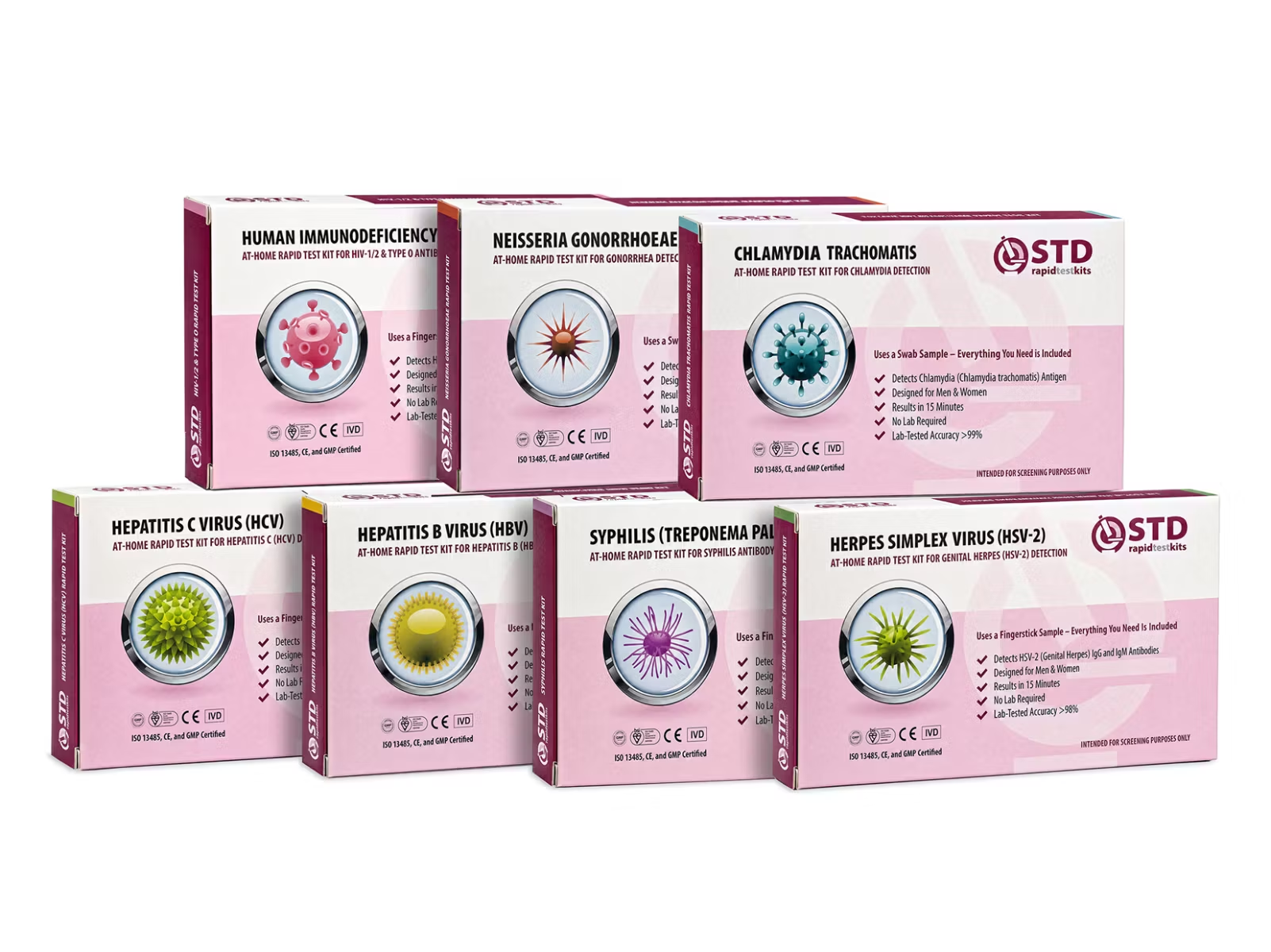
People often arrive at testing without a clear sense of which infection they were actually exposed to. A multi-infection screening panel removes that guesswork in a single appointment with yourself. Time the panel to the longest window of the infections it covers; for a panel including HIV antibody, that means 12 weeks for full coverage, with an earlier preliminary screen at 14 to 45 days for the bacterial and antigen-positive infections.
Why testing too early can miss a real infection
A test that returns negative inside the window period is doing exactly what it should. The biology just has not caught up. There is not yet enough viral RNA, bacterial DNA, or antibody response in the sample for the assay's detection threshold to register.
For HIV in particular, this gap matters. The CDC's HIV testing guidance notes that fourth-generation antigen-antibody lab tests detect most infections within 18 to 45 days of exposure, while rapid antibody tests done from a fingerstick can take 23 to 90 days. A rapid HIV test on day 5 is not a clearance.
For bacterial infections like chlamydia and gonorrhea, NAATs are highly sensitive but still need bacterial replication at the infection site before a swab or urine sample carries detectable DNA. That usually takes about a week.
Sores, unusual discharge, burning during urination, pelvic pain, or a new rash within days of exposure means see a clinician (or test) now, regardless of the calendar window. Symptomatic infections are usually testable earlier than asymptomatic ones because there is more pathogen present at the site.
Rapid, mail-in, or clinic: choosing the right test for the moment
Three test pipelines dominate at-home and accessible STI testing. They are not interchangeable; each one trades off speed, sensitivity, and follow-through.
| Pipeline | Result speed | Sensitivity | Best for |
|---|---|---|---|
| At-home rapid lateral-flow | 10 to 20 minutes | Good (slightly below lab NAAT in early window) | Symptom check, day-of peace of mind, repeat screening |
| Mail-in lab kit | 2 to 7 days after shipping | Lab-grade NAAT or 4th-gen Ag/Ab | Confirmatory test once you are past the window |
| Clinic visit | Same day to 7 days | Lab-grade with provider follow-up | Active symptoms, treatment, or partner counseling |
Same sample type, different chemistry
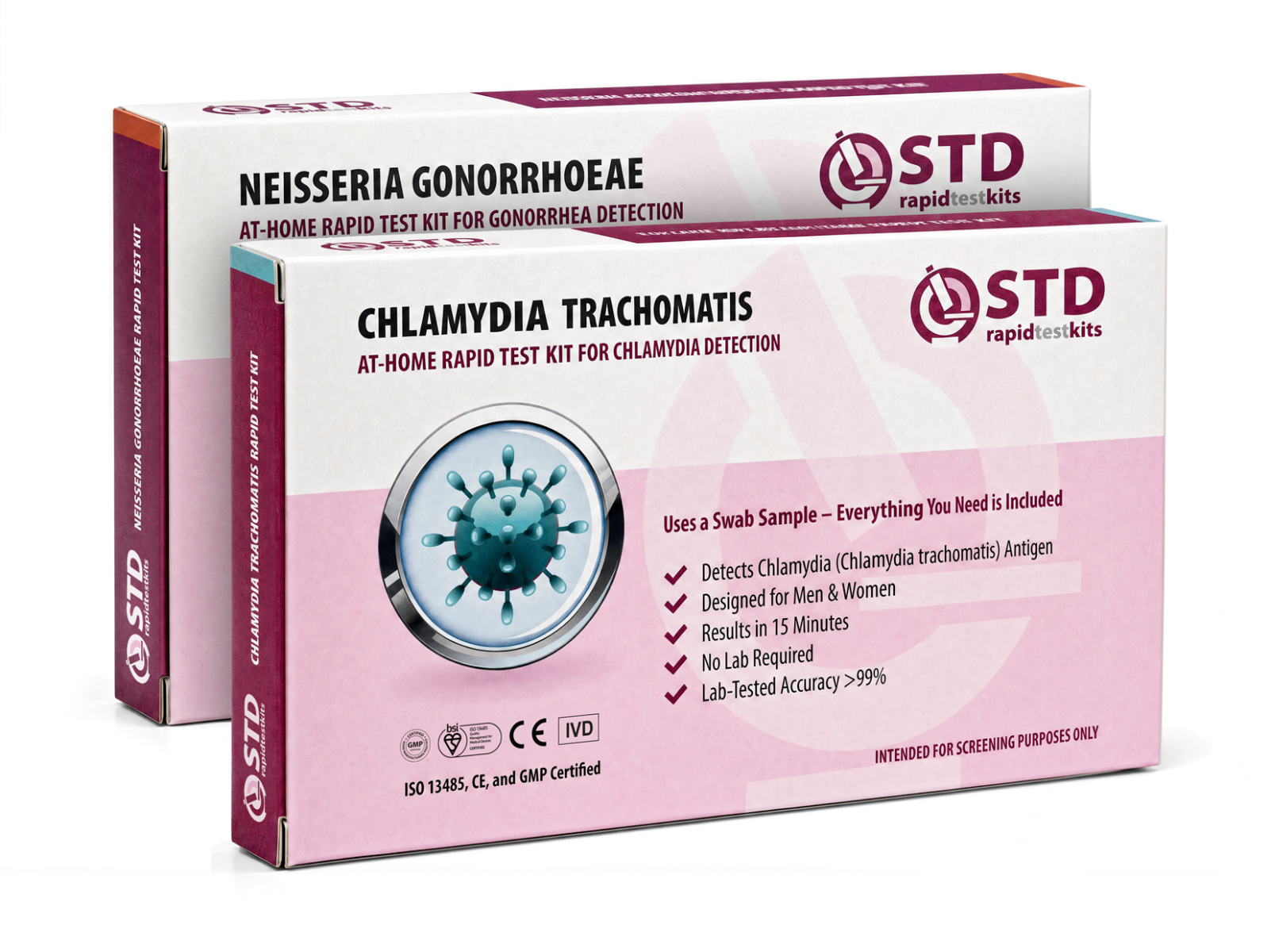
Rapid lateral-flow tests use the same sample type as labs (a swab for chlamydia or gonorrhea, a fingerstick for HIV or syphilis), but the chemistry is a different technology than a NAAT. A positive rapid result is worth confirming with a lab when possible, especially for HIV and syphilis. A negative rapid result inside the window is worth retesting once you reach the peak window. The two test types are complementary, not equivalent.
Retesting: who needs it and when
Three situations call for a retest. First: you tested inside the window period and the result was negative. Plan a follow-up at the window peak for the infection you were exposed to (typically 14 days for chlamydia and gonorrhea, 45 days for lab HIV, 6 to 12 weeks for syphilis, 12 to 16 weeks for HSV-2).
Second: you have completed treatment for a bacterial STI (chlamydia, gonorrhea, trichomoniasis) and want to confirm it cleared. Wait at least three to four weeks before retesting with a NAAT. Earlier than that, the test can pick up dead bacterial DNA and read positive even though the infection is gone. The CDC also recommends retesting approximately 3 months after treatment for anyone treated for chlamydia or gonorrhea, since reinfection from an untreated partner is common.
Third: you have ongoing exposure (a partner whose status you do not know, or a partner currently being treated). Retest at sensible intervals; the CDC recommends sexually active people retest every 3 to 6 months when they have new or multiple partners.
What to do if your test is positive
A positive STI result is not a verdict on character; it is information. Most STIs are curable with antibiotics (chlamydia, gonorrhea, syphilis, trichomoniasis). The chronic ones (HIV, herpes, hepatitis B, HPV) are manageable with modern treatment, and HIV in particular is a fully manageable chronic condition with antiretroviral therapy.
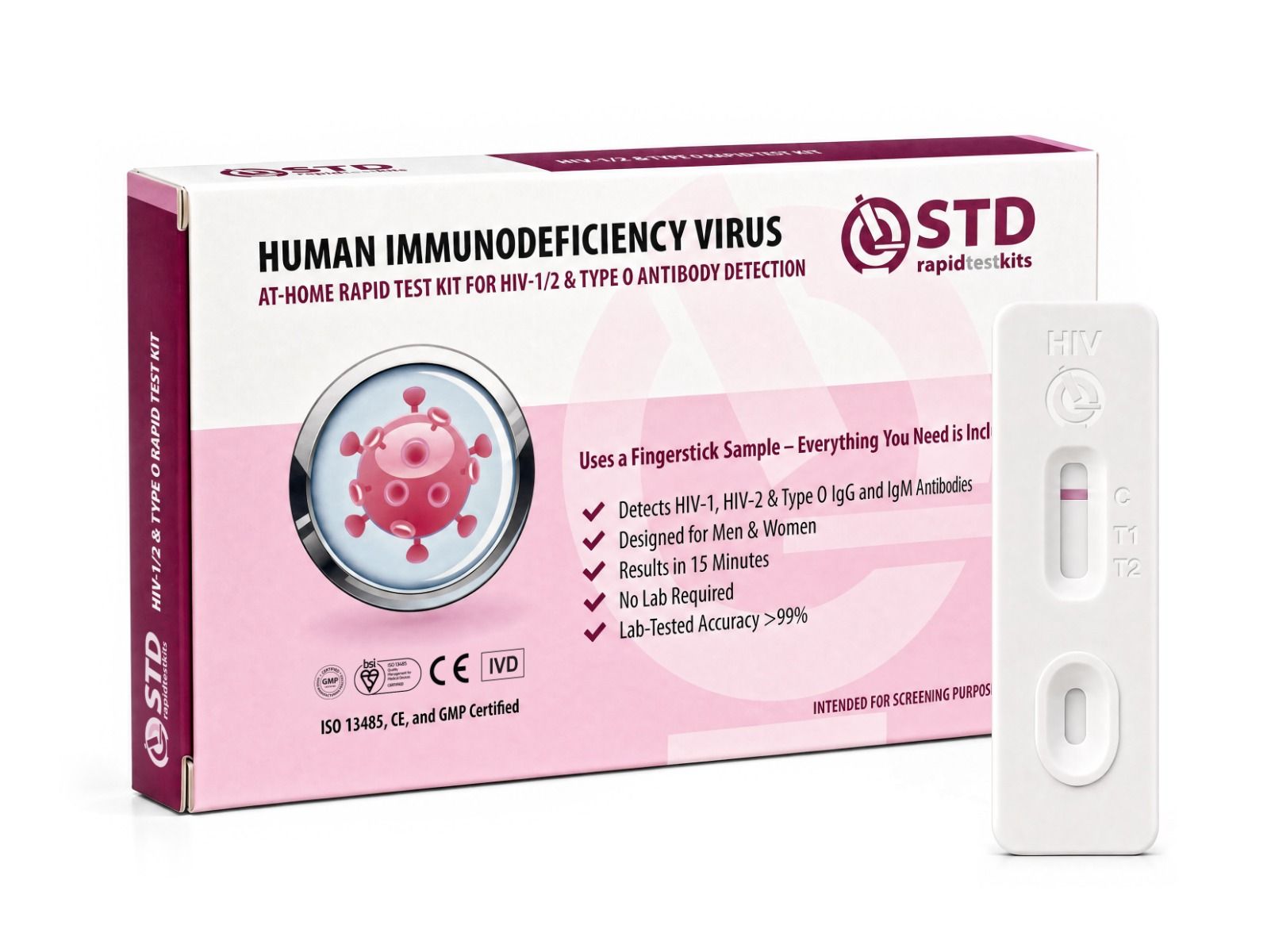
If you tested with a rapid kit, confirm the result at a lab before acting on it, especially for HIV and syphilis. Treatment usually starts soon after: bacterial STIs (chlamydia, gonorrhea, syphilis, trichomoniasis) clear with a single antibiotic course, while HIV requires antiretroviral therapy through a clinician. Once treatment is underway, notify recent partners so they can test; many state and local health departments offer anonymous notification services to help with that conversation.
Most STIs cause no signs or symptoms, but can still be passed to others. Testing is the only way to know your STI status.
Privacy, discretion, and what at-home testing actually changes
The barrier to testing for many people is not cost or time; it is the discomfort of a clinic visit, the worry that someone will see the package, or the calendar friction of an in-person appointment. At-home rapid kits address all three: discreet packaging, no insurance billing, results in your own bathroom. The trade-off is that a positive at-home result still benefits from clinical confirmation and treatment.
Discreet packaging, no insurance billing, and a result in under 20 minutes. Useful when the friction of a clinic visit is the reason a test would not happen at all.
The takeaway
Testing earlier than the window period is not wrong; it is incomplete. A negative test in the early window is a starting point, not an ending. Mark your calendar for the peak window of whatever infection concerns you, and plan a confirmatory test then.
Frequently asked questions
- How long after exposure should I wait to test for HIV?
- For a fourth-generation lab antigen-antibody test, most infections are detectable from 18 to 45 days after exposure. For a rapid fingerstick antibody test, the window stretches to 23 to 90 days, with peak reliability at 12 weeks. If you need certainty quickly, the lab Ag/Ab test is the earliest reliable option.
- What is the difference between the window period and the incubation period?
- The window period is when a test can reliably detect the infection. The incubation period is when symptoms (if any) start. The two often differ, and many STIs cause no symptoms at all, so testing should be timed to the window period, not to whether you feel symptoms.
- Can I have an STI and feel completely normal?
- Yes. Most people with chlamydia have no symptoms, according to the CDC, and the same pattern is common for gonorrhea, trichomoniasis, herpes, and early HIV. Routine testing is the only reliable way to know your status.
- I tested at day 3 and the result was negative. Am I clear?
- Not necessarily. A day-3 test is well inside the window period for almost every STI. Treat that result as a screen, not a final answer, and plan a follow-up test at the window peak for the infection you were exposed to: typically 14 days for chlamydia and gonorrhea, 45 days for lab HIV, 6 to 12 weeks for syphilis, and 12 to 16 weeks for HSV-2.
- Are at-home rapid tests as accurate as lab tests?
- For most screening purposes, yes. A rapid lateral-flow test catches the same infections as a lab NAAT, with slightly lower analytical sensitivity in the earliest window or for asymptomatic cases. The meaningful difference shows up in the margins. A positive rapid result warrants lab confirmation; a negative inside the window is worth a follow-up retest at the peak window for that infection.
- How long after treatment should I retest?
- For bacterial STIs (chlamydia, gonorrhea, trichomoniasis), wait at least three to four weeks after finishing antibiotics before retesting with a NAAT. Earlier than that, the test can detect dead bacterial DNA and read positive even though the infection is gone. The CDC also recommends a separate retest at three months to check for reinfection from a partner.
- Can I test for STIs during my period?
- Yes for blood-based tests (HIV, syphilis, HSV) and urine-based tests. For a vaginal self-swab (chlamydia, gonorrhea, trichomoniasis, HPV), you can swab during a period and the sample integrity is fine. If heavy flow makes the swab uncomfortable, waiting two or three days is reasonable.
- What if I do not know what I was exposed to?
- Use a multi-infection panel covering the most common STIs (chlamydia, gonorrhea, HIV, syphilis, herpes, hepatitis B, hepatitis C). A 6-in-1 or 7-in-1 combo kit screens all of them from a single appointment with yourself. Time the test to the longest window in the panel for full coverage; for a panel including HIV antibody, that is 12 weeks.
- U.S. Centers for Disease Control and Prevention. Sexually transmitted infections: prevention and testing overview, with general guidance on asymptomatic STI prevalence.
- U.S. Centers for Disease Control and Prevention. HIV testing: types of tests and detection windows for fourth-generation Ag/Ab and rapid antibody tests (18 to 45 days and 23 to 90 days respectively).
- U.S. Centers for Disease Control and Prevention. STI screening recommendations and 3-month retesting guidance after chlamydia and gonorrhea treatment.
- U.S. Centers for Disease Control and Prevention. Herpes testing: HSV-2 antibody window guidance, with detection up to 16 weeks after exposure.
- U.S. Centers for Disease Control and Prevention. Chlamydia overview: asymptomatic infection patterns and 3-month retesting recommendation.
- World Health Organization. Sexually transmitted infections fact sheet, with global prevalence and screening guidance.
- NHS. Sexually transmitted infections: when symptoms appear, when to test, and what each test detects.