
Published: September 2025 | Last updated: May 2026 | Editorial review and quality control: Martina N.
Most teens who have chlamydia don't feel sick. The U.S. Centers for Disease Control and Prevention classifies chlamydia as a “silent” infection because the majority of cases produce no clear symptoms in adolescent and young-adult bodies. That's why testing decisions need to start with exposure history, not with how someone is feeling on a given day.
This guide walks through what chlamydia can look like in younger bodies, when testing is most reliable after a possible exposure, and how teens can access confidential testing. The information is summarized from CDC, WHO, NHS, and MedlinePlus guidance for a general audience. It is not a substitute for advice from a clinician you trust.
Key Takeaways
- Most teens with chlamydia have no symptoms, so testing based on exposure is more reliable than waiting for warning signs to appear.
- Wait around 14 days after a possible exposure for the most accurate test result; treatment is a short course of antibiotics.
Why chlamydia often hides in teens
Public-health agencies call chlamydia a silent infection because most people who carry it never get a clear warning sign. According to the World Health Organization, the majority of chlamydial infections worldwide go undiagnosed, and adolescents face this problem more sharply than adults for several reasons.
Younger bodies are still adjusting to hormonal changes, menstrual cycles, and new patterns of sexual activity. Spotting between periods, mild discharge changes, and discomfort during early sexual experience can all be dismissed as normal puberty rather than recognized as a possible infection. Teens are also less likely to have routine STI screening and more likely to feel hesitant about asking for one. The combination is what allows chlamydia to spread through this age group at higher rates than any other.
The reliable approach is testing based on whether a possible exposure happened, regardless of whether anything currently feels wrong. Untreated chlamydia can quietly damage the reproductive tract over months or years before any symptom finally surfaces.
Most people who have chlamydia have no symptoms. If you do have symptoms, they may not appear until several weeks after you have sex with an infected partner.
What chlamydia can feel like, when it shows up at all
When teens do notice symptoms, they tend to be mild and easy to confuse with other things. The UK National Health Service lists early signs that include unusual discharge, burning during urination, lower abdominal discomfort, and pain during sex. None of these are specific to chlamydia, which is why so many cases get explained away as a yeast infection, a urinary tract infection, or “just stress.”
The table below maps the most common symptom patterns to what teens often think they're dealing with instead.
| Body Area | Possible Chlamydia Symptoms | How It's Often Misread |
|---|---|---|
| Genital (vaginal or penile) | Unusual discharge, spotting, mild pain during sex, odor changes | Yeast infection, hormonal shifts, “new to sex” discomfort |
| Urinary tract | Burning during urination, frequent urge, mild pelvic pressure | Urinary tract infection or bladder irritation |
| Pelvis or lower abdomen | Cramps outside the period, low back ache, discomfort after sex | Menstrual pain or stress |
| Rectal (after anal exposure) | Itching, bleeding, or discharge from the rectum | Hemorrhoids or general toilet irritation |
| Throat (after oral exposure) | Sore throat, mild redness, often no symptoms at all | Cold or seasonal allergies |
When to test after a possible exposure
Chlamydia bacteria need time to multiply in the body before they're detectable on any test. Test too early and a negative result may be falsely reassuring. The CDC's chlamydia fact page notes that symptoms, if they appear at all, may not show up until several weeks after exposure with an infected partner; clinical testing guidance generally points to a window of roughly two weeks before bacterial load is high enough to detect reliably.
If a condom broke, a hookup happened without protection, or a partner has just disclosed an STI, the right time to test is around 14 days from that event. Testing earlier is possible if symptoms are present, but a negative result before the window has closed is not the end of the story; a repeat test once the window closes is the standard recommendation.
| Days After Possible Exposure | Should I Test? | What to Expect |
|---|---|---|
| 0 to 5 days | Too early | Infection levels are usually below the detection threshold; retest later. |
| 6 to 13 days | Possible if symptoms are present | Some cases can be caught early, but a negative result still calls for a follow-up test. |
| 14+ days | Reliable testing window | Bacterial load is generally high enough for reliable detection. |
What can go wrong if you wait
Chlamydia treats easily with antibiotics when caught. The damage that gets people into long-term trouble comes from leaving it alone for months while it spreads quietly through the reproductive tract.
In teens with female reproductive anatomy, untreated chlamydia is one of the leading causes of pelvic inflammatory disease (PID). PID can scar the fallopian tubes and contribute to fertility problems and chronic pelvic pain later in life. In teens with male reproductive anatomy, untreated infection can spread to the epididymis and cause ongoing testicular pain, urethritis, and recurrent infections.
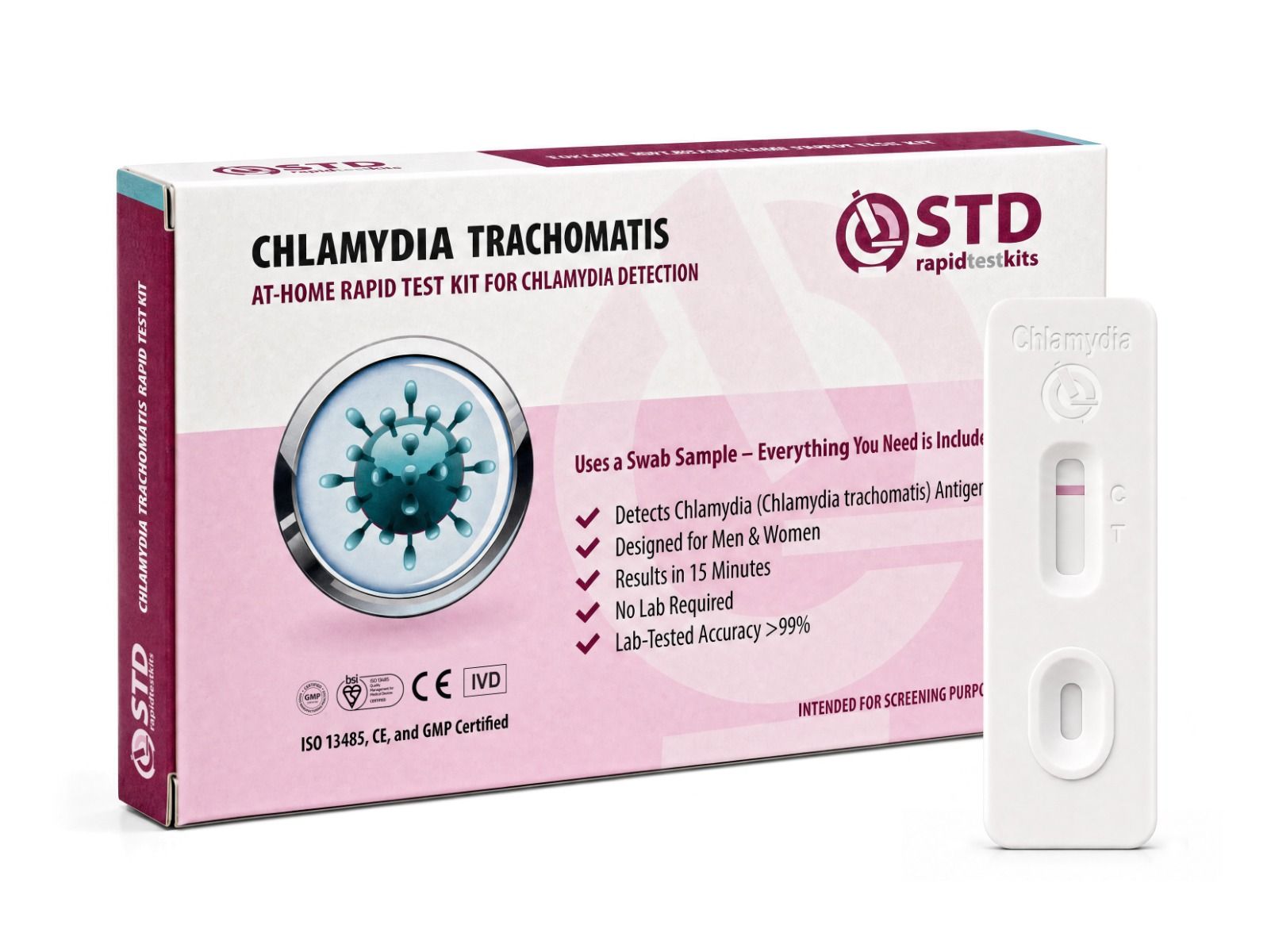
This is also why the at-home rapid tests linked below exist on this site: stdrapidtestkits.com sells the kits used here, and the links in this article go to our own products. We recommend a kit only when it actually fits the reader's exposure and sample-type needs.
Testing options for teens
Walking into a clinic is not the only path. For privacy reasons, many teens prefer testing at home, and several formats now exist. The right choice depends on how quickly you want answers and how much you want results to stay entirely under your control.
At-home rapid tests use a lateral-flow strip, much like a pregnancy test, and read out in about 15 minutes from a self-collected swab. Mail-in lab kits use a sample you collect at home and ship to a lab, which then runs a more sensitive nucleic acid amplification test (NAAT) and returns results in a few days. Clinic visits are the most clinically thorough option but the least private. The table below summarizes how the three compare.
| Testing Method | Sample Type | Privacy Level | Speed of Results |
|---|---|---|---|
| At-home rapid swab test | Self-collected swab (lateral-flow) | Fully private at home | About 15 minutes |
| At-home mail-in lab kit | Urine or swab (lab NAAT) | Anonymous lab processing | 2 to 5 days after mailing |
| Clinic or doctor visit | Urine or swab (lab NAAT) | Depends on the provider and insurance | 1 to 3 days |
Retesting and the reinfection risk
Teens have the highest reinfection rates of any age group. The CDC's screening guidance specifically recommends a follow-up chlamydia test about three months after treatment, regardless of whether symptoms have returned. Reinfection often happens because a partner did not finish treatment, or because new exposure occurred before retesting.
If a recent test was negative but unprotected sex happened again with a new or untreated partner, retesting 30 to 45 days later is a reasonable plan. Condoms substantially reduce the risk of chlamydia transmission without eliminating it.
Get retested for chlamydia approximately three months after treatment, regardless of whether symptoms have returned. Reinfection from an untreated partner is the most common reason for a second positive result, and the three-month retest is built into routine follow-up care for that reason.
Testing under 18: privacy and consent
In most U.S. states, minors can consent to STI testing and treatment without parental notification. Planned Parenthood, school-based health centers, and many urgent-care clinics provide confidential teen services. State laws do vary; the Guttmacher Institute's state policy database is a useful place to check what applies in your specific state if home delivery would risk a parent seeing a package.
At-home test kits are typically shipped in plain packaging without external branding. Results from rapid kits are read at home, never reported to insurance, and never sent through the mail. Mail-in lab kits return results through a secure online account, which means you can read them on a personal phone in incognito mode without leaving a paper trail. None of these workflows guarantee absolute privacy in every household, but they give teens substantially more control than a clinic visit billed through family insurance.
In most U.S. states you can consent to STI testing without a parent. Planned Parenthood, school-based health centers, and many urgent-care clinics offer confidential teen services. Check the Guttmacher Institute's state policy database if home delivery is a concern, and ask any clinic you visit how billing and records are handled before testing begins.
If you test positive: what comes next
A positive chlamydia result is treatable, usually with a seven-day course of doxycycline (currently the CDC's preferred regimen for uncomplicated genital chlamydia in non-pregnant patients) or, in some cases, a single dose of azithromycin. Most providers recommend avoiding sex for seven days after starting treatment, both to allow healing and to prevent passing the infection to a new partner.
Recent sexual partners (typically those from the past 60 days) should also be told to test. Anonymous partner-notification services exist if a direct conversation would be unsafe or unwelcome. A retest at three months confirms that treatment worked and that no new exposure occurred.
FAQs
- Can chlamydia really be present with no symptoms?
- Yes. The majority of chlamydial infections in teens produce no symptoms at all, which is why public-health agencies recommend screening based on exposure rather than waiting for warning signs. A “fine” feeling does not rule out infection.
- How soon after a possible exposure should I test?
- Around 14 days from the exposure for the most reliable result. Earlier testing is possible, especially if symptoms develop, but a negative result before two weeks have passed should be followed by a repeat test once the window closes.
- Do condoms fully protect against chlamydia?
- Condoms substantially reduce transmission risk without eliminating it. A condom that breaks, slips, or wasn't used from the start of contact still allows exposure.
- What does chlamydia feel like for someone with female anatomy?
- Most often, nothing at all. When symptoms do appear, they tend to overlap with a UTI: burning during urination, mild pelvic discomfort, or off-cycle spotting. Discharge changes and pain during sex are also possible.
- What does chlamydia feel like for someone with male anatomy?
- Symptoms can include penile discharge that's not normal morning fluid, burning during urination, or pain or swelling in one testicle. As with female anatomy, many cases produce no obvious signs.
- Can chlamydia be passed through oral sex?
- Yes. Pharyngeal (throat) chlamydia is well-documented and usually causes no symptoms, so a throat infection can be passed on without anyone knowing it's there. Throat-specific testing requires a clinic swab; the at-home rapid swab kit is for genital sample sites only.
- Can a teen test for chlamydia without parental consent?
- In most U.S. states, yes. Minors can typically consent to STI testing and treatment confidentially. Specific laws vary by state, and the Guttmacher Institute's state policy database is a useful resource for checking what applies where you live.
- How accurate are at-home rapid chlamydia tests?
- At-home rapid tests use lateral-flow technology, which is well-suited to private screening but generally less analytically sensitive than the lab NAAT used in clinics. A negative rapid test in someone with significant exposure or symptoms is still worth following up with a lab confirmation.
How we sourced this article: This guide is summarized from current CDC, WHO, NHS, and Guttmacher Institute guidance on chlamydia testing, screening, and treatment in adolescents. We do not provide clinical diagnosis. For symptoms that concern you, see a licensed provider.
- U.S. Centers for Disease Control and Prevention. Chlamydia basic fact sheet covering symptoms, transmission, and screening recommendations.
- U.S. Centers for Disease Control and Prevention. STI screening recommendations including the three-month retest interval after treatment.
- U.S. Centers for Disease Control and Prevention. Pelvic inflammatory disease (PID) overview and link to untreated chlamydia.
- UK National Health Service. Chlamydia overview covering symptoms, testing, and treatment.
- World Health Organization. Chlamydia fact sheet covering global prevalence and screening guidance.
- Guttmacher Institute. State policy database covering minor consent for STI testing and reproductive health services.
