
Published: June 2025 | Last updated: May 2026 | Editorial review and quality control: Martina N.
You both opened the results, and the room got very quiet. Two positive tests instead of one is a different kind of shock. There is the medical question, what does this mean for our bodies, and the louder question underneath it, what does this mean for us. Both deserve calm answers, in that order.
This article walks through what a mutual positive actually tells you (and what it does not), how to coordinate treatment so the same infection does not bounce back and forth between you, and how to handle the conversation without turning a treatable health issue into a breakup. For most bacterial sexually transmitted infections, the medical part is straightforward: matching antibiotics, a short pause from sex, and a follow-up test. The relationship part takes longer. Both are workable.
Key Takeaways
- A shared positive result is a treatment problem first and a relationship conversation second. Both partners need to be treated in the same window or the infection will keep cycling between you.
- Most common bacterial STIs (chlamydia, gonorrhea, syphilis, trichomoniasis) are fully curable with antibiotics. Viral infections (herpes, HPV, HIV) are managed long-term, and partners can still build a stable, intimate life around them.
What a Mutual Positive Actually Means
The first instinct after seeing two positive results is usually to figure out who brought it home. That impulse is human, and it almost never produces a useful answer. Chlamydia, gonorrhea, and herpes can sit silently for weeks, months, or years before any test or symptom shows up. The U.S. Centers for Disease Control and Prevention notes that the majority of chlamydia infections in women cause no symptoms, and a large fraction of gonorrhea cases are also asymptomatic, especially in women, which is exactly why screening matters in the first place (CDC chlamydia overview).
That silence means a shared positive does not prove a timeline. One of you could have carried the infection from a relationship years ago and only now triggered enough antibody response, symptom, or routine swab to register. The other could have been infected last month. Both of you could have picked it up between testing intervals from a single shared exposure. Without a stored sample from earlier in the relationship, there is no way to reconstruct the order, and clinicians do not try.
What the result does confirm is two pieces of information you can act on right now. First, you both have the same infection at the same time, so you both need treatment in the same window. Second, until that treatment is complete, your bodies will keep handing the infection back to each other if you have sex. Everything else, including the harder questions about trust and history, can wait for after the antibiotics are on board.

Why Treatment Timing Matters (A Lot)
If only one partner is treated, the infection has a place to live. The treated partner clears the bacteria, has sex with the still-infected partner before the next test, and gets reinfected. This is the textbook reason clinicians always ask whether the partner is being treated too, and it is the basis for the practice called expedited partner therapy, where many U.S. states let a provider hand out a second prescription for the partner without a separate visit (CDC expedited partner therapy legal status).
The CDC reports that repeat chlamydia infections are common, with surveillance data showing significant reinfection within months when partners are not concurrently treated (CDC chlamydia statistics). Each repeat infection raises the risk of complications, particularly pelvic inflammatory disease in women; the CDC notes that about 1 in 8 women with a history of PID experience difficulty getting pregnant later (CDC pelvic inflammatory disease overview).
The practical version of all of that is three rules:
- Both partners start treatment in the same week. Asymptomatic does not mean uninfected. Both of you take the full course, even the one who feels fine.
- No sex of any kind for at least 7 days after the last antibiotic dose. That includes oral sex and any partner contact that involves the affected anatomic site. For a single-dose treatment, count 7 days from that dose; for a multi-day regimen, count 7 days from the final pill.
- Retest at 3 months. The CDC recommends a follow-up test for chlamydia and gonorrhea about 3 months after treatment, because reinfection is the most common reason for a second positive, not treatment failure (CDC next steps after testing positive).
Treatment for the most common curable infections is short. A single oral dose of azithromycin or a 7-day course of doxycycline for chlamydia; a single intramuscular dose of ceftriaxone for gonorrhea.
Both partners need treatment in the same week, and no sex of any kind for seven full days after the last antibiotic dose. Schedule the 3-month retest at the same visit so it is already on the calendar.
The Reinfection Loop and How to Break It
The reinfection loop is the most common reason couples end up back at the clinic three months later wondering what went wrong. It is rarely a treatment failure. It is almost always one of three things:
- One partner started the antibiotics, felt better after two days, and stopped early.
- The couple resumed sex before the 7-day window closed.
- One partner had a second infection that was never tested for, so a different bug (often trichomoniasis or a viral co-infection) keeps the symptoms going.
The fix is unglamorous. Finish the full prescription even if you feel fine. Treat seven days as a full week, counted from the final pill on the calendar, regardless of how you feel before then. And if symptoms continue after treatment, push for a broader panel rather than assuming the first round did not work, because retreating the same infection without checking for a co-infection wastes a course of antibiotics and delays the actual fix.
One more piece worth flagging: untreated or repeatedly untreated chlamydia and gonorrhea cause real long-term harm. Pelvic inflammatory disease, chronic pelvic pain, and tubal infertility in women, and epididymitis (inflammation of the duct that carries sperm, which can cause pain and occasional fertility complications) in men, are the documented consequences (CDC complications data).
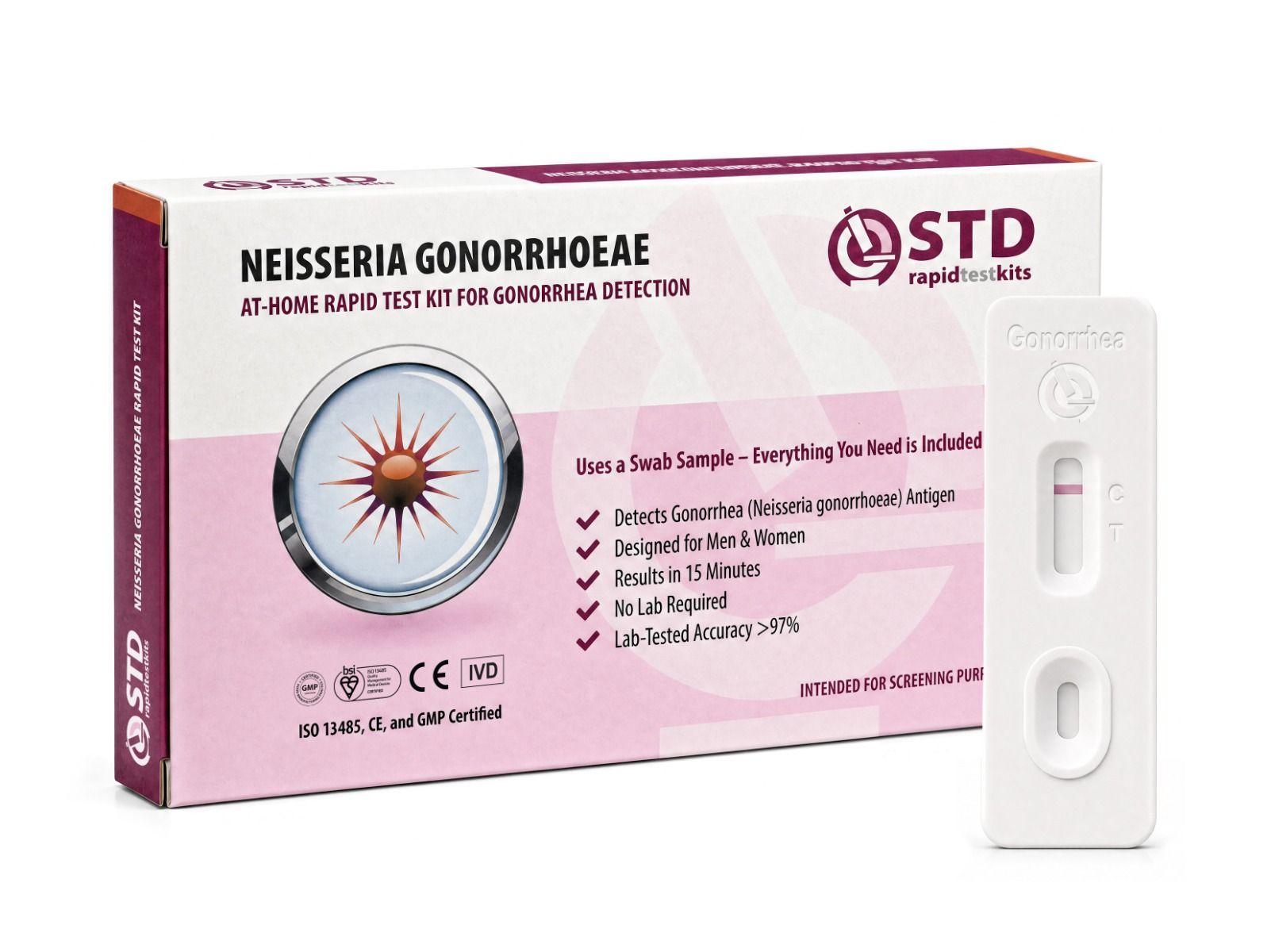
stdrapidtestkits.com sells rapid at-home lateral-flow STI tests, including the one linked below. We recommend kits based on fit for the article's topic, not commercial benefit.
Talking About It Without Making Things Worse
The conversation after a mutual positive is one of the hardest a couple can have, and most people walk into it without a plan. A few patterns help, regardless of how the diagnosis happened.
Start with the present, not the past. The first conversation should answer one question: what are we doing this week to take care of our health. Who is calling the clinic, who is picking up the prescriptions, what does the 7-day pause look like. Logistics are easier to talk about than blame, and they buy both of you time to process the rest before bigger questions get raised.
Use language that opens, not language that accuses. Compare two versions of the same statement:
- "You gave this to me, didn't you?" lands as an accusation. The other person hears a verdict and starts defending themselves before they have time to think.
- "We both tested positive. I have a lot of feelings about how this happened and I want to figure it out with you, not against you." lands as an invitation. The other person can answer honestly because they are not being prosecuted.
Give the conversation more than one sitting. A mutual diagnosis raises real questions, about past partners, about what each of you assumed monogamy meant, about what you tell anyone else. Those questions deserve days, not minutes. If one of you needs to step away mid-conversation, that is fine; pushing through to a resolution in one night usually means somebody is agreeing to something they have not actually thought about.
Consider outside help early, not as a last resort. A couples therapist who is comfortable with sexual health topics is an underused resource. So is a sexual health counselor at a Planned Parenthood or local STI clinic, who has had this conversation thousands of times and can normalize the experience without minimizing it.
What do we do first if we both tested positive?
For a curable bacterial STI like chlamydia, gonorrhea, syphilis, or trichomoniasis, both partners start the same antibiotic course in the same week, avoid all sex for at least 7 days after the last dose, and retest in about 3 months to confirm clearance. The relationship conversation can wait until after the treatment plan is in motion. For viral infections (herpes, HPV, HIV), the response is management rather than cure, but the principle is the same: coordinate care first, then talk.
Rebuilding Trust After a Shared Diagnosis
If the diagnosis did not surface a breach of trust, rebuilding is mostly logistical: you finish treatment, you retest, you move on. The diagnosis becomes a story you tell once, then close.
If it did surface something (a partner you did not know about, a window of time that one of you described differently to the other), the rebuild is longer. It is not impossible. Couples therapists who work with infidelity describe a fairly consistent shape to recovery: transparency about what actually happened, consistent follow-through on small commitments over months, and a willingness from the partner who broke the agreement to absorb the discomfort of repeated questions without becoming defensive.
A few concrete moves help during that stretch:
- Make follow-up testing a shared appointment, not a private chore. Schedule the 3-month retest together, on the same day, even if one of you is doing it at home and the other at a clinic. The shared timeline matters more than the venue.
- Talk about the treatment, not around it. If one partner is having side effects from antibiotics, that is something to mention. Silence builds resentment faster than awkwardness does.
- Renegotiate what monogamy means out loud. Many couples have never explicitly said what they consider in and out of bounds, and a diagnosis is a hard but useful prompt to do that work.
- Decide what you are willing to share with whom. Recent partners need to know they may have been exposed. Friends and family do not. Agreeing on the boundary together prevents one partner from feeling exposed by the other's confidences.
Many couples report that the months after a shared diagnosis end up being more honest, not less, because the diagnosis forced conversations they had been avoiding.
All sex partners within the 60 days preceding the patient's symptoms or diagnosis should be referred for evaluation, testing, and presumptive treatment. Concurrent treatment of partners is essential to reducing reinfection.

Long-Term Effects on Sex, Intimacy, and Future Plans
For curable bacterial infections, the long-term effect on sex is short. Once treatment is complete, the 7-day pause is over, and the retest at 3 months comes back negative, your sex life is the same one you had before the diagnosis. The kit on the bathroom shelf is the only material change.
For viral infections, the picture is different but still manageable. Genital herpes is lifelong, but most people on suppressive therapy go years between outbreaks, and consistent condom or dental dam use, antiviral medication, and avoiding sex during prodrome or active outbreak substantially reduces transmission risk to a partner (CDC genital herpes overview). Most HPV infections clear on their own within a few years without treatment, and the high-risk strains that persist are monitored with routine cervical screening rather than treated as ongoing infections. HIV today is a chronic, treatable condition; people on effective antiretroviral therapy with an undetectable viral load do not transmit HIV sexually, a finding summarized as Undetectable = Untransmittable (CDC HIV treatment).
A few longer-arc questions are worth raising as a couple, even if they feel premature:
- Pregnancy and fertility. Repeated or untreated chlamydia is a documented cause of tubal-factor infertility. If you are planning to try to conceive within the next year or two, mention the diagnosis at your preconception visit and ask about additional screening.
- Future partners, if it comes to that. Some viral infections (HSV, HPV, HIV) carry a disclosure conversation if your relationship ends. Knowing now that you might have that conversation later is easier than discovering it during a breakup.
- Mental health. Anxiety in the first few weeks after a shared diagnosis is common and expected. If it persists beyond the initial treatment window, it deserves its own appointment, either with a primary care provider or with a therapist familiar with sexual health topics.
| Infection type | Cure status | Standard care | Long-term posture |
|---|---|---|---|
| Bacterial (chlamydia, gonorrhea, syphilis, trichomoniasis) | Curable | Short antibiotic course | Resolved after a clean retest |
| Genital herpes (HSV-1, HSV-2) | Manageable, lifelong | Daily or episodic antivirals | Outbreak suppression and reduced transmission to partners |
| HPV | Often clears on its own | No infection-specific treatment for low-risk strains | Routine cervical screening for high-risk strains |
| HIV | Chronic, treatable | Daily antiretroviral therapy | Undetectable viral load means no sexual transmission |
Common Misconceptions Worth Clearing Up
A handful of myths surface in almost every mutual-diagnosis conversation. Each one steers couples toward worse decisions than the science supports.
- "One of us must have cheated." Not necessarily. Chlamydia and gonorrhea can be asymptomatic for months. Genital herpes can stay latent for years between outbreaks. HPV is so common that a majority of sexually active adults have been exposed at some point. A shared positive is consistent with cheating, and it is also consistent with a relationship-era infection that took a long time to surface. The result alone does not distinguish.
- "If we both have it, we cannot reinfect each other." You can. Strains differ, and antibody response after a chlamydia or gonorrhea infection does not produce reliable future immunity. Both of you need a full treatment course every time.
- "We feel fine, so we can skip treatment." The infections that produce no symptoms are the same ones that can cause infertility years later when left untreated, so feeling fine is poor evidence that the infection has cleared.
- "This means our relationship is broken." Many long-term, healthy relationships include at least one STI diagnosis somewhere in the timeline. The diagnosis is a health event, not a verdict on the partnership.
- "Condoms would have prevented this entirely." Condoms reduce risk substantially but not to zero, particularly for skin-to-skin infections (HSV, HPV, syphilis chancres outside the condom coverage area). They are still the single most useful tool for the bacterial infections that account for most diagnoses.
A shared positive result tells you what to treat right now. It does not prove a timeline, and it does not diagnose the relationship. Take the medical steps this week, and give the harder conversations the weeks or months they need.
What to Do This Week
The first week after a shared positive is the highest-leverage window. Most of the medical work happens here. A short checklist:
- Get the prescription, both of you, in the same week. If your provider is comfortable with expedited partner therapy and your state allows it, one visit can produce two prescriptions. Otherwise, both of you book back-to-back appointments.
- Pause sex for the full 7 days after the last dose, counting from the final pill, not from when symptoms ease or when you start to feel better. Mark the date on the calendar.
- Tell recent partners. Anyone you had sex with in roughly the 60 days before your positive test is in the CDC's recommended notification window. Public health departments in most U.S. states offer anonymous partner notification if you do not want to make the call yourself.
- Schedule the 3-month retest now. Put it in your calendar today, not later. The follow-up test is the single most effective way to catch a reinfection before complications develop.
- Plan one honest conversation, not five. Pick a time when neither of you is exhausted, take the logistics first, and leave room to come back to harder topics over the next few weeks.
FAQs
- Can both partners get treated at the same time?
- Yes, and they should. Simultaneous treatment is the most important factor in preventing reinfection. In many U.S. states, a provider can issue a prescription for the partner without a separate visit through expedited partner therapy.
- How long do we have to avoid sex after treatment?
- At least 7 days after the last dose, for both partners. That includes oral sex if the infection involves the throat. For a single-dose treatment, count 7 days from that dose. For a multi-day course, count 7 days from the final pill.
- How do we figure out who had it first?
- Usually you cannot. Chlamydia, gonorrhea, and herpes can stay silent for weeks, months, or years before any test or symptom shows. Without a stored sample from earlier in the relationship, there is no reliable way to reconstruct the timeline, and clinicians do not try.
- Do we have to tell recent partners?
- Yes. The CDC recommends notifying anyone you had sex with in the 60 days before your diagnosis so they can be tested and treated promptly. If you prefer not to make the call yourself, most U.S. state health departments offer confidential partner notification services that contact people on your behalf.
- Will condoms protect us from getting reinfected?
- Condoms are the most effective single tool for the bacterial infections that account for most diagnoses. They reduce skin-to-skin transmission of HSV, HPV, and syphilis less reliably, since those infections can spread from areas the condom does not cover. For chlamydia and gonorrhea specifically, consistent and correct use substantially reduces risk.
- What if my partner refuses to get treated?
- Untreated chlamydia and gonorrhea cause documented long-term harm, including pelvic inflammatory disease and tubal-factor infertility in women, and epididymitis (inflammation of the duct that carries sperm) in men. If a partner declines treatment, prioritize your own care, complete the antibiotic course, and reconsider the sexual relationship until they are willing to be treated. A counselor can help you think through that decision.
- Will this affect our chances of having kids?
- Repeated or untreated chlamydia is a recognized cause of tubal-factor infertility in women, and untreated infections in men can occasionally affect fertility through epididymitis or scarring. A single, fully treated infection is rarely the difference. If you are planning to conceive within the next year or two, mention the diagnosis at your preconception visit and ask about additional screening.
- Can we just retest at home instead of going back to a clinic?
- For the 3-month follow-up, at-home lateral-flow rapid tests are a reasonable option. They are screening-grade rather than NAAT-grade, so a positive result is worth confirming with a clinic NAAT, but a clean negative at 3 months on a properly used home test is reassuring evidence that the treatment worked and there has been no reinfection.
- U.S. Centers for Disease Control and Prevention. Next steps after testing positive for gonorrhea or chlamydia, including partner management and follow-up testing.
- U.S. Centers for Disease Control and Prevention. Chlamydia overview, symptoms, treatment, and complications including pelvic inflammatory disease.
- U.S. Centers for Disease Control and Prevention. Expedited partner therapy legal status by state and program description.
- U.S. Centers for Disease Control and Prevention. Pelvic inflammatory disease overview, including the link to untreated chlamydia and gonorrhea and the 1-in-8 figure for subsequent fertility difficulty.
- U.S. Centers for Disease Control and Prevention. HIV treatment and the Undetectable = Untransmittable evidence base.
- U.S. Centers for Disease Control and Prevention. Genital herpes overview, suppressive antiviral therapy, and partner transmission reduction.
- National Health Service (UK). Chlamydia patient information, symptoms, treatment, and partner notification.
