
Published: October 2025 | Last updated: May 2026 | Editorial review and quality control: Martina N.
Can I still have sex after an STD diagnosis?
Yes. Curable bacterial infections (chlamydia, gonorrhea, syphilis, trichomoniasis) clear with antibiotics; the CDC advises waiting at least 7 days after completing treatment, and until any partners are also treated, before sex resumes. Lifelong viral infections (HIV, herpes, HPV) become manageable with a layered combination of medication, barriers, vaccination, and honest disclosure. The right approach depends on the specific infection, your treatment status, and the kind of contact you're planning.
Key Takeaways
- Curable bacterial STIs (chlamydia, gonorrhea, syphilis, trichomoniasis) require finishing treatment plus a 7-day abstinence window before sex resumes; viral STIs (HIV, herpes, HPV) are managed lifelong with medication and matched protection rather than cured.
- Disclosure before sex protects both partners legally and ethically; in many U.S. states, nondisclosure of HIV before sexual contact is criminalized, and informed consent is the foundation of any honest sexual relationship.
A positive result can feel like a private earthquake. The first questions are usually the same: who do I tell, when can I have sex again, and will anyone want me now. None of those questions have scary answers, but most carry context worth getting right. STIs are common in the U.S.: roughly one in five people had an STI on any given day in 2018, with nearly half of new infections in people aged 15 to 24, per the CDC's 2018 STI surveillance estimates (see the CDC's STI hub for current data and overviews). That scale is one reason public-health agencies have spent the last decade rebuilding their guidance around honesty, treatment, and matched protection rather than abstinence and shame.
This article is published by stdrapidtestkits.com, which sells at-home STI testing kits. We recommend products based on fit-for-purpose for the reader's concern, not commercial benefit.
Diagnosis isn't the end of intimacy
The reflex after a positive test is often shame, and shame distorts. People decide overnight that they're now "unsafe to date," or that their sex life is over, or that any future partner deserves a written confession before a first kiss. None of that is medically true, and most of it isn't socially true either. Millions of people worldwide are living with chronic STIs (especially HSV-1, HSV-2, and HPV), and many of them date, marry, and have children without transmitting the infection to their partner. The shift that matters most is from secrecy to strategy. Instead of avoiding the topic, you build a small set of practices that match your specific diagnosis: treatment when treatment is available, suppressive medication when it isn't, condoms or barriers for the routes that need them, and honest pre-sex conversations that take the pressure off both people. Most of what follows in this guide is the mechanics of those practices, by infection.
The most useful mental shift after a positive result is moving from "how do I hide this?" to "what specific steps protect me and my partners?" Treatment when available, suppressive medication when not, matched barriers, and an honest pre-sex conversation cover almost every common scenario.
What to know based on your specific diagnosis
Different STIs follow very different post-diagnosis rules. The list below summarizes the practical, partner-facing implications of each. None of this replaces a conversation with the clinician who diagnosed you, but it gives you a starting frame.
- Chlamydia. Curable with a short course of antibiotics. CDC guidance recommends abstaining from sex for 7 days after completing treatment, and until all sex partners have been treated, to avoid reinfection. CDC also recommends retesting about 3 months after treatment because reinfection rates are high.
- Gonorrhea. Same 7-day rule, same 3-month retest window. Antibiotic-resistant gonorrhea is rising globally, so finishing the prescribed regimen exactly is more important than it used to be.
- Syphilis. Curable with penicillin in early stages. Wait until any chancres or rashes are fully healed and the clinician confirms treatment completion before sex resumes; partners typically need testing and presumptive treatment.
- HIV. Not curable, but extraordinarily manageable. People with HIV who take antiretroviral therapy and maintain an undetectable viral load have effectively no risk of transmitting HIV through sex, the U=U (Undetectable = Untransmittable) principle. HIV-negative partners can also use pre-exposure prophylaxis (PrEP) for an extra layer of protection.
- Herpes (HSV-1 and HSV-2). Lifelong, but most people have long stretches without symptoms. Daily suppressive antivirals (such as valacyclovir) plus condoms reduce transmission risk substantially. Avoid sex during prodromal symptoms or visible outbreaks. The CDC's herpes resources cover suppressive therapy in detail.
- HPV. So common that most sexually active adults will encounter at least one strain. Most infections clear on their own; a minority cause warts or, over years, cervical or other cancers. CDC recommends HPV vaccination routinely through age 26, with shared clinical decision-making for adults aged 27 to 45. Condoms reduce but don't eliminate HPV transmission because the virus spreads through skin-to-skin contact.
- Hepatitis B and C. Hep B is largely vaccine-preventable; chronic hep B is managed with antivirals. Hep C is now curable with direct-acting antivirals in 8 to 12 weeks for most people. Both can be sexually transmitted, though hep C transmission through sex is uncommon outside of specific risk groups.
- Trichomoniasis. Curable with antibiotics; partners are typically treated at the same time. The 7-day abstinence rule applies here too. At-home rapid trich tests, including ours, are validated for vaginal self-swab only; male readers needing confirmation should test via a clinic.
The first step to safer sex after a diagnosis is informed sex. Don't rely on memory of a high-school health class. Read the patient handout the clinician gave you, ask follow-up questions, and verify any specific number you read online against the CDC, NHS, or WHO before acting on it.
| Infection | Wait before sex resumes | Follow-up testing |
|---|---|---|
| Chlamydia | 7 days after treatment finishes, partners treated | Retest at 3 months |
| Gonorrhea | 7 days after treatment finishes, partners treated | Retest at 3 months |
| Syphilis | Until lesions heal and clinician confirms cure | Blood tests at 6 and 12 months |
| Trichomoniasis | 7 days after treatment, partners treated together | Retest if symptoms return |
| HIV | No abstinence rule once viral load is undetectable | Viral load every 3 to 6 months |
| Herpes (HSV) | Until lesions heal; suppressive therapy reduces shedding | No clearance test exists |
| HPV | No specific abstinence rule | Cervical screening per clinician schedule |
How to tell a partner: scripts and timing
Disclosure feels harder than it is. The most common worry, that an honest sentence will end the relationship before it starts, rarely plays out the way people expect. Most adults receive direct, calm health information well, especially when the discloser sounds informed rather than apologetic.
Two principles matter:
- Disclose before any contact that carries risk. For genital STIs that's before genital contact, not before holding hands. For HIV in particular, several U.S. states criminalize nondisclosure before sexual contact; even where the law is silent, informed consent is the ethical floor.
- Lead with information, not apology. A flat statement of fact, plus what you do to manage it, gives the other person room to ask questions instead of forcing them to react to your distress.
The script in the box below works for most STIs and can be adapted on the fly. For ongoing partners, the same principle applies but the conversation is different. You're not auditioning for permission, you're problem-solving together. Bring the actual data (recent test results, current viral load, treatment plan) and let the partner ask. Concrete information lets the partner ask informed questions instead of reacting to vagueness.
"Before we go further, I want to be upfront. I have [HSV-2, HIV, chlamydia treated last month, etc.]. Here's what that means in practice for sex with me: [I take daily antivirals; my viral load has been undetectable for X months; I finished antibiotics and am cleared by my doctor]. I'm happy to answer any questions, and we can talk about how to protect both of us."
Protection strategies that match your diagnosis
"Safer sex" is a more useful frame than "safe sex" because no single strategy covers every infection. Condoms are excellent against fluid-borne infections (HIV, gonorrhea, chlamydia, hepatitis B, syphilis when the chancre sits in a covered area) but only partially protective against skin-to-skin infections like HSV and HPV, where the virus can shed from areas the condom doesn't cover. Build a layered plan that matches your specific diagnosis:
- Barriers. External (penile) condoms, internal (vaginal/anal) condoms, and dental dams. Latex, polyurethane, and nitrile all work; latex-allergic partners should choose polyurethane or nitrile. Use them consistently for vaginal, anal, and oral sex involving exposure routes.
- Suppressive antiviral therapy. For HSV, daily valacyclovir or acyclovir reduces both outbreak frequency and asymptomatic shedding, the main driver of partner transmission. For HIV, daily antiretroviral therapy that achieves an undetectable viral load is itself prevention.
- PrEP for HIV-negative partners. Pre-exposure prophylaxis (oral or injectable) reduces HIV acquisition risk by about 99% when taken as prescribed (CDC PrEP guidance). It pairs well with U=U for serodiscordant couples.
- Vaccination. The HPV vaccine is the most underused tool in this list. It's effective even after one strain has been acquired because it protects against the others. Hepatitis B vaccination is similarly straightforward and recommended for adults who weren't vaccinated as children.
- Timing. Avoid sex during active outbreaks, prodromal warning symptoms, or while a course of treatment is still in progress. Risk peaks in those windows.
The right combination is usually two or three of these stacked, not one alone. Talk through the specifics with the clinician treating you so the plan matches the virology of your diagnosis and the structure of your relationship.
When to retest and follow up
Treatment doesn't close the testing schedule, it resets it. Retesting catches reinfection and confirms that treatment worked, both of which matter for partners.
- Chlamydia and gonorrhea. CDC recommends retesting about 3 months after treatment, regardless of whether partners were treated, because reinfection rates are high.
- HIV. Once on antiretroviral therapy, viral load testing every 3 to 6 months tracks suppression. If the load creeps up, your clinician may adjust the regimen.
- Syphilis. Repeat blood tests at 6 and 12 months after treatment confirm the infection has cleared serologically.
- Herpes. No "all-clear" test exists; the goal is fewer outbreaks and lower shedding, both of which suppressive therapy improves over time.
- HPV. Cervical screening (Pap and HPV co-testing) on the schedule the clinician sets. Most low-risk infections clear within 1 to 2 years.
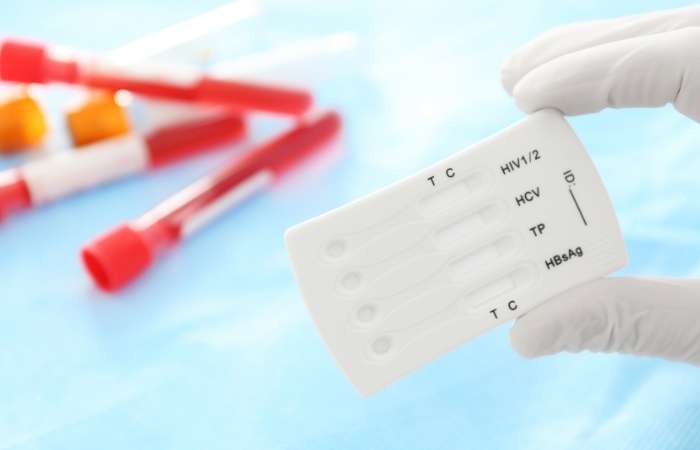
If you're back in dating after a clean retest, an at-home rapid panel is a low-friction way to confirm status before a new partner. The kit below covers the most common combinations of infections people retest for after treatment.

Pleasure after diagnosis: redefining sex
A diagnosis often forces a useful question: what did you actually mean by "sex"? For most people the answer was narrower than it needed to be (penetrative, on a script, maybe a little autopilot). The mechanics of safer sex after diagnosis tend to widen the menu rather than shrink it.
- Decouple sex from penetration. Hands, mouths (with barriers where indicated), toys, full-body touch, and explicit verbal cues all qualify. People navigating outbreaks or post-treatment windows often discover ranges of sensation they had been skipping.
- Talk specifically about turn-ons and limits. "What feels good" and "what's off-limits during a flare" are reasonable questions to negotiate up front. Being specific tends to feel less awkward than being vague, because it gives the partner concrete information instead of leaving them to guess.
- Use lube generously. Some antivirals and antibiotics cause vaginal dryness or mucosal irritation. Water- or silicone-based lube reduces micro-trauma, which itself reduces transmission risk and discomfort.
- Adjust positioning if a body is sore or healing. Recovery from a primary outbreak or a treatment course is short. Switch to less-pressured contact for that window rather than pushing through.
Communication tends to improve once a diagnosis forces it, and reported sexual satisfaction tends to follow. The improvement traces back to the conversations a diagnosis makes compulsory, conversations many couples skip until something forces them.
Practical adjustments after diagnosis
- Decouple sex from penetration; hands, mouths with appropriate barriers, toys, and full-body touch all qualify.
- Use water- or silicone-based lube generously, especially if antivirals or antibiotics are causing dryness.
- Adjust positioning during recovery from a primary outbreak or treatment course rather than pushing through soreness.
- Negotiate turn-ons and limits up front; specificity tends to feel less awkward than vagueness.
Mental health: the bedroom saboteur no one talks about
Shame is the most common post-diagnosis symptom, and the one no swab can detect. People often describe feeling like they've lost agency over their body, their dating prospects, and their reputation in one stroke. That anxiety leaks into intimacy in two opposite ways: some people avoid sex altogether for months, others perform through panic. Neither pattern is sustainable, and both tend to worsen the underlying anxiety.
What helps:
- Talk to a therapist or sexual-health counselor. Many community clinics have practitioners trained specifically in post-diagnosis adjustment. Peer support groups (in-person or moderated online communities for people with HSV, HIV, or HPV) reduce isolation faster than any single conversation.
- Don't internalize the stigma. STIs are infections, not moral indictments. The brain's reflex to equate "infected" with "unworthy" is cultural conditioning, not biology. Strep throat doesn't make you a bad person, and neither does HSV-2.
- Re-establish solo pleasure. Masturbation is an underrated tool for reclaiming a sense of agency over your own body after a diagnosis that felt like a loss of control. It's also a low-stakes way to notice what your body now feels like, which makes partnered sex less daunting.
- Watch for clinical depression or anxiety. If low mood, sleep disruption, or panic persists for more than two weeks, talk to a primary-care clinician. The medical and mental-health pieces are connected.
What works better than chasing the sex life you had pre-diagnosis is giving yourself permission to feel good in the body you have now, even if that body's relationship to sex looks different than it did before the diagnosis.
People with HIV who take HIV medicine as prescribed and get and keep an undetectable viral load have effectively no risk of transmitting HIV to their HIV-negative sexual partners.

Dating, love, and long-term relationships with an STD
The myth that an STI consigns you to a sexless life is, statistically, false. People with HIV, herpes, HPV, hepatitis B, and every other lifelong STI date, marry, and have biological children with seronegative partners every year. The variables that determine whether a relationship works are mostly the usual ones (compatibility, communication, shared values), with a small set of practical add-ons for the diagnosis.
What the patterns look like in long-term partnerships:
- Disclosure happens early, not late. The most common regret on disclosure timing is waiting too long, which adds emotional weight to a conversation that didn't need it. People who disclose on the first or second date almost never wish they had waited.
- Couples find their own protection rhythm. Some use condoms indefinitely. Some stop after a treatment cycle and rely on suppressive therapy plus periodic testing. Some use PrEP plus ART (the U=U combination) for serodiscordant pairs. There is no single right answer, just one that the two people in the relationship agree on and revisit when circumstances change.
- The emotional adjustment takes time. Sex can feel scary for weeks or months after a diagnosis. Overcompensation (forced enthusiasm) and shutdown (avoidance) are both common; neither is a sign the relationship is broken. Tell the partner what you need, and revisit the conversation as the medical picture stabilizes.
- Family planning is usually still on the table. Most STIs have minimal impact on fertility if treated early. Specific considerations exist for pregnancy with HIV (medication adjustments and obstetric care) and active genital herpes near delivery (timing of cesarean), but parenthood is not foreclosed by any of the common STIs (NHS STI overview).
For couples where one partner has HIV and the other does not, the standard combination is antiretroviral therapy on the positive side (Undetectable = Untransmittable) plus pre-exposure prophylaxis on the negative side. Together, the two approaches reduce sexual transmission risk to effectively zero per current CDC guidance.
Common myths and the truth
The fear loop after diagnosis runs on a small set of inaccurate beliefs. The five below cover most of the traffic.
- Myth: "No one will want me now." Truth: Millions of people manage chronic STIs and date, hook up, and fall in love regularly. The dating-pool effect of a diagnosis is real but overstated; mature partners weigh disclosure as one input among many.
- Myth: "I have to disclose before every kiss." Truth: Disclosure obligations apply before activities that carry meaningful transmission risk for your specific infection. For most STIs, kissing on the lips isn't in scope (HSV-1 oral cold sores being the main edge case). Focus the conversation on activities that actually transmit your infection.
- Myth: "If I use a condom, I don't need to disclose." Truth: Barriers reduce risk, they don't eliminate it, and consent is about information, not just protection. Disclosure is the foundation that makes any protection plan ethical.
- Myth: "Sex won't be enjoyable anymore." Truth: People who navigate post-diagnosis sex openly often report better communication and higher satisfaction over time, because the diagnosis forced the conversations the relationship needed anyway.
- Myth: "A positive test result means I'll never be cleared." Truth: Bacterial STIs (chlamydia, gonorrhea, syphilis, trichomoniasis) and hepatitis C are curable. Hep B and HIV are managed indefinitely with extraordinary modern treatment. Only HSV remains lifelong without a cure, and it is one of the easiest infections to live with day to day.
The fear is real, and so is the freedom on the other side of it. Most of the work after diagnosis turns out to be informational rather than moral.
Frequently asked questions
- Can I still have sex if I have herpes?
- Yes, with a layered plan. Avoid sex during prodromal symptoms or visible outbreaks, use condoms for the rest of the time, and consider daily suppressive antiviral therapy (such as valacyclovir), which reduces both outbreak frequency and asymptomatic viral shedding.
- Is it illegal to not tell someone you have an STD?
- It depends on the infection and the jurisdiction. Several U.S. states criminalize HIV nondisclosure before sexual contact; for other STIs the laws vary widely, and many states have no specific statute. Even where the law is silent, informed consent is the ethical baseline.
- Is any STD considered safer to have than another?
- No STI is risk-free, but bacterial STIs (chlamydia, gonorrhea, syphilis, trichomoniasis) are curable with antibiotics if caught early. Among lifelong infections, HSV-1 is generally the easiest to live with day to day. The clinician treating you can put your specific result in context.
- How long should I wait after treatment before having sex again?
- For curable bacterial STIs, the CDC recommends abstaining for 7 days after completing treatment, and until any partners are also treated. For viral infections, the timing depends on the specific virus (e.g., wait until herpes lesions have fully healed). Confirm the timing with the clinician treating you.
- Can I get the same STD again after treatment?
- Yes. Antibiotic treatment cures the current infection but doesn't make you immune. Reinfection from an untreated partner is common, which is why CDC recommends retesting roughly 3 months after treatment for chlamydia and gonorrhea.
- Do condoms protect against all STDs?
- Condoms substantially reduce risk for fluid-borne infections (HIV, gonorrhea, chlamydia, hepatitis B, syphilis when the lesion sits in a covered area). They reduce but don't eliminate risk for skin-to-skin infections like HSV and HPV, because the virus can shed from areas the condom doesn't cover.
- How do I start the disclosure conversation?
- Lead with the fact and your management plan, before any contact that carries meaningful transmission risk. A simple opener: "Before we go further, I want to be upfront. I have [diagnosis]. Here's what I do to manage it: [treatment, suppressive medication, recent test results]. Happy to answer questions." Specificity helps; apology hurts.
- Is there a dating app for people with STDs?
- Yes. Apps like PositiveSingles and MPWH cater specifically to people managing herpes, HIV, and other lifelong STIs. They aren't your only option (many people with STIs date on mainstream apps and disclose appropriately), but they remove the disclosure step from the front of the funnel.
- U.S. Centers for Disease Control and Prevention. Sexually Transmitted Infections (STIs) overview, prevalence data, and treatment guidelines.
- U.S. Centers for Disease Control and Prevention. HIV Basics: treatment as prevention (U=U), PrEP guidance, and PrEP effectiveness data.
- U.S. Centers for Disease Control and Prevention. Genital Herpes (HSV-1 and HSV-2): transmission, suppressive therapy, and partner management.
- U.S. Centers for Disease Control and Prevention. Human Papillomavirus (HPV): vaccination schedule (routine through age 26, shared clinical decision-making 27 to 45) and clinical management.
- U.S. Centers for Disease Control and Prevention. Chlamydia: treatment, 7-day abstinence rule, retesting at 3 months, and partner management.
- World Health Organization. Sexually Transmitted Infections (STIs) global fact sheet, including incidence, treatment, and management.
- National Health Service (UK). Sexually Transmitted Infections (STIs): symptoms, testing, and treatment guidance.
