
Published: August 2025 | Last updated: May 2026 | Editorial review and quality control: Martina N.
Most teen STI signs are quiet enough to ignore. A bit of unusual discharge, a low pelvic ache that comes and goes, a small sore that fades on its own, an itchy patch that gets blamed on shaving or new laundry detergent. None of that screams emergency, and that is exactly why so many infections in 14- to 24-year-olds get missed for weeks or months.
This guide walks through what those subtle signs look like in a teen body, the body changes they often get confused with, what happens when an STI is left to simmer, and how to test confidentially without involving a clinic visit, parental consent, or anyone you do not want involved. Citations link out to CDC, WHO, and Guttmacher. Where this article links to test kits, those are products sold on this site.
Key Takeaways
- Most teen STIs are subtle or silent. Unusual discharge, painless sores, a dull pelvic ache, or an itchy patch get mistaken for puberty, irritation, or a yeast infection. People aged 15 to 24 carry roughly half of new U.S. STIs each year (CDC).
- Confidential testing without parental consent is legal for minors in every U.S. state and DC, per Guttmacher Institute state-policy tracking. At-home rapid tests cover the most common infections privately and ship discreetly, with results in roughly fifteen to twenty minutes.
Why Teen STI Signs Slip Past Sex Ed
School health curricula tend to draw STI symptoms in big, dramatic terms: burning urination, open sores, fever. Those exist, but they are rarely the first signs in an adolescent body. Real-world early symptoms are usually small, slow, and easy to mistake for puberty, irritation, or a normal cycle change. The teen body is still calibrating itself, which gives infections time to settle in unnoticed.
According to CDC National Prevention Information Network data, youth aged 15 to 24 make up just over a quarter of the sexually active population but account for half of the 20 million new STIs that occur in the United States each year. Most chlamydia and gonorrhea cases in that age group are asymptomatic or only mildly symptomatic, which the CDC has flagged repeatedly as the reason routine screening matters even without obvious complaints.
The gap between what gets taught in class and what actually shows up in a teen body is where infection thrives. A spot of discharge, a brief pelvic twinge, a single painless bump near the groin: a teen body may register these as normal noise.
The CDC recommends annual chlamydia and gonorrhea screening for all sexually active women under 25, and screening for sexually active men who have sex with men based on practice. Routine screening exists because most early infections are silent or mild enough to be ignored.
The Subtle Symptoms Most Teens Misread
In adolescent sexual health, the common pattern is reinterpretation. Real symptoms get filed under puberty, yeast, or new laundry detergent. Here are the misreads that come up most often:
- Unusual vaginal discharge. Yellowish, grayish, watery, or oddly-smelling discharge is a classic sign of chlamydia or gonorrhea, but in teens it gets dismissed as a yeast infection, a tampon issue, or just "my body adjusting." A real yeast infection is usually thick, white, and intensely itchy. STI discharge tends to be thinner and more colored, sometimes with a faint odor that was not there before.
- Spotting after sex. Light bleeding after intercourse can be friction, but it is also one of the cleanest signs of cervicitis from untreated chlamydia or gonorrhea. If it happens more than once, the friction story stops fitting.
- An itchy patch on the inner thigh, groin, or buttocks. The first instinct is laundry detergent, sweat, or a new fabric. Persistent itch with small bumps in those zones can be early genital herpes, pubic lice, scabies, or HPV-related lesions.
- A painless sore. Syphilis often arrives as a single, painless ulcer that looks like a shaving nick or a small pimple. It heals on its own in two to six weeks, which feels reassuring; in reality the bacteria are moving on to the next stage of disease.
- A dull pelvic ache. Cramps that do not match the cycle and last more than a few days can be early pelvic inflammatory disease (PID). Many teens write this off as a bad period.
- Throat irritation after oral sex. A scratchy throat, mild swelling, or a slight low fever in the days after oral contact can signal pharyngeal gonorrhea or chlamydia. The CDC notes pharyngeal infections are often asymptomatic, and when symptoms do show up they look like an early cold.
Spotting any one of these once is not a diagnosis. Spotting one that lingers, repeats, or shows up shortly after a new sexual encounter is worth one round of testing. Most rule-outs come back clean; a few catch something early enough to treat with a short antibiotic course.
What Untreated STIs Do to a Teen Body Over Time
Missed symptoms matter because of the long arc of what happens when bacterial or viral infections get to keep working in the background.
For chlamydia and gonorrhea, the common path in adolescents and young adults assigned female at birth is upward migration into the uterus and fallopian tubes, which produces pelvic inflammatory disease. CDC PID treatment guidelines describe PID as a major cause of tubal scarring, ectopic pregnancy, and infertility, with risk rising the longer an underlying infection goes untreated. Subclinical cases (those with no obvious pelvic pain or fever) still leave behind tubal scarring.
For syphilis, an untreated primary chancre fades and the disease enters secondary stage with a body-wide rash, then a long latent period that can stretch decades. By the time late symptoms appear, organ damage is harder to reverse. Treatment in the early stages is a single antibiotic regimen; treatment late is much more complex.
Untreated HIV transitions from acute infection into chronic infection with slowly declining immune function. Modern antiretroviral therapy can keep viral load undetectable, but only when the diagnosis happens. The longer HIV runs without treatment, the higher the cumulative risk of opportunistic infections and the lower the probability of full immune reconstitution.
Genital herpes does not damage internal organs the way bacterial STIs can, but it does become part of the body and shed asymptomatically, meaning a teen can pass it to partners during periods that feel symptom-free. HPV similarly persists silently and is the underlying driver of nearly all cervical cancers and a growing share of throat cancers, per CDC HPV guidance; that is why the HPV vaccine is recommended routinely through age 26 and through age 45 with shared clinical decision-making.
Infection itself does not damage fertility on day one. Damage comes from infection that runs untreated long enough for bacteria to migrate up the reproductive tract or for high-risk HPV strains to drive cellular change. The intervention window is wide, and most teens who screen on a rough annual cadence stay inside it.
Many STIs do not cause symptoms or have only mild symptoms, so they can go unnoticed. The only way to know for sure is to get tested.
The "It Was Just Oral" Myth Still Runs the Hallway
One of the most persistent ideas in high school and early college sexual culture is that oral sex is risk-free, or at least very low risk. Public-health surveys consistently find that teens use barrier methods (condoms, dental dams) far less often during oral sex than during penetrative sex, and many believe oral contact is essentially safe.
The reality is messier. CDC guidance on STI risk and oral sex lists chlamydia, gonorrhea, syphilis, herpes (both HSV-1 and HSV-2), HPV, and HIV as transmissible through oral contact. The risk per encounter is generally lower than for receptive vaginal or anal sex, but cumulative risk over multiple partners stacks up.
Pharyngeal gonorrhea is the case study here. It frequently has no symptoms, is harder to treat than genital gonorrhea, and is increasingly resistant to first-line antibiotics. Because most teens never think to swab their throat after oral contact, it gets caught late or not at all, then transmitted onward.
The pragmatic answer is two ordinary habits: use barrier protection when feasible, and include throat or genital screening in any STI testing window if there has been recent oral contact with a new or untested partner.
Our home kits use genital swab samples or fingerstick blood samples. We do not currently sell a pharyngeal (throat) swab kit. For specific throat-swab testing after oral exposure, that is a clinic visit; our kits cover the genital and bloodwork side of the same exposure event.

Confidential Testing for Minors: What's Actually Allowed
A big reason teens do not test is logistical: they assume a clinic will tell their parents, or that they need a parent's permission to be seen at all. In most U.S. states, that is not how minor consent works for STI services.
Per Guttmacher Institute state-policy tracking, all 50 states and the District of Columbia explicitly allow minors to consent to STI testing and treatment without parental involvement. Some states extend the same protection to contraception, prenatal care, and HIV services. The exact age threshold varies (most states cover any minor; the rest set the floor at 12 to 14 years), but the practical effect is that a teenager can walk into a state STI clinic, a Title X clinic, a Planned Parenthood site, or many community health centers and request testing on their own.
Confidentiality at the billing layer is a separate issue. If a teen is on a parent's insurance, an Explanation of Benefits notice may show up at home with the visit listed. Public clinics that bill on a sliding-scale basis or do not bill insurance avoid this. At-home tests purchased and shipped on a teen's own account also avoid the EOB problem.
Knowing what is legally available matters because most teen barriers to testing turn out to be assumptions about laws, not the laws themselves.
State STI clinics, Title X family-planning sites, Planned Parenthood, and many community health centers offer confidential testing for minors at no or low cost. At-home rapid tests purchased on a teen's own card and shipped to a chosen address bypass the parental-Explanation-of-Benefits issue that commercial insurance can create.
Building a Sex-Positive Habit Around Testing
The frame that lands best with teens is normalization. Testing is a maintenance task that goes with being sexually active, the same way a bike rider checks tires or a runner replaces shoes. Treating it as something only people who did something wrong have to do is what keeps the cycle of late detection going.
A simple rhythm covers most situations:
- If sexually active in any form (oral, vaginal, anal, or manual contact with shared fluids), screen at least once a year.
- After every new partner, retest about two weeks (14 days) after first contact for chlamydia and gonorrhea, and again at twelve weeks if HIV exposure is a concern (most antibody tests detect by three weeks, but twelve weeks is the definitive clearance window).
- For syphilis exposure, retest at three to six weeks for antibody seroconversion.
- If a partner discloses a new diagnosis, test on the timeline their clinic recommends regardless of how recently you last tested.
- If a symptom shows up that fits any of the misreads above and lasts more than a few days, test sooner.
The CDC recommends annual chlamydia and gonorrhea screening for all sexually active women under 25, and screening for men who have sex with men based on practice. Many state public-health departments mirror those recommendations and offer free or low-cost testing for adolescents.
One small communication script that helps: "Before we do anything, when did you last get tested? Mine was [date]." That sentence sounds clinical written down; in practice it lands the same as asking about birth control or food allergies. Partners who treat the question as offensive are usually telling you something about how they handle their own sexual health.
One: If sexually active in any form, screen for STIs at least once a year. Two: After a new partner, retest at about two weeks for chlamydia and gonorrhea, and again at twelve weeks if HIV exposure is a concern. Symptom-driven testing happens on top of, not instead of, this rhythm.
How to Test Privately at Home
For teens who would rather avoid a clinic, a home rapid test is a reasonable first line for screening. The trade-offs are worth being honest about.
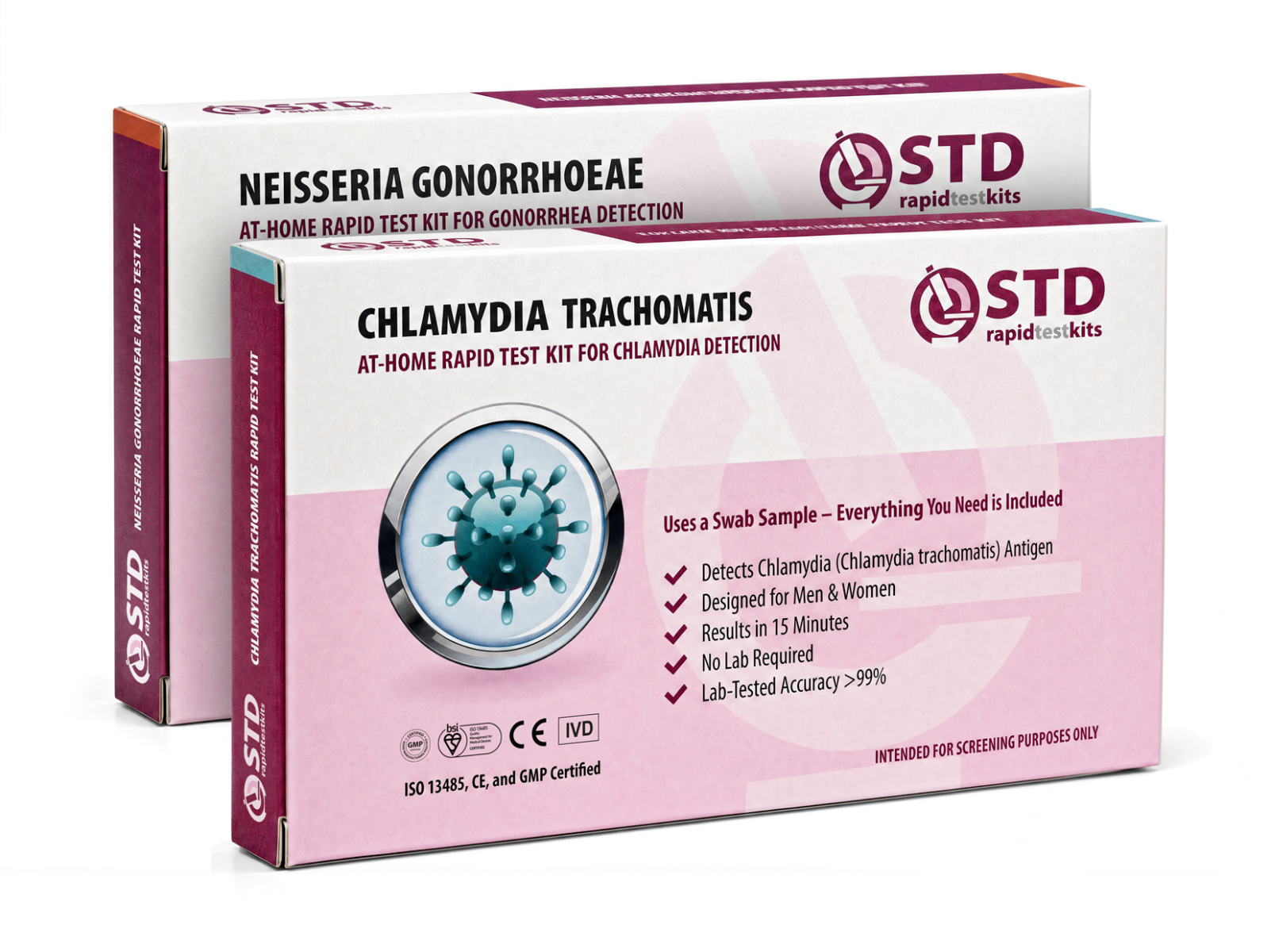
What home rapid tests do well: they are quick (results in roughly fifteen to twenty minutes for the lateral-flow cassettes we sell), they ship discreetly with no clinical paperwork, and they screen for the most common infections in a self-collected sample. Sensitivity varies by kit and infection; the package insert for each product lists the specific figures, so check those for the specific test you order. The kits we sell are lateral-flow immunoassays, the same chemistry used in many over-the-counter rapid tests; they are not laboratory NAAT or PCR. Lab NAAT remains the gold standard for chlamydia and gonorrhea sensitivity, especially in asymptomatic infection. The two are complementary: home rapid tests are useful for routine screening and quick reassurance, and a positive result is worth confirming with a lab test when access allows.
Window periods matter. A test taken too soon after exposure can miss a real infection. General guidance: chlamydia and gonorrhea are detectable from about two weeks (14 days) after exposure on a swab; syphilis antibodies typically rise by three to six weeks; HIV antibody tests detect infection from about three weeks onward, with the window extending to twelve weeks for the slowest seroconversions; HSV antibodies generally rise by twelve to sixteen weeks. Each kit's instructions list the specific window for that assay.
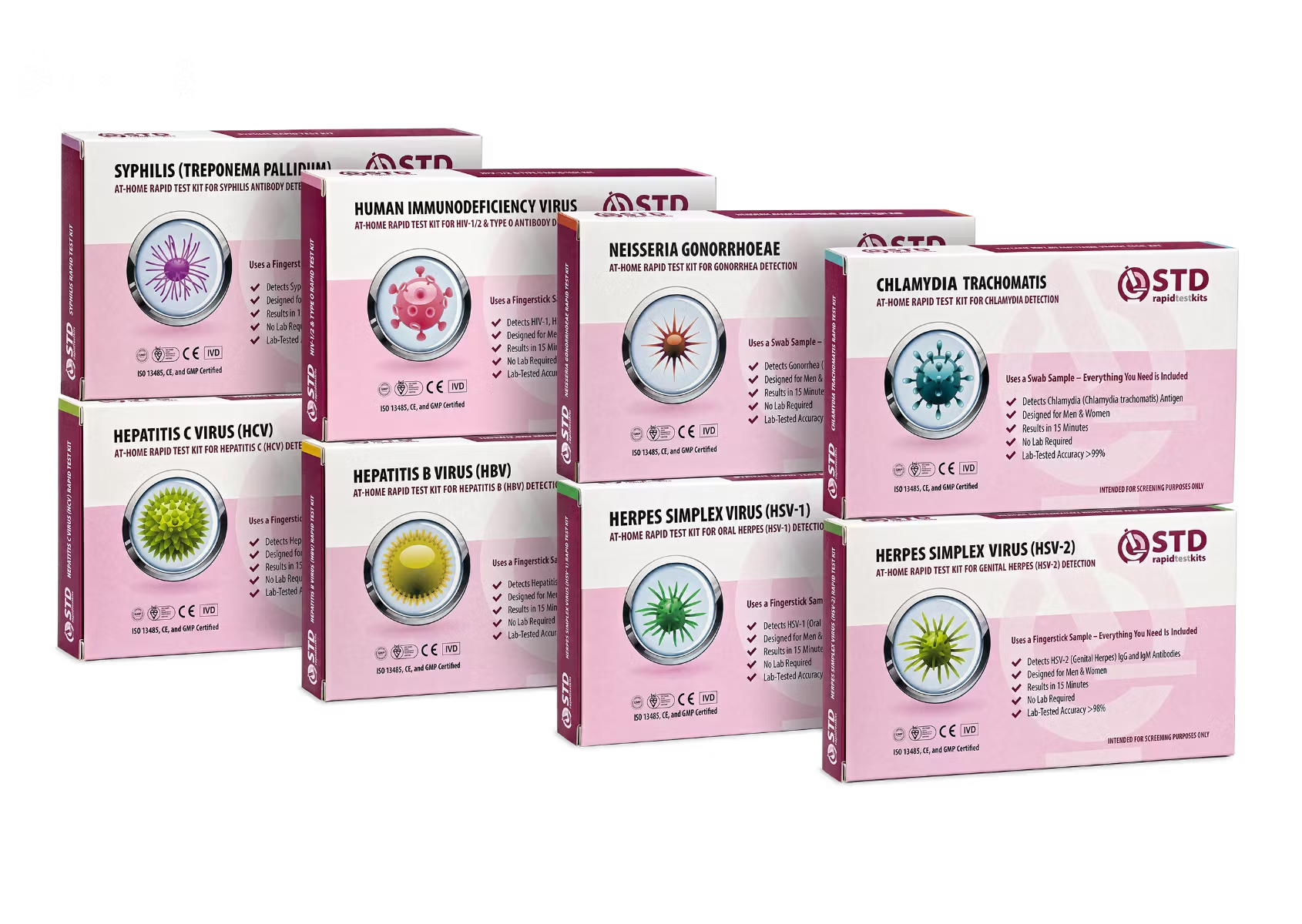
For routine screening of a sexually active teen with no specific exposure concern, a multi-infection combo kit covers the most ground per test. For follow-up after a known exposure to a specific infection, a single-infection kit is more cost-effective.
What to do with a result: a negative inside the correct window is reassuring. A positive on a home rapid test is a strong signal worth confirming through a local clinic, state STI program, or telehealth service. Most public-health departments offer free or low-cost confirmation. For bacterial STIs, treatment is typically a short course of antibiotics; the partner who exposed you should be told and tested too. For viral STIs, follow-up is about staging and management rather than cure.
The Fears Worth Naming Out Loud
Sex-ed avoidance leaves teens to imagine the worst-case scenario without information. The four fears that come up most often (HIV, infertility, cancer, treatment-resistant infection) deserve a calm, specific paragraph each.
HIV transmission risk in teen-typical sexual contact. Per CDC per-act transmission estimates, the per-event risk for receptive vaginal intercourse with an untreated HIV-positive partner is approximately 8 in 10,000; receptive anal intercourse is higher, about 138 in 10,000; insertive vaginal is about 4 in 10,000. Oral sex falls in the very low to negligible range. These numbers go up when the source partner has high viral load, when there are genital sores or other STIs, or when there is bleeding. They drop to effectively zero when the source partner is on antiretroviral therapy with sustained undetectable viral load (the U=U principle). Modern HIV is a manageable chronic condition with early treatment.
Fertility damage from untreated chlamydia or gonorrhea. The risk is real but not universal. CDC MMWR Grand Rounds on chlamydia prevention states that 10 to 15 percent of untreated chlamydial infections progress to clinically diagnosed PID, and only a subset of those PID cases produce tubal damage that affects future fertility. Detection within months of infection, followed by a standard antibiotic course, generally avoids that outcome.
Cancer risk from HPV. The vast majority of HPV infections clear spontaneously within one to two years. A persistent infection with a high-risk HPV strain can drive cervical, anal, oropharyngeal, or other cancers over years to decades. The HPV vaccine, given before exposure, prevents most of those infections. Pap and HPV screening catches early cell changes long before cancer develops.
Treatment-resistant gonorrhea. Gonorrhea has steadily lost susceptibility to most antibiotic classes once used to treat it. The CDC currently recommends a single 500-mg ceftriaxone injection as first-line therapy. Resistance to ceftriaxone is rare in the U.S. so far but rising; that is one public-health reason to avoid spreading untreated infection, and a personal reason to test promptly when exposure is plausible.
| Fear | Key context |
|---|---|
| HIV transmission per act | About 8 in 10,000 for receptive vaginal; 138 in 10,000 for receptive anal; 4 in 10,000 for insertive vaginal. Effectively zero when source partner is on ART with undetectable viral load. |
| Fertility damage from chlamydia or gonorrhea | 10 to 15 percent of untreated chlamydia progresses to PID; only some PID cases cause tubal damage. Detection within months avoids most of the risk. |
| HPV and cancer | Most HPV clears in one to two years. Persistent high-risk strains drive cervical, anal, and throat cancers over years. Vaccination prevents most. Pap and HPV screening catches early changes. |
| Treatment-resistant gonorrhea | Most antibiotic classes have lost reliability over the years. Ceftriaxone is current first-line; resistance is rare in the U.S. so far but rising. |

What to Do With Whatever You Just Read
The plain version: subtle teen STI symptoms are real, often misread, and rarely something to panic about, but worth one round of testing to rule out. Confidential testing is legally available to minors in every U.S. state. At-home rapid tests cover the most common infections privately, and a clinic visit covers the cases home tests cannot.
If something has felt off for more than a few days, run one test. If a new partner entered the picture in the last few weeks, run one test. If neither applies and a routine annual screen is due, run one test. The cost of staying current with screening is much smaller than the long-tail cost of a missed infection.
Whatever the result, the next step has the same shape: confirm with a clinic if positive, or retest at the next routine interval if negative. Either way, you walk away with a concrete piece of information you can act on instead of a question you keep deferring.
Symptom present and lingering more than a few days: test now. New partner in the last few weeks: test at two weeks for chlamydia and gonorrhea, twelve weeks for HIV. Neither, but the annual routine screen is due: test now. A single home kit usually covers all three cases.
FAQs
- Can teens get tested for STIs without their parents' permission?
- In all 50 U.S. states and DC, minors can legally consent to STI testing and treatment on their own, per Guttmacher Institute state-policy tracking. The age threshold varies by state, but every state covers the practical case of a teenager requesting STI services. Insurance Explanations of Benefits sent to a parent's address can break confidentiality on commercial insurance; public clinics, Title X sites, Planned Parenthood, and at-home tests purchased on the teen's own account avoid that issue.
- What does an early STI typically feel like in a teen, if it feels like anything at all?
- Most early infections in adolescents feel like nothing or like minor body weirdness: a bit of unusual discharge, a single painless sore, a dull pelvic ache, an itchy patch in the groin, or a scratchy throat after oral contact. Many infections (especially chlamydia, pharyngeal gonorrhea, and early HIV) have no symptoms at all, which is why screening matters even without complaints.
- How is a yeast infection different from an STI?
- A classic yeast infection involves thick white discharge and intense itch with no smell. STI-related discharge is more often watery, yellowish or grayish, sometimes with a faint odor, and may be paired with spotting or pelvic ache. If an over-the-counter antifungal does not clear symptoms in a few days, test for STIs.
- Do STIs ever go away on their own?
- A few visible symptoms (the syphilis chancre, an HSV outbreak) fade without treatment, but the infection itself is still in the body and continues to spread. Bacterial STIs (chlamydia, gonorrhea, syphilis) require antibiotics for clearance. Viral STIs (HIV, HSV, HPV) are managed long-term but not cured by current therapy.
- Can someone catch an STI through oral sex?
- Yes. Chlamydia, gonorrhea, syphilis, herpes (both HSV-1 and HSV-2), HPV, and HIV are all transmissible through oral contact, though the per-act risk is generally lower than for vaginal or anal intercourse. Pharyngeal gonorrhea is especially common in young adults and frequently asymptomatic, so a clinic-administered throat swab is worth requesting after oral contact with a new or untested partner.
- How long after sex should a teen wait to test?
- Testing too early is the most common reason a real infection gets missed. For most situations: two weeks (14 days) covers chlamydia and gonorrhea on a swab; twelve weeks is the definitive window for HIV antibody tests; sixteen weeks gives high confidence on herpes antibodies. When the exposure was recent, retest at the longer end of the window rather than treating a single early negative as final.
- Are condoms enough on their own?
- Condoms substantially lower (but do not eliminate) STI transmission risk. They are very effective against HIV, hepatitis B, gonorrhea, and chlamydia. They are less effective against herpes and HPV because those can be transmitted by skin contact outside the area a condom covers. Layering condoms with regular testing closes most of the remaining gap.
- What if a home test comes back positive?
- Treat it as a strong signal worth confirming. Reach out to a local STI clinic, state public-health program, or telehealth service for confirmation testing and treatment. Most public clinics offer free or low-cost confirmation. For bacterial STIs, treatment is typically a short antibiotic course; partners should also be informed and tested. For viral STIs, follow-up is about staging and management.
- U.S. Centers for Disease Control and Prevention, National Prevention Information Network. Sexually Transmitted Infections Among Young Americans: youth aged 15 to 24 account for half of new U.S. STIs each year despite making up just over a quarter of the sexually active population.
- U.S. Centers for Disease Control and Prevention. STI Treatment Guidelines, Pelvic Inflammatory Disease section: subclinical PID, tubal scarring, ectopic pregnancy, and infertility risks from untreated chlamydia and gonorrhea.
- U.S. Centers for Disease Control and Prevention. CDC Grand Rounds: Chlamydia Prevention: 10 to 15 percent of untreated chlamydial infections progress to clinically diagnosed pelvic inflammatory disease.
- U.S. Centers for Disease Control and Prevention. HIV Risk and Prevention Estimates: per-act transmission probability tables for vaginal, anal, and oral sex (8 in 10,000 receptive vaginal, 138 in 10,000 receptive anal, 4 in 10,000 insertive vaginal).
- U.S. Centers for Disease Control and Prevention. HPV Information: vaccination guidance through age 26 routinely and through age 45 with shared clinical decision-making, plus cervical cancer prevention.
- U.S. Centers for Disease Control and Prevention. About STI Risk and Oral Sex: chlamydia, gonorrhea, syphilis, herpes (HSV-1 and HSV-2), HPV, and HIV all transmissible through oral contact.
- World Health Organization. Sexually Transmitted Infections fact sheet: global burden, asymptomatic patterns, and recommended screening (verified live).
- Guttmacher Institute. State-policy tracking on minors' access to STI testing and treatment: minor consent provisions in all 50 states plus DC. (Linked to Guttmacher root domain because deep-link fact sheets are currently being updated.)
