
Published: November 2025 | Last updated: May 2026 | Editorial review and quality control: Martina N.
Can an STD damage your testicles?
Yes. Untreated chlamydia and gonorrhea can climb from the urethra into the epididymis and cause one-sided pain, swelling, and (in a small share of long-untreated cases) lasting shrinkage. A rapid at-home swab test 7 to 14 days after exposure usually catches both. If pain is sudden, severe, and one-sided, skip the test and go to an emergency room: that pattern can mean testicular torsion, which has roughly a 4-hour window before permanent loss.
Something feels off down there. Maybe one testicle aches when you sit a certain way. Maybe the size or weight on one side has shifted over a few weeks. Or the sensation is harder to name: one side simply feels different from the other. If a recent partner tested positive for an STI, if a condom slipped, or if you simply have not been screened in a while, the worry can sit heavily.
For most men, a change in sensation or an ache on one side turns out to have a benign explanation: a varicocele, a brief muscle strain, or nothing identifiable at all. The cases that do trace back to an infection are real, though, and worth understanding. Some untreated sexually transmitted infections can damage testicular tissue. Chlamydia and gonorrhea, the two most common bacterial STIs, can climb from the urethra into the epididymis (the coiled tube behind each testicle that stores and matures sperm). Left untreated for weeks, the inflammation that follows can cause swelling, pain, and in a smaller share of cases, lasting changes to testicle size or fertility. This article explains how that progression actually works, what realistic timelines look like, what an at-home rapid test can and cannot tell you, and which symptoms are emergencies that need a clinic the same day.
One pattern catches more men off guard than any other: testicular pain with no discharge, no burning during urination, no rash. Many men with chlamydia have no obvious symptoms at all, according to the CDC's About Chlamydia page. The ones who do notice something often describe a quiet ache that gets blamed on a long workout or a tight pair of jeans. That is exactly the pattern this article covers. This article is published by stdrapidtestkits.com, which sells at-home STI testing kits. We recommend products based on fit-for-purpose for the reader's concern, not commercial benefit.
Key Takeaways
- Untreated chlamydia and gonorrhea are the STIs most likely to cause testicular pain, swelling, or atrophy through epididymitis, often without producing any discharge. Prompt antibiotic treatment usually resolves the infection before lasting damage occurs.
- Sudden severe one-sided testicular pain with swelling can be testicular torsion, a surgical emergency unrelated to STIs. Do not wait for an at-home test result. Go to an emergency room. The window to save the testicle is only a few hours.
Which STIs Can Affect Your Testicles
Most testicular complications from STIs trace back to two bacterial infections: chlamydia and gonorrhea. Both can ascend from the urethra into the epididymis, causing a condition called epididymitis. Per the NHS epididymitis page, the main cause in men over 35 is usually a urine infection, while in younger sexually active men the typical causes are sexually transmitted infections. The CDC's 2021 STI Treatment Guidelines for epididymitis identify chlamydia and gonorrhea as the leading pathogens in this younger age group, and the CDC further notes that untreated chlamydia can spread to the tube that carries sperm and rarely lead to infertility.
To put the scale in context: the WHO STI fact sheet estimates 129 million new chlamydia infections and 82 million new gonorrhea infections globally in 2020. Many of those carriers had no symptoms at all and passed the infection on without knowing.
Other STIs can affect testicles in different ways, and a few do not affect them directly at all. The table below summarizes what each common infection can and cannot do to testicular tissue.
| STI | Can It Affect Testicles? | Mechanism | Common Symptoms |
|---|---|---|---|
| Chlamydia | Yes | Inflammation of the epididymis (epididymitis), sometimes spreading to the testicle | Swelling, tenderness, ache, sometimes mild fever; often asymptomatic at first |
| Gonorrhea | Yes | Same mechanism as chlamydia; the two often co-infect | Painful urination, urethral discharge, scrotal pain or swelling |
| Mycoplasma genitalium | Sometimes | Can occasionally cause epididymitis when standard panels miss it | Persistent urethritis or epididymitis after standard antibiotic treatment |
| Syphilis | Rarely | Late-stage syphilis can cause neurological and vascular damage affecting testicles | Painless chancre early; systemic and neurological symptoms in late stages |
| HIV | Indirectly | Late untreated HIV can lower testosterone through chronic illness and pituitary effects | Mostly absent until late disease; modern antiretroviral therapy prevents this |
| HPV | No | HPV does not infect internal genital structures | External warts; usually no testicular involvement |
How Infection Becomes Atrophy
The progression from infection to permanent testicular damage is not instantaneous. It happens in stages, and most men have weeks of warning if they pay attention.
When chlamydia or gonorrhea ascends from the urethra, the bacteria reach the epididymis first. The epididymis is a tightly coiled tube roughly 6 meters long packed into a few centimeters at the back of each testicle. Its job is to store and mature sperm. When bacteria reach it, the tube swells, becomes tender, and may feel firm or lumpy at the back of the testicle. This is acute epididymitis. Clinically, initial symptoms typically develop within one to three weeks of the ascending infection. At this stage, antibiotics almost always clear the infection per the CDC's 2021 STI Treatment Guidelines for epididymitis, and most men recover full function.
If the infection continues untreated for several more weeks, inflammation can spread from the epididymis into the testicle itself, a condition called epididymo-orchitis. The testicle becomes painful, swollen, and may feel hot to the touch. Blood flow can be partially compromised. A meaningful minority of men with prolonged untreated epididymo-orchitis develop testicular atrophy, where the testicle shrinks because tissue has been damaged or scarred.
The mechanism is straightforward. Inflammation produces fluid pressure inside a structure with very limited room to expand. Pressure compresses the small vessels supplying oxygen to testicular tissue. Tissue starved of oxygen for long enough cannot fully recover, even after the infection itself is cleared. The testicle that emerges from a long-untreated infection may be smaller, softer, and less productive than it was before.
Atrophy is not a guaranteed outcome. Most men with chlamydia or gonorrhea, even those untreated for some time, do not develop visible testicular shrinkage. The risk is real enough, however, that delaying testing or treatment is a gamble worth avoiding. The timeline still gives you room to act: from initial exposure to lasting tissue change, untreated infections typically take a month or more to do real harm.

Symptom Timeline by Infection
Different STIs follow different timelines for both initial symptoms and testicular complications. The window for testing differs from the window for damage; you can test reliably long before complications begin. The table below summarizes typical timeframes from CDC guidance and clinical reviews.
| STI | Earliest Symptoms | Timeframe for Testicular Damage if Untreated | Reversible With Treatment? |
|---|---|---|---|
| Chlamydia | 7 to 21 days post-exposure (often asymptomatic) | 1 to 3 weeks for initial epididymitis onset; 4 weeks or more for testicular damage to accumulate; longer for atrophy | Often, if treated within the first weeks of symptoms |
| Gonorrhea | 2 to 10 days post-exposure | 1 to 3 weeks for initial epididymitis; 2 to 4 weeks for testicular complications | Usually, with prompt antibiotics |
| Syphilis | 10 to 90 days for the first chancre | Years for late-stage complications | Damage from late-stage syphilis can be permanent |
What an At-Home Test Can Tell You
At-home rapid STI tests give you a quick screen for the most common infections without a clinic visit. Our kits use lateral-flow immunoassay technology, the same chemistry used in pregnancy tests and home COVID tests. A positive result is a strong signal that you have been exposed and should treat. A negative result is informative but not absolute, especially close to the window period.
It helps to understand the differences between at-home rapid tests and laboratory testing:
- Rapid lateral-flow tests use a sample (a self-collected swab for chlamydia or gonorrhea, fingerstick blood for HIV or syphilis) that reacts with antibodies on a test strip. A colored line appears within about 15 minutes.
- Laboratory NAAT tests (nucleic acid amplification testing) detect the bacteria's DNA directly. NAAT is the laboratory standard for chlamydia and gonorrhea and is more sensitive for low-level or asymptomatic infections.
- The two are complementary, not equivalent. Use the rapid test for speed and privacy. Use NAAT through a clinician for confirmation if a rapid result is borderline or if symptoms persist after a negative.
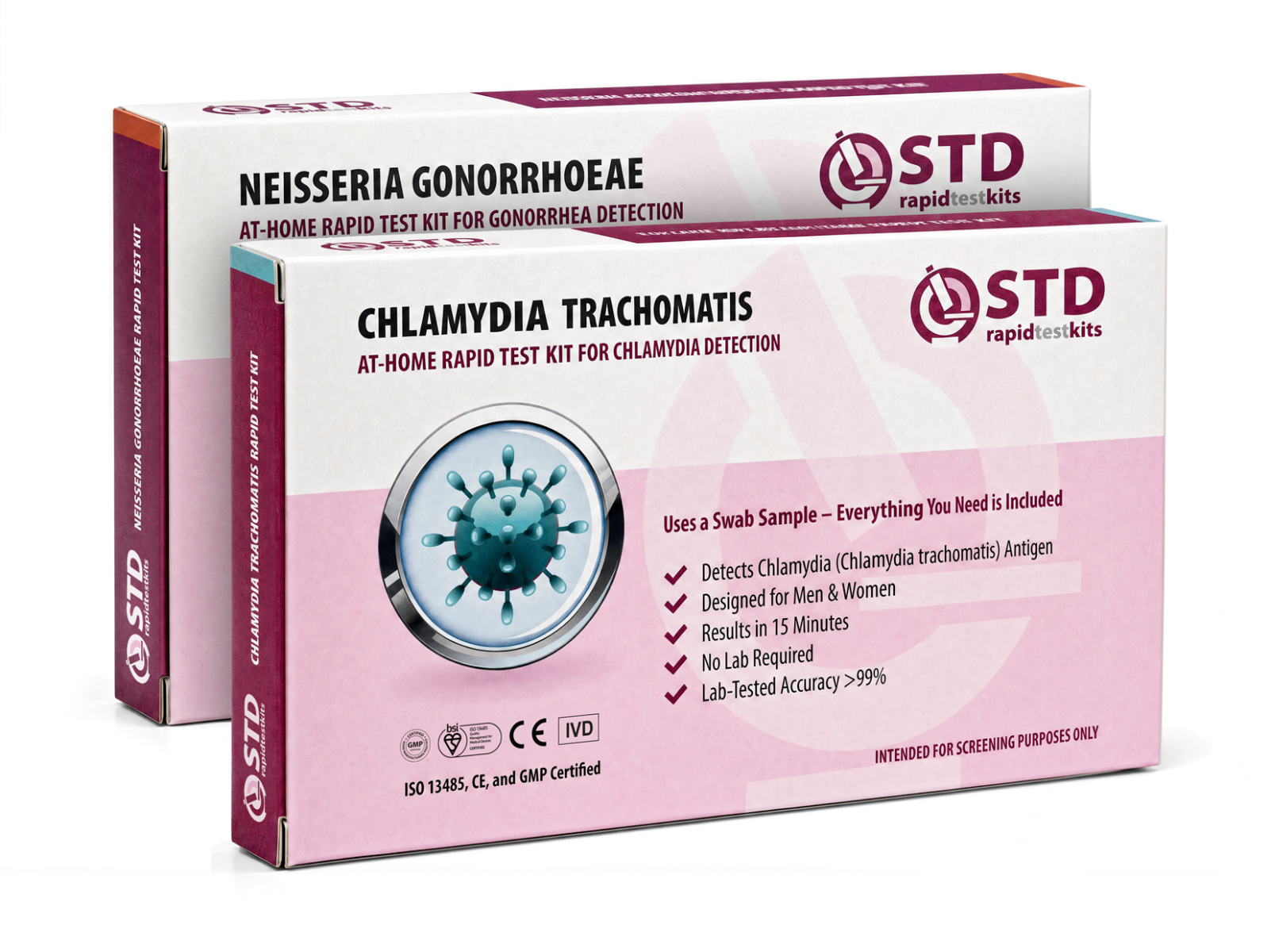
For testicular pain or swelling specifically, the most relevant at-home screen is one that covers chlamydia and gonorrhea, since these are the bacterial infections most likely to cause epididymitis. A combined at-home chlamydia and gonorrhea swab kit covers both organisms in one test. Broader combination kits add HIV, syphilis, and hepatitis screens if you want a fuller picture in one sitting.
One important caveat. If your suspected exposure included oral or anal sex, an at-home swab will not catch a pharyngeal or rectal infection. Those sites need a clinic-administered swab. The rapid blood antibody test for HSV-2 also detects past seroconversion, not an active local lesion, and herpes is rarely the cause of isolated testicular pain on its own; the pattern that points to herpes is genital lesions. CDC guidance on testing windows is available on the CDC's STI treatment guidelines page.
Visible discharge requires the infection to inflame the urethral lining enough to produce pus. With chlamydia in particular, the bacteria can ascend the genital tract and lodge in the epididymis without ever causing that surface-level reaction. The result: pain or heaviness in the testicle, with nothing visible at the tip of the penis. Treating absent discharge as a green light is one of the most common reasons men delay testing.
When the Test Comes Back Negative but the Pain Doesn't Go Away
A negative test followed by ongoing pain is one of the most disorienting outcomes. The most common reason is timing. If you tested within the first week after exposure, the bacterial load may have been below the rapid test's detection threshold. The infection was there; the test simply could not see it yet.
Most rapid lateral-flow manufacturers and general STI screening guidance recommend waiting at least seven days post-exposure before testing, with 14 days giving substantially better sensitivity for chlamydia and gonorrhea. Some test labels use a 14-to-21-day window for high-confidence results. A test on day three or day five, even if you already feel pain, can return a false negative because the bacterial load has not yet built up to detectable levels. When an early negative is followed by symptoms that do not resolve, retest after day 14.
The table below summarizes the most common test-timing scenarios when testicle pain is the trigger for testing.
| Scenario | Time since exposure | Best testing strategy | Retest needed? |
|---|---|---|---|
| Pain begins within 3 days of suspected exposure | 0 to 3 days | Too early. Wait at least 7 to 10 days | Yes, retest at day 14 |
| Pain begins about 1 week after exposure | 7 days | Test now, but plan a confirmation test in 7 more days | Yes, retest at day 14 |
| Tested negative on day 5, pain has worsened | 5 to 7 days at first test | Retest at day 14 or later | Yes |
| Pain returned after recent STI treatment | 14+ days post-treatment | Test now to check for reinfection or treatment failure | Follow clinician guidance |
When It Is Not an STI: Other Causes of Testicle Changes
Not every change in testicle size or sensation is caused by an STI. Several non-infectious conditions can mimic or overlap with STI symptoms, and one of them is a surgical emergency. The pattern matters for what you should do next.
Other non-STI causes worth knowing about include:
- Varicocele: dilated veins in the scrotum, often described as feeling like a bag of worms. A common finding in adult men, listed on the MedlinePlus testicular disorders page. Usually painless, can affect fertility, more often on the left side, and occasionally causes mild testicular atrophy from disturbed blood flow and temperature regulation.
- Hydrocele: a fluid collection around the testicle. Painless, soft, can cause visible scrotal enlargement without pain.
- Inguinal hernia: a loop of bowel slipping into the scrotum. Causes a soft bulge that may worsen with standing, lifting, or coughing. Common in men under 40 who do heavy lifting.
- Trauma: a hard direct blow can cause testicular injury or hematoma; severe trauma can lead to atrophy.
- Testicular tumors: usually painless, often described as a firm lump or area of irregular firmness on the testicle itself rather than the epididymis. Testicular cancer is uncommon but most curable when caught early. More on the MedlinePlus testicular disorders page.
- Mumps orchitis: a viral cause of testicular inflammation, mostly seen in unvaccinated populations exposed to mumps.
- Nerve entrapment: a lower-back or pelvic nerve issue that refers pain into the scrotum without anything actually wrong with the testicle.
- Kidney stone: a passing stone in the lower ureter can refer pain into the scrotum, mimicking a testicular issue.
The takeaway: a change in testicle size, weight, or sensation deserves attention, but the specific pattern matters. Sudden severe pain, especially in a teen or young adult, is a same-day emergency. Gradual change over weeks is something to investigate with a clinician and an STI screen. A new firm lump on the testicle itself, painless or not, deserves a clinic appointment within days, not weeks.
Testicular torsion is a surgical emergency where the spermatic cord twists and cuts off blood supply. The window to save the testicle is short. <a href="https://medlineplus.gov/ency/article/003160.htm" target="_blank" rel="noopener noreferrer">MedlinePlus on testicle pain</a> cites about four hours for the best chance of testicle preservation, after which the risk of permanent loss climbs steeply. Pain is typically sudden, severe, often accompanied by nausea, and the affected testicle may sit higher than the other. Skip the at-home test and go to an emergency room now if any of these apply: sudden severe one-sided pain coming on within minutes; high fever above 39 °C alongside testicular pain; visible blood in semen or urine; a hard new lump that does not change with palpation; or pain that began after a direct kick or blow to the groin and is not subsiding. A rapid test cannot diagnose torsion.
What a Normal Testicle Should Feel Like
Sex education rarely covers what a healthy testicle is supposed to feel like. The normal range is wider than people assume.
Testicles are roughly egg-shaped, smooth on the surface, and firm but not hard. The texture should feel uniform across the surface. Behind each testicle, you can usually feel a softer, comma-shaped structure: that is the epididymis. It can feel like a separate, less-firm attachment to the back of the testicle, and it is sometimes mistaken for a lump on first self-exam.
Slight differences between the two sides are normal. One testicle (usually the left) often hangs lower than the other. Small size differences are typical. Temperature affects how the scrotum sits: warm in the shower, the testicles drop and feel looser; cold or anxious, they pull up tighter to the body.
A monthly self-check in the shower, when the scrotum is relaxed, is the simplest way to notice changes early. If you do notice something, the checklist below covers the patterns that warrant a clinical exam, ideally with a scrotal ultrasound.
Testicle changes that warrant a clinical exam
Any one of these patterns deserves a clinical exam, ideally with a scrotal ultrasound. If pain is sudden and severe, do not wait for an outpatient appointment. Go to an emergency room.
- A sudden change in size on one side Common
- A new firm lump on the testicle itself, painless or not Common
- Persistent tenderness localized to one specific spot on the testicle or epididymis Common
- Visible swelling on one side that does not resolve in a few days Common
- A clear, progressive shrinking of one testicle over weeks Less common
- A new dragging or aching sensation that worsens by the end of the day, often left-sided (possible varicocele) Less common
- A soft scrotal bulge that worsens with standing, lifting, or coughing (possible inguinal hernia) Less common
- A hard, irregular nodule that does not move with palpation (rare but high-priority) Rare
Treatment: What Recovery Actually Looks Like
Bacterial epididymitis from chlamydia or gonorrhea is treatable. Standard regimens follow CDC guidance per the CDC's 2021 STI Treatment Guidelines for epididymitis: a single intramuscular dose of ceftriaxone for gonorrhea, plus oral doxycycline 100 mg twice daily for ten days for chlamydia. The standalone uncomplicated-chlamydia course is shorter (7 days of doxycycline per the CDC's 2021 chlamydia treatment guidelines), but the epididymitis course is ten days. Most men feel substantially better within 48 to 72 hours of starting antibiotics. Full resolution of pain and swelling can take a few weeks.
Adjunctive measures that help during recovery:
- Scrotal support and elevation, especially in the first few days
- Anti-inflammatories such as ibuprofen or naproxen to reduce swelling and pain
- Cold packs for the first 24 to 48 hours
- Avoiding sex until both partners have completed treatment and any follow-up testing is clear
Recovery prognosis depends heavily on how early treatment starts. Treatment within the first week of symptoms means most men recover completely, with no measurable change in testicle size, sperm production, or hormone levels. Treatment within the first month usually still produces a good outcome, though a smaller share develop residual tenderness or a slightly smaller affected testicle. Treatment after weeks or months of untreated infection raises the risk of permanent atrophy and reduced sperm production on the affected side. Many of these men remain fertile because the unaffected testicle compensates.
Antibiotic resistance, particularly in gonorrhea, is a growing concern, and CDC guidance has been updated repeatedly over the past decade in response. If symptoms persist after a full course of treatment, return to your clinician promptly. A different antibiotic regimen may be needed, or another organism such as Mycoplasma genitalium may be involved.
Treatment essentials
- Standard CDC regimen for STI epididymitis: ceftriaxone (intramuscular) for gonorrhea plus doxycycline (oral, 10 days) for chlamydia. The shorter 7-day doxycycline course applies to uncomplicated chlamydia without epididymitis.
- Most men feel better within 48 to 72 hours of starting antibiotics; full swelling resolves over weeks.
- Both partners need to be treated to prevent reinfection cycles.
- Persistent symptoms after a full course need follow-up; a different antibiotic or a different organism may be involved.
Retesting After Treatment
A single positive test is not the end of the story. The CDC recommends retesting at three months after treatment for chlamydia and gonorrhea, regardless of whether you think your partner was successfully treated. Reinfection is common, and the three-month retest catches both new exposures and any treatment that did not fully clear the original infection.
Two retesting paths are typical:
- Symptomatic infection treated with antibiotics: symptoms resolve, and you retest at three months to confirm clearance and rule out reinfection from the same or a new partner.
- Asymptomatic infection caught on routine screening: treat, then retest at three months. Continue routine screening at intervals appropriate for your sexual activity.
Other infections follow different timelines. Syphilis treatment response is checked through blood titer levels at six and twelve months. HIV may need confirmatory NAAT or PCR testing depending on the kind of test used and the time since exposure. At-home rapid kits cover most retesting needs for chlamydia, gonorrhea, syphilis, and HIV; ask a clinician about laboratory NAAT or PCR if a rapid result needs confirmation.

Hormonal and Other Causes Beyond Infection
Some testicle shrinkage has nothing to do with infection. Low testosterone, whether from aging, pituitary disorders, anabolic steroid use, chronic illness, or genetic conditions like Klinefelter syndrome, can cause gradual bilateral testicle shrinkage.
The pattern is usually different from infectious atrophy. Hormonal causes typically affect both testicles symmetrically and develop over months to years. Other symptoms beyond the testicles often accompany the change: lower libido, fatigue, mood changes, decreased muscle mass, increased body fat, and erectile difficulties.
Anabolic steroid use deserves a specific mention. Exogenous testosterone or anabolic steroids suppress the body's own testosterone production, and testicles can begin to shrink within weeks of starting. Recovery after stopping is variable: some men return to baseline within months, others have lasting changes.
Long-term opioid use, chronic alcohol use, and some chemotherapy regimens can also lower testosterone production and contribute to testicular shrinkage.
If your STI test comes back negative but your testicles still feel different, a hormone panel is the next reasonable step. A morning blood test for total testosterone, free testosterone, LH, and FSH gives a clinician most of what they need to assess hormonal causes. A scrotal ultrasound can confirm tissue changes that physical exam alone cannot pick up. Running an STI panel in parallel is the practical move here: a broader at-home rapid screen rules out lingering bacterial or bloodborne infections at the same time the hormone work-up is underway, so two negatives point a clinician straight to the structural or endocrine cause.

Privacy, Partner Conversations, and the Practical Side of Testing
For the cases where a rapid STI test is the right call, the practical advantages of testing at home are genuine. Walking into a clinic to describe testicle pain can feel disproportionately exposing, and some providers are quicker to dismiss vague scrotal complaints than they should be. An at-home rapid test removes the lobby, the small talk, and the wait. Kits arrive in plain packaging with no exterior product names. Self-collection takes a few minutes. The lateral-flow result is read at home in roughly 15 minutes. Most U.S. card payments use a generic merchant descriptor, so the line item on a statement does not reveal what was purchased.
Disclosure conversations are easier when framed as collaborative rather than confrontational. The simple version: "I noticed something and I want to be sure. Would you test with me?" Most STIs are passed between people who do not know they are infected. Many infections are asymptomatic in early stages, and the absence of symptoms in either partner does not rule out infection. Testing together, even when neither person feels sick, removes the question for both of you.
If a positive result comes back, treatment is straightforward. Most bacterial STIs can be cured with a short course of antibiotics, and telehealth providers can often issue the prescription within a day. Both partners need to be treated to prevent reinfection. State health departments offer expedited partner therapy in many places, where the index patient's clinician can prescribe antibiotics for a partner without a separate visit, depending on local rules. Several U.S. states and local health departments also offer anonymous partner-notification services if you test positive and want help with the conversation.
The infection can cause a fever and pain in the tubes attached to the testicles. This can, in rare cases, lead to infertility.
Frequently Asked Questions
- Can you have an STI with testicle pain but no discharge?
- Yes. Chlamydia and gonorrhea can ascend from the urethra into the epididymis without ever inflaming the urethral lining enough to produce visible pus. Many men with chlamydia have no other symptoms at all. The first thing many men notice is a one-sided ache or sense of heaviness, with nothing visible externally. A rapid at-home swab test 7 to 14 days after exposure can confirm or rule out these infections.
- How soon after sex would testicle pain show up if it is an STI?
- Chlamydia typically produces symptoms 7 to 21 days after exposure if they appear at all; gonorrhea is faster, usually 2 to 10 days. Pain starting within the first 48 hours of sex is more likely irritation, muscle strain, or trauma than an ascending infection. Pain that appears 5 to 14 days post-exposure with no clear physical cause is worth testing for.
- Can chlamydia really shrink a testicle?
- Yes, in a small share of untreated cases. When chlamydia ascends from the urethra into the epididymis and goes untreated for weeks or months, prolonged inflammation can damage testicular tissue and lead to atrophy. Most men treated within the first month recover without lasting size change.
- Is epididymitis always caused by an STI?
- No. In men under 35, sexually transmitted bacteria (mainly chlamydia and gonorrhea) cause the majority of epididymitis cases. In men over 35, the more common causes are urinary tract infections from gut bacteria such as E. coli, prostate inflammation, or recent urinary procedures. The treatment differs, so testing helps direct it correctly.
- I tested negative on day 5 but still have pain. What now?
- Retest at day 14 or later. Day 5 falls below the reliable detection threshold for both chlamydia and gonorrhea rapid tests, so an early negative does not rule them out. If pain continues or worsens after the day-14 retest also comes back negative, see a clinician for a physical exam and scrotal ultrasound. Persistent pain with two negative rapid results points away from a bacterial STI and toward causes like epididymal cyst, varicocele, or referred nerve pain.
- Is testicular atrophy reversible?
- Partial recovery is possible if treatment starts before significant scarring. Once tissue has been replaced by scar, the change is generally permanent. The earlier treatment begins, the better the outcome for both size and sperm production.
- When is testicular torsion the cause, and what does it feel like?
- Torsion is most common between ages 12 and 18 but can occur at any age. Unlike epididymitis, which builds over hours to days, torsion pain peaks within minutes, and the affected testicle often sits noticeably higher than the other or at an unusual angle. Nausea or vomiting commonly comes with it. If you cannot tell whether the onset was gradual or sudden, treat it as torsion until a clinician rules it out and go to an emergency room.
- If one testicle is damaged, am I infertile?
- Most men with one damaged testicle remain fertile because the unaffected side compensates. Sperm production and testosterone usually continue from the healthy testicle. A semen analysis after recovery gives a clear answer about your fertility status.
- What is the worst case if I just ignore the pain?
- Untreated chlamydia or gonorrhea can spread further into the reproductive tract and cause chronic pelvic pain, scarring, and reduced fertility. Untreated epididymitis can become a chronic recurring problem. Untreated torsion can cause loss of the affected testicle within hours. Most causes of testicular pain have a treatment that works well early and works less well the longer it is delayed.
What to Do, Today
Testicular changes deserve attention, not panic. Most men who notice a change do not have a serious problem. A meaningful share do, and the time-sensitive cases (torsion, untreated infection) are exactly the ones where acting today matters.
If pain is sudden and severe, go to an emergency room. If pain or change is gradual and at least seven days have passed since a possible exposure, screen for STIs with an at-home rapid test or a clinic visit, and follow up with a clinician for any positive result or persistent symptom. The simplest action you can take today, an at-home test or a clinic appointment, is almost always enough to put you on the right track.
What to do next
Is the pain sudden, severe, one-sided, and only a few hours old (often with nausea, a higher-riding testicle, or a high fever)?
Yes: Go to an emergency room now. The torsion treatment window is roughly 4 hours. Do not wait for an at-home test result, and a rapid test cannot diagnose torsion.
Has at least 7 days passed since the possible exposure, and the pain is gradual, mild, or low-grade?
Yes: Take an at-home rapid STI swab for chlamydia and gonorrhea (most reliable at day 14 or later). If positive, complete the full antibiotic course, get your partner(s) treated, and retest at three months. If symptoms continue with a negative result, follow up with a clinician for a physical exam and scrotal ultrasound.
No: Too early to test reliably. Wait until at least 7 days post-exposure (14 days for higher confidence). If pain worsens, becomes severe, or you develop a fever, see a clinician sooner.
Match your situation to the action below. When in doubt about whether pain is sudden enough, treat it as torsion and head to an ER.
- U.S. Centers for Disease Control and Prevention. 2021 STI Treatment Guidelines: Epididymitis. Standard of care, pathogen attribution by age group, and the 10-day doxycycline plus ceftriaxone regimen for STI epididymitis.
- U.S. Centers for Disease Control and Prevention. About Chlamydia: transmission, asymptomatic carriage, symptoms in men, and complications including epididymitis and rarely infertility.
- U.S. Centers for Disease Control and Prevention. About Gonorrhea: symptoms, complications including epididymitis, and reinfection guidance.
- U.S. Centers for Disease Control and Prevention. 2021 STI Treatment Guidelines: Chlamydia. Source for the standalone uncomplicated-chlamydia 7-day doxycycline regimen and three-month retesting recommendation.
- U.K. National Health Service. Epididymitis: Symptoms and Causes. Source for the age-based attribution that STIs are the typical cause in younger sexually active men while urine infections predominate over 35.
- MedlinePlus (U.S. National Library of Medicine). Testicle Pain: differential diagnosis including torsion, hernia, and infectious causes, with the approximately 4-hour torsion salvage window for emergency presentation.
- World Health Organization. Sexually Transmitted Infections (STIs) Fact Sheet. Source for 2020 global new-infection estimates of 129 million chlamydia and 82 million gonorrhea cases.
- MedlinePlus (U.S. National Library of Medicine). Testicular Disorders: differential diagnosis including varicocele, hydrocele, epididymitis, torsion, and testicular cancer.
