

Published: August 2025 | Last updated: April 2026 | Editorial review and quality control: Martina N.
You tested positive, and now you're trying to figure out whether you passed it to someone, when, and how to tell them. Maybe a current partner already tested positive too and the timelines don't line up cleanly. Maybe a former partner from months ago might still be carrying it without symptoms. This is the situation most people land in when they get a diagnosis they didn't see coming, because the majority of sexually transmitted infections spread well before anyone notices a single sign. The next few steps matter more than figuring out exactly where the chain started.
This article is published by stdrapidtestkits.com, which sells at-home STI testing kits. The product recommendations below are matched to fit-for-purpose for the situation, not commercial benefit; sections that don't call for a product mention don't include one.
What do I do if I gave someone an STI without knowing?
Most STIs spread before symptoms appear, so transmitting one without realizing is the more common pattern. Confirm your own diagnosis with a follow-up test if you haven't already. Tell every partner who falls within the relevant exposure window so they can test and treat. If direct contact isn't safe, ask a sexual-health clinic to handle anonymous notification on your behalf. Chlamydia, gonorrhea, syphilis, and trichomoniasis are curable with antibiotics in days. Herpes, HPV, HIV, and hepatitis B are managed long-term with high-effectiveness treatment that also reduces transmission risk to future partners.
Key Takeaways
- Silent transmission is the norm. Most people who pass chlamydia, gonorrhea, herpes, or HPV never had a visible symptom before doing so, per CDC guidance on STIs.
- Disclosure rebuilds trust more often than it destroys it. Direct, early conversations let partners test and treat early, and clinics can notify on your behalf when direct contact isn't safe.
Why silent transmission is so common
The biology here is genuinely uncomfortable. You can be infectious for weeks, months, or in some cases years before anything tells you something is wrong. The CDC describes chlamydia and gonorrhea as largely asymptomatic in women and frequently asymptomatic in men, with infections in the throat and rectum showing fewer symptoms still (CDC about STIs). Genital herpes follows the same pattern: the WHO herpes fact sheet notes that most people with HSV-2 never have classical sores, and that the virus can shed and transmit between flares without any visible signal at all.
What this adds up to in real life: by the time you finally test positive, it's likely you've already been carrying the infection long enough to expose at least one partner. That's not a moral failure; it's how these pathogens evolved to spread. The WHO global STI fact sheet estimates that more than one million curable STIs are acquired every day worldwide, and the silent-spread pattern is the main reason that number stays high despite condoms, screening, and treatment improving every decade.
Chlamydia and gonorrhea typically show up on testing within one to two weeks of exposure but can stay symptom-free for months. Herpes antibodies can take 12 to 16 weeks to register on a blood test after a first infection. Syphilis cycles between visible and silent stages over years if untreated. So a partner testing positive shortly after you doesn't prove they got it from you, and a long gap doesn't prove you got it from them. Trying to litigate the exact source rarely produces a useful answer.
Why disclosure matters, even when the timelines are messy
The instinct to stay quiet is understandable. Telling a current partner can feel like detonating the relationship. Telling a past partner can feel like dragging up something both of you moved on from. The case for telling anyway comes down to three things: their right to test and treat early, the prevention of onward transmission to people you'll never meet, and the possibility of catching complications before they become permanent.
Untreated chlamydia and gonorrhea can cause pelvic inflammatory disease in women and epididymitis in men, both linked to lasting fertility problems (CDC chlamydia information). Untreated syphilis can damage the nervous system and cardiovascular system years later. HIV caught early responds dramatically better to treatment than HIV caught after the immune system has already been hit. Telling someone gives them the chance to interrupt these timelines while there's still a clean exit.
Major public-health bodies, including the World Health Organization and the UK National Health Service, recommend partner notification as standard practice. Most sexual-health clinics will handle the notification themselves if you ask, without using your name.
What untreated infection can lead to
- Pelvic inflammatory disease and tubal-factor infertility from untreated chlamydia or gonorrhea in women.
- Epididymitis and rare infertility complications in men from the same two infections.
- Cardiovascular and neurological damage from late-stage untreated syphilis.
- Significantly worse long-term outcomes from delayed HIV diagnosis compared with HIV caught and treated early.
How to have the conversation
The script doesn't need to be elaborate. Most successful disclosures are short, clear, and led with care for the other person rather than guilt about yourself. The aim is to give someone the information they need so they can act on it.
A workable opening looks like this: "I just found out I tested positive for [infection]. I didn't have any symptoms, so I had no idea before this. I wanted to tell you as soon as I knew so you can get tested and treated if you need to." That's the whole script. No groveling, no detective work about who gave it to whom, no apology that turns into a request for absolution.
If they ask follow-up questions, a few short answers handle most of them: "I don't know exactly how long I've had it." "I'm getting treated now." "Whatever you decide is okay; I just wanted you to have the information." Resist the urge to fill silences. People often need a few minutes (or a few days) to process before they have a real reaction.
What a useful disclosure includes
- The infection by name, not vague language like "something" or "an issue".
- When you found out, so they can place themselves in the exposure window.
- Whether the infection is curable or managed, so they know what testing positive would actually mean for them.
- A clear next step they can take (clinic, GP, or at-home test).
- Permission for them to react however they need to, without you steering it.
When direct contact isn't safe or possible
Some situations rule out a direct conversation. An ex who was abusive, a former partner whose new spouse doesn't know about the relationship, a hookup whose number you no longer have, a partner who has explicitly said they don't want contact. None of that means notification has to be skipped. Most sexual-health clinics offer partner-services notification, where a contact-tracing nurse or counselor calls or messages the partner on your behalf, names the infection, recommends testing, and never reveals who reported it.
If you're testing through a sexual-health clinic, ask whether partner services is part of what they do. In most public-health systems it is, free, and confidential. If you're testing through a GP or at home, your local public-health department typically handles the same service when you call and request a partner notification. The NHS STIs overview describes the same model, where the clinic contacts partners without using your name.

Testing options when you don't know what you might have
If your original positive came back on a single-infection test (a routine chlamydia screen, say), it's worth checking that you don't also have something else from the same exposure event. STIs travel in clusters more often than people realize: a chlamydia diagnosis raises the prior probability of co-infection with gonorrhea, and a syphilis diagnosis is paired with HIV testing as a routine clinical reflex.
The realistic options:
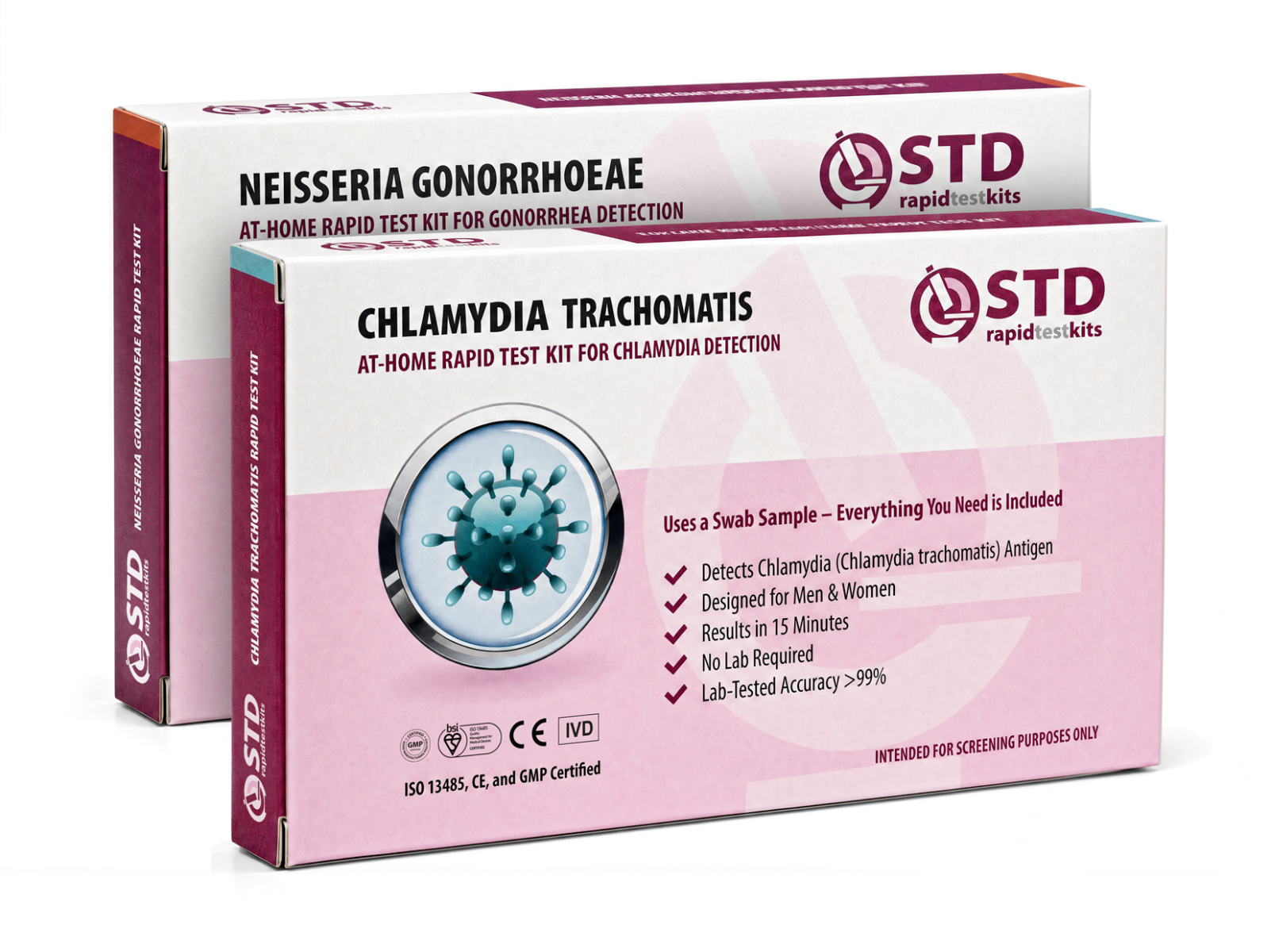
- Sexual-health clinic or GP. The most thorough route. Free or low-cost in most public-health systems, includes laboratory NAAT testing for chlamydia and gonorrhea (the analytical gold standard), confirmatory blood tests for syphilis and HIV, and partner-services support if you want it.
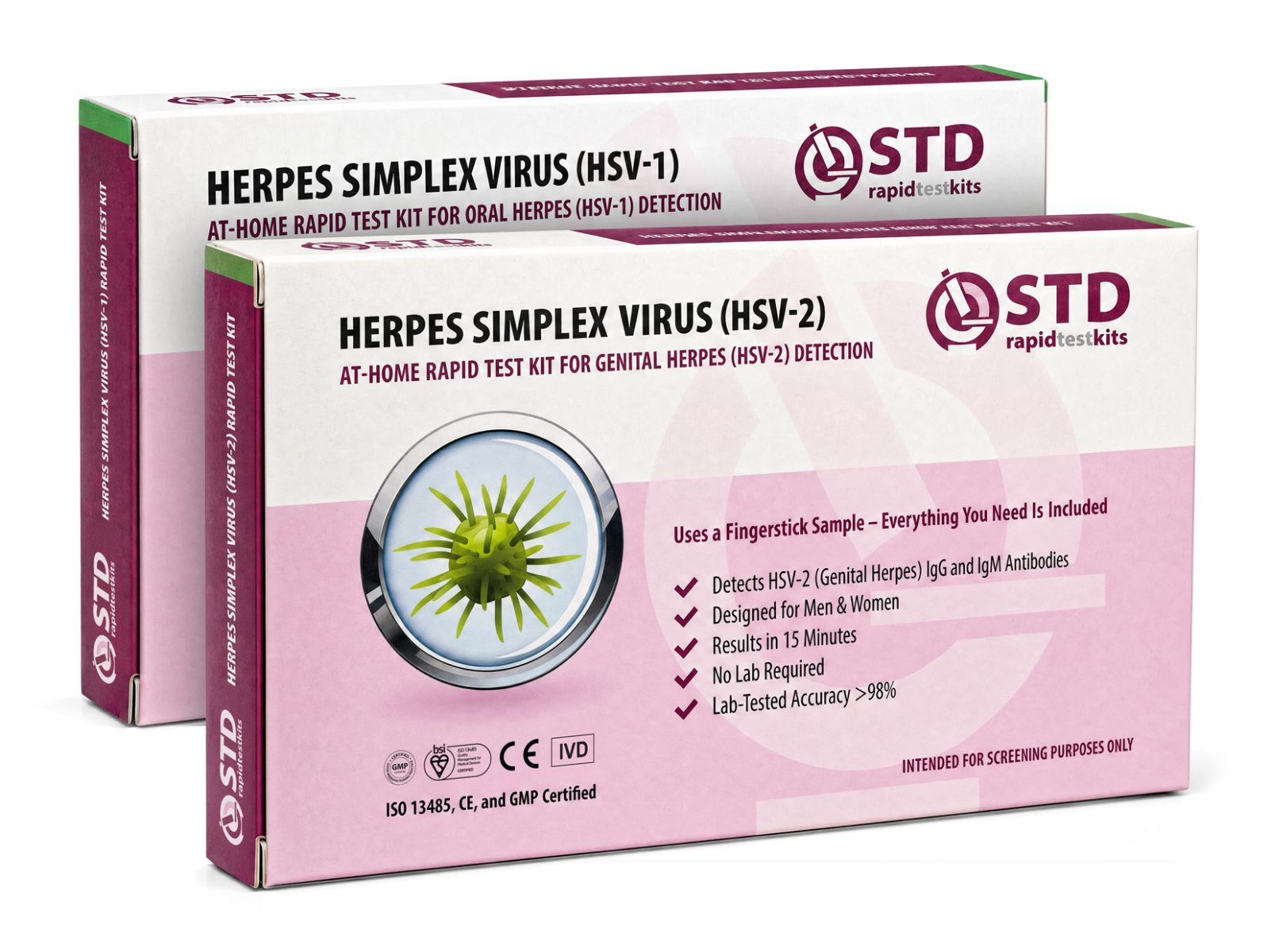
- At-home rapid lateral-flow tests. Useful for fast screening, particularly for the infections most likely to be silent. Results in around 15 minutes. A positive result on a rapid test is worth confirming at a clinic, since lab NAAT testing is more analytically sensitive than at-home lateral-flow chemistry; the two technologies are complementary rather than equivalent.
- Mail-in lab kits. A middle option with the analytical sensitivity of a clinic test and the privacy of home collection. Slower turnaround (a few days to a week).
The table below shows the realistic testing window for each common infection.
| Infection | Sample type (home rapid) | Reliable testing window after exposure |
|---|---|---|
| Chlamydia | Vaginal or penile swab | Around 1 to 2 weeks |
| Gonorrhea | Vaginal or penile swab | Around 1 to 2 weeks |
| Trichomoniasis (women) | Vaginal swab | Around 1 to 4 weeks |
| Syphilis | Fingerstick blood | Around 3 to 6 weeks |
| HIV | Fingerstick blood | Antibody tests reliable by 12 weeks; antigen/antibody combination tests earlier |
| Herpes (HSV-2) | Fingerstick blood antibody | Around 12 to 16 weeks |
| Hepatitis B / C | Fingerstick blood | Around 4 to 12 weeks |
Treatment basics: the curable infections
What treatment looks like depends entirely on which infection came back positive. Some are cured in a single appointment with antibiotics; others need long-term management. Starting with the curable group:
- Chlamydia is treated with a one-week course of doxycycline (or a single dose of azithromycin in specific circumstances). Cure rates are high. Re-test at three months because reinfection from an untreated partner is common.
- Gonorrhea is treated with a single intramuscular ceftriaxone injection per current CDC guidance, due to rising antibiotic resistance. Re-test at three months for the same reason.
- Syphilis is treated with one to three intramuscular benzathine penicillin injections, depending on stage. Earlier-stage syphilis needs fewer doses. Penicillin allergy doesn't necessarily rule it out; clinics have desensitization protocols.
- Trichomoniasis is treated with a course of metronidazole or tinidazole. Both partners typically treat at the same time to prevent ping-pong reinfection.
For chlamydia, gonorrhea, and trichomoniasis, treating both partners at the same time is the standard approach. If only one of you treats, the untreated partner reinfects the treated one as soon as sex resumes (the so-called ping-pong effect). Clinics offering expedited partner therapy can sometimes provide medication for the partner without a separate visit.
Long-term management for chronic infections
The remaining common STIs aren't fully curable, but the available treatments work well enough that most people on them live unaffected by the diagnosis day to day, with much-reduced risk of transmitting onwards.
- Genital herpes is well controlled with daily antivirals (valacyclovir or acyclovir), which suppress outbreaks and substantially reduce the chance of transmitting to a partner.
- HIV is treated with daily antiretroviral therapy. Modern regimens are typically one pill a day, and people on effective treatment with an undetectable viral load do not transmit HIV sexually (the U=U principle, endorsed by the CDC).
- Hepatitis B often resolves spontaneously in adults; chronic cases are managed with antivirals. Hepatitis C is now curable in most cases with an 8 to 12 week course of direct-acting antivirals.
- HPV doesn't have a curative treatment for the virus itself, but visible warts can be removed and routine cervical screening catches the high-risk strains before they cause cancer.
Legal exposure and what disclosure laws say
The law on STI transmission varies sharply by country and, within the United States, by state. A few general patterns hold across most jurisdictions:
- Knowingly transmitting HIV without disclosure is a criminal offense in many U.S. states, ranging from misdemeanor to felony, though several states have modernized these statutes in recent years to reflect current science (including U=U).
- A handful of jurisdictions criminalize transmission of other STIs (commonly syphilis, herpes, or hepatitis) under public-health or general assault statutes.
- Civil suits for STI transmission exist as a separate matter and are generally easier to bring than criminal charges, particularly where the plaintiff can show the defendant knew their status.
- Most jurisdictions distinguish sharply between knowingly transmitting (after testing positive) and unknowingly transmitting (before any positive test). Acting promptly after a positive result, including notifying partners, is the single most protective thing someone can do legally.
If you have specific concerns about a particular relationship or jurisdiction, speak with a lawyer rather than a search engine.
If there's any chance a former partner might allege intentional transmission, save your test result, the date, and any partner-notification messages you sent. "I told them as soon as I knew" is a much stronger position with a paper trail than without one.
Common misconceptions worth correcting
The myths most likely to drive bad decisions in the days after a diagnosis are worth naming directly.
"If they didn't get symptoms, I don't need to tell them." Most STIs cause no symptoms in most people. Symptom-free doesn't mean infection-free, and an asymptomatic partner can still develop complications and still transmit onwards. The argument from "they seem fine" doesn't hold.
"If I'm cured now, the past doesn't count." Treatment clears your current infection; it doesn't erase the exposure window. If a partner was at risk during the time you were contagious, they need a chance to test and treat regardless of where you are now.
"If neither of us cheated, the test must be wrong." Both lab NAAT and well-validated rapid tests have very high specificity, meaning false positives are uncommon. STIs from before the relationship can lie dormant for months or years (herpes especially), and infections in body sites that aren't routinely tested (throat, rectum) frequently go undetected. A positive result usually reflects a real infection rather than lab error or infidelity.
Surveys of people living with chronic STIs consistently find that direct, early disclosure produces supportive or neutral reactions far more often than rejection. Couples who navigate a positive diagnosis together frequently report stronger trust afterwards rather than weaker. The relationships that fracture tend to fracture over discovered secrecy, not over the diagnosis itself.
Living and dating after a diagnosis
Whether the relationship that produced the diagnosis continues or ends, the question of what to tell future partners arrives quickly. The pattern that works best is straightforward: disclose early, in your own words, before sex is on the table. People reject secrecy more reliably than they reject diagnoses, and being told well in advance gives a new partner the time to ask questions, do their own reading, and decide on their own terms.
For a curable infection that's already been treated, future-partner disclosure may not even be required after a clean retest. For a chronic infection like genital herpes, HSV-1, HIV, or HPV, disclosure is the standard. None of these are sentences against intimacy. Daily suppressive antivirals reduce HSV-2 transmission substantially. Effective antiretroviral therapy reduces sexual HIV transmission to effectively zero. Most adults will be exposed to HPV in their lifetime, and most clear it without ever knowing.
The harder part is rarely the medical information; it's the moment of telling someone new and waiting to see how they react. Most people are kinder than the worst-case voice in your head predicts.

Prevention without the fear lecture
The prevention conversation lands differently after a diagnosis than before one. There's nothing useful about being told to use condoms by someone who knows they already learned that lesson the hard way. What's worth saying instead is that the same techniques that would have reduced your original risk also reduce your future risk, and a few of them are underused even by people who think they're being careful.
- Routine testing every three to six months for anyone with new or multiple partners, regardless of symptoms. This is the single biggest difference between someone who transmits unknowingly for a year and someone who catches it within weeks.
- Testing at the right body sites. Throat and rectal swabs catch chlamydia and gonorrhea infections that genital-site testing misses entirely. If oral or anal sex is part of someone's pattern, they need pharyngeal or rectal screening at a clinic; at-home swab kits cover the genital site, not the others.
- Telling new partners about test history before sex, and asking the same back. "When were you last tested?" is one of the most underused questions in dating. The answer doesn't have to be perfect; the willingness to answer it is the signal.
Vaccines also belong in this picture. The HPV vaccine covers most high-risk strains and is recommended through age 26 routinely, with shared clinical decision-making through age 45 per ACIP. Hepatitis B vaccination is part of routine childhood immunization in most countries, with adult catch-up available.
Most STIs have no symptoms or only mild symptoms, so you may not know you have an STI. The only way to know your status is to get tested.
Frequently asked questions
- Can someone really transmit an STI without any symptoms?
- Yes, and it's how most transmission happens. Chlamydia, gonorrhea, herpes, HPV, and HIV all have long stretches where the infection is contagious but produces no signs the person could see or feel. By the time symptoms appear (or never appear at all), exposure to one or more partners has usually already happened.
- What's the simplest way to tell a partner I tested positive?
- Direct, short, and unapologetic in tone: "I just found out I tested positive for [infection]. I didn't have any symptoms, so I had no idea before this. I wanted to tell you so you can get tested." That's the whole script. Long apologies often make the conversation harder for the person receiving the news.
- Do I have to tell a casual partner from months ago?
- If they were within the realistic exposure window for the infection, yes. The window is around 1 to 2 weeks for chlamydia and gonorrhea, up to several months for syphilis, and longer still for HIV and herpes. A short, neutral message giving them the information is the right thing to do; you don't need to revisit the relationship.
- Is there a way to notify a partner anonymously?
- Yes. Most sexual-health clinics offer partner-services notification, where a contact-tracing nurse or counselor calls or messages the partner on your behalf, names the infection, and recommends testing without revealing your identity. Local public-health departments typically handle the same service when you call and request a partner notification.
- What if my partner reacts badly or threatens me?
- Anonymous clinic-based partner services is the safer option in any situation involving a history of abuse, threats, or coercive control. The recipient gets the same useful health information; you stay protected. Clinic staff are trained for these situations and won't push you toward direct contact if it isn't safe.
- If my treatment is finished, do I still need to tell the people I might have exposed?
- Yes. Treatment clears your current infection, but the exposure window predates the treatment. Anyone who was at risk during the time you were contagious still needs the chance to test and treat themselves, regardless of where you are now.
- Can I face legal consequences for not disclosing?
- It depends on the jurisdiction and the infection. Knowingly transmitting HIV without disclosure is criminalized in many U.S. states; a smaller number of states criminalize transmission of certain other STIs. Civil suits exist as a separate path. Acting promptly after a positive diagnosis (notifying partners, documenting what you did and when) cuts off most of the legal exposure that secrecy creates. For specific concerns, talk with a lawyer rather than a website.
- How do I forgive myself and move on after this?
- Guilt after a diagnosis you didn't see coming is a normal reaction, not a verdict on your character. The way out is action rather than rumination: confirm the diagnosis, complete treatment, notify the partners who need to know, and use what you learned about silent transmission to be more deliberate about testing going forward. Most people who go through this find that the period of acute shame is shorter than they feared, especially once the disclosures are done.
- U.S. Centers for Disease Control and Prevention. About sexually transmitted infections, used for asymptomatic-transmission framing and the central importance of testing.
- U.S. Centers for Disease Control and Prevention. About chlamydia, used for chlamydia complications including pelvic inflammatory disease and fertility risk.
- World Health Organization. Sexually transmitted infections fact sheet, used for global epidemiology, daily-acquisition figures, and partner-treatment guidance.
- World Health Organization. Herpes simplex virus fact sheet, used for HSV-2 asymptomatic-shedding and silent-transmission information.
- UK National Health Service. Sexually transmitted infections overview, used for testing-window guidance and clinic-handled partner notification model.
- Mayo Clinic. Sexually transmitted diseases (STDs) symptoms and causes, used as a general reference on STI symptoms, transmission, and complications.
