
Published: September 2025 | Last updated: May 2026 | Editorial review and quality control: Martina N.
Same-day STD results in Florida are real for some infections and overhyped for others. Rapid at-home lateral-flow tests can return a visible chlamydia, gonorrhea, syphilis, or HIV result in 15 to 30 minutes when you use them after the relevant window period. Walk-in clinics and mail-in services frequently advertise “same-day” testing, yet that phrase often refers to same-day collection rather than a same-day result on your screen. The rest of this guide walks through which Florida options are genuinely instant, when each test becomes reliable, and how to choose between an at-home rapid kit, a mail-in lab panel, and a clinic visit.
Key Takeaways
- Genuine same-day at-home rapid tests exist for HIV, syphilis, chlamydia, and gonorrhea, but the result only means something if you test after the infection's window period closes.
- Mail-in services that advertise “same-day” usually mean same-day sample collection, not a same-day on-screen result. At-home lateral-flow kits are the only category that finishes the loop the same hour.
What “Same-Day” Actually Means in Florida
Three different testing pathways get advertised under the “same-day” umbrella, and only one of them puts a result on your screen the same hour you collected the sample. Knowing which is which keeps you from paying for a service that does not match your timeline.
True at-home rapid tests. These are lateral-flow cassettes you use on your bathroom counter. You apply a drop of fingerstick blood or a self-collected swab, wait 15 to 30 minutes for a visible line, and read the result yourself. There is no lab in the loop. This is the only category where “same-day” means same-hour. At-home rapid tests are available for HIV, syphilis, hepatitis B, hepatitis C, herpes (HSV-2 antibody), chlamydia, gonorrhea, and several combination panels.
Mail-in or clinic-collected lab kits. You collect the sample at home or at a clinic, ship it to a lab, and the lab posts results to a portal in 1 to 5 business days. “Same-day” here usually means the kit ships the same day you order it, or that you can collect the sample the same day you walked in. Florida USPS delays in summer months can stretch the round-trip to a week or more.
Walk-in clinic with an onsite rapid panel. Some Florida clinics carry rapid HIV and syphilis testing onsite, but availability depends on stock, staff, and case load. Calling ahead matters. The CDC recommends routine STI testing for anyone sexually active, with annual screening for sexually active women under 25 and for sexually active men who have sex with men (CDC STI testing recommendations).
Florida has its own quirks. County health departments in larger counties run free or low-cost testing programs, but waitlists in Miami-Dade, Broward, and Orange County can stretch several days during peak season. The state's Florida Department of Health HIV/AIDS program offers a free at-home HIV test kit. For broader STI coverage on a same-day timeline, an at-home rapid panel is the most reliable shortcut.
| Pathway | Result time | Sample type | Best for |
|---|---|---|---|
| At-home rapid (lateral flow) | 15 to 30 minutes | Self-collected swab or fingerstick blood | Same-day answer after the window has closed |
| Mail-in lab kit | 1 to 5 business days plus shipping | Self-collected at home or at a clinic | Broader panels and higher analytical sensitivity |
| Walk-in clinic | Same-day if onsite rapid stock; otherwise 1 to 5 days | Clinician-collected swab, blood, or urine | Symptoms, extragenital exposures, or comprehensive testing |
Window Periods: When Each Test Becomes Reliable
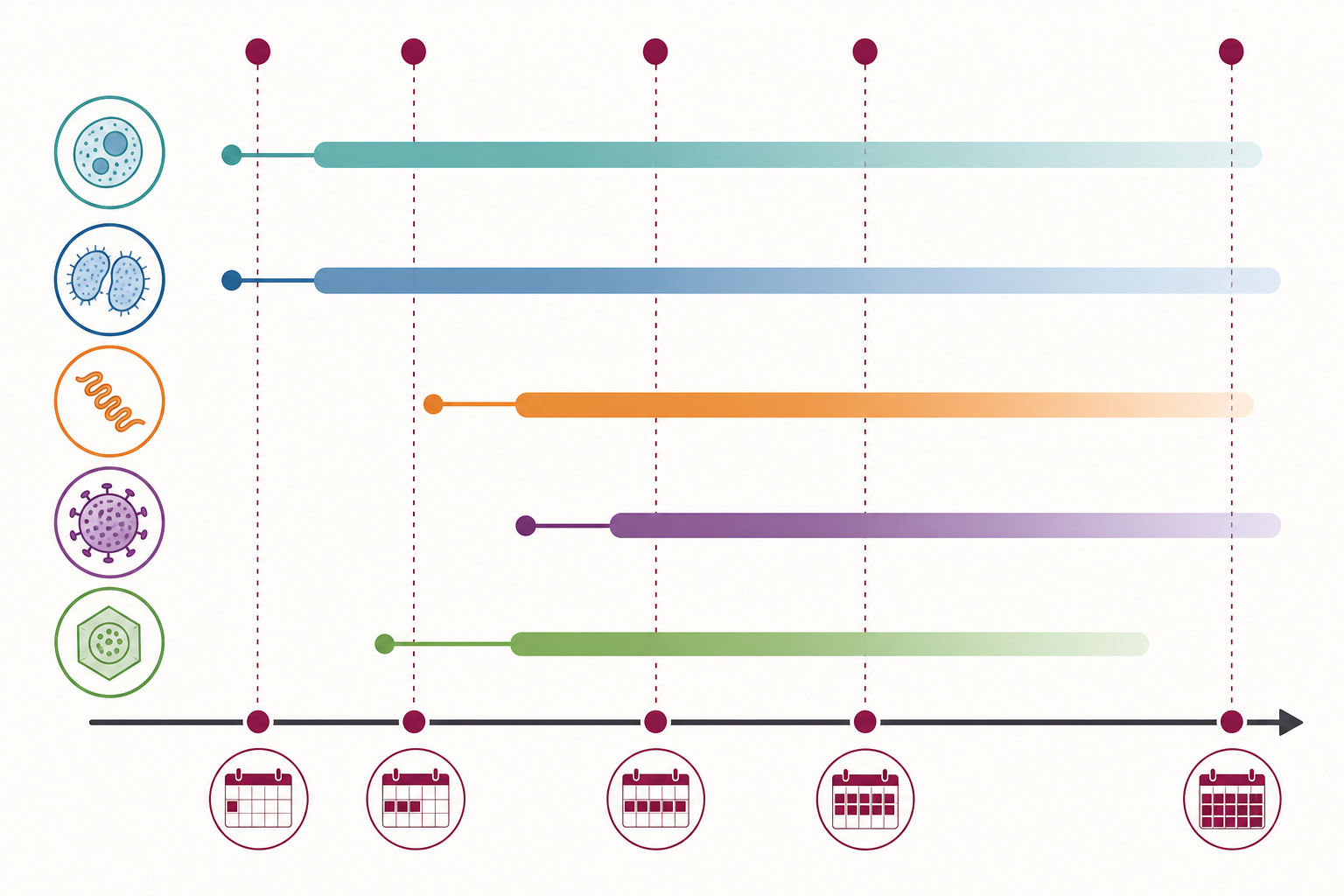
The window period is the gap between exposure and the moment a test can detect that infection. Test before that window closes and you can get a negative result while the infection is still establishing itself. This is the single biggest reason at-home rapid tests come back falsely reassuring.
The window depends on the infection and the test technology. Laboratory nucleic acid amplification tests (NAAT) for chlamydia and gonorrhea pick up bacterial DNA earlier than antigen-based methods, but the exact day-by-day window varies by assay. A practical guideline: for both lab NAAT and at-home rapid swab, plan to test within about one to two weeks of exposure, depending on the assay, with day 14 a reasonable benchmark for at-home rapid kits. The CDC's STI testing page covers screening recommendations and follow-up guidance (CDC STI testing recommendations).
For HIV, the CDC's testing page is the clearest reference. A rapid antigen/antibody (fourth-generation) test from a fingerstick can usually detect HIV 18 to 90 days after exposure. A rapid antibody-only test, the more common at-home format, detects HIV 23 to 90 days post-exposure (CDC HIV testing). If you are inside that window, a negative result does not rule out infection. Retesting at the 12-week mark gives you the most confident negative.
Syphilis sores typically appear within weeks of exposure rather than days. The CDC describes the syphilis stages and notes that primary sores last about 3 to 6 weeks before resolving on their own (CDC syphilis stages). For test timing, the CDC's STI testing recommendations are the better reference; if you are uncertain, plan a follow-up antibody test several weeks after a possible exposure rather than relying on a single early result. For herpes (HSV-2 antibody), the CDC notes that “it can take up to 16 weeks or more for current tests to detect infection,” so an early negative is not informative (CDC herpes testing).
Hepatitis C is a special case. The CDC recommends an HCV RNA (NAT) test rather than an antibody test for any exposure within the past 6 months, because antibodies may not appear early enough on an antibody-based screen (CDC hepatitis C testing). At-home rapid kits do not include HCV NAT, so for a recent suspected hepatitis C exposure a clinic visit is the right call.
HPV does not have a useful at-home rapid test for everyone. Cervical screening (Pap or HPV) happens at a clinic. Our HPV at-home self-test is validated for vaginal self-swab only, so male readers needing HPV testing should see a clinic.
| Infection | At-Home Rapid (lateral flow) | Lab NAAT or Ag/Ab | Notes |
|---|---|---|---|
| Chlamydia | From around day 14 | Within about 1 to 2 weeks (NAAT, assay-dependent) | Rapid kit uses self-collected swab |
| Gonorrhea | From around day 14 | Within about 1 to 2 weeks (NAAT, assay-dependent) | Rapid kit uses self-collected swab |
| Syphilis | Several weeks after exposure (antibody) | Several weeks after exposure (antibody) | Plan a follow-up test if the first is early |
| HIV (4th gen rapid) | 18 to 90 days | 18 to 90 days | Confirm any positive at lab |
| HIV (rapid antibody) | 23 to 90 days | 23 to 90 days | 12 weeks gives the most confident negative |
| HSV-2 | Up to 16 weeks or more | Up to 16 weeks or more | Fingerstick blood antibody test |
| Hepatitis B | 30 to 60 days (HBsAg) | 30 to 60 days (HBsAg) | Antigen-based |
| Hepatitis C | Weeks to months (antibody; assay-dependent) | NAT for exposures within 6 months | Use clinic NAT for recent exposures |
Rapid At-Home vs Lab Testing: Honest Tradeoffs
The three pathways have meaningfully different tradeoffs. The right one depends on how recent the exposure was, what you want to test for, and how much certainty you actually need.
At-home rapid lateral-flow kits. The format is simple: a fingerstick blood drop or a self-collected swab, then 15 to 30 minutes of waiting. The strengths are speed, privacy, and no clinic visit. The tradeoff is analytical sensitivity. Lab NAATs detect bacterial DNA at lower copy numbers than lateral-flow kits detect bacterial antigens, so a lab test catches infections earlier and at lower viral or bacterial loads. A positive on a rapid kit is worth taking seriously and confirming with a lab. A negative on a rapid kit, taken inside the window period, does not rule out infection.
Mail-in lab kits. You collect the sample at home, mail it in, and a lab processes it with NAAT or antigen-antibody assays. Sensitivity is higher, the panel is broader, and one collection often covers six or seven infections at once. The tradeoff is a 1 to 5 business day wait, plus shipping time. Florida summers add USPS delays, and a kit left in a hot mailbox can affect sample integrity. The recommendation on most kits is to drop the sample at the post office the same day you collect.
In-person clinic testing. The most accurate option for a comprehensive panel, especially when you have symptoms or need a NAAT. The tradeoff is wait times, paperwork, possible cost, and (for some readers) discomfort with the questions clinic staff need to ask. Florida county health departments offer reduced-cost testing.
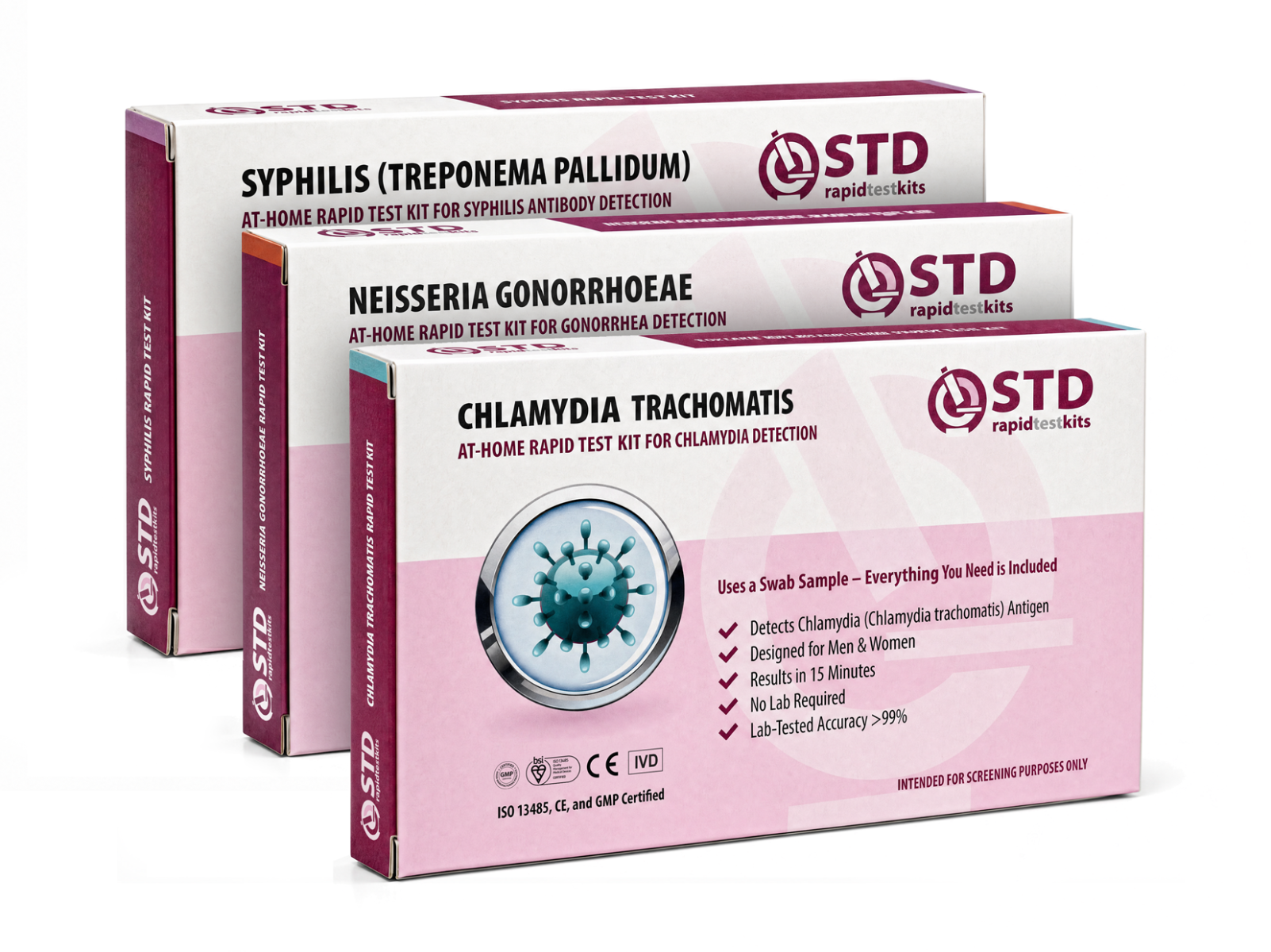
Our at-home rapid kits cover genital swab samples and fingerstick blood. We do not sell urine-based tests, throat (pharyngeal) swabs, or rectal swabs. If your exposure was oral or anal and that route is what you need tested, a clinic visit is the correct next step. The CDC recommends extragenital testing for men who have sex with men and for others with the relevant exposures (CDC STI testing). The tests below are sold by this site; the comparisons above describe where each format fits and where a clinic visit is the better option.
When to Test After a Possible Exposure
The most common late-night question we see is some version of “it has been 48 hours, can I test now?” You can run the test, but the result will not mean much yet. The body has not produced enough antibody (for HIV, syphilis, herpes) or enough bacterial antigen (for chlamydia and gonorrhea) for a lateral-flow strip to register.
A practical decision framework:
- If you have symptoms (discharge, sores, burning, unusual rash): see a clinician. Symptoms are clinical evidence regardless of what a test shows. Clinics can swab a sore or culture discharge directly, which is more informative early on.
- If your possible exposure was 7 to 14 days ago: a chlamydia and gonorrhea rapid swab is reasonable starting day 14. For HIV and syphilis, you are still inside the window. Test now if it gives you peace of mind, but plan a follow-up at the right window.
- If a partner disclosed a positive result: test now and again at the relevant window for the specific infection. Treatment for chlamydia and gonorrhea is straightforward antibiotics. Earlier confirmation means earlier treatment.
- For routine screening with no specific exposure: the CDC recommends annual testing for sexually active women under 25 and for sexually active men who have sex with men, with more frequent testing (every 3 to 6 months) for anyone with multiple partners (CDC STI testing recommendations).
Florida-specific factors matter here. Heat, friction from active outdoor lifestyles, frequent shaving, swimwear chafing, and yeast overgrowth in humid summers can produce symptoms that look like an STI but are not one. A clinic visit can distinguish irritation from infection. If you only want a yes-or-no answer for the most common rapid-detectable infections, an at-home panel is faster.
What If You Test Positive?
A positive result on a rapid lateral-flow kit needs context, not panic. Lateral-flow chemistry is good at flagging an infection that is present, but false positives do happen, particularly for HIV and syphilis. Confirmation at a lab is the standard next step.
For HIV, any positive home result should be confirmed with a laboratory antibody-differentiation test or a NAT (HIV RNA) test. The CDC's HIV testing guidance describes the confirmation pathway in detail (CDC HIV testing). For syphilis, a positive rapid antibody result is followed by a treponemal-specific lab test plus a clinical exam to stage the infection.
For chlamydia and gonorrhea, a positive rapid swab indicates the infection is present and antibiotic treatment is appropriate. A clinic can also screen for co-infections (NAAT for both at the same time) and prescribe partner therapy where applicable.
Practical steps after a positive at-home result:
- Confirm at a lab, especially for HIV and syphilis. A laboratory test sets the diagnostic record for treatment and follow-up.
- Get treatment quickly. Florida county health departments and many telehealth services prescribe same-day antibiotics for chlamydia and gonorrhea. Treatment is typically a single oral dose (chlamydia) or an injection plus oral dose (gonorrhea).
- Notify recent partners. They will want to test and, if positive, treat. Some clinics provide partner-notification support if the conversation is hard to start.
- Retest after treatment. For chlamydia, gonorrhea, and trichomoniasis, a test of cure 3 to 6 weeks after antibiotics confirms the infection has cleared.
Rapid kit positives for HIV and syphilis are preliminary by design. The CDC recommends laboratory confirmation before starting any treatment plan. A confirmed lab result also matters for accurate medical-record keeping and for any insurance or telehealth follow-up.
Privacy and Discreet Testing in Florida
The other big reason Florida residents put off testing is logistics rather than stigma. Between work hours, insurance gaps, county-clinic waitlists, and the discomfort of a waiting-room conversation, plenty of people simply skip the visit. At-home rapid testing removes most of those friction points.
What discreet at-home testing looks like in practice:
- Plain packaging. Boxes ship without medical or sexual-health terms on the outside. The return label uses a generic supplier name. Roommates, family members, and shared mailboxes do not see clinical signaling.
- Standard delivery windows. Most Florida orders arrive in 2 to 5 business days. Hurricane-season disruptions and tropical-storm advisories can extend that, so order ahead of any planned travel or storm window.
- Self-administered. No appointment, no clinician interview, no insurance disclosure. Reading the result is on you, with manufacturer instructions for line intensity and timing.
- Free at-home HIV through the state. The Florida Department of Health offers a free at-home HIV test through its HIV/AIDS program (Florida Health HIV/AIDS program). For broader STI panels, the rapid combination kit below covers more infections in a single round.
One climate caveat. Lateral-flow cassettes are stable in normal indoor conditions, but a kit left in a hot mailbox or a parked car for several hours in a Florida summer can lose performance. Bring the package indoors quickly and let it equilibrate to room temperature for about 30 minutes before opening.
Many infections do not have symptoms.
When Retesting Is the Right Call
Retesting is the second half of an honest testing plan, especially after a treatment course or in the months following a possible exposure. The most common reasons home-test users come back to a second test:
- You tested inside the window. A negative HIV antibody test at day 10 says almost nothing. Retest at 12 weeks for a confident answer.
- Symptoms changed. A new sore, persistent discharge, fever, or unexplained rash after a previous negative warrants a fresh look. Symptoms can lag the original detection window.
- A partner tested positive. Test now and again at the relevant window. The CDC recommends partner-based testing for known exposures (CDC STI testing).
- Multiple partners or ongoing risk. Routine screening every 3 to 6 months is the standard for sexually active people with multiple or new partners.
- After treatment. A test of cure 3 to 6 weeks after antibiotic treatment for chlamydia, gonorrhea, or trichomoniasis confirms the infection cleared.
A practical Florida note: the state's mix of high-density urban testing, college-town demand spikes, and seasonal tourism creates uneven access to clinical follow-up. At-home retesting is often the path of least resistance for the second-and-third visit, even when the first test was clinical.
The bottom line on same-day testing in Florida: rapid at-home kits are fast, private, and clinically useful when used after the relevant window closes. They are not a substitute for lab confirmation of a positive, and they are not a replacement for clinical care when symptoms persist. Used together with a clinic visit when needed, they cover most routine screening cases on a same-day timeline.

Frequently Asked Questions
- Can I really get STD results the same day in Florida?
- Yes, if you use an at-home rapid lateral-flow kit. Chlamydia, gonorrhea, syphilis, and HIV rapid tests show a visible result in 15 to 30 minutes on the cassette itself. Mail-in lab kits and most clinic panels need 1 to 5 business days, regardless of whether the service uses the phrase “same-day” in its marketing.
- How soon after a possible exposure should I test?
- For chlamydia and gonorrhea on a rapid kit, day 14 is a reasonable benchmark. For HIV, the most informative window opens 23 days post-exposure for a rapid antibody test and 18 days for a fourth-generation antigen-antibody test, with 12 weeks giving the most confident negative. For syphilis and herpes (HSV-2), plan a follow-up test several weeks after a possible exposure rather than relying on a single early result. Inside those windows, a negative is not yet meaningful.
- The home test is negative, but I still feel something is wrong. What now?
- Two possibilities: you tested inside the window and the infection has not yet reached detectable levels, or the symptom is not from an STI at all. Florida heat, friction, yeast overgrowth, and shaving irritation can mimic STI symptoms. Retest after the window closes, and see a clinic if the symptom persists or worsens.
- Are at-home rapid tests as accurate as lab tests?
- Rapid kits are a strong screening tool after the relevant window; lab NAATs are more sensitive for early or low-load infections and should confirm any positive result, especially for HIV and syphilis.
- Do Florida pharmacies stock these tests?
- Some CVS and Walgreens locations stock mail-in collection kits, which return results in 1 to 5 business days. True at-home rapid lateral-flow kits with on-cassette results in 15 minutes are most reliably ordered online. Pharmacy stock varies by location and season.
- What if my exposure was oral or anal sex?
- At-home rapid kits cover genital swab samples and fingerstick blood. They do not include throat (pharyngeal) or rectal swabs. The CDC recommends extragenital testing for these exposures, available at clinics. Use the rapid kit for what it covers (HIV, syphilis, hepatitis through blood; chlamydia and gonorrhea through genital swab) and add a clinic visit for the throat or rectal sample.
- Can my partner and I test together?
- Yes, and many couples do. Testing together before a new sexual relationship is a normal use case. Each partner uses a separate cassette and reads their own result. The kit instructions cover sample collection for any anatomy.
- How private are these tests?
- Boxes ship in plain packaging with a generic return label. There is no clinic record, no insurance claim, and no clinician interview. The result is yours alone, and you decide what to do with it.
- U.S. Centers for Disease Control and Prevention. STI testing recommendations and routine-screening guidance for sexually active populations.
- U.S. Centers for Disease Control and Prevention. HIV testing windows for fourth-generation antigen-antibody rapid tests (18 to 90 days) and antibody-only rapid tests (23 to 90 days).
- U.S. Centers for Disease Control and Prevention. Syphilis stages and primary-stage sore duration of 3 to 6 weeks.
- U.S. Centers for Disease Control and Prevention. Chlamydia overview and asymptomatic-infection prevalence.
- U.S. Centers for Disease Control and Prevention. Genital herpes (HSV-2) blood-test detection window of up to 16 weeks or more after exposure.
- U.S. Centers for Disease Control and Prevention. Hepatitis C testing guidance, including NAT recommendation for any exposure within the past six months.
- Florida Department of Health, HIV/AIDS program. State-level free at-home HIV testing program and county-clinic locator for Florida residents.
